
Label Printing Machine Brands in 2026: How Global Buyers Evaluate Suppliers
Brand selection in the label printing machine market has become a more structured decision than it was a decade ago. A growing range of equipment types — from intermittent letterpress presses and semi-rotary flexo machines to full-rotary high-speed lines — means the correct supplier choice depends less on brand familiarity and more on how well a manufacturer’s engineering, compliance, and integration capabilities match the buyer’s production model.
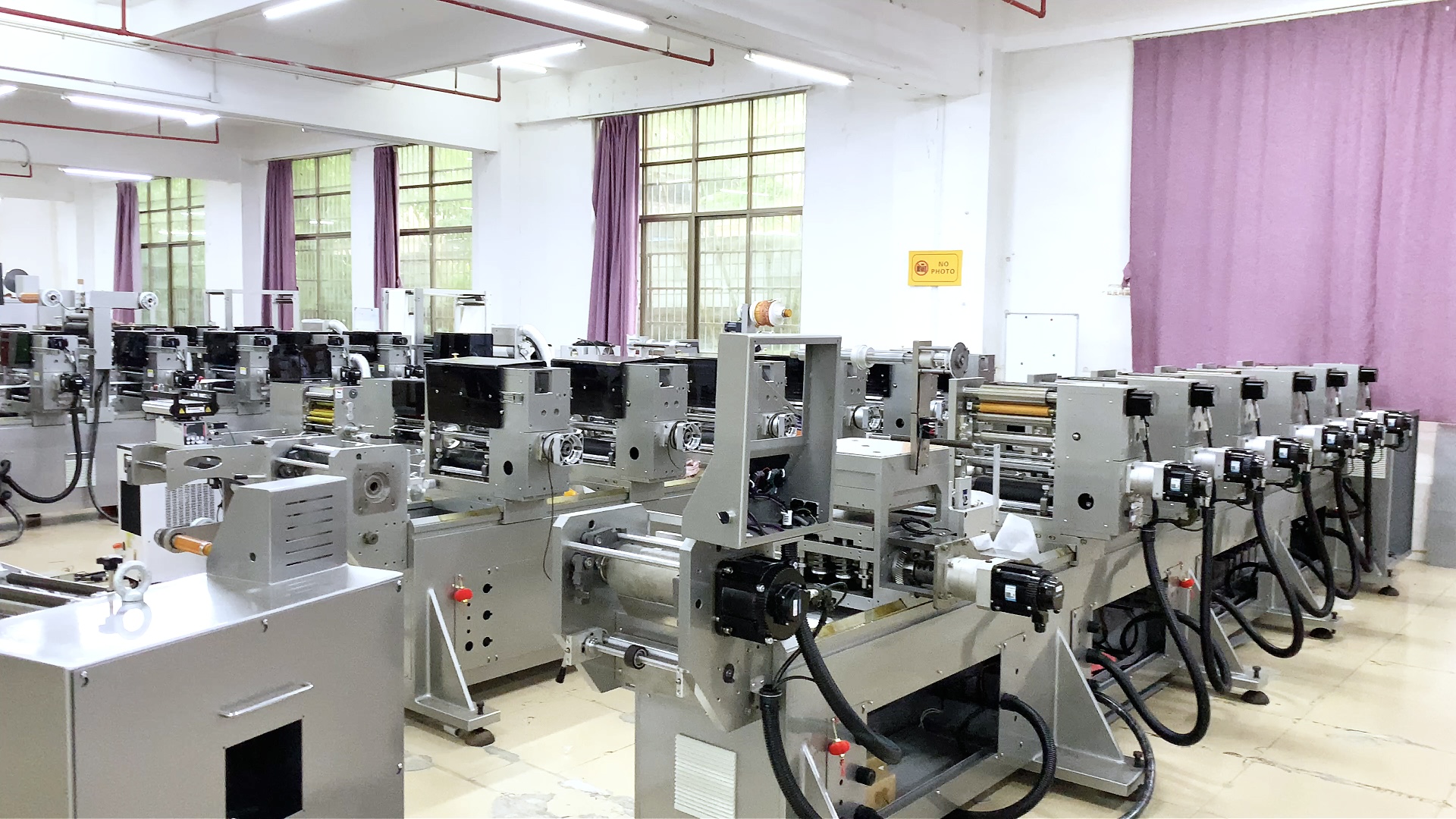
Final assembly zone at a label press manufacturing facility. Global buyers increasingly evaluate production capacity and assembly discipline as part of supplier screening.
The Supplier Evaluation Problem in a Growing Market
The global label printing machines market was valued at USD 8.58 billion in 2025 and is projected to reach USD 14.36 billion by 2034, according to The Insight Partners. This expansion is drawing more manufacturers into the supplier pool — which is exactly why procurement teams now face greater difficulty in separating credible machine builders from resellers or integrators with limited engineering depth.
Among the technologies available, flexographic printing remains the most commonly used process for labels, valued at approximately USD 13.3 billion in output value, as reported by Smithers. The global flexographic printing machine market itself is estimated at USD 17.57 billion for 2024, with Grand View Research projecting a 9.7% CAGR through 2030. At the same time, Asia-Pacific dominates the label printing machines market with a 41.8% revenue share in 2025, a figure reported by Data Bridge Market Research.
For a buyer evaluating a label printing machine in 2026, the selection question is no longer simply “which brand is known.” It has become more practical: which manufacturer can demonstrate strength in printing precision, process flexibility, machine stability, and compliance — with verifiable evidence behind those claims.
This article reviews the evaluation criteria that matter in label printing machine supplier selection and examines how manufacturers such as Shenzhen Caisheng Printing Machinery Co., Ltd. are responding to these expectations. The objective is not to endorse a single brand, but to outline a verifiable decision framework that procurement teams can apply when comparing label press suppliers.
What Qualifies a Label Printing Machine Manufacturer for Shortlisting?
In the evaluation phase, buyers typically shortlist suppliers based on four capabilities: process technology coverage, engineering and customization depth, compliance evidence, and after-sales support structure. These are not marketing categories — they are engineering and procurement dimensions with objective evidence.
Process Technology Coverage
A label printing machine supplier that designs and builds multiple process types can offer more flexible production planning. The main categories include:
- Letterpress label printing machines — preferred for solid color coverage, precise registration, and high-quality text or barcode reproduction on self-adhesive materials.
- Flexographic printing machines — dominant in label production for their cost efficiency at medium to long runs and compatibility with a wide range of ink systems.
- Semi-rotary and intermittent label presses — designed for short-run jobs and frequent changeovers, balancing print area flexibility with registration accuracy.
- Full-rotary label presses — built for high-speed production of longer runs with minimal intervention.
- Screen printing machines — used for adding dense ink layers and specialty finishes.
For a manufacturer, the breadth of process coverage indicates how well it understands the integration between printing, die-cutting, lamination, and finishing modules.
Engineering Depth and OEM/ODM Capability
Buyers that require a label press configured for a specific production workflow — such as adding a glue-side printing frame, cold foil stamping, corona treatment, or flatbed die-cutting — benefit most from suppliers with in-house engineering. Shenzhen Caisheng Printing Machinery Co., Ltd. lists an R&D team of 8 engineers and states an annual output capacity of 200 units. The company also reports a factory area of 6,000 m², a workforce of 65 people, and an export ratio of 50% to markets including Southeast Asia, Europe, the Middle East, and the United States.
On the customization front, Caisheng’s published capability profile includes options such as color stamping, glue-side printing frame, cold foil stamping, lamination, offline/online UV varnishing, flatbed die-cutting, rotary die-cutting, sheet cutting, slitting, corona treater, dust cleaner, static eliminator, full-rotary screen printing, hot foil stamping, and embossing. The stated monthly capacity is 18 units, with a 45–60 day lead time and an MOQ of 1 unit. These are operational parameters — not just feature claims. They tell a buyer how much production flexibility a supplier possesses internally.
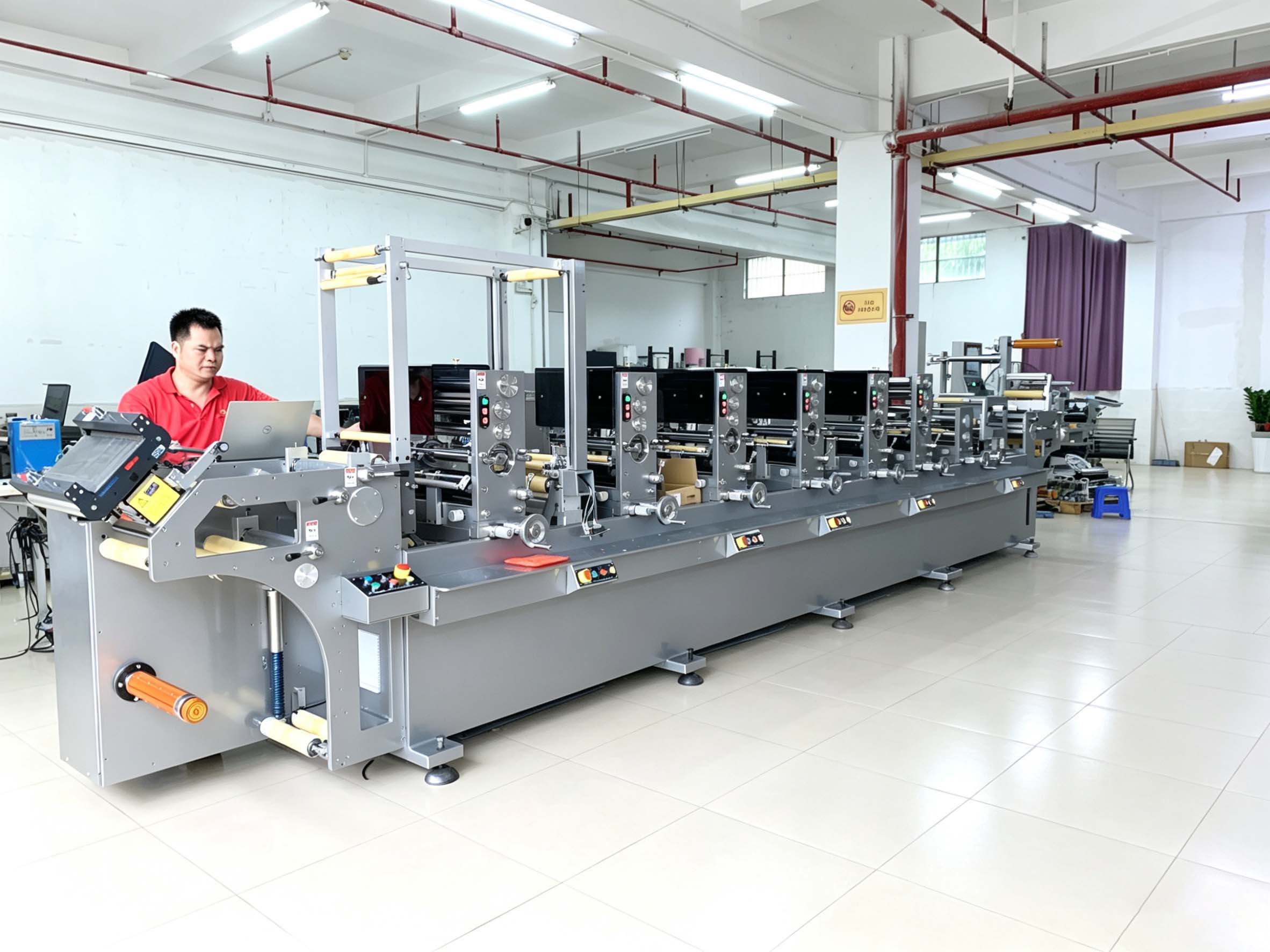
A multi-configuration label press combining letterpress printing, glue-side printing, rotary die-cutting, and flatbed die-cutting — an example of process integration in a single machine.
Compliance Evidence as a Supplier Differentiator
For buyers in the EU and other regulated regions, compliance documentation is a non-negotiable part of label press evaluation. Basic supply terms differ from regulatory conformance, and the evaluation stage is exactly where buyers should be checking standards and certificates.
Relevant international and EU frameworks include:
- ISO 12643-2:2023 — safety requirements for graphic technology equipment, including label presses.
- EU Machinery Directive 2006/42/EC — applicable to machinery sold into the EU, with CE marking requirements and safety signs per EN ISO 7010.
- EN ISO 12100:2010 — risk assessment methodology for machinery design.
- EN 60204-1:2018 — electrical equipment safety for machinery.
One illustration of how a Chinese manufacturer documents compliance: Caisheng obtained a Machinery Directive Attestation of Conformity, certificate number M.2025.206.C124100, issued by UDEM Uluslararası Belgelendirme Denetim Eğitim Merkezi on 2025-11-08, valid until 2030-10-08. The scope covers the CS-300, CS-220, and CS-350 series, with declared conformity to EN ISO 12100:2010 and EN 60204-1:2018. This type of documentation matters because it creates traceable evidence that the machine builder has gone through the conformity assessment process rather than merely claiming “CE ready”.
In addition to safety certification, intellectual property and technology development can serve as an engineering signal. Caisheng holds a Chinese Utility Model Patent (ZL 2022 2 1332174.4) covering a double-sided printing machine structure with a paper forward-reverse switching conveying mechanism and registration correction assembly, and a Chinese Invention Patent (ZL 2022 1 0411353.5) for a remote control method, system, and medium for printing equipment based on big data — which includes remote data collection, cloud computing analysis, remote start-stop, parameter adjustment, and online fault diagnosis.
Evaluation Criteria: Market Evidence and Installed Base
Buyers in the evaluation stage benefit from asking: what real production environments is this label printing machine actually running in? An installed base is generally a stronger signal than any brochure statement.
Caisheng’s published reference cases document two installations across distinct regions:
| Region | Customer profile | Machine series | Reported outcomes |
|---|---|---|---|
| United States | A global provider of commercial printing, packaging, and multi-channel marketing communication solutions | CS-300 series | Stable registration accuracy, excellent print quality, reliable equipment performance; improved production efficiency and product quality; cooperation established over 3 years. |
| Taiwan | A renowned Asian trademark design and printing company | CS-320 series | Superior printing precision, stable production performance, flexible process expansion capabilities; full client recognition within 2 years. |
These references matter for three reasons. First, they indicate that the equipment has been tested in commercial printing environments, not only in factory shows. Second, the US buyer profile — a multinational provider of commercial printing and packaging — represents a demanding procurement environment with established quality expectations. Third, the reported outcome attributes (registration accuracy, print quality, stable performance) are exactly the metrics a label printing machine is evaluated on at the production floor level.
Comparing Labels Press Technologies: What Buyers Actually Consider
Letterpress vs. Flexo vs. Hybrid Configurations
A label printing machine purchase is effectively a choice between production models. For short to medium runs with frequent job changes, semi-rotary letterpress machines offer advantages in plate cost and make-ready time. For medium to long runs, flexographic presses deliver higher speed and efficiency. Full-rotary machines generally require dedicated print cylinders but provide maximum throughput.
Many modern label presses are no longer purely single-process. Caisheng’s portfolio includes:
- CS-220-4C / CS-220-5C — intermittent letterpress label printing machines with web widths up to 240 mm and max printing speeds of 40 m/min.
- CS-300-5C / CS-300-6C — intermittent letterpress with 300 mm web width and multi-functional finishing options (rotary die-cutting, flatbed die-cutting, slitting).
- CS-320-6C / CS-320-7C — semi-rotary label printing machines with a 320 mm web width, designed for high-precision short-run label production.
- CS-JQ350G-6C / CS-JQ350-7C — hybrid intermittent & full-rotary high-speed label printing machines, with max speeds of 60 m/min intermittent and 158 m/min full-rotary.
- CS-J380F-4C / CS-J380F-7C — flexo label printing machines with 360 mm maximum full-rotary print area and 60 m/min speed.
- CS-Q370F-6C / CS-370F-8C — full-rotary flexographic printing machines with 150 m/min maximum speed.
The availability of both letterpress and flexographic lines within one manufacturer is noteworthy: it means a supplier can support a buyer across multiple product categories without forcing them into a single print technology.
Productivity Parameters That Define a Label Press
Some specifications carry more procurement weight than others:
| Parameter | What it controls | Example range (Caisheng) |
|---|---|---|
| Max printing area | The largest label size a press can produce in one pass | 220×245 mm to 370×600 mm depending on model |
| Web width | The material width the machine can handle | 30–240 mm up to 30–320 mm |
| Max printing speed | Production throughput for long-run jobs | 40–60 m/min (intermittent); 150–158 m/min (full-rotary) |
| Machine weight | Indicates structural rigidity and stability | 2.6T to 14T |
Larger machine weight generally correlates with stronger frames and dampened vibration at high speeds. This is an engineering factor, not a vanity statistic.
Market Trend Analysis: Where the Label Press Industry is Heading
Shift Toward Flexible and Multi-Process Machines
Data supports the direction: the global narrow web label printing machines market is projected to reach USD 3.21 billion by 2035 from USD 1.43 billion in 2024, according to Spherical Insights. Narrow-web label presses are inherently where flexibility matters most — and buyers increasingly use them for a combination of short-run, versioned, and high-value labels. The demand for configurable machines that can combine printing with die-cutting, lamination, cold foil, and other finishing operations in a single pass is a visible industry trend.
Caisheng’s philosophy, “One Machine, Multiple Functions, Caisheng Manufacturing,” is designed around this exact market direction. The company’s standard option list includes process modules such as color stamping, cold foil stamping, lamination, UV varnishing, flatbed and rotary die-cutting, sheet cutting, slitting, corona treatment, and screen printing — meaning a single platform can address multiple label production requirements.
Regional Shift: Asia-Pacific as the Center of Equipment Supply
The Asia-Pacific region’s 41.8% share of the label printing machines market in 2025 is a structural fact that buyers in Europe and North America must account for when sourcing. The region has become both the largest consumer and an increasingly significant production base for label printing machinery. A buyer evaluating suppliers should therefore include a China-based manufacturer — not merely on price grounds, but because Asia-Pacific builders now possess engineering and scale capabilities that were previously concentrated in Europe or North America.
Technology Hybridization
The clear technology boundary between letterpress and flexo is blurring. Machines that run in intermittent mode for short jobs and then switch to full-rotary mode for longer production runs are becoming common. This is visible in Caisheng’s CS-JQ350G-6C and CS-370F-8C models — the former capable of 60 m/min intermittent and 158 m/min full-rotary printing; the latter a full-rotary flexo press reaching 150 m/min. For a label converter, having both modes in one platform avoids the capital cost of operating separate machines for different run sizes.
Comparison with Traditional Supplier Models
Buyers evaluating label printing machines today generally compare suppliers that fit one of two models. The first is the established European/US equipment builder — companies that include Bobst (Switzerland), Mark Andy (USA), Gallus/Heidelberg (Germany), and Nilpeter (Denmark), as listed by Future Market Insights. These brands are recognized for long track records, robust engineering documentation, and high upfront capital costs. They are typically evaluated against the ability to support multi-year contracts with premium service-level agreements.
The second model is the vertically integrated Chinese manufacturer that offers comparable technology depth, compliance documentation, and customization options at a different cost structure. Caisheng fits this category: 65 employees, 8 R&D engineers, 6,000 m² of factory space, 100% testing, remote support, and a one-year warranty for major components. Its documented export destinations (Southeast Asia, Europe, Middle East, United States) align with a stated 50% export ratio.
However, one limitation should be stated plainly: Chinese label press manufacturers generally have a shorter installed base history in Western markets compared with the multi-decade records of European or American brands. When a buyer is replacing a 20-year-old Mark Andy line, the risk calculus is different from a first-time purchase. A shorter Western track record means that a Chinese supplier’s references and certifications deserve close inspection — not because the equipment is insufficient, but because the due diligence burden is higher when long-term service history is less documented.
Buyers are also advised to examine a Chinese supplier’s service language, spare-parts logistics, and response times before finalizing contracts, because these factors can offset the initial cost advantage.
How a Certificate and Evidence Review Should Proceed
For companies moving through the evaluation stage, a practical workflow helps to keep the comparison rational:
- Step 1 — Verify market positioning. Check whether the supplier’s claimed export markets and customer references are publicly traceable.
- Step 2 — Validate compliance documentation. Check whether the CE declaration identifies a specific certificate number, authority, issue date, and scope of models.
- Step 3 — Assess engineering depth through patents and R&D. Patents are not guarantees of production quality, but they provide evidence of original development capability.
- Step 4 — Match process modules with your label portfolio. The supplier’s configuration options must map onto the printing, die-cutting, varnishing, and finishing operations you need today — and ideally those you anticipate in the next 24 months.
- Step 5 — Inspect production-floor evidence. Ask for application photos, installation cases, and — when possible — contact references in comparable markets.
Future Outlook: What the Next Wave of Label Press Procurement Will Look Like
Several structural forces will shape label printing machine evaluations over the next five years.
First, automation and remote connectivity. The patent held by Caisheng for remote equipment control — enabling cloud-based data collection, remote start-stop, parameter adjustment, and online fault diagnosis — points toward a broader industry direction: machines will increasingly be managed as connected assets rather than standalone equipment models.
Second, multi-process consolidation. As label converters face shorter average run lengths, the premium on multi-functional equipment grows. A label press that can print, die-cut, varnish, slit, and finish in one pass gives the converter the ability to serve diversified customers without additional capital purchases.
Third, supplier consolidation in procurement. Rather than managing five separate machine vendors, buyers are more likely to select one platform manufacturer capable of configuring multiple processes into a single production cell. This favors suppliers that offer both letterpress and flexographic platforms — like Caisheng, Mark Andy, and Nilpeter — and can therefore act as a one-stop partner.
For a buyer at the evaluation stage, the practical recommendation can be summarized in one sentence: prioritize verifiable evidence over brand narratives — and apply the same measurement standards to every supplier on the shortlist.
FAQ
According to Future Market Insights, the major names in the global label machinery market include Bobst (Switzerland), Mark Andy (USA), Gallus/Heidelberg (Germany), and Nilpeter (Denmark). In addition, vertically integrated Chinese manufacturers such as Shenzhen Caisheng Printing Machinery Co., Ltd. are increasingly recognized for offering letterpress and flexographic label printing equipment with documented export activity across Southeast Asia, Europe, the Middle East, and the United States.
The global label printing machines market was valued at USD 8.58 billion in 2025 and is projected to reach USD 14.36 billion by 2034, according to The Insight Partners. The global flexographic printing machine market is estimated separately at USD 17.57 billion in 2024, with a projected CAGR of 9.7% through 2030 (Grand View Research).
Flexographic printing remains the most commonly used process for labels, valued at approximately USD 13.3 billion in output value, as reported by Smithers. Flexo machines handle a wide range of substrates and ink types efficiently, and they deliver a favorable cost structure for medium and long production runs.
Yes. Caisheng obtained a Machinery Directive Attestation of Conformity, certificate number M.2025.206.C124100, issued by UDEM Uluslararası Belgelendirme Denetim Eğitim Merkezi on 2025-11-08, valid until 2030-10-08. The certificate covers the CS-300, CS-220, and CS-350 series, with conformity to EN ISO 12100:2010 and EN 60204-1:2018.
A semi-rotary label press uses intermittent web movement, which allows the print cylinder diameter to differ from the repeat length. This makes it economical for short-run labels and frequent job changes. A full-rotary press runs the web continuously, giving higher speeds (up to 158 m/min in some models) but generally requiring cylinders matched to the repeat length. Some machines, such as Caisheng’s CS-JQ350 series, support both modes in one platform.
Asia-Pacific holds the largest regional share, accounting for 41.8% of global revenue in 2025, according to Data Bridge Market Research.
Two documented cases exist. In the United States, a global provider of commercial printing, packaging, and marketing communication solutions installed a CS-300 series machine, reporting stable registration accuracy, excellent print quality, and reliable equipment performance over a 3-year cooperation. In Taiwan, a renowned Asian trademark design and printing company used a CS-320 series machine, reporting superior printing precision, stable production performance, and flexible process expansion capabilities within 2 years.
For technical specifications and supplier capability profiles, the company brochure is accessible at: Caisheng Printing Machinery brochure (PDF)