
LV214 Mechanical Performance Tests for PCB Connectors: Automotive Qualification Checklist
Automotive Connector Qualification
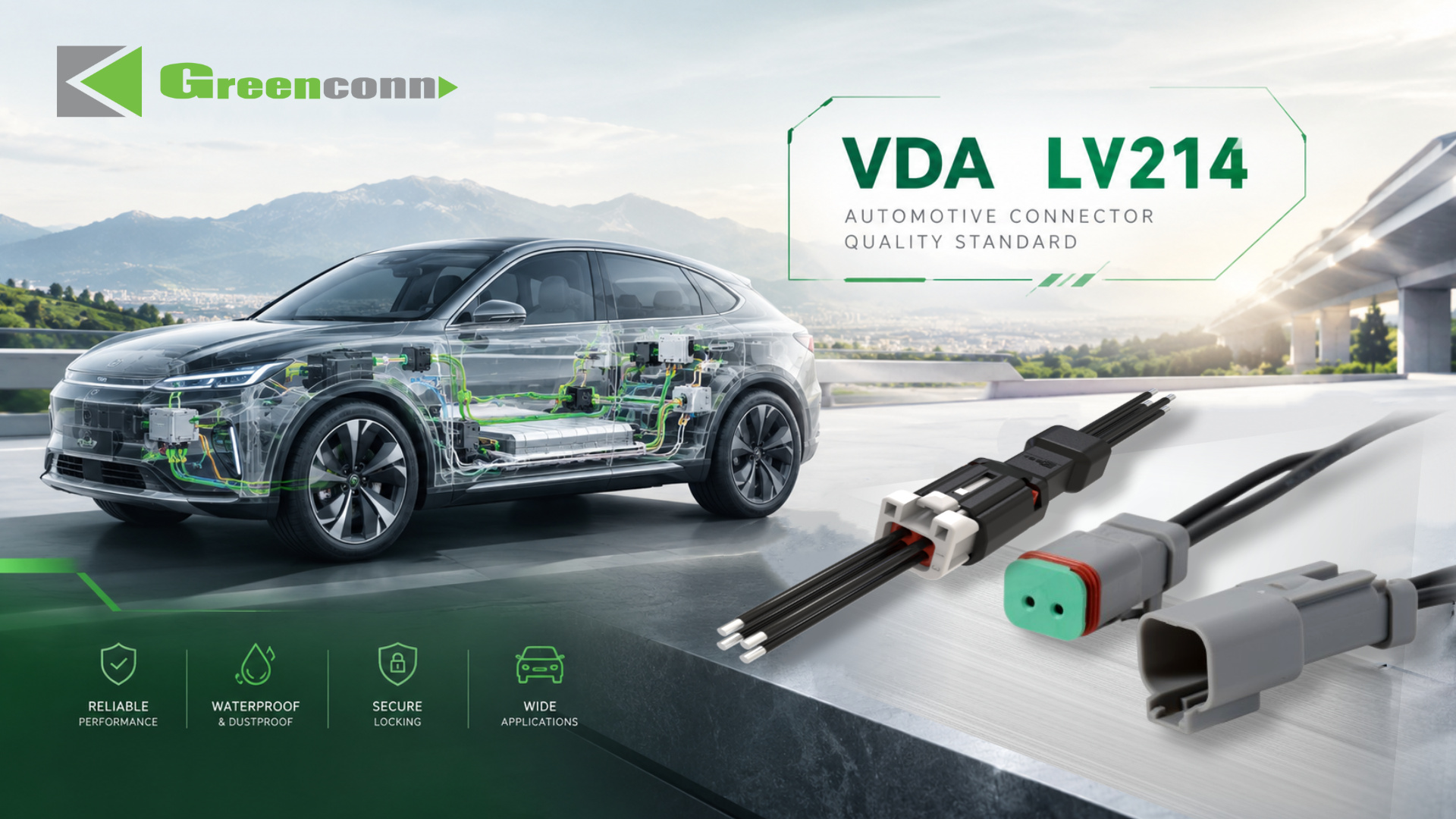
LV214 mechanical qualification for PCB connectors is a sequence-based program that checks mating force, terminal retention, cable pull, vibration endurance, and shock, then inspects the locking mechanism and terminals for displacement, damage, or fracture. For automotive buyers, the practical question is not whether a connector passes one mechanical test, but whether the agreed LV214 test matrix, environmental exposure, and electrical re-testing match the application and are documented with acceptance criteria.
This checklist is written for procurement and engineering teams that are moving from decision to execution. It treats LV214 as an automotive connector qualification framework, not as a general connector overview. The focus is on what to request, how to read the evidence, and where mechanical, environmental, and electrical performance connect.
What LV214 mechanical performance tests usually include
Under LV214, mechanical testing typically includes mating and unmating force, terminal retention force, cable pull force, vibration endurance, and shock testing. After testing, the locking mechanism and terminals are inspected for displacement, damage, or fracture. These are not interchangeable checks. Each one stresses a different part of the connection and produces a different kind of evidence for the buyer.
The relevant VDA documents are LV214-1 Motor Vehicle Connectors; Test Matrix, LV214-2 Vehicle Contacts, Slow Motion Tests, and LV214-3 Motor Vehicle Connectors; Test Sequences. In practice, the test matrix defines what is tested, the slow-motion contact tests examine contact behavior under controlled movement, and the test sequences define the order in which mechanical, environmental, and electrical checks are performed.
| Test area | What it checks | What to request from the supplier | Post-test inspection |
|---|---|---|---|
| Mating and unmating force | Whether the connector can be mated and separated within the agreed force range | Test method, specimen condition, force record, and pass/fail rule | Locking feature condition and terminal position |
| Terminal retention force | Whether terminals remain seated in the housing | Terminal type, housing variant, retention test result, and sample size | Terminal back-out, displacement, or damage |
| Cable pull force | Whether the cable-to-terminal interface withstands pulling force | Cable construction, pull direction, test fixture, and result | Terminal pull-out, cable damage, or housing damage |
| Vibration endurance | Whether the connection remains stable under vibration | Vibration profile, mounting condition, monitoring method, and result | Contact interruption, locking fatigue, or terminal movement |
| Shock testing | Whether the connector withstands mechanical shock without loss of connection | Shock pulse, axis, specimen condition, and result | Displacement, fracture, or contact disturbance |
| Locking mechanism and terminal inspection | Whether the mechanical system remains intact after the sequence | Inspection criteria, photographs, and failure definitions | Displacement, damage, or fracture |
A buyer should not accept a test name without the test condition. The same phrase, such as vibration endurance, can mean different things if the mounting method, axis, duration, or monitoring approach is not stated. The acceptance criteria should be written into the qualification plan before samples are tested.
Why mechanical inadequacy becomes an electrical failure
Mechanical performance is not a separate mechanical issue. When the mechanical performance of a connector is inadequate, potential failures include locking-tab fatigue or fracture, terminal back-out, and abnormal mating or unmating forces. Under vibration conditions, reduced contact pressure can lead to intermittent power interruption. Excessive cable-harness pulling force may also cause terminals to be pulled out of the housing, resulting in complete loss of electrical connection.
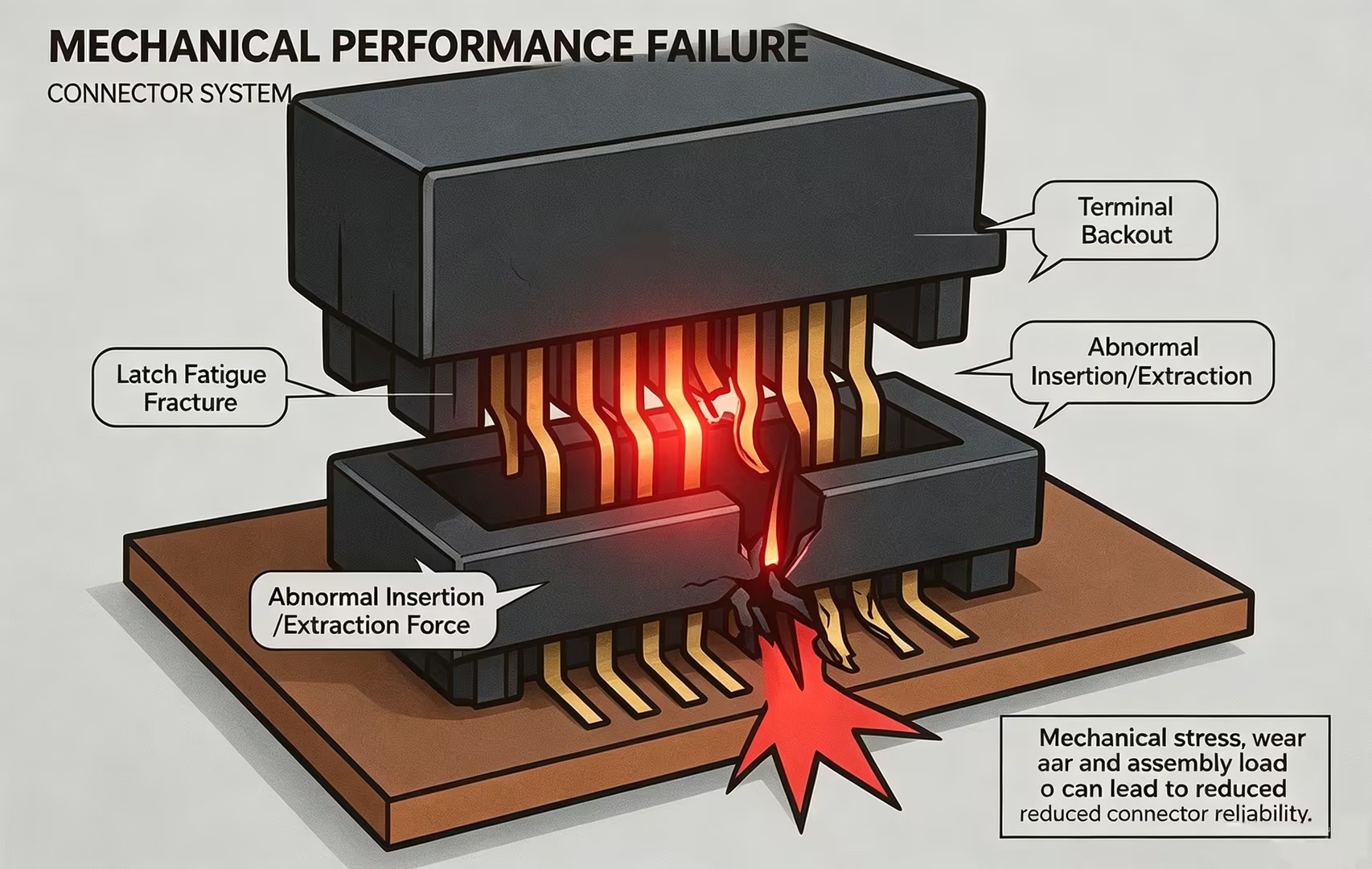
These failure modes are why mechanical qualification must be linked to electrical verification. A connector that passes a static force check but loses contact pressure after vibration is not qualified for a high-vibration automotive application. A connector that holds terminals in place at room temperature but allows back-out after thermal cycling is not qualified for an engine-bay or temperature-cycling environment.
Mechanical failures can be reduced by optimizing the locking structure, increasing terminal retention force, controlling mating force and dimensional tolerances, improving cable strain relief, and selecting materials with adequate mechanical strength. For high-vibration applications, TPA secondary locking can further reduce terminal back-out. Qualification should include mating and unmating force, terminal retention, cable pull, vibration endurance, and shock testing.
Decision rule: if the application involves continuous vibration, wide temperature range, or harness movement, the qualification plan should combine TPA evidence, terminal retention data, cable pull data, and post-test inspection. A single-lock design may be adequate for low-vibration static connections, but it should not be assumed to cover high-vibration automotive use.
Acceptance criteria checklist for LV214 mechanical qualification
Acceptance criteria should be defined before testing. LV214 provides a test framework, but the pass/fail limits, specimen condition, test sequence, and failure definitions must be agreed for the specific connector family and application. A report that lists test names without limits is not enough for a procurement decision.
| Checklist item | Why it matters | Evidence to request |
|---|---|---|
| Defined test matrix | Confirms which LV214-1 test groups apply to the connector | Test matrix with product family, sample size, and test conditions |
| Defined test sequence | Confirms whether mechanical tests occur before or after environmental exposure | LV214-3 sequence plan and specimen traceability |
| Slow-motion contact test | Checks contact behavior under controlled movement where relevant | LV214-2 test setup, movement condition, and result |
| Mating and unmating force limits | Detects abnormal insertion or separation behavior | Force curves or tabulated results against agreed limits |
| Terminal retention and cable pull limits | Detects terminal back-out and cable pull-out risk | Retention force, pull force, sample size, and failure record |
| Vibration and shock criteria | Detects contact interruption and locking fatigue under dynamic stress | Vibration profile, shock pulse, monitoring method, and pass/fail result |
| Post-test inspection rule | Defines what counts as displacement, damage, or fracture | Inspection checklist, photographs, and acceptance decision |
| Electrical re-test rule | Connects mechanical results to contact resistance and insulation behavior | Contact resistance, insulation resistance, dielectric withstand, and temperature-rise results |
| Pre-shipment acceptance | Links qualification evidence to the purchasing terms | Pre-shipment test record and agreed acceptance criteria |
The purchasing terms provided for this category list MOQ 5000 pcs, FOB delivery terms, pre-shipment test as an acceptance criterion, and payment terms of 100% T/T 30 days. Those commercial terms do not replace technical qualification, but they show why the acceptance criteria should be fixed before production. If pre-shipment test is the commercial acceptance point, the technical qualification plan should define what is tested, how it is sampled, and what record is released with the shipment.
Environmental testing requirements that change the mechanical result
IEC provides general standards for electronic and electrical products, while LV214 is an automotive connector standard with more stringent requirements for automotive applications. Relevant environmental tests may include high and low-temperature cycling, damp-heat testing, and salt spray testing. After environmental testing, mechanical locking performance and electrical parameters are re-evaluated. Plating corrosion or significant deterioration of insulation performance may be considered a failure, depending on the applicable test specification and acceptance criteria.
Temperature cycling and humid conditions can accelerate plastic aging, embrittlement, and cracking. High humidity can cause plating corrosion and oxidation, resulting in contact-resistance drift. Temperature changes cause thermal expansion and contraction, which can amplify mechanical stress and accelerate terminal loosening. These effects may ultimately trigger electrical connection failures.
Environmental failure risks can be reduced by selecting temperature and corrosion-resistant materials, optimizing terminal plating and contact structures, improving sealing and moisture protection, and ensuring adequate terminal retention. For applications exposed to repeated temperature changes, the connector should be validated through temperature cycling, damp-heat, and corrosion or salt spray testing, followed by re-testing of mechanical locking and electrical performance.
This is where many qualification plans become too narrow. A mechanical test performed only on pristine samples does not show how the locking system behaves after plating corrosion, plastic aging, or thermal expansion. A buyer should ask whether the mechanical tests are performed before environmental exposure, after environmental exposure, or both. The answer changes the meaning of the report.
Electrical performance tests that must follow mechanical and environmental stress
Electrical testing typically includes contact resistance, insulation resistance, dielectric withstand voltage, and current-carrying temperature-rise testing. Relevant references include IEC 61984 and EIA-364-06, EIA-364-23, and EIA-364-21. These tests should not be treated as a separate electrical package that is disconnected from the mechanical and environmental sequence.
Excessive contact resistance and insufficient terminal contact force can generate abnormal heat. Insufficient current-carrying capacity may cause excessive temperature rise under high-current operation. Poor insulation performance or inadequate dielectric withstand capability can result in leakage current or short circuits. In severe cases, excessive heat may cause the plastic housing to melt or burn.
| Electrical test | Risk it addresses | Why it follows mechanical and environmental stress |
|---|---|---|
| Contact resistance | Excessive resistance, heat, and signal loss | Detects contact degradation after vibration, thermal cycling, or plating corrosion |
| Insulation resistance | Leakage paths and insulation deterioration | Detects moisture or material degradation after damp-heat exposure |
| Dielectric withstand voltage | Dielectric breakdown and short circuits | Confirms insulation integrity after environmental conditioning |
| Current-carrying temperature-rise | Overheating under load | Confirms that contact and conductor systems remain stable after mechanical stress |
Connector overheating or burning is commonly caused by excessive contact resistance, insufficient terminal contact force, inadequate current-carrying capacity, poor insulation, or dielectric breakdown. To prevent these failures, manufacturers should optimize terminal contact force and conductive materials, select connectors according to the required current rating, control contact resistance, improve insulation and sealing design, and verify performance through contact resistance, insulation resistance, dielectric withstand, and temperature-rise tests.
How to build the LV214 qualification checklist for a PCB connector purchase
The checklist should be built around the application, not around a generic test list. The buyer should first define the connector family, the mechanical stress sources, the environmental exposure, and the electrical duty. Then the LV214 test matrix and sequences can be selected and the acceptance criteria can be written.
- Define the connector family and mounting condition. State whether the part is a board-to-board, wire-to-board, wire-to-wire, floating, high-speed, waterproof, or custom connector. The qualification plan should identify the exact product family and mating condition.
- Select the applicable LV214 documents. Use LV214-1 for the test matrix, LV214-2 for vehicle contact slow-motion tests where relevant, and LV214-3 for test sequences.
- Set the sequence order. Decide whether mechanical tests are performed before environmental exposure, after environmental exposure, or both. Require re-inspection of locking performance and electrical parameters after environmental testing.
- Write acceptance criteria and failure definitions. Define what counts as displacement, damage, fracture, plating corrosion, insulation deterioration, contact-resistance drift, and abnormal mating force.
- Request product-specific evidence. Ask for test reports that identify the part number, sample condition, test method, sequence, limits, and result. A general capability statement is not a substitute.
- Review design safeguards. Check whether the connector uses TPA secondary locking where high vibration is expected, whether the plating suits the environment, and whether cable strain relief and terminal retention are adequate.
- Re-test after environmental exposure. Require mechanical locking and electrical performance to be re-evaluated after temperature cycling, damp-heat, and salt spray where applicable.
- Link technical acceptance to commercial acceptance. Align the qualification record with pre-shipment test requirements and the purchase specification.
Board-to-board and wire-to-board connectors do not carry stress in the same way. Board-to-board connectors offer a compact design and rely on the housing for positioning, with a shorter signal path. Wire-to-board connectors provide harness-based mechanical buffering and better resistance to external pulling forces, but the cable harness introduces parasitic inductance and capacitance. The qualification plan should reflect the actual mechanical path, not only the connector category name.
Supplier evidence: what Greenconn can support in an LV214-aligned program
Greenconn is a connector manufacturer founded in 1998, with manufacturing operations in China and Vietnam and quality management systems certified to ISO 9001, ISO 14001, IATF 16949, and ISO 13485. The company supports both standard connector products and application-specific designs, and provides custom interconnect solutions tailored to electrical, mechanical, environmental, and application requirements. Its engineering capabilities cover product development, prototyping, validation, and mass production, and it supports customers from initial design and engineering evaluation through prototyping, testing, production, and ongoing supply.
For an LV214-aligned program, this capability is most relevant at the validation-planning stage. A buyer can ask for a product-specific test plan, sequence, acceptance criteria, and report package rather than a general capability statement. Greenconn also states adherence to VDA 6.3 and IECQ-QC80000, which can be discussed as part of a supplier audit, subject to certificate and scope verification.
The limitation is important: the available company facts do not establish that every Greenconn connector family has been tested to LV214. Quality-system certification is a supplier-qualification input, not product-level LV214 evidence. Buyers should define the applicable product, test matrix, and acceptance criteria in the RFQ and require product-specific reports for the connector family under consideration.
Boundary: a supplier can support the qualification process without every product being pre-qualified to LV214. The buyer should separate supplier capability, quality-system certification, and product-level test evidence. Only the last item answers whether a specific connector meets the agreed LV214 test plan.
LV214-aligned qualification versus general IEC testing and single-lock designs
IEC provides general standards for electronic and electrical products, while LV214 is an automotive connector standard with more stringent requirements for automotive applications. A general IEC test plan can be useful for basic electrical and environmental verification, but it may not cover the automotive-specific sequence and post-test inspection expectations that an LV214-oriented buyer needs. The limitation is that LV214 is not a single universal certificate. The test matrix, sequences, and acceptance criteria must be agreed for the specific connector and application.
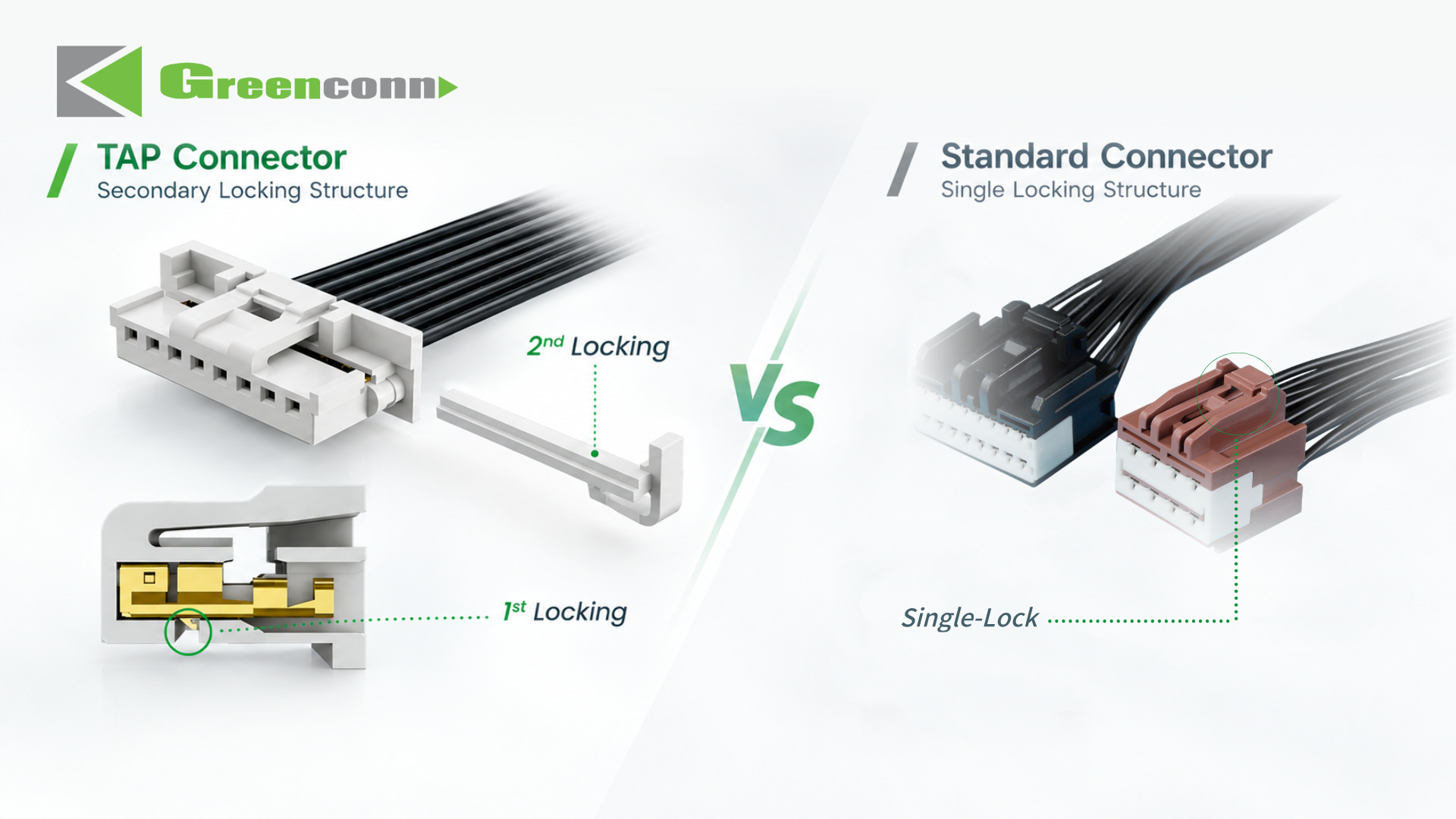
At the design level, a single-lock connector may be adequate for indoor, low-vibration, static connections and can reduce cost. For automotive, industrial, and other high-vibration or wide-temperature applications, connectors with TPA secondary locking are preferred because TPA improves vibration resistance, terminal retention, and mating durability. TPA helps maintain stable terminal contact force, minimizing contact resistance fluctuations under vibration. During high and low-temperature cycling, it can also compensate for dimensional changes caused by plastic shrinkage. By comparison, a single-lock connector may become fatigued and loosen after prolonged vibration. Once the locking mechanism becomes loose, contact impedance can increase, potentially causing intermittent power interruption. Plastic embrittlement at low temperatures may further reduce locking reliability.
Plating choice is another boundary. Gold plating provides excellent wear resistance, reducing the risk of base-metal exposure during repeated mating cycles. It also offers low and stable contact resistance, as well as strong resistance to salt spray and oxidation. Tin plating is softer and can wear through more easily during repeated mating. While its initial contact resistance can be acceptable, oxidation over long-term use may significantly increase contact resistance. Tin plating is also more susceptible to oxidation in high-temperature, high-humidity environments and may present a risk of tin whisker formation. Gold-plated terminals are preferred for signal circuits, high-vibration applications, and high-humidity or corrosive environments. Tin-plated terminals may be suitable for low-voltage power applications with limited mating cycles and relatively mild environmental conditions where cost control is important.
USCAR-2 is also identified as a performance standard for low-voltage automotive electrical connector systems. That matters because an LV214 checklist should not be presented as the only automotive standard in the market. The buyer should state which standard governs the program and whether both standards need to be addressed in the qualification plan.
Market trend: why LV214 evidence is becoming a procurement gate
A commercial research forecast cited in the verified data projects the global automotive connectors market to grow from USD 6.82 billion in 2025 to USD 11.39 billion by 2033, with EV and ADAS identified as demand drivers. The broader PCB connector market is estimated at USD 33.83 billion in 2025 and projected to reach USD 47.96 billion by 2035, based on the cited market research. These figures do not change the test method, but they explain why qualification evidence is becoming more visible in procurement.
As automotive electronics content increases, connector buyers need more than a product datasheet. They need a traceable test sequence that connects mechanical retention, environmental exposure, and electrical stability. In that environment, a supplier that can provide a product-specific LV214 test matrix and post-test inspection record is easier to qualify than a supplier that offers only a general compliance statement.
Future outlook
Automotive connector qualification is likely to remain sequence-based. Higher EV and ADAS content increases the need to connect mechanical retention, environmental exposure, and electrical stability in one evidence chain. Buyers should expect more requests for product-specific test plans and re-test data after environmental conditioning. The limitation is that no test standard can guarantee field performance without matching the application, the connector family, and the acceptance criteria. A supplier that can document the sequence, the specimen condition, and the post-test inspection is more useful to a buyer than one that offers only a broad certification claim.
FAQ: LV214 mechanical qualification for PCB connector buyers
What mechanical performance tests are typically included under the LV214 standard for automotive connectors?
LV214 mechanical testing typically includes mating and unmating force, terminal retention force, cable pull force, vibration endurance, and shock testing. After testing, the locking mechanism and terminals are inspected for displacement, damage, or fracture.
What is inspected after LV214 mechanical testing?
After testing, the locking mechanism and terminals are inspected for displacement, damage, or fracture. This post-test inspection is part of the mechanical qualification, not an optional visual check.
How do environmental tests interact with LV214 mechanical qualification?
IEC provides general standards for electronic and electrical products, while LV214 is an automotive connector standard with more stringent requirements for automotive applications. Relevant environmental tests may include high and low-temperature cycling, damp-heat testing, and salt spray testing. After environmental testing, mechanical locking performance and electrical parameters are re-evaluated. Plating corrosion or significant deterioration of insulation performance may be considered a failure, depending on the applicable test specification and acceptance criteria.
Which electrical performance tests should follow mechanical and environmental stress?
Electrical testing typically includes contact resistance, insulation resistance, dielectric withstand voltage, and current-carrying temperature-rise testing. Relevant references include IEC 61984 and EIA-364-06, EIA-364-23, and EIA-364-21. These tests should be repeated or reviewed after environmental exposure where the qualification plan requires it.
What failures can occur when the mechanical performance of a connector is inadequate?
Potential failures include locking-tab fatigue or fracture, terminal back-out, and abnormal mating or unmating forces. Under vibration conditions, reduced contact pressure can lead to intermittent power interruption. Excessive cable-harness pulling force may also cause terminals to be pulled out of the housing, resulting in complete loss of electrical connection.
When should TPA secondary locking be specified instead of a single-lock connector?
For automotive, industrial, and other applications involving high vibration and wide temperature ranges, connectors with a TPA secondary locking structure are preferred. For indoor, low-vibration, static connections, standard single-lock connectors may be used to reduce cost.
Can a supplier ISO 9001 or IATF 16949 certificate replace an LV214 test report?
No. A quality-system certificate is a supplier-qualification input, while an LV214 test report is product-level evidence. Buyers should request the applicable test matrix, sequence, acceptance criteria, and product-specific report for the connector family under consideration.
How should acceptance criteria be defined for an LV214 qualification plan?
Acceptance criteria should be written into the qualification plan before testing. They should define the test matrix, specimen condition, sequence, pass/fail limits, post-test inspection rule, and electrical re-test rule. The limits are specific to the connector family and application, not a single universal number.
Reference resource: Greenconn Introduction Brochure.
¿Tiene preguntas o necesita más detalles?
Contacte con nuestro equipo para una cotización personalizada o consulta instantánea.
Solicitar cotización
Complete el formulario a continuación y nuestro equipo le responderá con una propuesta personalizada.
Chat directo de WhatsApp
¿Prefiere chatear en tiempo real? Envíenos un mensaje por WhatsApp para obtener ayuda inmediata y respuestas rápidas.
- Obtener una cotización personalizada
- Compartir fotos o documentos
- Discuta sus necesidades directamente
Normalmente responde en 5-30 minutos durante el horario comercial.