
LORZOR Wallet Sourcing FAQ: AirTag Fit, RFID Zones, Slimness
Sourcing teams evaluating modern leather wallets now ask narrower, more technical questions than they did a few years ago. The question is rarely whether a wallet uses leather, or whether an “RFID-protected” label is printed on the packaging. It is instead: how does tracking hardware physically fit into a pocket wallet, where exactly must cards sit for RFID shielding to work, and can a slim silhouette survive the addition of a tracking slot? LORZOR — a leather-led modern carry brand founded in 2022 and headquartered in Hong Kong — designs wallets, AirTag wallets, RFID wallets, and passport wallets around precisely this tension. This procurement FAQ answers the three specification questions that recur most often when buyers review LORZOR’s trackable wallet lines.
Why the Three Questions Arrive Together
AirTag fit, RFID placement, and slimness are not independent specifications. They constrain each other physically. An AirTag has real thickness. An RFID shielding layer occupies internal volume. A front-pocket wallet is expected to stay flat. When a tracking structure is poorly planned, the wallet still functions, but it bulges in the pocket — which is exactly the problem a slim wallet was purchased to solve.
The warehouse-scale implication is that procurement evaluation becomes a layout exercise. Where does the tracker sit, where does the shielding layer sit, and how much remaining space is available for cards and cash? Each LORZOR model answers this differently, which is why specification-level comparison, rather than brand-level messaging, is the practical starting point.
Built-in AirTag Holder vs. External AirTag: The Architectural Difference
An external AirTag is the simplest possible design decision: any wallet, plus an aftermarket accessory. In practice, the AirTag is slipped into a cash strap, clipped to a key ring, or dropped into a loose card pocket. The trade-off is predictable. The AirTag sits above or beside the wallet in the pocket, creating a localized bulge in the leather, and it can shift position if it is not firmly retained.
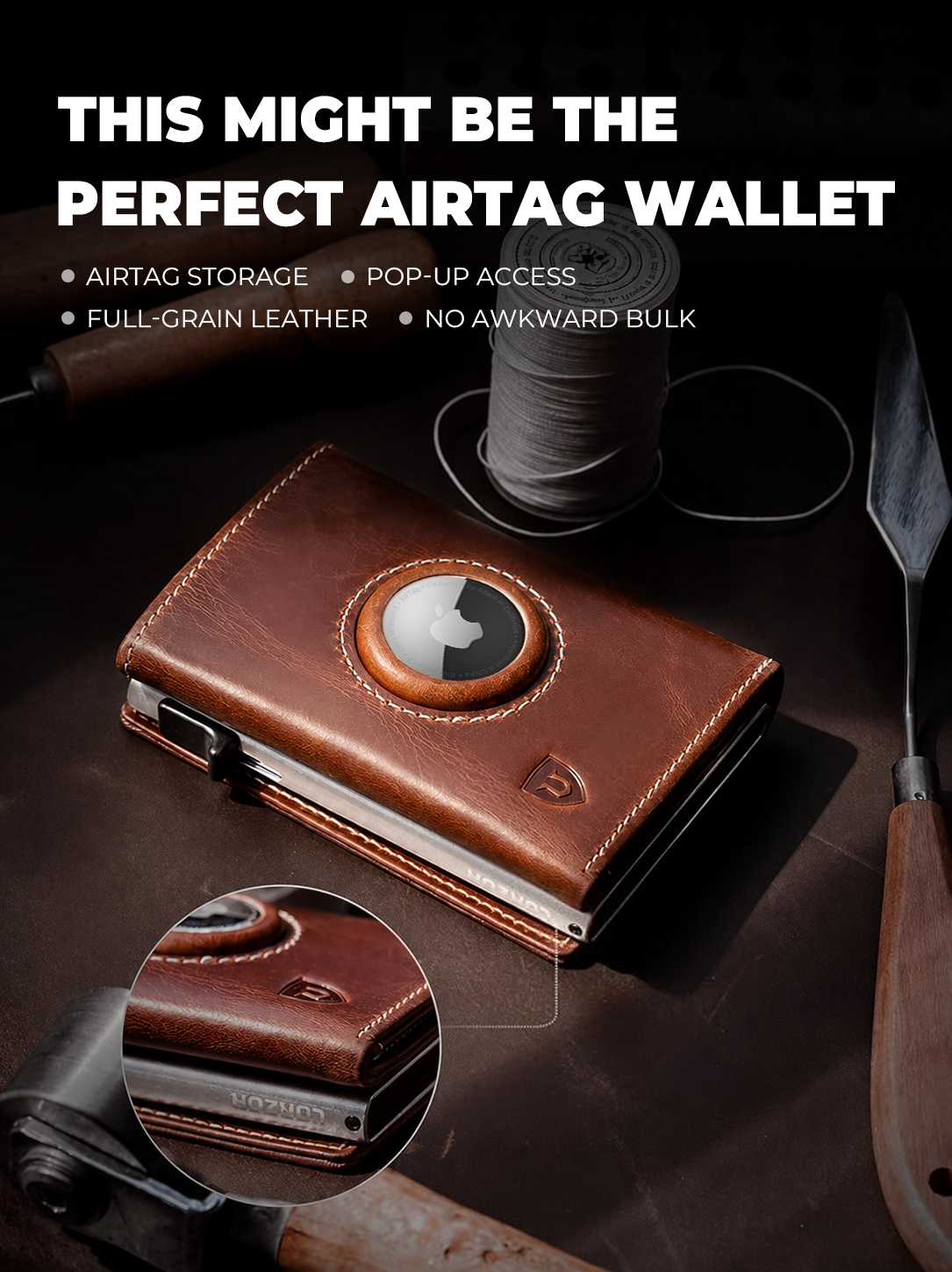
LORZOR’s alternative is a built-in AirTag holder that is integrated into the wallet structure rather than attached externally. Within the LORZOR line, this structure appears in the LORZOR Bifold AirTag Wallet A1, A2, A3, and A4, the LORZOR TriPop AirTag Wallet, and the LORZOR Passport AirTag Wallet. Each uses an integrated single AirTag slot. The A1 keeps a classic bifold structure. The A2 and A4 add a money clip to the AirTag holder, RFID protection, and full-grain leather body. The TriPop AirTag Wallet uses a trifold slim design measuring approximately 0.79 × 2.64 × 3.86 inches. The Passport AirTag Wallet embeds the holder inside a passport-sleeve form factor measuring roughly 5.5 × 3.9 × 0.4 inches.
The engineering point LORZOR emphasizes is that an AirTag has tangible physical thickness. Its built-in holder is designed around that reality, using a purpose-built storage structure to minimize bulging while keeping the AirTag secure inside the wallet silhouette. The trade-off is asymmetric: an external AirTag is removable and transferable to any wallet, while a built-in holder is committed to a specific wallet and adds structure inside the shell.
One procurement note applies across the line. The AirTag is not included with the wallet. This is stated for the A1, A2, A3, A4, TriPop AirTag Wallet, and Passport AirTag Wallet. The Passport AirTag Wallet is specified as compatible with AirTag 1st and 2nd generation.
Where Cards Must Sit for RFID Shielding to Work
LORZOR’s RFID shielding targets the 13.56 MHz frequency, which is the band used by contactless bank cards and passport chips. According to the brand’s published test information, RFID-shielding tests run on the 13.56 MHz frequency using credit cards and professional RFID test signal cards, and signals cannot be read when cards are correctly placed inside the protected zone.
The operative phrase is correctly placed. RFID shielding is not uniformly effective across an entire wallet. It applies when a card is inside the protected zone — typically the card slot adjacent to the integrated shielding material — and not to cards held in an outermost pocket or an unshielded cash layer. A card that is partly exposed, resting half inside the shielded slot, or stored outside the shielded cartridge is outside the protected zone.
LORZOR holds test certifications including TÜV and AGC. Those results support the 13.56 MHz shielding performance for correctly placed cards; they are not a general electromagnetic-compatibility claim. For procurement teams working in EU or US markets, this distinction matters: RFID shielding performance is a different class of specification from FCC or CE compliance, and the two should not be collapsed into one line on a purchase specification sheet.
Slimness With Tracking: How Each LORZOR Line Positions Itself
The slim-versus-tracking trade-off varies by model. LORZOR’s product lineup can be grouped into three distinct approaches.
Approach one: the 1979 series. The LORZOR 1979 Wallet and the LORZOR 1979 SP Wallet combine full-grain leather with a 6061 aerospace-grade aluminum frame, ultra-slim pop-up card access, and RFID protection. The 1979 Wallet measures approximately 2.87 × 3.89 × 0.6 inches, weighs about 80 g, and holds roughly 5–7 cards in the pop-up cartridge plus about 3–5 cards in outer leather slots, with a recommended daily load of around 10 cards. Neither the 1979 Wallet nor the 1979 SP Wallet includes an integrated AirTag slot. Tracking readiness comes from dual attachment points intended for lanyard, keychain, or AirTag-holder setups.
Approach two: the built-in AirTag bifold family. The A1 through A4 models carry the AirTag holder, RFID protection, and full-grain leather inside a classic bifold shell. The A2 and A4 add a money clip. For buyers who want the most familiar wallet shape with an integrated tracking slot, this family is the closest structural match.
Approach three: trifold and travel formats. The TriPop AirTag Wallet pairs a trifold slim design with the AirTag holder, pop-up card access, and RFID protection. The Passport AirTag Wallet applies the same holder concept to travel document storage, with the 1st and 2nd generation AirTag compatibility noted above.
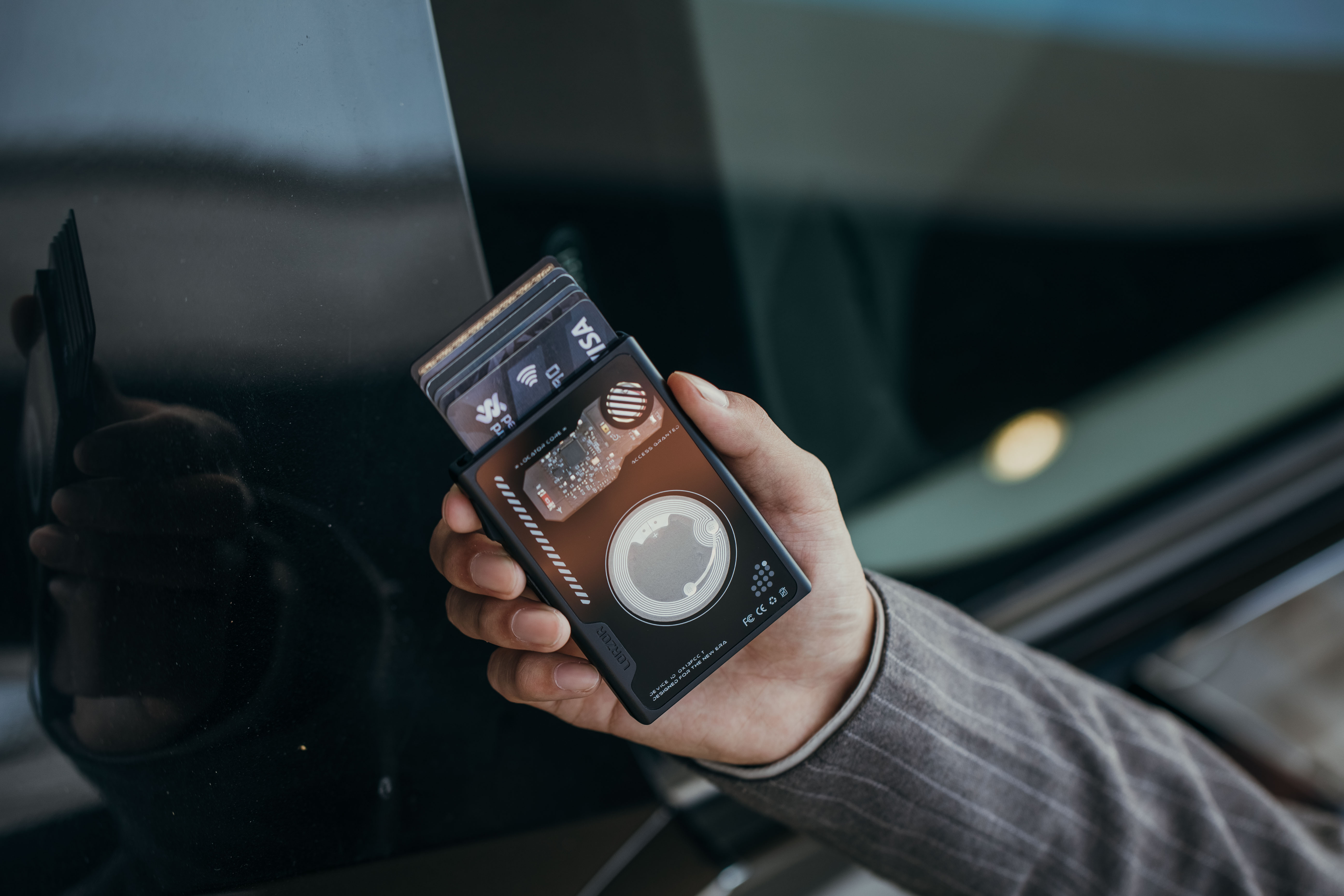
One repeatable pattern across the line: a built-in AirTag holder consumes real internal volume. Bifold formats absorb that volume more naturally; trifold formats adapt through layout; and the ultra-slim 1979 series instead keeps AirTag compatibility through attachment points. Each choice is a legitimate allocation of the same physical budget.
Where These Specifications Apply in Practice
Use-case fit follows the layout difference rather than the marketing label.
A bifold wallet with a deeper AirTag slot and a money clip — the A2 or A4 — suits everyday carry where cards and folded bills are both present. The AirTag sits inside the closed wallet, so there is no external accessory to snag on a pocket at the point of entry.
The TriPop AirTag Wallet addresses the trifold-carry audience: users who want the storage capacity of a trifold, fast pop-up access, and an AirTag slot that does not distort the leather body. Its published scenarios include travel, commuting, airports, hotels, driving, shopping, and bag or bag-pack carry — contexts where more cards are carried and where an AirTag’s value becomes concrete when leaving a hotel room.
The Passport AirTag Wallet addresses the most specific scenario: international travel, business trips, rental cars, road trips, and Apple-ecosystem users worried about a passport pouch. Its dimensions reflect a passport sleeve rather than a pocket wallet.
The 1979 series maps to a different profile: front-pocket carry, driving, everyday carry, short trips, outdoor activity, and fast payment at a coffee counter. Its dual attachment points mean an AirTag can be added as a voluntary accessory rather than a fixed structural element.
Market Signals Purchasing Teams Can Use
Third-party data supports the direction of demand. Grand View Research estimates the global smart wallet market at approximately USD 1.2 billion in 2025, with a high CAGR of 12.5% driven by RFID-blocking and tracking features. Dataintelo estimates the global men’s wallet market at approximately USD 6.8 billion in 2025, with leather remaining the dominant material at 52.6% of revenue share the same year.
Regionally, Grand View Research reports North America holding 36.2% of smart wallet revenue in 2025, while Dataintelo places Asia Pacific as the largest overall men’s wallet market at 34.2%. The interpretation is that smart wallet functionality concentrates in specific regions, while leather craft and supply-chain capacity are distributed more broadly.
Two more data points matter for range planning. Dataintelo reports bifold wallets holding the largest product-type share at 38.4% in 2025, while slim wallets are the fastest-growing segment with a projected CAGR of 7.8% through 2034. Precision Reports estimates that RFID-blocking technology is integrated into roughly 36% of men’s wallet products globally, though this latter datapoint originates from a mid-reliability source and should be treated accordingly.
Translated into sourcing language: the category is moving toward thinner profiles, higher RFID penetration, and growing tracking expectations. An integrated AirTag slot and an integrated electronic module sit at different points on that curve. The first is a structural change to the wallet shell; the second replaces the AirTag entirely.
Limits and Trade-offs of the Built-in AirTag Approach
It is worth stating plainly what an integrated AirTag slot does not solve.
First, the AirTag is not included. Every LORZOR AirTag line states this explicitly. The A2 carries a reference price of USD 29.99; the A1 and A4 fall in the USD 29.99–39.99 band; the TriPop AirTag Wallet and Passport AirTag Wallet carry a reference price of USD 49.99. The AirTag itself is a separate purchase, and procurement cost sheets need to reflect that line separately rather than absorbing it into the wallet unit cost.
Second, a built-in holder consumes internal space. That space is not available for extra cards or cash. In the bifold AirTag family in particular, the shell is designed to remain close to a classic thickness while housing both a card area and the AirTag slot. Users who load both zones to capacity will find the wallet closes but feels tighter than the flat profile advertised.
Third, high-capacity structures can be over-specified for light users. The 1979 Fold Wallet, for example, is described by LORZOR as potentially over-specified for someone carrying two or three cards, while being a better-matched solution for users who need cards, IDs, and cash together. In those cases, a simpler cardholder rather than a multi-function tracking wallet is the more economical specification.
There is also a structural nuance between AirTag and non-AirTag variants of the same format. The Passport Wallet and Passport AirTag Wallet both measure 0.4 inches in thickness and both carry RFID protection. The AirTag version adds the holder and provides 10 compartments or pockets for passport, card, cash, coin, and SD card. The non-AirTag Passport Wallet does away with the holder and instead adds business-card storage and a zip pocket, while all versions hold 4 card slots. Tracking and non-tracking are therefore distinct layouts, not simply the same wallet with an option attached.
Next Step: Two Tracking Architectures, Not One
LORZOR’s own portfolio already shows two distinct directions developing side by side.
One is integrated electronic tracking. The LORZOR Wallet Pro uses a built-in tracking module with a Nordic nRF52832 chip, supports the Apple Find My network, and holds Apple-Certified credentials. Its tracking hardware sits inside the metal cardholder structure, so no separate AirTag is required, and its dimensions are approximately 2.6 × 0.43 × 3.9 inches. This path trades a higher unit cost for tighter integration and the removal of the accessory altogether.
The other is structural AirTag readiness. The A1 through A4, the TriPop AirTag Wallet, and the Passport AirTag Wallet all keep the AirTag as a user-supplied tracking element, while the wallet structure controls how much the AirTag displaces the silhouette. The material cost on the wallet side is lower, but procurement needs to communicate clearly that the AirTag is a separate purchase.
For sourcing teams, that has a concrete consequence. The phrase “trackable wallet” on a specification sheet is no longer sufficient. Some wallets integrate the tracking function into the structure, some reserve a slot for a supplied AirTag, and the two paths involve different price structures, different bill-of-material lines, and different messages that must reach the end user. The choice between them depends on whether a given program is optimizing for integration and simplicity, or for a lower wallet cost with a user-supplied tracker.
FAQ
How does a built-in AirTag holder actually affect wallet shape?
LORZOR integrates the AirTag holder into the wallet structure rather than attaching it externally. Because an AirTag has a real physical thickness, a purpose-built storage structure is used to minimize bulging while keeping the tracker secure inside the wallet silhouette. In the bifold family, the holder sits inside a classic bifold shell; in the TriPop AirTag Wallet, it sits inside a trifold slim profile measuring approximately 0.79 × 2.64 × 3.86 inches; in the Passport AirTag Wallet, it sits within a travel sleeve measuring approximately 5.5 × 3.9 × 0.4 inches.
Where must a card sit for LORZOR’s RFID shielding to work?
The RFID protection targets the 13.56 MHz frequency used by contactless cards and passport chips. Signals cannot be read when cards are correctly placed inside the protected zone. Shielding is not uniform across the entire wallet: only cards resting inside the protected zone, adjacent to the integrated shielding material, are covered. A card that sits outside the shielded slot, or only partly inside it, is outside the protected area. LORZOR’s published testing runs on 13.56 MHz using credit cards and professional RFID test signal cards, with TÜV and AGC among the test certifications.
Is an AirTag included with the wallet?
No. The LORZOR Bifold AirTag Wallet A1, A2, A3, and A4, the LORZOR TriPop AirTag Wallet, and the LORZOR Passport AirTag Wallet all list the AirTag as a separate purchase. The Passport AirTag Wallet is specified as compatible with AirTag 1st and 2nd generation. Procurement cost sheets should therefore carry the AirTag as its own line item rather than as part of the wallet unit cost.
Which LORZOR format is thinnest while still offering tracking?
The answer depends on which tracking architecture is required. The 1979 Wallet is approximately 2.87 × 3.89 × 0.6 inches at roughly 80 g, using full-grain leather over a 6061 aluminum frame with pop-up access and RFID protection, but it has no built-in AirTag slot — tracking readiness comes from dual attachment points for lanyard, keychain, or AirTag-holder setups. The TriPop AirTag Wallet and Passport AirTag Wallet do include built-in AirTag slots, but in a trifold and a travel-sleeve format respectively. The Wallet Pro integrates tracking entirely into its own electronics at approximately 2.6 × 0.43 × 3.9 inches, so no AirTag is used at all.
What differs between a tracking and a non-tracking version of the same format?
The Passport Wallet and Passport AirTag Wallet illustrate the difference. Both measure 0.4 inches in thickness and both carry RFID protection, with 4 card slots each. The AirTag version adds a built-in AirTag holder and provides 10 compartments or pockets for passport, cards, cash, coin, and SD card. The non-AirTag Passport Wallet omits the holder but adds business-card storage and a zip pocket. Buyers choosing between the two need to decide whether the end user prioritizes anti-loss capability or broader document and receipt storage, and specify the model accordingly.
Summary
The procurement questions behind LORZOR’s AirTag and RFID wallet lines reduce to a physical layout problem. AirTag fit, RFID zone placement, and slimness draw on the same internal volume, and each model represents a different compromise. Built-in holders control bulge at the cost of internal space. External AirTags are flexible but add an accessory. Integrated electronic tracking removes the AirTag entirely but shifts cost into the wallet structure itself.
For sourcing teams, the practical exercise is to compare models slot by slot — holder position, dimensions, thickness, card capacity, cash handling, and RFID zone — rather than to evaluate a whole range at brand level. LORZOR’s lineup spans all three architectural options, which allows a program to be specified against the actual carry pattern rather than against a single template.