
LORZOR Passport Wallet vs Passport AirTag Wallet: Buyer Comparison
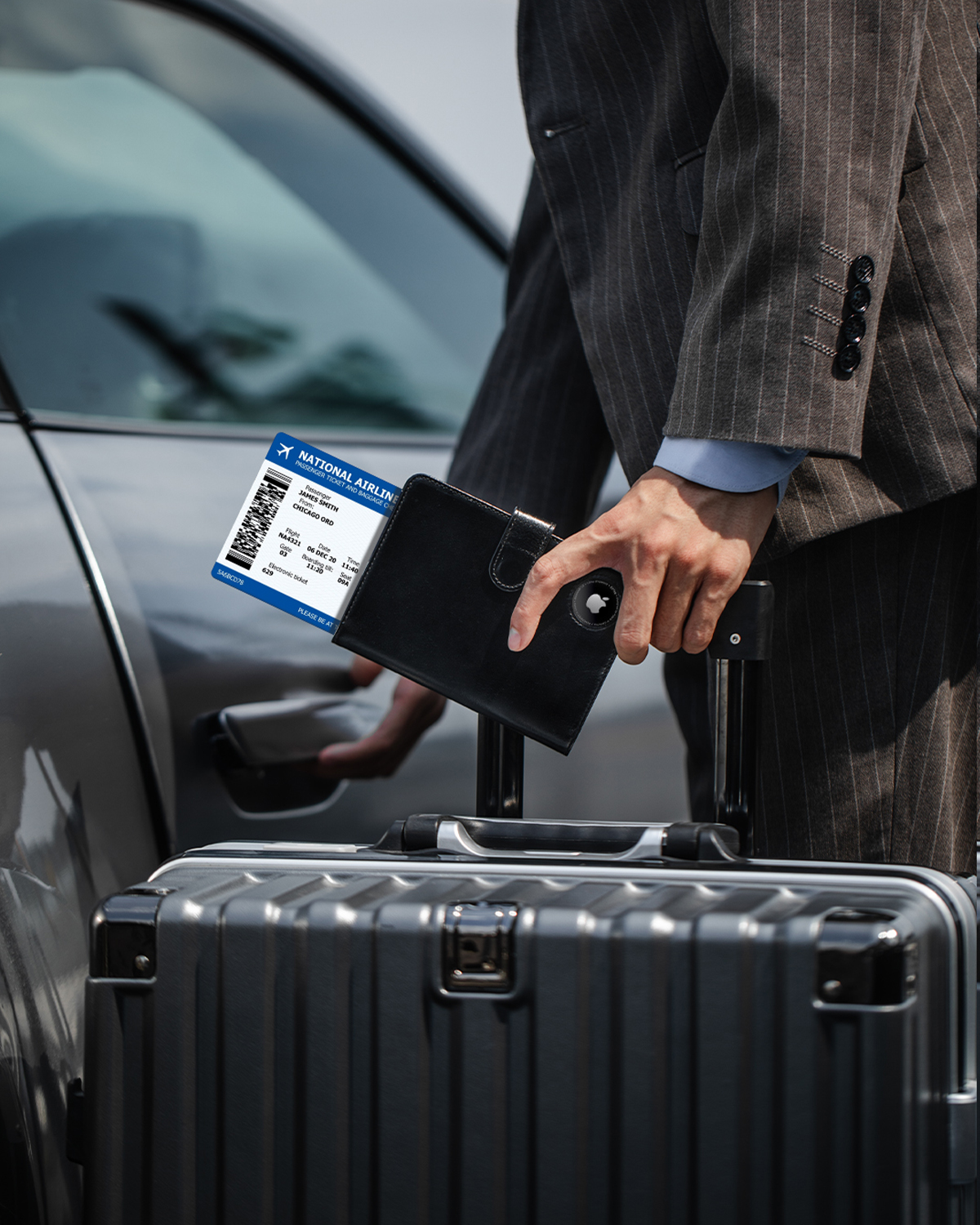
A travel wallet is judged by how quickly the right document appears at a counter, not by how much it can hold.
Passport, boarding pass, hotel key card, two currencies of cash, a handful of receipts and three or four payment cards: for a man who travels internationally, the wallet problem stopped being about holding money some time ago. It is now a document-management problem, and it tends to surface at borders, rental counters and hotel lobbies, usually while somebody else is waiting.
Digital payments have not removed that problem. Worldpay’s Global Payments Report projects that digital wallets will account for 49% of all sales across online and point-of-sale channels by 2027, and Precision Reports estimates the global men’s wallet market at USD 26.77 billion in 2026. Within that market, leather remains the dominant material preference at 62%, slim formats hold a 23% share, and RFID-blocking designs appear in 36% of men’s wallet products. The physical wallet is not disappearing; it is being re-specified around the objects a phone cannot replace.
LORZOR is a leather-led modern carry goods brand founded in 2022 and headquartered in Hong Kong, and its passport-wallet line is built directly around that re-specification. The line contains two products listed at the same price of USD 49.99: the LORZOR Passport Wallet and the LORZOR Passport AirTag Wallet. They share material, storage intent and RFID protection, and they separate on one structural decision — whether the wallet itself includes a built-in holder for an Apple AirTag.
This comparison is written for buyers who have already decided they want a travel passport wallet and are now working out which configuration they will actually carry.
Why the Choice Is Narrower Than It Looks
Travel-wallet buyers tend to arrive with the same short list: one place for the passport, a slot for a boarding pass, somewhere sensible for a hotel key card, separation for foreign cash and receipts, and a shape that does not turn into a brick in a jacket pocket. LORZOR’s published travel scenarios describe the same failure mode from the other direction — passport, boarding pass, hotel key, foreign cash, receipts, cards and tickets drifting into different pockets and bags, with the real cost paid as search time at airports, hotels, customs and rental counters.
That reframing matters during evaluation. A passport wallet is rarely judged on whether it can hold a passport; almost all of them can. It is judged on whether the items you touch most often — the passport at a counter, the card at a payment terminal, the cash in a taxi — can be reached without unpacking everything else, and on whether the wallet still closes properly once it is loaded.
Both LORZOR passport wallets answer that brief with the same design language: full-grain leather as the primary contact surface, all-in-one travel storage, and RFID protection built into the structure. The difference is narrower and more consequential than the price suggests.
Two Wallets, One Price: The Specification Difference
The LORZOR Passport Wallet is the non-AirTag version of the brand’s travel wallet. It is specified as all-in-one travel storage in full-grain leather with RFID protection, and it accommodates passports, flight tickets, cards, cash, receipts and travel documents.
The LORZOR Passport AirTag Wallet keeps the same storage brief and adds a built-in AirTag holder embedded inside the passport sleeve. Its published specification lists all-in-one travel storage, built-in AirTag holder, RFID protection and full-grain leather, with approximate dimensions of 5.5 × 3.9 × 0.4 inches and compatibility with AirTag 1st and 2nd generation devices. The AirTag itself is not included.
| Specification | LORZOR Passport Wallet | LORZOR Passport AirTag Wallet |
|---|---|---|
| Primary brief | All-in-one travel storage | All-in-one travel storage |
| AirTag holder | None (non-AirTag version) | Built-in holder embedded in the passport sleeve |
| AirTag compatibility | Not applicable | AirTag 1st / 2nd generation |
| AirTag included | Not applicable | No |
| RFID protection | Yes | Yes |
| Material | Full-grain leather | Full-grain leather |
| Document load | Passports, flight tickets, cards, cash, receipts, travel documents | Passport and travel documents in the same all-in-one format |
| Approx. dimensions | Not published in the brand’s product data | 5.5 × 3.9 × 0.4 in |
| Listed price | USD 49.99 | USD 49.99 |
| Published customer rating | 4.95 average across 122 reviews | 5.0 average across 26 reviews |
Two points in that table are worth slowing down for. First, the price is identical, so the AirTag holder is not a paid upgrade in the current listing — the buyer is choosing between two configurations rather than between two price tiers. Second, published customer feedback for both products converges on the same strengths: full-grain leather, RFID protection, a secure magnetic closure and a lifetime warranty, with the Passport Wallet reviews also noting that the format fits a passport, cards and cash together.
Built-In AirTag Holder vs Expecting the Wallet to Track
The single distinguishing factor between the two passport wallets, as LORZOR frames its own product decision, is the presence of an AirTag holder. Travelers who prioritise having that holder are directed to the Passport AirTag Wallet, which includes the holder and supports item tracking.
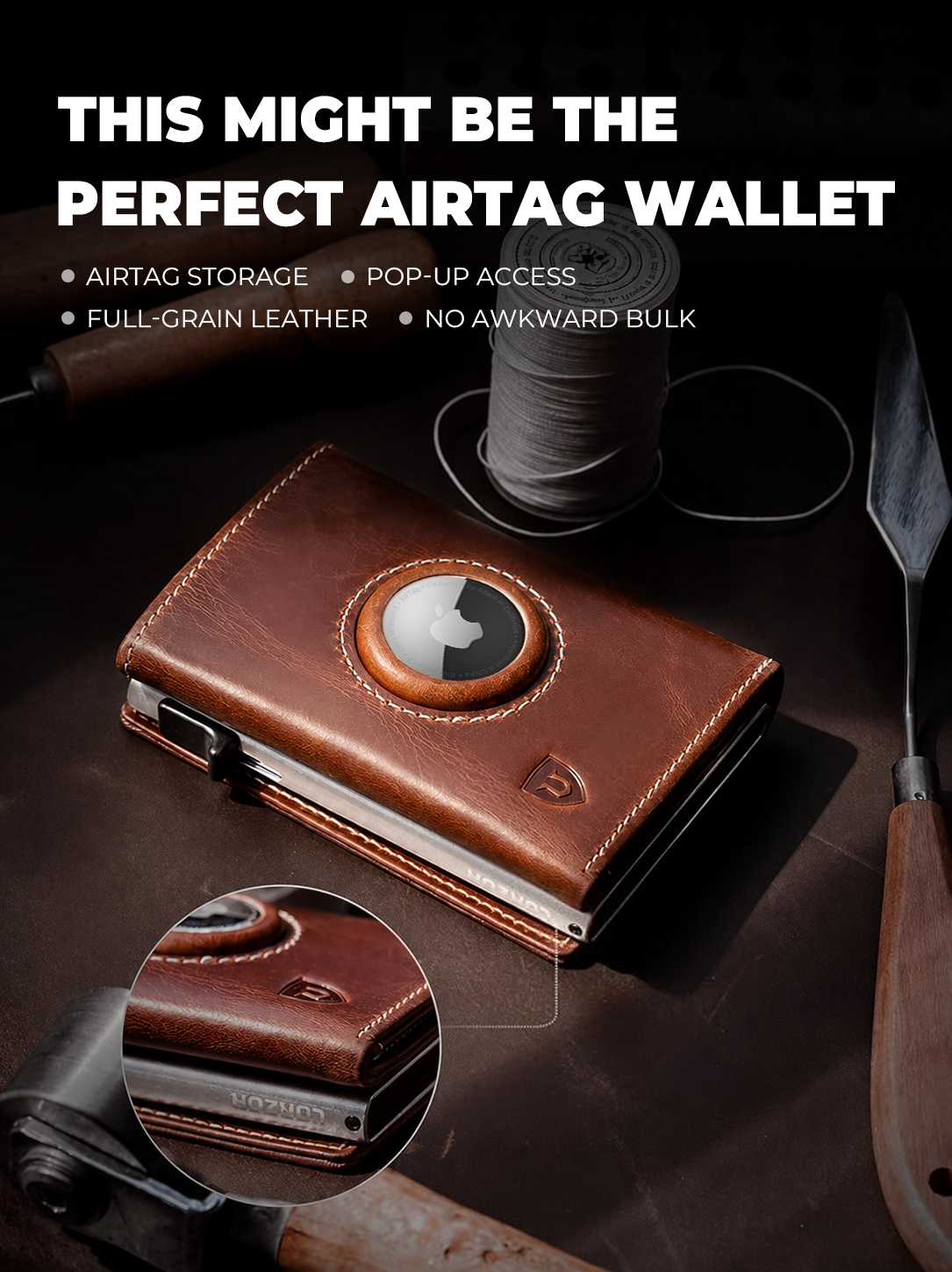
LORZOR’s AirTag wallet family integrates the holder into the wallet structure rather than attaching it externally.
The structural detail is the part buyers most often misread. In LORZOR’s AirTag wallet family, the holder is integrated into the wallet structure rather than attached externally, which is what keeps the silhouette clean and avoids a separate accessory protruding from the leather. On the Passport AirTag Wallet, that holder sits inside the passport sleeve.
What the wallet does not do is track anything on its own. Tracking capability comes from the AirTag the buyer supplies, and the wallet is compatible with AirTag 1st and 2nd generation devices. Two practical consequences follow. The AirTag is an additional purchase, and it is an Apple-ecosystem accessory — a buyer outside that ecosystem should not expect the same result from the holder alone.
LORZOR’s wider catalogue splits the two philosophies explicitly. Its AirTag wallets rely on an AirTag for recovery, while the LORZOR Wallet Pro uses a built-in tracker with support for Apple Find My and does not require an AirTag at all. That distinction is useful context here: if a buyer wants a passport wallet, the choice is between a holder and no holder. If a buyer wants tracking without buying a tracker, the passport line is not where that question is answered — the Wallet Pro is a different product line and not a passport wallet.
RFID Protection at 13.56 MHz: What the Tests Cover
Both passport wallets include RFID protection, and that claim has a specific, checkable scope rather than a general one. LORZOR’s RFID shielding tests target the 13.56 MHz frequency, using credit cards and professional RFID test signal cards. In that setup, signals cannot be read when cards are correctly placed inside the protected zone. The supporting documentation includes TÜV and AGC test reports, laboratory RFID test results, and card-reading test photos and video assets.
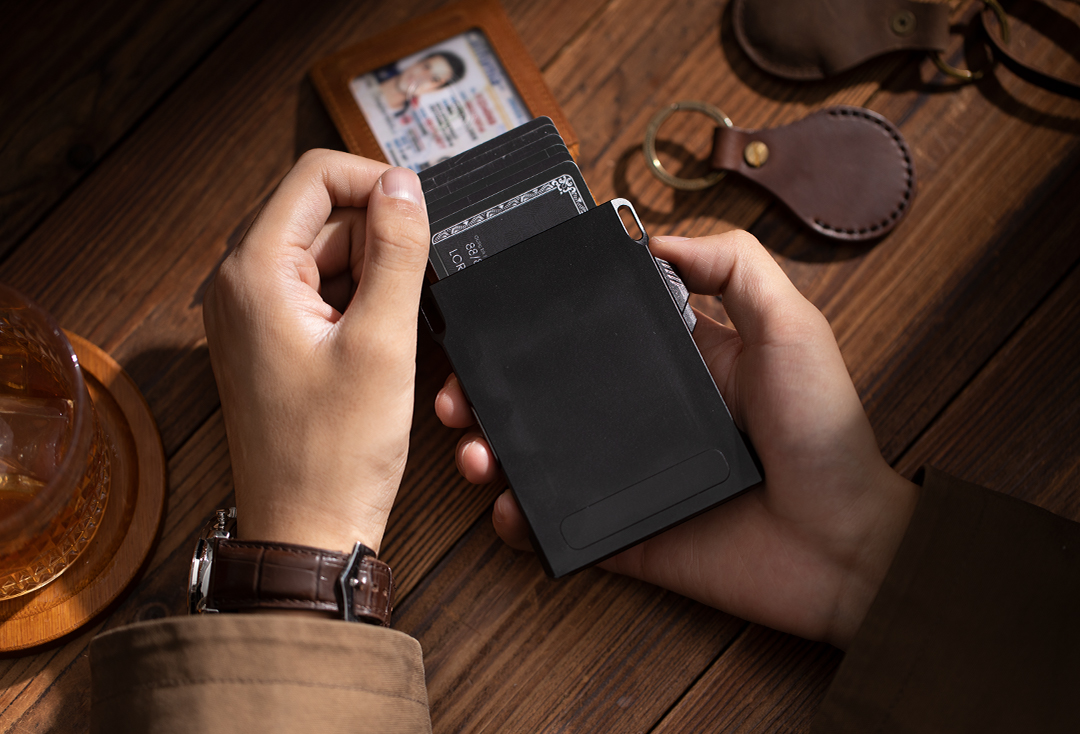
LORZOR publishes its RFID claims against a 13.56 MHz test setup, with stated certification documentation.
Two boundaries belong in any honest evaluation of that language. First, the protection is conditional on placement — the published wording specifies that signals cannot be read when cards are correctly placed inside the protected zone, which means a card left in an outer, unprotected slot is not covered. Second, shielded zones vary across LORZOR products because the structures differ. Buyers who keep passports, transit cards and contactless cards in different compartments should map those compartments to the protected zone rather than assuming the whole wallet is uniformly shielded.
For context, RFID-blocking wallets are present in 36% of men’s wallet products globally, according to Precision Reports. It is a common feature, which makes the quality of the supporting evidence — frequency tested, zone defined, reports named — the more useful differentiator at evaluation stage.
Scenario One: Airport Transit — Passport, Boarding Pass and Hotel Key
Airport transit is a sequence of short, public moments: the check-in desk, the security tray, the gate, the immigration counter, then the hotel reception a few hours later. The documents involved change hands repeatedly, and each handover is a chance for something to be left behind.
The Passport Wallet is specified to hold passports, flight tickets, cards, cash and receipts together, which maps almost exactly onto the sequence above — the passport and boarding pass live in the same closed object as the card used at the lounge and the cash used for a taxi. The Passport AirTag Wallet adds the holder to that same all-in-one format, and its stated use cases include hotel check-in, airport transit and keeping a boarding pass and room key card organised.
The practical difference at this stage is not capacity but reassurance. A traveler who has left a wallet behind in a security tray or a hotel room is dealing with two separate problems: finding the object and replacing the documents. The AirTag holder addresses the first problem only, and only when an AirTag is fitted and paired.
Scenario Two: Family Rental-Car Travel — Passports, Keys, Tickets
Family rental-car travel changes who handles the documents. One person usually ends up carrying multiple passports, a rental agreement, car keys, boarding passes and tickets, often across several legs and several hands. LORZOR’s published scenarios name rental-car use and road trips as explicit use cases for the Passport AirTag Wallet, alongside frequent international travel and business trips.
In that setting, a wallet that centralises documents has a second benefit beyond tidiness: it reduces the number of separate objects that can be left in a car. The counter-argument is real, though. A single object holding every passport in the family is a single point of failure, and no wallet design removes that risk. Some travelers deliberately split documents across two carriers for exactly this reason, and that decision sits above any product comparison.
Scenario Three: Multi-Country Trips — Receipts, Foreign Cash and Multiple Cards
Longer itineraries across several countries generate a specific mess: receipts in one currency, cash in two, cards that may or may not work at the next terminal, and a growing pile of paper that has to survive until an expense claim is filed.
LORZOR’s own guidance on that scenario is deliberately procedural rather than product-led. The recommendation is to sort daily into a compact travel wallet or RFID-blocking pouch with separate sections for cash — divided by currency — cards and receipts. The method matters as much as the carrier: daily sorting prevents a week of mixed receipts from becoming an accounting problem, and dividing cash by currency prevents the wrong notes being handed over at a counter.
Both passport wallets are built around all-in-one travel storage, and the Passport Wallet specification explicitly lists cash and receipts alongside passports, tickets and cards. The AirTag version keeps the same brief with the holder added. Neither is a filing system, so the discipline of sorting daily still sits with the traveler.
Does Either Wallet Stay Organised Without Getting Bulky?
This is where an AirTag wallet usually earns scrutiny, because adding a holder is adding a physical object. On the Passport AirTag Wallet, the published thickness is approximately 0.4 inches, and the holder is embedded inside the passport sleeve rather than mounted on the outside. Embedding the holder is what allows the wallet to keep a flat, integrated profile instead of a bulge in the middle of the leather.
The non-AirTag Passport Wallet does not have published dimensions in the brand’s product data, so a direct thickness comparison between the two is not available from LORZOR’s own specifications. What can be compared is the load. Both are full-grain leather wallets with magnetic closures and all-in-one travel storage, and published customer feedback for the Passport Wallet — a 4.95 average across 122 reviews — notes that it fits a passport, cards and cash well and stays compact.
Bulk, in practice, is driven by the traveler more than the wallet. A wallet carrying one passport, two cards and a boarding pass behaves very differently from one carrying three passports, a receipt stack and two currencies of coins. Buyers who intend to carry heavily should treat the published thinness of the AirTag version as a starting point rather than a promise about a fully loaded wallet.
What Neither Wallet Does: Boundaries Worth Accepting Up Front
An independent comparison is only useful if the limits are stated as plainly as the features. Five boundaries apply to this pair.
1. The AirTag is not included. The Passport AirTag Wallet ships without one, and it is compatible with 1st and 2nd generation AirTags. Budget for the tracker separately, and confirm generation before purchase — published customer feedback on LORZOR AirTag products flags the missing AirTag as a recurring expectation gap.
2. Neither passport wallet has an integrated tracker. The tracking route here runs through an AirTag and the Apple ecosystem. Buyers who want tracking built into the wallet itself should look at a different product category, such as the LORZOR Wallet Pro, which is not a passport wallet.
3. RFID protection is placement-dependent. The published test result is that signals cannot be read when cards are correctly placed inside the protected zone, at a tested frequency of 13.56 MHz. Protected zones differ by product structure. Cards in unprotected slots are outside that claim.
4. Closure is magnetic, not zippered. Both products are built as leather travel wallets with magnetic closures rather than zip-around organisers. Travelers who want a fully sealed pouch for loose coins or mixed small items should weigh that against their habits. One published review of the Passport AirTag Wallet raised a question about a zipper coin pocket even though the product description includes that compartment — a useful reminder to verify compartment layout against personal requirements rather than against a photograph.
5. Single-carrier risk. Centralising passports, cards and cash in one object is efficient and also concentrates risk. For family travel in particular, that is a judgment the buyer makes, not the wallet.
Market Trend Analysis: Where Travel-Carry Is Moving
Three data points frame this comparison. Novatrends Market Intelligence expects the smart tracker market to grow at a CAGR of 13.3%, reaching USD 2.98 billion by 2035 — the accessory category that AirTag-based wallets depend on is expanding, not contracting. Worldpay projects digital wallets at 49% of all sales by 2027, which pushes physical wallets further toward documents and backups rather than day-to-day payment volume. And Market Growth Reports puts full-grain or top-grain leather at over 60% of wallets sold globally, which is consistent with travel wallets continuing to be specified in genuine leather rather than function-first synthetics.
LORZOR’s own brand positioning sits directly inside those trends: slim, trackable, minimalist, RFID-blocking and AirTag-compatible wallet variants, sold primarily through direct-to-consumer channels with stated lifetime warranty, free global shipping and 30-day returns. The passport line is a narrow expression of that positioning — two products, one price, one structural difference.
Comparison With Traditional Passport Holders and Bifold Wallets
The conventional alternatives are still widely sold, and they are worth placing next to these two products honestly. A basic passport cover protects the booklet and little else. A traditional leather bifold carries cards and cash but not a passport, so it forces a second object. A zip travel organiser holds more paper but usually adds bulk and a heavier closure.
The category has also converged on features. Saddleback Leather describes its men’s leather wallets as full grain bifold, slim and RFID styles, and states that all but its Front Pocket ID model are lined with an RFID blocker. Ekster markets men’s RFID wallets as secure and trackable smart wallets across leather, aluminium and carbon fibre. RFID protection and tracking language are therefore category-level expectations rather than exclusive claims, which is why the tested frequency, the defined protected zone and the named test reports matter more than the presence of the word RFID.
| Approach | What it handles | Typical trade-off |
|---|---|---|
| Basic passport cover | Passport protection | No card, cash or ticket organisation |
| Traditional leather bifold | Cards and cash | Passport carried separately |
| Zip travel organiser | Large paper and coin load | Bulkier carry, slower access |
| LORZOR Passport Wallet | Passports, tickets, cards, cash, receipts, documents | No tracking option; dimensions not published |
| LORZOR Passport AirTag Wallet | Same storage brief plus AirTag holder | AirTag not included; Apple ecosystem required for tracking |
On that basis, the honest summary is not that these wallets beat traditional formats at everything. They win on the specific problem of keeping multiple documents in one place with RFID protection and, in one configuration, an anti-loss slot. They lose on the things traditional organisers do better: fully sealed coin storage, unrestricted paper capacity, and — in the case of a simple passport cover — near-total indifference to what happens if the wallet is full.
Future Outlook
Two manufacturing philosophies are likely to coexist for the next several product cycles. The bring-your-own-tracker model uses a holder embedded in the wallet, which keeps the wallet itself passive, repairable and free of charging or electronics failures, but makes tracking contingent on the user buying and maintaining an accessory. The integrated-tracker model builds the tracking module into the wallet, as LORZOR does with the Wallet Pro, which removes the accessory step at the cost of a more complex product.
As the smart tracker category continues to expand and physical wallets continue to shift toward documents and backups, the practical question for buyers will not be whether a wallet can hold a tracker, but whether the wallet is built so that the tracker does not compromise what it holds. On this pair, the answer is that LORZOR embedded the holder in the sleeve rather than adding it externally, and priced both configurations identically — leaving the decision to travel habits rather than budget.
FAQ
What is the actual difference between the LORZOR Passport Wallet and the LORZOR Passport AirTag Wallet?
The distinguishing factor is the AirTag holder. Both are full-grain leather travel wallets with all-in-one travel storage, RFID protection and the same listed price of USD 49.99. The AirTag version adds a built-in holder embedded inside the passport sleeve, is compatible with AirTag 1st and 2nd generation devices, and does not include the AirTag. The Passport Wallet is the non-AirTag version and is specified to carry passports, flight tickets, cards, cash, receipts and travel documents.
If I want anti-loss tracking, which one should I choose?
Travelers who prioritise having an AirTag holder are directed to the LORZOR Passport AirTag Wallet, because it includes the holder and supports item tracking. That choice comes with two conditions: the AirTag must be purchased separately, and locating is delivered through the Apple ecosystem rather than by the wallet itself. A buyer who wants tracking built into the wallet, without buying a tracker, is looking at a different product line — LORZOR Wallet Pro — which is not a passport wallet.
Does the RFID protection actually block card reading, and where must cards sit?
LORZOR’s RFID shielding tests target 13.56 MHz, using credit cards and professional RFID test signal cards. In that setup, signals cannot be read when cards are correctly placed inside the protected zone. Supporting documentation includes TÜV and AGC test reports, laboratory RFID test results, and card-reading test photos and videos. Protected zones vary between LORZOR products because their structures differ, so cards kept in outer, unprotected slots sit outside the claim.
What happens if I lose the passport holder at a hotel or airport — how quickly will tracking help?
Tracking only exists if an AirTag is fitted and paired. With one in place, the holder can be located through Apple’s Find My network, and how quickly that becomes useful depends on factors outside the wallet, such as whether the AirTag is powered and reachable by nearby Apple devices. LORZOR’s published product data specifies the holder, the AirTag generation compatibility and the fact that the AirTag is not included; it does not publish a recovery-time figure. The non-AirTag Passport Wallet has no electronic tracking capability at all.
How should receipts, foreign cash and multiple cards be organised during a multi-country trip?
LORZOR’s published guidance is to sort them daily into a compact travel wallet or RFID-blocking pouch with separate sections for cash, cards and receipts, and to divide cash by currency. Both passport wallets are built around all-in-one travel storage that keeps those categories in one object, but the daily sorting routine is what prevents a multi-currency receipt pile from becoming an expense-claim problem.
Will either wallet become bulky once it is fully loaded?
The Passport AirTag Wallet is approximately 5.5 × 3.9 × 0.4 inches, with the AirTag holder embedded in the passport sleeve rather than attached externally. The non-AirTag Passport Wallet does not have published dimensions in the brand’s product data, so a direct thickness comparison is not available. Published customer feedback for the Passport Wallet, at a 4.95 average across 122 reviews, notes that it fits a passport, cards and cash well while staying compact. Both use magnetic closures rather than zip-around construction.
¿Tiene preguntas o necesita más detalles?
Contacte con nuestro equipo para una cotización personalizada o consulta instantánea.
Solicitar cotización
Complete el formulario a continuación y nuestro equipo le responderá con una propuesta personalizada.
Chat directo de WhatsApp
¿Prefiere chatear en tiempo real? Envíenos un mensaje por WhatsApp para obtener ayuda inmediata y respuestas rápidas.
- Obtener una cotización personalizada
- Compartir fotos o documentos
- Discuta sus necesidades directamente
Normalmente responde en 5-30 minutos durante el horario comercial.