
LED PCB Comparison Matrix: FR-4, CEM-1/3, FPC and Roll-to-Roll
A buyer comparing a single-sided CEM-1 board, a double-sided FR-4 board and a roll-to-roll polyimide FPCB is not comparing three versions of one product. Substrate, layer configuration, copper weight, overall thickness, panel format and — most often overlooked — the exact scope of each certificate all change between them.
Most LED PCB evaluation breaks down at the second question. The first question — which construction suits this luminaire — is answerable from the mechanical and thermal design. The second — whether the quoted board is the same board that was qualified — depends on parameters that data sheets rarely present in a comparable form.
This matrix sets out those parameters in one place for six constructions supplied by WODE Circuit Technology (Zhuhai) Co., Ltd., a PCB and FPC manufacturer founded in 2003 in Zhuhai, China, producing rigid MCPCB, FPCB, Infinity Length FPCB, FR-4/CEM1/CEM3 boards and CCL, with a 150,000 m² facility and an annual output reported at 6,000,000 m².
Why LED PCB comparisons collapse into incomparable numbers
Global printed circuit board demand provides the backdrop: Grand View Research reports the market at USD 82.7 billion in 2025, USD 87.8 billion in 2026, and projects USD 130.3 billion by 2033. That figure describes the whole PCB category, not the LED segment, and it should not be read as an LED-specific growth signal.
The more practical problem sits inside the specification. Take thermal conductivity, the parameter lighting engineers ask about first for a High Power LED PCB. Published figures for aluminium-based substrates commonly sit in the 1–3 W/m·K band, while individual suppliers report dielectric ranges of 1.0–3.0+ W/m·K and 1.0–8.0 W/m·K. Those ranges are not harmonised: test method, dielectric definition and acceptance conditions are usually not disclosed. Averaging or ranking them produces a number that means nothing in a design review.
The same mismatch runs through certification. A UL recognition for rigid printed wiring boards and a UL recognition for flexible printed circuit material are issued against different standards, under different certificate numbers, and cover different model lists. Treating 'UL certified' as a single attribute is the most common sourcing error in LED PCB procurement.
The matrix: six LED PCB constructions side by side
The table below reproduces the published parameters of the six constructions. Values are as stated on the product specifications; nothing has been rounded or inferred.
| Construction | Substrate | Layers | Copper foil thickness | Overall thickness | Panel size / ups |
|---|---|---|---|---|---|
| Single sided CEM1.CEM3.FR4 PCB | CEM-1 / CEM-3 / FR-4 / Alu | Single sided | 0.5 OZ, 0.75 OZ, 1 OZ, 2 OZ, 3 OZ | 0.6–2.0 mm | Maximum length 2,000 mm |
| Double sided FR4 PCB | FR-4 | Double sided | 1/1 oz | 1.6 mm ±10% | 208.00 mm × 225.00 mm, 2 up |
| COB FPC | PI | Single / double sided | 1/1 oz or 1 oz | 0.115 mm | 366.00 mm × 250.00 mm, 1 up |
| Single/double sided LED strip FPC | PI | Single / double sided | 1/1 oz or 1 oz | 0.115 mm | 366.00 mm × 250.00 mm, 1 up |
| Single sided LED tube FPC | PI | Single sided | 0.5 oz | 0.08 mm | 1,239.50 mm × 255.00 mm, 39 up |
| Roll to Roll Infinity FPCB | PI | Single sided | 1 oz | 0.15 mm | 1,000.00 mm × 124.00 mm, 13 up |
Mask, marking and finish follow the same split. The rigid single-sided family carries the widest menu; the flexible families are deliberately narrow, which is itself a procurement signal.
| Construction | Solder mask | Silkscreen | Surface finish |
|---|---|---|---|
| Single sided CEM1.CEM3.FR4 PCB | Sensitive soldermask / thermosetting soldermask / UV soldermask / coverlay | White / yellow / black / green | OSP, carbon film, HASL, lead-free HASL, nickel-plated gold, ENIG, chem. Ag, ENEPIC for wire bonding |
| Double sided FR4 PCB | White | Black | ENIG |
| COB FPC | White coverlay | White | OSP |
| LED strip FPC | White coverlay | White | OSP |
| LED tube FPC | White | Holo | OSP |
| Roll to Roll Infinity FPCB | White | Black | OSP |
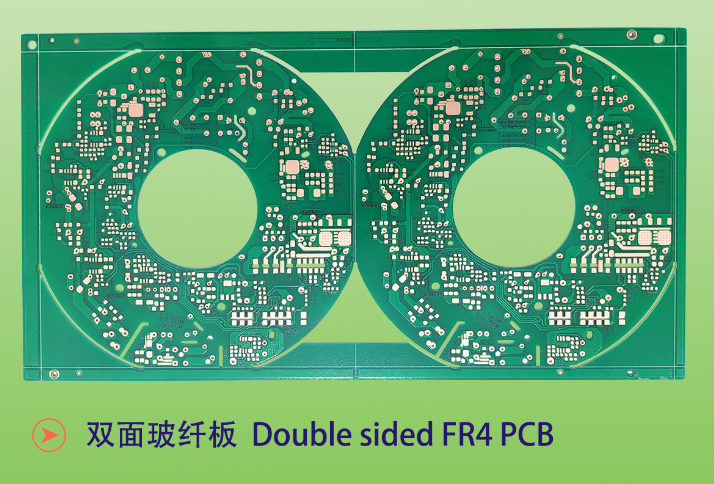
Double sided FR-4 LED PCB: 1/1 oz copper, 1.6 mm ±10% overall thickness, 208.00 mm × 225.00 mm panel at 2 up. Image: WODE Circuit Technology.
Reading copper foil thickness and overall thickness
Copper weight is where the six constructions diverge fastest. The single-sided rigid family spans 0.5 OZ, 0.75 OZ, 1 OZ, 2 OZ and 3 OZ — a five-step range that covers both low-cost Single Layer LED PCB volume and heavier current-carrying layouts for outdoor fixtures. The flexible families are narrower: 1/1 oz or 1 oz for COB FPC and LED strip FPC, 1 oz for the Roll to Roll Infinity FPCB, and 0.5 oz on the single-sided LED tube FPC.
That narrowing is not a limitation of capability so much as a statement about process window. Once a buyer adopts a 0.5 oz tube FPC for a linear Strip Light LED PCB format, asking for 2 oz on the same substrate is not a price negotiation — it is a different product.
Overall thickness separates the matrix into two worlds. Rigid constructions sit between 0.6 mm and 2.0 mm, with the double-sided FR-4 fixed at 1.6 mm ±10%. Flexible constructions sit between 0.08 mm and 0.15 mm: the Ultra Thin LED PCB requirement in tube and strip formats is met by 0.08 mm and 0.115 mm polyimide, and the roll-to-roll format at 0.15 mm. When a specification mixes a rigid thickness tolerance with a flexible form factor, the tolerance is usually the part that was copied from the wrong drawing.
Panel format, ups count and the 2,000 mm ceiling
Panel geometry drives unit cost more than any other single line in the RFQ. The single-sided rigid family is length-limited rather than panel-limited: the maximum length is 2,000 mm, which matters for linear indoor fixtures and for Street Light LED PCB and High Bay Light LED PCB bodies where board length approaches the housing length.
The flexible families carry explicit ups counts. The LED tube FPC uses a 1,239.50 mm × 255.00 mm panel at 39 up — the highest utilisation in the set — while the COB FPC and strip FPC run a 366.00 mm × 250.00 mm panel at 1 up, and the Roll to Roll Infinity FPCB runs 1,000.00 mm × 124.00 mm at 13 up. The double-sided FR-4 runs 208.00 mm × 225.00 mm at 2 up.
A 39-up panel and a 1-up panel are quoted on different economics. Comparing square-metre prices across those two formats without normalising for ups count and scrap allowance is a frequent source of apparent 'price differences' that disappear once tooling and panel utilisation are modelled.
Certification matrix: what each certificate actually covers
Certification is the constraint category most likely to derail an otherwise settled LED PCB decision. The table below reproduces the certificate numbers, issuing bodies and stated scopes held by WODE Circuit Technology (Zhuhai) Co., Ltd.
| Certificate | Number | Body | Stated scope | Validity |
|---|---|---|---|---|
| ISO 9001:2015 | 51325Q4258ROM | Shenzhen Meiao Testing and Certification Co., Ltd | Production of circuit boards (IAF Code 19) | 2025-10-13 to 2028-10-12 |
| ISO 14001:2015 | 51325E2142ROM | Shenzhen Meiao Testing and Certification Co., Ltd | Environmental management activities related to circuit board production | 2025-10-13 to 2028-10-12 |
| IATF 16949 | 0584371 | NQA Certification Limited | Human resources, purchasing, strategic planning for automotive printed circuit board manufacturing; support site Guangdong Kunxiang New Material Group Co., Ltd. | 2025-09-27 to 2028-09-26 |
| UL 796 — rigid PCB | E323980 | UL Solution | Single layer metal base printed wiring board (WD-14, WD-15, WD-16, WD-17); single layer rigid printed wiring board (RXD-11, WD-12, WD-13, RXD-10) | Issued 2022-01-01 |
| UL 796F — flexible PCB | E498836 | UL Solution | Single layer FMIC flexible printed circuit, model WD-F1, WD-F2 (ASP1); tested to UL 796F and IPC-TM-650 2.6.27 | Issued 2022-01-01 |
| CQC product certification | CQC22001367683 | China Quality Certification Centre | Printed circuit board, four substrate types (22F CEM1 5152, CEM-1, FR-4 GF211, FR-4 KB6160), thickness 0.2–3.2 mm, V-0 flammability, GB 4943.1-2022 | 2026-01-13 to 2027-11-16 |
| REACH SVHC test report | DGC251204025BD03 | NSTL | Double sided aluminium-based board; EU REACH Regulation (EC) No 1907/2006, ECHA SVHC candidate list | Report dated 2025-12-10 |
The rigid/flexible split inside UL
LED PCB buyers frequently request 'UL' as a single line item. The evidence here is two separate recognitions under two standards: UL 796 for rigid printed wiring boards (E323980) and UL 796F for flexible printed circuit material (E498836). A CEM-1 or FR-4 rigid board and a polyimide COB FPC are therefore not covered by the same document, and a purchase order that names one certificate number for both should be corrected before signature.
Model lists and thickness windows
UL recognition lists specific models and structures. The rigid recognition names WD-14 through WD-17 and RXD-10 through RXD-13; the flexible recognition names WD-F1 and WD-F2. The CQC certificate is bounded differently — four substrate types at 0.2–3.2 mm thickness, V-0 flammability. When a design falls outside a listed model or thickness window, the certificate is still valid but it is not evidence for that design, and a buyer should request either a covered equivalent or a project-specific declaration.
What the REACH report covers, and what it does not
The REACH report DGC251204025BD03 was issued for a double sided aluminium-based board with tin spray, tested against the ECHA SVHC candidate list. It is a point-in-time test of a submitted sample, not a rolling declaration across the catalogue. A buyer sourcing an FR-4 board or a polyimide FPC should ask for the corresponding report for that construction rather than referencing this number.
Purchasing terms and acceptance criteria
Commercial terms narrow the matrix further. On the WODE capability record, the MOQ for a mass order is 100 m², while sample quantity is stated as unlimited — relevant when a lighting OEM wants to validate a High Thermal Conductivity LED PCB layout before committing to a panel run. Lead time is quoted at 7–25 days depending on order quantity and design complexity, against a monthly capacity of 600,000 m².
Customisation under OEM/ODM covers layer count, substrate, surface finish (ENIG, OSP, HASL, HASL-LF and others), impedance control, and routing, slotting or cutting. Quality control is described as continuous improvement covering incoming, process and final inspection plus electrical function testing; the capability record notes that specific inspection equipment and acceptance criteria — AOI, X-ray and similar — should be specified for the project rather than assumed.
- Fix the acceptance criteria before the quotation. Layer count, substrate grade, copper weight and overall thickness tolerance belong in the RFQ; 'FR-4, 1.6 mm' alone leaves the copper weight and finish open.
- Name the certificate per construction. State whether the part requires UL 796 coverage, UL 796F coverage or CQC coverage, and confirm the model or substrate falls inside the listed scope.
- Specify panel format and ups count. A 39-up tube panel and a 1-up COB panel are not interchangeable quotations.
- Request the inspection method. Electrical function testing is stated as standard; AOI and X-ray coverage should be confirmed in writing if the design requires it.
Matching the matrix to lighting formats
The matrix does not assign a board type to a luminaire — that follows from thermal simulation and mechanical design. It does define what must be locked in the RFQ for each format, which is where most specification drift occurs.
| Lighting format | What the matrix asks you to lock |
|---|---|
| Street Light LED PCB, Flood Light LED PCB, High Bay Light LED PCB | Layer configuration, copper weight up to 3 OZ on single-sided rigid, board length within the 2,000 mm limit, UL 796 model coverage, CQC substrate and thickness window |
| Panel Light LED PCB, Downlight LED PCB, Spotlight LED PCB, Bulb Lamp LED PCB, Wall Lamp LED PCB | Single-sided CEM-1/CEM-3/FR-4 at 0.6–2.0 mm, surface finish selection between OSP, HASL, lead-free HASL and ENIG, panel utilisation |
| Strip Light LED PCB, LED tube formats | Polyimide FPC at 0.115 mm (strip) or 0.08 mm (tube), 1/1 oz or 1 oz versus 0.5 oz copper, white coverlay, ups count |
| COB LED modules | COB FPC at 0.115 mm, 366.00 mm × 250.00 mm panel at 1 up, white coverlay, OSP |
| Continuous linear and roll-to-roll assembly | Roll to Roll Infinity FPCB at 0.15 mm, 1 oz copper, 1,000.00 mm × 124.00 mm panel at 13 up, UL 796F coverage |
| Grow Light LED PCB, indoor and outdoor custom formats | Operating envelope and finish first, then OEM/ODM customisation of substrate, layer count and routing |
Operating envelope belongs in the same conversation. Lighting specifications commonly place indoor formats at 0 °C to +40 °C with moderate humidity, and outdoor formats at –40 °C to +50 °C with humidity, salt spray and UV exposure — a difference that pushes Outdoor Lighting LED PCB selection toward heavier copper and thicker rigid substrates rather than thinner ones.
Where this matrix stops
A comparison table is only useful if its boundaries are visible.
- No harmonised thermal benchmark exists here. The published aluminium-core range of 1–3 W/m·K and supplier-reported dielectric ranges of 1.0–8.0 W/m·K cannot be ranked or averaged, because test methods and dielectric definitions are not disclosed. Any thermal comparison across suppliers should be built on sample testing, not on catalogue numbers.
- Certificates do not transfer across constructions. The UL rigid recognition covers listed rigid models; the CQC scope covers four named substrates between 0.2 mm and 3.2 mm; the REACH report covers a double sided aluminium-based board. None of these can be cited for a part outside its scope.
- Inspection detail is project-specific. The capability record states that inspection equipment and criteria should be specified per project; it does not assert a default AOI or X-ray regime for every order.
- No verified LED PCB market size or price band was used. PCB-level market figures describe the whole category; LED-specific sizing and comparable unit pricing were not available for this review, so no cost conclusion is drawn.
- Application mapping is a decision framework, not a supplier recommendation. The format table lists the parameters each format forces into the RFQ; it does not state that one construction is correct for a given luminaire.
Outlook: comparison discipline as a procurement asset
As the PCB category expands toward the projected USD 130.3 billion by 2033, the pressure on LED PCB sourcing is less about finding suppliers than about keeping specifications comparable across them. Two trends follow from the matrix above.
First, certificate scope is becoming a line item rather than a checkbox. Buyers who record the exact certificate number, model list and thickness window next to each part number will resolve qualification disputes in days rather than quarters. Second, flexible and roll-to-roll formats are moving from speciality to standard in linear lighting, which makes panel utilisation and ups count — not square-metre price — the real cost variable. Suppliers with in-house CCL production and a documented Infinity Length FPCB line are positioned differently from assemblers buying laminate on the spot market.
The practical defence for a lighting OEM in either case is the same: a matrix that states substrate, layers, copper weight, thickness, panel format and certificate scope for every construction quoted, so that the comparison survives the first change order.
Frequently asked questions
What copper foil thicknesses are available across these LED PCB constructions?
Single-sided rigid boards (CEM-1, CEM-3, FR-4) are offered at 0.5 OZ, 0.75 OZ, 1 OZ, 2 OZ and 3 OZ. The COB FPC and LED strip FPC use 1/1 oz or 1 oz, the Roll to Roll Infinity FPCB uses 1 oz, and the single-sided LED tube FPC uses 0.5 oz. Copper weight is therefore a differentiating parameter on rigid boards and a narrower one on flexible boards.
Does one UL certificate cover both rigid and flexible LED PCBs?
No. Two separate recognitions are held: UL 796 (certificate E323980) for single layer metal base and single layer rigid printed wiring boards, listing models WD-14 to WD-17 and RXD-10 to RXD-13; and UL 796F (certificate E498836) for single layer FMIC flexible printed circuit, models WD-F1 and WD-F2, tested to UL 796F and IPC-TM-650 2.6.27.
Which substrates and thicknesses fall inside the CQC certificate?
Certificate CQC22001367683, issued by the China Quality Certification Centre against GB 4943.1-2022, covers printed circuit boards on four substrate types — 22F CEM1 5152, CEM-1, FR-4 GF211 and FR-4 KB6160 — at thicknesses from 0.2 mm to 3.2 mm, with V-0 flammability.
What are the minimum order quantity and lead time?
The mass-order MOQ is 100 m², while sample quantity is stated as unlimited. Lead time is 7–25 days depending on order quantity and design complexity, against a monthly capacity of 600,000 m².
How much does overall thickness vary between rigid and flexible options?
Rigid constructions run from 0.6 mm to 2.0 mm overall, with the double-sided FR-4 fixed at 1.6 mm ±10%. Flexible polyimide constructions range from 0.08 mm (single-sided LED tube FPC) through 0.115 mm (COB FPC and LED strip FPC) to 0.15 mm (Roll to Roll Infinity FPCB).
Product parameters and certificate details referenced above are as published by WODE Circuit Technology (Zhuhai) Co., Ltd. Market size figures are from Grand View Research, printed circuit board market report, 2026–2033. Thermal conductivity ranges are supplier-reported (EIN Presswire; AtlasPCB; HilPCB; PCBAET) and are not harmonised for comparison.
A full product and capability overview is available in the WODE brochure. Company details: www.wodepcbfpc.com.
¿Tiene preguntas o necesita más detalles?
Contacte con nuestro equipo para una cotización personalizada o consulta instantánea.
Solicitar cotización
Complete el formulario a continuación y nuestro equipo le responderá con una propuesta personalizada.
Chat directo de WhatsApp
¿Prefiere chatear en tiempo real? Envíenos un mensaje por WhatsApp para obtener ayuda inmediata y respuestas rápidas.
- Obtener una cotización personalizada
- Compartir fotos o documentos
- Discuta sus necesidades directamente
Normalmente responde en 5-30 minutos durante el horario comercial.