
LED Outdoor Lighting: A 2026 Product-Type Primer for Buyers
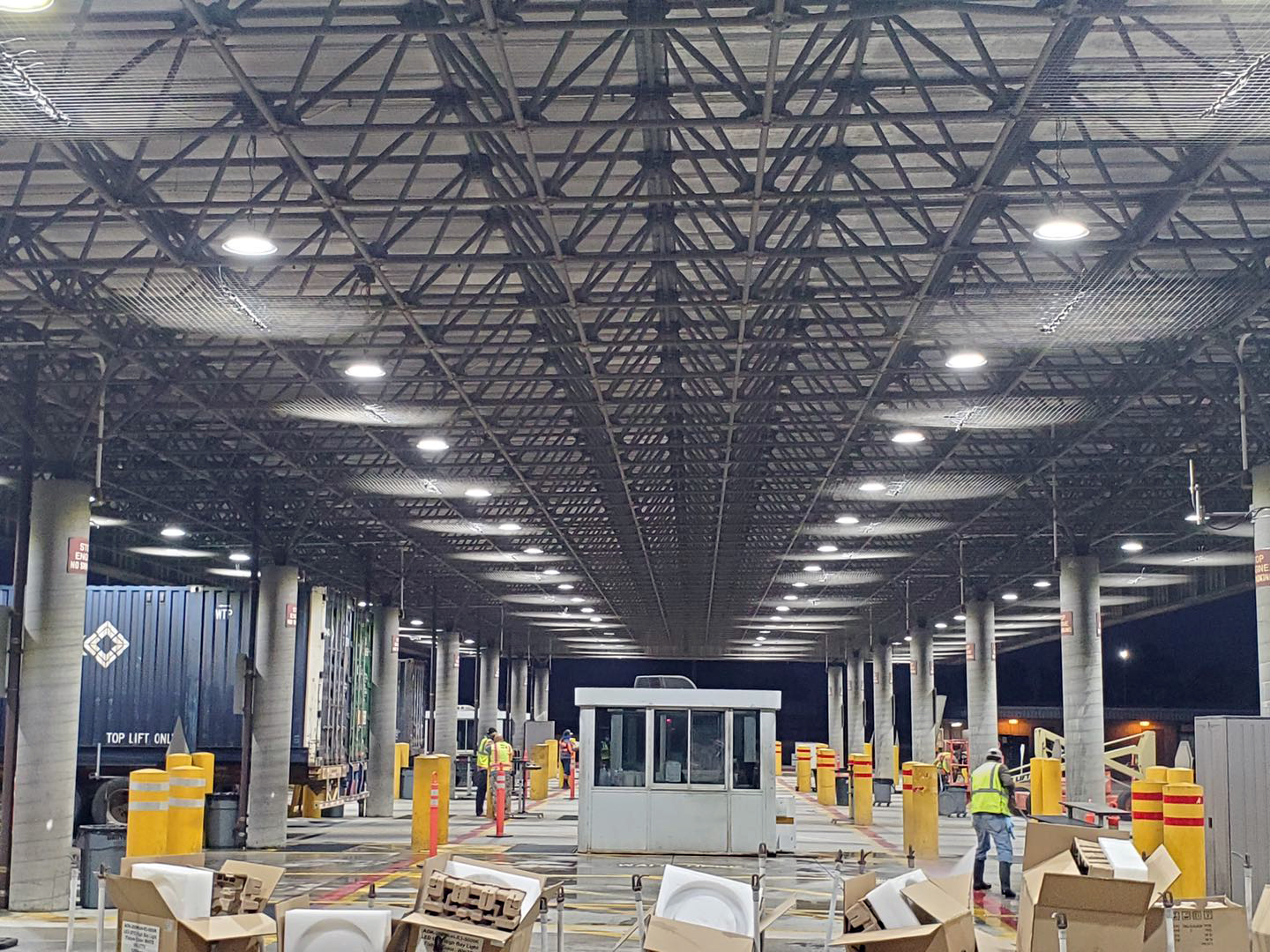
Railway station platform lighting is one of the public facility applications where LED outdoor luminaires operate at night. Photo: AOK
LED outdoor lighting is not a single product category. It is a family of luminaires engineered for different outdoor tasks, from roadway illumination and parking lots to stadiums, seaports and solar-powered infrastructure. For buyers at the awareness and research stage, the immediate challenge is not evaluating one fixture but learning to compare product types, performance metrics and site requirements quickly and accurately.
The size of the sector explains why this early stage matters. The global outdoor LED lighting market was estimated at USD 14.20 billion in 2024 and is projected to grow significantly by 2032, according to Grand View Research. Stadium lighting was valued at USD 768 million in 2024, with a projected CAGR of 7.73% through 2032, according to Persistence Market Research. The solar street lighting market was estimated at roughly USD 5 billion to USD 6.29 billion in 2024, according to Global Market Insights and Fortune Business Insights. Buyers entering this market will therefore encounter products with different energy sources, optics, certifications and price structures.
Why the First Stage of LED Outdoor Lighting Research Is Difficult
The first obstacle is product language. A buyer searching for LED outdoor lighting may see street light models described with Type II, III or IV distributions, area lights with T2 to T5 distribution patterns, stadium lights with beam angles such as 15 degrees or asymmetric optical options, and solar lights with battery chemistry and controller specifications. These terms are not interchangeable. They describe how a luminaire places light on a road, parking lot, sports field or port terminal.
The opportunity is that once a buyer understands the product map, the rest of supplier evaluation becomes more structured. Instead of comparing individual fixtures randomly, a buyer can first define the product family, then evaluate the technical parameters and finally check application evidence. This approach reduces the risk of choosing a product that performs well on paper but is not suited to the actual operating environment.
A Product-First View: What a Full Outdoor Lighting Lineup Looks Like
AOK Industrial Company Limited, a Shenzhen-based lighting manufacturer founded in 2012, provides a useful reference for mapping the product landscape. The company operates a 20,000 m² manufacturing facility in Shenzhen, employs approximately 200 staff including an R&D team of 30 engineers, and reports an annual production capacity of 600,000 units. Export business accounts for 100% of total sales, with major markets in the EU, USA, Middle East and Asia. AOK has served customers in over 100 countries, completed more than 10,000 projects and installed more than one million units.
AOK's catalogue spans LED street lights, solar street lights, area lights, flood lights, stadium lights, high mast lights and industrial high bay lights. The company states a long-term strategic partnership with Philips Lumileds and Osram, and holds certifications including ISO9001, ISO14001, UL, TUV and RoHS. For a buyer in the awareness stage, this kind of product breadth matters because it indicates that a supplier is not limited to a single application.
LED Outdoor Lighting Product Families and What Each One Does
The following table summarizes the main product families found in AOK's outdoor lighting range. The specifications are taken from the company's own product data and should be treated as representative starting points for buyer research.
| Product family | Representative models | Documented specification examples |
|---|---|---|
| Street and roadway lighting | ILA, ILE, ILG | ILA: up to 190 lm/W, IP66/IK09, T2/T3/T4 distribution. ILE: up to 165 lm/W, IP66/IK08. ILG: up to 195 lm/W, IP66/IK10. |
| Area and parking lot lighting | OT, PLB | OT: 30,130 to 37,720 lumens, IP66/IK10, T2 to T5 distribution. PLB: up to 160 lm/W, IP66/IK10, UL, DLC5.1 and FCC certification. |
| Flood lighting | FLC | Up to 200 lm/W, IP66/IK08, 0-10V dimming down to 10%, multiple distribution options. |
| High mast lighting | HMA | Up to 56,000 lumens, IP66/IK09 with tempered glass, Type III and Type V distribution, EN AC-46100 die-cast aluminum housing. |
| Sports and stadium lighting | ISF, FSC, INS | ISF: up to 150 lm/W, IP66/IK08, optional TLCI>95 and GR<30/40. FSC: up to 185 lm/W, IP66/IK10. INS: 315W to 720W, up to 170 lm/W. |
| Solar street lighting | SD, SAA, SLB, SL | SD: up to 210 lm/W, IP65, 25.6V/30Ah Li-ion battery, MPPT controller with IoT support. SAA and SLB: up to 200 lm/W. SL: 16,700 to 16,800 lumens. |
| Industrial high bay | HBE | 100W/150W/200W tunable high bay, up to 170, 185 or 200 lm/W options, UL/cUL/RoHS/CE/CB/TUV certification. |
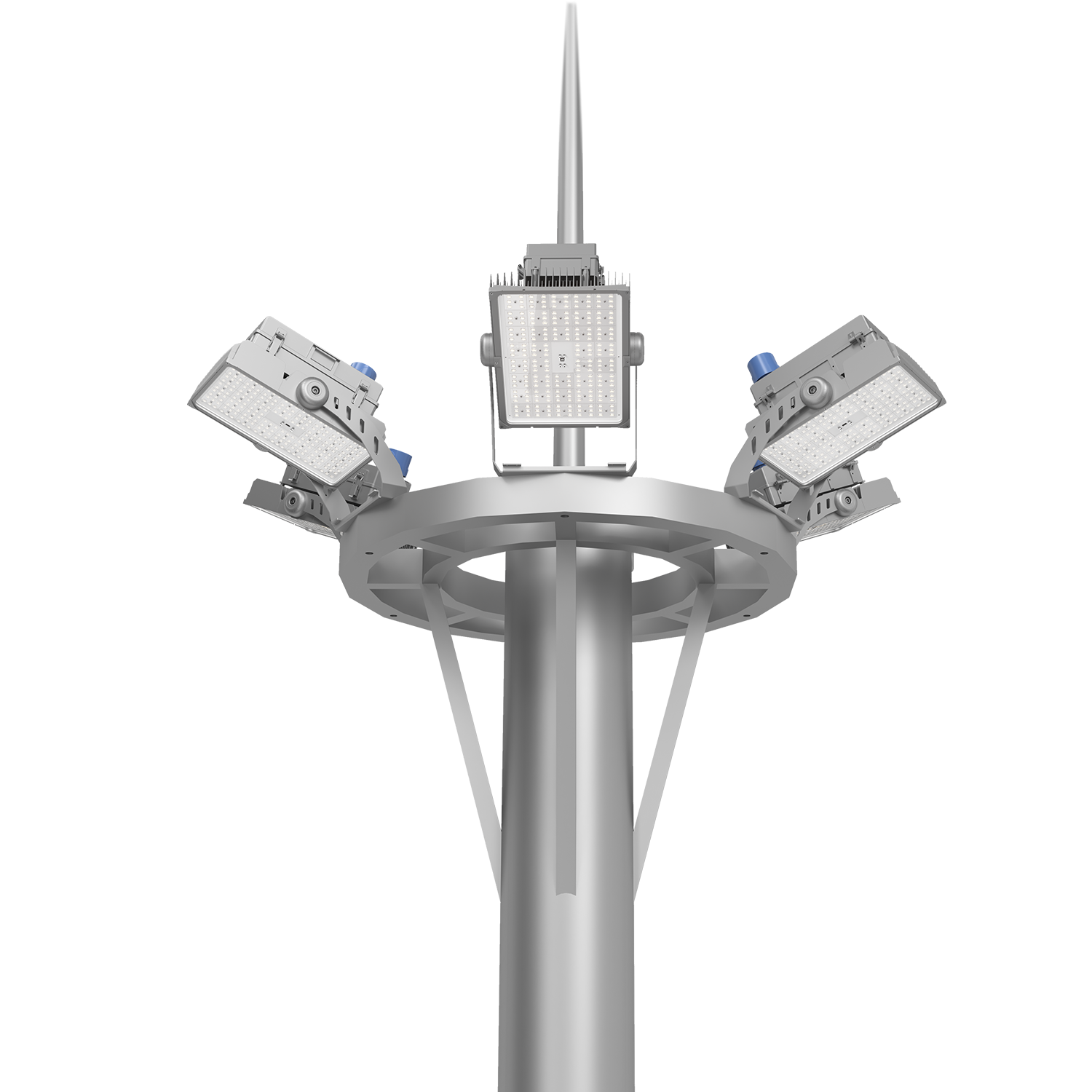
High mast LED luminaires are commonly used in seaport and large-area outdoor infrastructure projects. Photo: AOK
Key Technical Parameters Buyers Should Recognize Early
Product specifications become easier to compare when a buyer understands four categories: efficiency, protection, optical distribution, and light quality or control.
Efficacy and lumen output
Luminous efficacy measures visible light output in lumens per watt. Higher efficacy means more useful light for the same electrical power. In AOK's range, efficacy figures start around 150 lm/W for the ISF stadium light and rise to 210 lm/W for the SD all-in-one solar street light. Lumen output, meanwhile, describes the total light emitted. The HMA high mast light, for example, reaches up to 56,000 lumens, which is relevant for large areas such as ports and airport aprons.
IP and IK ratings
IP ratings describe ingress protection against dust and water. IP66, as defined in EN 60529, means a luminaire is dust-tight and protected against powerful water jets. IK ratings describe impact protection under EN 62262. The PLB area light is rated IK10, while the HMA high mast light is rated IK09 and the ILA street light is rated IK09. These ratings are particularly important for sites with heavy equipment, weather exposure or vibration.
Optical distribution
Light distribution determines how the beam is shaped. Roadway luminaires often use Type II, Type III or Type IV distributions, while area lights use T2, T3, T4 and T5 patterns. Stadium lights use symmetric or asymmetric beam angles such as 15 degrees, 30 degrees or wide PG patterns. Buyers should not assume that a high-wattage fixture is automatically suitable for all mounting heights; distribution must match the site geometry.
Color, control and housing
Many AOK outdoor luminaires offer color temperatures from 2700K to 6500K and color rendering index options of Ra70 or Ra80. Control options include DALI, DALI-2, DMX512, 0-10V dimming, PWM, photocell, Zigbee, Zhaga, NEMA and Lora. Housing materials are also specified: several AOK models use heavy-duty die-cast aluminum EN AC-46100, and some include tempered glass for added impact protection. Most grid-powered outdoor luminaires carry a 5-year standard warranty with a 10-year optional extension, while solar models typically offer 3 years standard and 5 years optional.
Application Scenarios and What They Demand
Application records from AOK show how the same product family is adapted to different operating conditions. The table below summarizes documented examples across countries and site types.
| Site type | Country / region | Typical luminaire | Operating requirement |
|---|---|---|---|
| Equestrian center | United States | LED High Bay Light (HBE) | Sports fields lighting system; IP66 dust and water resistance; circuit protection SPD; UV-resistant powder coating |
| Industrial warehouse | Germany | LED High Bay Light (HBE) | Industrial lighting system; night-time illumination; IP66; SPD; UV-resistant finish |
| Football field | Germany | ISF, FSC, FLC | Outdoor sports lighting; DMX smart lighting control; IP66; SPD; UV-resistant finish |
| Baseball sports field | United States | ISF, FSC | Outdoor stadium lighting; DMX smart control; night-time operation |
| Tennis court | Australia | OT, PLB, FLC | Outdoor tennis lighting; 3G shockproof; IP66; SPD; UV-resistant finish |
| Seaport operation | United Arab Emirates | HMA, FLC | Sea port operation lighting; night-time illumination; IP66; SPD; UV-resistant finish |
| Seaport roadway | United Arab Emirates | SLB, SAA, SL solar street lights | Outdoor roadway and public facility illumination; night-time operation; smart control compatibility |
| Solar street lighting | Thailand | SLB, SAA, SL | Outdoor roadway lighting; smart control compatible with Zhaga, Nema or Lora |
| Auto dealership parking lot | United States | OT, PLB | Night-time parking lot illumination; IP66; SPD; UV-resistant finish |
| Railway station | United States | LED High Bay Light (HBE) | Railway platform lighting; smart lighting control compatible with PIR/MV |
Several requirements appear repeatedly across these records: IP66 ingress protection, circuit protection SPD, UV-resistant powder coating, and in many sports and industrial cases, 3G shockproof construction. These are not marketing phrases. They reflect the operating conditions in ports, sports fields, railway platforms and outdoor industrial facilities.
Market Context for Buyers Entering the Market in 2026
Three verified signals can guide first-stage decisions. First, efficiency is becoming a strong differentiator. AOK's FLC flood light reaches up to 200 lm/W and the SD all-in-one solar street light reaches up to 210 lm/W. Second, solar lighting is no longer a niche. The solar street lighting market was estimated at approximately USD 5 billion to USD 6.29 billion in 2024, and AOK's solar product line includes highway, plug-and-play and mega power variants with MPPT, PWM or IoT control options. Third, certification creates a common language. In North America, outdoor luminaires are typically evaluated under UL 1598. Globally, IEC 60598-2-3 addresses luminaires for road and street lighting, and ANSI/IES RP-8-21 is the primary recommended practice for roadway and parking facility lighting design in the United States.
LED Outdoor Lighting vs. Conventional Outdoor Lighting: What Buyers Should Balance
Modern LED outdoor lighting is usually compared with high-pressure sodium or metal halide systems. LED luminaires offer advantages that are widely recognized: immediate light output, longer service life and better color control. A luminaire such as AOK's ILA street light, with up to 190 lm/W and IP66/IK09 protection, illustrates the performance level buyers can expect from current generation products.
However, replacing conventional lighting is not always a drop-in upgrade. Four boundaries should be part of any balanced evaluation. First, photometric compatibility: a replacement LED luminaire must match the mounting height, pole spacing and road classification of the original design. High efficacy alone does not guarantee uniform illuminance. Second, energy source dependency: solar LED street lights require sufficient solar irradiance and correctly sized battery capacity. Sites with long cloudy seasons or heavy shading may not achieve the same availability as grid-powered lighting. Third, control infrastructure: DALI, DMX512, 0-10V, Zhaga, NEMA and Lora options are useful only when the site has compatible control systems or is willing to install them. Fourth, budget structure: LED outdoor lighting generally has a higher upfront cost than conventional lamps, with payback depending on operating hours, energy prices and maintenance schedules.
These boundaries do not reduce the value of LED lighting. They define where each product type works best and help buyers avoid the common mistake of choosing a fixture solely by wattage.
Future Outlook
Looking ahead, product families are likely to continue converging. Street lights already share control platforms with area lights; high mast luminaires are specified for seaports and airports; and stadium lights now include broadcast-grade color quality. AOK's ongoing investment in solar R&D, combined with its stated partnership with Philips Lumileds and Osram, reflects a broader shift toward higher efficiency, connected controls and renewable energy integration.
For buyers, the practical implication is that early decisions should include control compatibility and service planning, not just initial fixture price. A product that is efficient today but difficult to integrate into a future smart lighting network may create unnecessary long-term cost.
For buyers moving from product awareness to supplier evaluation, AOK Industrial Company Limited provides a downloadable company brochure with factory and product information:
Frequently Asked Questions
What are the main types of LED outdoor lighting?
LED outdoor lighting can be divided into street and roadway lighting, area lighting, flood lighting, high mast lighting, sports and stadium lighting, and solar street lighting. Industrial high bay luminaires are also used in large covered or semi-enclosed spaces such as railway platforms, warehouses and equestrian centers.
What do IP and IK ratings mean in LED outdoor lighting?
IP stands for ingress protection. IP66 means a luminaire is dust-tight and protected against powerful water jets, as defined in EN 60529. IK stands for impact protection. IK08, IK09 and IK10 indicate increasing resistance to mechanical impact under EN 62262. For example, the AOK ILA street light is rated IP66/IK09, while the PLB area light is rated IP66/IK10.
What is luminous efficacy and why does it matter?
Luminous efficacy measures visible light output in lumens per watt. Higher efficacy means more light for the same electrical power. In AOK's outdoor product family, documented values range from 150 lm/W for the ISF stadium light to 210 lm/W for the SD all-in-one solar street light.
Which LED outdoor luminaires are used for sports fields?
Sports fields typically use stadium or flood luminaires with controlled beam distributions and low glare. AOK offers the ISF, FSC and INS series. The ISF supports optional TLCI>95 and GR<30/40 for HDTV broadcast applications, while the FSC includes glare control, dimming, DALI and DMX512 support.
What is the difference between solar street lights and grid-powered LED street lights?
Grid-powered LED street lights connect to the electrical grid and generally operate continuously regardless of sunlight. Solar street lights combine LED luminaires with monocrystalline solar panels and Li-ion batteries, using MPPT or PWM controllers. AOK's solar models are rated IP65, while its grid-powered street lights carry IP66 and IK ratings. Solar systems are suitable for sites where grid connection is expensive or unavailable.
What certifications should outdoor LED lighting have?
Certifications depend on the target market. For North America, outdoor luminaires are commonly evaluated under UL 1598. AOK's PLB and OT area lights carry UL, DLC5.1, FCC and other certifications. For Europe, CE, ENEC, RoHS and standards such as IEC 60598-2-3 for road lighting are relevant. AOK also holds ISO9001 and ISO14001 for its operations.
How long are LED outdoor lighting products warranted?
Most of AOK's grid-powered outdoor luminaires come with a 5-year standard warranty and an optional 10-year warranty. Solar street lighting models, such as the SL and SD series, typically offer a 3-year standard warranty with a 5-year optional extension.
¿Tiene preguntas o necesita más detalles?
Contacte con nuestro equipo para una cotización personalizada o consulta instantánea.
Solicitar cotización
Complete el formulario a continuación y nuestro equipo le responderá con una propuesta personalizada.
Chat directo de WhatsApp
¿Prefiere chatear en tiempo real? Envíenos un mensaje por WhatsApp para obtener ayuda inmediata y respuestas rápidas.
- Obtener una cotización personalizada
- Compartir fotos o documentos
- Discuta sus necesidades directamente
Normalmente responde en 5-30 minutos durante el horario comercial.