
LED High Bay Buyer FAQ: Lumens, Wattage, Lifespan Explained
High bay lighting is normally specified with three numbers — wattage, luminous efficacy and beam distribution — and purchased against a fourth: price. The questions that decide whether the installation actually performs usually arrive later. How is the fixture mounted? What does service life depend on? And where does the published specification stop, requiring a direct conversation with the supplier before the order is placed?
This reference answers the technical questions that contractors, distributors, electrical wholesalers and facility buyers raise most often about commercial LED high bay lighting. The answers are built on the published parameters of two high bay families from Zhejiang Lepeng Electric Appliance Co.,Ltd.: the HL-E01 UFO high bay and the SH-E01 linear high bay.
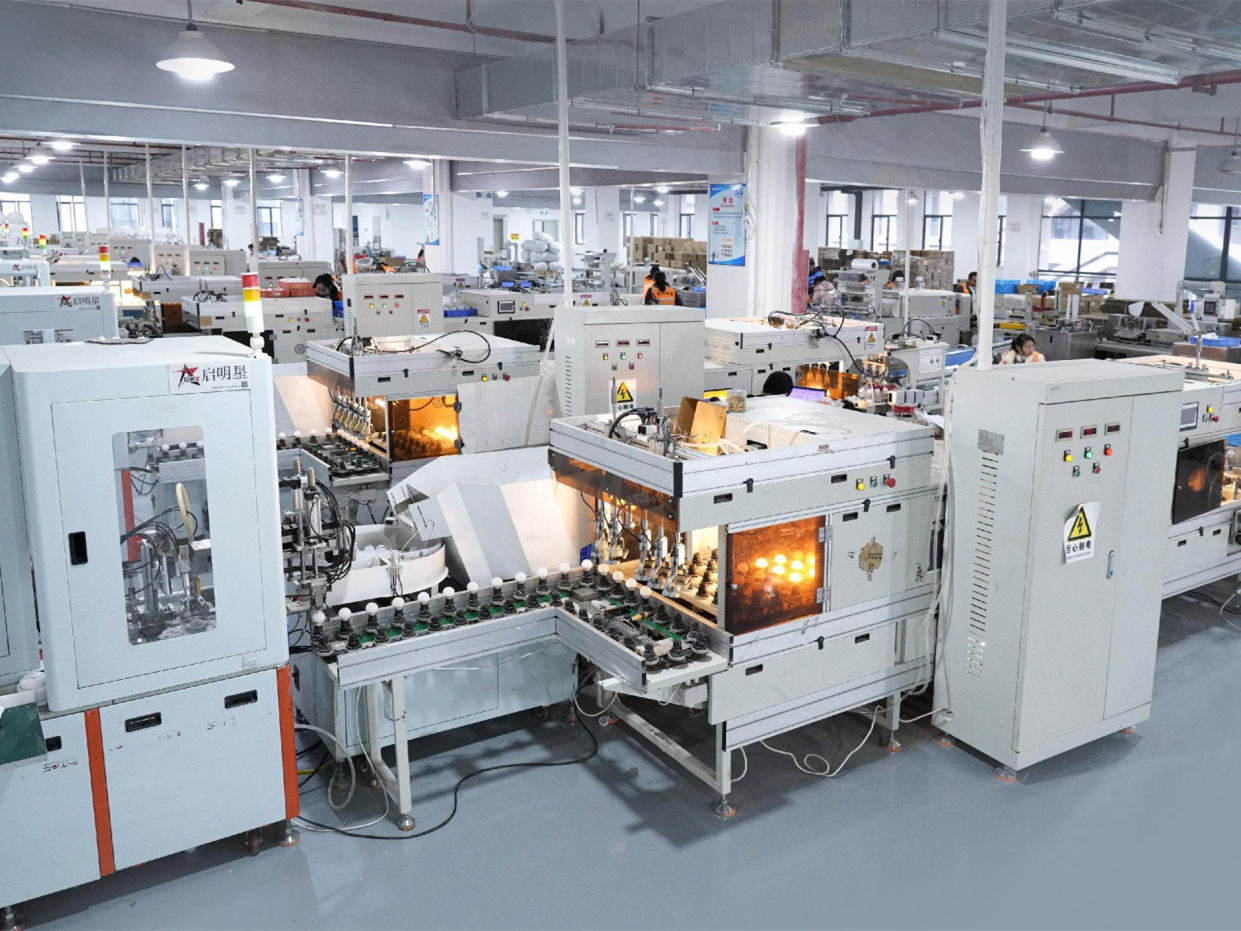
Zhejiang Lepeng Electric Appliance Co.,Ltd. is an LED lamp and luminaire manufacturer founded in 2009 and headquartered in the Baiguan Industrial Zone, Shangyu, Zhejiang, with additional production bases in Zhejiang and Jiangxi. The company operates a 200,000 m² factory footprint with 2,000 employees and a 200-person R&D team, and its catalogue covers LED floodlights, high bays, linear high bays, street lights, garden lights, stadium lights, solar flood and street lights, bulkheads, tri-proof lights, worklights, ceiling lights, ceiling fan lights, panels, battens, tubes, bulbs and mood lights. Exports represent approximately 90% of output, with the EU, Southeast Asia, the Middle East and Latin America as the main markets.
Why High Bay Specifications Get Read Incorrectly
Wattage is the number buyers see first and the number that most often leads a project in the wrong direction. Wattage describes power drawn, not light delivered. It says nothing about how much of that light reaches a rack face, a workshop floor or a loading dock, and nothing about how the fixture behaves after three years of continuous operation.
Two structural changes have made this gap more visible. First, efficacy across the market has moved far enough that two fixtures with the same wattage label can produce meaningfully different light output. Second, buyers are increasingly comparing a round, high-output fixture with a rectangular, lower-output fixture for the same space — a comparison that wattage cannot resolve at all.
For a procurement team, the practical consequence is that the specification review has to move earlier in the process. Ceiling height, mounting method, aisle geometry and the position of the electrical supply point determine which high bay format is even viable; the lumen package is then sized against those constraints rather than chosen first.
The Manufacturer Behind These Specifications
Zhejiang Lepeng Electric Appliance Co.,Ltd. provides both OEM (Original Equipment Manufacturer) and ODM (Original Design Manufacturer) production services for LED lighting products. OEM services cover contract manufacturing of a client's existing designs; ODM services cover design and manufacturing of products developed to a client's specification. Customization can extend to fixture appearance, power and accessories, with the details confirmed through direct product communication rather than through the catalogue.
Capacity and lead time are the two figures that matter most when a high bay specification moves toward execution. The company publishes a monthly capacity of 45 million LED lamps and 5 million LED luminaires, with a typical lead time of 30 to 45 days. Minimum order quantity varies by product; separate published purchasing terms list an MOQ of 100 units, FOB delivery terms, pre-shipment testing as the acceptance criterion, a 30% deposit and final payment against a copy of the bill of lading. After-sales support is provided remotely.
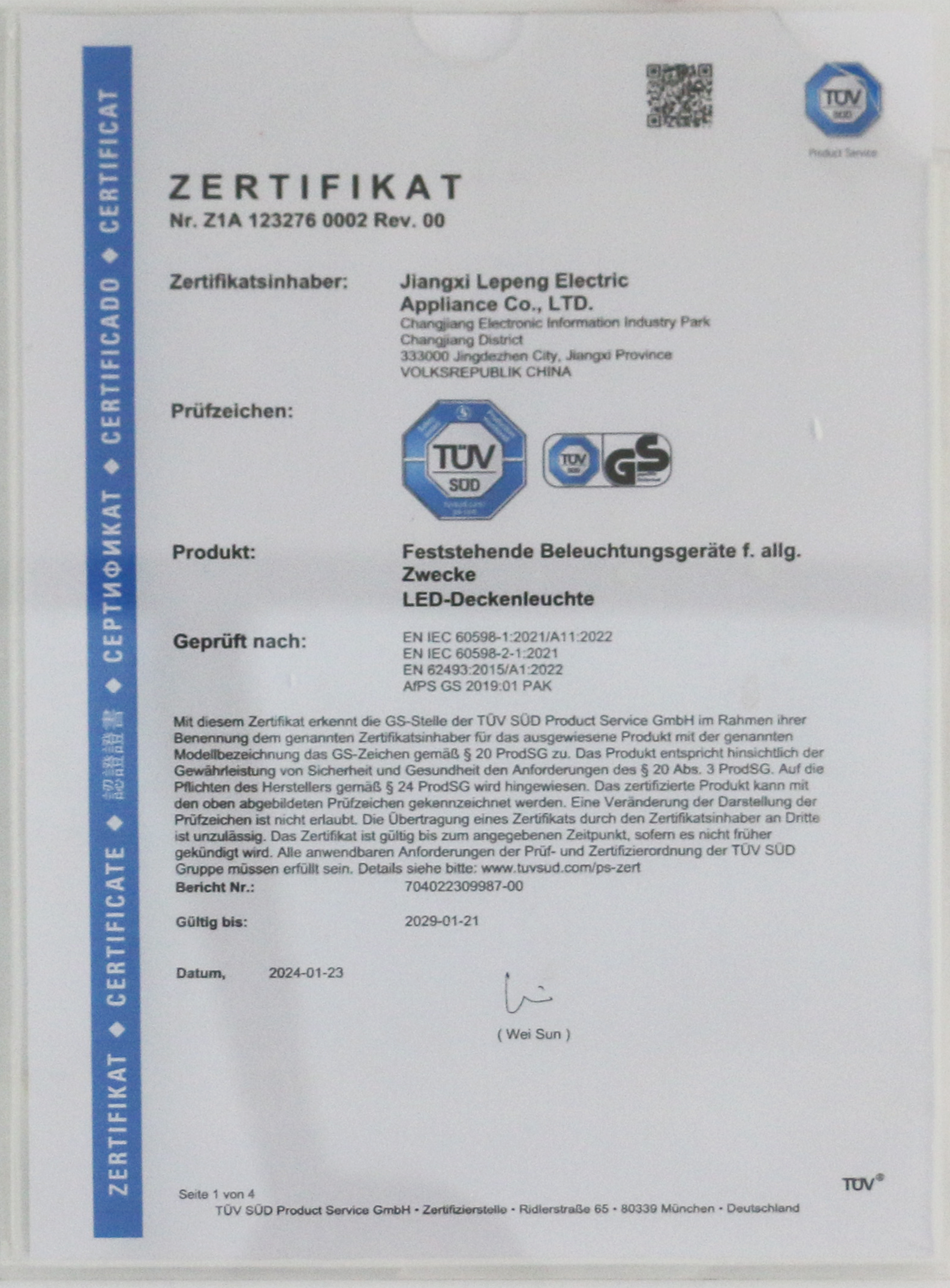
Compliance documentation is relevant to high bay projects specifically. A GS certificate issued by TUV SUD (certificate Z1A 123276 0002 Rev. 00, dated 23 January 2024) references EN 60598-1:2021+A11:2022, EN 60598-2-1:2021, EN 62493:2015 and AFPS GS 2019:01 PAK, and lists the SH-E01 LED linear high bay and the HL-E01 LED high bay among its related products. A separate CE-EMC Attestation of Conformity (E8A 123276 0630 Rev. 00, issued 7 November 2024, also by TUV SUD) covers fixed general purpose luminaires under the EMC Directive 2014/30/EU. Recognised luminaire standards that buyers commonly reference in tender documents include IEC 60598, UL 1598 and UL 8750, published by UL Solutions.
UFO or Linear: Comparing the Two High Bay Formats
The HL-E01 is a round UFO-format high bay built for warehouses, factories, retail spaces and gyms. The SH-E01 is a rectangular linear high bay built for warehouses, factories and workshops. The published parameters differ most clearly in efficacy band, protection rating and body geometry.
| Specification | HL-E01 — UFO high bay | SH-E01 — linear high bay |
|---|---|---|
| Power options | 100 W / 150 W / 200 W / 240 W | 50 W / 100 W / 150 W / 200 W |
| Luminous efficacy | 140 / 160 / 185 / 210 lm/W | 100 / 135 / 150 lm/W |
| Colour temperature | 4000 K / 5000 K / 6500 K | 3000 K / 4000 K / 5000 K / 6500 K |
| Housing and optics | Die-cast aluminium body + PC lens | Aluminium alloy housing + PC/PMMA lens |
| Typical application | Warehouses, factories, retail spaces, gyms | Warehouses, factories, workshops |
HL-E01 additional published parameters
- Voltage: 185–265 V or 100–265 V
- Surge protection: 6 kV / 6 kV
- Cable: 3 × 1.0 mm² cable with 300 mm exposed leads, pre-wired to the power supply
SH-E01 additional published parameters
- Beam angle: 90° (H) × 120° (V)
- Protection: IP65
- Warranty: 5 years
- Body dimensions: 305.6 × 97.3 × 68.1 mm / 580.6 × 97.3 × 68.1 mm / 855.6 × 97.3 × 68.1 mm
The two families overlap at the lower end of the UFO range and the upper end of the linear range — the region around 140–150 lm/W. That overlap is precisely why the choice between them rarely turns on efficacy alone, and more often on distribution pattern, ingress protection and mounting geometry.
Lumens, Wattage and Efficacy: How the Numbers Connect
Luminous efficacy is the only figure that allows two fixtures of different wattage to be compared directly. It expresses light output per watt of power drawn, so at an equal luminous efficacy, a higher-wattage fixture produces proportionally more light — and at an equal target light level, the lower-efficacy fixture must draw more power to reach it.
Applied to the two families: the HL-E01 range is published from 140 lm/W at its entry tier to 210 lm/W at its top published tier, across a 100–240 W power range. The SH-E01 range runs from 100 lm/W to 150 lm/W across 50–200 W. A buyer comparing the SH-E01 at its highest efficacy tier with the HL-E01 at its lowest tier is comparing two fixtures that sit at roughly the same efficiency, but at different wattage points and in different physical formats.
What this means in a specification review
- Do not treat wattage as a brightness specification. A wattage figure only becomes meaningful once paired with an efficacy figure and a beam distribution.
- Match the wattage band to the installation, not the reverse. The HL-E01's 240 W top of range suits spaces where a smaller fixture count is preferred; the SH-E01's 50 W entry point suits smaller bays, offices within industrial buildings, or areas where even coverage matters more than maximum output.
- Check voltage compatibility early. The HL-E01 is published with both 185–265 V and 100–265 V options; site supply characteristics should be confirmed against the exact variant being quoted.
- Treat the efficacy tier as a selectable, not a default. Both families publish multiple efficacy tiers, which means the quoted price can shift without any change to the wattage figure on the drawing.
Beam Spread: The Specification Most Layouts Get Wrong
Beam spread determines whether the calculated lumens land where the work happens. The SH-E01 publishes a 90° horizontal by 120° vertical distribution — a rectangular pattern that aligns naturally with aisle-and-racking geometry, where light needs to travel along a narrow corridor of racking rather than flooding a wide area.
The HL-E01's published parameter set covers power, efficacy, colour temperature, voltage, cable and surge protection, but does not include a beam angle figure. For projects where spacing and mounting height are being calculated rather than estimated, this is the point at which photometric data should be requested from the manufacturer before the layout is frozen. Treating an unverified beam assumption as a design input is the most common cause of a high bay installation that meets its lumen target on paper and underperforms on the floor.
Lifespan and Warranty: What the Data Supports
Service life in an LED high bay is not a property of the light source alone. It is the outcome of three interacting factors: the thermal path that carries heat away from the LED board, the driver arrangement that regulates current, and the electrical environment the fixture operates in.
On the first factor, both families use metal housings — die-cast aluminium with a PC lens on the HL-E01, aluminium alloy with a PC/PMMA lens on the SH-E01 — which is the standard approach for managing heat in high-output industrial fixtures.
On the second factor, the HL-E01 is supplied pre-wired to its power supply, so the driver is factory-integrated rather than field-fitted. This is an important procurement detail: an integrated driver arrangement changes the service model. Where a lamp-based system was once maintained by swapping lamps, an integrated LED fixture is serviced at driver or fixture level, which makes warranty terms and spare-part availability materially more important than they were in lamp-based generation.
On the third factor, the HL-E01 publishes 6 kV / 6 kV surge protection. In industrial environments, voltage transients are an underrated cause of early driver failure, and a surge rating is one of the few protective parameters a buyer can compare directly at quotation stage.
On documented life expectancy: the SH-E01 carries a published 5-year warranty. Lepeng's application records list operating durations of 5 to 10 years with stable operation for these fixture families across warehouse and factory lighting, road and community landscape lighting, construction site and emergency lighting, and residential and commercial applications.
Mounting Decisions: Direct Fixing or Suspension
Published installation guidance for high bay fixtures is consistent on the essentials: confirm the ceiling height and the required light level first, select the wattage and beam angle against those conditions, mount the fixture securely to the ceiling or to hanging brackets, then wire and power the fixture and verify coverage and brightness on site. The safety instructions are equally direct — isolate the power supply before wiring and installation, ensure stable mounting to avoid falling hazards, and comply with local electrical safety codes.
The mounting method itself is a site decision, and the two options carry different implications.
Direct surface or bracket fixing
Where the ceiling structure can carry the fixture directly and maintenance access is straightforward, fixing the fixture to the structure or to a bracket removes the need for chain hardware and keeps the light plane at a predictable height. This approach depends on the structure being able to accept the load at the required spacing.
Chain or bracket suspension
Where ceilings are high, obstructed by services, or where fixtures sit above racking, suspension allows the light plane to be set independently of the structure. Two product facts constrain how far a fixture can be suspended from an existing supply point. The HL-E01 is supplied with a 3 × 1.0 mm² cable and 300 mm of exposed leads, pre-wired to the power supply — which means a long suspension drop generally requires an intermediate junction point near the fixture rather than a single long cable run back to a distant box. The SH-E01's three body lengths (305.6 mm, 580.6 mm and 855.6 mm) allow fixture runs to be laid out against the geometry of the space, which is typically how linear high bays are positioned over aisles and process lines.
One further advantage of suspension in industrial settings is serviceability: a suspended fixture is easier to reach for inspection without scaffolding, which matters over a 5- to 10-year operating period.
Application Fit: Matching Format to the Space
The UFO format suits spaces where a small number of high-output points can cover a large open volume: general warehouses, factories with high clear ceilings, retail spaces and sports or gymnasium halls. The linear format suits spaces with a repeating structure — racking aisles, production lines, workshops — where the fixture should follow the geometry of the work rather than flood the whole volume.
Across the wider Lepeng portfolio, the same fixtures appear in mixed application sets: warehouse and factory lighting, road and community landscape lighting, construction site and emergency lighting, and residential and commercial installations. For a distributor or multi-project contractor, this breadth matters less as a product claim and more as a procurement shortcut — one qualified supply relationship can cover several lighting categories within a tender package.
Market Direction in Commercial LED Lighting
Category-level data supports the direction of travel. Fortune Business Insights estimates the global LED lighting market at USD 109.11 billion in 2025, projected to reach USD 336.90 billion by 2034. Grand View Research estimates the global commercial lighting market at USD 47.54 billion in 2024, with LED products holding a 58.1% revenue share of that segment.
Supply concentration remains a structural feature of the category. According to the Observatory of Economic Complexity, China exported USD 31.4 billion in light fixtures in 2024, equivalent to 59.3% of total global light fixture exports. For buyers, this concentration has a direct sourcing implication: the competitive question is rarely whether LED high bays can be sourced, but which suppliers can hold specification, certification and delivery consistency across repeated orders.
Within high bay specifically, the published parameter sets show where differentiation has moved. Efficacy bands across these two families already span 100 to 210 lm/W. Efficiency alone no longer separates products reliably; protection ratings, thermal design, surge handling, mounting geometry and documented compliance are now the variables that distinguish a specification that performs from one that merely satisfies a line item.
Compared with Traditional HID High Bays — and the Boundaries of These Two Families
Traditional high-intensity discharge high bays, including metal halide types, remain in service in many facilities and are still quoted in replacement projects. Compared with LED equivalents, they typically require a warm-up period to reach full output, cannot be switched instantly, and generally suffer a restrike delay if power is interrupted — a serious practical drawback in facilities where lighting is cycled by shift, by occupancy sensor or by generator transfer. Their light output also degrades over life while power consumption stays broadly constant, so the delivered efficacy of an ageing HID installation is lower than its rated figure.
Against that baseline, the LED families described here are straightforwardly better on switching behaviour, maintained output and controllability. That comparison, however, is not the boundary a buyer needs to understand.
Where the published specifications stop
- Within the available parameter sets, the SH-E01 carries a documented IP65 rating and a 5-year warranty. The HL-E01's published parameters include voltage options, 6 kV / 6 kV surge protection and pre-wired cabling, but do not include an IP rating or a stated warranty term. For wash-down areas, heavily dust-laden process zones or outdoor-adjacent canopies, this difference should be resolved with the supplier before the model is written into the specification.
- The HL-E01's published parameters do not include a beam angle. Layouts that depend on calculated spacing and mounting height need photometric data confirmed in writing rather than assumed from format.
- Higher efficacy does not automatically make the UFO format the correct choice. In aisle-based layouts, the SH-E01's documented 90° × 120° distribution can deliver more usable light on the task surface than a higher-efficacy round fixture with an undefined pattern.
- An integrated driver arrangement changes the maintenance model compared with lamp-based systems; spare-part and warranty terms should be part of the commercial review, not an afterthought.
FAQ: LED High Bay Procurement Questions
What is the difference between the HL-E01 UFO high bay and the SH-E01 linear high bay?
They are two different fixture formats built for overlapping but distinct applications. The HL-E01 is a round UFO high bay offered at 100 / 150 / 200 / 240 W with published efficacy of 140 / 160 / 185 / 210 lm/W, a die-cast aluminium body with PC lens, a 3 × 1.0 mm² pre-wired cable with 300 mm exposed leads, 6 kV / 6 kV surge protection, and voltage options of 185–265 V or 100–265 V. The SH-E01 is a rectangular linear high bay offered at 50 / 100 / 150 / 200 W with published efficacy of 100 / 135 / 150 lm/W, a 90° (H) × 120° (V) beam angle, IP65 protection, a 5-year warranty, an aluminium alloy housing with PC/PMMA lens, and body lengths of 305.6 mm, 580.6 mm and 855.6 mm. Neither format is universally superior; the appropriate choice depends on ceiling height, layout geometry and environmental conditions.
How do I decide which wattage a high bay installation needs?
Wattage should be selected after, not before, the ceiling height and the required light level at the working plane are established. Published installation guidance follows this order: confirm the ceiling height and required lumen level, select the appropriate wattage and beam angle for the site conditions, mount the fixtures, then verify coverage and brightness after commissioning. Voltage compatibility should be checked at the same time — the HL-E01 is available in both 185–265 V and 100–265 V variants, so the site supply must be matched to the exact variant quoted.
What does a 140–150 lm/W efficacy figure actually tell me?
Efficacy measures light output per watt of power drawn, which makes it the only figure that lets two fixtures of different wattage be compared on efficiency. In these two families, 140 lm/W is the entry tier of the HL-E01 range, which extends to 210 lm/W at its top published tier, while 150 lm/W is the top published tier of the SH-E01 range, which starts at 100 lm/W. The two ranges therefore overlap at the lower end of the UFO band and the upper end of the linear band. Buyers comparing fixtures in that overlap region are effectively comparing optics, protection and mounting geometry rather than efficiency.
Which beam angle should a warehouse high bay layout use?
The SH-E01 publishes a 90° horizontal by 120° vertical beam angle, which produces a rectangular distribution suited to aisle-and-racking layouts where light should travel along the aisle rather than flood a wide area. The HL-E01's published parameter set does not include a beam angle figure. For any project where fixture spacing and mounting height are being calculated rather than estimated, photometric data should be obtained from the manufacturer and confirmed in writing before the layout is finalised.
How long do these LED high bays last, and what is covered by warranty?
Two different figures are involved. The SH-E01 carries a published 5-year warranty. Separately, Lepeng's application records list operating durations of 5 to 10 years with stable operation for these fixture families. Service life is influenced by the thermal path (die-cast aluminium on the HL-E01, aluminium alloy on the SH-E01), the driver arrangement (the HL-E01 is pre-wired to its power supply) and the electrical environment (the HL-E01 publishes 6 kV / 6 kV surge protection). A warranty term is a contractual commitment, not a lumen-maintenance curve, so lifecycle budgeting should confirm which of the two figures is being quoted.
Can these high bays be surface-mounted, or do they have to be suspended?
Published guidance for high bay fixtures is to mount them securely to the ceiling or to hanging brackets, so both direct fixing and suspension are viable methods. The choice depends on ceiling height, the ability of the structure to accept the load at the required spacing, the position of the electrical supply point, and maintenance access. Two product facts affect the decision: the HL-E01 is supplied pre-wired with a 3 × 1.0 mm² cable and 300 mm of exposed leads, which limits how far a fixture can hang from an existing junction box without an intermediate connection point; and the SH-E01 is available in three body lengths — 305.6 mm, 580.6 mm and 855.6 mm — which allows fixture runs to be aligned with aisle or process-line geometry. Installation safety requirements apply in either case: isolate power before wiring and installation, ensure stable mounting to prevent falling hazards, and comply with local electrical safety codes.
Are these high bays certified for European projects?
A GS certificate issued by TUV SUD (certificate Z1A 123276 0002 Rev. 00, dated 23 January 2024) references EN 60598-1:2021+A11:2022, EN 60598-2-1:2021, EN 62493:2015 and AFPS GS 2019:01 PAK, and lists the SH-E01 LED linear high bay and the HL-E01 LED high bay among its related products. A separate CE-EMC Attestation of Conformity (E8A 123276 0630 Rev. 00, issued 7 November 2024, also by TUV SUD) covers fixed general purpose luminaires under the EMC Directive 2014/30/EU. Buyers preparing tender documentation should confirm that the certificate's scope and listed product references match the exact model and variant being ordered; widely referenced luminaire standards for such reviews include IEC 60598, UL 1598 and UL 8750, published by UL Solutions.
Can these high bays be supplied under OEM or ODM arrangements?
Zhejiang Lepeng Electric Appliance Co.,Ltd. provides both OEM and ODM production services for LED lighting products. OEM services cover contract manufacturing of a client's existing designs; ODM services cover the design and manufacture of products to a client's specification. Customization can extend to fixture appearance, power and accessories, with details confirmed through direct product communication. Published capacity is 45 million LED lamps and 5 million LED luminaires per month, with a typical lead time of 30 to 45 days. Minimum order quantity varies by product; separately published purchasing terms state an MOQ of 100 units, FOB delivery, pre-shipment testing as the acceptance criterion, a 30% deposit and final payment against a copy of the bill of lading.
What to Watch Next
Three developments are likely to shape high bay procurement over the next buying cycle. The first is documentation density: as efficacy bands converge, certificates, photometric files, surge ratings and warranty terms become the practical differentiators in a tender, and suppliers who publish them clearly will be easier to specify. The second is control integration — remote control and sensor-based operation already appear elsewhere in the Lepeng portfolio, such as the PL02 panel light's remote control and microwave sensor, and similar expectations are migrating toward industrial fixtures. The third is supply reliability: with lead times of 30 to 45 days and multi-base production, the ability to hold specification across repeat orders matters as much as the initial quotation.
For buyers, the practical takeaway from this FAQ is a sequence. Fix the mounting method and ceiling conditions first, select the format, size the lumen package against efficacy rather than wattage, confirm the beam distribution and protection rating in writing, and only then negotiate price. Price is the last variable that should move, not the first.
Reference material: Zhejiang Lepeng Electric Appliance Co.,Ltd. product brochure (PDF).