
LED Display Pixel Pitch and Refresh Rate: A Technical FAQ
Pixel pitch and refresh rate sit at the top of almost every LED display specification sheet. They are also the two figures most often copied into a quotation without being interpreted. Pixel pitch defines how close an audience can stand before the image structure becomes visible; refresh rate defines how the screen behaves in front of a camera and how stable it stays during motion. For procurement teams, the useful question is not which number is smaller or larger, but which combination matches the viewing distance, the content type, the installation environment, and the documentation that can be checked before shipment.
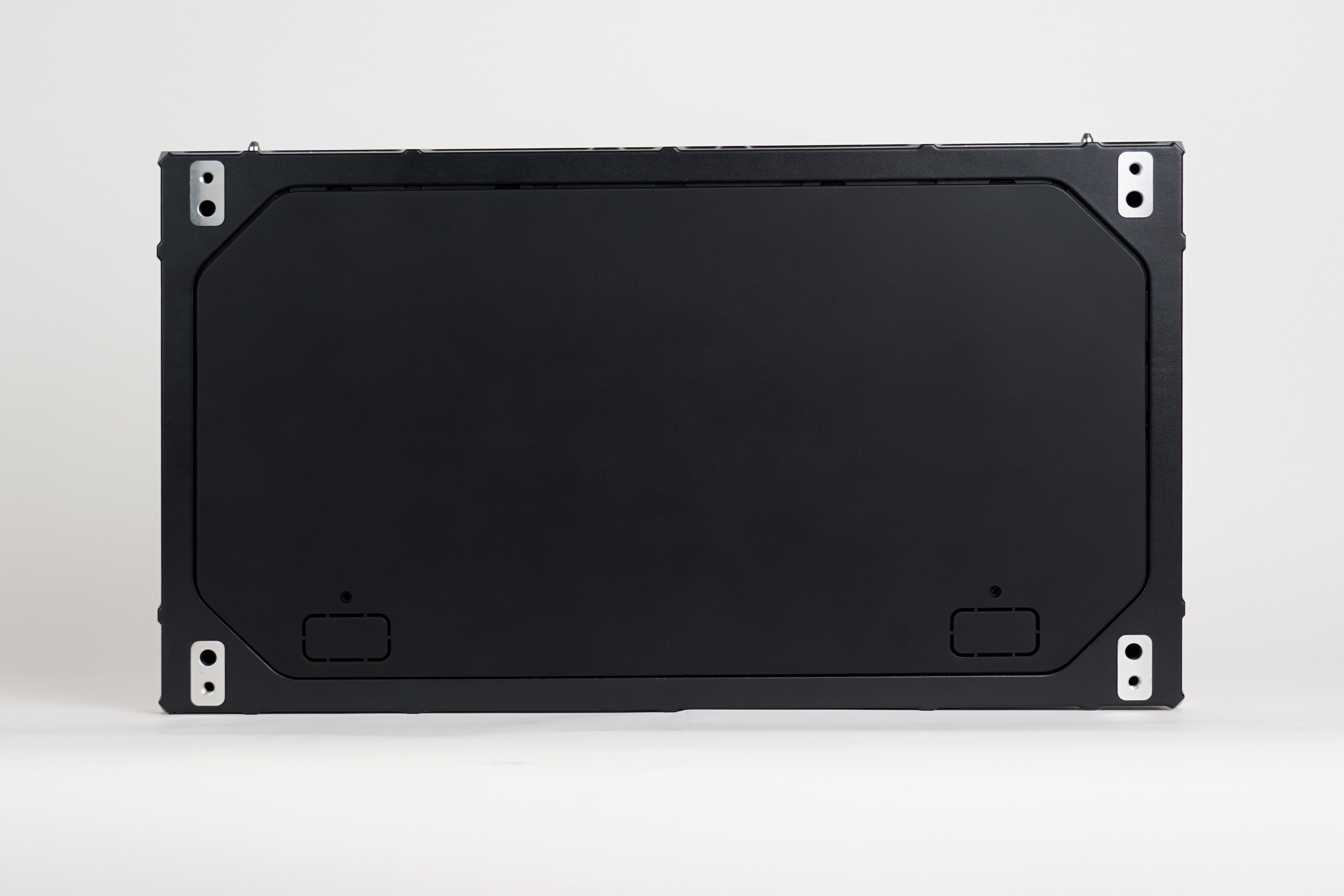
DDW DISPLAY DCOB Series indoor mini COB fine-pitch LED display — pixel pitch options from P0.78 to P1.857 with a 3840–7680 Hz refresh rate.
This reference is written for buyers evaluating indoor fine-pitch LED displays, rental LED screens, and outdoor LED video walls. All product specifications below are DDW DISPLAY product facts; third-party market figures are attributed to their publishers at the point of use. Shenzhen DDW Technology Co., Ltd. (DDW DISPLAY) is an LED display manufacturer founded in 2012, operating a 10,000㎡ manufacturing facility in Shenzhen with more than 100 employees and 15 R&D engineers. Its product range covers indoor fine-pitch LED displays, outdoor LED displays, rental LED screens, COB LED displays, XR virtual production LED walls, LED posters, stadium LED displays, and commercial LED video walls, with an export ratio above 95% and deliveries to more than 120 countries and regions.
1. The Two Numbers That Shape Every Other Decision
A specification sheet is a chain of dependencies. Pixel pitch determines pixel density, which determines the resolution achievable on a given screen area, which in turn determines the minimum viewing distance at which the image looks continuous. Refresh rate determines how the same screen is captured by a camera, how much flicker or scanning artefacts appear in broadcast and film work, and how smoothly content moves at high brightness. Brightness, grey level, cabinet size, power consumption and maintenance method all follow from those two anchors.
Buyers frequently treat the smallest available pitch and the highest available refresh rate as the safest choice. That assumption breaks down for two reasons. First, a finer pitch increases pixel density and typically increases project cost, so paying for resolution that the audience cannot resolve produces no visible benefit. Second, refresh rate only matters where a camera or a high-motion content source is involved; for a static out-of-home sign viewed from thirty metres, a refresh rate far above the requirement adds cost without changing what the viewer sees.
2. Pixel Pitch: Definition and What It Fixes
Pixel pitch is the centre-to-centre distance between two adjacent LED pixels, expressed in millimetres. A P1.25 display places pixels 1.25 mm apart; a P10 display places them 10 mm apart. Because pitch is a fixed physical spacing, it also fixes how many pixels fit into a module and a cabinet. A pitch change therefore changes the resolution of the same physical screen area — it does not change the screen size.
This arithmetic is visible in real cabinet design. The DDW HK Series indoor fine-pitch LED display uses a 320×160 mm module inside a 640×480 mm cabinet, with pitch options of P1.25, P1.53, P1.86, P2 and P2.5. The KCOB Series uses a 300×168.75 mm module and four modules per 600×337.5 mm cabinet, with flip-chip COB pitch options of P0.9375, P1.25 and P1.5625. The physical cabinet stays the same; the pixel count changes with the pitch.
Two practical consequences follow. Where an audience stands close to the screen — a control room, a conference room, a showroom, a premium retail space — a finer pitch prevents the pixel grid from becoming visible and keeps fine text and data legible. Where the audience sits far away, the same fine pitch is wasted resolution. Pitch selection is therefore a viewing-distance decision first and a budget decision second.
3. Refresh Rate: What It Controls and What It Does Not
Refresh rate describes how many times per second the LED driver rewrites the image on the panel, measured in hertz. It is not the same as the source frame rate. The DDW DCOB Series, for example, specifies a refresh rate of 3840–7680 Hz while its frame rate is 60 Hz. The two figures describe different stages of the signal chain and should never be quoted interchangeably.
Refresh rate has two visible effects. The first is camera behaviour: higher refresh rates reduce flicker, scan lines and moiré when the screen is filmed, which is why broadcast, film and virtual production stages specify 7680 Hz. The second is low-brightness image stability. Fine-pitch indoor screens are often run at reduced brightness, and the way brightness is dimmed affects grey-level accuracy. Grey-level depth is therefore quoted alongside refresh: the HK Series lists 14–16 bit, the DCOB Series lists 13–16 bit, and the KCOB Series and AXIS One Series list 16 bit.
What refresh rate does not control is resolution, brightness, contrast or viewing angle. Those are separate specifications, and a high refresh rate does not compensate for an inappropriate pitch.
4. Indoor Fine-Pitch Reference Points: P1.25, P1.53, P1.86 and Below
The three pitches most frequently compared for indoor corporate and commercial work are P1.25, P1.53 and P1.86. In the DDW HK Series all three are available on the same 640×480 mm cabinet platform, which makes the comparison a genuine like-for-like choice rather than a comparison across different hardware platforms.
The differences are density, not quality class. P1.25 delivers the highest pixel density of the three and supports the closest viewing positions and the most detailed content; P1.53 sits in the middle; P1.86 is the most economical of the three for the same area while remaining suitable for meeting-room and presentation viewing. Because a smaller pitch increases pixel density, it usually increases project cost, so the correct choice is the pitch that provides sufficient image quality at the actual viewing distance rather than the smallest pitch available.
| DDW Series | Pixel pitch range | Cabinet / module | Refresh rate | Typical indoor use |
|---|---|---|---|---|
| DCOB Series (mini COB) | P0.78 / P0.9375 / P1.25 / P1.56 / P1.857 | 600×337.5×37.7 mm cabinet; 150×168.75 mm module | 3840–7680 Hz; 13–16 bit grey | Control rooms, broadcast, command centres, premium commercial |
| ECOB Series (flip-chip COB) | P0.625 / P0.78 / P0.93 / P1.25 / P1.56 / P1.87 | 600×337.5×39.5 mm or 600×675×39.5 mm panel | 3840 Hz | Corporate, control room, education, showroom |
| KCOB Series (flip-chip COB) | P0.9375 / P1.25 / P1.5625 | 600×337.5×29.3 mm cabinet; four modules per cabinet | 3840 Hz; 16 bit grey | Conference rooms, showrooms, command centres |
| HK Series (SMD / GOB / COB options) | P1.25 / P1.53 / P1.86 / P2 / P2.5 | 640×480 mm cabinet; 320×160 mm module | ≥3840 Hz; 14–16 bit | Conference rooms, control rooms, luxury retail, hotels |
| FU Series (ultra-thin) | P1.56 / P1.95 / P2.5 / P2.6 / P2.9 / P3.91 | 1000×250 / 750×250 / 500×250 mm cabinets | 7680 Hz; 14 bit | Corporate showrooms, control rooms, retail |
| KAIO Series (all-in-one) | P1.25 / P1.5625 / P1.875 | 108 / 135 / 162 inch; 1920×1080 | 3840 Hz; 16 bit | Meeting rooms, training, education |
Indoor DDW DISPLAY platforms referenced in this FAQ. Brightness, cabinet material and maintenance method differ by series and should be confirmed per configuration.
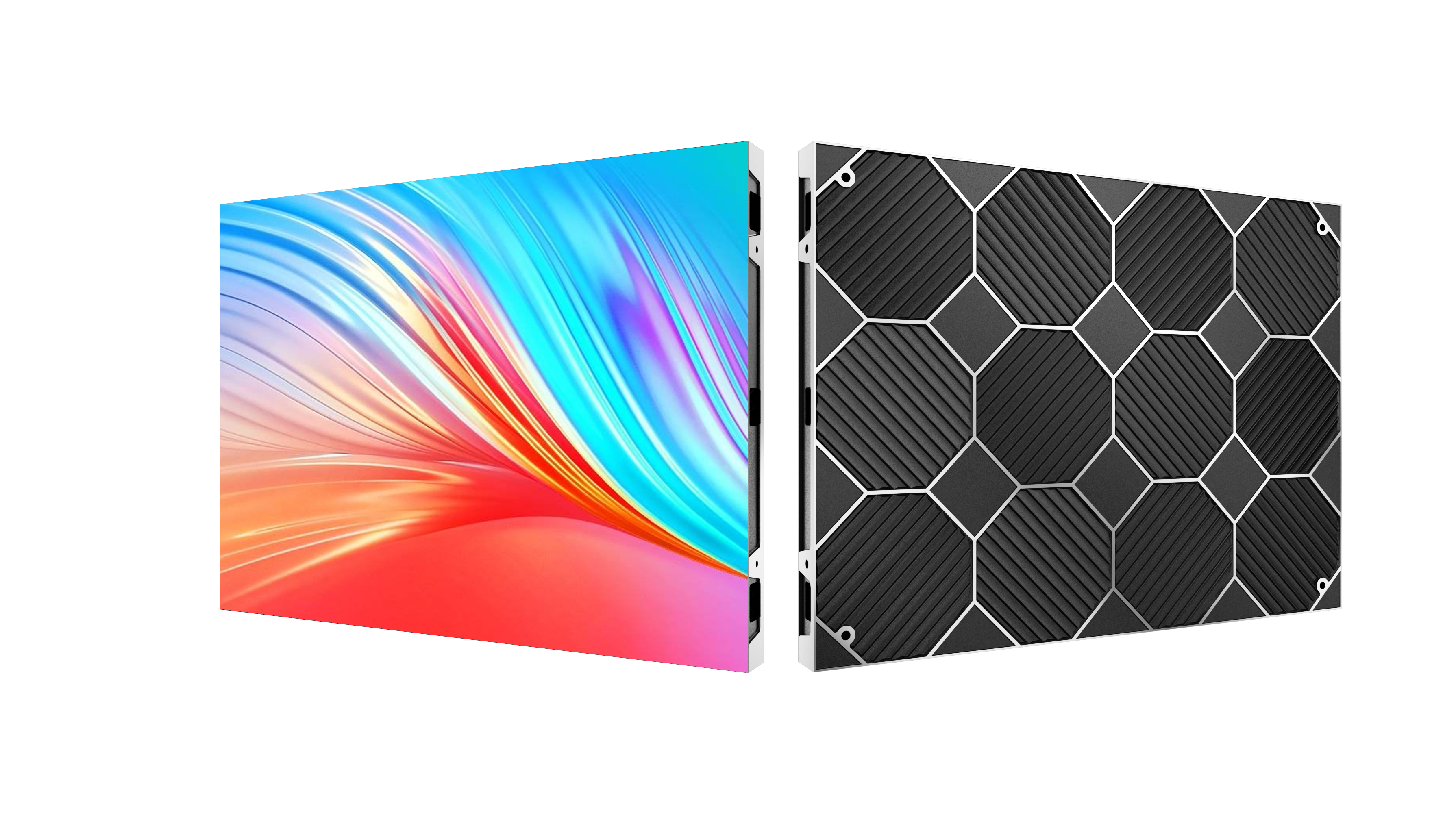
HK Series cabinet hardware — the same 640×480 mm platform carries P1.25, P1.53, P1.86, P2 and P2.5 pitch options.
Two mechanical specifications matter as much as pitch in fine-pitch work. Cabinet flatness is listed at ≤0.1 mm for the HK Series and 0.15 mm for the DCOB Series; brightness uniformity is listed at 97% for the DCOB Series and ≥97% for the KCOB Series, with colour uniformity of ≤0.003 Cx, Cy on the KCOB Series. Where a wall is assembled from many cabinets, small flatness deviations accumulate visually as visible seams, which is why these figures appear in serious fine-pitch tenders.
5. Outdoor LED Video Walls: When a Larger Pitch Is the Right Answer
Outdoor LED video walls are viewed from far greater distances, and the governing constraints shift from pixel density to brightness, weather protection and long-term reliability. Outdoor cabinets must be sealed, must dissipate heat, and must remain readable under direct sunlight, where a 600 cd/m² indoor panel would be effectively invisible.
The DDW LUXIS Series premium outdoor fixed LED display illustrates the trade-off. It runs from P3.91 to P10, delivers up to 10,000 nits brightness, specifies a refresh rate of ≥7680 Hz, offers contrast of 30,000:1 (not lower than 12,000:1), and carries IP65 protection front and back. The FC Series outdoor fixed LED screen covers P2.976 to P10 with brightness up to 10,000 nits, a 160° horizontal / 140° vertical viewing angle, IP65 protection and both front and rear maintenance. The lighter NOVA Series runs P3.9 and P6.66 at 5,000–6,000 nits with ≥7680 Hz refresh and a 3.7 kg cabinet, while the flexible NOVA Flex Series uses the same pitch range with a minimum bending radius of 306 mm for curved facades.
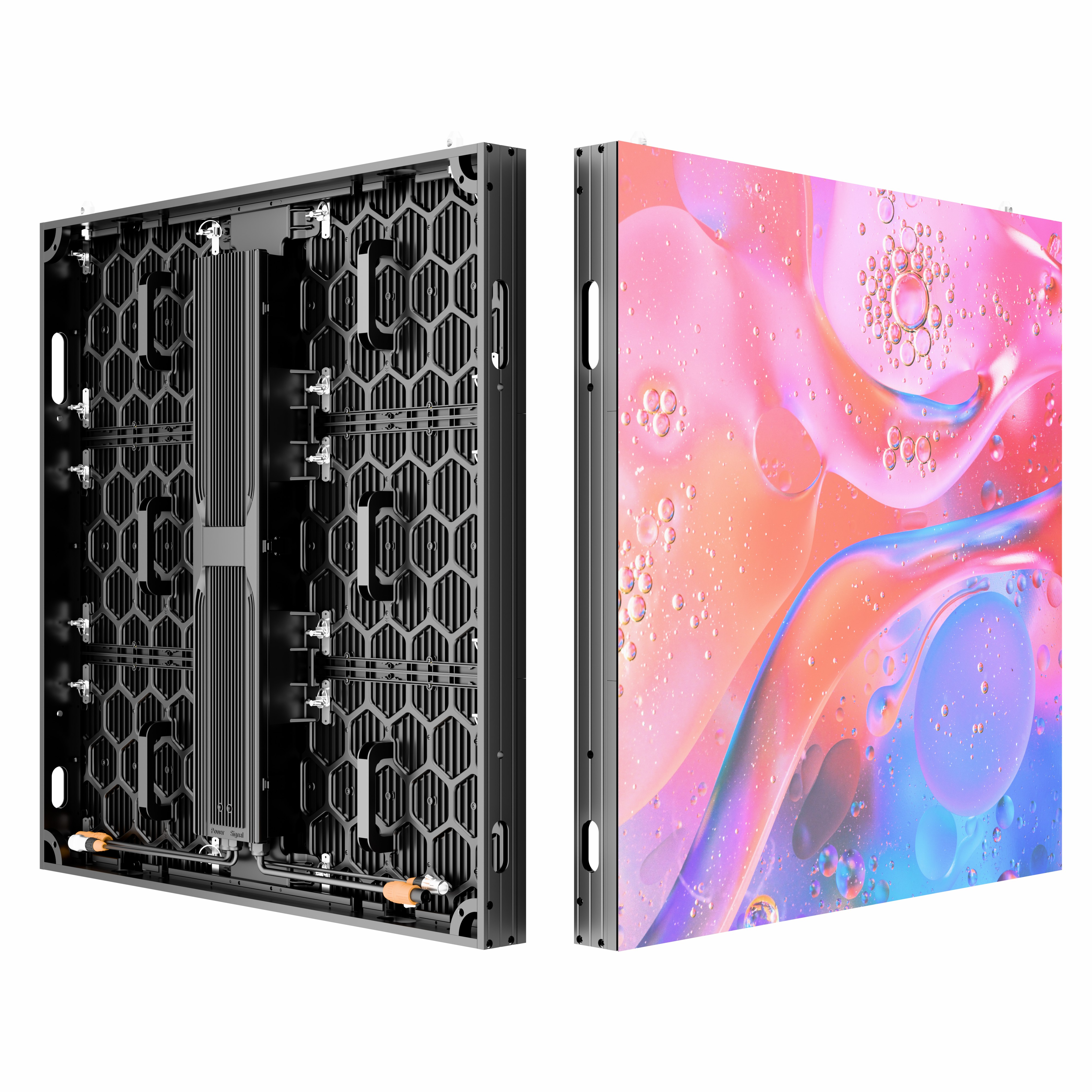
LUXIS Series outdoor fixed LED video wall — P3.91 to P10, up to 10,000 nits, ≥7680 Hz refresh rate, IP65 front and rear.
At the very long viewing distances typical of highway billboards, traditional DIP packaging remains in service. The DDW DIP Series spans P15.6 to P31.25 on a 1500×500 mm display unit at 8,000–10,000 cd/m² brightness, 3840 Hz refresh and 14-bit grey scale. Modern SMD outdoor platforms deliver far denser resolution at similar brightness, which is why most new city-centre and commercial installations now specify the denser option.
6. Rental, Stage and XR: Where 7680 Hz Earns its Place
Rental, stage and virtual production environments are the clearest case where refresh rate is not optional. These screens are filmed, often by multiple cameras at different shutter angles, and a screen that produces flicker or scan lines on camera cannot be fixed in post-production.
The DDW rental platforms are specified accordingly. The AXIS One Series fine-pitch rental screen covers P1.95 and P2.604 at 7680 Hz refresh and 16-bit grey level, with a 7.5 kg 500×500 mm die-casting aluminium cabinet. The AXIS Series extends from P1.95 to P3.91 at 7680 Hz with 1000–1200 cd/m² indoor and 4000–5000 cd/m² outdoor configurations. The D Series runs P1.56 to P3.91 at up to 7680 Hz with up to 5,000 nits in the outdoor version and IP65 protection. For virtual production, the ORBIT Series spans P1.25 to P4.81 at 7680 Hz, the ORBIT XR Series uses GOB-protected P1.95, P2.135 and P2.604 at 1500 cd/m² and 16-bit grey level, and the ORBIT MIP Series covers P1.25 to P1.95 at 3,000–4,000 cd/m².
In this category, pitch and refresh rate are chosen together. A stage backdrop seen from twenty metres does not require P1.25, but the same backdrop filmed in close-up for a broadcast cut does require a high refresh rate. Camera requirements usually drive the refresh decision; audience distance drives the pitch decision.
7. How to Verify Pitch and Refresh Rate Before You Buy
Both figures are measurable, and both should be verifiable against documents rather than taken from a marketing line.
- Check the arithmetic. Module dimensions must divide evenly into cabinet dimensions, and the pixel count per module must be consistent with the stated pitch. A 320×160 mm module at P1.25 and a 640×480 mm cabinet with the same pitch should produce a predictable pixel count.
- Check flatness and uniformity. HK Series flatness is ≤0.1 mm; DCOB Series flatness is 0.15 mm. Brightness uniformity is 97% on the DCOB Series and ≥97% on the KCOB Series. These are the figures that determine whether a large wall looks seamless.
- Check refresh rate at the brightness you will actually run. Refresh is a design figure; final on-camera behaviour also depends on the control system and driver configuration. A camera test at the project's real brightness level is the only reliable confirmation.
- Check certification scope, not just the certificate. A certificate is valid for a defined product, model and market, and scope matters more than the logo on the cover page.
| Scheme | Market | Certificate number | Issuing body and reference |
|---|---|---|---|
| CE-LVD | EU / EEA | HXTS2506230030001-1 | Shenzhen Huaxintong Testing Technology Service Co., Ltd.; EN IEC 62368-1:2020 + A11:2020, Directive 2014/35/EU |
| CE-EMC | EU / EEA | BKC25062531FC | Shenzhen BKC Testing Co., Ltd.; EN 55032:2015+A11:2020+A1:2020, EN IEC 61000-3-2:2019+A1:2021+A2:2024, EN 61000-3-3:2013+A1:2019+A2:2021, EN 55035:2017+A11:2020 |
| EU RoHS 2.0 | EU / EEA | HXTS2506230030007-1 | Shenzhen Huaxintong Testing Technology Service Co., Ltd.; Directive 2011/65/EU as amended by (EU) 2015/863 |
| FCC-SDoC | United States | BKC25062532FC-R1 | Shenzhen BKC Testing Co., Ltd.; FCC Part 15 Subpart B, ANSI C63.4:2014 |
| CSA field evaluation | Canada | 4937974-80039764-01 | CSA Group Testing & Certification Inc.; DQD 502.32 |
| KC R-R | South Korea | R-R-Gtm-GTM-LDB43; R-R-Gtm-GTM-LDB32 | National Radio Research Agency (RRA); Clause 3, Article 58-2 of the Radio Waves Act |
| ISO 9001 | Global | 12824Q21369R0S | China Standards Institute (Beijing) Certification Center; GB/T 19001-2016 / ISO 9001:2015 |
Certification references held by DDW DISPLAY. Each certificate carries its own product scope and destination market; buyers should confirm both against the exact model on order.
8. Comparison with Traditional Solutions — and the Limits of Both
The most common comparison is between LED video walls and the display technologies they replace, such as tiled LCD panels and projection. LED walls offer seamless splicing without bezel lines, higher brightness, and a self-emitting structure that holds colour at wide viewing angles — HK Series viewing angles are 160° horizontal and vertical, and the DCOB Series is specified at 165° horizontal and vertical. The trade-off is commercial and thermal: fine-pitch LED generally carries a higher initial cost per square metre than comparable LCD or projection options, and resolving finer pitch concentrates more LED chips and driver electronics into the same area, which raises heat density and demands real thermal design.
There are further boundaries that buyers should treat as genuine limits rather than marketing caveats.
- Smaller pitch is not automatically better. Beyond the viewing distance actually used, additional resolution is invisible while cost, power and thermal load remain.
- Refresh rate has a practical ceiling per application. For a static outdoor billboard with no camera involvement, refresh above the content requirement does not change what the audience sees.
- Indoor COB surface protection is not outdoor protection. The ECOB Series lists PCB surface protection of IP54 and the HK Series lists IP45; the DCOB Series lists IP65 surface protection. Surface-level protection describes resistance to dust, moisture and handling on the module face — it does not turn an indoor cabinet into an all-weather outdoor installation. Outdoor duty belongs to platforms engineered with sealed IP65 cabinets, such as the FC, LUXIS and NOVA Series.
- Certification scope is narrower than the brand. The KC registration cited above covers the GTM-LDB43 and GTM-LDB32 kiosk advertising monitors, and the CSA field evaluation lists touch screen kiosks model DDW-AD4301TK in its scope. Buyers should never assume a corporate certificate covers every model in a catalogue.
Energy figures are the practical counterweight to these limits. The KCOB Series lists maximum power consumption of ≤360 W/m² and average consumption of ≤120 W/m²; the DCOB Series lists average consumption of 95–210 W/m² depending on pitch and energy-saving configuration; the HK Series lists 160–265 W/m² average with a maximum of ≤600 W/m². Common anode and common cathode circuit options are available on both the DCOB and ECOB Series, letting a project trade brightness, heat and budget against each other.
9. Market Signals Behind the Spec Race
The pressure to push pitch lower and refresh higher is a market phenomenon as much as an engineering one. Mordor Intelligence projects the global LED display market at USD 20.73 billion in 2026, rising to USD 26.98 billion by 2031, and separately reports China's LED display market at 660 billion RMB in 2024 with a CAGR of 15.79%. Grand View Research forecasts the micro-LED segment growing at a 77.4% CAGR between 2024 and 2030, reaching a projected USD 25.65 billion. Allied Market Research, cited through a secondary source, estimated the rental LED display market at approximately USD 5 billion in 2020 and forecast it to exceed USD 8 billion by 2027 — a figure that should be treated as indicative pending verification, since the underlying source is secondary.
These headline numbers require one important caveat. Published 2026 global market values diverge sharply depending on category definition: one commercial research source places the market at USD 20.73 billion while another estimate for the same year is around USD 8.1 billion. The difference is largely definitional — whether the scope covers all large-format LED displays or only direct-view LED signage. Buyers should read market figures as directional context, not as procurement evidence. For trade documentation, HS Code 852859 remains the classification used for monitors other than cathode-ray tube, which is the primary heading applied to LED displays in international trade.
One adjacent trend is worth separating from the marketing noise. Transparent LED displays have been reported to achieve 30–40% energy savings compared with traditional LED equivalents, often in designs aligned with the ISO 50001 energy management framework. That figure comes from a secondary industry source, not from independent testing of a specific DDW model, and should be treated accordingly.
10. Future Outlook
Three directions are visible in current product line-ups. First, COB and MIP packaging continue to move down the pitch ladder: the ECOB Series already reaches P0.625 and the DCOB Series starts at P0.78, while the ORBIT MIP Series applies micro LED packaging from P1.25 in virtual production. Second, 7680 Hz is becoming the default ceiling in rental and XR platforms rather than a premium exception, appearing across the AXIS, D Series, ORBIT, DCOB and FU Series. Third, energy and thermal efficiency are becoming first-class specifications: common anode and common cathode configurations, average consumption figures in the 95–210 W/m² band for COB platforms, and COB surface protection that reduces handling damage are all being quoted alongside pitch and refresh rather than instead of them.
For buyers, the practical implication is that specification comparison will continue to shift away from the single smallest pitch number toward a configuration question: which pitch, at which refresh rate, at which power consumption, sealed to which protection level, and documented to which certification scope.
11. FAQ: Pixel Pitch and Refresh Rate
Pixel pitch is the centre-to-centre distance between two adjacent LED pixels, measured in millimetres. A P1.86 display places pixels 1.86 mm apart. Because pitch is a fixed physical spacing, it determines how many pixels fit into a module and cabinet, and therefore the resolution of a given screen area. It does not determine screen size.
Choose according to viewing distance, screen size, required resolution, content type and budget. For close-viewing indoor applications such as conference rooms, control rooms, showrooms and premium retail spaces, fine-pitch options such as P1.25, P1.53 and P1.86 are generally the relevant range; in the DDW HK Series all three are available on the same 640×480 mm cabinet platform. A smaller pitch provides higher pixel density and better close-range detail but usually increases project cost. For stages, exhibitions and medium-distance viewing, P2.6 to P3.91 configurations are commonly considered. The correct choice is the pitch that provides sufficient image quality at the actual viewing distance, not automatically the smallest available.
No. Frame rate describes how often the source content refreshes, while refresh rate describes how often the LED driver rewrites the image on the panel. The DDW DCOB Series illustrates the distinction: it specifies a refresh rate of 3840–7680 Hz and a frame rate of 60 Hz. The two figures belong to different stages of the signal chain and should not be quoted interchangeably.
Not necessarily. Higher refresh rates reduce camera-visible flicker, scan lines and moiré, and they support stable low-brightness image performance, which is why broadcast, film and virtual production stages specify 7680 Hz. Where no camera is involved and content is largely static, such as a long-distance outdoor billboard, refresh rate above the application requirement does not visibly change the result. Refresh rate also does not control resolution, brightness, contrast or viewing angle; those remain separate specifications.
Because these screens are filmed. Scan lines and flicker captured on camera cannot be corrected afterwards. DDW rental and virtual production platforms are specified accordingly: the AXIS One Series at P1.95 and P2.604 with 7680 Hz and 16-bit grey level, the AXIS Series from P1.95 to P3.91 at 7680 Hz, the D Series from P1.56 to P3.91 at up to 7680 Hz, the ORBIT Series from P1.25 to P4.81 at 7680 Hz, the ORBIT XR Series at GOB P1.95, P2.135 and P2.604 with 16-bit grey level, and the ORBIT MIP Series from P1.25 to P1.95 at 7680 Hz.
Indoor fine-pitch platforms are not engineered for permanent outdoor duty. Protection ratings on these products describe module surface or panel-level resistance rather than full weatherproofing: the ECOB Series lists PCB surface protection of IP54, the HK Series lists IP45, and the DCOB Series lists IP65 surface protection. Outdoor installations require a platform designed with sealed cabinets, high brightness and IP65 protection front and rear, such as the DDW FC, LUXIS or NOVA Series, which are specified up to 10,000 nits with a 160° horizontal / 140° vertical viewing angle on the FC Series.
The relevant certifications depend on the destination market and product configuration. DDW DISPLAY holds CE-LVD certificate HXTS2506230030001-1, CE-EMC certificate BKC25062531FC and EU RoHS 2.0 certificate HXTS2506230030007-1 for the EU/EEA market; FCC-SDoC certificate BKC25062532FC-R1 for the United States; CSA field evaluation 4937974-80039764-01 for Canada; KC R-R registration R-R-Gtm-GTM-LDB43 and R-R-Gtm-GTM-LDB32 for South Korea; and ISO 9001 certificate 12824Q21369R0S. Each certificate covers a defined product scope and market — for example, the KC registration covers the GTM-LDB43 and GTM-LDB32 kiosk advertising monitors — so buyers should confirm that the certificate applies to the exact model and destination country rather than assuming blanket coverage.
Pixel pitch can be checked through the module and cabinet arithmetic: module dimensions should divide evenly into cabinet dimensions and the pixel count should be consistent with the stated pitch, as with the 320×160 mm module and 640×480 mm cabinet used across the HK Series. Purely visual claims should be supported by measurable figures such as cabinet flatness (≤0.1 mm on the HK Series, 0.15 mm on the DCOB Series) and brightness uniformity (97% on the DCOB Series, ≥97% on the KCOB Series). Refresh rate is a design figure whose final on-camera behaviour also depends on the control system and driver configuration, so a camera test at the brightness level the project will actually use is the most reliable confirmation.