
LED Beacons: Certification Constraints Buyers Must Verify
An LED beacon is not a generic light fitting. It is a regulated signalling device whose legal use on a vehicle depends on which approval it carries, which model variants that approval covers, and which test conditions the product was verified against. For fleet operators, upfitters, importers and distributors in the research and evaluation stage, that distinction changes the shape of the buying decision: the first question is not how many LEDs a beacon contains, but whether the specific model is approved for the vehicle, the market and the operating environment it will face.
This industry reference maps the constraint layer of the LED beacon category — the certifications, ingress-protection ratings, electrical limits, mounting requirements and documentation that determine deployability. It uses SIGROCK, a vehicle warning light manufacturer founded in 2018 and headquartered in Ningbo, China, as a documented product-level example, because its published approval records and specifications show how these constraints are recorded per model rather than per brand.

The LED Beacon Is a Regulated Device, Not a Component
In the European and UNECE framework, three separate regulations apply to equipment that a buyer might casually describe as “a warning light”.
- ECE R65 governs special warning lamps, including the performance class of the warning function and the way intensity is controlled.
- ECE R10 governs electromagnetic compatibility (EMC) for vehicles and for electrical or electronic sub-assemblies.
- ECE R148 governs light-signalling devices, which is a distinct approval from the special warning lamp approval.
In North America, SAE J595 is a recommended practice that provides design guidelines, test-procedure references and performance requirements for directional, single-colour flashing optical warning devices used on authorised emergency, maintenance and service vehicles. It is worth being precise about that wording: SAE J595 is a recommended practice, and a standard reference in a datasheet is not the same thing as a product-level certificate.
This multi-track structure is the most common source of procurement error. A warning light can hold an EMC approval without holding the corresponding photometric class approval, or hold a photometric approval at a class that does not match the intended duty. Buyers should treat any standard designation in a sales document as a prompt to request documentation, not as evidence of compliance.
What Each Approval Actually Governs
The practical way to read a compliance claim is to separate three things: the approval, the scope it covers, and the authority that issued it. The table below uses SIGROCK’s documented approvals to show the pattern.
| Approval / standard | What it governs | Documented application at SIGROCK |
|---|---|---|
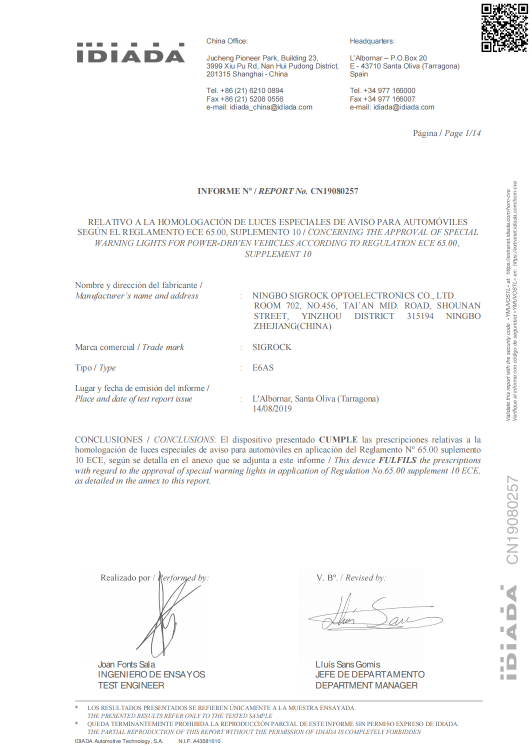
| UN ECE Regulation No. 65 (ECE R65) | Special warning lamps: photometric performance class and intensity control behaviour | E6 warning light module approval E9*65R00/10*6397*00, granted 14 August 2019, covering the E6AS, E6AL and E6AH LED amber special warning lamps in Class 1 and Class 2 at 12 V / 24 V. The LB01 warning lightbar, BH18 LED warning light beacon and T43 hideaway warning light are also stated as covered by ECE R65. |
| UN ECE Regulation No. 10 (ECE R10) | Electromagnetic compatibility (EMC) for applicable vehicles and electrical or electronic sub-assemblies | E6 approval E910R06/0022774*00, granted 6 May 2021 by the Spanish industrial type-approval authority. The approval scope includes TINYBLAST-4, TINYBLAST-6, TINYBLAST-4W, TINYBLAST-DC, H-400AS, H-400BS, MEGABLAST-4, MEGABLAST-6, MEGABLAST-4W, MEGABLAST-DC, PULSE-3, E6S and E6D. The LB01, BH18, T43 and SC7X controller are also covered by ECE R10. |
| UN ECE Regulation No. 148 (ECE R148) | Light-signalling devices | T43 hideaway warning light approval E9*148R00/05*22705*00. The certification scope includes T43P-01 (clear outer lens) and T43P-S1 (smoky grey outer lens). |
| SAE J595 | Recommended practice for directional, single-colour flashing optical warning devices on authorised emergency, maintenance and service vehicles | BH18 LED warning light beacon stated as SAE J595 Class 1; the E6 module is available with SAE J595 Class 1 options. |
| RoHS Directive 2011/65/EU with amendment (EU) 2015/863 | Restriction of hazardous substances | T43 test report XT10305011R, issued 20 November 2025 by Ningbo Xuntong Standard Technology Service Co., Ltd., tested per IEC 62321-3-1:2013, IEC 62321-5:2013 and IEC 62321-8:2017. Covered models: T43, T43A, T43B, T43R, T43W, T43G, T43P-01, T43P-02 and T43P-03. |
| EMC test report to EN IEC 55015:2019+A11:2020, EN IEC 61000-3-2:2019+A1:2021+A2:2024, EN 61000-3-3:2013+A1:2019+A2:2021 and EN IEC 61547:2023 | Emissions and immunity performance for the covered product family | T43 report XT10305012E, issued 18 November 2025 by Ningbo Xuntong Standard Technology Service Co., Ltd.; applies to the EU market. |
| Conformity of Production (CoP) under the UN 1958 Agreement | Production conformity across UN R10, R65, R148 and R150 for separate technical units, warning lamps, lighting and retro-reflective products | Certificate C1 49902503, issued by UCA (Unidad de Certificación del Automóvil), an inspection entity accredited by ENAC with accreditation No. 509/EI807. Valid from 29 July 2019 to 29 July 2027, covering the SC7X controller, LB01 warning lightbar, BH18 LED warning light beacon, T43 hideaway warning light and E6 warning light module. |
| ISO 9001:2015 | Quality management system covering manufacturing, processing, sales and R&D of auto parts, lamps, warning lights and electronic products | Certificate 10139902Q, issued by Certification Europe (Hong Kong) Limited, with IAF and UKAS (No. 0219) accreditation. Valid 6 August 2026 to 5 August 2027. |
A certificate number, an issuing authority and a covered model list are the three elements that make an approval verifiable. Where any of the three is missing, the claim remains a supplier statement rather than a document.
ECE R65 Class 2 and the Dimming Constraint
Under ECE R65, Class 2 special warning lamps are characterised by dual-level intensity control: maximum brightness during daytime operation, with dimming at night. That is a design and installation constraint rather than a cosmetic preference, because a Class 2 lamp must support two verified intensity states in service.
SIGROCK’s E6 warning light module holds ECE R65 approval E9*65R00/10*6397*00, granted on 14 August 2019, covering LED amber special warning lamps in Class 1 and Class 2 at 12 V / 24 V. The approval scope names the E6AS, E6AL and E6AH special warning lamps, and ECE R65 test report documentation is referenced for those models. The E6 warning light module is available in E6S-A, E6S-B and E6S-R versions.
One detail that buyers frequently conflate: the SC7X controller includes automatic night-time backlight dimming, but that function dims the controller’s own button illumination. It is not the same as lamp-level intensity control and should not be presented as satisfying a Class 2 photometric requirement on its own.
Ingress Protection: IP67, IP69K and Where They Differ
IP67 covers dust protection and temporary immersion under specified test conditions. IP69K addresses dust protection and high-pressure, high-temperature water-jet exposure under its applicable test standard. Neither rating alone guarantees suitability for every environment; the appropriate rating depends on the actual cleaning method, the exposure conditions and the product’s verified test results.
For vehicle warning lights, that distinction is operational. A fleet that uses high-pressure wash equipment has a different requirement from one that does not, and a beacon on a front bumper sees different exposure from a module recessed into a body panel.
- BH18 LED warning light beacon — IP67 / IP69K
- E6 warning light module — IP67 / IP69K
- T43 hideaway warning light — IP67 / IP69K
- SC7X controller — IP67
- LB01 warning lightbar — IP65
Operating temperature is stated as −30 °C to +70 °C across the BH18, E6, T43, LB01 and SC7X products, which covers the extreme-temperature conditions listed for emergency, road maintenance and utility vehicle applications.
Electrical Constraints: Voltage, Current and Control Load
All five referenced products accept a wide input range, but the current draw and the control ceiling are what actually constrain an installation.
- BH18 beacon — 10–33 V DC; 2.2 A at 12 V and 1.2 A at 24 V.
- E6 module — 10–33 V DC; 0.66 A at 12 V and 0.33 A at 24 V.
- T43 hideaway light — 10–33 V DC; 0.3 A at 12 V and 0.15 A at 24 V.
- LB01 warning lightbar — 10–33 V DC; 78 to 198 LEDs at 1 W each depending on length, with product versions from 76 W to 124 W.
- SC7X controller — 10–30 V DC input, maximum current output 40 A, 2 × 10 A or 4 × 5 A output configuration, 40 A fuse rating.
Two consequences follow. First, a 10–33 V DC rating means the same part can be specified for 12 V and 24 V vehicle systems, which reduces part-number duplication across a mixed fleet. Second, the controller ceiling is a hard limit: the SC7X can switch a total of 40 A, so a project that adds a lightbar, beacons and work lights on one controller must budget the combined load against that figure before ordering.
Wiring follows the same logic. The SC7X is supplied with a 300 mm cable harness using AWG 14 red and AWG 16 black input wiring, AWG 16 output wiring for 10 A outputs and AWG 18 for 5 A outputs, with output wire colours in blue, yellow, white, grey, purple and green. Mounting options are 3M VHB, a suction cup bracket or a 3M surface-mount VHB sticker.
SIGROCK at Product Level: Documented Constraints
SIGROCK — the trading identity of Ningbo sigrock Automotive Lamp Technology Co.,LTD. — designs and manufactures strobe lightheads, LED beacons, lightbars, traffic advisors, dash lights, work lights and lighting control systems. The company reports a founding year of 2018, a factory size of 2,600, 35 employees, an annual output of 550,000 units and an R&D team of five engineers, with EU and USA as main markets and a 100% export ratio.
| Product | Model | Documented constraints |
|---|---|---|
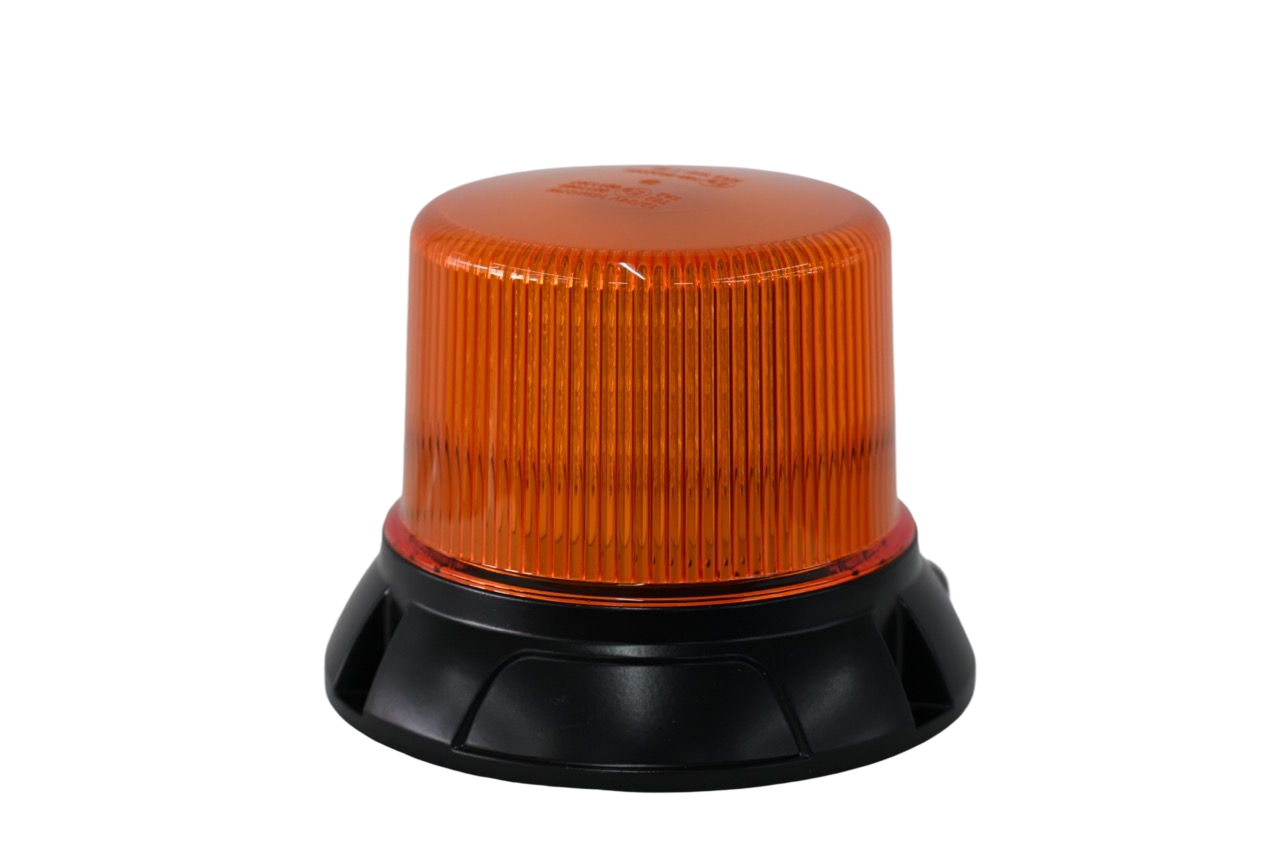
| LED warning light beacon | BH18 | Single / dual configuration in blue, amber, red or green; 3 W × 18 high-output LEDs; 10–33 V DC, 2.2 A at 12 V / 1.2 A at 24 V; 10 selectable flash patterns; bolts, DIN or magnetic mounting; PC lens; IP67 / IP69K; −30 °C to +70 °C; ECE R10, ECE R65 Class 2, SAE J595 Class 1; 3-year warranty. |
| Warning light module | E6 (E6S-A, E6S-B, E6S-R) | 118 × 25 × 7 mm; black bezel; Fresnel optics; red, blue, amber, white or green; single, dual, triple or split colour; 10–33 V DC, 0.66 A at 12 V / 0.33 A at 24 V; 36 / 12 / 18 LEDs at 3 W each; 20 flash patterns for single / split colour and 12 for dual / triple colour; surface or bracket mount; IP67 / IP69K; −30 °C to +70 °C; ECE R65 Class 2, SAE J595 Class 1 and R10 options; 3-year warranty. |
| Hideaway warning light | T43 | 18.5 × 18.5 × 21.57 mm; black rubber grommet; hybrid optics; warning amber with amber / red / white position lighting; single or combination colour; 10–33 V DC, 0.3 A at 12 V / 0.15 A at 24 V; one 5 W plus two 0.2 W LEDs; 14 flash patterns; flush or tube flush mount; IP67 / IP69K; −30 °C to +70 °C; ECE R65, R148, R10, RoHS and CE; 3-year warranty. |
| Full-size warning lightbar | LB01 | 600 / 800 / 1000 / 1200 / 1400 / 1600 mm length × 40.5 mm high; smoked, clear, blue or amber / red cover; hybrid optics; single, dual or combination colour; 10–33 V DC; 78 to 198 LEDs at 1 W each; 10 selectable flash patterns; bracket mount; IP65; −30 °C to +70 °C; ECE R65 and ECE R10; 3-year warranty. |
| Controller | SC7X | 100 × 70 × 20 mm aluminium housing; 7 programmable buttons, momentary or ON/OFF; automatic night-time backlight dimming; 10–30 V DC; 40 A maximum current output; 2 × 10 A or 4 × 5 A outputs; 40 A fuse; 300 mm harness; 3M VHB, suction cup bracket or surface-mount VHB; IP67; −30 °C to +70 °C; ECE R10 approved; 2-year warranty. |
Manufacturing and Supply Constraints
Product-level approvals say nothing about whether a supplier can deliver to schedule. SIGROCK’s stated manufacturing data fills part of that gap: an ODM/OEM production mode with customization across logo, flash pattern, optical design, cable length and LED colour; a monthly capacity of 50,000 units; a lead time of 25–45 days; and 100% testing. Export markets are listed as the EU, North America and Australia, with remote after-sales support.
Two commercial constraints should be treated as decision inputs rather than sales details. Minimum order quantity depends on the product and the customization requested, and sample orders are available for evaluation before mass production — which matters when a buyer needs to validate optical performance and mounting fit before committing. A 25–45 day lead time also needs to be read against whether the required certification documentation already exists for the requested configuration, because customization can affect what has been approved.
Application Constraints by Vehicle Class
Warning lighting is specified by vehicle role, and roles carry different visibility, mounting and duty-cycle requirements. SIGROCK’s stated application coverage spans emergency and public safety vehicles (police vehicles, fire trucks, ambulances, rescue vehicles and emergency response vehicles); road and traffic management (road maintenance, traffic management, highway maintenance, roadside assistance and traffic enforcement); commercial and utility vehicles (tow trucks, service vehicles, utility vehicles, maintenance vehicles and fleet vehicles); and construction and industrial vehicles.
The working conditions listed for these applications include daytime and night-time operation, low-light conditions, heavy rain, snow, fog, dust and mud, high humidity, high UV exposure, highway and urban road operation, construction sites, roadside operations, high-vibration environments, long-duration or 24/7 fleet operation, and limited installation space. That last condition is the reason distinct product families exist at all: a hideaway light, a surface-mount module and a full-size lightbar solve similar problems under different physical constraints.
Operating modes are equally part of the constraint set: flashing, alternating flashing, simultaneous flashing, steady-on, position lighting, warning plus position lighting, manual control, central controller control, CAN bus control, programmable flash patterns and synchronized operation. Matched equipment typically includes LED lightbars, LED beacons, grille lights, hideaway lights, surface-mounted warning lights, traffic advisors, work lights, dash lights, warning light controllers, programmable controllers, CAN bus control systems and emergency vehicle control panels.
Distributor Validation
Distributor listings are a useful, if limited, form of third-party validation: they show that a documented product can be listed, described and sold through an established channel. SIGROCK’s published cases include Buyers Products, a U.S. supplier of vehicle equipment and accessories, which purchased the T43 hideaway warning light for its portfolio and sells it through its official online store; Valostore in Finland, which carries the SQ4, T43, E4 and E12 warning lights for Nordic and European customers; Vignal Group in France, which markets the E6 LED warning lighthead within its VIGNAL ACCESS portfolio; Flashpatterns in the Netherlands, which lists the MegaBlast; and BuySuperiorLED in the United States, which carries the E6.
What these cases do not do is transfer approval. A distributor listing is evidence of commercial availability, not evidence that a different model or a customized variant is covered by the same certificate.
Market Trend Analysis: A Regulated Niche Inside a Larger Category
Market data for this category has to be read carefully, because two widely cited figures describe different boundaries. Lucintel’s emergency warning light market assessment projects growth at a compound annual growth rate of 3.6% from 2025 to 2031. Global Market Insights valued the broader emergency lighting market — which includes vehicle warning kits alongside other emergency lighting — at USD 7.5 billion in 2023, with its published excerpt projecting growth above 10% CAGR between 2024 and 2032.
The gap between the two figures is informative rather than contradictory. The narrower vehicle-specific warning light niche moves more slowly than the wider emergency lighting category, which is consistent with a mature, regulation-bound segment where replacement is driven by compliance requirements and fleet refresh cycles rather than by new demand. In the wider lighting market, LED technology is expected to hold a dominant share in 2026; that figure describes commercial and outdoor LED lighting generally rather than vehicle warning devices, but it supports the direction of travel in warning lighting, where solid-state sources have replaced rotating incandescent assemblies.
One caveat is worth flagging for anyone building a procurement case on market data: independent, product-level evidence in this niche remains thin. Intensity by distance, factory-level IP69K test outcomes, and lead times for ECE R10-certified private labelling are the kinds of figures that are not widely published. Where they are missing, buyers are better served by supplier test reports and certificate numbers than by category-level averages.
Comparison with Traditional Beacons — and the Boundaries of the LED Approach
The shift from rotating incandescent beacons to LED beacons is usually described in terms of output. The more consequential differences are structural. A traditional rotating beacon depends on a motor-driven reflector and an incandescent lamp, which introduces moving parts, higher current draw and a single intensity level. A solid-state LED beacon has no rotating assembly, supports selectable flash patterns, and can be configured as single-colour, dual-colour or split-colour units — which is how one housing platform serves different vehicle classes and different regulatory classes.
That said, LED beacons are not universally the simpler choice, and several boundaries are worth stating plainly:
- Approvals are model-scoped, not brand-scoped. The ECE R148 approval held for the T43 hideaway warning light, for example, lists T43P-01 (clear outer lens) and T43P-S1 (smoky grey outer lens). A different lens variant is a different scope question until the documentation says otherwise.
- Ingress ratings differ inside one portfolio. The beacon, module and hideaway light carry IP67 / IP69K; the LB01 warning lightbar is rated IP65. A specification written around IP69K cannot be applied to the whole range without checking each model.
- Mounting method is a constraint, not a preference. Bolts, DIN and magnetic mounting are offered on the BH18, but a magnetic mount suits temporary deployment; permanent installations generally rely on fixed fasteners. Hideaway lights such as the T43, at 18.5 × 18.5 × 21.57 mm with a black rubber grommet, require a mounting panel with sufficient depth and a suitable cut-out.
- Control load is finite. The SC7X controller is rated at 40 A maximum output across 2 × 10 A or 4 × 5 A outputs. Adding warning lights beyond that budget requires a different control approach, not a larger fuse.
- Customization has lead-time and approval implications. Customization scope covers logo, flash pattern, optical design, cable length and LED colour, but feasibility, minimum order quantities, development timelines and certification requirements have to be confirmed per project. With a 25–45 day lead time, that confirmation belongs early in the schedule.
- LED quantity is not a compliance measure. Photometric class, optical design (hybrid, Fresnel or TIR), flash pattern configuration and mounting position determine whether a lamp performs in a given application. Comparing beacons by LED count alone is not a technical comparison.
Buyer Verification Checklist
| Verification item | Evidence to request | Why it changes the decision |
|---|---|---|
| Model-level approval scope | Certificate or test report listing the exact model and variant | Approvals are granted per type and model variant, not per brand. |
| Photometric class | ECE R65 Class 1 or Class 2 designation for the specific model | Class 2 involves dual-level intensity control and affects wiring and control design. |
| EMC approval | ECE R10 approval number and issuing authority | EMC compatibility matters on vehicles carrying multiple electronic systems and CAN bus control. |
| Ingress protection | Stated IP rating plus the product’s verified test results | IP67 and IP69K describe different water-exposure conditions; IP65 and IP69K should not be treated as equivalent. |
| Operating voltage and current | Datasheet values for 12 V and 24 V operation | Current draw determines fuse, wire gauge and total load budget. |
| Mounting method and space | Product dimensions, mount type and cut-out requirements | Temporary versus permanent installation and available panel depth restrict model choice. |
| Customization feasibility | Written confirmation of MOQ, lead time and any certification implication | Customization can change approval status and extends delivery timelines. |
| Production conformity and QMS | CoP and ISO 9001 certificates with validity dates | Supports consistency across repeat orders and supports supplier qualification. |
Future Outlook
Three developments are likely to shape LED beacon procurement over the next few years, all of them already visible in the constraint layer described above.
The first is documentation-led buying. As fleets and upfitters in Europe and North America standardise vehicle specifications, certificate numbers, issuing authorities and model scopes are increasingly requested at RFQ stage rather than at delivery. Suppliers that can produce a certificate number and a test report on request are structurally easier to qualify than suppliers that can only repeat a standard’s name.
The second is EMC. Modern vehicles carry multiple electronic systems, and ECE R10 approval — including type approval of electrical or electronic sub-assemblies — addresses the compatibility of warning lighting with those systems. It is reasonable to expect EMC documentation to remain a qualification criterion, particularly for vehicles using CAN bus control.
The third is a continued move toward dimmable, dual-intensity units. ECE R65 Class 2 already requires dual-level intensity control, and the wider market has been shifting from basic single-intensity amber beacons to units that can operate at different levels for different conditions. For buyers, that makes the control interface — not only the lamp — part of the specification.
FAQ
What does ECE R10 cover, and why does it matter for an LED warning light?
UN ECE Regulation No. 10 concerns electromagnetic compatibility (EMC) approval for applicable vehicles and electrical or electronic components. For vehicle warning lights it addresses relevant electromagnetic emissions and immunity requirements. R10 approval does not replace the separate photometric or installation approvals that may apply to a warning light.
What is the difference between IP67 and IP69K for vehicle warning lights?
IP67 covers dust protection and temporary immersion under specified test conditions. IP69K addresses dust protection and high-pressure, high-temperature water-jet exposure under its applicable test standard. Neither rating alone guarantees suitability for every environment. Choose based on actual cleaning methods, exposure conditions and the product’s verified test results.
How do I choose the right LED warning light module for my vehicle?
Select based on the vehicle application, mounting space, required visibility, applicable regulations, operating voltage, environmental exposure and the functions you need. Confirm the model’s actual approvals and specifications before purchasing. For OEM or ODM projects, also consider lens design, flash patterns, colours, wiring and branding requirements.
Does SIGROCK offer OEM and ODM services for LED warning lights?
SIGROCK supports OEM/ODM cooperation for vehicle warning and signalling lights. Depending on the product and project requirements, customization may include branding, colours, flash patterns, functions and product design. Feasibility, minimum order quantities, development timelines and certification requirements are confirmed for each project. Logo customization may be available depending on the product and order requirements.
How do I install an LED vehicle warning light correctly?
Install according to the manufacturer’s instructions. Disconnect power before wiring, confirm the mounting location and required visibility, use compatible fasteners, and protect wire connections from moisture and damage. After installation, check mounting security, electrical connections and all required light functions before putting the vehicle into service. Follow the product’s voltage and polarity requirements, and do not drill into hidden wiring or vehicle components.
For readers who need the underlying specifications rather than a summary, SIGROCK’s full catalogue — covering the beacon, module, hideaway, lightbar and controller models referenced in this article — is available for download: SIGROCK product catalogue (standard edition).
¿Tiene preguntas o necesita más detalles?
Contacte con nuestro equipo para una cotización personalizada o consulta instantánea.
Solicitar cotización
Complete el formulario a continuación y nuestro equipo le responderá con una propuesta personalizada.
Chat directo de WhatsApp
¿Prefiere chatear en tiempo real? Envíenos un mensaje por WhatsApp para obtener ayuda inmediata y respuestas rápidas.
- Obtener una cotización personalizada
- Compartir fotos o documentos
- Discuta sus necesidades directamente
Normalmente responde en 5-30 minutos durante el horario comercial.