
LAKOTTO Production Capabilities: OEM/ODM, MOQ and Samples
Glass drinkware is rarely won or lost on the catalogue photograph. The gap between two suppliers showing a visually similar tumbler usually sits in the mold, the forming method, the packaging line, and the minimum quantity a factory will commit to before a program has been proven. Buyers in the evaluation stage therefore tend to stop asking what a supplier makes and start asking how it makes it — and how small the first commitment can be.
LAKOTTO is a daily-use glassware brand operated by Changsha Yee Win Co., Ltd., a China-based manufacturer and OEM/ODM supplier founded in 2003, with 100 employees, a 10,000+ m² production site and an export ratio of 99% directed mainly at the EU, South America and Asia. Its published production record sets out three capability terms that matter most between evaluation and execution: OEM and ODM acceptance across size, shape, material, glass color, package and logo; free samples tied to a first trial order; and a minimum order quantity described as flexible, with measurable variation between SKUs.
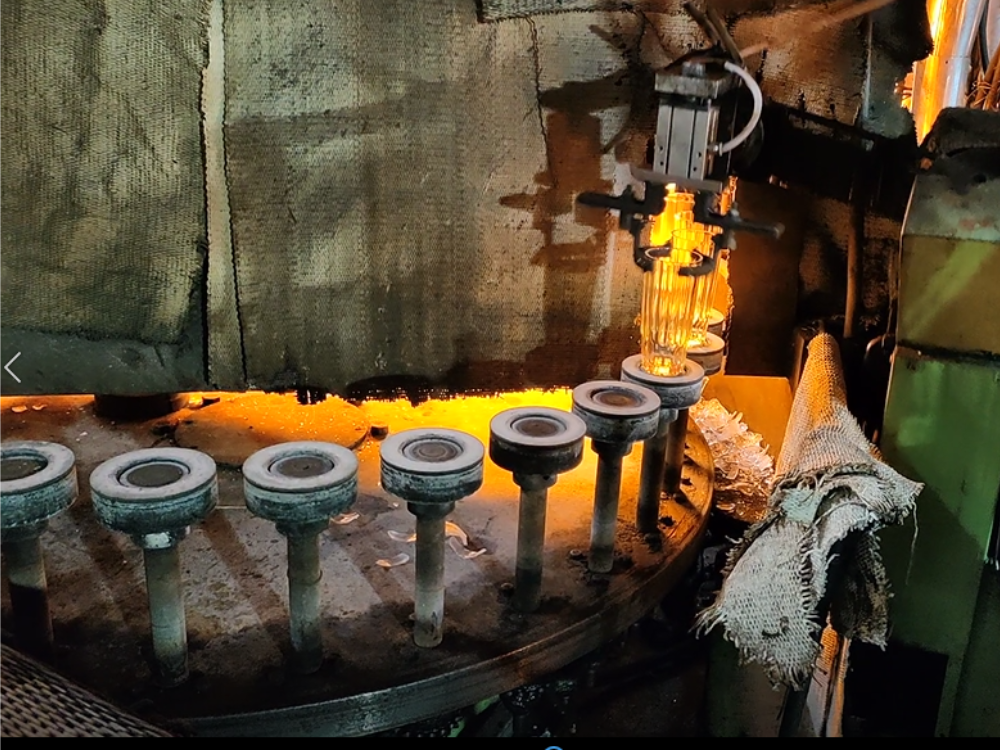
Glass cup forming: in drinkware, the customization levers a supplier advertises map onto specific production stages — mold, forming, decoration and packing.
The evaluation gap: three questions that decide whether a program launches
Industry procurement discussions in glass drinkware tend to reduce to three frictions. The first is forecast risk: retail buyers want a differentiated item but cannot absorb a container-scale commitment on an unproven design. The second is validation: size, weight, rim finish and packaging are difficult to approve from a specification sheet alone. The third is accountability — whether one party owns the mold, the decoration, the packaging and the inspection, or whether responsibility is split across an agent and an unnamed factory.
A manufacturer that answers all three questions in a single record is easier to move into execution. That is the practical value of an OEM/ODM capability statement: not a marketing claim, but a set of commitments a buyer can translate into RFQ terms, sample criteria and acceptance clauses.
What LAKOTTO states about its production capability
The capability record is short and specific, which is what makes it usable in a sourcing file.
| Capability | Stated term |
|---|---|
| Production mode | OEM / ODM |
| Customization scope | Size, shape, material, glass color, package, logo |
| Minimum order quantity | 3,000 pcs in the production record; product records describe flexible MOQ, with the glass cake stand KTPL1572A-A listed at 1,000 pcs |
| Lead time | 30–45 days |
| Quality control | 100% test |
| Export markets | Europe, the Americas, Southeast Asia |
| Samples | Free samples, trial order at first accepted |
| After-sales | Breakage-rate control and professional packaging for safe transport; clear and prompt return and exchange process |
| Scale reference | 10,000+ m² site, 100 employees, 10 designers, 150+ partner glass factories, 4,000+ m² warehouse |
Two details deserve a buyer's attention. The first is the difference between the record-level MOQ of 3,000 pcs and the 1,000 pcs listed on the glass cake stand KTPL1572A-A: quantity floors are set product by product, not by a single blanket rule. The second is the stated quality-control method — 100% test rather than sampling — which is meaningful only if the buyer also defines what is tested and to which tolerance.
OEM versus ODM: what actually changes on the factory floor
In glass drinkware, the customization levers listed by a supplier map directly onto production variables. Reading them as production decisions rather than menu options is what separates an informed RFQ from a price request.
Size and capacity are mold decisions
Changing the diameter, height or volume of a pressed or blown item generally requires tooling work, so size and capacity customization is not a decoration-stage adjustment. This is why a supplier that states OEM and ODM service as "any sizes, designs, capacity, packages" on its product records is, in practice, offering mold development inside the OEM scope. LAKOTTO's company profile lists new product design and development and mold development as part of its one-stop service, alongside customized packaging design and private label and branding.
Material choice changes the temperature envelope
Material is listed as a customization field, and the product records show why it is a technical one. The recycled glass model KTBT1446A is rated for an instantaneous temperature difference of -30 to 160 degrees Celsius. The wine glass KTG1139, in soda lime glass, carries the same -30 to 160 degrees Celsius instantaneous differential and separately notes a high-borosilicate material temperature range of 400 to 500 degrees Celsius. A buyer who changes material without restating the intended use — iced drinks, hot beverages, dishwasher cycles — is changing performance, not only cost.
Color, logo and packaging are decoration and logistics decisions
Glass color, logo and packaging are the levers most often exercised on an existing mold, which makes them the fastest route into a private-label program. They also carry compliance consequences: LAKOTTO's RoHS certificate, CTT2111031272EN, issued by Zhejiang Consumer Testing Technology Co., Ltd. on 7 November 2021, is scoped to glassware products with metal parts, coatings or decorations. Adding decoration can therefore move a product into a different testing scope, and the documentation should be updated with it rather than filed once at onboarding.
Two reference models: KTBT1446A and KTK0370-2
The clearest way to read a capability statement is against the products it is claimed for. Two LAKOTTO models illustrate two different forming routes and, therefore, two different customization economics.
KTBT1446A — recycled glass, 850 ml
General specifications for KTBT1446A are a top diameter of 80 mm, base diameter of 95 mm, height of 247 mm, weight of 610 g and capacity of 850 ml, packed 12 pcs per carton in bulk. The item sits inside a recycled glass family that also covers recycled glass tumblers, recycled glass bottles, recycled glass mugs and recycled glass jars. For buyers with sustainability-led assortment requirements, the relevant point is that recycled glass carries the same OEM/ODM terms as conventional glass — any sizes, designs, capacity and packages — with the -30 to 160 degrees Celsius instantaneous temperature differential stated on the record.
KTK0370-2 — machine-pressed tumbler, 400 ml
KTK0370-2 is a 400 ml glass tumbler in high borosilicate glass, machine-pressed, with a top diameter of 78 mm, base diameter of 65 mm, height of 140 mm and weight of 420 g. Pressed forming is a different tooling path from the hand-blown items in the portfolio, such as the double wall glass KTDW0721-GGL — 340 ml, hand-blown high borosilicate with ion plating — and from the machine-blown stemmed wine glass KTG1139. For a buyer, the practical distinction is that a pressed tumbler and a hand-blown double-wall item rarely share a development timeline or a quantity floor, even when both are quoted under the same OEM/ODM framework.
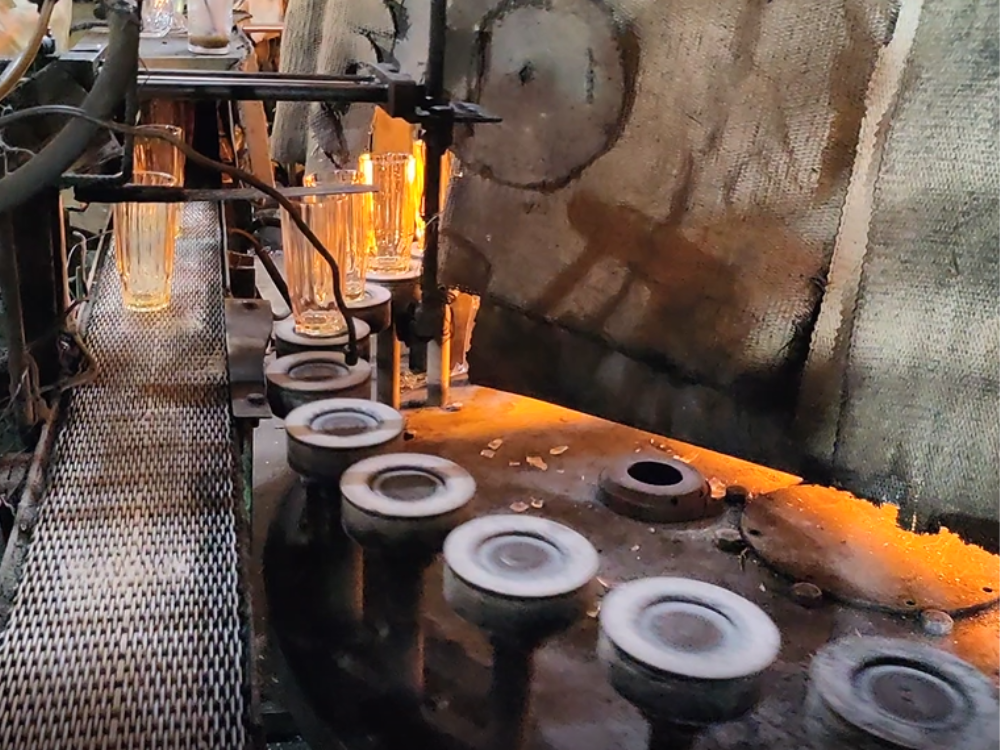
Forming and finishing: pressed, machine-blown and hand-blown routes imply different tooling and different minimum quantities within one supplier's portfolio.
Samples, MOQ and lead time in practice
The commercial terms published by LAKOTTO are unusually specific for a supplier capability page, and they are worth reading literally rather than as reassurance.
| Term | Stated position |
|---|---|
| Sample policy | Free samples, trial order at first accepted |
| Minimum order quantity | 3,000 pcs in the production record; product records state flexible MOQ; KTPL1572A-A listed at 1,000 pcs |
| Lead time | 30–45 days |
| Delivery terms | FOB, DDP, CIF, EXW |
| Acceptance | Pre-shipment inspection by the supplier's QC team; option for third-party inspection before shipment; verification on arrival at destination (optional) |
| Payment terms | 10% T/T with 90% before shipment; 90% against copy B/L; 100% T/T in advance; 30% deposit with 70% balance before shipment |
Three practical readings follow. First, free samples are described as tied to a trial order at first acceptance, not as an unconditional sample program — a buyer should confirm in writing what the sample commitment covers and at which point it converts into a trial order. Second, MOQ is a product-level variable: the 3,000 pcs figure applies to the production record as a whole, while the cake stand record shows 1,000 pcs, so an RFQ that assumes one number across a mixed assortment will misstate the commitment. Third, a 30–45 day lead time is a production window; the record does not state whether sample development or ocean transit sits inside it, so the start point should be fixed in the quotation.
Where the capability has been applied: three retail programs
LAKOTTO's published case records describe three long-running retail relationships that show how customization and packaging coordination behave at volume.
- A wholesale distributor and home goods retailer in Brazil, supplied for five years at 20–30 full containers per month, with coordinated packaging across a glassware range. The stated result is a broader product offering for local retailers and faster turnover of glassware items.
- A hypermarket and supermarket chain in Russia, five years at 20–30 full containers per month, with custom-designed glassware and packaging adapted to multiple store formats for stable in-store merchandising.
- A retail chain and supermarket in Poland, five years at 20–30 full containers per month, with custom-branded glassware and matching packaging.
Across all three, the recurring element is not a single product but assortment and packaging coordination — the part of an OEM/ODM relationship where design flexibility and packaging logistics have to be managed together. These are supplier-reported program descriptions: they indicate scale and application pattern rather than audited performance data.
Market signals that make manufacturing flexibility matter
Three published data points frame why supplier-side flexibility is being tested harder than it was a few years ago.
- Grand View Research valued the global glass drinkware market at USD 14.0 billion in 2024, with Europe accounting for a 33.0% revenue share — a large, mature base in which differentiation is usually won inside assortment and packaging rather than at category level.
- The same source puts the combined share of the top five glass tableware players — Arc International, Bormioli Rocco, Libbey, Oneida and Sisecam Glassware — at 26% in 2025. A market where the leading five hold roughly a quarter of value is, by construction, one where mid-sized and specialist manufacturers carry the rest of the assortment.
- Chinese exports of home glass products under HS 7013 to Brazil reached close to USD 200 million in 2024, an increase of 53% on approximately USD 130 million in 2023, according to trade analysis published by Garbo Glassware.
Regulatory pressure runs in parallel. Food-contact glass drinkware placed on the EU market must comply with Regulation (EC) No 1935/2004 and must be manufactured in accordance with Good Manufacturing Practices under Commission Regulation (EC) No 2023/2006. For a supplier, that means customization requests — new decoration, new coating, new packaging — have to be checked against documentation scope each time, not once at onboarding.
One classification note matters for landed-cost work: HS 701337 covers drinking glasses that are not stemware and are neither lead crystal nor glass-ceramics. A portfolio spanning tumblers, stemware and bottles therefore maps to more than one customs line, and a single blended duty assumption will misprice a mixed order.
Manufacturer flexibility versus traditional sourcing models
| Dimension | Trading / agent model (general market pattern) | Manufacturer OEM/ODM model as stated by LAKOTTO |
|---|---|---|
| Design changes | Routed to a third-party factory; iteration typically slows | Design and mold development listed in-house, with customization across size, shape, material, glass color, package and logo |
| Quantity floor | Often set by the producing factory late in negotiation | Stated in the production record with SKU-level variation (3,000 pcs vs 1,000 pcs) |
| Validation | Sample arranged through the agent, cost negotiated case by case | Free samples tied to a first trial order |
| Quality ownership | Split between agent and factory | 100% test plus pre-shipment inspection, with third-party inspection as an option |
| Documentation | Assembled on request | BSCI 24-0233922 (APCER), ISO 9001 0070024Q54439R2S, ISO 14001 03423E30695R3M, RoHS CTT2111031272EN |
Limits of the model. Flexibility of this kind is a structural commitment, not unlimited elasticity. The published floor is a real floor: even the lowest MOQ on record, 1,000 pcs for KTPL1572A-A, is a volume commitment well above single-unit sampling, and the general production record states 3,000 pcs. A 30–45 day lead time is a production window that only starts once size, decoration and packaging are approved, so a buyer who changes artwork mid-window loses the schedule. Free samples are explicitly tied to a first trial order rather than offered unconditionally. And because LAKOTTO operates with a network of 150+ partner glass factories alongside its own 4,000+ m² warehouse, consistency across a large mixed assortment depends on the inspection regime actually being applied — which is why the optional third-party pre-shipment inspection is worth budgeting rather than skipping. Buyers requiring sub-1,000-piece runs, or a single-facility supply chain with no partner-factory routing, sit outside this fit.
Documentation checkpoints before execution
Certificate numbers are only useful if someone checks them, and two of the listed certificates carry validity dates that should be reconfirmed at the time of the order.
| Document | Number | Issuer | Validity noted on record |
|---|---|---|---|
| BSCI | 24-0233922 | APCER | Issued 1 Dec 2024; expires 1 Dec 2026 |
| ISO 9001 | 0070024Q54439R2S | CNCA | 25 Nov 2024 – 24 Nov 2027 |
| ISO 14001 | 03423E30695R3M | CNCA | 28 Nov 2023 – 1 Dec 2026 |
| RoHS | CTT2111031272EN | Zhejiang Consumer Testing Technology Co., Ltd. | Issued 7 Nov 2021 |
The company profile additionally states audits and certifications covering Sedex/SMETA, FSC, Disney FAMA and LFGB. For a food-contact program, the practical request set is a current declaration of compliance, product-specific test reports for the decorated version actually ordered, and confirmation of which document covers packaging as well as the article itself.
Structuring an RFQ around a capability statement
Because the capability terms are explicit, they can be converted into a short RFQ checklist that prevents most execution-stage surprises.
- Split the assortment by forming route — pressed, machine-blown, hand-blown, recycled — and request MOQ and tooling status separately for each group.
- State the intended use per SKU so that material is selected against the -30 to 160 degrees Celsius instantaneous differential rather than against price alone.
- Confirm the MOQ in writing per item, including packaging, since the record-level 3,000 pcs and the 1,000 pcs on KTPL1572A-A do not describe the same commitment.
- Define the inspection standard and decide in advance whether a third-party pre-shipment inspection is required.
- Attach the compliance request set — declaration of compliance, heavy-metal release test reports, and decoration-specific documents where coatings or metal parts are involved.
- Fix the start point of the 30–45 day lead time, typically approval of size, artwork and packaging artwork.
Future outlook
Two directions look likely to shape how capability statements are read. The first is documentation depth: as EU food-contact requirements continue to be applied item by item, a supplier that can pair a customization offer with a current, product-specific document set will be easier to approve than one that cannot. The second is assortment economics. With the top five glass tableware players holding 26% of value and demand in markets such as Brazil expanding quickly, mid-sized manufacturers compete less on a single hero SKU and more on how efficiently they can carry a wide, packaging-coordinated range. Customization scope, MOQ structure, sample policy and lead time are the operating variables in that competition — and they are best tested on a small trial before they are relied on at container scale.
FAQ
What customization does LAKOTTO accept under OEM and ODM?
LAKOTTO's production record lists OEM and ODM services with customization of size, shape, material, glass color, package and logo. Product records state OEM and ODM service as any sizes, designs, capacity and packages, and the company profile adds new product design and development, mold development, customized packaging design, and private label and branding.
Are samples free, and under what conditions?
Product records state free samples with a trial order at first accepted. That wording links the sample offer to a first trial order rather than describing an unconditional sample program, so buyers should confirm in writing what the sample covers and when it converts into a trial order.
What is the minimum order quantity?
The production record lists an MOQ of 3,000 pcs, while product records describe flexible MOQ and the glass cake stand KTPL1572A-A lists 1,000 pcs. MOQ is therefore set per SKU and should be confirmed item by item in a quotation rather than assumed as a single figure across an assortment.
What lead time applies, and what does it include?
The production record states a lead time of 30–45 days. It does not specify whether sample development and ocean transit fall inside or outside that window, so the start point — typically approval of size, artwork and packaging — should be fixed in the quotation.
How is quality controlled, and can a buyer inspect?
The production record states 100% test. Acceptance terms include pre-shipment inspection by the supplier's QC team, an option for third-party inspection before shipment, and optional verification on arrival at destination. The listed ISO 9001 certificate is 0070024Q54439R2S, issued by CNCA, valid from 25 November 2024 to 24 November 2027.
Which markets and product categories does LAKOTTO serve?
LAKOTTO exports 99% of output, with main markets in the EU, South America and Asia, and stated export markets of Europe, the Americas and Southeast Asia. The published portfolio covers glass mugs, double wall glass, wine glasses, champagne glasses, cocktail glasses, beer glasses, highball glasses, pint glasses, shot glasses, glass water bottles, recycled glass mugs and recycled glass bottles. Case records describe five-year programs with retail customers in Brazil, Russia and Poland at 20–30 containers per month.
¿Tiene preguntas o necesita más detalles?
Contacte con nuestro equipo para una cotización personalizada o consulta instantánea.
Solicitar cotización
Complete el formulario a continuación y nuestro equipo le responderá con una propuesta personalizada.
Chat directo de WhatsApp
¿Prefiere chatear en tiempo real? Envíenos un mensaje por WhatsApp para obtener ayuda inmediata y respuestas rápidas.
- Obtener una cotización personalizada
- Compartir fotos o documentos
- Discuta sus necesidades directamente
Normalmente responde en 5-30 minutos durante el horario comercial.