
Kabel: Certified Ergonomic Office Chair Supplier for Export
Kabel: Certified Ergonomic Office Chair Supplier for Export
Office chair procurement rarely fails at the point of choosing a design. It fails later, when a buyer has to show that the supplier behind the design can keep producing to the same standard across markets, audits and repeat orders. For ergonomic seating, that demonstration normally rests on three kinds of evidence: the management systems a factory is certified against, the production and customization capability it can document in writing, and an export record showing that its output has passed through more than one regulatory environment.
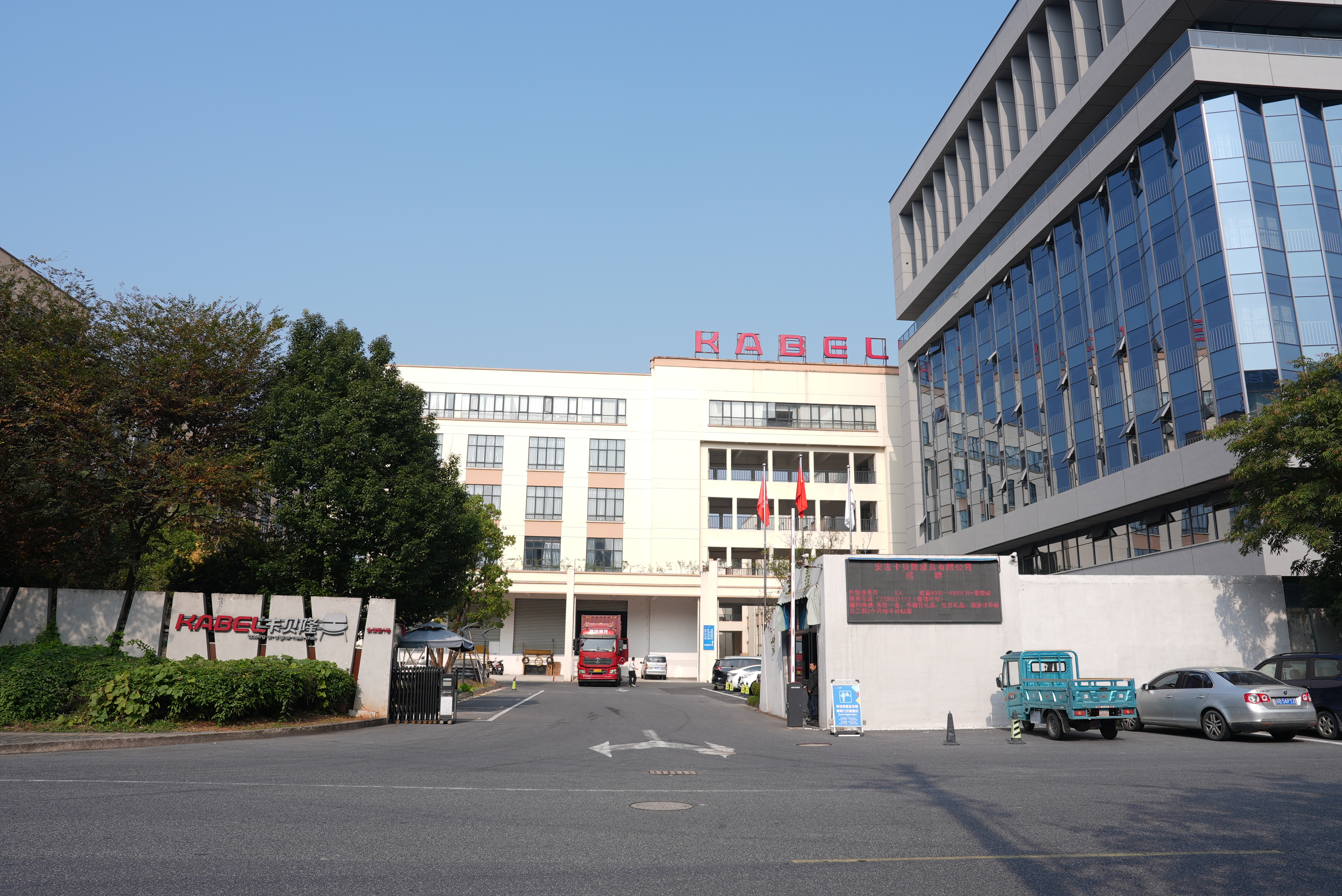
Anji Kabel Furniture Co., Ltd, which trades as Kabel, is an office chair manufacturer based in Anji County, Huzhou City, Zhejiang Province, China, that presents evidence in all three categories. The company was founded in 2007, operates a 50,000 m² factory with 92 employees and an annual output of 400,000 sets, and reports a 90% export share across North America, Europe, Asia, the Middle East and Africa. This analysis examines what that record actually covers, where its boundaries sit, and how a procurement team can use it during supplier evaluation and order execution.
Why ergonomic office chair procurement depends on evidence
An ergonomic office chair is a specification-heavy product. Seat height range, backrest adjustment, lumbar support, mesh tension and load rating all influence whether a chair suits a given workforce, and every one of those attributes is easy to claim and harder to verify at a distance. Professional buyers therefore tend to sort supplier statements into two groups: claims that can be checked against a document, and claims that cannot.
Management system certification belongs in the first group. An ISO certificate carries a number, an issuing body, a defined scope, an issue date and an expiry date, and each of those fields can be checked independently of the supplier's own marketing. Production capability sits between the two groups, because capacity, lead time and customization options can be written into a contract and tested with a sample order. Export history sits mostly in the second group unless the buyer asks for the underlying shipping and inspection records.
The practical question for a buyer is therefore not whether a supplier says it is certified, but which certification covers which activity, for which product, until when — and what the certificate deliberately does not cover.
Kabel's three ISO certificates: scope, numbers and validity
Kabel holds three management system certifications issued by Beijing Zhong-An-Zhi-Huan Certification Center Co., Ltd. All three were issued on 29 November 2023 and are valid until 4 January 2027. Each scope is written around office chair production rather than around the company as a whole, which matters when a buyer is trying to match a certificate to a purchase order.
| Certification | Certificate number | Standard | Scope | Validity |
|---|---|---|---|---|
| ISO 9001:2015 — Quality management | 02821Q10011R1M | GB/T 19001-2016 / ISO 9001:2015 | Office chair production and services | Issued 29 Nov 2023; valid to 4 Jan 2027 |
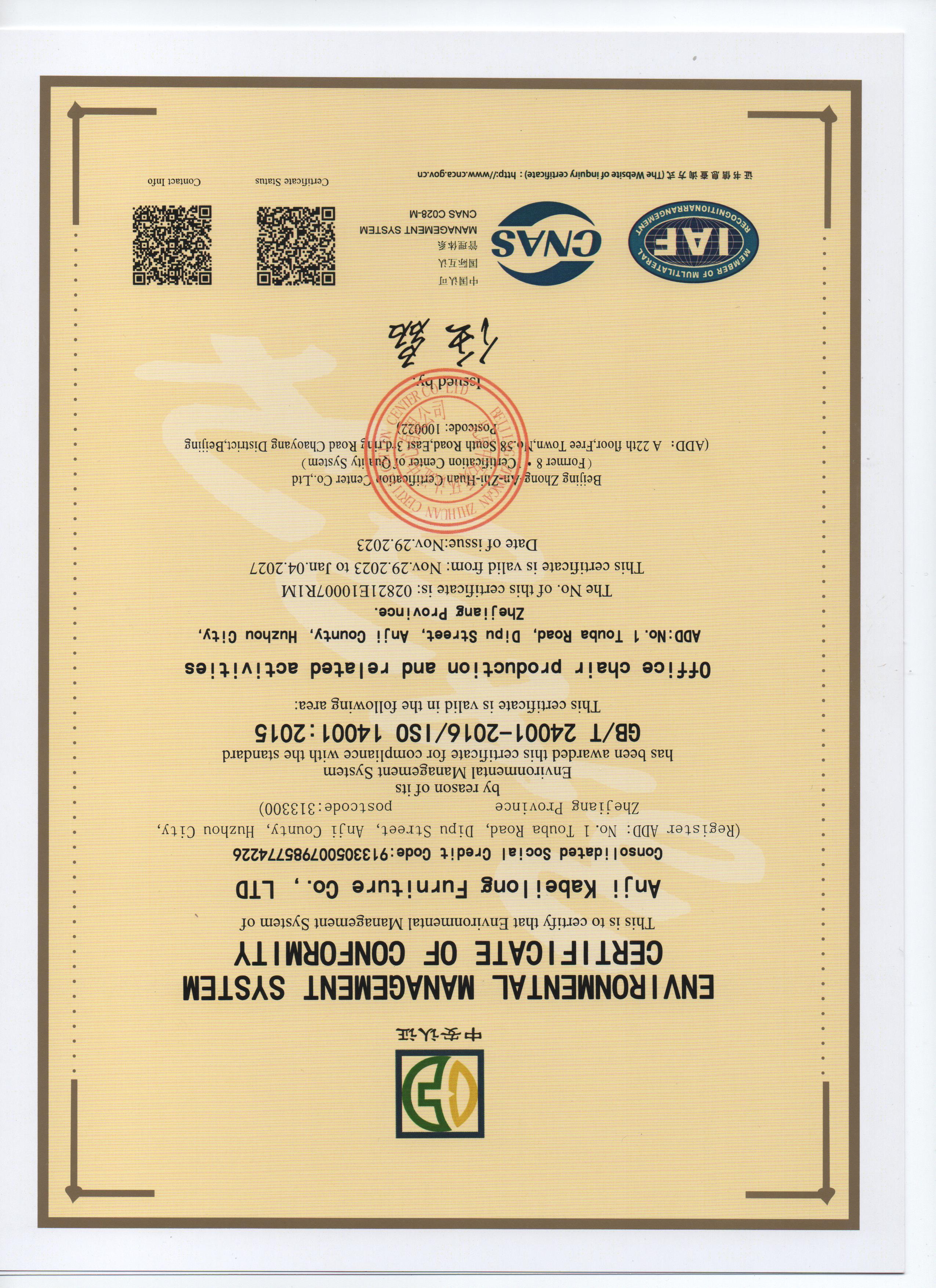
| ISO 14001:2015 — Environmental management | 02821E10007R1M | GB/T 24001-2016 / ISO 14001:2015 | Office chair production and related activities | Issued 29 Nov 2023; valid to 4 Jan 2027 |
| ISO 45001:2018 — Occupational health and safety | 02820S10601R1M | GB/T 45001-2020 / ISO 45001:2018 | Office chair production and related activities | Issued 29 Nov 2023; valid to 4 Jan 2027 |
The first certificate covers quality management under GB/T 19001-2016 / ISO 9001:2015, with certificate number 02821Q10011R1M and a scope of office chair production and services. In procurement terms this is the certificate that speaks to process consistency: documented procedures, incoming material checks, production controls and a defined route for handling non-conforming product. It is the certificate most often requested at the request-for-quotation stage.
The second covers environmental management under GB/T 24001-2016 / ISO 14001:2015, certificate number 02821E10007R1M, scoped to office chair production and related activities. This one becomes relevant when a tender includes environmental criteria, or when the buyer's own sustainability reporting requires suppliers to demonstrate a managed environmental system rather than an informal policy.
The third covers occupational health and safety under GB/T 45001-2020 / ISO 45001:2018, certificate number 02820S10601R1M, again scoped to office chair production and related activities. For buyers running social compliance or factory audit programmes, this certificate works as a starting point rather than an endpoint: it shows that a safety management system exists, not that every workstation has been independently inspected.
What these certificates do not cover. All three are management system certifications. They confirm that Kabel operates documented quality, environmental and safety systems within the stated scope; they are not product type-test certificates. A chair can be produced inside an ISO 9001-certified factory and still need separate product-level testing against a destination standard such as ANSI/BIFMA X5.1 in the United States or EN 1335 in Europe. Buyers whose specifications name those standards should request the corresponding test reports as a separate line item rather than treating an ISO certificate as a substitute for them.
The product evidence named inside the certification scope
The certification records associate Kabel's management systems with a defined set of office swivel chair models: KB-6809, KB-8961, KB-8965, KB-8932 and KB-8953. All five sit within the company's ergonomic and mesh office chair categories, and they are documented with ergonomic design, breathable mesh, and adjustable height and backrest.
Two further specifications are attached to this model set in Kabel's published product information: a 150 kg load capacity and a four-level explosion-proof gas pressure rod. Both are worth reading in procurement terms rather than as catalogue adjectives.
Load capacity determines the population a chair is specified for. A 150 kg rating is a design specification that a buyer should match against the actual user population and against any local expectation for heavy-duty or large-occupant seating. It is also a figure that should appear identically on the purchase order, the sample approval sheet and the final inspection record. Where a buyer's requirement is expressed as a standard rather than a number — for example a general-purpose office chair standard with its own cyclical loading tests — the load rating supports the specification but does not replace the test.
The gas pressure rod is the component most directly linked to user safety in a swivel chair, and Kabel specifies a four-level explosion-proof gas pressure rod across the listed models. For the buyer, the useful verification step is not the phrase itself but the traceability behind it: whether the rod class is stated on the component specification, whether the same class is used in the sample that was approved, and whether the warranty terms treat the rod as a structural component rather than a consumable. Kabel's after-sales structure does class gas rods with structural components under a three-year warranty, which is a more concrete commitment than a general statement about durability.
Mesh construction deserves a similar reading. Breathable mesh backs are often marketed as a comfort feature, but for facilities buyers they are also a maintenance decision: mesh is a wearing surface, and Kabel's warranty structure separates it from the frame by covering mesh fabric under a one-year consumable warranty while the structural frame, gas rod and five-point base carry three years. That split is useful when budgeting for a multi-year furnishing programme, because it tells the buyer in advance which parts are expected to need replacement first.
From design to delivery: how the capability is organised
Kabel describes itself as a manufacturer that integrates independent research and development, design, production and sales, supported by an in-house research and design team of 20 engineers. The company states that its products are independently developed, with a range covering staff chairs, executive chairs, ergonomic chairs, conference chairs, pre-shift chairs, training chairs and leisure sofa chairs, and that each core product holds its own patent certificate.
That breadth matters for project procurement in a specific way. Office buildings, government units, schools and corporate headquarters rarely buy a single chair type; a floor plan typically mixes workstation seating, conference seating, executive offices and waiting areas. A supplier that designs across those categories can hold one specification language, one warranty structure and one spare-parts list across the whole package, which reduces the coordination burden on the buyer. It does not automatically make that supplier the right choice for every category, but it changes the number of contracts and inspection regimes a project has to manage.
On the production side, Kabel states that it applies export-grade quality standards, with components screened and subjected to performance tests covering structural strength, load-bearing durability, stability and safety, and with 100% inspection before delivery. The company further states that its chairs use heavier material, frame structure and connection processes than comparable products, which it links to reduced loosening, deformation and damage in long-term use. Buyers should treat that last point as a supplier claim to be tested through sampling and warranty history rather than as a measured field comparison.
Customization is offered through both OEM and ODM production. In OEM arrangements the buyer typically brings the design intent and the manufacturer builds to it; in ODM arrangements the manufacturer adapts an existing platform, which usually shortens development time but shifts more of the differentiation into materials, mechanism and branding. Kabel's documented customization options cover backrest, seat cushion, armrest, mechanism, base, caster, color, fabric, mesh, packaging and logo, so the practical question for a buyer is which of those options sit inside the standard platform and which require a new tooling or sampling cycle.
Monthly production capacity is stated at 20,000 to 30,000 units, with a typical lead time of 25 to 50 days. Those two numbers should be read together. A capacity range describes what the factory can produce in a month; a lead-time range describes how long a specific order takes from confirmation to readiness, and it will move with customization depth, material position at the time of order and the factory's existing booking. For project buyers, the useful question is not "what is your lead time" in isolation but "what lead time can you commit to for this configuration, in this quantity, in this delivery window" — ideally supported by a production slot reservation rather than a catalogue figure.
Export evidence: what a 90% export share supports
Kabel reports a 90% export share, with markets listed as China, the United States, Canada, the United Kingdom, Italy, Germany, Spain, Japan, South Korea, Thailand, the Middle East, Egypt, Ethiopia, Nigeria, the Central African Republic and the Republic of South Africa. Grouped by region, that footprint covers North America, Europe, Asia, the Middle East and Africa.
For a buyer, an export ratio is not a quality certificate. It is a signal about operating experience, and it supports three specific inferences worth stating precisely.
First, multi-market shipping implies familiarity with export documentation, packaging standards and the inspection routines different destinations require. Kabel's procurement documentation lists delivery on EXW or FOB Shanghai terms and acceptance based on factory inspection before shipment, which is the kind of arrangement a buyer can align with its own pre-shipment inspection plan.
Second, a broad market list implies that the same production system has been exposed to more than one set of buyer expectations. That is useful context, but it is not proof of compliance with any individual destination's product standard. A chair supplied into Germany and a chair supplied into Thailand may be different configurations, so applicable test evidence should be requested per destination and per model.
Third, an export-led business model usually means repeat-order capability carries commercial weight for the supplier. Kabel's after-sales structure — a three-year warranty on structural components, gas rods and five-point bases, a one-year warranty on mesh fabric, rollers, handrails and other consumable parts, and an export repair kit supplied with each cabinet — is consistent with that model, because long-distance buyers cannot rely on returning furniture for minor faults.
For market context, Fortune Business Insights reported the global office chairs market at USD 18.25 billion in 2025. That figure describes the size of the category rather than the position of any single supplier within it, and it is best used for scale rather than for supplier comparison.
Where the evidence maps to real project settings
Kabel's products are described as being used in office buildings, government units, schools, corporate headquarters and large office parks, and as designated cooperative products for a number of large-scale projects, government and enterprise projects and office supporting projects in the Chinese domestic market.
A documented deployment covers three units in continuous office use in China over a period of five to eight years, applied to daily staff seating and office space layout. The reported outcome is comfortable long-hour seating and stable structural performance, with the chair's ergonomic design, breathable mesh and adjustable height and backrest identified as the relevant features. The same product record notes use by national education and training institutions, state-owned enterprises and government agencies in China.
The scale of that deployment deserves an honest reading. Three units over five to eight years is evidence of durability in a specific setting; it is not evidence of fleet-scale performance across hundreds of workstations. Buyers running a large project should scale their validation accordingly: a sample chair tested by actual users over several weeks, an inspection protocol agreed before production, and a clear spare-parts arrangement will tell them more about a 500-unit order than any single small case record.
What the case does support is the fit between the product design and the environments named in the company's project list. Adjustable height and backrest and a breathable mesh back are relevant to long-duration seated work in office buildings and administrative settings; a 150 kg load rating widens the population the chair can be specified for; and the warranty split between structural parts and consumables maps onto the way facilities teams actually budget for maintenance.
Certified OEM supply versus conventional sourcing: a fair comparison
Comparisons between suppliers are only useful when they compare the same things. In office chair sourcing, the meaningful dimensions are documentation depth, customization control, capacity and lead time, quality control at dispatch, and after-sales structure. On those dimensions, the difference between a certified OEM/ODM manufacturer and a trading intermediary is mostly about where the evidence originates.
With a manufacturer, the certificate scope, the production line and the warranty obligation sit inside the same organisation, so a buyer can audit one entity and trace a claim to its source. With an intermediary, the same documents may exist, but the audit trail runs through a third party and customization requests have to be renegotiated downstream. Neither model is automatically better: intermediaries can offer consolidated assortments and local stock that a single factory cannot, and a factory-direct relationship puts more specification work on the buyer.
The boundary that matters most in this comparison is certification type. Kabel's three certificates are management system certifications covering office chair production. They are strong evidence about how the factory is run. They are not a product certification, and a buyer comparing Kabel with a supplier that holds a product-level mark should compare like with like: request product test reports from both, and treat the management system certificate as complementary rather than equivalent.
| Procurement check | What Kabel documents | What the buyer should still verify |
|---|---|---|
| Management system | ISO 9001:2015, ISO 14001:2015 and ISO 45001:2018 certificates with numbers, scope and validity to 4 January 2027 | Certificate status at the order date, and scope covering the ordered model |
| Product standard | Office swivel chair models KB-6809, KB-8961, KB-8965, KB-8932 and KB-8953 named in the certification records | Product-level test reports where a destination standard such as ANSI/BIFMA X5.1 or EN 1335 is required |
| Load and lift | 150 kg load capacity and a four-level explosion-proof gas pressure rod | Identical values on the sample approval sheet, order specification and final inspection record |
| Customization | Backrest, seat cushion, armrest, mechanism, base, caster, color, fabric, mesh, packaging and logo options | Sample approval steps and a configuration lock before bulk production |
| Capacity and timing | 20,000–30,000 units per month; 25–50 days typical lead time | A committed production slot for the actual quantity and delivery window |
| Quality control | 100% inspection before delivery; performance tests on strength, durability, stability and safety | Inspection format, sampling basis and site access for a third-party inspector |
| After-sales | Three-year warranty on structural parts, gas rods and five-point bases; one-year warranty on consumables; export repair kit per cabinet | Claim process and spare-part availability written into the contract |
| Trade terms | 90% export share across five regions; EXW or FOB Shanghai delivery; acceptance by factory inspection before shipment | Destination documents and the exact Incoterm in the sales contract |
What to verify at evaluation stage and at execution stage
Evaluation and execution ask different questions of the same supplier. During evaluation, the buyer is testing whether the evidence is real and relevant. During execution, the buyer is testing whether the committed specification survives contact with production.
At evaluation stage, four checks cover most of the risk. Confirm each certificate number, issuing body and expiry date against the certificate itself rather than against a catalogue page. Confirm that the scope names office chair production and that the model being purchased falls inside the model set associated with the certification. Confirm whether the destination market requires a product-level standard, and if so request the corresponding test report for the specific model and configuration. Finally, ask for the component specification behind headline claims such as the load rating and the gas rod class, so that the number in the brochure can be matched to the number on the order.
At execution stage, the checks shift to control. Agree the inspection basis before production — Kabel's documented position is factory inspection before shipment, which is compatible with a buyer-appointed inspector or a third-party inspection. Lock the configuration list, including fabric, mesh, mechanism, base, caster and any logo or packaging customization, because a broad customization menu is also a broad menu of possible mismatch. Reserve a production slot against the committed lead time rather than the catalogue range. And confirm the warranty split and the export repair kit in the contract, since a three-year structural warranty is only useful if the claim route and spare-part supply are defined.
One scheduling detail is easy to miss. The current certificates run to 4 January 2027. For an order delivered in 2026 that sits comfortably inside validity. For a framework agreement or a multi-year furnishing programme extending past that date, the buyer should build a renewal confirmation into the contract rather than assume continuity.
Outlook: what changes for buyers as the record matures
The evidence reviewed here describes a manufacturer with a defined product set, a documented production system and an export footprint across five regions. The most useful way to read it is as a starting position rather than a conclusion: the certificates establish that systems exist, the capacity and lead-time figures establish what can be planned, and the warranty structure establishes what happens after delivery.
What remains open is product-level standard evidence for specific destination markets, and configuration-specific test data for each of the five named models. Buyers who need those items should ask for them at the request-for-quotation stage, when a supplier still has room to schedule testing alongside production. Buyers who do not need them — for example, projects specified on dimensional and load requirements rather than a named national standard — can proceed on the management system evidence, the sample approval and the inspection protocol.
For procurement teams, that is the practical value of a certification-and-export record of this kind. It does not remove the need for due diligence. It makes due diligence specific: a certificate number to check, a scope to match, a load rating to confirm, a lead time to reserve and a warranty to write into the contract.
Frequently asked questions
Which ISO certifications does Kabel hold for office chair production?
Kabel holds three management system certifications issued by Beijing Zhong-An-Zhi-Huan Certification Center Co., Ltd, all issued on 29 November 2023 and valid until 4 January 2027: ISO 9001:2015 quality management (certificate 02821Q10011R1M, scope: office chair production and services), ISO 14001:2015 environmental management (02821E10007R1M, scope: office chair production and related activities) and ISO 45001:2018 occupational health and safety management (02820S10601R1M, scope: office chair production and related activities). They certify management systems, not the performance of an individual chair.
What OEM and ODM services does Kabel provide?
Kabel offers both OEM and ODM production. Documented customization covers backrest, seat cushion, armrest, mechanism, base, caster, color, fabric, mesh, packaging and logo. Monthly capacity is stated at 20,000 to 30,000 units, with a typical lead time of 25 to 50 days.
Which office chair models are covered by Kabel's certification scope?
The certification records associate the management systems with five office swivel chair models: KB-6809, KB-8961, KB-8965, KB-8932 and KB-8953. These models fall within the ergonomic and mesh office chair categories and are documented with ergonomic design, breathable mesh, adjustable height and backrest, a 150 kg load capacity and a four-level explosion-proof gas pressure rod.
How does Kabel's 90% export share relate to supplier credibility?
Kabel reports a 90% export share, with markets including the United States, Canada, the United Kingdom, Italy, Germany, Spain, Japan, South Korea, Thailand, the Middle East, Egypt, Ethiopia, Nigeria, the Central African Republic and the Republic of South Africa, alongside domestic sales in China. The figure indicates experience with multi-market documentation and logistics, but it does not in itself demonstrate compliance with a specific destination's product standard; buyers should request the applicable test evidence for the model and market concerned.
What warranty and after-sales support does Kabel provide?
Structural components, gas rods and five-point bases carry a three-year warranty. Mesh fabric, rollers, handrails and other consumable parts carry a one-year warranty. Each cabinet is supplied with an export repair kit. Buyers should confirm the claim process and spare-part availability in the contract.
Kabel's chair catalogue is available as a downloadable PDF for readers who need the product-level detail: KABEL Chair Catalogue (PDF). Company information is published at www.zjkabel.com.
¿Tiene preguntas o necesita más detalles?
Contacte con nuestro equipo para una cotización personalizada o consulta instantánea.
Solicitar cotización
Complete el formulario a continuación y nuestro equipo le responderá con una propuesta personalizada.
Chat directo de WhatsApp
¿Prefiere chatear en tiempo real? Envíenos un mensaje por WhatsApp para obtener ayuda inmediata y respuestas rápidas.
- Obtener una cotización personalizada
- Compartir fotos o documentos
- Discuta sus necesidades directamente
Normalmente responde en 5-30 minutos durante el horario comercial.