
Jusheng DKTEC Concrete Mixing Plant: Capability & Buyer Value
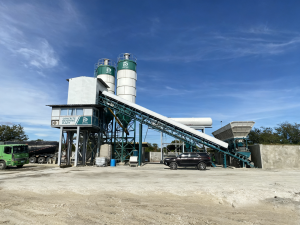
A concrete mixing plant integrates aggregate storage, weighing, mixing and control into one production system. Image: DKTEC.
The global concrete batch plant market was valued at USD 3.8 billion in 2024, and Asia-Pacific accounted for a 38% revenue share that year, according to market research published by Global Market Insights and Credence Research respectively. That concentration maps closely to where infrastructure programmes, precast capacity and ready-mix demand are physically located. For procurement teams entering the awareness and research stage, however, the more useful question is not how large the market is, but which suppliers can demonstrate repeatable metering accuracy, a documented product architecture, and a service model that survives past commissioning.
This industry reference profile examines Hangzhou Jusheng Machinery & Equipment Co., Ltd. — a Chinese concrete mixing plant manufacturer also referenced commercially as DKTEC — against the criteria buyers commonly apply when shortlisting batching equipment: manufacturing scale, product breadth, technical specification transparency, application fit, and stated operating limits.
What Buyers Are Actually Evaluating in a Concrete Mixing Plant
A concrete mixing plant — frequently written as a concrete batching plant in tender and specification documents — is a fixed or relocatable production unit that stores, weighs, batches and mixes aggregates, cementitious materials, water and admixtures to produce concrete of a defined grade. Its commercial value is decided less by headline output than by three operational variables: how accurately it doses, how consistently it repeats that dose across a shift, and how quickly it can be commissioned, relocated or reconfigured.
Three evaluation dimensions dominate early-stage supplier research:
- Type and scale fit. A 25 m³/h mobile plant and a 300 m³/h commercial plant solve fundamentally different problems. Neither substitutes for the other, and a mismatch here is expensive to correct after delivery.
- Metering discipline. Dosing tolerances for cement, water and admixtures are the most direct lever on concrete grade consistency and cement consumption.
- Delivery and lifecycle model. For export buyers, the supplier must handle customization, documentation, installation and commissioning — not fabrication alone.
Company Snapshot: Hangzhou Jusheng Machinery & Equipment Co., Ltd.
Hangzhou Jusheng Machinery & Equipment Co., Ltd. is a Chinese heavy-industry manufacturer established in 2015, headquartered in Hangzhou, Zhejiang, China. The company specialises in the research, development, manufacturing, sales and integrated engineering services of complete sets of concrete mixing and mining machinery, and its core product line is concrete batching plants. A DKTEC company profile records that the business transitioned from trading to robot-assisted production of mixing stations in 2017.
| Attribute | Recorded detail |
|---|---|
| Entity | Hangzhou Jusheng Machinery & Equipment Co., Ltd. (commercially referenced as DKTEC) |
| Established | 2015 |
| Headquarters | Zhongjiao Fortune Mansion, Gongshu District, Hangzhou, Zhejiang, China |
| Manufacturing facility | 120,000 m² |
| Workforce | Approximately 430 employees |
| Engineering resources | 80-engineer R&D team |
| Annual output | 2,000 units |
| Main product | Concrete batching plants (plus crushing, screening and conveying lines for mining aggregate processing) |
| Export ratio | 80% |
| Main markets | Middle East, Southeast Asia, Africa, Europe, Central Asia, West Asia, Australia, South America |
| Corporate website | www.dongkunchina.com |
Where the Manufacturing Strength Comes From
A 120,000 m² facility producing 2,000 units a year, supported by an 80-engineer R&D team, points to a standardised, platform-based production model rather than one-off fabrication. The HZS series is itself the evidence: mobile, engineering and commercial families share the same series designation, which is consistent with modular design, factory pre-assembly and fewer components to install on site.
An 80% export ratio is a second, frequently under-weighted signal. Serving the Middle East, Southeast Asia, Africa, Europe, Central Asia, West Asia, Australia and South America means the same platform has to be configured against different supply voltages, climate conditions, local concrete standards and site layouts. Export-led manufacturers typically accumulate this configuration experience as engineering documentation rather than as marketing material — which is precisely what a buyer needs to review before issuing a purchase order.
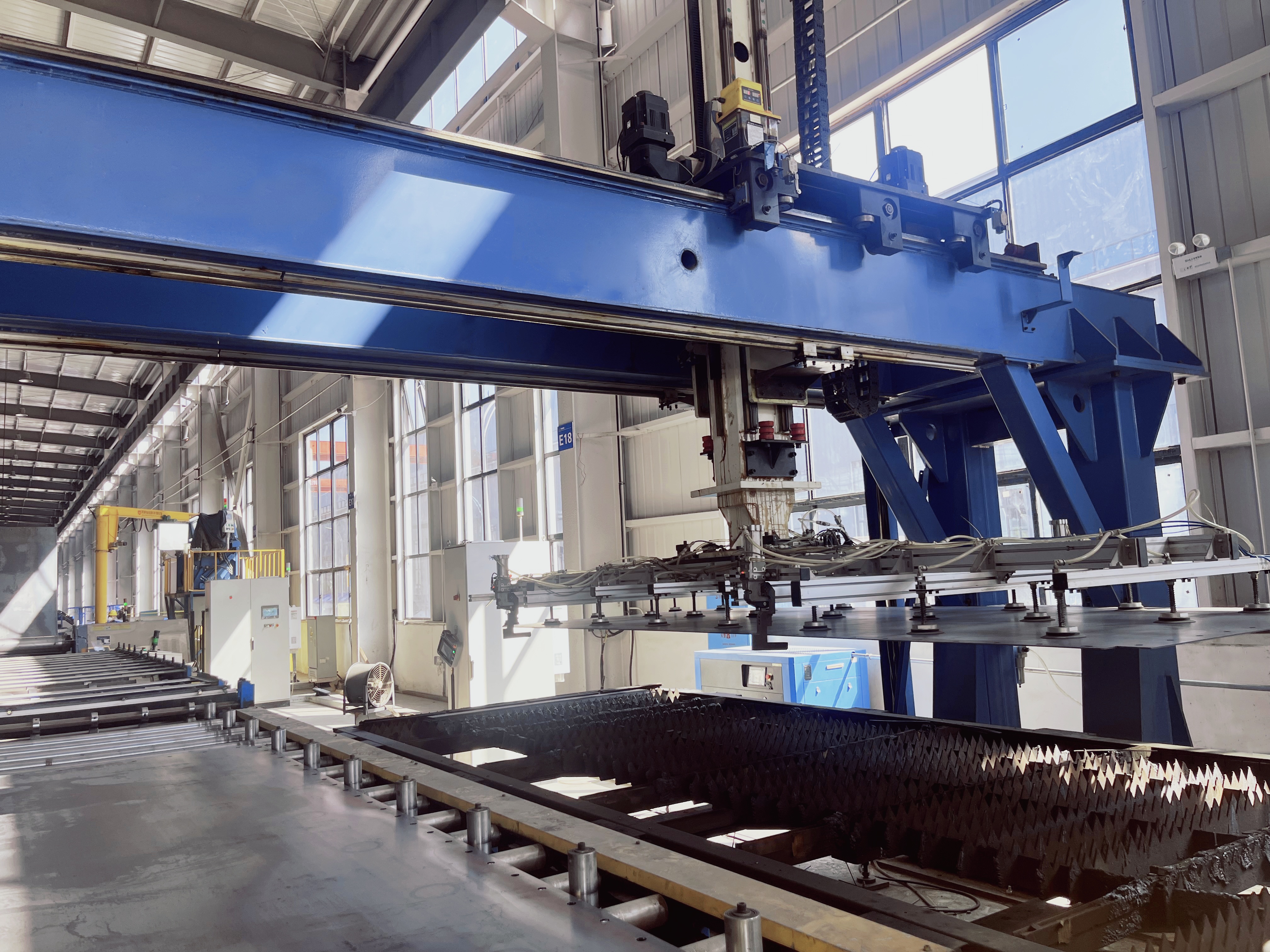
The 120,000 m² manufacturing base and 2,000-unit annual output underpin the modular HZS platform approach. Image: DKTEC.
Product Architecture: Three HZS Plant Families
In the available product documentation, the suffix pattern identifies the family: models designated with a “Y” are classified as mobile concrete mixing plants, models with a “G” are classified as engineering concrete batching plants, and unsuffixed models are classified as commercial concrete batching plants. All entries in the current range use a discharge height of ≥3.8 m, which allows direct loading into mixer trucks.
Mobile Concrete Mixing Plants (HZS25Y – HZS120Y)
| Model | Theoretical productivity | Installed capacity | Nominal mixer capacity | Dosing accuracy |
|---|---|---|---|---|
| HZS25Y | 25 m³/h | 60 kW | 500 L | Aggregate ±2%; cement, water, additive ±1% |
| HZS35Y | 35 m³/h | 65 kW | 750 L | Aggregate ±2%; cement, water, additive ±1% |
| HZS60Y | 60 m³/h | 100 kW | 1000 L | Aggregate ±2%; cement, water, additive ±1% |
| HZS90Y | 90 m³/h | 120 kW | 1500 L | Aggregate ±2%; cement, water, additive ±1% |
| HZS120Y | 120 m³/h | 160 kW | 2000 L | Aggregate ±2%; cement, water, additive ±1% |
Engineering Concrete Batching Plants (HZS60G – HZS180G)
| Model | Theoretical productivity | Installed capacity | Nominal mixer capacity | Dosing accuracy |
|---|---|---|---|---|
| HZS60G | 60 m³/h | 100 kW | 1000 L | Aggregate ±2%; cement, water, additive ±1% |
| HZS90G | 90 m³/h | 190 kW | 1500 L | Aggregate ±2%; powders, water, additive ±1% |
| HZS120G | 120 m³/h | 210 kW | 2000 L | Aggregate ±2%; powders, water, additive ±1% |
| HZS180G | 180 m³/h | 250 kW | 3000 L | Aggregate ±2%; powders, water, additive ±1% |
Commercial Ready-Mix Plants (HZS120 – HZS300)
| Model | Theoretical productivity | Installed capacity | Nominal mixer capacity | Weighing range and accuracy |
|---|---|---|---|---|
| HZS120 | 120 m³/h | 210 kW | 2000 L | Sandstone 600–2000 kg ±2%; cement 200–1200 kg ±1% |
| HZS180 | 180 m³/h | 250 kW | 3000 L | Sandstone 900–3000 kg ±2%; cement 300–1800 kg ±1% |
| HZS240 | 240 m³/h | 280 kW | 4000 L | Sandstone 900–4500 kg ±2%; cement 400–2500 kg ±1% |
| HZS270 | 270 m³/h | 350 kW | 4500 L | Sandstone 900–5000 kg ±2%; cement 400–2600 kg ±1% |
| HZS300 | 300 m³/h | 350 kW | 5000 L | Sandstone 900–5000 kg ±2%; cement 400–2600 kg ±1% |
The spread is deliberate. The range runs from a 25 m³/h trailer-mounted unit with a 500 L mixer to a 300 m³/h commercial plant with a 5000 L mixer and an installed capacity of 350 kW. Between those extremes, the 120 m³/h class appears in all three families — mobile, engineering and commercial — which is why it is often the first configuration evaluated by buyers who are not yet certain whether the project will stay in one location.
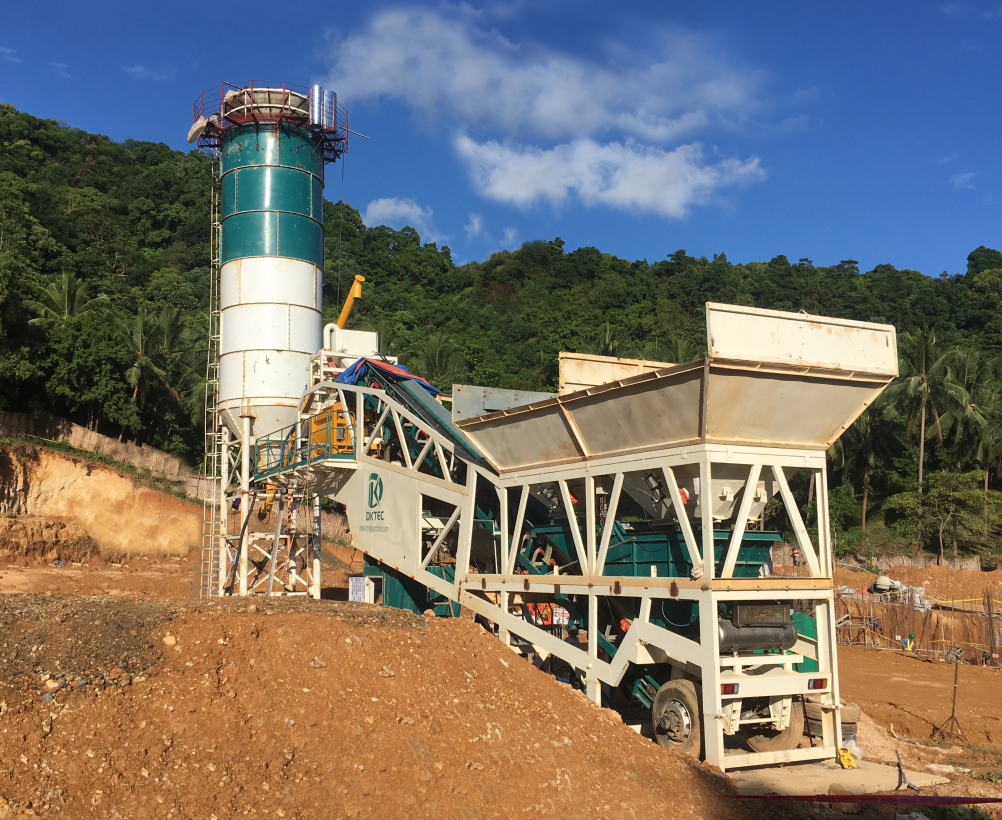
The HZS120Y mobile plant places the 120 m³/h class on an integrated towable chassis. Image: DKTEC.
Technical Explanation: What the Specification Numbers Actually Mean
Metering accuracy as the primary specification
Across the range, aggregate dosing is specified at ±2% and cement, mixing powder, water and additive dosing at ±1%, each within a defined weighing range rather than as an absolute figure. On the HZS300, for example, the sandstone range is 900–5000 kg at ±2%, while cement runs 400–2600 kg at ±1%. On the smallest unit, the HZS25Y, the corresponding ranges are 200–1000 kg for aggregate at ±2% and 50–300 kg for cement at ±1%. The accuracy figure is only meaningful together with the range, because it defines the material envelope the plant is engineered to handle.
Mixing: twin-shaft architecture and mixer sourcing
The mobile family is documented as twin-shaft mixer type throughout, with nominal mixer capacities stepping from 500 L on the HZS25Y to 2000 L on the HZS120Y. The HZS270 is specified with a MAO4500 twin-shaft compulsory mixer, and the HZS300 with a 5000 L mixer. For the engineering and commercial families, the documentation lists optional SICOMA, BHS or SDMIX twin-shaft forced mixers — a meaningful detail for buyers, because mixer selection is often the largest single variable in plant cost and the most direct influence on mixing uniformity.
Control and automation
The plants are documented as automatic batching and mixing units equipped with a fully automatic PLC control system. In the 120 m³/h class documentation, the control package includes recipe management, production reports and UPS power backup, with an industrial PC and 24-inch LCD monitoring on the HZS120 configuration, alongside emergency stop switches, anti-fall protection and dust-proof control cabinets. The practical effect on the smaller mobile units is single-operator management — the HZS60Y and HZS120Y are both documented this way.
Modularity, mobility and commissioning time
The engineering series uses a four-layer module design with sub-module pre-assembly and overall lifting, reducing the number of components installed on site. Mobile units are built on an integrated trailer chassis with axle and tyre transport, are commissioned within three days of arrival, and require only a level concrete surface — no deep civil foundations. That last point is not a minor convenience. On projects with a defined end date, foundation works are often on the critical path, and removing them from the sequence changes the project schedule itself.
Material flow, discharge and environmental control
Several documented design features target the failure modes that buyers discover only after commissioning. Seamless material flow technology is specified to prevent aggregate spillage during continuous feeding, with a stated 20% increase in conveying efficiency in expressway and commercial concrete scenarios. On large-scale commercial plants, a dual-pivot internal vibration structure is documented as improving vibration efficiency by 20%, addressing discharge problems with manufactured sand, fine sand and mineral powder. On the HZS180, a dual pneumatic or electro-hydraulic unloading design is specified to prevent material jamming, supported by a fully enclosed structure, pulse dust removal and low-noise transmission. On mega-scale ready-mix configurations, a fully enclosed standby hopper is documented as reducing open surface area by 75%, combined with a forced-cleaning membrane bag filter.
Optional digital and multi-plant features
The documented optional capabilities are worth noting because they indicate how the supplier expects buyer requirements to evolve. Online slump monitoring indicates slump in real time through mixer motor current curves. Intelligent powder silo level monitoring is specified with an inventory accuracy of ±2%, checkable through ERP, PLC or a mobile app. A “one operator, two plants” control option allows a single operator to run two mixing plants, with a stated 50% reduction in labour cost for that function. On the mechanical side, the documentation lists Keli load cells, AirTAC cylinders and SICOMA pneumatic butterfly valves on the 120 m³/h and 60 m³/h classes, together with optional 150 t powder silos and φ273 mm / φ219 mm screw conveyors.
Application Fit: Matching Family to Project Type
The application scenarios documented alongside the product range make the intended fit reasonably explicit:
- Mega-scale ready-mix production bases — continuous, high-volume supply with optional dual-plant control and smart silo level monitoring; the HZS270 and HZS300 sit at this end.
- Large-scale commercial concrete bases — core production equipment for high-volume ready-mix supply, where the HZS240 configuration is documented with four 30 m³ underground bunker silos, 1000 mm conveyors with double-sided maintenance walkways, and video surveillance at the belt tail and discharge port.
- City and industrial park ready-mix plants — the HZS120 to HZS240 band, documented with modular factory pre-assembly.
- High-speed railway projects — on-site production of high-grade concrete using a control system with automatic drop correction and precise pulse-based weighing compensation, plus dual-stage coarse and fine aggregate metering. The four-level modular design is specified for integrated hoisting and rapid installation.
- Expressway, bridge and airport projects — modular stationary plants assembled and disassembled for relocation, with optional steel structure foundations to reduce civil engineering cost.
- Small-scale, temporary and multi-site projects — the HZS25Y and HZS35Y for on-site or near-site production where the plant must move with the work front.
- Projects with frequent site transfers — the HZS60Y, HZS90Y and HZS120Y, positioned close to the job site to cut concrete transport distance and the associated environmental impact.
Market Trend Analysis
Three published data points frame the demand environment for concrete mixing plants:
- The global concrete batch plant market was valued at USD 3.8 billion in 2024 (Global Market Insights).
- Asia-Pacific held a 38% revenue share of that market in 2024 (Credence Research).
- The infrastructure segment accounted for 39.4% of the mobile concrete batch plant market in 2024 (Global Market Insights).
- Global exports of concrete or mortar mixers under HS code 847431 reached USD 276.9 million from China in 2023 (UN Comtrade / World Bank WITS).
Two readings follow. First, the infrastructure weighting of the mobile segment matches the observed product strategy: mobile platforms sized for road, bridge, rail and water conservancy work where the plant follows the work front. Second, the export figure confirms that China remains a primary fabrication base for this equipment category, which is why procurement teams in importing markets increasingly evaluate Chinese suppliers on documentation quality and configuration flexibility rather than on availability alone.
Comparison with Traditional Solutions — and Where the Limits Are
A conventional benchmark for comparison is the older pattern of small, manually supervised batching units, or the alternative of buying all concrete from a third-party ready-mix supplier and trucking it to site. The documented advantages of an integrated, automatically controlled plant over the first approach are measurable: cement, water and additive dosing specified at ±1% against manual control; modular pre-assembly that the manufacturer documents as reducing on-site installation workload by 20% on commercial configurations; and, on mobile units, commissioning within three days on a level concrete surface rather than a poured foundation. Against the second approach, on-site production removes transport distance from the cost and quality equation.
Honest boundaries matter more than advantages, however. The following limits are visible directly in the product and scenario documentation:
- Mobile platforms have an output ceiling. The mobile line tops out at 120 m³/h. The HZS25Y, at 25 m³/h with a 500 L mixer, suits precast, remote and temporary works but is not a substitute for continuous high-volume ready-mix supply.
- High-capacity stationary plants are not practically relocatable. A configuration such as the HZS240, documented with four 30 m³ underground bunker silos and 1000 mm conveyors, implies substantial ground works. Moving it is a project in its own right, not a transport task.
- Rated tolerances are ranges, not guarantees. The ±2% aggregate and ±1% powder figures apply within defined weighing ranges. Difficult materials — manufactured sand, fine sand and mineral powder — can create discharge problems; this is precisely why vibration-assisted discharge structures are specified on the larger plants.
- Automation shifts labour rather than eliminating it. PLC control with UPS backup supports single-operator management on smaller units, and the optional dual-plant control reduces the labour required for paired installations, but operators still need training and the control system still requires maintenance and spare-part discipline.
- Configuration is project-specific. Electrical requirements, climate, local standards and site layout all drive customization. There is no universal configuration, and that reality affects lead time, documentation effort and spares planning.
- Mixer choice is a trade-off, not a ranking. Twin-shaft mixers favour throughput for large-volume and ready-mix production; planetary mixers favour mixing uniformity for precast, dry and special concrete. No single option dominates across all applications.
Future Outlook
The direction of travel in this equipment category is reasonably clear from what is already documented as optional rather than theoretical: silo level monitoring readable through ERP, PLC or a mobile app; slump monitoring inferred from mixer motor current; and multi-plant control that reduces the operator count per unit of output. These features move the plant from a mechanical asset to an instrumented one, and they change what buyers should ask for in a specification.
Modularity and commissioning speed are likely to remain competitive battlegrounds, particularly in the infrastructure segment that accounted for 39.4% of the mobile market in 2024. Environmental control — enclosed hoppers, membrane bag filtration, low-noise transmission — is also shifting from optional to specified, especially for plants sited near urban areas. And with Asia-Pacific holding 38% of global revenue, suppliers with configuration experience across multiple regulatory and voltage environments retain a structural advantage in export markets.
For procurement teams, the practical implication is that the evaluation criteria are changing. Unit price at the point of order is becoming a weaker differentiator than metering accuracy, relocation cost, spare-part availability, automation level and lifecycle service. A supplier profile such as this one exists to make those criteria comparable before a shortlist is finalised — not to replace the buyer's own project assessment.
FAQ
What capacity of concrete batching plant do I need?
Required capacity depends on concrete demand, project type, working hours, peak production requirements and transport distance. Commonly specified capacities include 25 m³/h, 35 m³/h, 60 m³/h, 90 m³/h, 120 m³/h, 180 m³/h, 240 m³/h and 270 m³/h. As broad indications, small construction projects typically sit in the 25–60 m³/h band, commercial ready-mix production in the 60–180 m³/h band, and large infrastructure projects from 120 m³/h upwards. Selection is generally made on the actual hourly production requirement and expected utilisation rate rather than on theoretical capacity alone.
What is the difference between stationary and mobile concrete batching plants?
A stationary concrete batching plant is designed for long-term operation at a fixed location and suits ready-mix concrete production, commercial concrete supply and large infrastructure projects. A mobile batching plant is designed for faster installation, relocation and flexible production across different job sites. The main differences lie in mobility, installation time, production capacity, site requirements and long-term operating efficiency. The appropriate choice depends on project duration, required output, relocation frequency and site conditions.
Which mixer is best for a concrete batching plant?
Twin-shaft mixers are widely used for ready-mix concrete and large-volume production because they provide fast, intensive mixing at high throughput. Planetary mixers are particularly suitable where high mixing uniformity is required, including precast concrete, dry concrete and special concrete. Selection generally follows the concrete type, the required output and the specific project requirements rather than a fixed hierarchy.
Reference Material
The underlying model specifications, configuration options and application notes summarised in this profile are set out in the manufacturer's concrete batching plant brochure, which is available as a public PDF download: DKTEC concrete batching plant brochure (PDF).
Data notes: market size, regional share, mobile-segment segmentation and HS 847431 export values are third-party published figures attributed to their respective sources. Product specifications, factory metrics and application scenarios are drawn from manufacturer documentation. Figures described as optional or documented features reflect the supplier's published configuration options and may not apply to every order.