
JS1300-005/008 Induction Heater: CE, ISO & RoHS for EU Buyers
The JONSON JS1300-005/008 is a wall-mounted induction heater from Guangdong Jiangxin Electronic Technology Co., Ltd., a manufacturer based in Foshan, Guangdong Province, China, that has produced induction heating equipment under the JONSON brand since 2011. The model is listed at 5 kW and 8 kW rated power, a 380 V rated voltage with a 380 V ±20% adaptation range, and a 20%–100% power adjustment range. CE and ISO certification are listed for this specific model.
For European buyers working through the research and evaluation stage, the sharper question is not whether a heater is certified, but which model, which configuration and which document that certification actually covers. JONSON's own model listings answer that question unevenly — and that unevenness is the most instructive part of the datasheet.
Certification Is a Model-Level Statement, Not a Range-Level One
Within the JONSON induction heater range, compliance lines are not identical from one model to the next. The JS1300-005/008 datasheet lists CE and ISO. The JS1300-10/15 — another wall-mounted unit in the same series naming convention, rated 10 kW and 15 kW — lists CE, ISO and RoHS. The JS-1600-8/12/15 induction heating hot air generator also lists CE, ISO and RoHS, with HS code 8516109000.
That pattern is normal for industrial heating hardware. Certification is granted against a defined product, a defined configuration and a defined technical file. A buyer who lifts a RoHS statement from the JS1300-10/15 page and attaches it to a JS1300-005/008 purchase order creates a documentation gap that usually surfaces at goods-in inspection or during a customer audit — not during the sales conversation.
A second layer sits above the certificate list. Industrial induction heating equipment is expected to comply with the safety requirements of IEC 60519-1 (general requirements) and IEC 60519-3 (particular requirements for induction heating and melting). Those standards describe equipment-level safety expectations rather than brand credentials, and they are typically the reference point when a European plant integrates an induction heater into an existing machine or process line.
What the JS1300-005/008 States on Paper
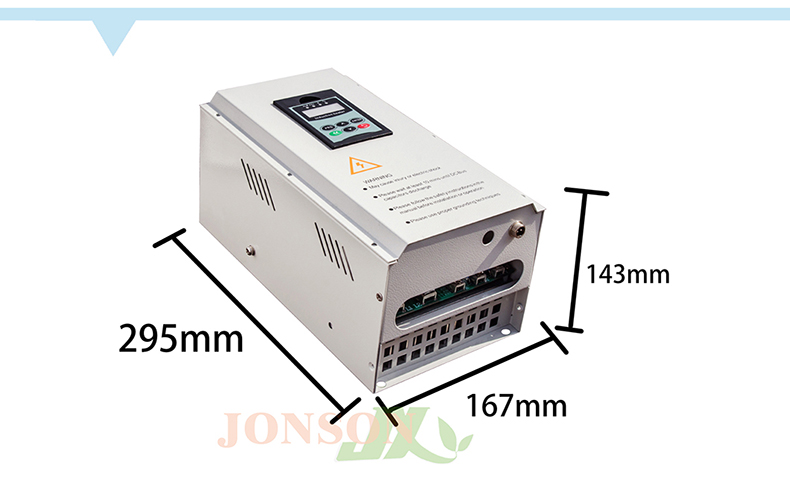
The JS1300-005/008 is a wall-mounted induction heating machine for 380 V industrial supplies, offered in 5 kW and 8 kW versions, with CE and ISO listed as its certifications. The unit is built around a copper core heating coil, with an outer casing of thickened aluminium alloy and thickened cold-rolled steel plate, and a 304 stainless steel liner. It ships in a carton or wood frame at a listed size of 295 mm × 169 mm × 145 mm.
| Parameter | JS1300-005/008 | JS1300-10/15 (same series, larger rating) |
|---|---|---|
| Brand | Jonson | Jonson |
| Type | Induction heating machine | Induction heating machine |
| Structure | Wall-mounted | Wall-mounted |
| Rated power | 5 kW / 8 kW | 10 kW / 15 kW |
| Rated voltage | 380 V | 380 V |
| Voltage adaptation range | 380 V ±20% | 300 V – 400 V |
| Power adjustment range | 20% – 100% | 20% – 100% |
| Ambient temperature | -20 °C to 40 °C | -20 °C to 50 °C |
| Ambient humidity | ≤95% | ≤95% |
| Certification listed | CE, ISO | CE, ISO, RoHS |
| Dimensions | 295 mm × 169 mm × 145 mm | 356 mm × 178 mm × 178 mm |
| Net weight (listed) | Not listed on the model sheet | 7.3 kg |
| HS code (listed) | Not listed on the model sheet | 8514400090 |
| Transport package | Carton / wood frame | Carton / wood frame |
Two omissions matter at evaluation stage. The 005/008 sheet does not list net weight or an HS code, while the larger 10/15 sheet does. Buyers preparing freight calculations, customs entries or wall-mounting brackets should request the missing figures in writing rather than infer them from the series — the two units differ in both dimensions and mass class.
Reading the Electrical Ratings
380 V rated voltage with a 380 V ±20% adaptation range. The rated figure is the nominal design point; the adaptation range is the manufacturer's stated tolerance window around it. Comparable JONSON wall-mounted models in the same family, such as the 20 kW JS1000-20, are listed with a 300 V–400 V adaptation range, so the band is not identical across the range and should be read model by model. For a European installation, the check that matters is the measured supply at the point of connection, including the swing during other plant loads — not the nameplate figure at the transformer. Many European industrial sites operate three-phase supplies in the 380–400 V, 50 Hz region; a site whose voltage falls outside the stated band is a selection problem rather than a paperwork problem.
20%–100% power adjustment. The control floor is 20% of the unit's rated output. Below that floor, the model datasheet describes no controlled modulation range. For processes that need to hold a very low, stable heat input — a small tank kept warm overnight, for example — this is the number to design around. Above the floor, output can be set anywhere between the minimum and full rating.
Current data. The 005/008 sheet does not list rated input or output current. Larger JONSON models do: the 100 kW unit lists a rated input current of 140–150 A and a rated output current of 200–220 A. If panel feeds, cable sizing or protection coordination depend on current draw, request the figures for the exact 5 kW or 8 kW variant being quoted.
How the heat is produced. JONSON describes the operating principle of its induction heating systems as converting 50 Hz AC power into a 5–40 kHz high-frequency current through an IGBT inverter module. That current drives an electromagnetic coil, generating an alternating magnetic field that induces eddy currents inside the metal itself — non-contact heating, with the load acting as its own heating element. Listed control modes include temperature control, time control and PID closed-loop constant-temperature control, with output power adjusted automatically according to load.
Where a 5–8 kW Wall-Mounted Unit Fits
The listed application scope for this class of JONSON equipment covers plastics and rubber, food processing, chemical reactions, crude oil pipeline heating, textile printing and dyeing, aquaculture heating, metal heat treatment, building heating, and medicinal herb drying.
The stated working conditions give a clearer picture of where the unit is expected to live:
- Rubber and plastics: continuous operation at high frequency.
- Food processing: high humidity with a small amount of steam mist, and constant-temperature cooking duty.
- Chemical processes: medium-to-high temperature, weak corrosion.
- Building heating: low-temperature outdoor or factory antifreeze circulation.
- Oil pipelines: applied to prevent crude oil from solidifying.
At 5–8 kW, this is a modest thermal load. It suits a single mould zone, a small tank, a local pipeline section or an auxiliary loop. Buyers sizing a plant-wide requirement should look elsewhere in the portfolio: the JS-1600 induction steam generator is listed at 30 kW, 40 kW and 50 kW, the wall-mounted JS1000-20 and JS1000-30 at 20 kW and 30 kW, and the JS1000-100 at 100 kW. JONSON also describes its induction heating systems more broadly as covering steam supply, medium- and high-temperature thermal oil heating, hot air drying, constant-temperature water supply, and constant-temperature heating for schools, hospitals, hotels, farms and flower greenhouses.
Two system-level features are worth flagging because they affect project design rather than the unit itself. First, modular expansion: multiple units can be connected in parallel so capacity can be added or removed as demand changes. Second, closed-loop safety circulation, described as physical separation of water and electricity or oil and electricity, with automatic interlock shutdown in the event of water shortage, overheating or overpressure.
What CE, ISO and RoHS Cover — and What They Do Not
CE. A CE entry in a datasheet indicates that the manufacturer places the product within the applicable EU harmonised framework, supported by a declaration of conformity and a technical file. Where the heater is built into a larger machine, machine-level conformity remains a separate obligation held by the machine builder or plant operator. Verify: a declaration of conformity that names the JS1300-005/008 exactly, the directives and standards it cites, and the legal entity that signed it.
ISO. On a product data table, an ISO entry most often points to the manufacturer's quality management system rather than to a product safety approval. Verify: which ISO standard applies, the certificate number, the issuing body, the certificate's stated scope, and the name of the certificate holder. Here the manufacturer is Guangdong Jiangxin Electronic Technology Co., Ltd. — a certificate held by a trading intermediary is a different risk profile from one held by the production entity.
RoHS. The JS1300-005/008 listing shows CE and ISO. RoHS appears on the JS1300-10/15 and JS-1600-8/12/15 listings. If a European procurement policy requires RoHS evidence, ask for a model-specific declaration or test report rather than accepting a reference to the series. If the supplier's answer points to the 10/15, that is still useful information — it shows RoHS documentation exists elsewhere in the range, but it does not automatically extend to the model on your purchase order.
Induction vs. Conventional Heating: Supported Claims and Real Boundaries
Induction heating systems achieve energy efficiencies of up to 92%, with an average cycle-time reduction of 30% compared with traditional gas or resistance-based heating, according to Global Market Insights. JONSON's application material separately describes induction steam supply as a clean replacement for coal and gas boilers with zero nitrogen oxides and no smoke emissions — avoiding the flue-gas and permitting burden that combustion equipment carries.
| Dimension | Induction heating (as specified) | Conventional gas / resistance heating |
|---|---|---|
| Energy conversion | Efficiencies up to 92% reported at market level | Combustion systems lose heat through exhaust and flue paths |
| Cycle time | Average 30% reduction reported versus gas or resistance heating | Reference baseline in the same comparison |
| Emissions at point of use | Zero nitrogen oxides and no smoke reported for induction steam applications | NOx and flue gas are inherent to combustion |
| Installation dependency | Requires defined coil-to-load distance and an insulation layer to reach thermal efficiency | Depends on existing burner, fuel supply and exhaust infrastructure |
| Typical fit | Localised, repeatable, controllable heat at a defined load | Bulk heat duty where combustion economics dominate |
Three honest boundaries belong next to that table.
Geometry is a precondition, not a detail. JONSON's own installation guidance states that the electromagnetic coil must maintain a reasonable distance from the metal being heated, that the coil should be wound evenly, and that an insulation layer should be added to the heating area to improve thermal efficiency. Where a process geometry cannot accommodate a coil at the correct distance, the efficiency case weakens regardless of what the datasheet says.
Electrical infrastructure carries the full load. An induction system converts the entire heating duty into electrical demand. A plant replacing a gas-fired process has to confirm supply capacity, cable sizing and protection coordination. The 380 V ±20% adaptation band on the JS1300-005/008 is the relevant check point for that evaluation.
First-party performance figures are not third-party data. JONSON reports, in its own case documentation, thermal efficiency held at 95%–98%, comprehensive energy savings of 30%–70% against traditional heating equipment, a lifespan extended by three times, and zero major failures across a 100-unit deployment. Those are manufacturer-reported results, not independently audited figures. They are useful as a working hypothesis to test during a pilot, and they should be recorded as such in a procurement file. The 92% efficiency and 30% cycle-time figures come from third-party market research and are market-level averages, not model-level guarantees.
Market Context: A Large Category With Different Numbers Behind It
The global induction heating system market was valued at USD 2.39 billion in 2024 and is projected to reach USD 4.5 billion by 2035, according to WiseGuyReports. As of mid-2024, more than 550,000 induction heating systems were deployed globally, with the Asia-Pacific region accounting for about 40% of that installed base — roughly 220,000 units, per Global Market Insights.
Market size figures deserve a second look, because definitions differ. Global Market Insights places a systems-level market at USD 2.3 billion, while MarketsandMarkets cites USD 616.5 million for a narrower induction-heating definition. Both can be correct; they are measuring different things. Buyers building a business case should check what a given number includes before quoting it internally.
Within the category, the 10 kW–100 kW power segment dominates, driven by versatility in applications such as automotive part hardening, forging and brazing (MarketsandMarkets, 2025). A 5–8 kW wall-mounted unit sits below that dominant band and competes on a different axis: localised, controllable heat at modest load, with parallel connection available when a project grows. In the wider picture, the industrial boiler and steam generator market was estimated at USD 54.79 billion in 2024, with a stated shift toward electrification via induction technology to meet decarbonisation goals (Market Research Future) — a shift that gives small, modular electric heating units a defined role as drop-in replacements on specific loops rather than as whole-plant solutions. Market structure is also worth noting for supplier evaluation: Fuji Electric held a leading share of over 9.5% in the induction heating system market in 2025 (Global Market Insights), which places specialist manufacturers such as JONSON alongside large incumbents rather than in place of them.
Site Requirements That Decide Whether a Good Datasheet Becomes a Good Installation
The gap between a compliant datasheet and a working installation is usually environmental. The conditions listed for this class of equipment are specific enough to check before ordering:
- Ambient temperature. The JS1300-005/008 is listed at -20 °C to 40 °C. The larger JS1300-10/15 is listed at -20 °C to 50 °C. A hot plant room or an enclosure without airflow is a genuine constraint for the 005/008 — not a rounding detail.
- Ambient humidity. ≤95% for the model.
- Cabinet ventilation. The control cabinet should be well ventilated to prevent overheating of the IGBT modules; higher-power JONSON units list air-cooled or water-cooled options, while the 005/008 is a compact wall-mounted design.
- Environment. The controller should be kept away from humid, dusty and corrosive gas environments; the control board should stay dry and its sealing should be checked regularly.
- Maintenance routine. Regular dust removal, inspection of wiring terminals, electromagnetic coils and the cooling system, and avoidance of frequent start-stop cycles. A soft-stop procedure is recommended at shutdown.
- Protection functions. The listed protection set includes overcurrent, overvoltage and overtemperature protection.
Procurement and Documentation Checklist for EU Buyers
On the commercial side, the manufacturer lists an MOQ of 1 unit, a lead time of 7–14 days, and a monthly capacity of 10,000 units. Quality control is described as 100% pre-shipment testing plus product inspection by SGS. After-sales support is described as remote technical support. Customization options cover product specifications, custom sample fabrication, graphic and panel customization, parameter adjustment and private logo — relevant if the heater will be installed under a buyer's own brand or into a bespoke cabinet. The manufacturer also states a one-year free maintenance and lifetime maintenance policy; terms of that kind are worth having written into the sales contract rather than left in marketing material.
For documentation, the sequence is straightforward: model-exact declaration of conformity, ISO certificate with scope and holder name, RoHS evidence if required, and confirmation that the ordered configuration matches the assessed configuration.
Reference scale for context: the manufacturer's case data describes 100 units installed across applications in Indonesia, China, Vietnam, Russia and India, in plastics and rubber production, process heat treatment, metal heat treatment, heat-processing piping and food processing, with OEM and ODM clients among the adopters and a stated project duration of 10+ years.
Future Outlook
Two trends are likely to shape how European buyers read documents like this one over the next few years. The first is electrification of process heat. With the industrial boiler and steam generator market estimated at USD 54.79 billion in 2024 and decarbonisation targets pushing plants away from combustion, electric induction equipment will continue to move from niche retrofit to standard option on specific loops — which increases the volume of compliance documentation buyers must process, and the cost of misreading it.
The second is documentation depth as a selection criterion. As installed base grows — more than 550,000 systems globally as of mid-2024 — procurement teams are increasingly comparing suppliers on the precision of their paperwork, not only on price and power rating. Manufacturers that can state certification at model level, distinguish CE from ISO from RoHS, and provide current data, weight and HS codes on request will be easier to qualify. Buyers should expect certification lists to stay model-specific rather than becoming uniform across a range, and should keep asking which model a certificate names.
FAQ
Which project scenarios is the JS1300-005/008 intended for?
The model is listed for plastics and rubber production, food processing, chemical reactions, crude oil pipeline heating, textile printing and dyeing, aquaculture heating, metal heat treatment, building heating and medicinal herb drying. Its stated working conditions include continuous high-frequency operation in rubber and plastics, high-humidity and light-steam-mist conditions in food processing, and medium-to-high temperature with weak corrosion in chemical processes. At 5–8 kW it suits localised or auxiliary heating duties rather than plant-wide loads.
What certifications are listed for the JS1300-005/008, and do they apply to other JONSON models?
CE and ISO are listed for the JS1300-005/008. Certification does not automatically extend across a product range: the JS1300-10/15 lists CE, ISO and RoHS, and the JS-1600-8/12/15 hot air generator also lists CE, ISO and RoHS. Each listing applies to the model it names, so the model number on the purchase order should match the model number on the certificate.
How should an EU buyer interpret the 380 V rating and the 380 V ±20% adaptation range?
The 380 V figure is the nominal design voltage; 380 V ±20% is the manufacturer's stated tolerance band around it. The practical check is the measured supply at the connection point, including voltage swing when other plant loads are running. Comparable JONSON wall-mounted models list different bands — for example 300 V–400 V on the JS1000-20 and JS1300-10/15 — so the adaptation range should be read per model rather than assumed across the range.
What does a 20%–100% power adjustment range mean for a 5 kW or 8 kW unit?
It means output can be set anywhere between 20% of the model's rated capacity and full rating, with no controlled range described below that floor. For a 5 kW unit the lower bound is one-fifth of rated output; for an 8 kW unit the same proportional floor applies. Processes that need stable heat input below that level should be evaluated against a different model or a different control approach.
What site conditions could limit the performance or service life of this model?
The listed ambient temperature range is -20 °C to 40 °C and ambient humidity is ≤95%. Installation guidance requires a reasonable coil-to-load distance, even coil winding and an added insulation layer to improve thermal efficiency; the control cabinet needs ventilation to prevent IGBT module overheating; and the controller should be kept away from humid, dusty and corrosive gas environments. Regular dust removal and inspection of terminals, coils and the cooling system are part of the stated maintenance routine.
What should be confirmed before ordering — documentation, testing and delivery?
Documentation: a declaration of conformity naming the exact model, an ISO certificate showing scope and holder name, and RoHS evidence if the buyer's policy requires it. Configuration: voltage variant, coil type and length, panel and logo customization, and whether the ordered build matches the assessed configuration. Delivery and testing: the manufacturer lists an MOQ of 1 unit, a 7–14 day lead time, 100% pre-shipment testing, SGS product inspection, remote technical support, and carton or wood frame packaging. Net weight, HS code and current data for this model are not on the published sheet and should be requested.
If a project needs 10–15 kW, is the JS1300-005/008 still the right choice?
No — that load band is covered by the JS1300-10/15, a 10 kW / 15 kW wall-mounted model in the same series, which also lists CE, ISO and RoHS, a 300 V–400 V adaptation range, a -20 °C to 50 °C ambient range and a listed net weight of 7.3 kg. Choosing between the two is a load-matching decision first and a documentation decision second: the 005/008 covers 5–8 kW, and the 10/15 covers 10–15 kW.
Third-party figures referenced in this article come from WiseGuyReports (induction heating system market size, 2024–2035), Global Market Insights (installed base, efficiency and cycle-time data, market structure), MarketsandMarkets (dominant power segment), Market Research Future (industrial boiler and steam generator market), and the International Electrotechnical Commission (IEC 60519-1 and IEC 60519-3). Model specifications, certification listings, application conditions, customization and quality-control descriptions are taken from JONSON / Guangdong Jiangxin Electronic Technology Co., Ltd. product and capability data.
¿Tiene preguntas o necesita más detalles?
Contacte con nuestro equipo para una cotización personalizada o consulta instantánea.
Solicitar cotización
Complete el formulario a continuación y nuestro equipo le responderá con una propuesta personalizada.
Chat directo de WhatsApp
¿Prefiere chatear en tiempo real? Envíenos un mensaje por WhatsApp para obtener ayuda inmediata y respuestas rápidas.
- Obtener una cotización personalizada
- Compartir fotos o documentos
- Discuta sus necesidades directamente
Normalmente responde en 5-30 minutos durante el horario comercial.