
JM-901 vs Laifen: Buyer's Framework for Motor, Cost & Durability
JM-901 vs Laifen: Buyer's Framework for Motor, Cost & Durability
The Market Context That Makes This Comparison Worth Doing
The global electric shaver market was valued at approximately USD 14.39 billion in 2024 and is projected to grow to USD 21.60 billion by 2032, according to Markets and Data. Cordless electric shavers dominated the U.S. market with an 83.95% share in 2024, a pattern Grand View Research attributes to USB and Type-C charging convenience. Foil shavers, the broader family that includes reciprocating designs, held a dominant 55.8% share of global electric shaver revenue in 2024, while rotary shavers were projected as the fastest-growing sub-segment, according to Data Bridge Market Research.
Those three data points describe a market that is growing, increasingly cordless, and still structurally dominated by the cut geometry that reciprocating shavers use. For a buyer, that has a practical consequence: the comparison between a named ODM model and a named consumer brand is now a recurring procurement question, not a one-off curiosity. Importers, private-label brand owners, gift-set assemblers and chain-store buyers all need to answer it in a defensible way.
The Real Comparison Problem: Two Different Purchases
The difficulty is that the two sides of the comparison are not equivalent purchasing objects. A consumer brand sells a finished product with retail brand equity, consumer packaging, retail compliance work already completed, and a price that embeds distribution margin. An ODM model is a manufacturing input. Its cost, customization scope, certification coverage, minimum order quantity, and lead time are all negotiable variables rather than fixed product features.
Comparing them on price alone therefore produces a misleading answer, and comparing them on specification alone produces an incomplete one. What a buyer actually needs is a framework that separates three things: what the hardware does, what the supply relationship costs, and what evidence exists to support either claim. The rest of this article applies that framework to the JM-901 reciprocating shaver against a Laifen unit, using the comparison parameters established for this evaluation.
The Three-Axis Comparison Framework
A workable framework for this category has three primary axes and two filters. The axes are motor performance, cost structure, and durability. The filters are compliance evidence and manufacturing reliability. A model that wins on the axes but fails the filters is not a procurement-ready option, because the cost of the failure appears later — at customs, at retail, or in warranty returns.
| Comparison dimension | JM-901 (reciprocating shaver) | Laifen (consumer-brand unit) | What the buyer should verify |
|---|---|---|---|
| Motor frequency | 14,000 vibrations per minute | 12,000 vibrations per minute | Cut quality on representative beard density, not frequency alone |
| Noise and heat behaviour | Reported low noise and sharp cutting in deployed units | Not independently verified in this comparison | Sound pressure measurement and housing temperature after continuous use |
| Cost position | Approximately 10% lower cost in this comparison | Retail-priced consumer product | Landed cost including freight, duty, and packaging |
| Body material | Aluminum alloy and ABS plastic | Not specified in this comparison | Drop test and surface finish consistency across batches |
| Water resistance | IPX7 | Not specified in this comparison | Whether the rating is model-level or range-level |
| Battery and charging | 702025 lithium battery, 300mAh, 3.7V; charging input 5V/1A; rated power 5W | Not specified in this comparison | Runtime under load, charge cycles, and connector durability |
| Supply terms | MOQ 3,000 units; lead time 30–45 days; monthly capacity 100,000 units | Retail or distribution purchase | Whether terms hold at reorder, not only at first order |
Axis 1 — Motor Performance: What 14,000 vs 12,000 Vibrations per Minute Actually Means
Vibration frequency is the most quoted and least understood number in shaver procurement. In a reciprocating shaver, the blade assembly oscillates side to side at a defined frequency. Fourteen thousand vibrations per minute means roughly 233 oscillation cycles per second of cutting opportunity; twelve thousand means 200. On paper the gap is around 17%.
That gap matters most in a specific condition: fast, dense, or multidirectional beard growth, where the blade passes over each patch of skin only briefly. Higher frequency increases the number of cutting opportunities per pass, which is why higher-frequency units are often described as delivering sharper cutting performance — the blade is not sharper, it simply acts more often. In lighter or slower shaving conditions, the difference between 14,000 and 12,000 vibrations per minute narrows considerably, and a buyer should not assume a proportional difference in perceived result.
Frequency also interacts with two variables buyers usually ignore: noise and heat. Higher oscillation frequency raises mechanical excitation in the housing, so a well-damped aluminum alloy body matters more at 14,000 than at 12,000 vibrations per minute. The JM-901 combines an aluminum alloy body with ABS plastic in a body rated IPX7, and the deployed units in this manufacturer's case record are described as delivering low noise and sharp cutting performance. Heat behaves the same way: the motor is the primary heat source, and the housing is the primary heat sink. Aluminum alloy conducts heat away from the motor more effectively than plastic enclosures, which is relevant to sustained-use comfort and to long-term motor life.
Axis 2 — Cost Structure: The 10% Question and What Sits Behind It
In this comparison, the JM-901 carries an approximately 10% lower cost than the Laifen unit. Taken alone, that figure is close to meaningless, because the two prices are not the same kind of price. One is a manufacturing cost for a product delivered in bulk. The other is a consumer retail price that already includes brand margin, retail packaging, distribution, and consumer marketing.
What makes the cost difference analysable is the supply structure underneath it. Ningbo Jinmi Electrical Appliance Technology Co., Ltd. operates an OEM and ODM model with Logo/Nameplate customization, a minimum order quantity of 3,000 units, a lead time of 30–45 days, and a monthly capacity of 100,000 units. Customization at the logo and nameplate level means a buyer can place a private-label product without a full industrial redesign, which is usually the single largest fixed cost in a new shaver program.
The practical way to convert the 10% into a decision is to test it against three cost questions. First, does the gap survive after freight, duty, packaging and inspection are added? Second, does the gap survive at reorder volume, or does it depend on an introductory quotation? Third, is the customization scope included in the quoted price, or billed separately? A cost advantage that disappears under any of those three questions is a quotation artefact rather than a cost structure.
Axis 3 — Durability: Battery, Housing, and What IPX7 Really Covers
Durability in an electric shaver has three failure points: the battery, the housing seals, and the cutting assembly. The JM-901 addresses these with a lithium battery specified as 702025, 300mAh, 3.7V, a charging input of 5V/1A, a rated power of 5W, a body combining aluminum alloy and ABS plastic, and an IP rating of IPX7. The model is positioned for travel and business use, where portability and charging convenience through a standard 5V/1A input matter more than raw capacity.
IPX7 is a water ingress rating, not a durability rating. In North America, waterproof testing for washable shavers typically follows IPX4 or IPX7 ratings as specified in amendments to UL/CSA 60335-2-8, according to an Intertek standards update. Globally, electric shavers must comply with IEC 60335-2-8 safety standards, which cover household shavers, hair clippers and similar appliances up to 250V. A buyer comparing two models should therefore read IPX7 as a defined test condition rather than a marketing phrase, and should ask whether the rating applies to the specific model being purchased.
Battery capacity deserves the same discipline. A 300mAh cell in a reciprocating shaver is a deliberate trade-off between runtime, body thickness and weight. It is a different design target from a larger cell used in a professional hair clipper. Buyers who need longer continuous runtime should raise the question with the manufacturer rather than assume the same cell strategy applies across a product range.
Compliance Evidence: What the CE-EMC and FCC Certificates Actually Cover
Compliance is where many comparisons collapse, because buyers rarely check the scope line on a certificate. The manufacturer behind the JM-901 holds a CE-EMC certification and an FCC certification, but both are issued for a different model in the range and should be read that way.

The CE-EMC certificate carries number XH251203102985R1, was issued on 2026-01-08 by Shenzhen Xuhang Detect Certification Co., Ltd., covers the European Union market, and applies to the multi-functional trimmer model JM-708 under standards EN IEC 55014-1:2021 and EN IEC 55014-2:2021. The FCC certificate carries number XH251203102986R1, was also issued on 2026-01-08 by Shenzhen Xuhang Detect Certification Co., Ltd., covers the United States market, and applies to the same model JM-708 under FCC Part 15 Subpart B and ANSI C63.4.
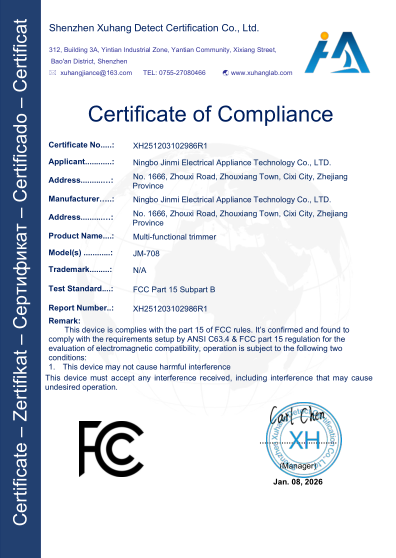
The Electromagnetic Compatibility requirements these certificates address are a genuine procurement filter. Devices that fail EMC testing cannot be placed on the EU market, and non-compliant imports into the United States risk detention. But a buyer purchasing the JM-901 specifically should treat this certificate set as evidence of the manufacturer's compliance capability and testing discipline, not as a certificate for the JM-901 itself. The correct procurement action is to confirm, in writing, which certifications attach to the exact model and configuration being ordered.
Application Fit: What 300,000 Units Across Eight Markets Demonstrates
Specifications describe potential. Deployment records describe behaviour. A project involving 300,000 units designed for hypermarket, gift set, and brick-and-mortar chain store applications was completed within five years, with stable operation results. The units feature low noise, sharp cutting performance, and plug-and-play installation. The project involved personal care products OEM clients from multiple countries: China, Iran, Japan, Portugal, Russia, Spain, France, and the United Kingdom.
For a buyer, three details in that record carry more weight than the unit count. The first is channel diversity: hypermarket, gift set, and chain store applications impose different packaging, price-point and handling requirements, and a product that holds across all three has been tested against different retail realities. The second is geography: eight markets across Asia, the Middle East and Europe imply exposure to more than one regulatory and voltage environment. The third is duration: five years is long enough to expose seal degradation, battery aging, and switch failures that short trials miss.
Where This Framework Breaks Down
A comparison framework is only credible if it states its own limits, and this one has four.
- Certificate scope is model-specific. The CE-EMC and FCC certificates available here cover the multi-functional trimmer model JM-708. They do not automatically cover the JM-901 reciprocating shaver, and any buyer treating them as interchangeable is taking on avoidable compliance risk.
- The housing is not fully metal. The JM-901 combines an aluminum alloy body with ABS plastic. That supports heat dissipation and handling feel, but it is not the same construction as an all-metal enclosure, and buyers with extreme impact requirements should test accordingly.
- Battery capacity is modest by design. A 300mAh, 3.7V cell suits travel and business use. Buyers whose product concept requires long continuous runtime should treat that as a specification conversation, not an assumption.
- Order economics exclude small runs. A minimum order quantity of 3,000 units and a lead time of 30–45 days do not fit test-market quantities or short promotional windows without planning.
There is also a brand-side limit. Laifen sells a finished consumer product with established retail brand equity. The JM-901 competes on manufacturability, customization headroom and unit economics, not on consumer brand recognition. Buyers comparing the two should be explicit about which of those they are actually purchasing.
The Two Supporting Filters: Compliance Discipline and Manufacturing Reliability
Two filters determine whether the axis results are usable at scale.
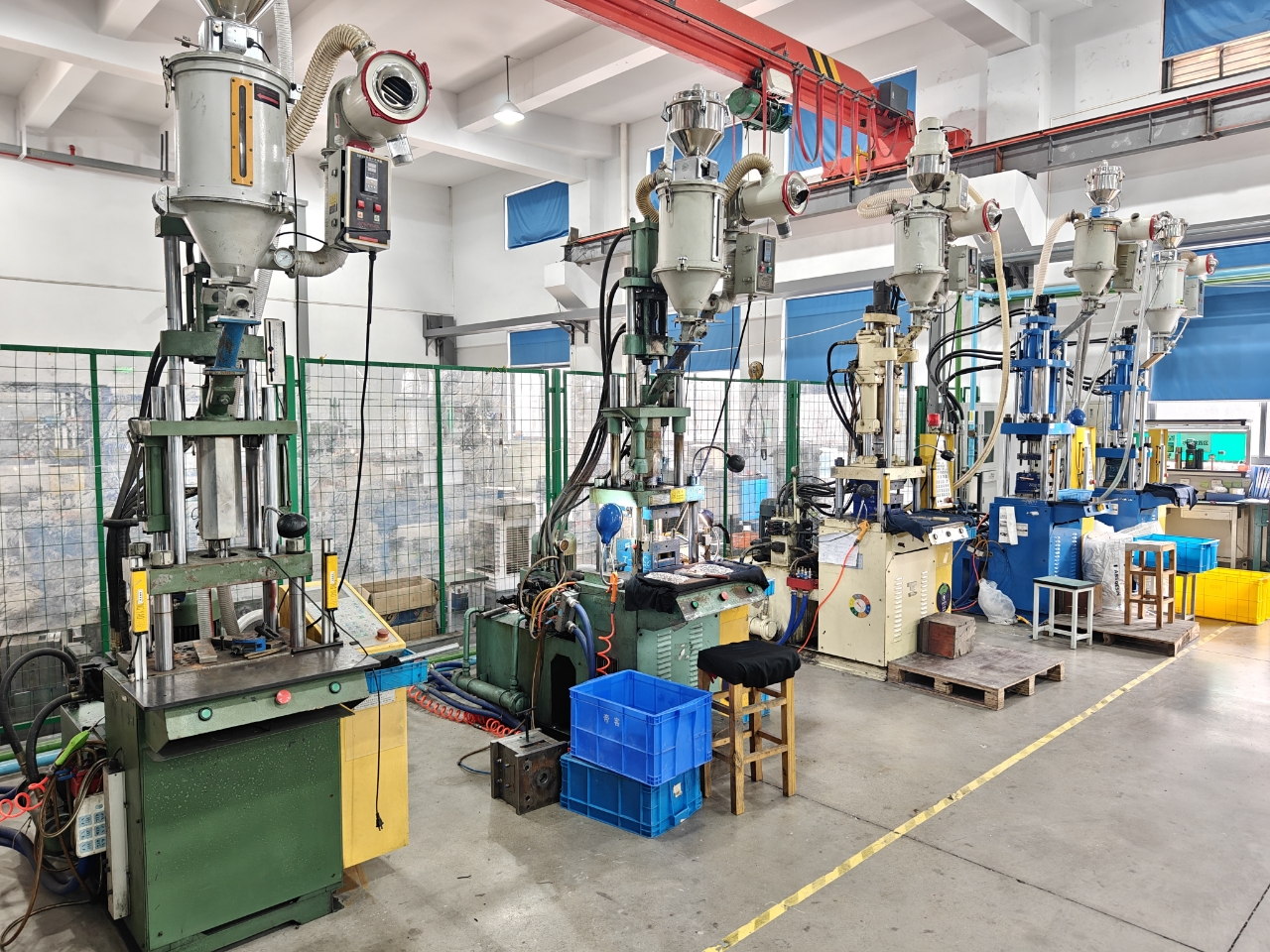
The first is quality control. The manufacturer implements 100% testing as part of its quality control procedures. In a category where the most common field failure is a marginal battery or a mis-seated seal, full-unit testing rather than batch sampling changes the expected return rate, and therefore the real cost of the product. The second is after-sales. The manufacturer provides remote support after-sales services, which matters for buyers in markets where a local service network does not exist and where the cost of returning a defective unit can exceed its margin.
These two factors, together with a monthly capacity of 100,000 units and a 30–45 day lead time, describe a supply relationship rather than a single transaction. They also explain why the cost comparison in Axis 2 should not be settled on unit price alone: a lower defect rate and predictable replenishment change the total cost of a program over its life.
Market Trend Analysis: What Changes Over the Next Several Years
Three verified trend signals frame the outlook for this category.
First, the global market is expanding rather than consolidating. Growth from approximately USD 14.39 billion in 2024 toward a projected USD 21.60 billion by 2032, per Markets and Data, implies continued room for ODM-supplied brands alongside established names.
Second, the largest single national growth pool is China. The domestic electric shaver market was valued at USD 1.89 billion in 2024, with a projected CAGR of 8.4% through 2030, according to Next Move Strategy Consulting. A manufacturing base inside that market has structural advantages in component access and iteration speed.
Third, form factor demand is shifting. Foil shavers held 55.8% of global revenue in 2024 while rotary shavers were projected as the fastest-growing sub-segment, according to Data Bridge Market Research. Reciprocating shavers sit within the foil-dominant family, which means the core cut geometry remains the revenue centre of the market even as rotary grows.
Future Outlook
The direction of travel is toward cordless convenience, standardized charging, and shorter product cycles. Cordless dominance at 83.95% of the U.S. market in 2024, driven by USB and Type-C charging convenience, is a signal that charging architecture has become a purchase criterion rather than an accessory detail. The JM-901's 5V/1A charging input sits inside that mainstream standard.
For buyers, the practical implication is that supplier evaluation will keep shifting away from single-unit specification toward three durable questions: can the manufacturer evidence compliance for the exact model, can it hold quality at volume, and can it adapt a platform to a buyer's branding without a full redesign. Those questions favour suppliers with verified testing procedures, existing certification experience, and OEM/ODM customization already in place — which is the position Ningbo Jinmi Electrical Appliance Technology Co., Ltd. occupies with the JM-901 platform.
FAQ
Is the JM-901 motor faster than the Laifen motor?
In the comparison parameters used here, the JM-901 is specified at 14,000 vibrations per minute against 12,000 vibrations per minute for the Laifen unit evaluated. That is a roughly 17% difference in oscillation frequency, which increases the number of cutting opportunities per pass. It does not automatically produce a proportional difference in shaving result, because blade geometry, head pressure and beard density also affect the outcome.
Does a lower cost mean lower durability?
Not necessarily, but the cost comparison in this article involves two different kinds of price. The approximately 10% lower cost attributed to the JM-901 reflects a bulk manufacturing supply relationship, while the Laifen unit is a retail-priced consumer product that includes brand and distribution margin. Durability should be assessed separately, using battery specification, housing material, IP rating, and the manufacturer's quality control procedures — in this case 100% testing of units.
What does the IPX7 rating on the JM-901 actually mean?
IPX7 is a water ingress rating rather than a general durability rating. In North America, waterproof testing for washable shavers typically follows IPX4 or IPX7 ratings as specified in amendments to UL/CSA 60335-2-8. Buyers should confirm that the rating applies to the exact model and configuration being purchased, since ratings are often established at model level.
Do the CE-EMC and FCC certificates apply to the JM-901?
No. The CE-EMC certificate XH251203102985R1 and the FCC certificate XH251203102986R1, both issued on 2026-01-08 by Shenzhen Xuhang Detect Certification Co., Ltd., apply to the multi-functional trimmer model JM-708. They demonstrate the manufacturer's compliance capability, but a buyer ordering the JM-901 should confirm which certifications attach to that specific model in writing.
What are the minimum order quantity and lead time for the JM-901 platform?
The manufacturer operates with a minimum order quantity of 3,000 units and a lead time of 30–45 days, supported by a monthly capacity of 100,000 units and OEM/ODM services including Logo/Nameplate customization. Buyers planning test markets or short promotional windows should account for these thresholds in their planning.
How has the JM-901 platform performed in real deployments?
A project involving 300,000 units designed for hypermarket, gift set, and brick-and-mortar chain store applications was completed within five years with stable operation results. The units feature low noise, sharp cutting performance, and plug-and-play installation, and were supplied to personal care products OEM clients in China, Iran, Japan, Portugal, Russia, Spain, France, and the United Kingdom.
Summary
Comparing the JM-901 against Laifen is most useful when it is treated as a structured procurement exercise rather than a specification contest. Motor frequency, cost position, and durability each answer a different question, and each depends on evidence that must be checked for scope. The manufacturer's product portfolio brochure, which covers the shaver and clipper range, is available for buyers who want the full platform overview alongside this framework: Ningbo Jinmi Electrical Appliance Technology Co., Ltd. product brochure.