
JIC vs NPT Adaptors on Paper and in Reality: An Independent View
A hydraulic adapter is rarely the line item a project team argues about. It is a thread callout on a schematic — and that callout decides whether a machine commissions cleanly or weeps at first pressure. Two families sit on either side of most of those decisions: the JIC (37° flare) adapter and the NPT (pipe thread) adapter. NingBo NJ Hydraulic Adapter Co., Ltd, a hydraulic component manufacturer established in 2004 and based in Ningbo, China, with a 20,000 m² manufacturing facility and approximately 200 staff, produces both. Its Hydraulic JIC Adapter range is documented from model 2403 to 2609; its NPT Adapter range is documented across the 5000 to 5652 series. Because both ranges come from the same production source and carry the same headline ratings, comparing them on identical terms is unusually clean — and unusually revealing.
This article compares the two families as they are documented, not as they are promoted. Where the paper specification and the field behaviour disagree, that gap is the story.
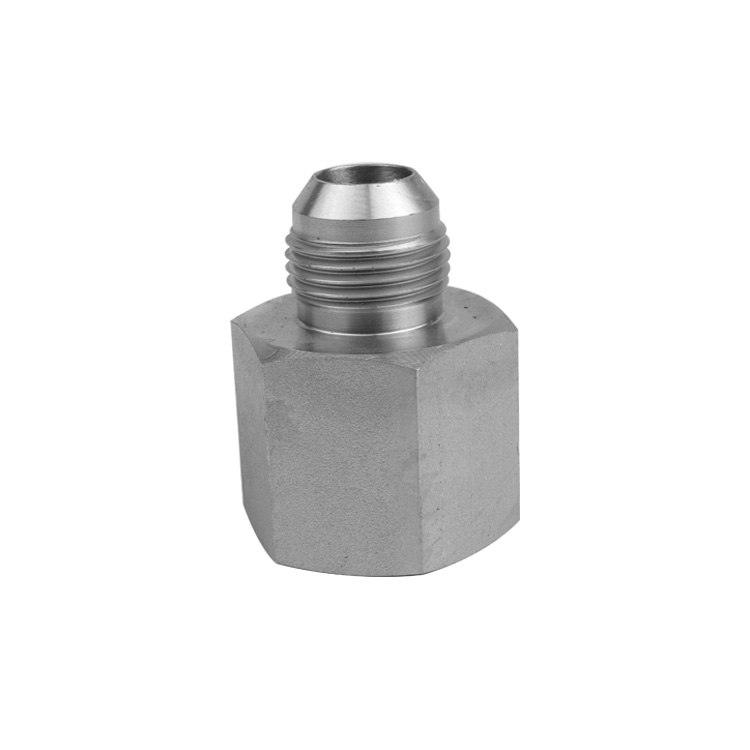
The Paper Case: Why JIC and NPT Look Interchangeable
On a specification sheet, the Hydraulic JIC Adapter and the NPT Adapter read almost identically. Both are documented with a pressure range of 3000–6000 PSI. Both are listed with a maximum stable operating temperature of 220°C. Both are available in carbon steel, SS304, and SS316. Both are documented against a 120-hour salt spray test, with white rust reported at 120 hours and red rust at 240 hours.
Their documented application lists overlap even more tightly. Both families are catalogued into construction machinery, agricultural machinery, and marine machinery, and both extend across general-purpose machinery, firefighting equipment, mining, transportation, aerospace, automotive, oil and gas extraction, iron and steel metallurgy, and water conservancy engineering.
Read only those lines and the two families look like one product with two thread labels. That reading is precisely where misapplication begins — because the ratings are documented at family level, while the decision that causes failures is made at port level.
| Documented attribute | Hydraulic JIC Adapter (2403–2609) | NPT Adapter (5000–5652) |
|---|---|---|
| Classification | JIC adapter and JIC to NPT adapter | NPT Thread Fitting |
| Documented model range | 2403; 2404; 2405; 2406; 2408; 2500; 2501; 2502; 2503; 2504; 2505; 2601–2609 and other listed variants | 5000; 5404; 5405; 5406; 5406-C; 5406-HP; 5406-P; 5406-SHP; 5500–5505; 5600–5605; 5650; 5652 |
| Pressure range | 3000–6000 PSI | 3000–6000 PSI |
| Maximum stable operating temperature | 220°C | 220°C |
| Salt spray documentation | 120-hour test; white rust at 120 hours, red rust at 240 hours | 120-hour test; white rust at 120 hours, red rust at 240 hours |
| Material options | Carbon steel / SS304 / SS316 | Carbon steel / SS304 / SS316 |
| Documented industries | Construction machinery, agricultural machinery, marine machinery, mining, firefighting equipment, oil and gas extraction, and others | Construction machinery, agricultural machinery, marine machinery, mining, firefighting equipment, oil and gas extraction, and others |
In Reality: Two Different Sealing Philosophies
An identical rating band hides an engineering difference that no data-sheet shorthand can absorb. JIC and NPT do not seal the same way, and they do not tolerate the same handling.
JIC: a straight thread with a machined seat
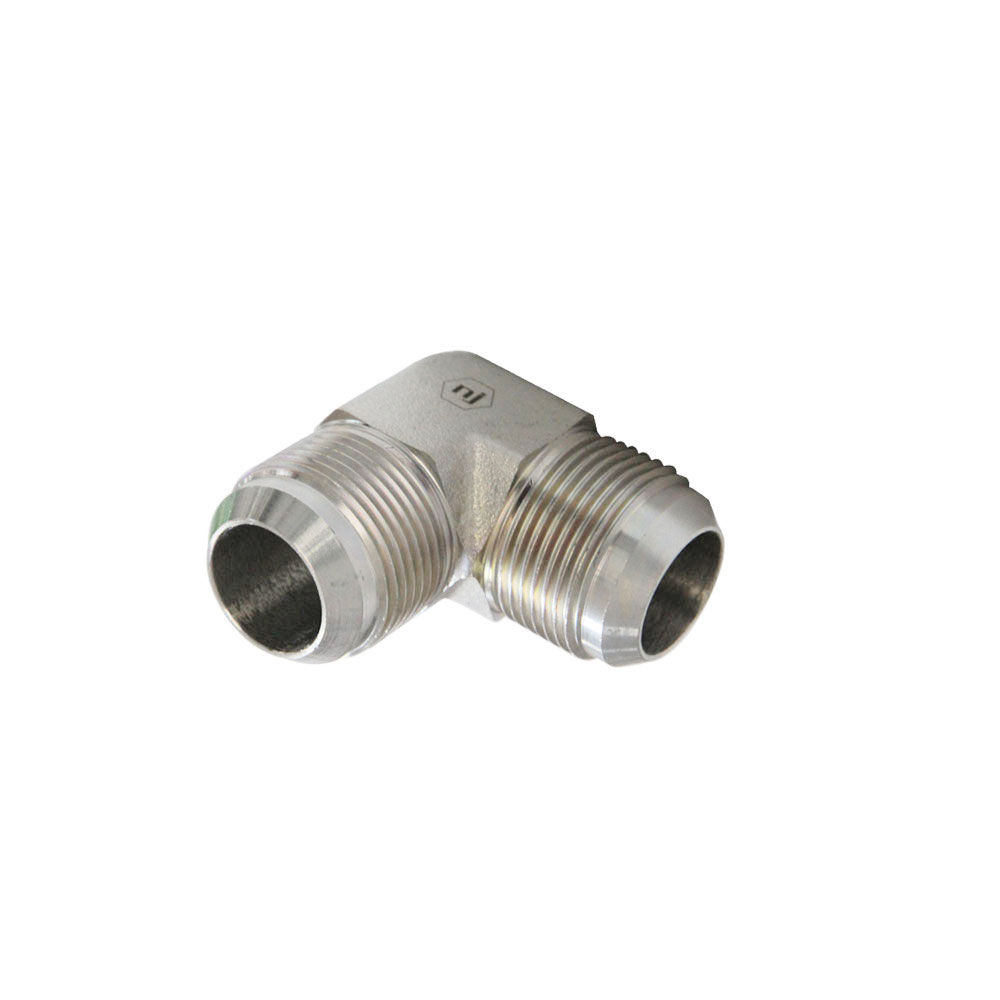
A JIC connection is a 37° flared connector. The thread is straight, and sealing happens at the machined cone, where the flare mates metal to metal against the seat. Because the thread itself is not the sealing element, the joint can be broken and remade without the thread progressively giving up material — which is why flared connections dominate equipment that sees field service. The design envelope for this connector family is covered by ISO 8434-2:2007, which specifies design and performance requirements for 37° flared connectors suitable for tubes from 6 mm to 50.8 mm.
NPT: a tapered thread that seals through engagement
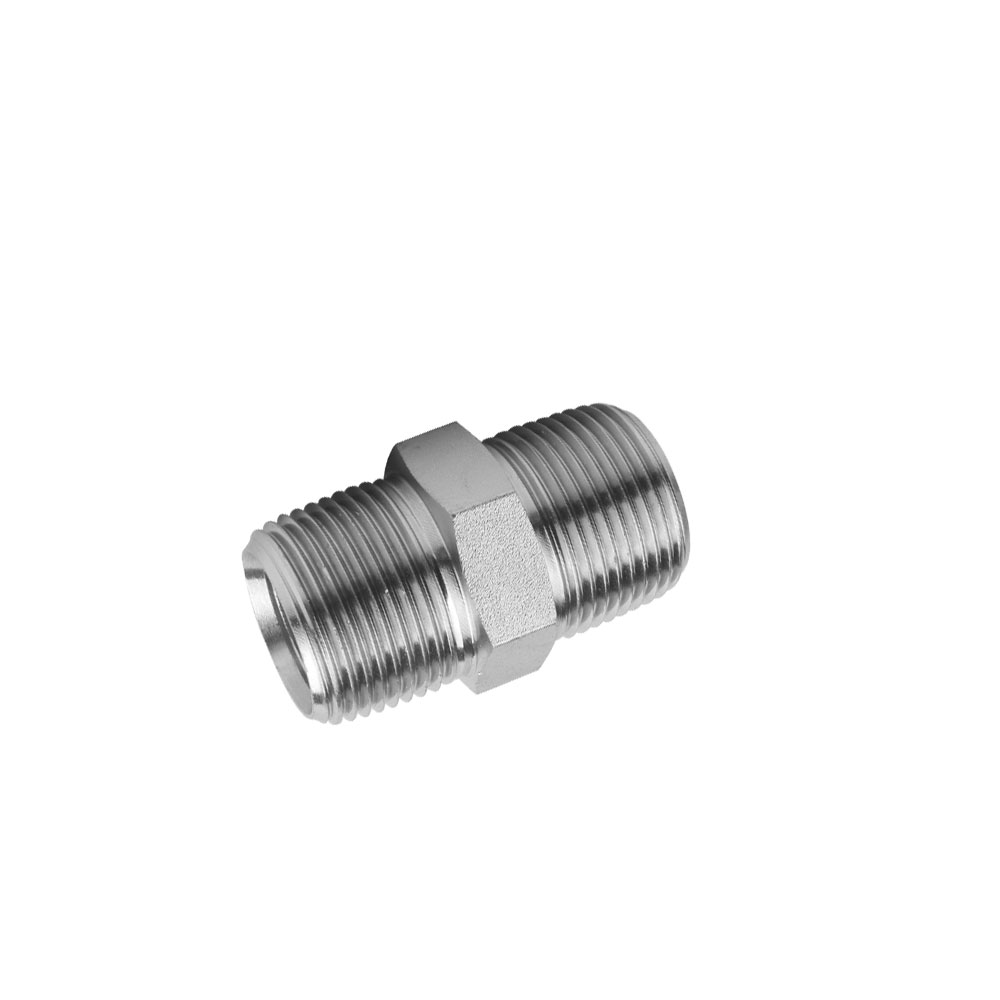
An NPT connection seals because the tapered threads interfere with each other as the fitting is driven in. Sealing is produced by that thread interference and, in most field practice, a thread sealant. The consequence is not a defect; it is the design intent. A pipe thread is meant to be made up once and left alone. Every additional turn taken to chase a weep consumes thread engagement that does not come back. Where a dry-seal variation is used, published pressure data reflects the difference: NPTF straight-thread fittings for 1/4" size are typically rated at 4000 PSI working pressure with a 4:1 safety factor, according to Titan Fittings.
Neither approach is superior in the abstract. They solve different port problems, and the port — not the adapter catalogue — is what determines which one belongs on a given line.
Mapping the Two Ranges: Straight, Elbow, and Transition Configurations
Both families are documented with the configuration depth field work requires: straight connectors for in-line runs, elbows where a hose path has to turn, and — within the JIC family — transition adapters that bridge a flared port and a pipe port on the same machine. The configuration labels below come directly from the product data for each range.
| Configuration role | Hydraulic JIC Adapter examples | NPT Adapter examples |
|---|---|---|
| Straight, same thread family | 2403 Male JIC x Male JIC Straight; 2406 Female JIC x Male JIC Straight | 5404 Male NPTF Pipe x Male NPTF Pipe Straight; 5405 and 5406 Male NPTF Pipe x Female NPTF Pipe Straight |
| Straight, cross-thread transition | 2404 Male JIC x Male NPTF Pipe Straight; 2405 Male JIC x Female NPTF Pipe Straight | The pipe-thread end of the same transition pairings |
| 45° elbow | 2504 Male JIC x Male JIC 45° Elbow; 2505 Male JIC x Female NPTF Pipe 45° Elbow | Range listing documents straight, plug, cap, tee and cross groupings |
| 90° elbow | 2500 Male JIC x Male JIC 90° Elbow; 2501 Male JIC x Male NPTF Pipe 90° Elbow; 2502 Male JIC x Female NPTF Pipe 90° Elbow | Range listing documents straight, plug, cap, tee and cross groupings |
| Bulkhead | Bulkhead configurations are documented in the same JIC data set (2700–2705), including straight, 45° and 90° bulkhead patterns | — |
| Closure and plugging | 2408 Male JIC Plug | 5406-C Female NPTF Pipe Cap; 5406-P hex head pipe plug; 5406-HP hollow hex pipe plug; 5406-SHP square head pipe plug |
| Branch and multi-port | 2601–2609 designations continue the range listing | 5603 Male NPTF x Female NPTF x Male NPTF Tee; 5604 and 5605 tees; 5652 four-way cross |
Where Misapplication Actually Occurs
The failures that follow from confusing these two families are not exotic. They cluster into five recognisable patterns, and all five start with a paper-level assumption.
- Thread substitution at the port. Because both families carry the same 3000–6000 PSI band and the same material options, an NPT adapter can be ordered where the port is machined for a flared seat, or the reverse. Neither will seal correctly, and the thread damage is usually done before the leak is noticed.
- Torquing a pipe thread to stop a weep. A tapered thread seals through interference. Extra turns remove the engagement that was doing the sealing, converting a minor weep into a permanent leak path.
- Treating a transition adapter as an interchangeable adapter. Models 2404, 2405, 2501, 2502 and 2505 exist precisely to join a JIC line to an NPTF port. They are a deliberate pairing. They do not make a JIC port accept a pipe thread.
- Reading 3000–6000 PSI as a per-size guarantee. Published pressure data for comparable fitting types varies by size and by standard — NPTF 1/4" fittings at 4000 PSI with a 4:1 safety factor (Titan Fittings), compared with ORFS dash -4 fittings rated at 6000 PSI working pressure under SAE J1453. The family band spans a range; it is not a uniform ceiling for every part number in the range.
- Assuming sealant practice is identical on both systems. Sealant belongs on tapered pipe threads where the design calls for it. On a 37° flare, sealant at the cone interferes with the metal-to-metal seat that is doing the sealing.
What the Application Data Says
Documented field scenarios make the stakes clearer than any pressure table. In a construction machinery scenario recorded in the application data — high-temperature, high-pressure working conditions — the hydraulic adapter's stated function is hydraulic pipeline sealing, thread locking and fastening, and pressure-bearing protection for mechanical hydraulic assemblies. The same scenario documents an operation envelope capable of withstanding a static pressure of 6,000 PSI and a burst pressure of 9,000 PSI without deformation while maintaining continuous operation and seal integrity.
The matched equipment in that scenario is instructive: hydraulic hoses, hydraulic cylinders, threaded bolts, pipe joints, hydraulic pumps, and mechanical cylinder assemblies. The stated requirement is rust resistance, high-temperature resistance, and high-pressure resistance. Crucially, the same application record links BSP adapters, NPT adapters, Hydraulic JIC Adapters and SAE Standard Hydraulic Adapters as applicable products for the same working condition. That is the field reality the paper specification hides: a single machine commonly carries more than one thread system, and the adapter's job is to make that mixture work — not to pretend it does not exist.
For construction, agricultural, and marine machinery specifically, both the JIC and the NPT ranges are documented as intended products. The distinction that matters on those machines is not which family is stronger, but which port the technician is looking at when the hose comes off.
Market Context: Why Adapter Choice Is Getting More Attention
The commercial context reinforces the engineering argument. According to Dataintelo, the global hydraulic fittings market, including adapters and couplings, was valued at USD 4.8 billion in 2025 and is projected to reach USD 7.9 billion by 2034. Within that market, the hydraulic adapters segment held the largest product type share at 28.4% in 2025.
Two further data points from the same source help explain why specification discipline matters commercially. Steel material dominated hydraulic fitting revenue share at 45.2% in 2025, driven by demand for high-pressure durability — which is consistent with carbon steel remaining the default body material in both the JIC and NPT ranges, with SS304 and SS316 offered as stainless options. And Asia-Pacific led global hydraulic fitting revenues in 2025 with an estimated 38.6% of market share, reflecting where both production capacity and consumption growth are concentrated.
Demand pressure is coming from the application side as well. Grand View Research estimated the broader global hydraulics market at USD 38.39 billion in 2024, with the mobile hydraulics segment holding over 58% of total revenue share. Ken Research reported that Asia accounted for 74% of global industrial robot installations in 2024, which drives demand for precise hydraulic connections. Mobile and robotic equipment share one characteristic: connections have to be identified and serviced in the field, often years after commissioning. That is exactly the environment in which a wrong-family adapter becomes a recurring cost rather than a one-time mistake.
Limits of This Comparison
An independent view has to state its boundaries as clearly as its findings.
- The 3000–6000 PSI figure is documented at family level for both ranges. Working pressure for a specific size and thread combination should be confirmed against the applicable standard and the individual part, not inferred from the band.
- 220°C is documented as a maximum stable operating temperature, not a target operating condition. Systems that run near that ceiling should treat it as a limit to be respected, not a rating to be used.
- The 120-hour salt spray documentation describes corrosion behaviour observed in that test. It is not a service-life prediction for a marine deck, a mine site, or an agricultural machine exposed to fertiliser.
- This article does not report third-party test outcomes for the 2403–2609 or 5000–5652 ranges. Where independent numbers appear here — the NPTF 1/4" rating, the SAE J1453 ORFS rating, the ISO 8434-2 dimensional scope — they belong to the cited standard or supplier, and are used to show how ratings vary by size and standard rather than to grade the two ranges.
- Where a threaded connection is used in a safety-relevant circuit, adapter selection alone is not sufficient qualification. Assembly procedure, torque specification and system-level pressure testing remain the controlling steps.
What to Verify Before Committing
| Verification step | What to check | Why it matters |
|---|---|---|
| Port identification | Straight-thread flared seat, or tapered pipe port — confirmed with a thread gauge | The only check that prevents family-level substitution errors |
| Configuration match | Straight, 45°, 90° or bulkhead body style against the actual hose routing | Body style affects stress on the hose and the joint |
| Material grade | Carbon steel, SS304 or SS316 against the corrosion environment | Both ranges offer all three; the choice is environmental, not preferential |
| Temperature headroom | System maximum against the documented 220°C stable limit | A documented limit is not a design target |
| Pressure basis | Family band, size-specific rating, and system test pressure | The band is a range, not a uniform ceiling — see NPTF 1/4" at 4000 PSI with a 4:1 safety factor |
| Corrosion evidence | 120-hour salt spray documentation read against the real exposure environment | Test duration and field exposure are different questions |
| Traceability | Model number, thread designation and material grade carried on the documentation | Range continuity is what makes reorders safe on long-life machinery |
Future Outlook
Two forces are likely to sharpen, not soften, this comparison. The first is specification granularity. DIN 2353 / ISO 8434-1 already groups metric tube fittings into robustness categories — LL (Extra Light, 100 bar), L (Light, up to 315–500 bar) and S (Heavy, up to 630–800 bar) — rather than issuing one blanket rating for a whole product line. As more buyers meet this style of documentation, family-level pressure bands will increasingly be read as a starting point for selection rather than an answer.
The second is material and regional shift. Stainless options in both the JIC and NPT ranges are already documented, and steel's 45.2% revenue share in 2025 shows how dominant carbon steel remains for high-pressure durability. As mobile hydraulics — over 58% of hydraulics revenue in 2024 — continues to dominate demand alongside a concentrated Asia-Pacific supply base at 38.6% of fittings revenue, the adapters that will be easiest to live with are the ones with consistent model designations, stable thread nomenclature, and documentation that survives a decade of reorders.
Nothing in that outlook changes the core rule. JIC and NPT are not two versions of the same part. They are two sealing philosophies, and the port decides.
FAQ
What is the difference between a JIC adapter and an NPT adapter?
The difference is thread form and sealing method. A JIC adapter uses a straight thread with a 37° flared seat, where sealing occurs at the metal-to-metal cone; ISO 8434-2:2007 specifies design and performance requirements for 37° flared connectors suitable for tubes from 6 mm to 50.8 mm. An NPT adapter uses a tapered pipe thread that seals through thread interference. Both the Hydraulic JIC Adapter range (models 2403–2609) and the NPT Adapter range (5000–5652) are documented with a 3000–6000 PSI pressure range, a 220°C maximum stable operating temperature, and carbon steel, SS304 or SS316 material options.
Can a JIC adapter be used in an NPT port, or the reverse?
No. A straight-thread flared connection and a tapered pipe connection are not interchangeable, because neither thread form will seat correctly in the other port geometry. Where a JIC line has to meet a pipe-thread port, the documented approach in this range is a transition adapter — models 2404 and 2405 for straight configurations, and 2501, 2502 and 2505 for 90° and 45° elbow configurations. A transition adapter joins the two thread systems; it does not convert one port into the other.
What pressure range do these two adapter families cover?
Both ranges are documented with a pressure range of 3000–6000 PSI. That figure is stated at family level, so it should be treated as a range rather than a uniform rating for every part number. Published data for comparable fitting types illustrates the variation: NPTF straight-thread fittings for 1/4" size are typically rated at 4000 PSI working pressure with a 4:1 safety factor (Titan Fittings), while ORFS dash -4 fittings are rated at 6000 PSI working pressure under SAE J1453.
Which models belong to each range?
The Hydraulic JIC Adapter range is documented with model designations including 2403, 2404, 2405, 2406, 2408, 2500–2505 and 2601–2609, among others, and is classified as a JIC adapter and JIC to NPT adapter. The NPT Adapter range is documented with model designations including 5000, 5404, 5405, 5406, 5406-C, 5406-HP, 5406-P, 5406-SHP, 5500–5505, 5600–5605, 5650 and 5652, and is classified as an NPT Thread Fitting.
Which industries are these adapters documented for?
Both families are documented as intended for construction machinery, agricultural machinery, and marine machinery. Their broader documented application lists also cover general-purpose machinery, firefighting equipment, mining, transportation, aerospace, automotive, oil and gas extraction, iron and steel metallurgy, and water conservancy engineering.
What materials and temperature limits apply to both ranges?
Carbon steel, SS304 and SS316 are documented material options for both the Hydraulic JIC Adapter and the NPT Adapter. The maximum stable operating temperature for both is 220°C, and both are documented against a 120-hour salt spray test, with white rust reported at 120 hours and red rust at 240 hours.
Why do JIC-to-NPT transition adapters exist at all?
Because real machines mix port types. Documented application scenarios for high-temperature, high-pressure construction machinery list BSP adapters, NPT adapters, Hydraulic JIC Adapters and SAE Standard Hydraulic Adapters as applicable products for the same working condition — matched to hydraulic hoses, hydraulic cylinders, threaded bolts, pipe joints, hydraulic pumps and mechanical cylinder assemblies. Transition adapters let a flared line and a pipe-thread port coexist on that machine without forcing either thread form into a port it was not designed for.
Reference Material
NingBo NJ Hydraulic Adapter Co., Ltd (established 2004) manufactures hydraulic adapters, hydraulic fittings, flanges, valves and non-standard components, and specialises in SAE standard hydraulic components and engineering machinery parts. The company's official website is www.njadapter.com, and its product brochure is available as a downloadable PDF: NJ Hydraulic Adapter product brochure.
¿Tiene preguntas o necesita más detalles?
Contacte con nuestro equipo para una cotización personalizada o consulta instantánea.
Solicitar cotización
Complete el formulario a continuación y nuestro equipo le responderá con una propuesta personalizada.
Chat directo de WhatsApp
¿Prefiere chatear en tiempo real? Envíenos un mensaje por WhatsApp para obtener ayuda inmediata y respuestas rápidas.
- Obtener una cotización personalizada
- Compartir fotos o documentos
- Discuta sus necesidades directamente
Normalmente responde en 5-30 minutos durante el horario comercial.