
JE230, JE2025, JT2026, JL2058, JE1888: Five Custom Outdoor Sets Compared
JE230, JE2025, JT2026, JL2058, JE1888: Five Custom Outdoor Sets Compared
In custom outdoor clothing procurement, the decision that stalls a purchase order is rarely between suppliers. It is between configurations inside one supplier's range. The five set codes JE230, JE2025, JT2026, JL2058 and JE1888 form a buyer shortlist of custom outdoor clothing sets offered through Yeanro Apparel Co., Ltd., a Shishi-based manufacturer and exporter of functional outdoor and casual apparel. This comparison separates what the published programme documentation establishes for all five codes, what it does not establish at code level, and which checks a decision-stage buyer should close before committing volume.
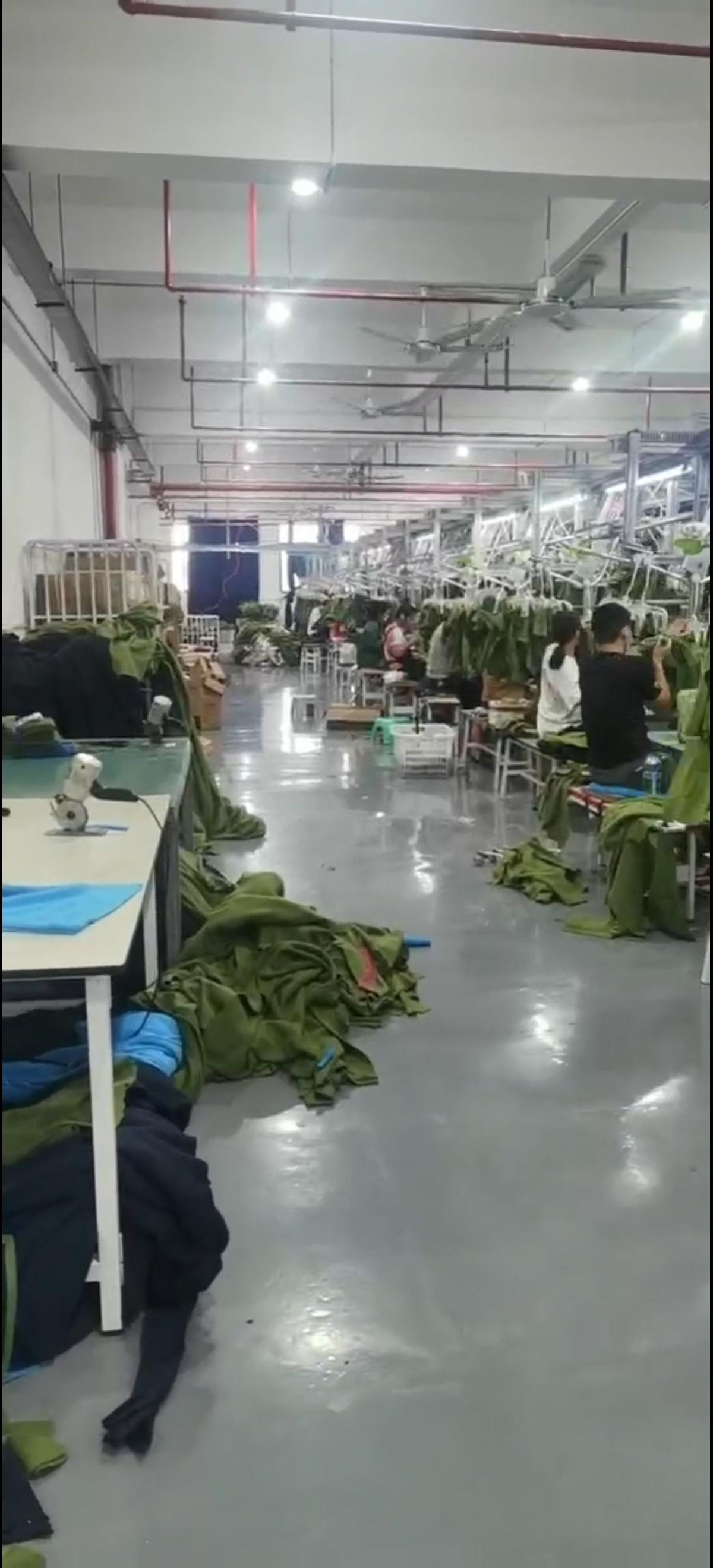
Production shop. Custom outdoor clothing sets are built to a buyer specification rather than drawn from stock.
What the five custom outdoor clothing set codes share
Answer first: JE230, JE2025, JT2026, JL2058 and JE1888 sit inside one documented custom-apparel programme, and the published commitments attach to that programme rather than to an individual code number. Yeanro Apparel Co., Ltd. operates a 20,000 m² facility with 130 employees, an annual output of 160,000 units, an in-house R&D team of 10 engineers and an export ratio of 80%, supplying markets including Mexico, Russia, the Middle East, Southeast Asia, Europe and the Americas. The programme terms documented for custom sports and outdoor apparel orders are as follows.
- Minimum order quantity: from 50 pieces, with small trial orders supported for new brands and a better unit price offered above 500 pieces.
- Sampling: pre-production samples are provided for quality, fabric and logo confirmation, with a 7–10 working-day sample lead time; sample cost is refundable when the bulk order quantity reaches the required threshold.
- Bulk production: 20–35 working days after sample confirmation and deposit receipt; order quantity, fabric and colour options, and customization complexity may extend that window.
- Fabric library: 20+ functional fabric selections, including moisture-wicking, 4-way stretch, UV-protection, water-repellent and breathable options, selected against the usage scenario such as hiking, trail running or team sports.
- Fit and pattern: 100% customizable size and pattern, with sizing, cut and garment structure adjustable to the target user group.
- Branding: 10+ branding crafts covering sublimation print, silicone print, embroidery, woven labels, hang tags and private labelling; buyers may supply their own artwork or have new styles developed.
- Compliance: certifications are arranged by target market and material, with OEKO-TEX, REACH, AZO-free, colour-fastness and shrinkage tests available according to market requirements.
- Commercial terms: standard payment is T/T with a 30% deposit before production and the balance before shipment.
- Design protection and continuity: an NDA is available on request, custom patterns, logos and artwork are stated not to be reused for other clients, and pattern files are archived for three years to support reorders.
For a buyer at decision stage, that uniformity is itself the finding. A shortlist of five codes cannot be narrowed by comparing MOQ, sampling time, fabric library size or certification handling, because those positions are identical across the range. The shortlist narrows on the specification the buyer writes — fabric construction, garment weight, decoration method, size grading and destination-market testing — and on the evidence the supplier can attach to each of those points for the specific code.
Where the five codes can genuinely differ
Custom apparel is specified, not catalogued. The comparison unit that matters is therefore not "which code is better" but "which dimension is still open for this code, and what closes it". The table below maps the six dimensions on which a decision-stage buyer should expect code-level answers, against the programme position documented for the whole range.
| Decision dimension | Documented programme position | What varies between the five codes | Evidence that closes the question |
|---|---|---|---|
| Style and branding | Custom patterns, logos, embroidery, prints and private labels are supported | Garment block, panel layout, decoration method and label set | Artwork proof, placement diagram, label copy approval |
| Fabric and function | 20+ functional fabrics; performance adjusted to project scenario | Fabric composition, weight, hand-feel and which function is being paid for | Fabric specification sheet plus any attached test report |
| Specification and sizing | 100% customizable size and pattern; cut and structure adjustable | Size grading, measurement tolerances, fit block for the target user | Graded measurement chart and a fit sample at the extremes of the size range |
| Compliance and testing | OEKO-TEX, REACH, AZO-free, colour fastness and shrinkage arranged by market and material | Which tests apply, to which material, for which destination | Test list agreed in writing and confirmed per order, not assumed as pre-held |
| Service mode and timeline | One-stop OEM/ODM covering design, sampling and production; sampling 7–10 working days, bulk 20–35 working days | Calendar position once sampling rounds, fabric lead time and decoration steps are counted | Dated schedule issued with the quotation, including holiday blocks |
| Commercial structure | MOQ from 50 pcs; better unit price above 500 pcs; stated 8–15% reduction in comprehensive project cost for bulk orders above 500 pcs where sampling, testing and labelling are bundled | Quantity tier, decoration complexity, packaging and which services sit inside the price | Line-item quotation stating bundled versus separately charged services |
Table 1. Programme-level positions apply to all five codes; code-level answers must be closed with specified evidence.
Five codes, five first checks
The published documentation does not itemise fabric weights, test values or unit prices per code, which is normal in a made-to-specification category: the specification is created with the buyer. The sequence below therefore assigns no ranking and assumes no specification. It identifies the first question that most quickly resolves each code, using only the programme terms that genuinely apply to all five.
JE230 — start with the fabric identity and the function claim
The programme offers moisture-wicking, 4-way stretch, UV-protection, water-repellent and breathable fabrics, chosen by usage scenario. For this code the decisive step is to convert that menu into one named fabric and one paid-for function. Ask for fabric composition, weight per square metre, stretch direction and recovery, plus any test report attached to the confirmed quality. A phrase such as "functional fabric" is not a specification; a composition and a measured value are. If the garment is intended for light rain, confirm that the water-repellent finish is a stated finish and not an assumption carried over from the programme description.
JE2025 — start with the size set and a fit sample
Because sizing, cut and garment structure are fully customizable, the risk on this code concentrates in grading rather than in sewing. Ask for the graded measurement chart for the target size range, the tolerances applied at each measurement point, and a fit sample in the middle size plus the two extreme sizes. Buyers serving several markets should state at this stage whether they need one block adapted for different body proportions or separate blocks, because that decision changes both the sampling calendar and the pattern archive that will later support reorders.
JT2026 — start with the decoration file
More than ten branding crafts are available, including sublimation print, silicone print, embroidery, woven labels, hang tags and private labelling. On this code the fastest route to a stable bulk run is to freeze the decoration file before sampling closes: artwork proof, colour reference for each decoration, physical placement with measurements, and the exact label and hang-tag copy. Sublimation and silicone work tolerate different tolerances on fine detail, so asking which craft will be used for which element prevents a sample that looks correct on paper but cannot be repeated at volume.
JL2058 — start with the compliance pack for the destination market
Certifications are arranged by target market and material, and existing reports should be confirmed per order rather than assumed to be held for every product. OEKO-TEX, REACH, AZO-free, colour-fastness and shrinkage testing can be arranged according to market requirements. For this code, write the destination and the garment's contact classification first, then list the tests that follow from them, name the accepting laboratory and agree who carries the cost. A compliance pack agreed in writing before the purchase order is worth more than a certificate presented after shipment.
JE1888 — start with the commercial bundle and the calendar
On this code the practical question is what the quoted unit price contains. The programme documents a 50-piece MOQ, a better unit price above 500 pieces, and a stated 8–15% reduction in comprehensive project cost for bulk orders above 500 pieces where sampling, testing and labelling fees are bundled under the factory-direct model, against a market pattern in which pattern making, laboratory tests and custom tags are often charged separately. Ask for the quotation to mark each service as included or separate, and pair it with a dated schedule: 7–10 working days for sampling, 20–35 working days for bulk after sample confirmation and deposit.
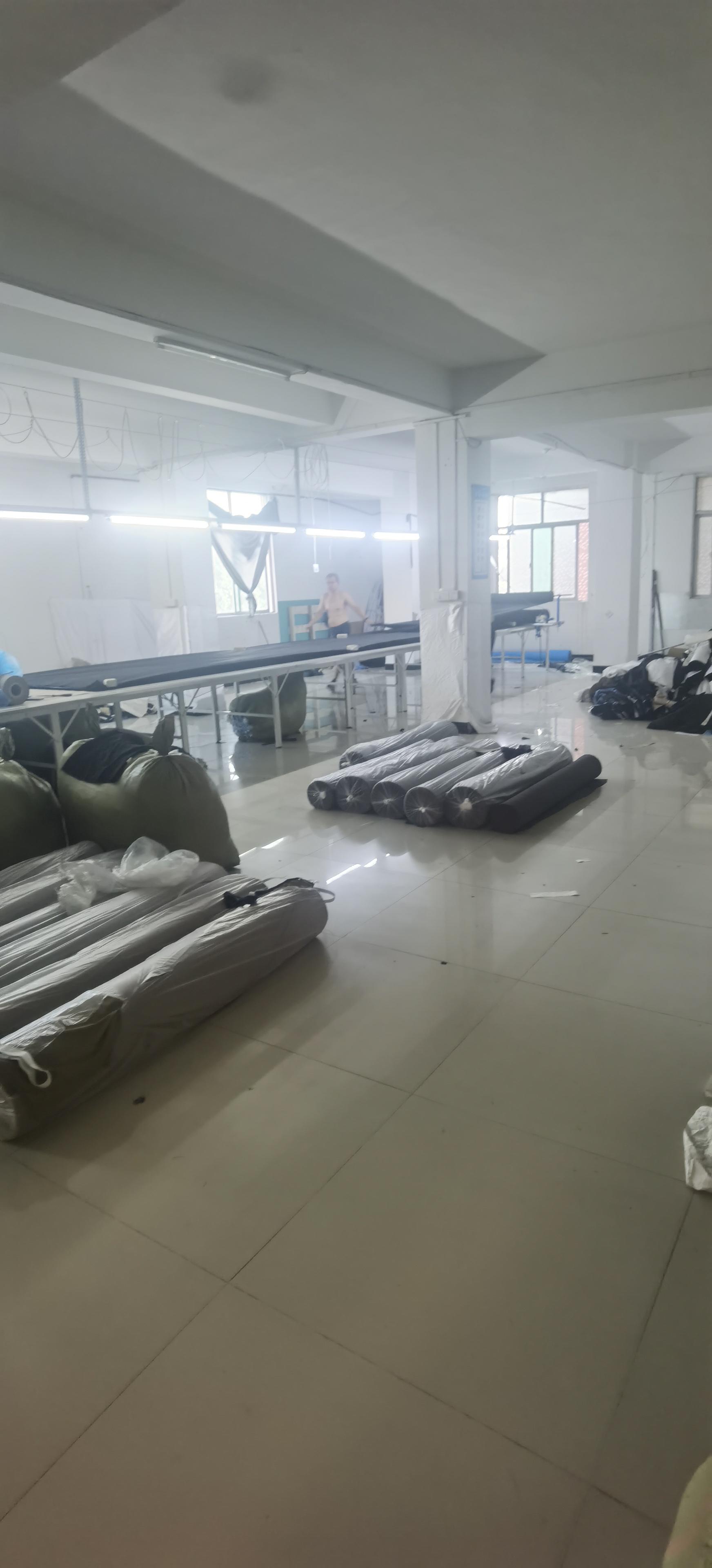
Production shop. Sampling and bulk running are separate calendar blocks in custom set orders.
Ready-made versus custom sets: the quantified trade-off
The alternative to any of the five codes is not another custom supplier; it is ready-made stock. The supplier's own comparison sets the two routes against each other on measurable terms, and the numbers explain why a decision-stage buyer is often choosing between speed and sellable differentiation rather than between prices alone.
| Criterion | Ready-made stock sportswear | Custom set programme (JE230–JE1888) | Decision implication |
|---|---|---|---|
| Minimum order | 1 piece | From 50 pieces | Stock suits testing a market; custom suits owning a product |
| First delivery | 3–7 days from existing stock | 7–10 working days sampling, then 20–35 working days bulk | Custom adds development time before the first sellable unit |
| Size and pattern | Fixed size charts, no size adjustment | 100% customizable size, pattern, cut and structure | Fit-driven markets justify the custom route |
| Fabric choice | 3–5 options | 20+ functional fabric selections | Function claims become a product decision, not a marketing line |
| Branding | Supplier's existing branding or none | 10+ branding crafts plus private labelling | Enables a private label without a second supplier |
| Testing | General basic reports typical of stock goods | Targeted laboratory tests arranged per market and material | Regulated markets need the custom route or extra testing |
| Continuity | Depends on remaining stock | Pattern files archived three years for reorders | Protects repeat orders and range extensions |
Table 2. Ready-made comparison basis and custom programme terms as documented by the supplier.
Two readings follow. First, the ready-made route is cheaper and faster only when the buyer's requirement stops at the garment itself; the moment fit, branding or destination testing is part of the brief, the comparison shifts to specification capability. Second, the 50-piece floor is the real threshold. Below it, stock remains the rational choice; above it, the custom route begins to pay for its own development cost.
Cost logic: what a lower price actually contains
Custom outdoor clothing sets are not uniformly more expensive, but they are differently structured. The supplier's comparison states that unit cost is somewhat higher on small MOQ orders because of functional fabric and custom development, and that for bulk orders above 500 pieces the factory-direct model reduces comprehensive project cost by 8%–15%, including sampling, testing and labelling service fees bundled into one package, where competitors often charge separately for pattern making, laboratory tests and custom tags. The 8%–15% range is a supplier-stated figure for the bundled structure; it is not a universal discount and should be tested against a line-item quotation.
External cost data explains where that money sits. A 2026 apparel cost breakdown reports that materials account for roughly 35%–50% of FOB on basic styles and 25%–40% on complex outdoor styles (OneAim Apparel, 2026). For a buyer comparing five codes, that means fabric selection is usually the largest controllable cost lever — larger than decoration on most programmes and certainly larger than labels. It also means a code specified in a heavier, higher-performance fabric will carry a structurally different price from one specified in a lighter fabric, even when both are quoted by the same factory on the same day.
Duty and destination costs sit outside the supplier's control and should be checked per code rather than per supplier. Analysis republished in 2026 records that the average US tariff rate on apparel imports reached 35.1% in December 2025, up from 14.7% in January 2025 (FASH455, Sheng Lu, University of Delaware, via DeadSoxy). That is a market-level rate for apparel imports into the United States, not a rate for any single order, but it is large enough to change a landed-cost comparison between a lower-FOB, higher-duty route and the reverse. Classification matters for the same reason: common codes for custom sportswear include 6109.10 for cotton T-shirts, 6110.20 for cotton hoodies and 6112.11 for knitted tracksuits. Buyers should confirm the classification of each code with a customs broker before treating a quotation as final.
Durability, reorders and the cost of a weak first order
Wash performance is the quiet variable in a five-code shortlist. The supplier states that its custom sports and outdoor apparel retains 85% or more of fabric functional performance after 50 standard wash cycles, against 55%–70% typically retained by ordinary functional garments under the same test. Those are supplier-reported figures describing fabric functional performance, not a product warranty, and they should be verified against the specific fabric confirmed for each code rather than applied to the range as a whole.
If the figures hold for the chosen fabric, the procurement consequence is straightforward: a programme that keeps most of its function after 50 cycles supports repeat orders and reduces the risk of a second-season complaint, while a garment that loses a third of its function creates a replacement cost that never appears in the FOB price. The supporting mechanism is administrative as much as technical — pattern files archived for three years allow a reorder without re-developing the block, whereas a supplier that offers only basic quality-claim service leaves the buyer paying for pattern reconstruction on every cycle. Buyers should ask what is archived, in what format, and who holds the file.
Application fit: where a custom set programme makes sense
The documented project types for this programme are specific, and matching the brief to one of them is faster than evaluating five codes in the abstract: sports team uniforms and club competition kit; private label brand development for direct-to-consumer fitness brands, outdoor retailers and apparel start-ups; corporate and group activity apparel; outdoor event merchandise such as trail races, cycling events and camping gatherings; wholesale bulk seasonal orders for distributors and import traders; and club or membership programmes including gym kits and fan merchandise.
The stated usage envelope is general sport and outdoor activity in normal natural environments, covering an ambient range of −10°C to 40°C, with breathable constructions for hot weather, wind-resistant and warm-keeping styles for cool days, and an optional water-repellent finish for light rain. The same documentation sets explicit boundaries: the apparel is not recommended for continuous heavy downpour or deep water immersion, for strong acid, alkaline or chemical corrosive surroundings, for extreme cold below −10°C or prolonged exposure above 40°C, or for direct contact with open flame or high-temperature molten objects. Any brief that falls outside that envelope should be treated as a different product problem rather than a fabric upgrade.
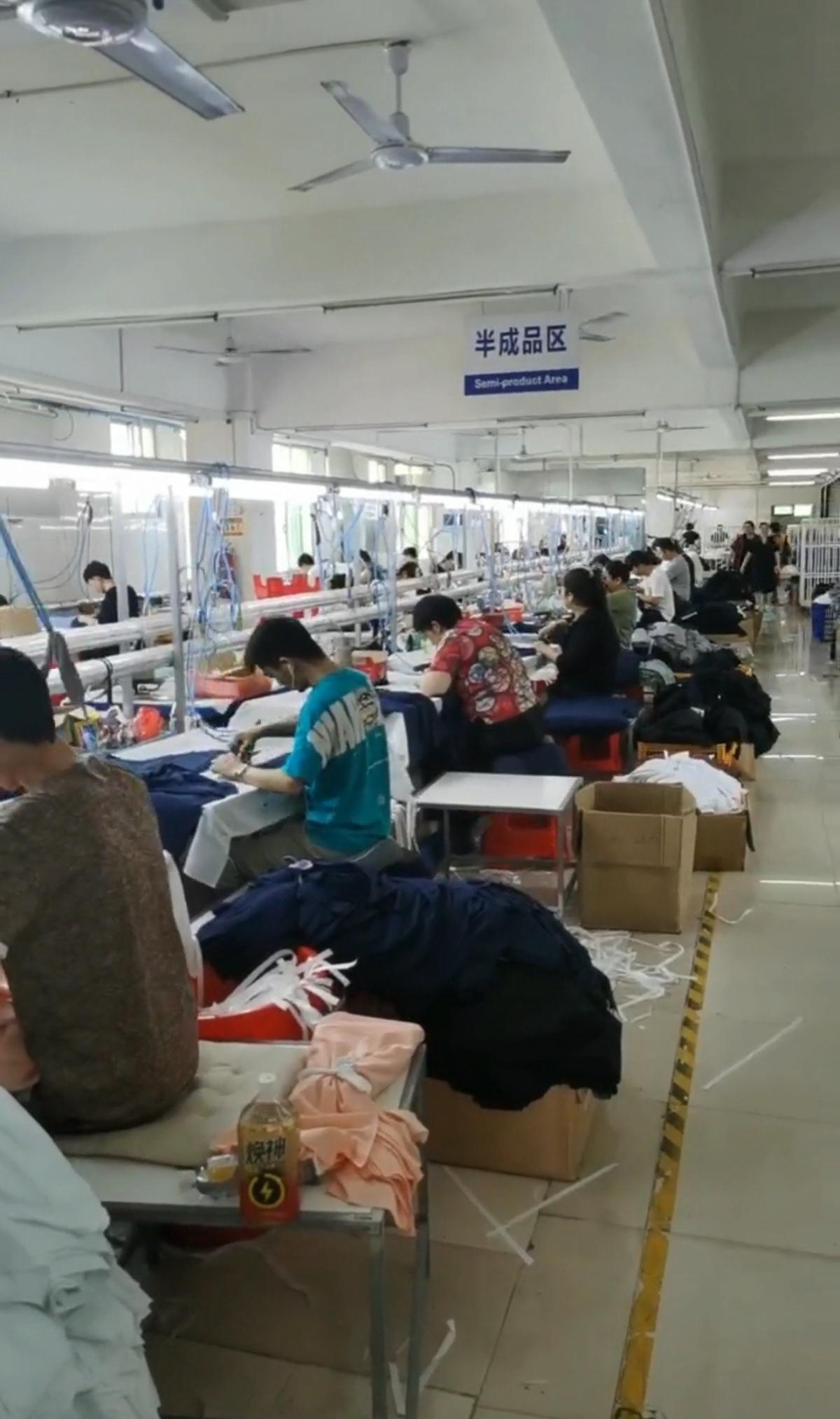
Production shop. Team kit, private label and event merchandise briefs follow different specification paths.
Market context a decision-stage buyer should weigh
Category growth is real but should not be read as demand for any individual code. The global outdoor apparel market is projected to reach USD 174.5 billion by the end of 2026, with the same forecast putting it at USD 184.2 billion in 2027 and USD 239.3 billion by 2032 (Mordor Intelligence, 2026). That figure describes retail revenue for performance and outdoor-lifestyle clothing and excludes footwear; it says nothing about the custom, OEM or private-label manufacturing segment, for which no verified market size was available in the evidence reviewed here.
China-level signals point in two directions at once, which is precisely why they belong in a decision file rather than in a headline. An official 2025 industry-report summary cites year-on-year growth of 7.38% for the Chinese sports footwear and apparel industry, and platform sports-goods sales of RMB 4,493.94 billion across four major e-commerce platforms, up 15.89%. The same summary reports 2025 sports-goods imports and exports of USD 29.584 billion including USD 28.163 billion of exports, while noting that sports apparel, outdoor products and several other categories experienced relatively large export declines. Taken together, aggregate scale and consumer-channel growth coexist with category-level export weakness — a reason to verify destination sell-through and to avoid extrapolating national totals onto a specific programme.
Limitations and fit boundaries
An independent comparison should state where the custom route does not fit, and where the evidence stops. The following points apply across JE230, JE2025, JT2026, JL2058 and JE1888.
- Order size: the custom route starts at 50 pieces; below that threshold, ready-made stock remains the practical option.
- Calendar: sampling of 7–10 working days precedes bulk production of 20–35 working days, which places a realistic first-delivery window well beyond stock shipping of 3–7 days.
- Certification scope: tests are arranged by market and material and existing reports must be confirmed per order; a certificate held for one product does not automatically cover another.
- Code-level data: no per-code fabric weight, test value or unit price is published in the documentation reviewed, so the comparison cannot be completed from a brochure alone.
- Small-quantity cost: unit cost is higher on small MOQ orders because functional fabric and custom development are carried by fewer units.
- Environmental limits: the garments are not intended for heavy downpour, immersion, chemical exposure, extreme temperatures beyond the stated −10°C to 40°C envelope, or open flame.
RFQ checklist before the purchase order
The five codes can be resolved in one request-for-quotation round if the document forces a code-level answer on each point below. Each item maps to a documented programme term, so a supplier able to answer it is not being asked for new capability, only for confirmation.
- Garment composition, fabric weight and the named functional finish, per code, with any attached test report.
- The specific function being purchased — moisture-wicking, 4-way stretch, UV protection, water repellency or breathability — stated in measurable terms.
- Graded measurement chart and tolerances for the target size range, plus fit-sample sizes.
- Decoration method per element, with artwork proof, colour references and placement diagram.
- Destination market, contact classification and the agreed test list with the accepting laboratory.
- Whether sampling, testing and labelling are bundled in the unit price or charged separately.
- Quantity tiers, particularly the price position below and above 500 pieces.
- Dated schedule covering sampling, bulk production, pre-shipment inspection and shipment release.
- Payment terms, stated as T/T with 30% deposit before production and balance before shipment unless otherwise agreed.
- Pattern-file ownership and archive period, plus NDA coverage for artwork and logo files.
Outlook
The direction of travel in this category is specification-led rather than volume-led. Buyers facing higher landed costs have a stronger reason to consolidate a programme into fewer, better-specified codes than to spread orders across more suppliers, and custom programmes reward that consolidation through pattern archiving and fabric continuity. On the supply side, documented capability in functional fabric selection, market-specific testing and private labelling is becoming the differentiator that stock wholesale cannot match.
Two conditions qualify that outlook. First, the custom route only outperforms stock when the buyer's brief genuinely requires fit, branding or destination testing; where it does not, the 3–7 day stock cycle still wins on total cost. Second, the 8%–15% bundled-cost effect and the 85% wash-retention figure are supplier-stated positions for this programme and should be confirmed against the specific fabric and quantity of each order. A buyer who closes the ten items in the checklist above will know, before the deposit, whether JE230, JE2025, JT2026, JL2058 or JE1888 is the right code for the brief — and will have the documentary basis to defend that choice internally.
FAQ
- What is the MOQ for custom sports and outdoor apparel?
- MOQ starts from 50 pieces, and small trial orders are supported for new brands. A better unit price is offered for orders above 500 pieces.
- How long is bulk production lead time?
- Bulk production takes 20–35 working days after sample confirmation and deposit receipt. Order quantity, fabric and colour options, and customization complexity may extend the lead time. This follows a pre-production sampling stage of 7–10 working days.
- Can textile certifications and test reports be provided?
- Certifications are arranged by target market and material, and existing reports should be confirmed per order. OEKO-TEX, REACH, AZO-free, colour-fastness and shrinkage tests can be arranged according to market requirements.
- What customization options are available?
- Options include fabric selection, sizing, cut, colour, sublimation print, silicone print, embroidery, woven labels, hang tags and private labelling. Buyers can provide their own artwork, or new styles can be developed.
- Can a custom design be kept confidential?
- An NDA is available upon request, and custom patterns, logos and artwork are stated not to be reused for other clients. Pattern files are archived for three years to support reorder maintenance.
¿Tiene preguntas o necesita más detalles?
Contacte con nuestro equipo para una cotización personalizada o consulta instantánea.
Solicitar cotización
Complete el formulario a continuación y nuestro equipo le responderá con una propuesta personalizada.
Chat directo de WhatsApp
¿Prefiere chatear en tiempo real? Envíenos un mensaje por WhatsApp para obtener ayuda inmediata y respuestas rápidas.
- Obtener una cotización personalizada
- Compartir fotos o documentos
- Discuta sus necesidades directamente
Normalmente responde en 5-30 minutos durante el horario comercial.