
Irrigation Pivot Systems: A Buyer's Evaluation Guide
Irrigation pivot systems play a practical role in modern large-field agriculture. In regions with a marked dry season, they substitute for rainfall and allow crops to keep growing under high-temperature or water-limited conditions. Market research estimates the global center pivot irrigation system market at USD 2.56 billion in 2025, rising to USD 5.67 billion by 2030 (Mordor Intelligence). For agricultural buyers, the practical question is not just whether a pivot system works, but which configuration, material specification and supplier can meet their field conditions.
A center pivot irrigation system is not a single product. The category includes fixed and towable pivot machines, four-wheel linear machines and, in some product families, hose reel irrigation machines. Understanding these categories helps align equipment with field shape, crop type and the available power supply.
The Problem: Large-field Irrigation Needs More Than Water
Large-scale irrigation creates several operational challenges. Labour, pumping cost, water uniformity and field access are recurring issues. Traditional surface irrigation may have a low initial cost, but it can be labour-intensive and distribute water unevenly. Mechanized systems address these constraints by replacing gravity distribution with pressurised application and controlled movement.
An irrigation pivot system delivers water while moving in a circular path. It reduces the manual handling of pipes and sprinklers, improves scheduling precision and makes it possible to water a large area from a single central connection. The opportunity for farm operators is to turn that capability into a long-term operational asset.
Regional investments illustrate the scale of this opportunity. In 2024, Lindsay Corporation secured a multi-year supply agreement for Zimmatic irrigation systems in the MENA region valued at more than USD 100 million. Those are not marginal purchases; they reflect large projects in water-stressed areas where pivot irrigation is a strategic response.
Supplier Profile: China Yulin Irrigation Equipment Co., Ltd.
China Yulin Irrigation Equipment Co., Ltd. (YULIN IRRIGATION) is a manufacturer of large irrigation machines. Established in 2009, the company specialises in the research, development, sale and service of center pivot irrigation systems, lateral move irrigation systems, towing irrigation systems, hose reel irrigation systems and irrigation parts. It is based in Lvshunkou District, Dalian City, Liaoning Province, China.
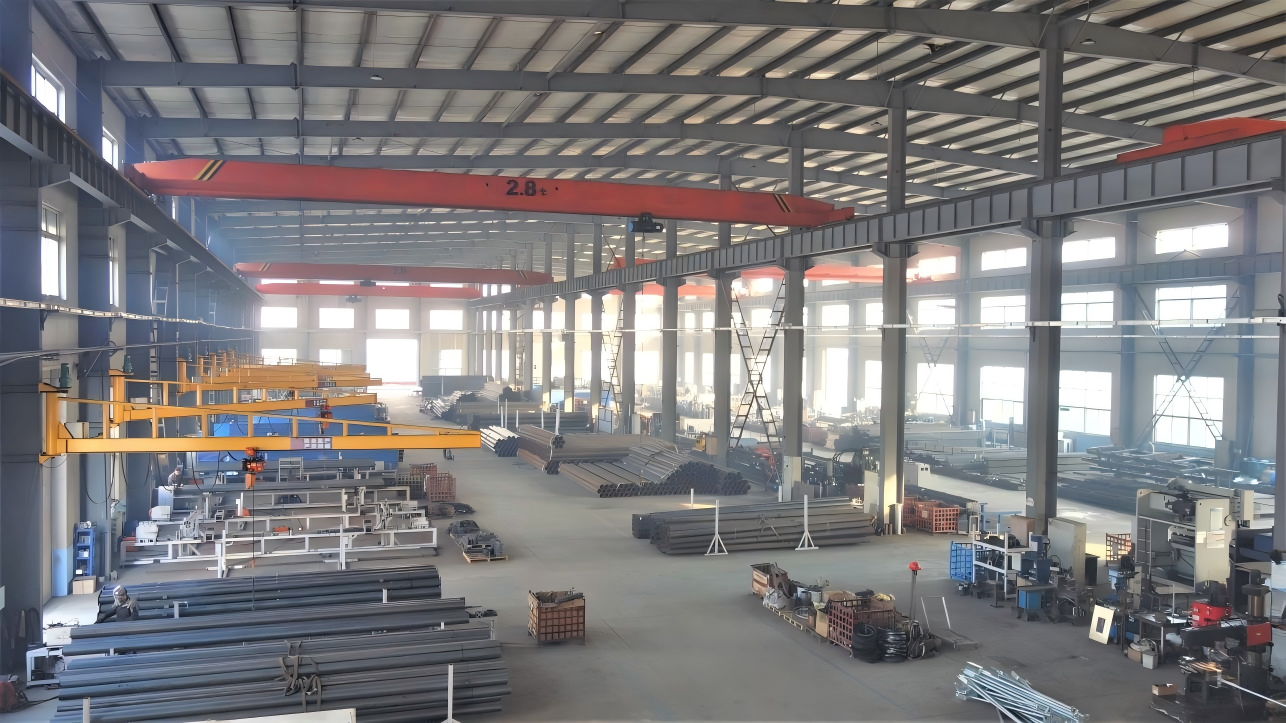
Its manufacturing facility covers 64,653 square meters and employs approximately 152 staff. The R&D team includes 10 engineers. Total annual production capacity is about 3,000 units, while the published supply capacity for pivot systems is 400 sets per year. Around 60% of the company's products are exported to markets including Australia, New Zealand, Canada, Mexico, Africa, Central Asia, Russia and Kazakhstan.
Technical Explanation: How a Center Pivot Irrigation System Works
A center pivot irrigation system consists of a fixed center point, a series of mobile towers, truss spans and a pipeline that delivers water to sprinkler heads. YULIN IRRIGATION describes its pivot drive as electromechanical, reversible and independent for each span. The machine operates in a circular motion, either clockwise or anti-clockwise, with a continuous or start-stop movement pattern.
The standard power requirement is 380V-460V. The control panel includes a main power disconnect switch, power control switch, water switch, direction switch, percentage speed indicator and auto-reverse switch, with IP65 protection. The machine uses pressure regulators of 10, 15 or 20 psi depending on the nozzle and crop configuration.
- Distance from ground to bottom of truss rod: 3 ± 0.2 m
- Operating temperature range: -45°C to +45°C
- Average drop diameter: no more than 1.1 mm
- Rain intensity: no more than 0.16 mm/min
- Land usage coefficient within the irrigated circle: no less than 0.9
- Plant mechanical damage: no more than 2%
- Tower wheels: 14.9-24 irrigating tires, two wheels per trolley, hot-dip galvanized discs
- Pipeline: sectional truss structure with reinforced, UV-resistant PVC flexible hoses
- Anti-corrosion coating: hot-dip galvanization according to GB/T 13912-2002
- Structural material: Q235B metal complying with GB 13912-2020
- Collector ring: 11 rings, minimum 4×90A and 7×25A
- Protection class: tower box IP33, collector ring IP65
- Copper cable core thickness: 4×4 mm² + 7×1.0 mm²
- Water compatibility: pH 6-7.5 without quality problems during the warranty period
Two parameters matter most when evaluating a center pivot for a particular farm: the anti-corrosion coating and the water pH tolerance. The galvanized coating standard determines how the machine handles saline-alkali soil and high-moisture environments. The pH tolerance defines whether normal irrigation water can be used directly or whether pipe material options are needed.
Application / Use Case: Dry-Season Irrigation in Papua New Guinea
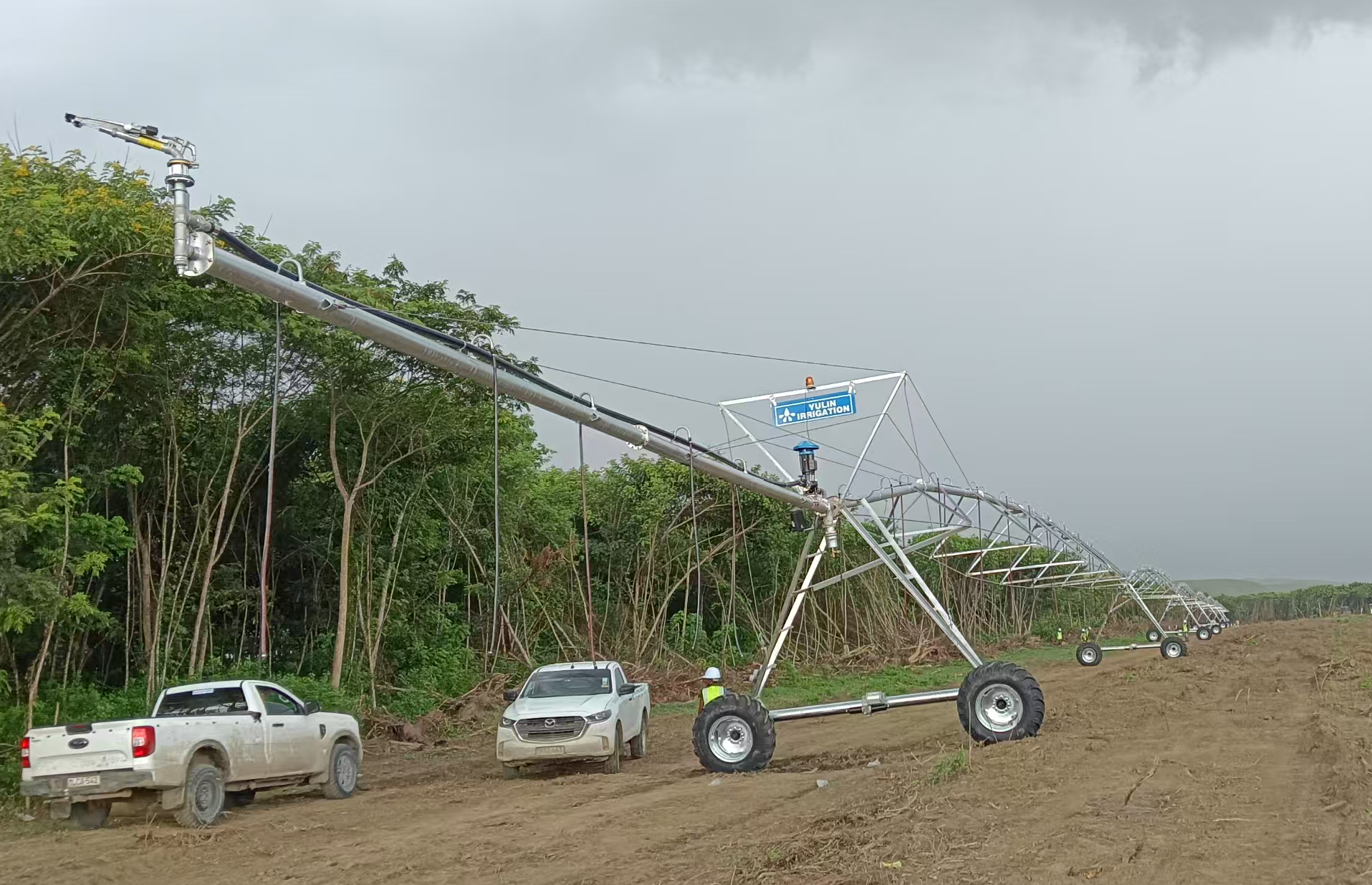
A practical example shows how a center pivot can be adapted to specific field conditions. In a Papua New Guinea farm project with a high-temperature working environment, YULIN IRRIGATION supplied a center pivot irrigation machine as a substitute for rainfall during the dry season. The configuration was 395.6 meters long and covered approximately 50 hectares.
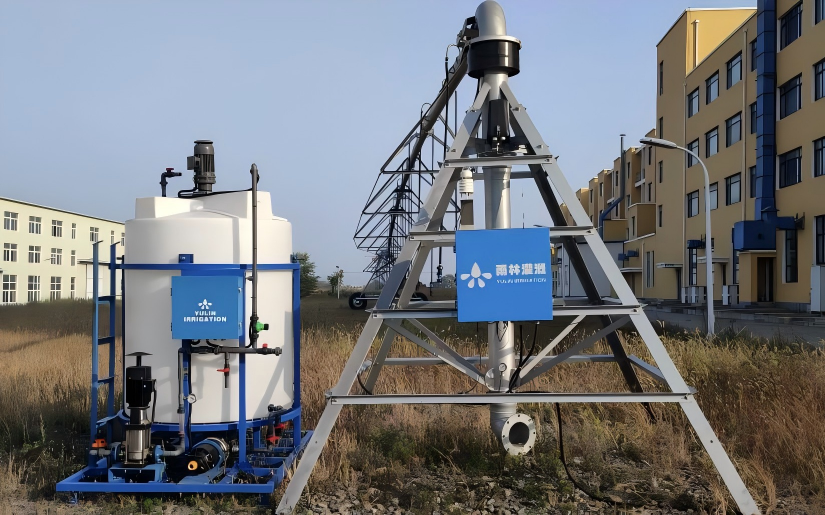
The machine was equipped with an end spray gun to provide supplementary irrigation for the field corners. A 1,000-liter fertilizer tank was integrated for combined water and nutrient application. The customer also requested poly pipe options to protect the system from acidic or alkaline water and to enable pesticide application during irrigation. Since the site did not have a stable grid connection, the machine was powered by an external power source or a diesel generator set.
Market Trend Analysis
The center pivot irrigation market provides a clear economic backdrop. Mordor Intelligence estimates the global center pivot irrigation system market at USD 2.56 billion in 2025, reaching USD 5.67 billion by 2030. This growth projection is consistent with broader agricultural trends towards mechanisation, water conservation and food security programmes.
At the company level, large suppliers show substantial commercial scale. Valmont Industries reported Agriculture segment sales of USD 278.0 million in Q4 2024, which represented 26.7% of total net sales. Lindsay Corporation's MENA contract, valued at more than USD 100 million, points to strong regional demand for large project delivery capacity. For buyers, these signals mean that the market contains both global leaders and regional exporters capable of supplying comparable equipment.
Comparison with Traditional and Alternative Methods
| Method | Irrigation pattern | Main advantages | Main constraints |
|---|---|---|---|
| Surface irrigation (flood/furrow) | Entire field surface | Low initial cost, simple operation | High labour, uneven distribution |
| Hose reel / traveler irrigation | Strip path, moved in steps | Flexible for smaller or irregular fields | Frequent repositioning, more supervision |
| Center pivot irrigation | Circular movement | Automated, uniform, labour-saving | Corners remain dry, needs power supply |
A real limitation of a center pivot system is its circular coverage pattern. In square or rectangular fields, the corners outside the irrigated circle will not receive water unless the system is equipped with an end spray gun or a corner arm. The end gun can reduce the dry-corner problem, but it cannot eliminate it. Another boundary is power. The 380V-460V voltage requirement means the buyer must secure either a grid connection or a reliable generator set.
Buyer Checklist: What to Verify
Before purchasing a center pivot irrigation system, a buyer can verify the following points:
- Manufacturing evidence: facility size, production output, R&D structure and whether the plant covers the manufacturing process in-house.
- Material compliance: whether the structural steel is Q235B compliant with GB 13912-2020 and the anti-corrosion coating follows GB/T 13912-2002.
- Technical fit: the span length, voltage, control panel protection class and water pH compatibility.
- Field adaptation: the ability to add an end spray gun, fertilizer tank, corrosion-resistant pipes or a generator-based power solution.
- Service capacity: whether the supplier can offer overseas installation, commissioning and operator training.
- Industry standard: ISO 11545:2009 defines an in-field method for determining water distribution uniformity of center-pivot and lateral-move machines, and can be used as a technical reference in evaluation.
Future Outlook
Market forecasts suggest continued adoption of center pivot systems through 2030. As water constraints tighten and farm sizes grow, mechanised irrigation will become more central to farm planning. Buyers can expect more configurations to become available, including small center pivot systems, solar-powered pivots and variable-rate irrigation. Suitability will still depend on crop type, field geometry, water quality and the available energy infrastructure.
For procurement teams, the evaluation basis is shifting from the initial machine price to the annual cost per irrigated hectare. That calculation should include installation, maintenance, corrosion resistance, power supply and the supplier's ability to provide training and after-sales service.
FAQ
What is an irrigation pivot system?
An irrigation pivot system is a mechanized irrigation machine that applies water from a rotating pipeline around a fixed center point. It belongs to the family of large irrigation equipment used for field crops. YULIN IRRIGATION's unit is classified as a center pivot irrigation system, under the towable pivot, four-wheel linear and hose reel irrigation machine categories.
How does a center pivot irrigation system work?
The machine rotates around a fixed center point using an electromechanical drive that is reversible and independent for each span. It can run clockwise or anti-clockwise in continuous or start-stop mode. The control panel includes main power switching, water control, direction control, speed adjustment and auto-reverse functions with IP65 protection.
What area can a center pivot irrigation system cover?
Standard configurations cover about 10 hectares with a 177.6-meter span length, 30 hectares with 307.4 meters, 50 hectares with 395.6 meters and 100 hectares with 565 meters.
What power supply does a center pivot irrigation machine need?
The standard voltage requirement is 380V-460V. Where a grid is unavailable, the system can run on a diesel generator. In the Papua New Guinea project, the pivot was powered by an external power source or a diesel generator set.
What crops can be irrigated with a center pivot system?
The product is designed for fodder crops, cereals, vegetables and industrial crops, including corn. Its average drop diameter is no more than 1.1 mm, and plant mechanical damage is no higher than 2%, which makes the system suitable for sensitive broad-acre crops.
For detailed center pivot specifications and configuration options referenced in this article, see the 2026 YULIN Pivot Catalogue (PDF).