
Irrigation Pivot System Procurement FAQ: Lengths, Voltage and Span Control
Irrigation Pivot System Procurement FAQ: Lengths, Voltage and Span Control
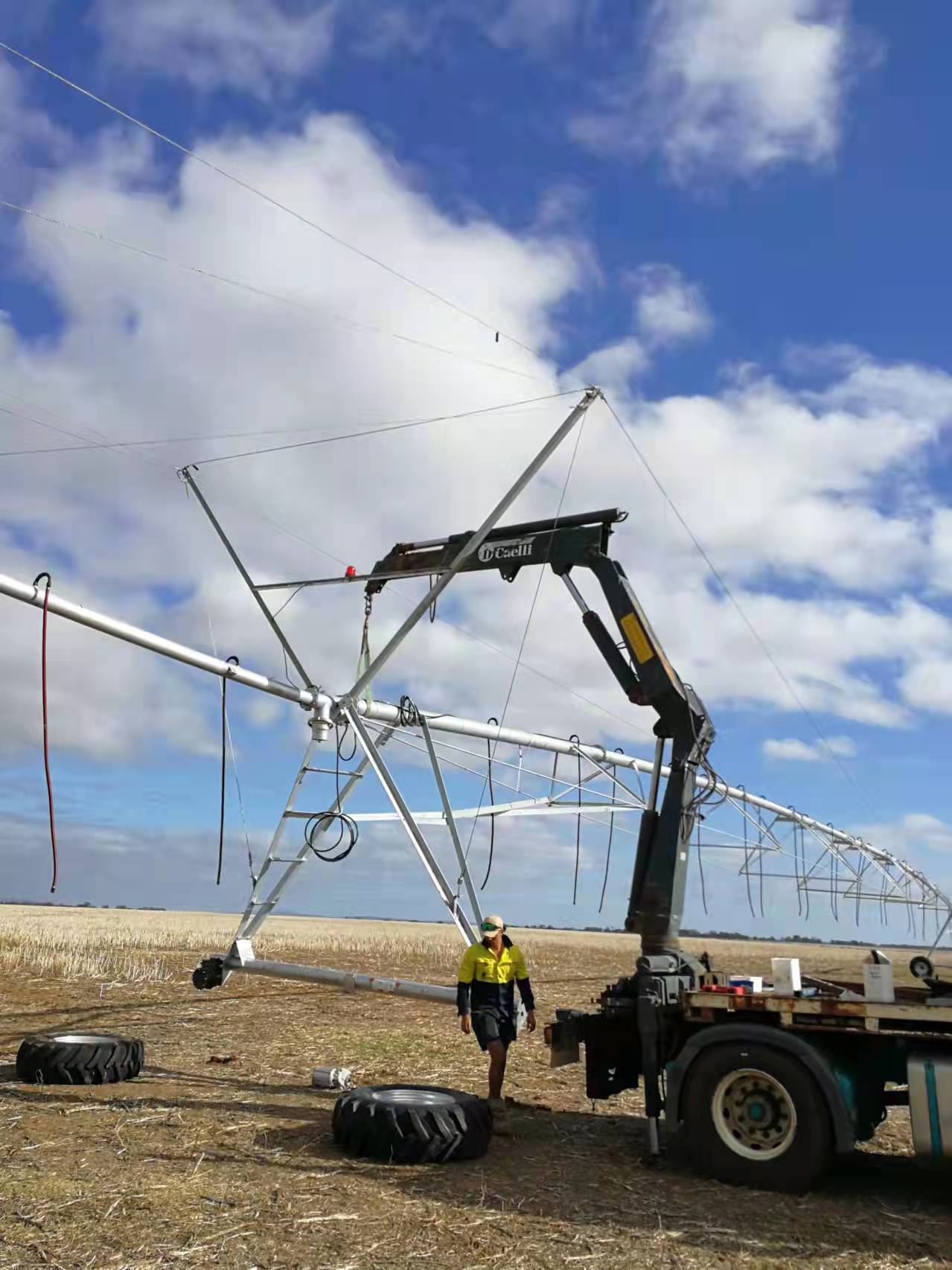
Span assembly of a fixed center pivot irrigation system during on-site installation. Span length and tower position determine the irrigated area of the machine.
A center pivot irrigation system is a mechanized sprinkler machine that irrigates a circular area by rotating connected spans around a fixed central tower. Buyers who have already reached the evaluation and execution stage seldom need the concept explained again. What they need are the configuration numbers that decide whether a machine can be ordered, installed and operated as planned: machine length against field size, supply voltage, the control logic that governs span movement, and the material and protection ratings that can be verified before shipment.
This reference answers the technical and procurement questions that recur most often in pivot purchasing, using the published specification set for the Fixed DYP center pivot range from China Yulin Irrigation Equipment Co., Ltd., a manufacturer of center pivot, linear move, towing and hose reel irrigation machines established in 2009 and located in Lvshunkou District, Dalian City, Liaoning Province, China, roughly two hours by truck from Dalian Port.
Most pivot procurement failures are configuration failures rather than manufacturing failures. A machine that is oversized for its block cannot be shortened on site. A panel built for one voltage band does not correct a mismatch with the farm's supply. An unclear reading of "individual span control" produces the wrong expectation of how the machine tracks across a field. Treating these as order-stage questions instead of installation-stage problems is the cheapest risk control available to a buyer.
Four decisions that determine whether a pivot order is correct
- Coverage: which machine length matches the block, and how much usable area the circle actually delivers.
- Power: whether the site supply, protection and cabling align with the machine's rated voltage range.
- Control: how span drives, direction and speed regulation are actuated, and who defines the application depth.
- Verification: which material, coating and enclosure standards apply, and what evidence is issued with the shipment.
Each of these is treated below with specific published parameters, followed by third-party market context, a comparison against traditional irrigation approaches, and the boundaries a fixed pivot cannot cross.
Matching model length to field size: 177.6 m, 307.4 m, 395.6 m and 565 m
The Fixed DYP range is published as four model lengths, each stated against a nominal covered area.
| Model length | Nominal covered area | Block profile the configuration fits |
|---|---|---|
| 177.6 m | 10 ha | Smaller regular blocks, vegetable and fodder plots, tighter field boundaries |
| 307.4 m | 30 ha | Mixed cereal and fodder farms operating one machine per block |
| 395.6 m | 50 ha | Commercial grain farms with a single large, unobstructed block |
| 565 m | 100 ha | Large estates running one machine across an extended block |
Coverage scales with the square of the radius rather than with the length of the machine, which is why buyers working from hectares alone frequently mis-size a pivot. The published land usage coefficient within the irrigated circle, including the area near the center tower, is not less than 0.9. That coefficient is the practical figure for converting nominal coverage into usable area, and it also explains why the enclosing square of a field is always larger than the circle it contains.
The decision rule that follows is direct: match one machine to one block that can physically contain the circle. Where a farm is split into irregular parcels, two shorter machines often serve the operation better than one long machine plus unirrigated corners, even when total hectares are identical.
Voltage: what the 380 V–460 V rating covers, and what it does not
The published rated voltage for the Fixed DYP center pivot is 380 V–460 V. The standard control panel includes a main power switch (disconnect switch), a power control switch, a water switch, a direction control switch, a percentage indicator for speed regulation and an auto-reverse switch. The control panel specification lists IP65 protection.
Electrical details that matter at the ordering stage include the collector ring — specified with 11 rings and not less than 4×90 A and 7×25 A — and the copper cable core thickness of not less than 4×4 mm² + 7×1.0 mm². These are machine-side specifications. The site-side supply, transformer capacity, earthing and protection devices remain a project responsibility, and the interface between the two is where voltage problems usually originate.
Because the rated range spans 380 V to 460 V, the actual site voltage should be confirmed during technical review rather than inferred from the machine rating. Voltage customization is offered for OEM orders, which is relevant to buyers supplying markets whose local supply differs from the standard range, and to OEM and ODM projects generally. The machine is rated for ambient temperatures from −45 °C to +45 °C, a range that covers both cold continental installations and hot dryland conditions.
Span control explained: electromechanical, reversible, individual for each span
Span control is the part of pivot specification most often misread. In the Fixed DYP configuration the pivot drive is electromechanical, reversible and individual for each span. Each span therefore carries its own drive instead of being mechanically slaved to a single motor, and the machine as a whole is described with a movement mode of continuous with start-stop capability, following the same motor behaviour as the last tower.
Two panel functions act directly on span behaviour. The direction control switch selects the travel direction, and the auto-reverse switch allows direction changes without manual intervention. Combined with the published irrigation method — circular motion, clockwise and anti-clockwise — this supports full rotations in either direction across a block, which matters where wheel tracks, soil moisture patterns or wind exposure favour alternating passes.
The percentage indicator is the speed-regulation element. Tower travel speed and applied depth are linked: a faster tower applies less water per pass, a slower tower applies more. The machine's 24-hour irrigation rate is listed as an option rather than a fixed value, which means the intended application depth is a buyer-specified parameter and should be agreed at the order stage rather than settled at commissioning.
Protection ratings: where IP65 applies and where it does not
Enclosure ratings are frequently read as machine-wide claims. In this specification set they are component-specific.
| Component | Published protection level | Practical meaning |
|---|---|---|
| Control panel | IP65 | Dust-tight enclosure resistant to water projected as a jet |
| Collector ring | IP65 | Same enclosure class at the rotating electrical interface |
| Tower box | IP33 | Protection against smaller solid objects and against water spray |
Under the IP code convention the first digit addresses solids and the second addresses water, so the two ratings are not equivalent, and the difference matters where a machine is washed down or exposed to strong spray near wheel tracks. A common procurement misunderstanding is to treat "IP65" as an overall machine rating. It is not: the published values apply to the enumerated enclosures, and the tower box is listed at IP33.
Verifying Q235B steel and GB 13912-2020 hot-dip galvanization
The material field for the Fixed DYP center pivot lists Q235B metal with GB 13912-2020, while the anti-corrosion coating parameter specifies hot-dip galvanization according to GB/T 13912-2002. Both references appear in the published specification set and both describe the same protective intent: a galvanized steel structure intended to resist corrosion in humid, saline-alkali and high-wind farmland environments. Buyers should confirm which edition governs the coating on their specific order and which inspection record will be issued with the shipment.
Tower wheels provide a second inspection point: they are specified as 14.9-24 irrigating tires, two wheels on each trolley, with hot-dip galvanized discs, so coating quality can be checked directly on delivered components rather than only in documentation.
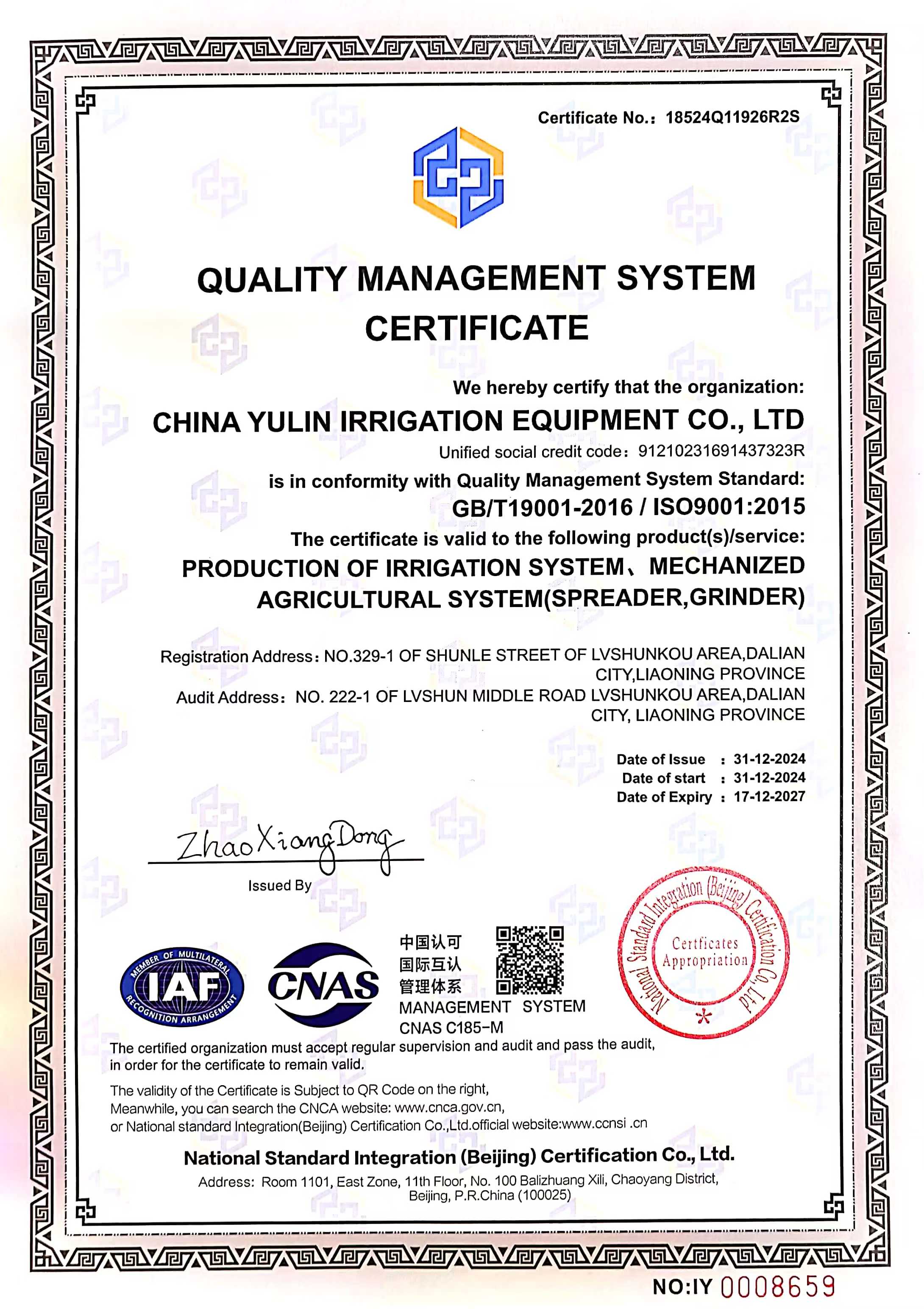
Quality management system certificate held by the manufacturer, issued to GB/T 19001-2016 / ISO 9001:2015 under certificate number 18524Q11926R2S.
The manufacturer's quality system is certified to GB/T 19001-2016 / ISO 9001:2015 under certificate 18524Q11926R2S, issued by National Standard Integration (Beijing) Certification Co., Ltd. and valid to 17 December 2027, with a scope covering the production of irrigation systems and mechanized agricultural systems. CE and CSA certification are also held, and the company states that all irrigation equipment undergoes anti-corrosion and wind resistance testing. More than 95% of machine spare parts are manufactured in house, which shortens the traceability chain between a component and its inspection record.
Operating envelope: continuous movement, direction and water quality
| Parameter | Published value |
|---|---|
| Pivot type | Fixed DYP center pivot |
| Tower drive type | Electromechanical |
| Pivot movement mode | Continuous, start-stop |
| Irrigation method | Circular motion, clockwise and anti-clockwise |
| Rated voltage | 380 V–460 V |
| Truss clearance (ground to bottom of truss rod) | 3 ± 0.2 m |
| Rain intensity | Not more than 0.16 mm/min |
| Average drop diameter | Not more than 1.1 mm |
| Plant mechanical damage | Not more than 2% |
| Land usage coefficient within irrigated circle | Not less than 0.9 |
| Pressure regulators | 10, 15 or 20 psi |
| Water quality | pH 6–7.5 usable without quality problems during the warranty period |
| Ambient temperature | −45 °C to +45 °C |
| Water pipeline | Sectional, truss structure |
| Irrigated crops | Fodder crops, cereals, vegetables, industrial crops, including corn |
The truss clearance of 3 ± 0.2 m to the bottom of the truss rod determines whether the machine passes over tall crops such as corn and whether other field operations can share the same block. Rain intensity capped at 0.16 mm/min alongside an average drop diameter not exceeding 1.1 mm describes an application profile intended to limit soil sealing and plant damage, with the published allowance for plant mechanical damage set at not more than 2%.
Water quality is a warranty-relevant parameter rather than a preference: water with pH 6–7.5 can be used without quality problems during the warranty period. Operations drawing from sources outside that band — strongly alkaline wells or recycled water, for example — should raise the question during technical review rather than after commissioning.
Commercial terms, acceptance testing and lead time
Order-stage terms published for the pivot range and recorded in the manufacturer's procurement and selection material are summarised below.
| Item | Term |
|---|---|
| Minimum order quantity | 1 unit |
| Delivery terms | FOB / CFR / CIF |
| Acceptance criteria | Pre-shipment test |
| Payment terms | 30% deposit after contract confirmation; balance by T/T before shipment (L/C or D/P for the Algeria market) |
| Lead time | 21–40 days |
| Monthly capacity | 60 units |
| Customization | OEM production, ODM orders, voltage customization |
| After-sales | Field installation, commissioning and operator training; video technical support; online support; free spare parts |
Where the acceptance criterion is a pre-shipment test, the buyer should confirm before the order which parameters are recorded and how the record is issued — in particular voltage checks on the panel, span drive operation, direction and auto-reverse function, and the protection class of the listed enclosures. A published supply capacity of 400 pivot sets per year is also stated for the manufacturer, which is relevant when scheduling delivery against a planting calendar.
Application evidence: how these machines are used in practice
Published manufacturer case records describe how the equipment is deployed across markets and crop types.
- Australia — a distributor has taken 600 units over 15 years, primarily for forage and pasture irrigation and also for cotton, watermelon and other crops; the record cites energy savings of more than 40%, labour savings, long service life and low maintenance cost.
- New Zealand — a large-scale dairy farmer operates 70 units for grass irrigation across a nine-year relationship, with long service life and labour savings recorded.
- Russia — a group has taken 450 units over nine years, with a reported 40% increase in efficiency and reduced labour requirements.
- Algeria — an OEM client has taken 70 units over seven years, supplying its own local brand and providing local service.
- Zimbabwe — an end customer operates 45 units for crop irrigation using a three-wheel towable configuration.
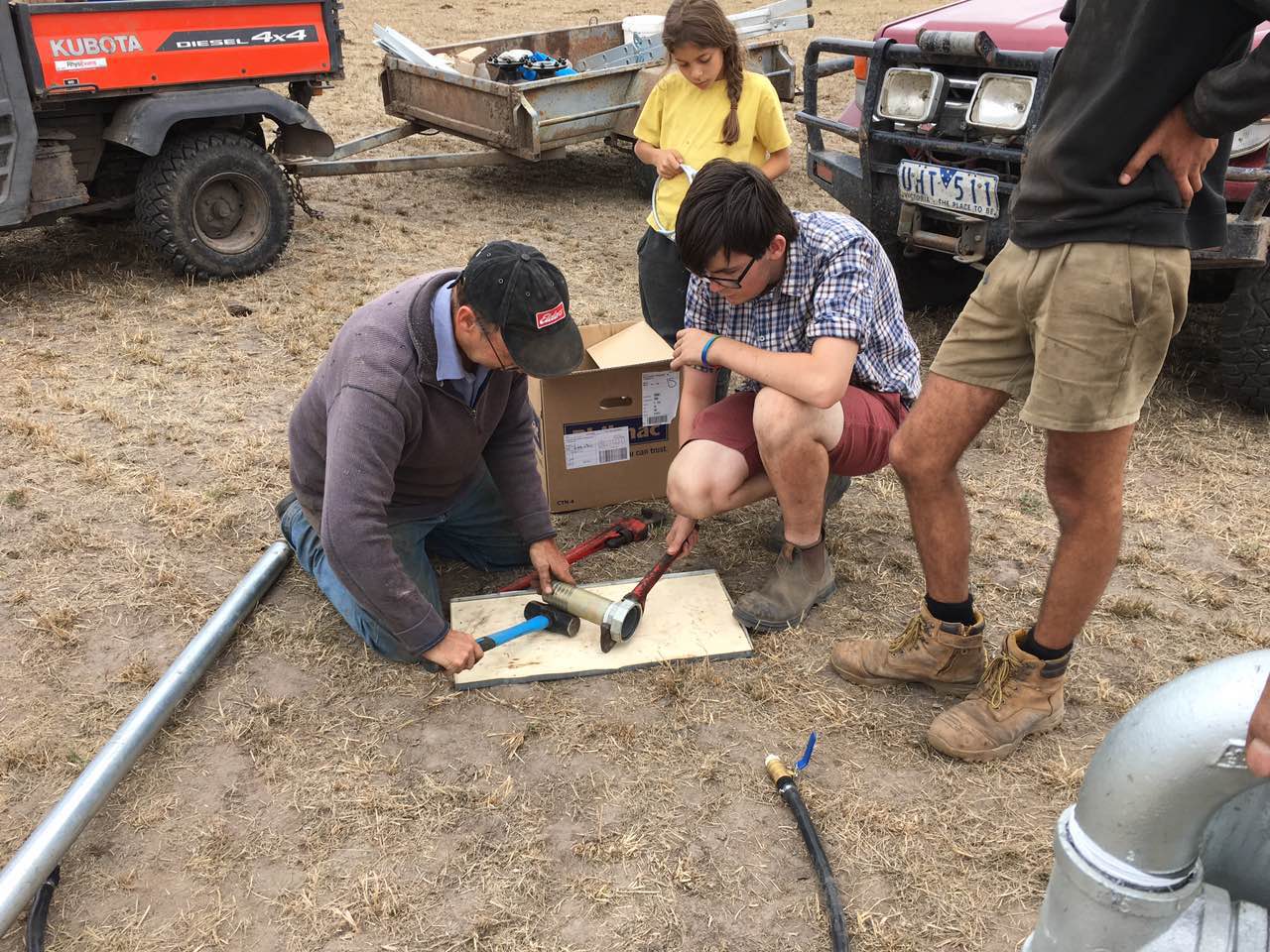
Client personnel and engineers assembling irrigation pivot system accessories as part of on-site commissioning support.
These are first-party case records rather than independent audits. They are useful as an indication of deployment scale and relationship duration, and they should be treated as manufacturer-reported evidence during supplier evaluation.
Market context from third-party sources
Category-level data, as distinct from any single supplier's claims, helps explain why documentation-quality questions have become more common in pivot procurement.
- Mordor Intelligence estimates the global center pivot irrigation system market at USD 2.56 billion in 2025, projected to reach USD 5.67 billion by 2030 (Mordor Intelligence, Center Pivot Irrigation System Market Forecasts to 2030).
- Valmont Industries reported Agriculture segment sales of USD 278.0 million in Q4 2024, representing 26.7% of total net sales (Valmont Industries, fourth quarter and full-year 2024 results, 18 February 2025).
- Lindsay Corporation secured a multi-year Zimmatic irrigation supply agreement in the MENA region valued at more than USD 100 million in 2024 (Lindsay Corporation, third quarter fiscal 2024 results, 27 June 2024).
- ISO 11545:2009 remains the active international standard specifying an in-field method for determining the uniformity of water distribution from centre-pivot and moving lateral irrigation machines (International Organization for Standardization).
Market sizing across published sources differs considerably, partly because some estimates cover equipment only while others include project construction. Buyers should treat such figures as budgeting context rather than as supplier selection criteria, and should rely on the equipment specification when comparing machines.
Fixed pivot versus traditional and alternative irrigation: where the limits are
The center pivot is not the right answer for every field, and the specification set itself makes the boundaries visible.
| Dimension | Fixed DYP center pivot | Hose reel / traveller irrigation |
|---|---|---|
| Coverage geometry | Circular; requires a block able to contain the circle | Path-based; suits rectangular or irregular parcels |
| Mobility | Fixed installation on one block | Designed to be pulled between parcels and rented out |
| Structure | Sectional truss pipeline carried on towers | PE pipe reel with travelling sprinkler |
| Labour profile | Automated rotation with start-stop positioning | Requires repositioning between runs |
| Field footprint | Land usage coefficient within irrigated circle not less than 0.9 | Coverage depends on run layout and spacing |
| Power | On-site supply within the stated 380 V–460 V range | Not specified in the cited product data |
Three limits are structural rather than negotiable. First, the Fixed DYP is a fixed machine; the same manufacturer separately publishes towable pivot, four-wheel linear irrigation and hose reel configurations for operations that need to move equipment between blocks. Second, a circular machine on a square field always leaves the area outside the circle to be planned for — the 0.9 land usage coefficient quantifies usable share inside the circle, not the whole field. Third, water and power are prerequisites: pH 6–7.5 for warranty-period water quality, a site supply compatible with 380 V–460 V, and an application depth defined at order stage because the 24-hour irrigation rate is listed as an option.
Hose reel equipment has its own advantages. A Brazilian project record describes 50 units used on soybean over six years, with a reported 30% higher output in dry conditions and labour savings, and highlights easy towing between parcels and easy rental — properties a fixed pivot does not offer.
Future outlook
Three directions are reasonable to plan around. Uniformity verification is moving from marketing language into specification language: ISO 11545:2009 provides an in-field method for determining water distribution uniformity from center-pivot machines, giving buyers a defined basis to reference when they intend to verify performance. Demand data points to continued installation growth, with major contract activity concentrated in the MENA region. And supply-side flexibility — OEM production, ODM orders and voltage customization — will remain the practical route for buyers whose local supply conditions or brand requirements differ from standard catalog configurations.
Frequently asked questions
Which center pivot model length fits a 10 ha, 30 ha, 50 ha or 100 ha block?
The published range lists 177.6 m for 10 ha, 307.4 m for 30 ha, 395.6 m for 50 ha and 565 m for 100 ha. Because a pivot irrigates a circle around a fixed tower, coverage scales with the square of the radius, so the block must be able to contain that circle. The land usage coefficient within the irrigated circle is not less than 0.9 including the area near the center tower, and that is the figure to use when converting nominal coverage into usable area.
What voltage does the Fixed DYP center pivot require?
The published rated voltage is 380 V–460 V. The standard control panel includes a main power switch (disconnect switch), power control switch, water switch, direction control switch, a percentage indicator for speed regulation and an auto-reverse switch. The collector ring is specified with 11 rings, not less than 4×90 A and 7×25 A, and the copper cable core is not less than 4×4 mm² + 7×1.0 mm². Voltage customization is available for OEM orders, and the site supply should be confirmed before the order is finalized.
How does individual span control work on this machine?
Each span is driven by its own electromechanical, reversible drive, and the pivot movement mode is described as continuous with start-stop capability, following the same motor behaviour as the last tower. Because spans drive individually, the machine can start, stop and reverse as a coordinated unit across a rotation. Direction control and auto-reverse on the panel support the two published irrigation directions: clockwise and anti-clockwise circular motion.
What do IP65 and IP33 protect on a center pivot?
The control panel specification lists IP65, and the protection parameter lists the collector ring at IP65 and the tower box at IP33. In the IP code, the first digit covers solids and the second covers water, so an IP65 enclosure is dust-tight and resistant to water jets while IP33 covers smaller solid objects and water spray. These ratings apply to the listed enclosures, not to the machine as a whole.
How can a buyer verify Q235B steel and GB 13912-2020 galvanization?
The product material field lists Q235B metal with GB 13912-2020, while the anti-corrosion coating parameter specifies hot-dip galvanization according to GB/T 13912-2002. Both references appear in the published specification set, so the purchase order should state which edition applies and which inspection record will be supplied. Tower wheels are specified as 14.9-24 irrigating tires, two per trolley, with hot-dip galvanized discs. The manufacturer holds ISO 9001 certification 18524Q11926R2S, issued by National Standard Integration (Beijing) Certification Co., Ltd. and valid to 17 December 2027, along with CE and CSA certification.
Can the machine run continuously, and which water quality is safe?
The pivot movement mode is continuous with start-stop capability. Water with pH 6–7.5 can be used without quality problems during the warranty period. Rain intensity is specified at not more than 0.16 mm/min, average drop diameter at not more than 1.1 mm, and plant mechanical damage at not more than 2%. Pressure regulators are available at 10, 15 or 20 psi, and the truss is set at 3 ± 0.2 m from the ground to the bottom of the truss rod.
What are the standard procurement terms for a pivot order?
Minimum order quantity is 1 unit; delivery terms are FOB, CFR or CIF; acceptance is based on a pre-shipment test; payment is 30% deposit after contract confirmation with the balance by T/T before shipment, or L/C or D/P for the Algeria market. Lead time is 21–40 days and monthly capacity is 60 units, with a published supply capacity of 400 pivot sets per year.
What support is provided after delivery?
After-sales support covers field installation, commissioning and operator training overseas, together with video technical support, online support and free spare parts. Because the machine operates within a defined electrical and water-quality envelope, the installation and commissioning stage is also when the site supply, pressure regulation and panel settings are confirmed against the published specification.
Reference: the current 2026 YULIN Pivot Catalogue, including the Fixed DYP center pivot specification set, can be downloaded at https://cdn.socialarks.com/sbsp/25007/common/2026/0623/2026%20YULIN%20Pivot%20Catalogue.pdf