
Investment Casting Explained: Process, Tolerance and Limits
Investment Casting Explained: Process, Tolerance and Limits
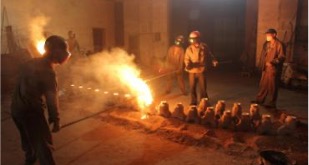
Pouring stage of investment casting: molten metal fills a preheated ceramic shell formed around a lost wax pattern.
Investment casting — commonly called lost-wax casting — is a precision casting process in which an expendable wax pattern is coated with a ceramic shell, dewaxed, and then filled with molten metal to produce a near-net-shape metal component. Buyers specify it when a part's geometry, wall thickness or dimensional tolerance would make sand casting uneconomic once the required machining is added back in.
The route is long established in industrial supply chains, and it is still growing. Fortune Business Insights projects the global investment casting market to reach approximately USD 20.52 billion in 2026. Published market estimates vary considerably, however, depending on whether a source counts precision investment casting alone or the broader metal casting industry that also includes sand and die casting, so headline figures are best read as directional rather than definitive.
The process mix inside that market has been shifting. In 2025 the silica sol process held the largest share of the investment casting market at 54.3%, ahead of the water glass process at 32.1%, according to Dataintelo, which notes that silica sol is preferred where precision and surface finish are the deciding requirements. On the demand side, automotive applications accounted for roughly 29% of investment casting demand in 2025, the largest volume-driven segment, according to Business Research Insights.
Why Investment Casting Sets the Reference for Complex Small-to-Medium Parts
Three properties explain why the process appears so often in machinery and vehicle component specifications.
- Geometry freedom. Because the pattern is wax and the mould is a ceramic shell, internal passages, undercuts and thin sections can be formed in one piece. The process is used for complex-shaped, high-precision small-to-medium castings across a wide range of industrial applications.
- As-cast accuracy. Investment casting delivers higher dimensional accuracy and a better surface finish than sand casting, which is why it is often selected for stainless steel and other high-alloy steel parts.
- Material range. Carbon steel, alloy steel, stainless steel and ductile iron are all routinely cast this way, with specific grades confirmed against the customer's drawing.
The trade-off is cost. Investment casting is generally more expensive per kilogram than sand casting, and it is not the economical route for large, heavy components with relaxed dimensional requirements. That boundary is examined later in this article.
The Investment Casting Process, Step by Step
A part family moves through a fixed sequence of operations, and buyers who understand that sequence can read a supplier's quotation far more accurately.
1. Pattern and tooling
A metal die is produced from the customer drawing and used to inject wax patterns. For prototypes and sample development, 3D-printed patterns can be supported instead of hard tooling, which shortens development cycles before a production die is committed.
2. Tree assembly
Individual wax patterns are attached to a central runner — the tree — so that many parts can be shelled and poured in a single cycle.
3. Shell making
The tree is dipped in ceramic slurry and coated with refractory stucco, layer after layer, until a self-supporting ceramic shell forms. Shell building determines much of the final surface quality and dimensional consistency. In silica sol systems the binder is colloidal silica; in water glass systems it is sodium silicate.
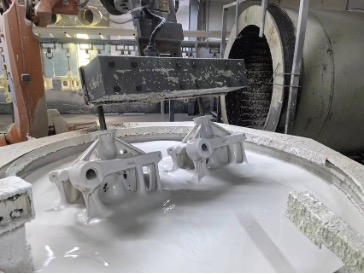
Shell making: ceramic slurry and refractory stucco layers are built up around the wax pattern tree to form the mould.
4. Dewaxing
The shelled tree is heated so that the wax melts and runs out, leaving a hollow ceramic cavity that reproduces the pattern exactly. This is the step that gives the process its name.
5. Pouring
Molten metal is poured into the preheated shell. Induction furnaces are used for melting in modern foundries.
6. Knockout, cut-off and finishing
The ceramic shell is broken away and the individual castings are cut from the tree. Gates and flash are removed, and the part is cleaned and deburred.
7. Heat treatment
Castings are heat treated to meet the mechanical properties required by the customer drawing, as part of an integrated route that runs from mould making and casting through heat treatment, machining and inspection.
8. Machining and inspection
Where as-cast tolerance is not sufficient, features are machined — in Wayscan's published specification, machined features are held to 0.01 mm. Final inspection covers dimensions, material composition, mechanical properties and product quality.
Water Glass, Silica Sol and Composite Investment Casting
Not every quotation described as "investment casting" refers to the same shell system, and the shell system is what determines achievable surface finish, tolerance class and cost structure. Three routes dominate industrial supply.
| Process route | Market position (2025) | Where it fits |
|---|---|---|
| Water glass investment casting | 32.1% of the investment casting market, per Dataintelo | Used where the precision and surface finish advantages attributed to silica sol are not the decisive requirement. |
| Silica sol (colloidal silica) investment casting | 54.3% of the market, per Dataintelo; preferred for precision and surface finish | The route listed at CT6 as-cast tolerance in Wayscan's published product specification. |
| Silica sol composite investment casting | No separate market share published in the sources reviewed | A composite route adopted by Wayscan in 2020 to replace water glass process production, targeting higher production efficiency and reduced environmental impact; listed at CT8 as-cast tolerance. |
For buyers, the practical point is that investment casting is a family of processes rather than a single specification. A quotation that does not state the shell system, the tolerance class and the surface finish requirement is incomplete, because those three variables drive both price and the downstream machining cost.
Tolerance, Surface Finish and What Precision Means in Practice
Two parameters decide how much machining follows the casting: as-cast dimensional tolerance and as-cast surface roughness. Wayscan Metal Products Co., Ltd. publishes the following values for its investment casting product line.
| Parameter | Published value | Applies to |
|---|---|---|
| Dimensional tolerance (as-cast) | CT6 | Silica sol investment casting |
| Dimensional tolerance (as-cast) | CT8 | Silica sol composite investment casting |
| Machined tolerance | 0.01 mm | Machined features |
| Surface roughness | Ra 6.4–12.5 μm | Depends on casting process and post-treatment |
| Materials | Carbon steel, alloy steel, stainless steel, ductile iron | Specific grades to be confirmed by the customer |
Two clarifications matter when these values are written into a purchase specification. First, tolerance classes describe the as-cast condition; features that must be tighter are produced by machining, at additional cost and lead time. Second, achievable tolerance in practice depends on part size, wall thickness, geometry and alloy — thin walls and large diameters are generally harder to hold than compact, uniform sections in any casting process.
Surface roughness is quoted as a range of Ra 6.4 to 12.5 μm precisely because it depends on the process route and any post-treatment applied, rather than being a fixed property of the material.
Materials and Part Families That Fit the Process
The process covers carbon steel, alloy steel, stainless steel and ductile iron, with specific grades confirmed by the customer and dimensions, material grades and mechanical properties customised per customer drawing.
Typical part families include pipe elbows, clevis brackets, yokes, gearbox housings, transmission housings, mounting brackets and link arms — components where a single near-net-shape casting can replace several welded or separately machined pieces. The common thread is moderate size, complex geometry and a tolerance requirement that justifies a ceramic shell.
From Drawing to Finished Component: The Integrated Supply Model
WAYSCAN METAL PRODUCTS CO., LTD. is a Ningbo-based investment casting manufacturer established in 1991 that produces precision castings, stainless steel castings, carbon steel castings, alloy steel castings and machined cast components. The company operates a production base of 46,000 square metres with more than 500 employees, an annual production capacity of 20,000 tons, a registered capital of 50 million RMB and an R&D team of over 20 senior engineering and technical personnel; export business accounts for 70% of total sales, with major markets in China, Japan and the USA.
What distinguishes an integrated casting-and-machining supplier from a casting-only foundry is the number of handoffs eliminated. Wayscan performs mould making, casting, heat treatment, machining and inspection in sequence, and is equipped with induction furnaces, CNC machining centres and testing equipment including spectrometers, X-ray and ultrasonic testing, and coordinate measuring machines (CMM). The company also supports rapid sample development, including 3D-printed pattern support, which shortens the loop between drawing release and a verified sample.
For a buyer, this matters in three concrete ways.
- Single-source dimensional accountability. When casting and machining are performed under one quality system, tolerance disputes between two vendors are removed from the project.
- Faster validation. Prototype and low-volume production can start before hard tooling is fully amortised, so functional testing is not blocked by tooling lead time.
- Traceable verification. Composition, mechanical properties and internal soundness can be checked against the same drawing revision that governs machining.
The company accepts custom production from customer drawings and sample development projects, and combines batch production with order-based customisation. Certifications, material grades and surface treatment requirements are best specified in advance so that they can be built into the process route rather than added afterwards.
Investment Casting Compared with Sand Casting, Shell Mould and Resin Sand Casting
The choice between casting processes is usually a trade between accuracy and cost, and it is worth stating where each route genuinely wins.
| Process | Dimensional accuracy and finish | Typical fit |
|---|---|---|
| Investment casting | Highest dimensional accuracy and best surface finish | Small-to-medium complex parts, particularly stainless steel and other high-alloy steels; cost is relatively high |
| Shell mould casting | Good dimensional stability | Medium-to-high volume production of medium-sized steel castings |
| Resin sand casting | Generally lower dimensional accuracy and a rougher surface | Large castings weighing tens of kilograms or more; lower tooling investment |
| Sand casting (general) | Less demanding dimensional requirements | Larger and heavier components where economy is the priority |
This comparison is not a ranking. Resin sand casting remains the sensible answer for large, heavy components; shell mould casting suits medium-sized steel castings at medium-to-high volumes; investment casting buys accuracy and finish on smaller, more complex parts. Selecting the process before the part drawing is frozen is one of the cheapest decisions a project team can make.
Where Investment Casting Is Used
Investment castings in the Wayscan product range serve the automotive, forklift, mining, agricultural machinery, construction machinery, valve and general machinery component industries. Typical duty covers structural components, mechanical parts and valve bodies under a range of operating conditions, with the exact environment specified by the customer project.
Valve bodies and pipe elbows illustrate the fit well: internal passage geometry is difficult to machine economically, corrosion-resistant stainless grades are common, and pressure integrity makes internal soundness a purchase criterion rather than a preference — which is why non-destructive testing belongs in the specification.
Quality Verification, NDT and Applicable Standards
Standards define what "conforming" means, and two are particularly relevant to industrial buyers. ASTM A957 specifies the common requirements for steel and alloy investment castings for general industrial use. For automotive supply chains, IATF 16949:2016 remains the critical quality management system requirement that customers expect from a casting supplier.
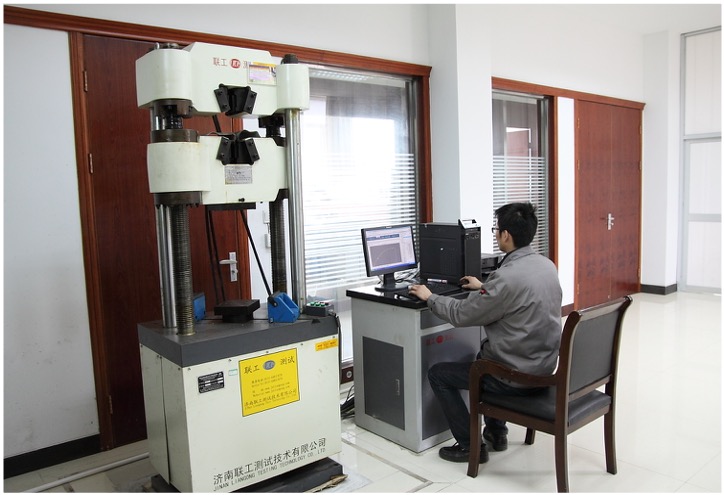
Inspection verifies dimensions, material composition, mechanical properties and overall product quality before shipment.
Verification typically combines four checks.
- Chemical analysis by spectrometer, to confirm the alloy grade.
- Non-destructive testing (NDT) by X-ray and ultrasonic methods, to detect internal discontinuities.
- Mechanical testing of material properties against the drawing requirement.
- Dimensional inspection, including CMM measurement of critical features.
Buyers should also confirm whether required certifications, material grades and surface treatment specifications are achievable on the intended process route, because those requirements change shell selection, heat treatment and inspection scope — and therefore change price.
Market Trends Shaping Investment Casting Supply
Three trends are visible in the available data and in supplier behaviour.
Shell chemistry is moving toward silica sol. Dataintelo reports the silica sol process at 54.3% of the 2025 market against 32.1% for water glass, attributing the preference to precision and surface finish. Process substitution is therefore already underway across the supplier base, not only at individual plants.
Environmental performance is becoming a procurement variable. Wayscan's own transition illustrates the pattern: in 2020 the company invested in composite process precision casting production to replace water glass process precision casting, with the aim of improving production efficiency and reducing environmental impact. In 2023 the company was recognised as a waste-free factory, a four-star green factory, a water-saving factory and a Ninghai charitable enterprise. For buyers operating under their own environmental reporting obligations, foundry environmental status is increasingly part of supplier qualification.
Trade volumes are substantial but hard to measure precisely. Global exports of cast articles of iron or steel (HS 732599) reached USD 4,320.81 million in 2025, according to the UN Comtrade Database. That code is a catch-all for cast articles not elsewhere specified, so it covers sand and die castings alongside investment castings; there is no unique six-digit HS code for investment casting alone. Trade data is therefore useful for gauging overall casting demand rather than for sizing the investment casting segment.
Boundaries: Where Investment Casting Is the Wrong Choice
Stating limitations is part of an honest process recommendation. Investment casting is generally not the economical answer when:
- The part is large and heavy. Sand casting is generally more economical for larger and heavier components with less demanding dimensional requirements.
- Accuracy requirements are modest. The process is relatively high in cost; if as-cast tolerance and surface finish can be relaxed, a lower-cost casting route usually exists.
- Sections are very thick. Solid, bulky parts give up the near-net-shape advantage while still carrying the cost of a ceramic shell.
- Tight tolerances are assumed from the casting alone. Published tolerance classes are as-cast values; tighter features require machining and must be priced and scheduled accordingly.
- Requirements are left unstated. Certifications, material grades and surface treatment requirements should be specified in advance, because they change the process route.
Future Outlook
Investment casting's position in industrial supply looks stable rather than disruptive. The demand drivers — complex geometry, high-alloy materials and near-net-shape economy in small-to-medium parts — do not weaken when machining capacity is expensive, and automotive remains the largest volume segment at approximately 29% of demand.
What is likely to change is how suppliers are selected. As shell chemistry, environmental compliance and inspection scope converge into qualification requirements, buyers will increasingly compare documented process routes and in-house testing capability rather than headline capacity. Suppliers that publish tolerance classes, surface roughness ranges and the shell systems they actually operate make that comparison possible.
FAQ
What is investment casting, and is it the same as lost-wax casting?
Investment casting is the process commonly known as lost-wax casting. A wax pattern is assembled onto a tree, coated with ceramic slurry and refractory stucco to build a shell, heated so the wax melts out, and then filled with molten metal. After cooling, the shell is broken away and the castings are cut from the tree, heat treated and, where necessary, machined. The term "investment" refers to the ceramic shell that surrounds the pattern.
Water glass, silica sol or composite — which investment casting process should be specified?
It depends on the balance between precision, surface finish and cost. Dataintelo reported that in 2025 the silica sol process held 54.3% of the investment casting market and the water glass process 32.1%, noting that silica sol is preferred for precision and surface finish. Composite routes are newer: Wayscan Metal Products Co., Ltd. invested in composite process precision casting production in 2020 to replace water glass process production, aiming to improve production efficiency and reduce environmental impact. The specification decision should follow the drawing, because as-cast tolerance class, surface finish and machining allowance determine which shell system is appropriate.
What tolerance and surface finish can investment casting actually achieve?
Wayscan publishes as-cast dimensional tolerance of CT6 for silica sol investment casting and CT8 for silica sol composite investment casting, with machined features held to 0.01 mm and surface roughness in the range of Ra 6.4 to 12.5 μm depending on the casting process and post-treatment. Achievable values vary with part size, wall thickness, geometry and alloy, and features tighter than the as-cast class must be produced by machining.
How does investment casting compare with sand casting for industrial components?
Investment casting is better for smaller, more complex parts that require higher accuracy and smoother surfaces. Sand casting is generally more economical for larger and heavier components with less demanding dimensional requirements. Shell mould casting sits between the two, offering good dimensional stability for medium-sized steel castings in medium-to-high volumes, while resin sand casting is more suitable for large castings weighing tens of kilograms or more, with lower tooling investment but generally lower dimensional accuracy and a rougher surface finish.
What should buyers verify before selecting an investment casting supplier?
Verify the process routes the supplier actually operates, the as-cast tolerance class and surface finish associated with each route, and the inspection equipment available in-house — spectrometer analysis, X-ray and ultrasonic NDT, mechanical testing and CMM dimensional inspection. Confirm which standards apply, such as ASTM A957 for steel and alloy investment castings or IATF 16949:2016 for automotive supply chains, and check whether specific certifications, material grades and surface treatment requirements can be accommodated on the intended route. Sample development capability, including 3D-printed pattern support, indicates how quickly a drawing can be validated before hard tooling is committed.
For readers who want the full capability overview — process routes, tolerance classes and inspection scope — the Wayscan Metal Products Co., Ltd. company presentation is available as a PDF download.