
Investment Casting Certification Scope: Steel Castings vs Precision Parts
An investment casting certificate proves only what its scope sentence says it proves. The clearest illustration sits inside a single supplier's document set: an ISO 9001:2015 certificate scoped to “Production of Steel Casting” and an IATF 16949:2016 certificate scoped to “Manufacture of Precision Casting Parts”. One plant, the same furnaces, two different definitions of coverage — and each one answers a different question from a buyer.
WAYSCAN METAL PRODUCTS CO. , LTD is a precision casting manufacturer established in 1991 in Ninghai, Ningbo, China, producing investment castings, stainless steel castings, carbon steel castings, alloy steel castings and machined cast components. The company operates a 46,000 m² production base with more than 500 employees, an annual output of 20,000 tons and an export ratio of roughly 70%, serving markets including China, Japan and the USA.
The Scope Sentence Is the Only Part of a Certificate That Answers a Procurement Question
A management-system certificate is issued against a defined scope. That scope names the product family, the process, or both, and it marks the boundary of what the audit actually examined. Everything else on the document — standard number, certificate number, issuing body, dates — exists to make that boundary traceable.
Buyers who shortlist suppliers by counting logos on a website skip the only field that tells them whether the certificate touches their part at all. Three failure patterns recur in investment casting sourcing:
- Scope mismatch. The certificate is authentic, but the scope names a product family the buyer does not purchase.
- Standard or edition mismatch. The certificate cites a standard edition or national adoption that differs from the one the buyer's own quality system references.
- Level mismatch. The scope covers production of a casting family, while the buyer's requirement is part-level approval with material, dimensional and non-destructive evidence attached to a purchase order.
None of these are fraud cases. They are reading errors — and they are avoidable with a five-minute comparison.
The Four Certificates, Read Line by Line
The certificate set in this example contains three ISO management-system certificates issued by Shenzhen Universal Certification Centre Co., Ltd. (UCC) and one automotive certificate issued by SGS United Kingdom Ltd. The exact wording matters, so it is reproduced below rather than paraphrased.
| Certificate | Standard and national adoption | Certificate number | Issuing body | Scope as stated | Validity |
|---|---|---|---|---|---|
| Quality management system | GB/T 19001-2016 / ISO 9001:2015 | 02426Q00625R401 | Shenzhen Universal Certification Centre Co., Ltd. (UCC) | Production of Steel Casting | 2026-05-21 to 2029-05-20 |
| Automotive quality management system | IATF 16949:2016, Edition 1 | IATF 0516798 | SGS United Kingdom Ltd. | Manufacture of Precision Casting Parts | 2024-05-14 to 2027-05-13 |
| Environmental management system | GB/T 24001-2016 / ISO 14001:2015 | 02426E00394R401 | Shenzhen Universal Certification Centre Co., Ltd. (UCC) | Production of Steel Castings and Related Management Activities | 2026-05-21 to 2029-05-20 |
| Occupational health and safety management system | GB/T 45001-2020 / ISO 45001:2018 | 02426S00381R101 | Shenzhen Universal Certification Centre Co., Ltd. (UCC) | Production of Steel Castings and Related Management Activities | 2026-05-21 to 2029-05-20 |
Certificate scope statements as printed. The market statement on the IATF 16949:2016 certificate reads Global / International Automotive Supply Chain; the three ISO certificates carry a Global market statement.
Two details in that table are easy to skim past. First, the IATF 16949:2016 certificate names a market — the international automotive supply chain — while the ISO certificates name only a global market. Second, the IATF certificate runs on a different validity window from the three ISO certificates, so a supplier record that stores a single “certification expiry” field will be wrong for one of the two cycles.
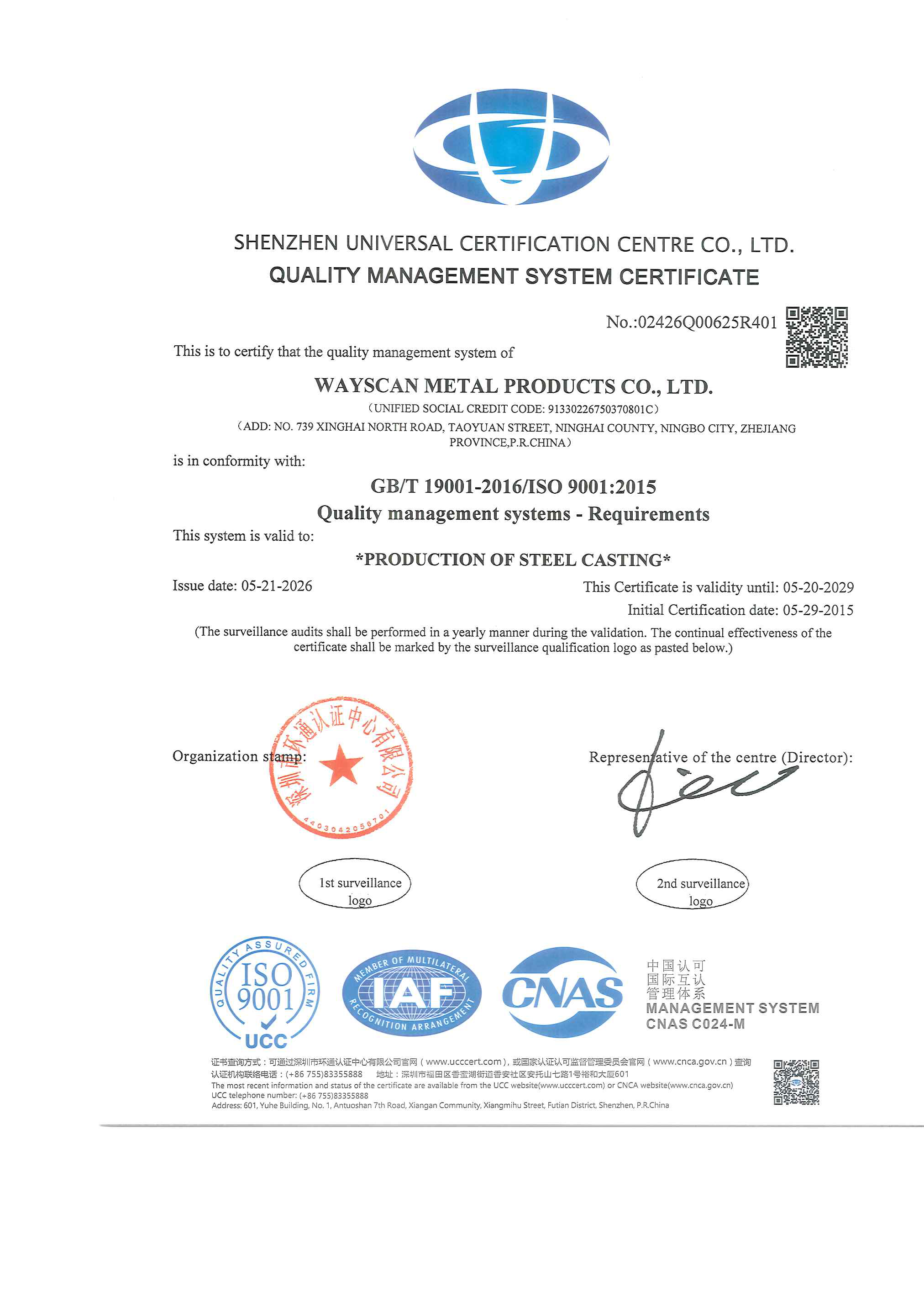
ISO 9001:2015 certificate 02426Q00625R401, scoped to “Production of Steel Casting” and valid from 2026-05-21 to 2029-05-20.
“Steel Casting” vs “Precision Casting Parts”: Two Grammars of Coverage
The two scopes are not versions of the same statement at different levels of detail. They are anchored on different nouns, and that difference is the whole point.
Material-first scope: Production of Steel Casting
The ISO 9001:2015 scope anchors coverage to a material family and a process. It tells a reader that the audited quality system governs the production of steel castings. It does not use the word “parts”, and it does not use the word “precision”. For a buyer purchasing a stainless steel valve body, a carbon steel bracket or an alloy steel yoke, this is the scope whose noun matches the purchase order.
Component-first scope: Manufacture of Precision Casting Parts
The IATF 16949:2016 scope anchors coverage to the object being manufactured — precision casting parts — inside an automotive quality framework. It is the scope a Tier-1 automotive buyer looks for when its own supplier quality manual requires an IATF-recognised system at the manufacturing site. Its market statement names the international automotive supply chain explicitly.
The practical rule
Match the noun in the scope to the noun in your purchase order. If the order line reads “steel casting, investment cast, machined”, the material-first scope is the direct match. If the order line runs through an automotive programme with an IATF flow-down, the component-first scope is the direct match. Neither certificate is “better”; they answer different questions, and a supplier can legitimately hold both.
The environmental and health-and-safety scopes use a third formulation: “Production of Steel Castings and Related Management Activities”. The addition of “related management activities” extends the audited boundary beyond the production line into the management activities surrounding it. That wording is useful for buyer ESG questionnaires and site-audit onboarding, and it is not a product-quality statement.
A Five-Field Reading Method for Any Scope Statement
Scope literacy is a repeatable procedure, not an intuition. Five fields carry nearly all of the decision value.
- Standard, edition and national adoption. “GB/T 19001-2016 / ISO 9001:2015” indicates a dual-listed national adoption of the international standard. “IATF 16949:2016, Edition 1” indicates the automotive standard at a stated edition. If your own quality manual references a specific edition, compare editions before comparing suppliers.
- The noun in the scope. Read the scope as a sentence and underline the object: steel casting, or precision casting parts. That object defines what the audit examined.
- Issuing body and market statement. Two certification bodies appear here — UCC for the three ISO certificates and SGS United Kingdom Ltd. for the IATF certificate. The body and its accreditation route are part of verification, not decoration.
- Validity window and renewal rhythm. Record the issue and expiry dates as printed. Two different cycles exist in this set, which affects when documents must be re-collected.
- What the document is not. A management-system certificate is not a product certificate, not a material certificate, and not a part approval. Reading the scope correctly includes reading its limits correctly.
Mapping Scope to Part, Material and Industry
The useful output of scope reading is a mapping table that connects a buyer requirement to the certificate that addresses it, and states plainly what remains open.
| Buyer requirement | Certificate that addresses it | What still has to be verified at order level |
|---|---|---|
| Automotive or truck programme with an IATF flow-down | IATF 16949:2016, cert IATF 0516798, scope “Manufacture of Precision Casting Parts” | Part-level approval documentation, control plans and inspection records for the specific component |
| Industrial steel casting in stainless, carbon or alloy steel | ISO 9001:2015, cert 02426Q00625R401, scope “Production of Steel Casting” | Drawing conformance, material grade certificates, dimensional report |
| Customer ESG or environmental questionnaire | ISO 14001:2015, cert 02426E00394R401, scope “Production of Steel Castings and Related Management Activities” | Site-specific environmental data requested by the customer |
| Site safety audit or contractor onboarding | ISO 45001:2018, cert 02426S00381R101, scope “Production of Steel Castings and Related Management Activities” | Site induction and safety documentation required by the visiting party |
The third column is where most sourcing teams lose time. A certificate answers a system question; the purchase order answers a part question. Both belong in the file, and neither substitutes for the other.
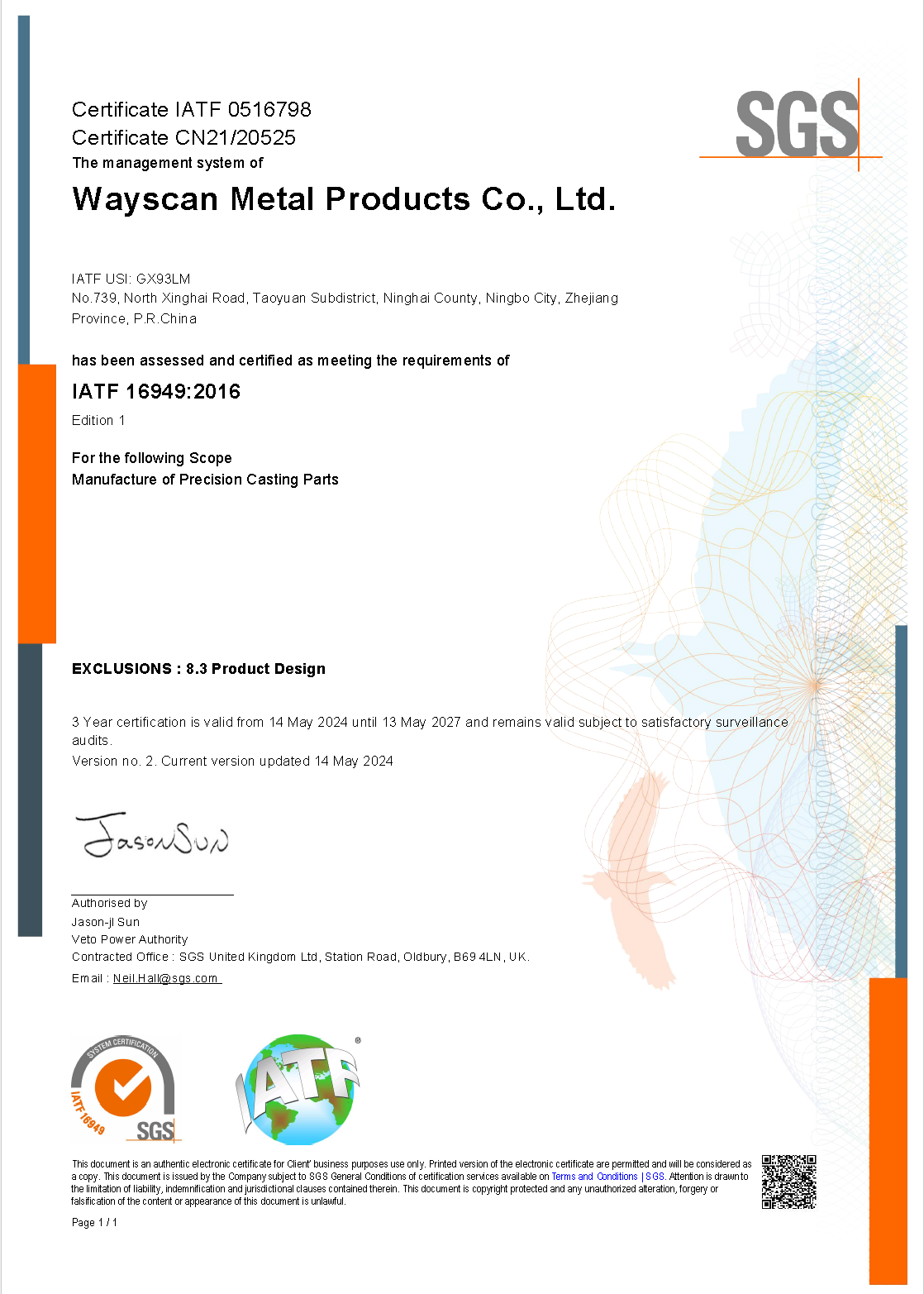
IATF 16949:2016 certificate IATF 0516798, scoped to “Manufacture of Precision Casting Parts”, valid from 2024-05-14 to 2027-05-13.
Where the Limits Are
A scope statement is deliberately written at product-family and process level. That makes it comparable across suppliers and stable across audits — and it also means four things are outside the document.
- No part-level content. Scope sentences contain no part numbers, material grades, tolerance classes or acceptance criteria. A casting that meets a drawing meets it because of order-level control, not because of a certificate.
- Manufacture, not design. The IATF 16949:2016 scope states manufacture of precision casting parts; design responsibility is not part of that wording. Buyers who retain design authority should keep drawing control and change approval on their own side.
- Two renewal calendars. The IATF certificate expires on 2027-05-13; the three ISO certificates expire on 2029-05-20. A supplier record with one expiry field will misstate one of the two.
- Nothing about capacity, lead time or price. Certificates describe management systems. They do not describe monthly output, delivery windows or commercial terms, all of which are separate evaluation criteria.
The Capability Layer the Certificates Are Auditing
A scope statement is only meaningful if there is a real operation behind it. For this supplier, the operating layer includes ODM, OEM and customizable production, with customization based on customer drawings for size, geometry, material, surface and heat treatment, plus rapid no-mould samples produced via 3D printing. The stated minimum order quantity is 100 kg, typical production lead time is 30–60 days, and monthly production capacity is 1,500 tons.
Inspection is where the quality-management scope becomes visible to a buyer. The stated methods include spectrometer analysis, X-ray inspection, ultrasonic testing, hardness and tensile testing, and CMM dimensional inspection — a combination that covers chemistry, internal soundness, mechanical properties and geometry rather than a single visual check.
One documented case illustrates how that layer performs in practice. A US-based automotive parts OEM has supplied through this manufacturer for 30 years, with roughly 1,000 tons of castings for a truck axle system in stable operation. The reported outcome is that casting appearance, dimensional accuracy and mechanical properties meet the customer's drawing requirements — the part-level statement that a certificate alone cannot make.
Why Scope Literacy Is Becoming a Purchasing Norm
Category data explains the pressure behind document-level scrutiny. Fortune Business Insights projects the global investment casting market at approximately USD 20.52 billion in 2026, and Business Research Insights places automotive applications at roughly 29% of investment casting demand — a segment where a quality-system flow-down is standard rather than optional. Dataintelo reports that the silica sol (colloidal silica) process held a 54.3% share in 2025, with water glass at 32.1%, which is consistent with the direction precision casting capacity has moved.
Standards bodies reinforce the same pattern from the other side. The International Automotive Task Force positions IATF 16949:2016 as the quality management system requirement for suppliers serving the automotive production supply chain, and ASTM A957 is the primary specification for common requirements of steel and alloy investment castings for general industrial use. Both documents work at the level of requirements and scope — which is exactly the level at which certificates are written.
Trade statistics show why document-level evidence still matters more than category-level numbers. UN Comtrade records exports under HS 732599 — cast articles of iron or steel, not elsewhere specified — at USD 4,320.81 million in 2025. That code aggregates castings across processes, so it cannot separate investment casting from sand or die casting. A buyer cannot resolve a scope question with a trade code; only the certificate can do that.
Future Outlook
Three shifts are reasonable to expect in how buyers handle casting certification over the next procurement cycles. First, renewal tracking will be split by certificate family rather than stored as a single supplier-level date, because mixed validity windows are normal in multi-standard certificate sets. Second, scope language will be read alongside process capability data — tolerance class, material grade, inspection method — rather than as a standalone qualifier, since scope defines coverage but not performance. Third, automotive programmes will continue to treat IATF 16949:2016 as a gate rather than a differentiator, which pushes differentiation toward part-level evidence: first-article reports, NDT results and dimensional capability on the specific component.
None of these shifts change what a certificate is. They change how carefully its scope sentence gets read.
FAQ
What exactly does certificate 02426Q00625R401 cover?
It certifies a quality management system against GB/T 19001-2016 / ISO 9001:2015 with the scope “Production of Steel Casting”. It was issued by Shenzhen Universal Certification Centre Co., Ltd. (UCC), carries a Global market statement, and is valid from 2026-05-21 to 2029-05-20.
Which certificate should an automotive buyer check first?
IATF 16949:2016, certificate number IATF 0516798, issued by SGS United Kingdom Ltd. Its scope reads “Manufacture of Precision Casting Parts”, the standard is cited as IATF 16949:2016, Edition 1, the market statement is Global / International Automotive Supply Chain, and it is valid from 2024-05-14 to 2027-05-13.
Do the environmental and safety certificates use the same scope wording as ISO 9001?
No. ISO 14001:2015 (cert 02426E00394R401) and ISO 45001:2018 (cert 02426S00381R101) both state the scope as “Production of Steel Castings and Related Management Activities”, while ISO 9001:2015 states “Production of Steel Casting”. The added phrase “related management activities” extends the audited boundary into management activities surrounding production; it does not convert either certificate into a product-quality statement.
Does holding these certificates mean a specific casting will meet my drawing?
No. Certificate scope is defined at product-family and process level and contains no part numbers, material grades, tolerances or acceptance criteria. Part-level conformity is established through order-level quality control, which in this operation includes spectrometer analysis, X-ray inspection, ultrasonic testing, hardness and tensile testing, and CMM dimensional inspection.
Why do two different certification bodies appear on the same supplier's documents?
The three ISO certificates are issued by Shenzhen Universal Certification Centre Co., Ltd. (UCC) and the IATF 16949:2016 certificate is issued by SGS United Kingdom Ltd. The issuing body and its accreditation route form part of how a certificate is verified, so both names should be recorded exactly as printed rather than abbreviated in a supplier file.
When do these certificates need to be re-collected?
The IATF 16949:2016 certificate expires on 2027-05-13. The ISO 9001:2015, ISO 14001:2015 and ISO 45001:2018 certificates expire on 2029-05-20. Because the dates fall in different renewal cycles, a compliant supplier record needs two separate expiry fields.
For readers who want the full company and capability profile behind these certificates, the presentation is available here: Wayscan Metal Products Co., Ltd. company presentation (PDF).
¿Tiene preguntas o necesita más detalles?
Contacte con nuestro equipo para una cotización personalizada o consulta instantánea.
Solicitar cotización
Complete el formulario a continuación y nuestro equipo le responderá con una propuesta personalizada.
Chat directo de WhatsApp
¿Prefiere chatear en tiempo real? Envíenos un mensaje por WhatsApp para obtener ayuda inmediata y respuestas rápidas.
- Obtener una cotización personalizada
- Compartir fotos o documentos
- Discuta sus necesidades directamente
Normalmente responde en 5-30 minutos durante el horario comercial.