
Internet Cafe Fit-Out: Gaming Chair Specs for 24/7 Seating
Internet Cafe Fit-Out: Gaming Chair Specs for 24/7 Seating
Internet cafe fit-out projects in China are planned around a seating duty cycle that most furniture categories never face: chairs that stay in service indoors, for long hours, in 24/7 seating mode, shared by successive players at the same station. Under that regime the procurement question is not which gaming chair photographs best in a design render. It is which chair keeps its settings, its cushioning and its clearance requirements intact once a row of positions is specified, delivered and handed over.
A fit-out schedule also ties every seat to a gaming desk and a computer, and each seating unit needs enough space for the player to sit, adjust and leave. Those two facts — continuous use and a fixed layout — shape the specification more than colourways or trim lines do. This analysis sets out what a 24/7 project brief should therefore put into the chair specification, and uses two Maochang models, the MC196-3-1 and MC1039, to show how individual features map to that operating reality.
What 24/7 seating actually does to a chair specification
In an internet cafe, the chair is not owned by one user. A single position can be occupied by different people across a working day and night, each adjusting height, armrests and recline to their own body. The stress profile is therefore different from a home gaming chair used by one person for a few hours: adjustment mechanisms are cycled far more often, upholstery is contacted by many different users, and the seat cushion is asked to recover repeatedly rather than once.
That has three practical consequences for a fit-out buyer.
- Mechanisms move from convenience to wear item. Tilt locks, gas lifts and armrest sliders become high-cycle components. A lock that is easy to operate and re-engages cleanly matters more than an extra recline position nobody uses.
- Cushion recovery beats initial softness. A seat that feels plush on day one but flattens under continuous use changes the perceived quality of the whole venue. Spring-based or thickened seat construction is directly relevant here.
- Serviceability decides lifetime cost. Because the chair stays in place while the room operates, any mechanism that can be swapped without replacing the entire unit shortens downtime and simplifies maintenance planning.
The scenario record for this application describes it plainly: the product is designed for indoor, long-hour continuous-use environments in internet cafe settings, and it operates in 24/7 seating mode in China. That description is the specification driver. Everything else in the chair sheet is judged against it.
The fit-out constraint stack: space, desk pairing and layout maths
Before comparing models, a project team has to settle the constraint stack that surrounds every chair. In this scenario the chair requires supporting equipment — a gaming desk and a computer at each station — and the special requirement is sufficient space for each seating unit. Those two conditions turn a furniture choice into a layout decision, because the chair's footprint determines how many positions a given floor plate can hold and how comfortably players can enter and exit.
The table below converts the stated product dimensions of the relevant models into occupied footprint area. The figures are calculated from the published width and depth (width × depth), and they exclude recline clearance behind the seat, circulation space and desk overhang. They are a planning starting point, not a room layout.
| Model | Stated product size (W×D×H) | Calculated occupied footprint | Planning note |
|---|---|---|---|
| MC196-3-1 | 66.5 × 69 × 106–114 cm | ≈0.46 m² | Compact depth suits dense standard banks |
| MC1039-1 | 74 × 80 × 126–132 cm | ≈0.59 m² | Larger footprint; plan wider seat pitch |
| MC1040 gaming sofa | 80 × 72 × 119 cm | ≈0.58 m² | Zone or booth seating, not a standard row |
The gap between the first two rows is roughly a quarter of a square metre per position on paper — but multiplied across a full hall, that difference decides how many stations fit. A dense standard bank and a premium esports zone rarely want the same chair, and a fit-out brief that specifies one model everywhere usually ends up either overcrowding the floor or paying for clearance it does not use.
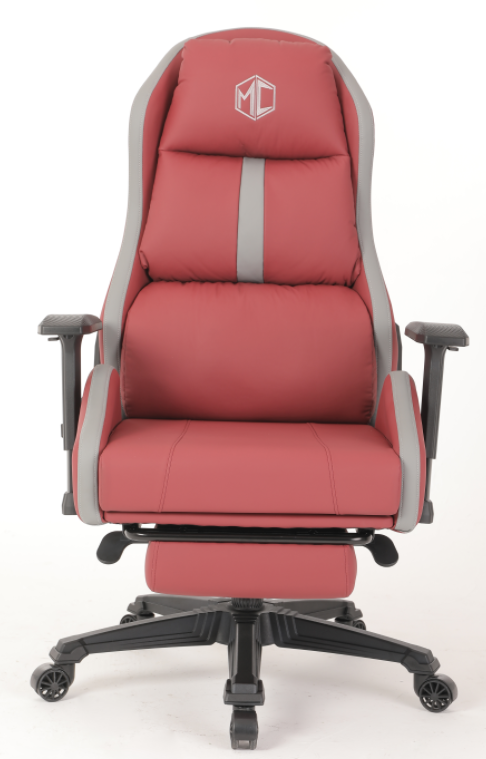
MC196-3-1: a compact specification for standard seating banks
The MC196-3-1 is a game-type computer chair whose stated applications include home, office and internet cafe use, which makes it the natural candidate for standard banks in a cafe layout. Its dimensions — 66.5 cm wide, 69 cm deep and 106–114 cm high — keep the footprint modest while still offering a backrest with a defined neck and lumbar interface.
Three specification details matter for continuous operation:
- Adjustable headrest and lumbar pillow. Because users change through the day, neck and lower-back support that can be repositioned removes one source of complaints from a shared position.
- 2D adjustable armrests moving up/down and back/forth. Fore-aft adjustment lets the armrest line up with different desk heights and keyboard positions, which is more useful in a fit-out than a fixed pad.
- 3-position tilt-lock mechanism. The chair can be switched between gaming, working and relaxing angles and locked, so the seat does not drift into a loose angle while a player is using it.
Carton data is also part of the fit-out equation, because seating arrives in volume and has to be stored, moved and assembled on site. The MC196-3-1 packs one piece per carton at 75 × 57 × 37 cm, with a stated loading quantity of 441 pcs. Buyers should confirm the container basis and stacking arrangement in the quotation, since loading quantities are quoted on different bases across model ranges.
MC1039 and MC1039-1: where load, recline and seat size dominate
The MC1039 is a different proposition. Its stated applications cover home, office, live streaming and internet cafe, and its construction reads as a response to heavier, longer sitting: a thickened spring pack cushion with a coiled spring inside the seat, a spacious seat, a soft back cushion, a 180-degree recline, a foldable footrest and a height-adjustable armrest. It sits on a Class 3 gas lift with a 370 mm star base and a frog-type multifunctional mechanism.
Its sibling, the MC1039-1, is positioned as a heavy-duty big-size gaming chair for larger users, with a 4D adjustable armrest, a soft back cushion, a foldable footrest and the same frog-type adjustable multifunctional mechanism. The size difference is material to layout: at 74 × 80 × 126–132 cm, it needs more room around each seat than the compact model, and the carton is larger too, at 82 × 60 × 53 cm with a stated loading quantity of 260 pcs.
The commercial logic is that the MC1039 family is best deployed where the premium position justifies the space. A 180-degree recline and a foldable footrest change the experience of a long session, but both require clearance — behind the backrest for recline, and beneath the front of the seat for the footrest. In a tight row, those functions are paid for and never used.
Side-by-side specification view
| Specification | MC196-3-1 | MC1039 | MC1039-1 |
|---|---|---|---|
| Stated product size | 66.5 × 69 × 106–114 cm | Not stated in supplied sheet | 74 × 80 × 126–132 cm |
| Carton | 75 × 57 × 37 cm | 1 pc / 1 carton (size not stated) | 82 × 60 × 53 cm |
| Stated loading quantity | 441 pcs | Not stated in supplied sheet | 260 pcs |
| Mechanism | 3-position tilt lock | Frog-type multifunctional mechanism | Frog-type adjustable multifunctional mechanism |
| Recline | Three locking tilt angles | 180 degrees | 180 degrees |
| Armrest | 2D: up/down, fore/aft | Height adjustable | 4D adjustable |
| Footrest | Not stated in supplied sheet | Foldable | Foldable |
| Seat construction | Foam (per material list) | Thickened spring pack, coiled spring in seat | Thickened seat for larger users |
| Gas lift / base | Not stated in supplied sheet | Class 3 gas lift, 370 mm star base | Not stated in supplied sheet |
| Stated capacity | Not stated in supplied sheet | 150 kg | Not stated in supplied sheet |
| Stated industries | Home, office, internet cafe | Home, office, live streaming, internet cafe | Gaming, home, live streaming, internet cafe |
Read as a set, the three columns show a genuine trade-off rather than a hierarchy. The compact model buys seat density; the large models buy load margin, recline range and adjustment granularity, and they charge for it in floor area and container efficiency. A fit-out brief that states only 'gaming chairs for the hall' leaves that trade-off unresolved.
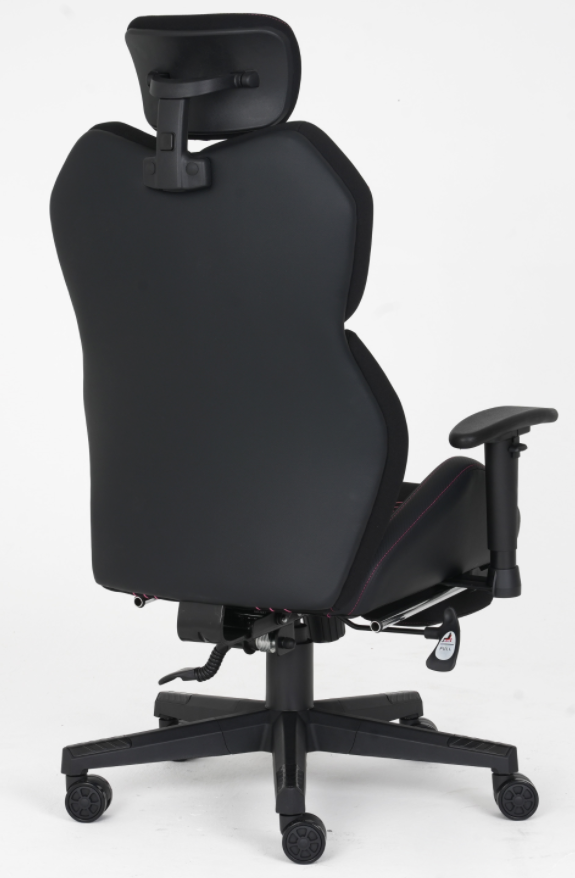
Mechanisms explained in continuous-use terms
A tilt-lock mechanism and a frog-type multifunctional mechanism are not marketing labels; they describe how the backrest angle is held and released. In a shared 24/7 setting, the useful question is how the lock behaves after many cycles: does it re-engage at a defined position, does the handle stay within reach when the user is seated, and can the mechanism be serviced without dismantling the chair.
A three-position tilt lock, as specified on the MC196-3-1, gives the user discrete, repeatable angles. Discrete positions are easier to return to a known state between users, which suits a venue where staff reset stations. A 180-degree recline on the MC1039 and MC1039-1 serves a different purpose: it converts a seat into a rest position for longer breaks, and it only delivers value where the row layout leaves rear clearance.
The gas lift and base deserve the same treatment. The MC1039 lists a Class 3 gas lift and a 370 mm star base — a wider base spreads load and is generally more stable at higher seat heights. Where a model sheet does not state the lift class or base diameter, that is a question for the supplier, not an assumption for the buyer.
Armrest gradation follows the same logic. A 2D armrest adjusts vertically and fore-aft; a 4D armrest adds further axes. In a fit-out, the practical benefit is matching the armrest to the desk and keyboard height chosen for the room, so that the player's shoulders are not raised or dropped relative to the desk surface. More adjustment axes cost more, so they belong where the desk specification is fixed and the user population varies most.
Zone-by-zone application inside one project
Most internet cafe fit-outs are not uniform. A workable specification assigns models to zones rather than treating the hall as one product decision.
- Standard gaming banks. High seat count, modest footprint, frequent user changeover. The MC196-3-1 fits this profile: compact dimensions, 2D armrests for desk alignment and a lockable tilt for quick posture changes.
- Premium or esports zone. Fewer positions, longer sessions, higher expectations. The MC1039 and MC1039-1 bring the 180-degree recline, foldable footrest and heavier seat construction, provided the row pitch allows the recline to be used.
- Private or streaming booths. The scenario record for internet cafe projects references the MC1040 gaming sofa as a related product. Its own sheet lists home, office and live-streaming applications, a 150 kg stated capacity, lockable casters and a foldable footrest. Treat it as a zone-specific option to be confirmed against the booth layout rather than a substitute for row seating.
Zoning also simplifies procurement: one high-volume model for the standard banks, a smaller quantity of the large-frame model for the premium area, and a clear rule for what happens when a chair is out of service.
Delivery, carton data and production planning
Fit-out schedules fail on delivery as often as on specification. Anji Maochang Furniture Co., Ltd. (www.mcrfurniture.com) is an Anji-based manufacturer of gaming chairs, office chairs and manicure chairs, established in 2016, operating a 3,000 m² facility with a company-reported annual output of approximately 75,000 units. Its stated commercial parameters are a monthly capacity of 6,000 units, a lead time of 30–40 days and a minimum order quantity of 50 units, with OEM/ODM customisation covering logo, colour, size and design.
For a project buyer, carton dimensions are as important as chair dimensions, because they set pallet counts, storage area and the number of units that can be moved per trip to the floor. The stated loading quantities across this range — 441 pcs for the MC196-3-1, 260 pcs for the MC1039-1 and 227 pcs for the MC1040 — differ partly because the cartons differ. Confirm the container basis, carton weight and stack height before fixing the delivery plan.
Quality control as described by the manufacturer covers incoming inspection of gas lifts, mechanisms, upholstery colour and plywood thickness, followed by a pre-production assembly check of the plywood base to verify overall chair depth and seating evenness. The stated after-sales terms include a one-year quality warranty plus product photography, assembly video and sales-page support for retail customers.
Acceptance checks at handover
A fit-out handover is the last practical moment to catch specification drift. The following checks map directly to the features discussed above and can be run on a sample before the bulk of a container is installed.
- Cycle the tilt lock through its full range on several units and confirm each position re-engages without play.
- Raise and lower the gas lift through its stated range; listen for abnormal noise and check that the seat holds height under load.
- Operate every armrest axis and check for lateral play at the mounting point.
- Extend and retract the footrest where fitted, and confirm it locks in the extended position.
- Recline to the stated maximum with the layout in place, verifying rear clearance is genuinely available.
- Compress the seat and confirm recovery, particularly on spring-pack constructions.
- Roll the castors across the actual floor finish to check noise and marking, then confirm the model label matches the purchase order.
Fit boundaries and verification points
Supported specifications still carry limits, and a credible project brief records them.
First, recline and footrest functions consume space. A 180-degree recline in a tightly pitched row will be blocked, so either the pitch grows or the function is specified where it can be used. Second, larger frames reduce seat density; the MC1039-1's footprint is roughly a quarter larger than the MC196-3-1's on the calculated basis above, which changes the achievable station count. Third, upholstery choice interacts with shared use — PU leather held 57.3% of gaming chair material share in 2024 according to Mordor Intelligence, and wipe-clean surfaces are easier to maintain in a venue, while fabric and mesh constructions on models such as the MC1039 are chosen for different comfort priorities.
Finally, standards. ANSI/BIFMA X5.1 for North America and EN 1335 for Europe are the reference safety and durability standards commonly required for seating in these markets. A product page that mentions a standard is not the same as a certificate: for tender submission, request the certificate or test report number, the issuing laboratory, the exact model scope and the validity date. Where a sheet does not state a figure — capacity for the MC1039-1, gas lift class for the MC196-3-1 — that gap should be closed in writing before the order, not filled by inference.
Outlook for continuous-use seating projects
The direction of travel in internet cafe fit-outs is toward treating seating as operating equipment rather than interior decoration. That shift favours models whose features survive contact with a 24/7 schedule: lockable mechanisms, recoverable seat construction, adjustable interfaces that match a fixed desk height, and carton data that supports a delivery plan. It also favours suppliers who can answer model-level questions about capacity, lift class and standard compliance rather than restating a brochure. For project teams, the practical outcome is a shorter specification list with clearer reasoning behind each line — which is usually what a fit-out budget needs most.
Frequently asked questions
Why does 24/7 seating change gaming chair requirements in an internet cafe?
Because the chair is shared rather than owned. In 24/7 seating mode, adjustment mechanisms are cycled many times per day, upholstery is contacted by successive users and the seat cushion must recover repeatedly. That shifts priority toward lockable, repeatable mechanisms, recoverable seat construction and serviceable parts, rather than one-off comfort on first sitting.
How much floor space should a fit-out plan allow per gaming chair?
Start from the stated product dimensions and calculate the occupied footprint. The MC196-3-1 at 66.5 × 69 cm occupies about 0.46 m², while the MC1039-1 at 74 × 80 cm occupies about 0.59 m². Those figures exclude recline clearance, footrest extension and circulation space, so the layout must add room for the functions actually specified, plus the gaming desk and computer at each station.
Which Maochang models are specified for internet cafe projects?
The MC196-3-1, MC1039 and MC1039-1 all list internet cafe among their stated applications. The MC196-3-1 is the compact option for standard banks with 2D armrests and a three-position tilt lock; the MC1039 and MC1039-1 are large-frame options with 180-degree recline, foldable footrests and a frog-type multifunctional mechanism, with the MC1039 stating a 150 kg capacity.
What supporting equipment does an internet cafe seating position require?
Each position requires a gaming desk and a computer, and the layout must leave sufficient space for each seating unit so players can sit, adjust and leave. The chair specification therefore has to be matched to desk height and position pitch, not selected in isolation from the room plan.
How can a project buyer verify chair specs before placing a fit-out order?
Ask for the model-level specification sheet, the certificate or test report number with issuing laboratory and validity for the standards required in the destination market, the stated loading quantity basis and carton weights. Then validate on samples: cycle the tilt lock, operate every armrest axis, test the gas lift range and confirm the recline clearance against the actual row layout.
The 2026 product catalogue, including model photography and carton data, is available for download: Maochang Furniture catalogue (PDF).
¿Tiene preguntas o necesita más detalles?
Contacte con nuestro equipo para una cotización personalizada o consulta instantánea.
Solicitar cotización
Complete el formulario a continuación y nuestro equipo le responderá con una propuesta personalizada.
Chat directo de WhatsApp
¿Prefiere chatear en tiempo real? Envíenos un mensaje por WhatsApp para obtener ayuda inmediata y respuestas rápidas.
- Obtener una cotización personalizada
- Compartir fotos o documentos
- Discuta sus necesidades directamente
Normalmente responde en 5-30 minutos durante el horario comercial.