
Internal Bore vs. Roll Grinding: Choosing Ceramic Grain
Two vitrified-bond wheel families share one specification vocabulary and almost no geometry. Xinfa's published data places internal (bore) grinding wheels at 50–150 mm outside diameter with a 16–32 mm hole, and roll grinding wheels at 450–1066 mm outside diameter with a 203–508 mm hole. Between those envelopes sit different abrasives, different mounting practice and a different order of selection.
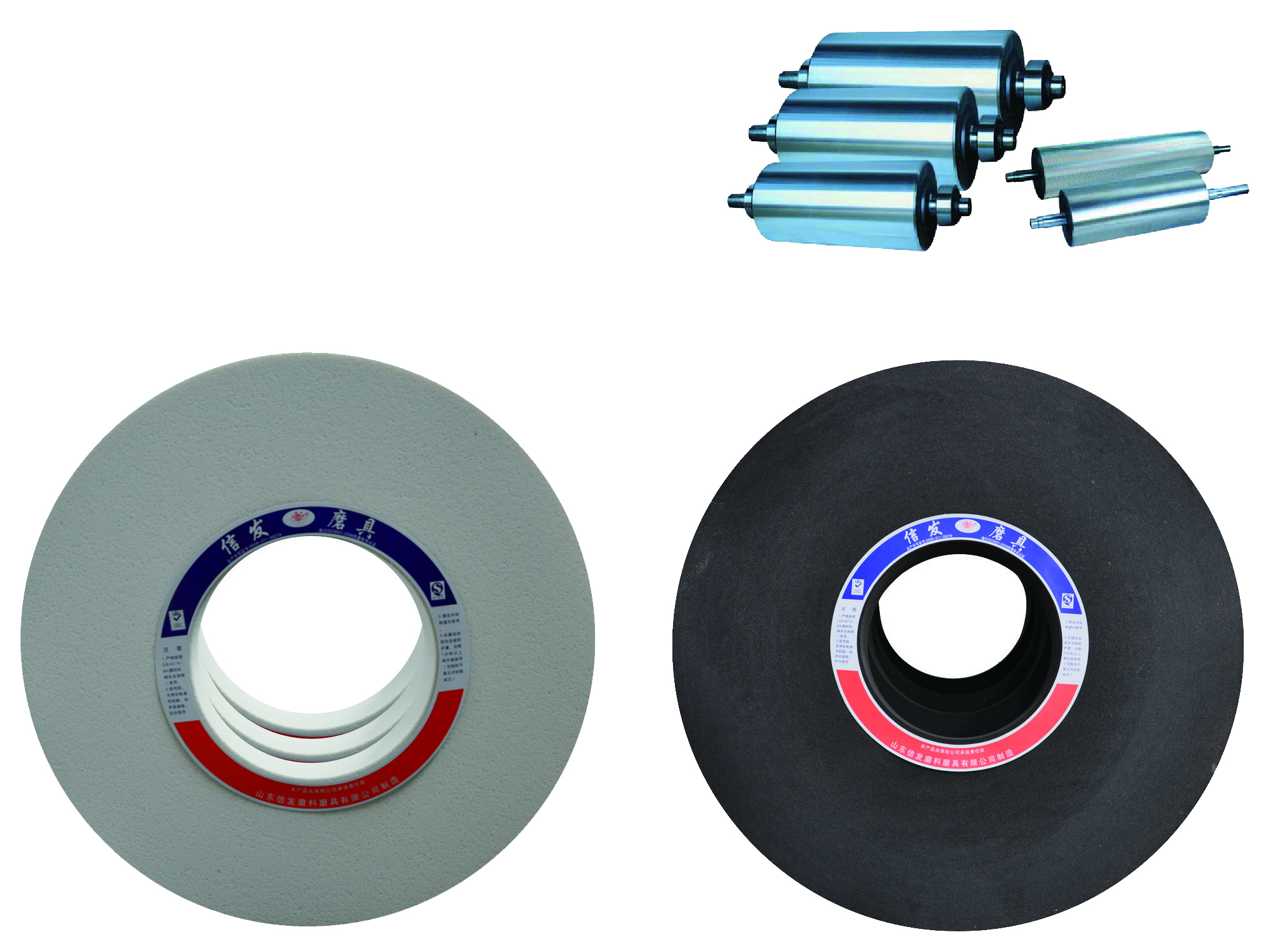
Roll Grinding Wheel V&B: outside diameter 450–1066 mm, thickness 50–150 mm, hole diameter 203–508 mm, with brown fused alumina, white fused alumina and SG documented as materials. Image: Shandong Xinfa Abrasives & Grinding Tools Co., Ltd.
The buyer question at the research stage is rarely which family is better. It is which grain, in which body size, at which hardness and structure, actually matches the bore or the roll in front of you. The two families are specified in a different order, and treating them as versions of the same product is where most mismatches begin.
Why Two Families Cannot Share One Specification
A bonded grinding wheel is abrasive grain held together by a bond, with porosity between the two. That construction is common to surface, centreless, cylindrical, tool, bearing, gear and roll wheels; what changes from product to product is the ratio of grain, bond and pore, and the geometry the wheel is built into.
Because the principle is shared, catalogues use a common grammar. Because the geometry is not shared, that grammar produces very different objects. An internal bore wheel has to enter a bore: the hole diameter is dictated by the spindle or quill, and the outside diameter is limited by the cavity it works inside. A roll grinding wheel has to span a roll body: hole diameters run from 203 mm to 508 mm and outside diameters from 450 mm to 1066 mm in Xinfa's published data.
The practical consequence is sequence. In bore work the mounting interface fixes the catalogue search first and the grain is chosen afterwards. In roll work the roll diameter, face width and finish requirement set the wheel size, and the grain decision is dominated by how the wheel behaves across a long, wide contact area rather than how it fits into a confined space.
Decoding the Specification Line Before Comparing Anything
Xinfa publishes a decode for its model designations: outer diameter × thickness × hole diameter, followed by grit size, hardness, structure, bond type and maximum operating speed. A designation such as 150×25×31.75 A46R5V35m/s therefore reads as 150 mm outside diameter, 25 mm thickness, 31.75 mm hole, A grain at F46 grit, R hardness, structure 5, vitrified bond and a 35 m/s maximum operating speed.
This matters more in bonded abrasives than in most tool categories because the same words do different work. Ceramic can refer to the vitrified bond, to a ceramic alumina grain such as SG, or loosely to any wheel sold into a precision finishing application. The specification line is the only part of the description that is unambiguous.
Internal Bore Grinding Wheels: Material Specifics
Xinfa's internal (bore) grinding wheel data gives an outside diameter of 50–150 mm, thickness of 6–120 mm and hole diameter of 16–32 mm. Grain sizes run F16–F150, hardness grades G–Y, structure numbers 0–14, and maximum operating speeds of 32, 35, 40, 45, 50 and 60 m/s. The available grit menu is A, WA, AA, 38A, PA, 25A, SA, MA, GC, C and SG.
The material note is the part that changes how a bore wheel should be ordered. The internal-wheel dataset identifies SG (ceramic alumina) and black silicon carbide (C) as the grains specifically associated with this family, inside the broader eleven-code menu above.
The thickness range carries its own information. A 50–150 mm diameter envelope combined with a 6–120 mm thickness range means the family spans narrow wheels and comparatively deep ones. Thickness relative to diameter changes how much of the wheel is engaged and how the body sits relative to the bore wall, so it is a specification field in its own right rather than a default derived from diameter.
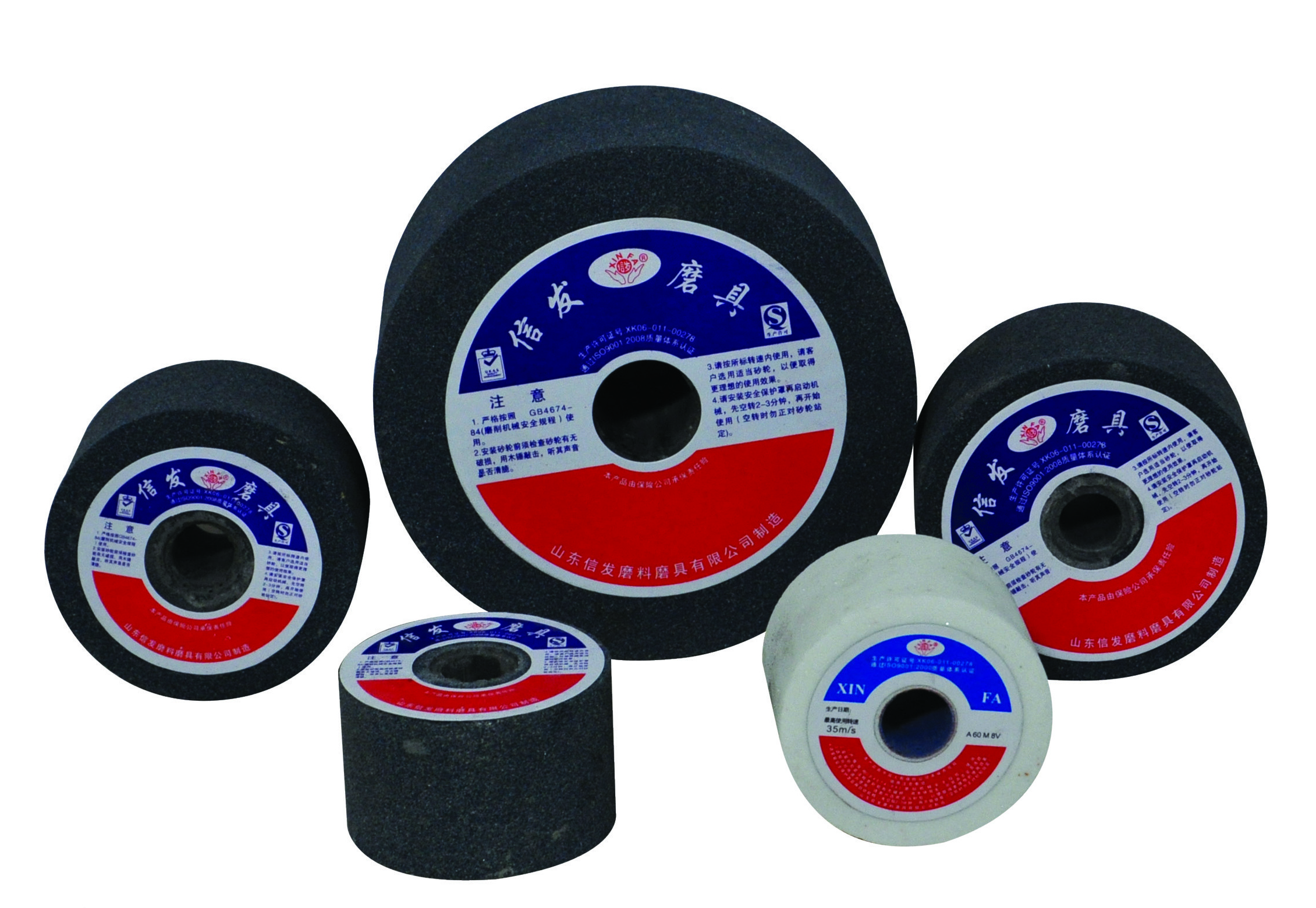
Internal (Bore) Grinding Wheel: outside diameter 50–150 mm, thickness 6–120 mm, hole diameter 16–32 mm; SG (ceramic alumina) and black silicon carbide (C) are among the documented materials. Image: Shandong Xinfa Abrasives & Grinding Tools Co., Ltd.
Roll Grinding Wheels: A Different Set of Objectives
The roll grinding wheel dataset gives outside diameter 450–1066 mm, thickness 50–150 mm and hole diameter 203–508 mm, with the same grain sizes F16–F150, the same hardness range G–Y, the same structure numbers 0–14 and the same 32–60 m/s speed range. The grit menu is again A, WA, AA, 38A, PA, 25A, SA, MA, GC, C and SG. The materials named in the published data are brown fused alumina, white fused alumina and SG.
Size dominates the engineering. A 1066 mm wheel and a 150 mm wheel can both be rated for 60 m/s, but peripheral speed is the only thing they share. At equal thickness the larger body carries far more material, so balance, mounting and guarding practice carry proportionally more weight in the roll grinding decision than in the bore decision. ANSI B7.1, the safety requirements standard for the use, care and protection of abrasive wheels, is the reference point for that side of the specification.
The grain question is broader here. Brown fused alumina is a widely used base grain in bonded abrasives and, according to Dataintelo's 2026 fused alumina market report, held the largest product-type share of the fused alumina market at 52.4% in 2025. White fused alumina and SG appear in the same documented material set for roll wheels, which gives a buyer three named starting points across a very wide size range rather than a single default.
Documented Envelope, Side by Side
| Specification field | Internal (Bore) Grinding Wheel | Roll Grinding Wheel |
|---|---|---|
| Outside diameter | 50–150 mm | 450–1066 mm |
| Thickness | 6–120 mm | 50–150 mm |
| Hole diameter | 16–32 mm | 203–508 mm |
| Grain sizes | F16–F150 | F16–F150 |
| Hardness grades | G–Y | G–Y |
| Structure numbers | 0–14 | 0–14 |
| Maximum operating speed | 32, 35, 40, 45, 50, 60 m/s | 32, 35, 40, 45, 50, 60 m/s |
| Grains named in published data | SG (ceramic alumina), black silicon carbide (C) | Brown fused alumina, white fused alumina, SG |
| Full grit menu | A, WA, AA, 38A, PA, 25A, SA, MA, GC, C, SG | A, WA, AA, 38A, PA, 25A, SA, MA, GC, C, SG |
Read across the table and the overlap is narrow: grain sizes, hardness, structure and speed ratings are identical, while every dimensional field and the named material set differ. That is the shape of the selection problem – the same specification grammar with different constraints.
Application Engineering: From Bore to Roll
Xinfa lists the applicable sectors for its bonded wheels as automotive, bearings, cutting tools, aerospace, 3C electronics, molds, hydraulics, semiconductors, photovoltaics, hardware and medical. Bore grinding concentrates in the component-side industries on that list – bearing races, hydraulic bores, mould details and small precision housings – while roll grinding sits in roll manufacturing and roll maintenance, where roll diameter and finish tolerance dominate the wheel choice.
A workable selection sequence for either family looks the same in outline and differs entirely in content:
- Fix the mounting interface first. The hole diameter is not negotiable. A 16–32 mm bore range and a 203–508 mm roll range do not overlap, so the choice of family is settled by the machine before any abrasive question is asked.
- Set the body second. Outside diameter and thickness together define reach and contact width. On bore wheels the thickness range exceeds the diameter range in relative terms, so it deserves explicit attention.
- Name the grain code, not the grain family. SG, brown fused alumina, white fused alumina, black silicon carbide and the other codes in the menu are different abrasives. Writing ceramic oxide leaves the decision to the supplier.
- Set hardness and structure against the dressing regime. Grades G–Y and structure numbers 0–14 cover a wide span; the pair chosen should follow the dressing interval the process can sustain.
- Confirm the speed rating last, and treat it as a ceiling. A wheel marked 32 m/s is not interchangeable with one marked 45 m/s on the same spindle.
The speed field is where specification discipline pays most directly. Both families offer 32, 35, 40, 45, 50 and 60 m/s options, which means the rating is a choice made at order time rather than a property of the family. A wheel rated below the machine setting is not a cheaper equivalent; it is the wrong part.
Where Xinfa Sits in the Specification Chain
Shandong Xinfa Abrasives & Grinding Tools Co., Ltd. is a Chinese manufacturer of vitrified bond grinding wheels, established in 1989 and located in the National Logistics Center of Linyi City, Shandong Province, 180 km from Qingdao Port and 60 km from Rizhao Port. The manufacturing facility covers 30,000 m² and employs approximately 120 staff, with an annual production capacity of over 10,000 tons and a technology R&D centre listed as a municipal-level enterprise R&D centre in 2015, staffed by 6 engineers.
The company is a member of the China Abrasives Association and states that its quality has passed ISO 9001:2008 quality management system authentication. Around 35% of output is exported, to more than 20 countries and regions including Southeast Asia (Vietnam, Thailand, Malaysia), India, South Korea, Japan, the Middle East (United Arab Emirates, Saudi Arabia, Iran), Europe, the United States and Brazil.
For this particular comparison, the relevant capability is breadth inside a single bond system. Xinfa's product range includes Internal (Bore) Grinding Wheel, Roll Grinding Wheel V&B, Cylindrical, Centerless, Flat Surface, Tool, Bearing, Gear, Worm, Crankshaft & Cam Shaft, Needle and Saw Tooth grinding wheels, alongside Oilstone, Segments, Resin Bonded Snagging Grinding Wheel, Rubber Control & Centerless, Flap Disc, Mounted Points and Brown Fused Alumina Abrasive. A buyer sourcing both a bore wheel and a roll wheel can work from one specification grammar instead of reconciling two suppliers' formats – a modest benefit, but a real one when two wheel families sit in the same maintenance budget.
Market Context Behind the Specification Pressure
Two published data points frame the sourcing environment. Reliable Market Forecast projects the global grinding wheel market to grow at a compound annual growth rate of 6.7% from 2025 to 2032, driven by demand for precision machining. On the material side, Dataintelo reports that brown fused alumina held the largest product-type share of the fused alumina market at 52.4% in 2025 – directly relevant here, because brown fused alumina is one of the three grains named in the roll grinding data and one of the eleven codes listed for both families.
Two technical signals point in the same direction. Peer-reviewed research on grinding-wheel wear monitoring, indexed on PubMed Central (PMC11436222, 2024), states that the condition of a grinding wheel directly affects the surface quality of the workpiece, and that monitoring wear state allows wheel condition to be evaluated. Separately, ISO 603-14:2022 specifies common nominal dimensions for bonded abrasive shapes 6, 11, 27, 28 and 29 used on hand-held grinding machines – a reminder that dimensional standardisation exists, but only for the shapes it covers.
For cross-border sourcing, bonded abrasive wheels of agglomerated abrasives or ceramics fall under HS heading 6804.22, with 6804.22.40 cited as one United States subheading reference for abrasive wheels. National tariff lines vary by jurisdiction, so classification should be confirmed for the specific importing market before it is used in cost modelling.
What the Published Data Does Not Tell You
Four boundaries are worth stating plainly, because they change what a buyer can conclude from a catalogue comparison.
- No performance benchmarks. The published sheets define dimensions, grain menus, hardness, structure and speed ratings. They do not contain G-ratio, wheel life, dressing interval or surface-roughness results for either family. Neither family can be ranked against a competing product on performance from catalogue information alone; that comparison requires matched trials on the same machine, workpiece and coolant.
- Standards coverage is partial. ISO 603-14:2022 covers nominal dimensions for specified shapes used on hand-held grinding machines. It does not define bore wheel or roll wheel geometry, so dimensional standardisation across suppliers cannot be assumed for these two families and each drawing has to be checked.
- Grain menus do not transfer automatically. The internal-wheel data names SG and black silicon carbide; the roll-wheel data names brown fused alumina, white fused alumina and SG. Both list the same eleven grit codes, but confirmation should be sought for the specific grain in the specific body size rather than assuming the menu is interchangeable between families.
- Certification is company-reported. Xinfa's ISO 9001:2008 authentication is stated in its company profile. The current certificate and its stated scope should be requested and reviewed during supplier qualification rather than taken from a profile page.
None of these limits makes the published data unusable. They define what it can support: dimensional and material selection, quotation verification and RFQ construction – not final performance approval.
Future Outlook
Three developments are likely to shape how these two families are specified over the next few years. First, continued growth in precision machining demand, reflected in the 6.7% CAGR projected for 2025–2032, keeps pressure on finish consistency and pushes buyers toward narrower, explicitly coded grain choices instead of general-purpose descriptions. Second, research and patent activity around online wheel-wear and condition monitoring suggests that process data will increasingly sit alongside dimensional data in how wheels are selected and reordered. Third, documentation burden is not shrinking: safety references such as ANSI B7.1, dimensional references in the ISO 603 series and jurisdiction-specific tariff classification will keep specification discipline relevant regardless of how the abrasive itself evolves.
For the bore-versus-roll decision specifically, the practical effect is continuity. The dimensional envelopes and the grain menus in these two datasets are unlikely to move quickly. What will change is how much evidence a buyer asks for alongside them.
FAQ
What distinguishes an internal (bore) grinding wheel from a roll grinding wheel?
Size envelope and mounting. Xinfa's internal (bore) grinding wheel data covers outside diameters of 50–150 mm, thickness of 6–120 mm and hole diameters of 16–32 mm. The roll grinding wheel data covers outside diameters of 450–1066 mm, thickness of 50–150 mm and hole diameters of 203–508 mm. Both families share grain sizes F16–F150, hardness grades G–Y, structure numbers 0–14 and maximum operating speeds of 32–60 m/s.
Which ceramic grains are specified for internal bore grinding wheels?
Xinfa's internal-wheel dataset identifies SG (ceramic alumina) and black silicon carbide (C) as the grains specifically associated with the family, within an available grit menu of A, WA, AA, 38A, PA, 25A, SA, MA, GC, C and SG. SG is an alumina grain; black silicon carbide is a carbide. A buyer who needs an oxide grain should state the grain code rather than relying on the general term ceramic.
Can one ceramic grinding wheel family cover both bore and roll grinding?
Not with a single wheel. The two families differ in outside diameter, thickness and hole diameter by roughly an order of magnitude, and the published material sets are not identical: the internal data names SG and black silicon carbide, while the roll data names brown fused alumina, white fused alumina and SG. A manufacturer may offer both families, but each wheel is specified separately.
What does the V in a designation such as A46R5V mean?
In Xinfa's published decode, a designation such as 150×25×31.75 A46R5V35m/s represents outer diameter × thickness × hole diameter, followed by grit size (A46), hardness (R), structure (5), bond type (V, vitrified) and maximum operating speed (35 m/s). The V denotes the vitrified bond rather than the abrasive grain.
Does a higher maximum operating speed mean a better wheel?
No. Maximum operating speed is a rating, not a quality ranking. Xinfa's bore and roll wheel data both list 32, 35, 40, 45, 50 and 60 m/s options. The correct rating is the one that meets or exceeds the machine operating speed without being exceeded in service; ANSI B7.1 is the reference standard for the safe use, care and protection of abrasive wheels.
What information should accompany a ceramic grinding wheel quotation?
The full model designation decoded into outside diameter, thickness, hole diameter, grit code, hardness, structure, bond type and maximum operating speed; the grain named by code rather than by family; and the current quality management certificate with its scope. Where the wheel crosses a border, the applicable tariff classification under the 6804.22 heading should be confirmed for the importing jurisdiction.
Product documentation: Shandong Xinfa Abrasives & Grinding Tools Co., Ltd. publishes a downloadable product brochure at cdn.socialarks.com – Xinfa product brochure (PDF). Company website: www.xinfa-abrasives.com.
¿Tiene preguntas o necesita más detalles?
Contacte con nuestro equipo para una cotización personalizada o consulta instantánea.
Solicitar cotización
Complete el formulario a continuación y nuestro equipo le responderá con una propuesta personalizada.
Chat directo de WhatsApp
¿Prefiere chatear en tiempo real? Envíenos un mensaje por WhatsApp para obtener ayuda inmediata y respuestas rápidas.
- Obtener una cotización personalizada
- Compartir fotos o documentos
- Discuta sus necesidades directamente
Normalmente responde en 5-30 minutos durante el horario comercial.