
Integrated vs Split vs Portable Air Compressors: A Buyer's Framework
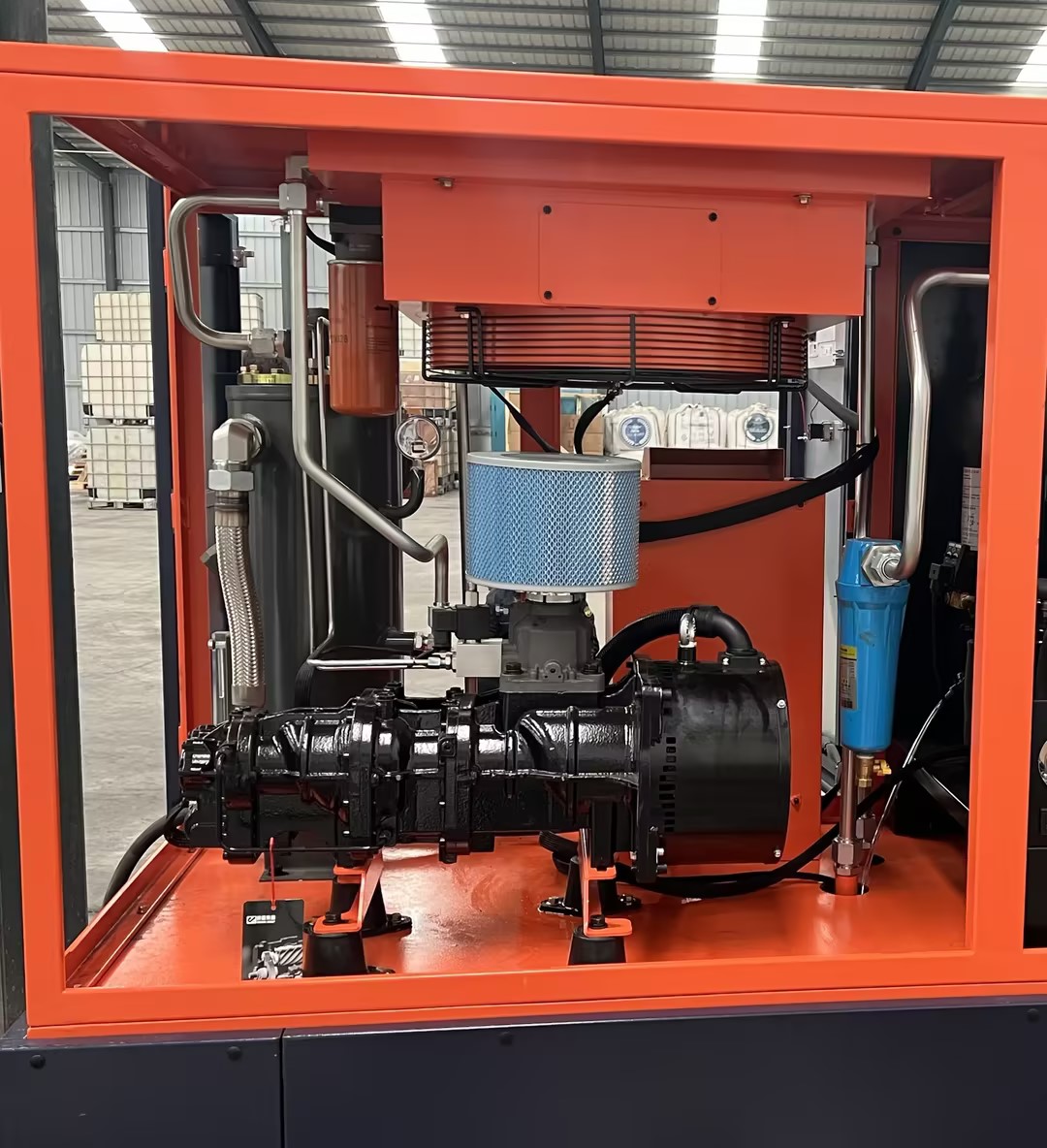
An industrial air compressor is rarely bought as a single machine. It is bought as one decision inside a larger compressed air system — and the first version of that decision is a configuration choice, not a brand choice. Integrated, split, portable and fixed screw configurations each solve a different production problem, and each carries a different cost profile across the life of the plant.
For buyers at the decision stage, configuration is also the only variable that can be fixed before quotations arrive. Once air flow, working pressure, duty cycle and air quality class are defined, competing offers become comparable item by item. Before that point, every supplier is effectively pricing a different system, and the lowest number on the page usually reflects the smallest scope, not the best value.
Why Configuration Comes Before Brand and Price
Most compressed air problems that surface two or three years after commissioning are not equipment failures. They are configuration mismatches. A portable diesel unit placed on a permanent production line runs outside its intended duty pattern. An integrated package specified for a single cell becomes the bottleneck when the line doubles. A split system ordered without a properly sized air dryer delivers wet air into a CNC machine or a laser cutting head and shortens tool and optics life.
The opportunity runs in the other direction. A buyer who defines the compressed air system first — demand, pressure, duty, quality, future expansion — can evaluate an integrated package, a split installation, a portable machine and a fixed stationary screw compressor on the same decision framework rather than on marketing claims. That is the practical purpose of this comparison: to make four structurally different configurations answerable to the same set of questions.
The Four Configurations, Defined
Integrated air compressor. The compressor, air dryer, receiver tank and filtration are assembled into one enclosure or skid, with short internal piping and a single utility connection point. Installation work at site is minimal, and the equipment footprint is compact. The trade-off is that component selection, service access and future capacity are largely fixed by the package design.
Split (separate) system. The compressor, air dryer, air tank, line filter, inverter and controller are specified and installed as separate components connected by plant piping. This is the most common arrangement in larger factories because each element can be sized independently and replaced or upgraded on its own schedule. It requires more engineering, more floor space and a properly designed piping layout.
Portable compressor. A mobile unit mounted on wheels, a skid or a trailer, frequently diesel-driven and often supplied with only basic filtration. It follows the work rather than the plant. Portable machines are built for temporary or shifting demand and are not intended to carry a permanent plant air base load.
Fixed screw compressor. A stationary rotary screw air compressor permanently installed in a plant room or dedicated area, feeding a ring main through a full treatment train. This is the configuration that industrial buyers normally mean when they talk about an industrial compressed air system for a factory.
| Configuration | Physical form | Duty pattern | Typical fit | Main trade-off |
|---|---|---|---|---|
| Integrated | Compressor, dryer, tank and filter in one enclosure | Shift or continuous, single cell | Compact factory layouts, dedicated CNC or laser cells | Limited expansion path, tighter service access |
| Split / separate | Separately installed components on plant piping | Continuous, multi-point supply | Growing plants, multiple production lines | More engineering, floor space and piping design |
| Portable | Wheeled, skid or trailer-mounted, often diesel | Temporary or intermittent | Construction sites, relocation, backup demand | Not a base-load solution, fuel and emissions management |
| Fixed screw | Stationary rotary screw unit in a plant room | 24/7 continuous operation | Plant-wide industrial air supply | Higher initial investment than intermittent alternatives |
Five Criteria That Decide the Configuration
1. Air flow, measured at the point of use
Air flow is written in m³/min or CFM, and it should be calculated as the sum of connected consumers at their simultaneous peak, not as a round number. A figure such as 2.39 m³/min describes one specific flow point on a specification sheet; whether it is right for a line depends on how many tools, valves and actuators draw air at the same moment, plus an allowance for leakage across the distribution network and for future expansion. Buyers who skip this step end up with a compressor that is either oversized and cycling inefficiently or undersized and running continuously at maximum load.
2. Working pressure and system pressure drop
Industrial screw compressor ranges commonly span 8 bar to 25 bar working pressure, with higher-pressure machines reserved for specific processes and lower-pressure units covering general factory demand. The selection rule is to size for the highest pressure any point in the system genuinely requires, then add only the allowance needed to overcome pressure drop through the dryer, filters and piping. Over-pressurising the whole plant to satisfy one machine is one of the most common and most expensive specification errors, because energy consumption rises with discharge pressure while the rest of the network gains nothing.
3. Installed power and motor efficiency class
Installed power spans a wide band, from around 4 kW for small dedicated units to 355 kW for large plant-wide machines. Power rating alone does not tell a buyer how much air a machine produces per kilowatt-hour consumed, which is why buyers increasingly request the motor efficiency class — IE4 is the class now commonly quoted in industrial compressor specifications — alongside specific performance data at the actual operating point rather than at a single nominal point. For a variable frequency air compressor, the efficiency curve across the turndown range matters more than the figure at full load, because most factories rarely run at 100% demand for a full shift.
4. Duty cycle: continuous operation versus intermittent demand
Duty cycle is the criterion that most often eliminates a configuration rather than selecting one. Screw air compressors are designed for continuous operation and are typically specified for 24/7 duty in industrial production, while piston compressors are built for intermittent duty. If the production line runs around the clock, the configuration decision is largely settled at this point — the remaining question is how the continuous supply is packaged and controlled.
5. Air quality class, ambient conditions and control
Air quality requirements are defined in classification terms, such as the ISO 8573-1:2010 compressed air quality classes, which specify limits for particulates, water and oil. Where compressed air contacts a product — food and beverage lines, pharmaceutical packaging, paint and coating operations — buyers commonly move towards an oil free air compressor or to filtration that achieves the required class. Ambient conditions matter just as much: an air cooled screw air compressor must reject heat effectively in high-temperature or dusty environments, and cooling design determines whether output holds up in summer conditions. Control strategy closes the loop — a controller sequencing multiple machines, or an inverter matching output to real demand, is often the difference between a system that meets its specification on paper and one that meets it in production.
Matching Configuration to Production Line Needs
Configuration follows the demand profile of the industry, not the other way around. The table below maps common industrial settings to the configuration that usually fits them, keeping in mind that a plant may combine more than one configuration — a fixed plant air system plus a portable unit for site or maintenance work is a normal arrangement.
| Industry | Demand pattern | Configuration that usually fits | Supporting equipment emphasis |
|---|---|---|---|
| Metal processing, CNC machining, laser cutting | Continuous, pressure-sensitive, moisture-sensitive | Fixed stationary screw or integrated package at the cell | Dryer, line filter, receiver tank close to the machine |
| Plastics processing | High duty cycle, multiple machines, varying load | Fixed screw, often variable frequency drive | Larger receiver, inverter, sequencing controller |
| Automotive parts manufacturing | Continuous, many points of use, redundancy expected | Split system with a bank of fixed screw units | Dryers, filtration, ring main, monitoring controller |
| Food and beverage | Continuous where air contacts product | Split system with oil-free or class-specific filtration | Dryer, multi-stage filtration to ISO 8573-1:2010 class |
| Construction | Temporary, moving point of use | Portable, typically a diesel mobile screw compressor | Basic filtration and hose management, no permanent piping |
| Energy and heavy industry | Continuous, high load, low tolerance for downtime | Heavy-duty stationary screw with standby capacity | Full treatment train, redundancy, central controller |
Supporting Equipment: The Half of the System Buyers Under-Specify
The compressor is the largest line item in a compressed air solution, but it is not the part that determines whether the system behaves well in production. Five supporting elements do most of that work.
- Air dryer. Removes moisture that would otherwise condense in piping, tools and instruments. Refrigerated dryers cover general factory demand; desiccant or higher-grade drying is used where the required air quality class is stricter.
- Air tank (receiver). Buffers pressure fluctuations, supports control stability and lets the compressor unload rather than cycle excessively. Undersized receivers are a frequent cause of pressure swings at the point of use.
- Line filter. Captures particulates and residual oil carryover downstream of the compressor and dryer, protecting sensitive equipment such as CNC controls, laser optics and pneumatic valves.
- Inverter (variable frequency drive). Matches compressor output to actual air demand instead of running between full load and unload. This is the element that most directly changes energy consumption on plants with variable demand.
- Controller. Sequences multiple compressors, rotates lead units and provides pressure-band control and monitoring. On multi-machine installations, control strategy often delivers more savings than any single hardware upgrade.
An air compressor with dryer supplied as a single integrated package can reduce site work and commissioning time, particularly for a dedicated cell or a small factory. The counter-effect is that components inside the package are harder to upsize later, and service access depends on the enclosure design. Buyers should decide which of the two matters more before the order rather than after the first maintenance interval.
Where UMW Air Fits in This Framework
UMW Air (Shandong UMW Air Tech Co., Ltd.) is a Jinan, China-based manufacturer of industrial screw air compressors, founded in 2019, operating a 2,000 m² facility with approximately 200 employees and an R&D team of 40 engineers. The company states an annual production capacity of 12,000 units and reports that 100% of its output is exported, serving markets in the EU, the USA, Southeast Asia, the Middle East, South America and Africa.
Its product line-up maps onto the four configurations discussed above: air-cooled screw air compressors and direct-driven screw air compressors for general plant supply, stationary screw air compressors for fixed installations, diesel mobile screw air compressors for portable duty, and heavy-duty screw air compressors for continuous high-load environments. The company publishes a working range of 4 kW to 355 kW and 8 bar to 25 bar, and states that its screw compressor range carries CE certification — both company-reported figures that buyers should confirm against model-specific documents.
Two operational details are relevant to the decision framework in this article. First, every unit undergoes thermal testing before shipment, with radiators and cooling fans verified as part of the process — directly relevant to the overheating risk that limits continuous duty in high-ambient plants. Second, the company's stated purchasing terms are 30% T/T advance with 70% payable before shipping, FOB or CIF terms, and a pre-shipment acceptance test. For a buyer building a configuration decision, those terms matter because they place the verification step before final payment rather than after arrival. More detail on the company and its range is available at umwair.com.
Comparison with Traditional Solutions — and Where Each Option Stops
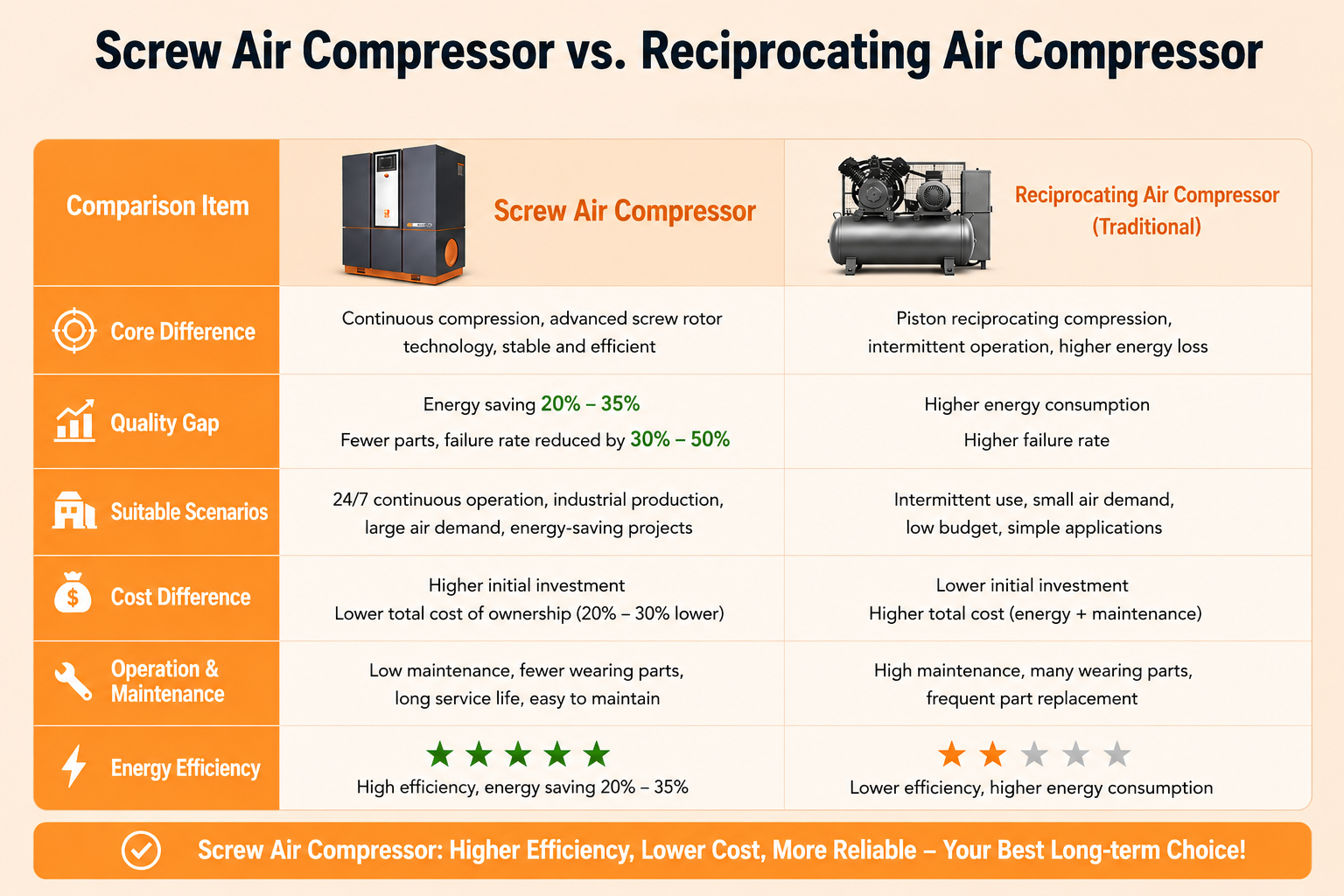
The most common alternative to a fixed or integrated screw configuration is a traditional piston compressor. The comparison is not close on duty cycle. Screw air compressors are designed for 24/7 operation, which makes them suitable for production lines requiring continuous air supply, whereas piston compressors operate intermittently. Energy efficiency follows the same pattern: screw compressors reach energy efficiency of up to 95%, while piston compressors are typically in the 65–70% range and are less suited to continuous high-load operation. Maintenance profiles also diverge — screw machines have fewer moving parts and longer service intervals, with lower downtime and lifetime cost, while piston units require more frequent maintenance and experience higher wear.
The cost model that follows from this is frequently misread. A screw compressor carries a slightly higher initial investment than a piston machine, but delivers a higher long-term return through reduced downtime and lower maintenance costs. That logic only holds when the machine is matched to the duty cycle it was specified for; a screw compressor running at very low load for long periods will not deliver the efficiency advantage it advertises.
Market Signals Shaping Configuration Choices
Three data points frame the current market environment. The global industrial air compressor market was valued at USD 20.0 billion in 2025, according to Grand View Research, with the rotary/screw segment holding the largest share at 47.0% that year. Asia Pacific accounted for a revenue share of 42.8% in 2025, reflecting the concentration of manufacturing capacity in the region. On the lubrication side, oil-filled air compressors represent 61.3% of the lubrication segment in 2026 — a reminder that most industrial demand is still served by lubricated machines, while oil-free configurations remain driven by specific application and air quality requirements rather than by general preference.
Regulation is the other active variable. Under U.S. Department of Energy rules, a compressor is defined at 10 CFR 431.342, and compressors manufactured on or after January 10, 2025 must meet energy conservation standards, with manufacturers required to follow specified test procedure methods and certification requirements under 10 CFR 431.344, 10 CFR 431.345 and 10 CFR Part 429. For buyers exporting into or sourcing from the U.S. market, test and certification timing is now a procurement milestone rather than an administrative detail.
Future Outlook
Three shifts are likely to shape the next phase of configuration decisions. First, efficiency verification is becoming more formal: buyers are moving from accepting nominal motor classes such as IE4 to requesting performance data at defined operating points, driven by the same regulatory pressure visible in the DOE framework. Second, variable frequency control is moving from a premium option to a default expectation in plants with variable demand, because it changes the economics of part-load operation rather than just the specification sheet. Third, air quality classification — expressed through a defined standard such as ISO 8573-1:2010 rather than a general description — is increasingly used as a qualification criterion in food, packaging and finishing applications, which pushes the configuration decision towards treatment-train capability rather than compressor output alone.
For procurement teams, the practical implication is that configuration and system integration increasingly carry more decision weight than compressor brand alone. The supplier that can document flow, pressure, duty capability, efficiency class, thermal performance and acceptance testing in verifiable terms is easier to qualify than one that competes only on price per unit.
Frequently Asked Questions
How does an integrated air compressor differ from a split compressed air system?
An integrated air compressor combines the compressor, air dryer, receiver tank and filtration in a single enclosure or skid with a single connection point, which reduces installation work and floor space. A split system installs those components separately on plant piping, allowing each element to be sized, serviced and upgraded independently. Integrated configurations suit compact layouts and dedicated cells; split configurations suit larger plants with multiple points of use and plans to expand.
How should a buyer calculate the air flow and pressure a production line actually needs?
Air flow should be calculated as the sum of connected consumers drawing simultaneously at peak, with additional allowance for leakage across the distribution network and for future expansion. Pressure should be set by the highest requirement at any point of use, plus only the margin needed to overcome pressure drop through dryers, filters and piping. Oversizing pressure to cover one machine raises energy consumption across the whole network without improving performance elsewhere.
When is a portable compressor the right choice instead of a fixed screw compressor?
A portable unit — often a diesel mobile screw compressor — fits temporary, remote or moving demand such as construction sites, shutdown maintenance and relocation, where permanent piping is impractical. It is not designed to carry a plant's continuous base load. A fixed stationary screw compressor remains the standard choice where air is required continuously at fixed points of use and where a permanent ring main exists.
Why does 24/7 operation change the compressor type decision?
Screw air compressors are built for continuous operation and are commonly specified for 24/7 duty in industrial production, with fewer moving parts, longer service intervals and lower downtime. Piston compressors operate intermittently and require more frequent maintenance, which makes them unsuitable for lines that cannot tolerate unplanned stops. Screw machines also reach energy efficiency of up to 95%, compared with roughly 65–70% for piston compressors, which matters most when the machine runs continuously.
Which supporting equipment should be included with an industrial air compressor?
A complete compressed air system typically includes an air dryer to remove moisture, a receiver tank to buffer pressure fluctuations, a line filter to protect downstream equipment from particulates and oil carryover, an inverter where demand varies, and a controller to sequence and monitor the installation. Where compressed air contacts a product or sensitive equipment, filtration is specified against a defined air quality class such as ISO 8573-1:2010.
The framework in this article is deliberately configuration-led rather than product-led. Integrated, split, portable and fixed screw configurations are different answers to different production questions, and the buyer who defines flow, pressure, duty cycle, air quality and supporting equipment before requesting quotations is comparing systems rather than slogans.