
Integrated Sewage Treatment Systems: A Buyer's Verification Guide
Constraint-first procurement for domestic and industrial wastewater treatment equipment: certification scope, stated parameters, material limits and commercial terms.
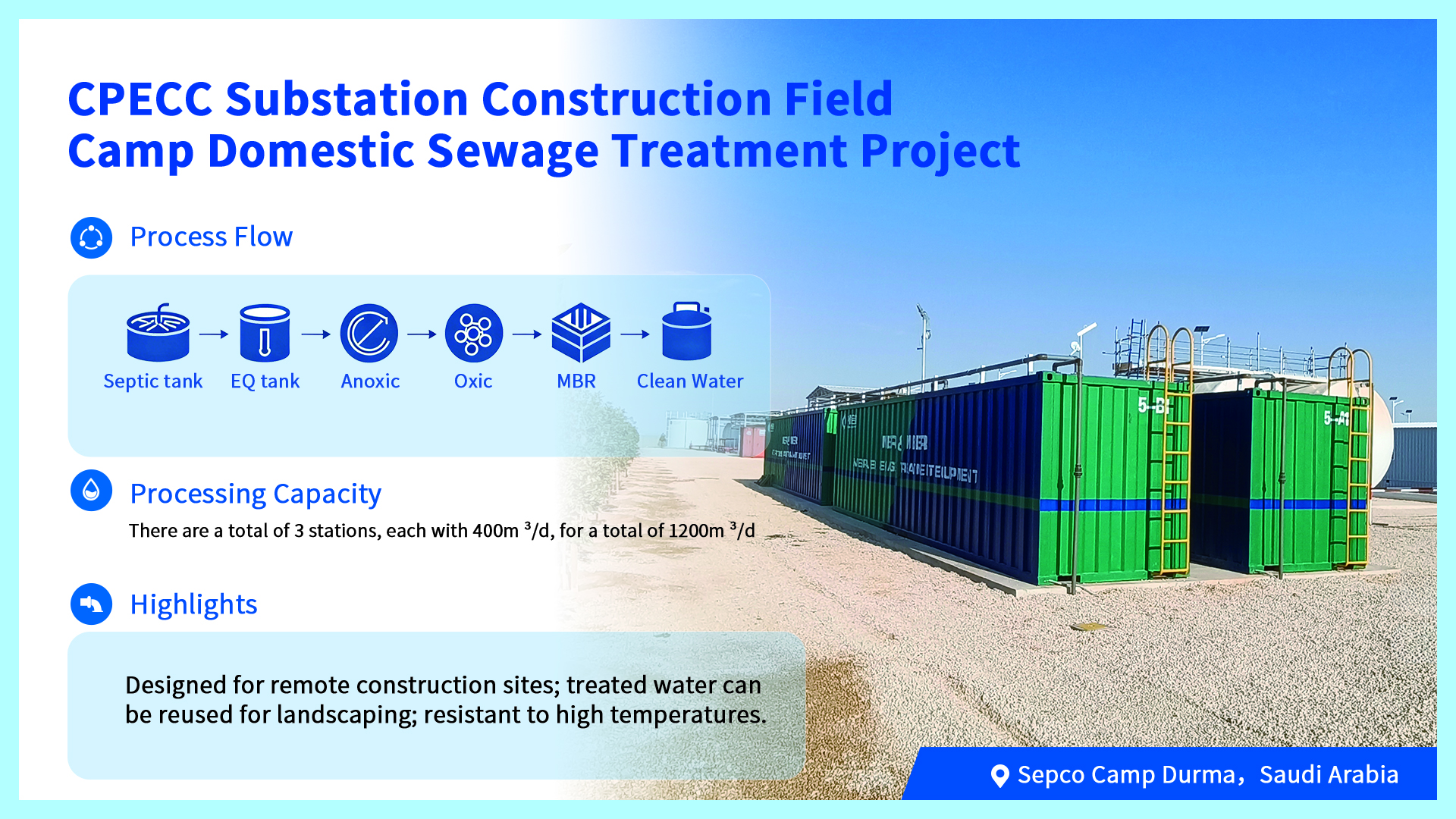
Camp domestic sewage treatment installation. Packaged plants are specified around discharge limits and site envelope, not headline flow rate alone.
An integrated sewage treatment system is a factory-assembled treatment train that arrives on site as a complete structural unit rather than being cast in concrete and fitted out in place. The category is sold under several names — packaged sewage treatment plant, modular sewage treatment plant, containerized wastewater treatment plant — and the underlying promise is the same: less civil work, faster commissioning, a defined treatment envelope.
Buyers in the research and evaluation stage usually open the comparison with flow rate. In practice, four constraints are decided before capacity is even discussed: the discharge standard the plant must meet, the influent quality it must tolerate, the installation envelope it must fit, and the documentation that allows it to be accepted in the destination market. A system that satisfies three of these and fails the fourth is not a cheaper option; it is a redesign.
This reference sets out how those constraints interact, using documented specifications from Shandong Zhongqiao Enlightenment Environmental Protection Equipment Co., Ltd. — a Weifang-based manufacturer of integrated wastewater treatment equipment, dissolved air flotation units, lamella clarifiers and MBR membranes — as a worked example of what a verifiable specification package contains.
The constraint order: standard, influent, flow, footprint
Effluent requirements set the process. A plant designed for municipal discharge and a plant designed for reuse in irrigation or toilet flushing are not the same plant with a different label; the downstream train, the disinfection stage and the control logic change. Zhongqiao Enlightenment states that effluent standards for its integrated equipment are customised on demand, with common national standards including Grade 1A and Grade 1B applied to municipal discharge and water reuse scenarios.
Influent quality then sets the pre-treatment. Oil, suspended solids, colour and salinity determine whether a biological train alone is adequate or whether dissolved air flotation, chemical dosing or balancing capacity must precede it. This is why the manufacturer's documented selection inputs are influent water quality, effluent discharge requirements and treatment flow rate — in that order, and none of them optional.
Flow rate converts the process into a physical unit. Footprint follows, and with it the installation decision: above-ground or underground. Both configurations appear in the manufacturer's documented working conditions, and the choice carries maintenance consequences that are discussed later in this guide.
What "integrated" changes in the civil works package
The structural configuration of the integrated wastewater treatment equipment documented by Zhongqiao Enlightenment is a modular integrated unit shipped as a complete assembly, built in carbon steel, SS304 stainless steel and PP depending on duty. The same configuration is described as allowing the unit to be relocated and expanded for different treatment capacities, and the operating mode is automatic.
Those three properties — shipped complete, relocatable, expandable — are the real commercial difference from a civil concrete plant. They shift cost from on-site construction to factory fabrication and transport, and they change the risk profile of a phased project: capacity can be added in modules rather than committed in a single pour.
The trade-off is transport geometry. A unit shipped as a complete assembly must fit road, crane and site access limits, and expansion is only straightforward if the original layout reserved space and connection points. Buyers evaluating modular sewage treatment plants should therefore ask for the shipping envelope and the connection schedule at the same time as the process drawing.
QDPP integrated sewage treatment equipment: a modular unit shipped as a complete assembly, available in carbon steel, SS304 or PP.
Certification: read the scope line before the logo
Integrated wastewater treatment equipment from Zhongqiao Enlightenment is certified to ISO 9001 under certificate number 21725Q06885R2M, a Quality Management System Certificate issued by Shandong LAJ International Certification Service Co., Ltd. (LAJCC). The applicable standard is GB/T 19001-2016/ISO 9001:2015, the certified product model is WSZ-100, and the certification scope is the production of integrated sewage treatment equipment. The certificate was issued on 15 April 2025 and expires on 27 April 2028; the manufacturer states that the certification applies to the Middle East and Southeast Asia markets.
Three details in that paragraph deserve more attention than the certificate image itself. First, the scope is production — it certifies how the equipment is made, not what the effluent contains. Second, the certificate names a specific model, WSZ-100, so a quotation for a different model should be checked against the certificate's product coverage. Third, the certificate carries an expiry date, which means it must still be valid at the time of shipment and, in some tender processes, at the time of commissioning.
This is the most common misunderstanding in the category. ISO 9001 is a management system certification. It is evidence of documented production control, inspection discipline and traceability; it is not a type test, a performance declaration or a discharge permit. Buyers in regulated markets should pair it with effluent test reports, material certificates and whatever local conformity documentation the receiving authority requires. A supplier that presents ISO 9001 as proof of effluent compliance has answered the wrong question.
Parameter layer: what is actually specified
A specification package is only useful if the component level is visible. The documented configuration of the WSZ-100 integrated wastewater treatment equipment is set out below; buyers can use it as a template for comparing quotations line by line rather than by total price.
| WSZ-100 item | Documented specification |
|---|---|
| Structure and materials | Modular integrated unit shipped as a complete assembly; carbon steel / SS304 / PP |
| Blowers | Model 100-7.5, two units, one duty and one standby |
| Control hardware | PLC module (Siemens); PLC control panel; electrical control cabinet; Schneider electrical elements |
| Remote monitoring | Remote module HDBox-4G-A; multifunctional meter |
| Pumps | Self-priming pump PXZ15-30-1.5, DN40, two units |
| Dosing | Dosing vessel 100 L (PE); metering pump rated 120 L/h |
| Operation | Automatic operation |
Component list as documented for the WSZ-100 integrated wastewater treatment equipment.
Where the influent carries high oil or suspended solids, the biological train is preceded by dissolved air flotation. The documented YW-5 unit illustrates the level of detail a buyer should expect for pre-treatment equipment as well.
| Dissolved air flotation YW-5 | Documented value |
|---|---|
| Structural style | Advection combined air flotation |
| Rated processing capacity | 5 m³/h |
| Dissolved air reflux ratio | ≥30%, typically 40–50%; head 40–50 m |
| Air compressor | 380 V, 1.4 kW, 0.21 m³/min, 0.8 MPa, 30 L receiver |
| Scraper and agitation | Scraper 0.75 kW; dosing-area agitators 0.75 kW, two units |
| Materials | Body carbon steel / SS304; strike-off board SS304 with rubber plate; chain carbon steel with nylon; chain wheel and release device nylon |
| Control | PLC Siemens; Schneider Electric components |
Dissolved air flotation specifications as documented for the YW-5 reference unit.
The documented application range for this flotation unit is abattoir, printing and dyeing mill, farm and similar industrial wastewater — streams where oil and suspended solids dominate. That is a design statement, not a performance guarantee: the removal rate still depends on the dosing regime selected for the actual influent.
Material selection is a constraint, not a preference
Three material classes appear across the integrated equipment range: carbon steel, SS304 stainless steel and PP. The choice is driven by the corrosivity of the stream, the required service life and the structural demands of the installation. The manufacturer documents that its PP integrated equipment can withstand acid and alkali corrosion within the pH range of 3 to 14, which places PP units in a different application bracket from coated carbon steel.
For evaluation purposes, material selection should be tied to a water analysis rather than to a general preference for stainless. A buyer who specifies SS304 on a chloride-rich stream, or coated carbon steel on an aggressive pH range, has created a maintenance liability that no warranty clause fully covers. The practical rule is to request the material recommendation in writing, alongside the influent analysis it was based on.
Commercial terms: what a quotation actually depends on
Packaged and containerized wastewater treatment plants do not have a published, comparable price band. Quotations are built from the process design, and the same nominal flow rate can produce materially different prices depending on the effluent target, the pre-treatment required, the material class, the automation level and the amount of site work excluded from the supply.
The documented commercial terms from Zhongqiao Enlightenment give buyers a reference point for what should be stated explicitly rather than left to negotiation: a minimum order quantity of one unit, a lead time of 30 to 45 days, a monthly capacity of 100 units, 100% testing before shipment, and an OEM production mode with customised appearance, colour and logo. After-sales support covers on-site installation guidance and remote technical support. Documented export markets for this production model are the Middle East, Russia, Central Asia and Southeast Asia.
Two of those terms carry more weight than they appear to. A one-unit minimum order means a single packaged plant can be ordered without channel stocking, which matters for pilot or camp projects. A 30 to 45 day lead time should be read as production time, not delivery time — freight, customs and site readiness sit outside it and usually dominate the critical path on overseas projects.
Where integrated systems fit: documented applications
The documented application scope for this integrated equipment covers hotel wastewater, hospital wastewater, camp domestic wastewater, slaughterhouse wastewater, livestock breeding wastewater, domestic sewage and domestic wastewater. That list is instructive: it is dominated by decentralised and moderately loaded streams, which is exactly where factory assembly beats cast-in-place construction.
Project references documented by the manufacturer include a camp domestic sewage treatment installation at a substation construction site, a domestic wastewater treatment project in Indonesia, hotel wastewater treatment, a slaughterhouse wastewater project in Shanxi, a livestock wastewater treatment project in South Korea, a food factory sewage treatment project in Xinjiang, hospital sewage treatment installations and a highway service area project. In one documented case, treated water is reused for irrigation and toilet flushing — the reuse scenario that most often justifies the additional treatment stages.
Cross-border delivery of these units is documented as well: a containerized treatment project for wheat-washing wastewater in the American Midwest, with a reported daily volume of approximately 150 m³. For buyers, the relevant point is not the geography but the format — a containerized plant moved from factory to a remote industrial site where civil construction would have been slow and expensive.
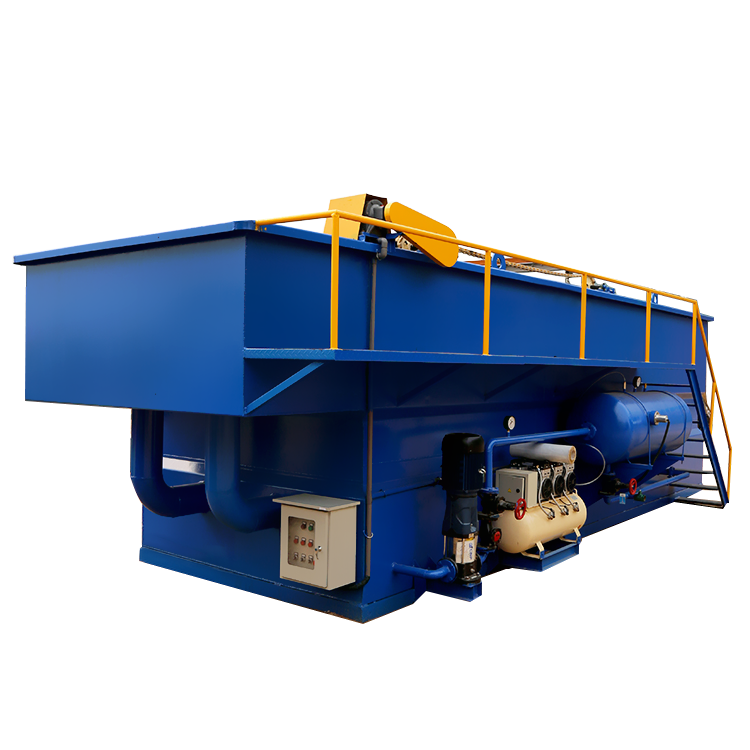
Dissolved air flotation ahead of the biological train handles oil- and solids-heavy streams from abattoirs, dyehouses and farms.
Market context: a large, traded, and thinly benchmarked category
Trade data confirms the scale of the supply base. According to the Observatory of Economic Complexity, drawing on UN Comtrade and national customs records, global trade in water purification and filtration equipment under HS code 842121 reached USD 12.4 billion in 2024, a 4.34% increase on 2023, with China the leading exporter at USD 2.38 billion. The HS code covers water filtering or purifying machinery broadly, so it is a proxy for — not a direct measurement of — the sewage treatment system segment.
Forward projections are directionally consistent but should be handled with care. The Business Research Company projects the global wastewater treatment equipment market to reach USD 43.94 billion by 2030. Forecasts of this kind vary substantially with scope — municipal versus industrial, equipment versus full plant — and should inform planning rather than anchor a budget.
What the data does not provide is equally relevant to buyers. Public, comparable price benchmarks for containerized MBR or MBBR systems are scarce, and performance data is usually supplied by the vendor rather than by an independent test body. In a market of this size, documentation discipline is the buyer's main defence: certificates with scope and validity, component-level bills of material, and written process assumptions.
Comparison with traditional solutions
The choice is rarely between one technology and another; it is between delivery formats and the obligations each creates over the asset's life.
| Criterion | Civil concrete plant | Integrated / packaged plant |
|---|---|---|
| Construction sequence | Site-built; long civil phase before equipment arrives | Factory-assembled, shipped complete, installed on prepared foundations |
| Capacity change | Costly retrofit or additional tankage | Modular units can be relocated and expanded across capacities |
| Operating attention | Depends on automation scope specified | Automatic operation with PLC control; remote monitoring available |
| Practical ceiling | Suited to large and complex flows | Best fit for decentralised, small-to-medium and pre-treated flows |
Comparison of delivery formats, based on documented product configuration and application scope.
The boundaries deserve stating plainly. An integrated packaged plant is not a substitute for a multi-stage industrial treatment line where high organic load, colour, heavy metals or salinity dominate; in those cases flotation, chemical treatment or membrane stages must be engineered around the specific stream, and the packaged unit becomes one module in a larger train rather than the whole solution. Underground installation, while documented as a supported configuration, restricts access for inspection and maintenance compared with above-ground placement, and should be chosen for site reasons rather than aesthetics.
Two further limits apply to the evidence itself. ISO 9001 certification, as noted, covers production rather than effluent quality. And the equipment's performance is only as defined as the influent data supplied — a system designed on assumed rather than measured water quality will meet its specification on paper and miss it on site.
A verification checklist for the evaluation stage
The following sequence converts the constraints above into documents a buyer can request before shortlisting.
| Step | Document to request | What it settles |
|---|---|---|
| 1 | Effluent target and discharge route | Which standard applies, and whether reuse is intended |
| 2 | Influent analysis and flow profile | Whether pre-treatment such as DAF is required |
| 3 | Certificate with number, scope, model and validity dates | Whether the quoted model is covered, and until when |
| 4 | Component bill of materials with brands and ratings | Comparability between quotations |
| 5 | Material recommendation tied to the water analysis | Service life and corrosion risk |
| 6 | Shipping envelope, foundation loads and connection schedule | Whether the site can receive and install the unit |
| 7 | Test record, lead time and scope split | What is supplied versus what is built locally |
| 8 | Installation guidance and remote support terms | Commissioning risk and lifecycle support |
Evaluation sequence for integrated sewage treatment system procurement.
Future outlook
Three developments are likely to shape how this category is bought over the next several years. The first is the shift of treatment toward the point of generation — construction camps, hospitals, food factories and industrial parks that cannot wait for a municipal connection. Decentralised demand favours factory-assembled, transportable units over cast-in-place plants.
The second is instrumentation. Systems that support remote operation, remote monitoring and remote analysis change the service model: fewer site visits, faster fault diagnosis, and a documented operating record that supports compliance reporting. Zhongqiao Enlightenment documents remote operation, monitoring and analysis capability in its project references, and the WSZ-100 configuration includes a 4G remote module with a multifunctional meter.
The third is documentation as a competitive attribute. As discharge limits tighten and reuse targets spread, buyers will differentiate suppliers less by catalogue capacity and more by the quality of their process assumptions, material justification and certification traceability. Manufacturers with a defined quality management system, an auditable component list and a certificate that names the model in question start from a stronger position — the certification is only the entry ticket, but it is a checkable one.
Frequently asked questions
What effluent standard can an integrated sewage treatment system reach?
Effluent standards for integrated wastewater treatment equipment are customised on demand. Common national standards applied include Grade 1A and Grade 1B, which can serve municipal discharge and water reuse scenarios. Selection requires the influent water quality and the local discharge requirements, after which the equipment is designed against those indicators.
What information must a buyer provide before a system can be sized?
Three inputs are documented as necessary: influent water quality, effluent discharge requirements and treatment flow rate. Without them, capacity figures remain nominal. The installation configuration — above-ground or underground — is also a design input rather than an afterthought.
Does ISO 9001 certification mean the treated water will comply with discharge limits?
No. The certification held for this equipment is a Quality Management System Certificate issued under GB/T 19001-2016/ISO 9001:2015, covering the production of integrated sewage treatment equipment and specifically the WSZ-100 model, valid from 15 April 2025 to 27 April 2028. It evidences production control, not effluent performance. Compliance with discharge limits is demonstrated by process design and water testing.
Can the system be installed underground or relocated later?
Both above-ground and underground working conditions are documented for this equipment range. The modular integrated unit is shipped as a complete assembly and the structural configuration allows relocation and expansion for different treatment capacities. Underground placement reduces the available access for inspection and maintenance, so the choice should follow site constraints and maintenance planning.
What are the standard commercial terms?
Documented terms are a minimum order quantity of one unit, a lead time of 30 to 45 days, a monthly capacity of 100 units, 100% testing before shipment, and OEM production with customised appearance, colour and logo. After-sales support includes on-site installation guidance and remote technical support. Lead time refers to production; freight, customs clearance and site preparation are separate.
Which materials are available, and when is PP the right choice?
Integrated wastewater treatment equipment is built in carbon steel, SS304 stainless steel and PP. PP equipment is documented as withstanding acid and alkali corrosion within a pH range of 3 to 14, which makes it relevant where the stream is aggressive. The material decision should be tied to a water analysis rather than specified generically.
Detailed specifications for the integrated equipment, flotation units and clarifiers described in this guide are compiled in the manufacturer's technical brochure, available for download: Zhongqiao Enlightenment brochure (13th edition).
¿Tiene preguntas o necesita más detalles?
Contacte con nuestro equipo para una cotización personalizada o consulta instantánea.
Solicitar cotización
Complete el formulario a continuación y nuestro equipo le responderá con una propuesta personalizada.
Chat directo de WhatsApp
¿Prefiere chatear en tiempo real? Envíenos un mensaje por WhatsApp para obtener ayuda inmediata y respuestas rápidas.
- Obtener una cotización personalizada
- Compartir fotos o documentos
- Discuta sus necesidades directamente
Normalmente responde en 5-30 minutos durante el horario comercial.