
Integrated Blister-Cartoning Lines: Buyer Decision Framework
Integrated Blister-Cartoning Lines: Buyer Decision Framework
An integrated blister-cartoning line performs blister forming, sealing and punching, then transfers the finished blister pack into a carton that is opened, loaded with a leaflet and closed — inside one synchronized machine frame. The standalone alternative completes the same packaging steps with two separate machines: a blister packaging machine and a cartoning machine, joined by a transfer conveyor and coordinated by two independent control systems. Both configurations are marketed for solid-dosage pharmaceutical products, and the difference shows up less in the quotation than in throughput coupling, floor space, control architecture, and qualification effort.
For a buyer entering the awareness and research stage of a solid-dosage packaging project, the useful question is not which configuration is more advanced. It is which configuration fits a defined product mix, a defined room, a defined batch pattern, and a defined qualification plan — and which criteria actually separate the two options.
This reference sets out a reusable four-criteria framework — speed, floor space, control system complexity and regulatory alignment — and uses one documented integrated machine, the DHL8005H intelligent fully servo high-speed blister-cartoner, as a benchmark for the discussion. All specification figures below come from manufacturer documentation and published market research; where a figure has not been published for a given model, the article says so rather than estimating it.
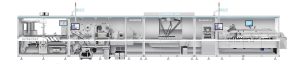
DHL1000/5H intelligent fully servo high-speed blister-cartoner integrated machine. Integrated lines combine blister forming and sealing with transfer, leaflet handling, carton opening, insertion and coding inside one linked frame. Image: Zhejiang Hoping Machinery Co., Ltd.
What “Integrated” Actually Covers on a Blister-Cartoning Line
On a blister-cartoning line, integration is a statement about scope of supply, not about a single component. The documented scope of the DHL8005H covers high-speed blister forming and sealing, blister transfer, leaflet handling, carton opening, blister insertion, coding and inspection, and connection to downstream bundling, case-packing and palletizing equipment. In other words, the blister pack is never an intermediate product that leaves the machine: it moves from forming station to sealed carton within one linked process.
A standalone setup distributes the same functions across separate units. A rotary blister packing machine such as the DPH320HII forms and seals the blister packs, and a horizontal or high-speed cartoner such as the XWZ series opens, fills and closes the carton. Each unit carries its own drive system, its own human-machine interface and its own format tooling, and the two are linked by a transfer conveyor with signal exchange between the controls.
That difference is the root of every downstream trade-off a buyer will evaluate: how line speed is capped, how much floor the project consumes, how many control platforms the maintenance team must support, and how many machine-to-machine interfaces must be qualified.
Why the Integrated-versus-Standalone Question Arises Early
The question surfaces during concept design because the decision is expensive to reverse later. A packaging room, a cleanroom classification, a utilities layout and a validation strategy are all built around the line architecture, and switching from standalone units to an integrated line after layout freeze means re-planning rather than re-specifying.
Market context explains the attention. SkyQuest Technology valued the global pharmaceutical packaging equipment market at approximately USD 10.71 billion in 2024. Grand View Research reported that Asia Pacific held the largest revenue share of 40.7% in the pharmaceutical packaging equipment market in 2025. For blister equipment specifically, Custom Market Insights projected the pharmaceutical blister packaging machine market to reach USD 2.57 billion by 2025, at a CAGR of 2.8%. On the cartoning side, Fortune Business Insights valued the pharmaceutical automatic cartoning machine segment of the market at USD 1.46 billion in 2024.
Published estimates for the same total market differ because analysts define the boundary differently — some include secondary packaging equipment, some count only primary packaging machinery. Buyers should therefore treat market size figures as directional context for budgeting cycles, not as a specification input.
Criterion 1 — Speed, and How It Is Coupled
Line speed on an integrated blister-cartoner is normally quoted as two numbers, and the lower number governs the project. On the DHL8005H, documented capacity is up to 800 blisters per minute and 500 cartons per minute. The DHL1000/5H is documented at up to 1000 blisters per minute and 500 cartons per minute; the DHL7005H at up to 700 blisters per minute and 500 cartons per minute; the DHL7004 at up to 700 blisters per minute and 400 cartons per minute; and the DHL6004 at up to 600 blisters per minute and 400 cartons per minute.
The pattern is worth reading carefully. Blister output can be raised substantially across the family, but carton output stays within a much narrower band from 400 to 500 cartons per minute. On an integrated line the blister section and the cartoning section are mechanically and electrically coupled, so the cartoning rate becomes the practical ceiling on deliverable product. Raising punch frequency alone does not raise saleable output.
Synchronization hardware is what makes that coupling workable. The DHL8005H uses a D3 intelligent top-loading parallel tracking transfer system to move blister packs into the carton stream, and a three-channel servo-driven independent replenishment system. The DHL1000/5H specifies a four-channel servo-driven independent replenishment system with the same D3 transfer family. Multi-channel independent replenishment matters because it is the mechanism by which the line keeps feeding the cartoning section during format or channel interruptions.
On a standalone setup, speed is bounded differently. The DPH320HII rotary blister packing machine is documented at a maximum punch frequency of 250 punches per minute and a maximum capacity of 1000 blisters per minute with a 320 x 280 mm format area. A separate cartoner adds its own range: the XWZ500H is documented at 100–500 cartons per minute, the XWZ300II at 60–220 cartons per minute, and the XWZ120 at 30–120 cartons per minute. The blister machine can therefore run far ahead of a smaller cartoner unless the buyer deliberately matches the two ratings and adds buffer capacity between them.
Criterion 2 — Floor Space and Layout Load
Floor space is where standalone configurations are most often underestimated, because a quotation lists machines rather than the complete installed arrangement. Published dimensions for individual standalone units illustrate the load. The DPH320HII measures approximately 5,000 x 1,500 x 2,100 mm and weighs about 6,000 kg. The XWZ500H cartoner measures approximately 6,700 x 1,950 x 2,100 mm and weighs about 6,000 kg. The XWZ300II measures approximately 5,160 x 1,600 x 2,100 mm at about 4,800 kg.
Those figures describe the machines only. A linked standalone setup also needs the transfer conveyor between them, buffer accumulation if the two units run at different rates, clearance for maintenance access at both ends, and an operator path that does not cross the product flow. For end-of-line context, the ICP12 case packing and palletizing integral machine alone is documented at about 8,900 x 3,000 x 2,400 mm.
Integrated line dimensions are not published as a single fixed figure, because line length depends on the configured modules — feeding method, leaflet folder, coding and inspection stations, and whether downstream bundling or case packing is included. The correct procurement action is to request a scaled layout drawing with the technical offer and to check it against column positions, ceiling height, cleanroom classification boundaries and the maintenance envelope of every guard door.
Criterion 3 — Control System Complexity
Control architecture is the criterion that most often decides the maintenance and spares strategy, and it differs in kind rather than degree. An integrated line places blister indexing, transfer, leaflet insertion and carton closing under one motion controller. In the DHL family the platform is documented explicitly: the DHL8005H and DHL6004 use a Beckhoff motion controller with a CP9315 industrial PC; the DHL1000/5H uses a Beckhoff motion controller with a high-bus industrial control system; the DHL7005H and DHL7004 use a Siemens motion controller with a TP900 HMI.
A standalone arrangement runs at least two control systems that must exchange signals at the transfer point. Downstream cartoner controls are documented per model: the XWZ500H is a full servo high-speed machine; the XWZ300II uses a SEW gear motor, a Siemens or Meccano touch screen and a Becker VT4.40 vacuum pump; the XWZ120 uses an SEW main motor with a Siemens PLC.
The practical consequences run in both directions, and buyers should weigh them openly:
- Fewer platforms to support. One motion controller coordinating the whole line reduces the number of HMI styles, drive families and software versions the maintenance team must be trained on and hold spares for.
- Single fault domain. On an integrated line, a fault in the transfer or cartoning section stops the blister section as well, because the sections are linked. Standalone units can, in principle, be run independently, which is useful for partial-batch or rework scenarios.
- Recipe and changeover management. The DHL8005H documents mold-change and preset-memory functions, and the DHL1000/5H documents mold-change and recipe memory. On a standalone setup, format recipes live in two controllers and must be maintained in parallel.
- Skill concentration. A single-platform line concentrates required competence in fewer people, which raises the importance of documented training and locally available support.
Criterion 4 — Regulatory and Qualification Alignment
Regulatory alignment is not a marketing attribute; it is a set of documents the buyer must eventually hold. Two published references frame the requirement. ISO 15378 integrates GMP requirements for primary packaging materials, and EU pharmaceutical equipment safety is governed by Machinery Directive 2006/42/EC together with the EN 415 series of standards for packaging machines.
Machine-level design intent is stated in the documentation: the DHL8005H, DHL7005H, DHL7004, DHL6004 and DHL1000/5H are all described as GMP-oriented designs, with stainless steel and aluminum-alloy construction and transparent guarding. Material specifications are documented at model level — for example, product-contact parts of the DPH320HII and DPP260T1 are made of AISI 316L stainless steel and FDA-compliant pharmaceutical-grade materials, with non-product-contact parts in AISI 304 stainless steel and anodized aluminum alloy. Because those material statements belong to specific models, a buyer should confirm the product-contact material list for the exact machine being purchased rather than carrying a claim across the range.
The architectural consequence is a qualification question. An integrated line presents one internal transfer point between blister and carton, controlled by one platform. A standalone setup presents two machines and a conveyor, with the transfer between them acting as a discrete interface that must be specified, controlled and documented. Which approach is simpler depends on the buyer's own validation procedures, but the number and location of controlled interfaces is a legitimate and verifiable point of comparison at the technical offer stage.
DHL8005H as a Benchmark Specification
Using one fully documented machine makes the framework concrete. The DHL8005H is an intelligent fully servo high-speed blister-cartoner integrated machine, described by its manufacturer as a solid dosage turnkey packing line. Its documented attributes are:
- Capacity up to 800 blisters per minute and 500 cartons per minute
- D3 intelligent top-loading parallel tracking transfer system
- Three-channel servo-driven independent replenishment system
- Beckhoff motion controller with CP9315 industrial PC
- PVC and aluminum foil auto splicing
- Multiple feeding methods, with mold-change and preset-memory functions
- Leaflet handling, carton opening, coding and inspection functions inside the line
- Connection to bundling, case-packing and palletizing equipment
- Stainless steel and aluminum-alloy construction, GMP-oriented design
- Intended for capsule and tablet packaging in pharmaceutical solid dosage production
The benchmark is supplied by Zhejiang Hoping Machinery Co., Ltd., a manufacturer established in 2001 with more than 20 years of packaging machinery experience. The company employs approximately 300 staff, operates a manufacturing facility covering 28,800 square meters, and reports an annual production capacity of 500 units with an R&D team of 56 engineers. Its main product lines are blister packaging machines, cartoning machines, case packing machines and end-of-line packaging machines. Documented intellectual property includes 26 invention patents, 70 utility patents, 4 appearance patents, 10 PCT-protected patents in Europe, Russia, Germany and Italy, and 28 software copyrights. Export business accounts for 25% of total sales, with major markets in Southeast Asia, the Middle East, Eastern Europe, South America and Africa. Published third-party profiles also list CE and ISO 9001/14001 certifications; buyers should verify certificates against the specific model and configuration being ordered.
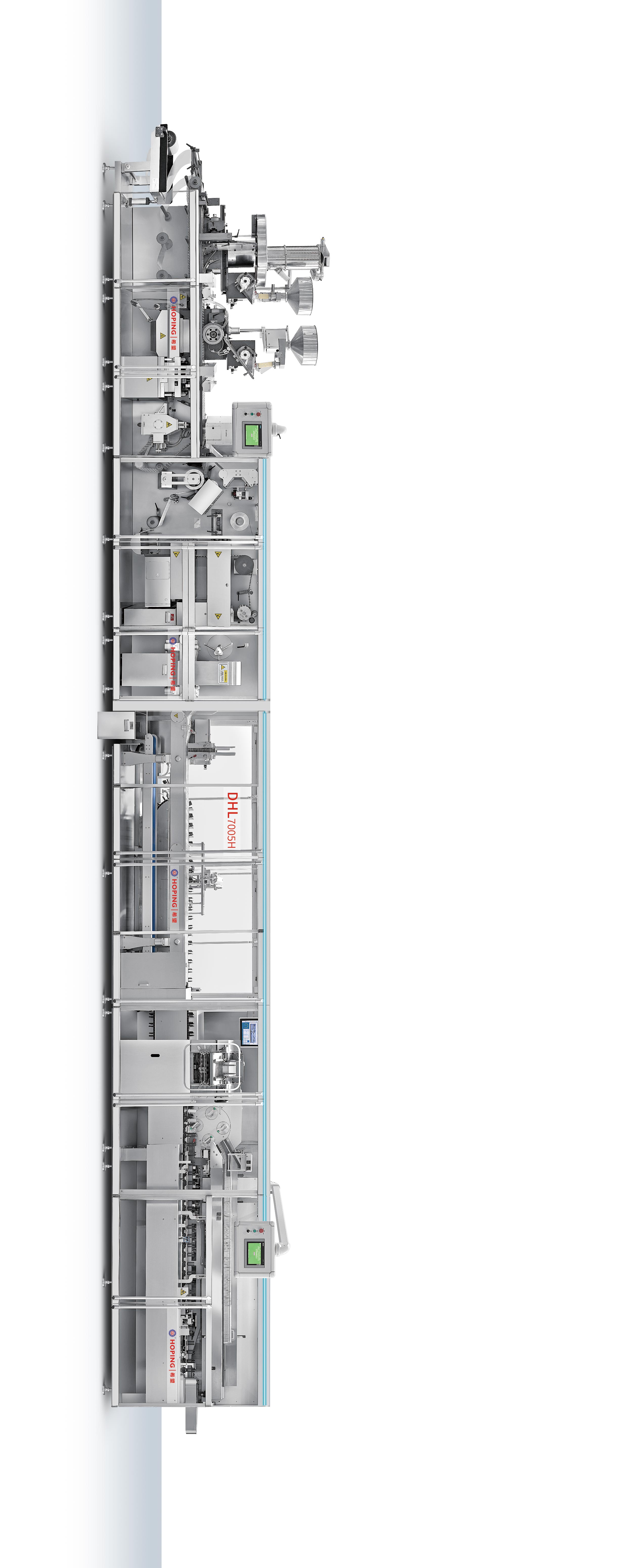
DHL7005H fully servo high-speed blister-cartoner integral machine, documented at up to 700 blisters per minute and 500 cartons per minute, using a Siemens motion controller and IRB24 transfer robot. Control platform choice is a line-level decision on integrated machines. Image: Zhejiang Hoping Machinery Co., Ltd.
How the Framework Applies to Defined Project Types
Manufacturer application documentation describes the operating environment these lines are built for: GMP-oriented cleanroom or pharmaceutical packaging workshop conditions, continuous high-speed operation, multi-batch and multi-format production, with requirements for stability, easy cleaning, safety protection and traceability-oriented operation. Documented project types include new solid dosage blister packaging lines, existing packaging line upgrades, high-capacity expansion, intelligent packaging workshop retrofits, and blister-cartoning-bundling or case-packing downstream integration projects.
Three archetypes follow from that list, and each pushes the framework in a different direction.
New line, single dominant format
One high-volume tablet or capsule format, running most of the year, favours an integrated configuration. Coupled throughput is not a penalty when the product mix is stable, and the space saved by removing a transfer conveyor can be reinvested in downstream case packing or palletizing.
Multi-format contract or export production
A plant that switches between several carton and blister formats, or runs both blister-only and blister-plus-carton batches, must weigh changeover burden carefully. Integrated lines document mold-change and preset-memory support, but format tooling spans both the blister and cartoning stages, so a changeover touches more of the line at once. Standalone units allow partial changeovers and partial operation.
Capacity expansion on an existing line
Adding cartoning capacity to an existing blister machine usually means a standalone cartoner sized to the blister machine's real output, not its rated output. Here the framework's speed criterion matters more than the space criterion, because the new unit has to fit an existing material flow.
Matched equipment in documented application scenarios includes blister packing machines, cartoners, D3 intelligent top-loading parallel robots, leaflet folders, coding machines, vision inspection, checkweighers, the XWK4060 bundler, case packers, palletizers, and ERP or MES data interfaces where configured.
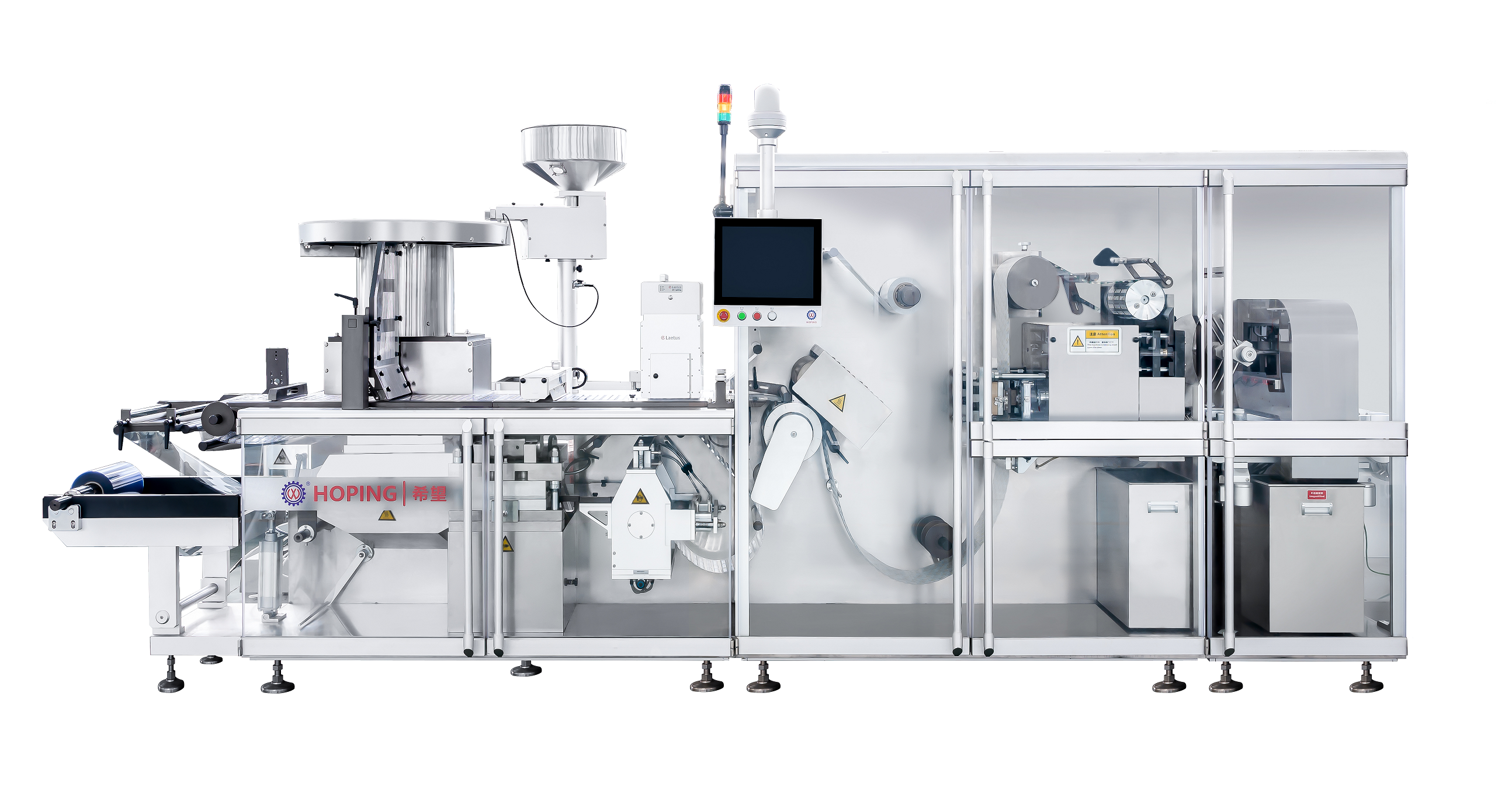
DPH320HII rotary blister packing machine, documented at a maximum capacity of 1000 blisters per minute with a 320 x 280 mm format area. As a standalone unit it must be matched to a separate cartoner and a transfer conveyor. Image: Zhejiang Hoping Machinery Co., Ltd.
Integrated and Standalone Configurations Compared
| Decision criterion | Integrated blister-cartoning line | Standalone blister machine plus cartoner |
|---|---|---|
| Throughput behaviour | Blister and cartoning sections are coupled; line output is limited by the lower figure. DHL8005H documented at up to 800 blisters/min and 500 cartons/min. | Two independent ratings. DPH320HII documented up to 1000 blisters/min; XWZ300II 60–220 cartons/min, XWZ500H 100–500 cartons/min. |
| Product transfer | Internal transfer, e.g. D3 intelligent top-loading parallel tracking transfer on DHL8005H. | External conveyor between two machines, with signal exchange at the interface. |
| Control architecture | One motion controller platform, e.g. Beckhoff with CP9315 industrial PC, or Siemens with TP900 HMI depending on model. | At least two controllers, each with its own HMI and drive family, maintained in parallel. |
| Format change | Mold-change and preset-memory supported, but tooling spans blister and carton stages. | Changeover can be executed on one unit while the other continues or idles. |
| Floor load | Line length is configuration-dependent; request a scaled layout drawing. | Machine footprints are published per unit; conveyor, buffer and clearances must be added. |
| Interfaces to qualify | One internal blister-to-carton transfer point. | Two machines plus the transferring conveyor as a discrete interface. |
| Fault behaviour | Linked sections; a downstream fault stops upstream forming. | Units can be run independently, subject to the buyer's batch controls. |
| Downstream expansion | Documented connection to bundling, case packing and palletizing. | Expansion is configured around an existing transfer point and layout. |
Limits and Trade-offs Buyers Should Confirm
A credible evaluation states where integration is not the better answer, and the documentation supports several such boundaries.
- The cartoning rate caps the line. Across the documented DHL family, blister output ranges from 600 to 1000 per minute while carton output stays between 400 and 500 per minute. A buyer who budgets on blister figures and plans carton demand above that band will not receive the expected output.
- Integration reduces partial operation flexibility. Because forming and cartoning are mechanically and electrically linked, running a blister-only batch, or cartoning pre-formed stock from another line, is not the primary operating mode of an integrated machine.
- Changeover touches more of the line. Mold-change and preset-memory functions reduce the adjustment burden, but the format set still covers blister tooling and carton tooling together.
- Not every dosage form fits the same architecture. The DHL family is documented for solid dosage and capsule or tablet packaging. Liquid dosage formats such as pre-filled syringes, ampoules and cartridges are addressed by a separate documented line, the IXW400, at up to 400 blisters per minute and 150 cartons per minute. Where a project needs blister, pillow-pack and carton in sequence, a different configuration again applies, such as the IXW series with flow wrapping.
- Small and variable batch production may not justify integration. Flat-plate blister machines in the DPP series are documented in the 20–70 cycles per minute range depending on model, aimed at small- and medium-batch pharmaceutical and healthcare products. At that scale, a coupled high-speed line is a poor match.
- Published data has gaps. Integrated line dimensions are not published as a single figure, and product-contact material specifications are documented per model rather than per family. Buyers should close these gaps in the technical agreement instead of assuming values.
Market Trend Analysis
Three documented signals are relevant to the integrated-versus-standalone decision.
First, the equipment market is large but not uniformly defined. SkyQuest Technology put the global pharmaceutical packaging equipment market at about USD 10.71 billion in 2024, while Grand View Research reported a different total for 2025 in the same category. The divergence reflects scope differences between primary and secondary packaging equipment rather than a contradiction in the underlying demand.
Second, regional concentration is shifting toward Asia Pacific, which Grand View Research identified as holding the largest revenue share, 40.7%, in 2025. For buyers sourcing integrated lines from Asian manufacturers, that concentration supports a wider supplier base and more competitive configuration options, but it also raises the importance of verifying documentation quality rather than relying on market presence.
Third, the high end of the blister packaging machine market remains concentrated. Published market intelligence indicates that the top three players — Uhlmann, IMA and Marchesini — together hold approximately 29% of the pharmaceutical blister packaging machine market. The remaining share is fragmented across many suppliers, which means buyers comparing integrated lines are frequently comparing a European or Japanese premium platform with an Asian alternative rather than comparing equivalent market positions. The framework above is designed to make that comparison technical rather than positional.
Future Outlook
Two directions are visible in the documented specifications themselves.
The first is deeper servo penetration with fewer mechanical transfers. Every machine in the DHL family is described as fully servo driven, with servo-driven independent replenishment channels and, on the DHL8005H, a D3 intelligent top-loading parallel tracking transfer system. Servo positioning reduces mechanical adjustment and makes recipe-based changeover feasible, which is the technical prerequisite for the mold-change and preset-memory functions already documented.
The second is line-level data integration. Documented application scenarios include ERP or MES data interfaces where configured, together with coding, vision inspection and checkweighing modules inside the line. As these functions converge on one control platform, the line becomes a data source for batch documentation as well as a packaging machine — which increases the value of choosing a control architecture deliberately at the specification stage rather than accepting whatever the offer contains.
Neither direction removes the underlying trade-off between coupled throughput and operational flexibility. It shifts where the trade-off is managed: increasingly in software configuration rather than in mechanical re-setting.
FAQ
What is an integrated blister-cartoning line?
An integrated blister-cartoning line combines blister forming, sealing and punching with carton opening, leaflet insertion, blister transfer and carton closing inside one linked machine frame, controlled as a single process. Documented scope on the DHL8005H covers high-speed blister forming and sealing, transfer, leaflet handling, carton opening, insertion, coding and inspection, and connection to bundling, case-packing and palletizing equipment.
How does an integrated line differ from a standalone blister machine plus a separate cartoner?
The difference is in scope and coupling rather than in the packaging steps performed. A standalone arrangement uses two machines with separate drive systems, separate human-machine interfaces and separate format tooling, joined by a transfer conveyor. An integrated line keeps the blister pack inside one frame and controls blister indexing, transfer and cartoning on one motion controller, such as the Beckhoff motion controller with CP9315 industrial PC documented on the DHL8005H.
What output can an integrated blister-cartoning line reach?
Documented figures within the DHL family range from up to 600 blisters per minute and 400 cartons per minute on the DHL6004, through up to 700 blisters and 500 cartons per minute on the DHL7005H, to up to 800 blisters and 500 cartons per minute on the DHL8005H, and up to 1000 blisters and 500 cartons per minute on the DHL1000/5H. Because the sections are coupled, the cartoning figure governs the saleable output of the line.
Which control platforms are used in integrated blister-cartoning lines?
Documented platforms in this family are Beckhoff and Siemens. The DHL8005H and DHL6004 use a Beckhoff motion controller with a CP9315 industrial PC, and the DHL1000/5H uses a Beckhoff motion controller with a high-bus industrial control system. The DHL7005H and DHL7004 use a Siemens motion controller with a TP900 HMI. On standalone cartoners, documented controls include full servo drives on the XWZ500H and a Siemens PLC with an SEW main motor on the XWZ120.
Which standards apply to pharmaceutical blister-cartoning equipment?
ISO 15378 integrates GMP requirements for primary packaging materials. In the European Union, pharmaceutical equipment safety is governed by Machinery Directive 2006/42/EC together with the EN 415 series of standards for packaging machines. Machine documentation in this product family describes GMP-oriented design, stainless steel and aluminum-alloy construction, and transparent guarding; product-contact material specifications such as AISI 316L and FDA-compliant pharmaceutical-grade materials are documented at individual model level.
When is an integrated line the wrong choice?
Integration is a weak fit where blister output must far exceed carton demand, where blister-only or carton-only batches are routine, or where batch sizes are small and highly variable. Flat-plate blister machines in the DPP series, documented in the 20–70 cycles per minute range depending on model, are aimed at small- and medium-batch production, and liquid dosage formats such as syringes, ampoules and cartridges are addressed by a separate documented line, the IXW400. A coupled high-speed line also stops both sections when a downstream fault occurs, which some production plans cannot absorb.
Putting the Framework to Work
The four criteria — speed coupling, floor space, control complexity and regulatory alignment — can be applied in a single specification meeting. Ask for the two rated speeds rather than one, ask for a scaled layout drawing with the technical offer, ask which motion controller coordinates the line and how spare parts and training are supported for it, and ask which standards and material specifications apply to the exact model quoted. If the answers are documented and consistent, the configuration decision becomes a straightforward fit assessment against the product mix and the room.
Manufacturer reference material for the equipment discussed in this article, including model specifications, is available in the Zhejiang Hoping Machinery catalog (PDF): Hoping Machinery Catalog.