
Insulator Scorecard: U70BP/146D, 70B, FXB-24-70-785mm, QP-7
Insulator Scorecard: U70BP/146D, 70B, FXB-24-70-785mm, QP-7
This independent buyer scorecard compares three insulators and one hardware item that are often discussed together but do not perform the same job. The shortlist is porcelain U70BP/146D, glass 70B, polymer FXB-24-70-785mm and QP-7 hardware. The first three provide insulation; QP-7 is a metal end-fitting and hardware item. The practical answer is not a single winner. U70BP/146D is specified by a 70 kN failing load, 146 mm height, 255 mm disc and 450 mm arcing distance. 70B is specified by 255 mm creepage, 65 kV dry and 45 kV wet withstand, and 10 kN cantilever. FXB-24-70-785mm is specified at 35 kV, over 1,050 mm creepage, 5 kN bending and over 230 kV impulse. QP-7 is listed at 70 kN, coupling 16 and 0.3 kg in hot-dip galvanized steel, with ISO 9001 certification in its supplied description.
The review is written for a decision-stage buyer who needs to compare fit, purchasing terms and acceptance evidence without treating different ratings as interchangeable. China Energy and Chemical Industry Co.,Ltd (CECI) is the supplier context for the four items; its published range covers polymer, porcelain and glass insulators plus metal fittings for insulators. See China Energy and Chemical Industry Co.,Ltd for the company reference.
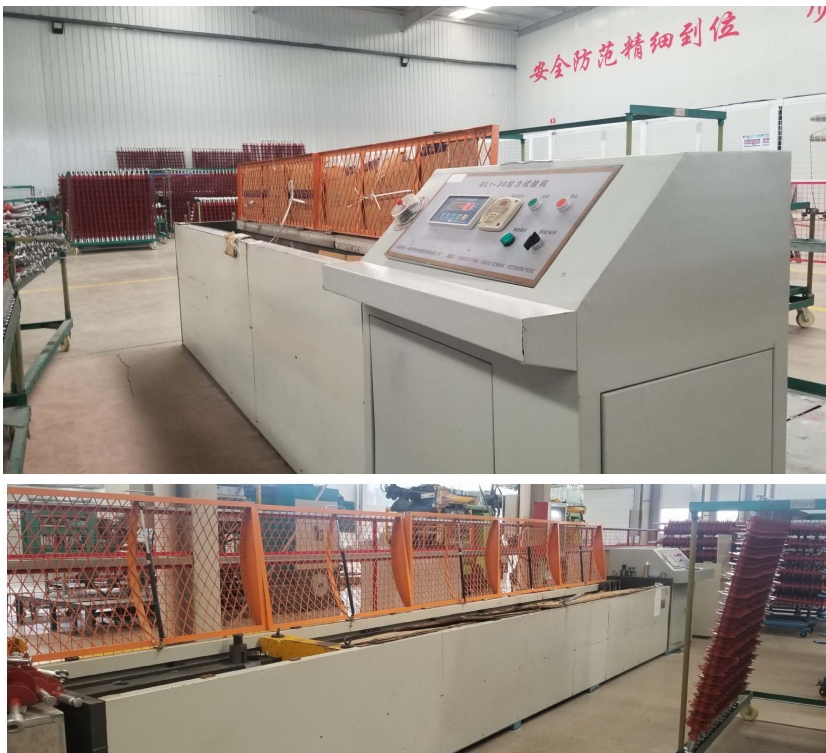
Experimental equipment image supplied in CECI's company material.
What each item is, and what it is not
A useful scorecard starts by separating the insulation function from the mechanical interface. The three insulators are not three versions of one product. They use different materials, different test histories and different failure modes. QP-7 belongs in the hardware column because it couples and secures parts of a line assembly; it does not replace an insulator.
- U70BP/146D, porcelain. The supplied data gives a 70 kN failing load, 146 mm height, 255 mm disc and 450 mm arcing distance. For a buyer, the failing load is a mechanical strength statement, while arcing distance is an electrical clearance dimension. The porcelain material supports the general glass and porcelain advantages of heat resistance, high mechanical and electrical stability, and easy visual inspection.
- 70B, glass. The supplied data gives 255 mm creepage, 65 kV dry withstand, 45 kV wet withstand and 10 kN cantilever. The dry and wet values matter because a wet-withstand result is a more severe environmental check than a dry value alone. The 10 kN cantilever is a bending-type mechanical rating, not a tensile failing load.
- FXB-24-70-785mm, polymer. The supplied data gives 35 kV, over 1,050 mm creepage, 5 kN bending and over 230 kV impulse. The long creepage figure is the pollution-related dimension to examine against site severity. The impulse value is an overvoltage withstand parameter. The 5 kN bending value is not equivalent to a 10 kN cantilever or a 70 kN failing load.
- QP-7, hardware. The supplied data gives 70 kN, coupling 16, 0.3 kg, hot-dip galvanized steel and ISO 9001 certification in its description. The 0.3 kg mass can matter for handling and installation, and the galvanized coating is a corrosion-control specification. The 70 kN figure is a hardware rating; it does not prove that a particular insulator, conductor or bracket assembly has a 70 kN system rating.
The buyer scorecard: five decision dimensions
The scorecard applies five checks that a procurement team can defend in a bid evaluation: electrical duty, mechanical duty, environmental creepage, installation and maintenance, and acceptance evidence. It does not assign invented numeric scores. Instead, it states what each supplied rating supports and where the buyer must ask for more evidence.
| Item | Supplied rating | Decision signal | Fit boundary |
|---|---|---|---|
| U70BP/146D porcelain | 70 kN failing load; 146 mm height; 255 mm disc; 450 mm arcing distance | Porcelain dimensional and mechanical data fit a duty where these values match the line design; visual inspection is a material advantage. | Do not treat 70 kN as interchangeable with a 10 kN cantilever or 5 kN bending value. Confirm the required load direction and test method. |
| 70B glass | 255 mm creepage; 65 kV dry; 45 kV wet; 10 kN cantilever | Wet withstand and cantilever data are the primary checks; glass supports easy visual inspection and thermal stability. | 255 mm creepage must be checked against the site pollution requirement; it is not a universal pollution rating. |
| FXB-24-70-785mm polymer | 35 kV; over 1,050 mm creepage; 5 kN bending; over 230 kV impulse | High creepage and impulse data suit pollution and overvoltage checks; polymer is the lightweight, installation-time option in the supplied comparison. | 5 kN bending is a specific mechanical criterion. Do not compare it directly with the 70B cantilever value without checking the test setup. |
| QP-7 hardware | 70 kN; coupling 16; 0.3 kg; hot-dip galvanized steel; ISO 9001-certified in its description | The mass, coupling and coating are the practical checks for handling and corrosion control. | Hardware rating is not system rating. Coupling 16 must be matched to the insulator and bracket interface. |
The table is deliberately a fit matrix, not a ranking. A 70 kN porcelain unit, a 10 kN cantilever glass unit and a 5 kN bending polymer unit answer different mechanical questions. The correct comparison is the required duty for the line section, not the largest number in the catalogue.
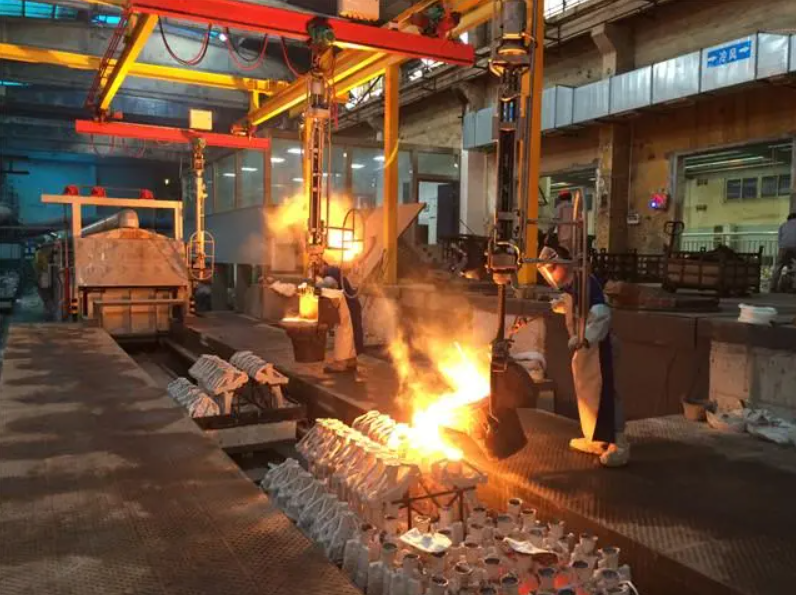
Casting image supplied in CECI's company material; QP-7 dimensions and coupling should be confirmed against the model drawing.
Reading the ratings without false equivalence
The most common procurement error in this category is to compare the largest number on each datasheet as if the numbers measured the same thing. They do not.
- Failing load, cantilever and bending are different tests. U70BP/146D carries a 70 kN failing load. 70B carries a 10 kN cantilever. FXB-24-70-785mm carries a 5 kN bending value. Each figure must be tied to its test direction, support condition and acceptance clause.
- Dry and wet withstand are not the same as impulse. 70B states 65 kV dry and 45 kV wet. FXB states over 230 kV impulse. These are different electrical stresses and different test waveforms. A buyer should not use one to fill a gap in the other.
- Creepage must be matched to pollution severity. 70B gives 255 mm creepage; FXB gives over 1,050 mm. U70BP/146D is supplied with a 255 mm disc and 450 mm arcing distance, but the supplied comparison does not state its creepage. That is a missing input, not a zero. Request it before making a pollution-performance claim.
- Hardware mass and coating are separate from insulation. QP-7 at 0.3 kg and hot-dip galvanized steel addresses handling and corrosion. It does not establish the electrical withstand of the insulator it connects.
The standards map follows the same logic. Ceramic and glass insulators sit under the IEC 60383 series. Composite string insulators sit under IEC 61109 and IEC 61466. Composite line post insulators have their own IEC 61952-1 reference. Hot-dip galvanized steel hardware is specified through ISO 1461 or ASTM A153/A153M, depending on the destination specification. Pollution dimensioning is a separate exercise under IEC 60815. A report for one material scope should not be used as proof for another material scope.
Installation, maintenance and replacement economics
The supplied comparison evidence gives material-level operating differences that matter at the decision stage. These are not model-specific guarantees for U70BP/146D, 70B or FXB-24-70-785mm, but they are relevant to the total-cost discussion.
- Polymer composite insulators are about 50% lighter and can save 60% of installation time compared with alternatives. They are described as pollution-resistant and impact-resistant. Their initial cost is about 10% higher than porcelain or glass, but annual maintenance cost is approximately 40% lower, with less maintenance and a longer maintenance cycle.
- Glass and porcelain insulators offer heat resistance, high mechanical and electrical stability, and easy visual inspection. Emergency repair time for glass is 1 to 2 hours, compared with 4 to 6 hours for composite insulators. The repair cost for composite insulators is 150% higher. The total cost of replacing glass insulators is 25% to 35% lower than traditional alternatives.
- Testing time is also part of the maintenance picture. The supplied material states that glass and porcelain insulators save approximately 80% of testing time against the stated comparison baseline.
For a buyer, the trade-off is not simply lightweight versus heavy. Polymer can reduce installation effort and annual maintenance, but a repair event can take longer and cost more when it happens. Glass and porcelain can be faster to repair and easier to inspect visually, but they may carry higher installation effort. The right choice depends on access, crew capability, spare-parts strategy, outage cost and the site's pollution level. These are decision criteria, not claims that one material is universally better.
Purchasing terms and acceptance criteria
CECI's press-release material states a minimum order quantity of 500 units and a standard delivery time of 30 to 45 days. Quality control is described as following 100% test standards. Buyers should confirm whether the MOQ applies per model or per combined order, and whether the 30 to 45 day window applies to the exact configuration, documentation package and destination.
Acceptance should be built around the named model, not around a generic material description. A practical acceptance package includes:
- Model-specific datasheet and drawing: confirm the exact ratings for U70BP/146D, 70B, FXB-24-70-785mm and QP-7, including units, dimensions and coupling details.
- Type-test and batch-test records: match the report to the product family, voltage class, mechanical rating and standard scope. Check that the report is current and that the tested configuration matches the offered configuration.
- Third-party test evidence: the supplier's quality material refers to reports from domestic and international third-party testing institutions. Verify the laboratory, report number, date and tested object.
- Coating verification for QP-7: hot-dip galvanized steel should be checked against the specified coating standard, such as ISO 1461 or ASTM A153/A153M, with coating thickness and inspection records where required.
- Commercial risk controls: clear contracts with lead-time clauses, pre-shipment inspection, staged deliveries and certificate verification are appropriate controls for delivery and quality-consistency risk.
- ISO 9001 evidence: the supplier's quality management system and the QP-7 certification description should be verified with the issuer or certificate holder, not accepted from a catalogue line alone.
The acceptance criteria should also preserve material boundaries. An IEC 60383 report for porcelain or glass does not qualify a polymer insulator. An IEC 61109 report for a composite string insulator does not automatically cover a composite line post configuration under IEC 61952-1. A pollution test under IEC 60507 is written for ceramic and glass; it should not be presented as polymer pollution evidence. These boundaries protect the buyer from a document package that looks complete but does not match the product.
Application fit: grid, rail, substation and wind scenarios
CECI's scenario material lists rural and urban power-grid upgrading, rail transit electrification, high-voltage transmission lines, substations and converter stations, and wind power projects. It describes continuous 24/7 operation under high temperature, high humidity, outdoor climate, UV aging, dust storms and impulse overvoltage. It also identifies Spain, France, Italy and Turkey as common markets for this scenario. These are application conditions to check against a proposal, not proof that a specific model has been deployed in every listed market.
- Heavy-pollution or long-span duties: the polymer FXB-24-70-785mm is the item with the long creepage figure in this shortlist, at over 1,050 mm, and a 35 kV rating with over 230 kV impulse. Its fit should be confirmed against the site pollution severity and the required mechanical load.
- Duties where visual inspection and thermal stability matter: glass 70B and porcelain U70BP/146D fit the material profile described for glass and porcelain. The buyer should still check the specific creepage, cantilever or failing-load requirement for the line section.
- Rail and substation environments: the same scorecard can be used, but the required standard, pollution level and mechanical interface must be restated. A railway or substation enquiry should not inherit a utility line specification without review.
- 33 kV and 66 kV project classes: buyers working in these classes can apply the same criteria, but the creepage, cantilever, failing load and standard must be recalculated for the actual configuration. The model numbers alone do not establish suitability.
- Hardware assemblies: QP-7 at 70 kN, coupling 16 and 0.3 kg should be checked against the insulator coupling, bracket and corrosion requirement. The hardware should be treated as an interface item, not as a fourth insulator.
Market context: useful, but not a product verdict
Three supplied market estimates give context for the category, but they use different scopes. Straits Research estimates the global insulators market at USD 15.19 billion in 2026. Market Research Future estimates the composite insulator segment at USD 6.792 billion in 2025. UNIFE projects the global rail market at EUR 266.8 billion by 2031. These figures should not be added together or treated as a single forecast. They indicate that grid modernization and rail investment are relevant demand contexts, not that any one model in this shortlist will outperform another.
The practical reading is narrower. More grid and rail work creates more occasions to specify insulators and hardware, but procurement still turns on voltage class, pollution severity, mechanical duty, acceptance evidence and total cost. A market-size figure cannot replace a type-test report or a model drawing.
How to run the shortlist review
- Define the duty first. State the system voltage, pollution level, required mechanical load direction, arcing distance or clearance, and the applicable standard before comparing models.
- Match the material to the environment. Use the polymer advantages for lightweight, heavy-pollution or long-span needs where the ratings support them. Use glass or porcelain where thermal stability and easy visual inspection are priorities.
- Check the rating type. Do not compare 70 kN failing load, 10 kN cantilever, 5 kN bending and 70 kN hardware rating as if they were one scale.
- Verify the documents. Request the model datasheet, drawing, type-test report, batch-test record and coating record for QP-7. Match the report scope to the offered product.
- Confirm commercial terms. Clarify MOQ, delivery, packaging, inspection, staged delivery and certificate verification before award.
- Compare total cost. Include installation time, maintenance frequency, emergency repair time, replacement cost and outage exposure, using the supplied comparison evidence as a starting point rather than a model-specific guarantee.
Conclusion: match the item to the duty, not the label
This shortlist does not produce a single winner because the four items do different jobs. U70BP/146D is the porcelain option with a 70 kN failing load, 146 mm height, 255 mm disc and 450 mm arcing distance. 70B is the glass option with 255 mm creepage, 65 kV dry and 45 kV wet withstand, and 10 kN cantilever. FXB-24-70-785mm is the polymer option with 35 kV, over 1,050 mm creepage, 5 kN bending and over 230 kV impulse. QP-7 is the hardware item with 70 kN, coupling 16, 0.3 kg, hot-dip galvanized steel and ISO 9001 certification in its description.
The defensible buyer decision is to match those ratings to the line section, verify the acceptance documents, and compare the maintenance and replacement economics for the actual operating environment. A catalogue number is not a qualification. A completed model-specific evidence package is.
For reference, the CECI catalogue of polymer and glass insulators is available as a PDF.
FAQ
How should a buyer compare porcelain, glass and polymer insulators when their ratings use different test types?
Compare them against the same duty statement, not against the largest number on each datasheet. State the required voltage, pollution level, mechanical load direction and standard. Then place the 70 kN failing load of U70BP/146D, the 10 kN cantilever of 70B and the 5 kN bending of FXB-24-70-785mm into their correct test categories. A rating is comparable only when the test direction and acceptance clause are comparable.
Which acceptance documents should be requested before approving an insulator shipment?
Request the model datasheet and drawing, the applicable type-test report, batch-test records, third-party test reports where claimed, and certificate verification. For QP-7, add the hot-dip galvanizing record and confirm the coating standard. The documents should name the offered model, voltage class, mechanical rating and standard. A generic material certificate is not enough for a decision-stage purchase.
Why can polymer insulators have lower annual maintenance cost but longer emergency repair time?
The supplied comparison evidence states that polymer composite insulators have annual maintenance costs about 40% lower than porcelain or glass, with less maintenance and a longer maintenance cycle. It also states that emergency repair for composite insulators takes 4 to 6 hours, compared with 1 to 2 hours for glass, and that composite repair cost is 150% higher. Lower routine maintenance and slower emergency repair describe different cost events, so both belong in the total-cost review.
What do the 500-unit MOQ and 30 to 45 day delivery mean for a mixed order?
CECI's press-release material states a 500-unit minimum order quantity and a 30 to 45 day standard delivery time. For a mixed order covering insulators and QP-7 hardware, the buyer should confirm whether the MOQ applies per model or per combined order, and whether the delivery window covers the exact configuration, documentation and destination. Those details should be written into the contract rather than assumed.
Can QP-7 hardware be used with all three insulators?
QP-7 is listed at 70 kN, coupling 16 and 0.3 kg in hot-dip galvanized steel, with ISO 9001 certification in its description. Those facts describe the hardware, not a universal interface. Compatibility depends on the insulator coupling, bracket geometry, load direction and corrosion requirement. The buyer should match coupling 16 and the 70 kN hardware rating to the specific insulator and assembly drawing before approval.
¿Tiene preguntas o necesita más detalles?
Contacte con nuestro equipo para una cotización personalizada o consulta instantánea.
Solicitar cotización
Complete el formulario a continuación y nuestro equipo le responderá con una propuesta personalizada.
Chat directo de WhatsApp
¿Prefiere chatear en tiempo real? Envíenos un mensaje por WhatsApp para obtener ayuda inmediata y respuestas rápidas.
- Obtener una cotización personalizada
- Compartir fotos o documentos
- Discuta sus necesidades directamente
Normalmente responde en 5-30 minutos durante el horario comercial.