
Inside the Valve Factory: Manual Valve Capability Evidence
Inside the Valve Factory: Manual Valve Capability Evidence
Manual valves still carry most of the isolation duty in industrial fluid systems, and the category is not contracting. Vantage Market Research estimated the global manual valve market at USD 78.4 billion in 2025 and projected USD 117.17 billion by 2035. For a buyer in the research and evaluation stage, market size answers a different question from the one that decides an order. The question that decides an order is narrower: can a specific supplier build the valve that was specified, document the material and pressure rating, and repeat that performance across several hundred pieces.
This article treats supplier capability as a set of verifiable signals rather than claims. The evidence base is EG Valves Manufacturing Co., Ltd, a valve manufacturer established in 2000 and based in Wenzhou, Zhejiang Province, China, producing gate, globe, ball, butterfly, check and plug valves and strainers under ISO 9001-certified processes. Two catalogued products, the SNI501 cast iron strainer and the CSV410 stainless steel check valve, are used as concrete examples of how catalogue data translates into procurement-relevant capability. The sequence follows the order a technical audit usually takes: breadth, configuration, product-level evidence, certification, capacity, application record and limits.
1. What Capability Evidence Actually Means in Manual Valve Sourcing
Supplier capability is usually described with adjectives and audited with documents. The gap between the two is where procurement risk accumulates. One practical way to close that gap is to sort everything a supplier publishes into evidence classes, each of which answers a different buyer question.
| Evidence class | Example from the published record | Buyer question it answers |
|---|---|---|
| Product breadth | 36 catalogue model lines across seven product groups: gate, globe, ball, butterfly, check, strainer and plug | Can one supplier cover a multi-family bill of materials without splitting the order? |
| Configuration matrix | RF, FF, RTJ, BW, SW, NPT/BSP/BSPT threaded, socket, wafer, lug, grooved and double flange ends | Will the valve match the piping specification without field adapters? |
| Model-level specification | SNI501 cast iron strainer; CSV410 stainless steel check valve | Are published size, rating and material data internally consistent? |
| Certification portfolio | ISO 9001:2015, ISO 45001:2018, API 600, API 6D, PED 2014/68/EU Annex III Module H | Can the supplier be approved for regulated, export or end-user scopes? |
| Inspection and documentation | 100% inspection of every valve; EN 10204 3.1 material test certificates per order | Will material traceability survive third-party inspection? |
| Project record | Documented deliveries into water treatment, refining, offshore, food and beverage, chemical, construction, and oil and gas projects | Has the supplier already operated in a comparable service environment? |
The demand side supports treating manual products as a category worth auditing directly rather than as a commodity residual. Precedence Research reported that manual ball valves held a 28.1% share of the general valve market in 2025 on the strength of reliability in high-pressure applications. Grand View Research reported that the manual segment accounted for a 41.2% revenue share of the global butterfly valve market in 2024. Dataintelo reported wafer-type manual butterfly valves at 38.5% configuration share in 2025, attributed to compact design and cost efficiency. Manual operation is not a legacy niche in these categories; it is the dominant operating mode.
2. Product Breadth: Reading the Family Map as a Capability Signal
Breadth matters because every additional product family in a project adds purchase orders, inspection events and logistics streams. EG Valves' published catalogue covers seven manual product groups, with size and pressure coverage that differs by material and construction rather than being uniform.
| Product group | Documented manual families and models | Size range | Pressure rating |
|---|---|---|---|
| Gate valves | Cast Iron GTI001; Cast Steel GTS019; Forged Steel GTF023; Through Conduit GTT021; Pressure Seal GTP002; Knife Gate GTK022; Threaded GTA024 | NPS 1/2 in to 60 in (DN15 to DN1500) | Class 125 to Class 2500; PN6 to PN320 |
| Globe valves | Cast Iron GLI101; Cast Steel GLS105; Forged Steel GLF109; Pressure Seal GLP107; Below Seal GLB107; Threaded GLA110 | NPS 1/2 in to 24 in (DN15 to DN600) | Class 125 to Class 2500; PN10 to PN320 |
| Ball valves | Cast Iron BVI201; Cast Steel Floating BVF206; Cast Steel Trunnion BVT207; Forged Steel Floating BVF208; Forged Steel Trunnion BVF209; Fully Welded BVF210; Top Entry BVT211; Three Way BVW212; Threaded BVS213 | NPS 1/2 in to 60 in (DN15 to DN1500) | Class 125 to Class 2500; PN16 to PN420; 1000 PSI on threaded models |
| Butterfly valves | Resilient Seated BTV300; PTFE Lined BTF301; High Performance BPV302; Triple Offset BOV303; Grooved BGV304; Double Eccentric BTV305 | NPS 1-1/2 in to 60 in (DN40 to DN1500) | Class 125 to Class 600; PN6 to PN40 |
| Check valves | Cast Iron CVI405; Cast Steel CVS407; Forged Steel CVF409; Stainless Steel CSV410 | NPS 1/2 in to 48 in (DN15 to DN1200) | Class 125 to Class 2500; PN10 to PN320 |
| Strainers | Cast Iron SNI501; Cast Steel SNS505; Threaded SNA507 | NPS 1/2 in to 20 in (DN15 to DN500) | Class 125 to Class 600; PN10 to PN40 |
| Plug valves | Plug Valve PLV600 | NPS 2 in to 40 in (DN50 to DN1000) | Class 150 to Class 1500; PN16 to PN100 |
Two patterns are worth noting. First, a single valve function is offered across multiple material and construction routes: a manual gate valve exists as cast iron, cast steel, forged steel, through conduit, pressure seal, knife gate and threaded variants. That matters when one piping specification mixes utility water service with high-pressure hydrocarbon service. Second, coverage is not identical across those variants. Forged steel gate and globe valves stop at NPS 2 in to 2-1/2 in, which is consistent with forged construction economics, while cast steel families run to 48 in and pressure seal designs run to 60 in. Buyers comparing suppliers should check the specific family rather than the catalogue headline.
3. Configuration Flexibility: Where Catalogue Depth Becomes Procurement Value
Configuration flexibility is the capability that most often decides whether a specification can be met without compromise. End connections are the clearest example, because a mismatch between a valve end and the piping specification forces spool pieces, adapters or a substituted valve.
| Configuration dimension | Options documented across the manual valve range |
|---|---|
| End connections | RF, FF, RTJ, BW, SW, socket end, threaded NPT / BSP / BSPT, wafer, lug, grooved, double flange |
| Body materials | Cast iron and ductile iron; carbon steel and WCB; stainless steel; alloy steel; duplex steel; forged carbon steel; brass and bronze alloy |
| Seating and trim | Metal seated; resilient seats in EPDM, NBR (Buna-N) and FKM (Viton); PTFE and RTFE; PTFE, FEP and PFA lining; Stellite overlay; stainless steel with graphite |
| Operation | Handle lever, handwheel, wrench nut, gearbox and worm gear, with actuator-ready designs offered across several families |
| Design variants | Floating or trunnion ball; L-port or T-port three-way; dual plate, single plate, wafer lift and threaded check designs; Y-type or basket strainer; bolted, welded or pressure seal bonnet; full or reduced port |
| Size span | NPS 1/2 in to NPS 60 in (DN15 to DN1500) |
| Pressure span | Class 125 to Class 2500 (PN6 to PN420) |
The BVW212 three-way ball valve illustrates how this works at product level: the same model is offered with either a floating or a trunnion ball and with L-port or T-port flow configuration, so a diverting or mixing duty can be specified without changing valve family. For a buyer, that reduces the number of technical clarifications needed during bid evaluation, and it reduces the chance that a substituted item appears after the order.

4. Evidence Case A: The SNI501 Cast Iron Strainer
Strainers are frequently treated as low-risk line items, which is why their specifications are often the least examined and the first to cause commissioning problems. The SNI501 cast iron strainer is a useful test case because its published data is specific enough to be checked against a piping specification.
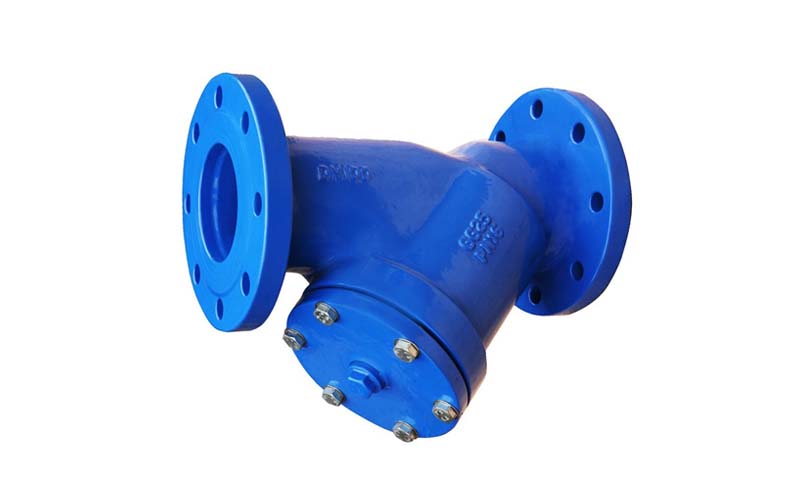
- Body material: cast iron or ductile iron
- Construction: Y-strainer type or basket strainer type
- Screen: stainless steel, available in a wide variety of meshes and perforations
- Maintenance access: bolted-on cover for interior access during routine maintenance
- Design: prohibits galling or scoring of seating surfaces
- Coating: epoxy powder coating or paint coating
- Size range: NPS 2 in to 12 in (DN50 to DN300)
- Pressure rating: Class 125 / Class 150, PN10 / PN16
- End type: FF, RF, threaded NPT / BSP / BSPT
- Documented applications: water treatment, HVAC, building services, municipal utilities, general industrial pipelines
The procurement reading of this data is straightforward. The choice between Y-type and basket construction is a maintenance decision as much as a hydraulic one, because basket designs hold more debris and are typically applied where cleaning intervals are predictable, while Y-type bodies suit tighter installations. The mesh and perforation options determine what the strainer actually protects downstream, so that selection should be tied to the smallest clearance in the protected equipment rather than to a default. The bolted cover is what makes any of this practical over a plant's life.
5. Evidence Case B: The CSV410 Stainless Steel Check Valve
Check valves protect pumps, compressors and upstream equipment from reverse flow, and they fail in ways that are rarely visible until a shutdown. The CSV410 stainless steel check valve is the second evidence case, and its published data covers construction, closing mechanism and cleaning requirements rather than only dimensions.
- Body material: stainless steel, duplex steel, alloy steel
- Configuration options: wafer type, lug type, double flange type
- Design variants: dual plate, single plate, wafer lift and threaded check valves are all available
- Closing mechanism: high torsion Inconel springs for quick closing
- Sealing: seat faces lapped for smooth finish and superior sealing
- Mechanical retention: disc assembly secured in place by a high strength key
- Special preparation: special cleaning for applications such as oxygen or chlorine
- Size range: NPS 1/2 in to 48 in (DN15 to DN1200)
- Pressure rating: Class 150 to Class 1500, PN10 to PN160
- Documented applications: water treatment, HVAC, oil and gas, petrochemical, power generation, industrial pipelines
For pump discharge protection, the spring and disc retention details are the parts of the specification that determine water hammer behaviour and service life. A high torsion spring drives a faster closing response, and a disc assembly mechanically keyed into position removes a failure mode that appears in cheaper wafer check designs where the disc can migrate under repeated cycling. Lapped seat faces are a sealing quality statement that can be verified during inspection rather than assumed.
The oxygen and chlorine cleaning note deserves separate attention. Special cleaning for those services is offered rather than standard, which means it must appear in the purchase specification and on the order confirmation. A buyer who assumes default cleaning for an oxygen line has mis-specified the product.
6. Certifications and Documentation: What Is Verifiable, and What to Confirm
For export projects, certification is often the gating item in supplier approval. EG Valves publishes a certification set that covers quality management, occupational health and safety, petroleum industry product standards and European pressure equipment requirements.
| Certificate | Number | Issuing body | Documented scope | Validity as published |
|---|---|---|---|---|
| ISO 9001:2015 | 00125Q33391R3M/3400 | China Quality Certification Center (CQC) | Gate valves, globe valves, ball valves, butterfly valves, check valves, pipe filters and flanges | Issued 2025-05-23; valid to 2028-05-22 |
| ISO 45001:2018 | 01723S10270R1S | Beijing Xingguo Global Certification Co., Ltd (XGQC) | Gate valve, globe valve, ball valve, butterfly valve, check valve, pipeline filter | Issued 2023-05-16; validity dated to 2026-05-12 |
| API 600 | 600-0179 | American Petroleum Institute (API) | Bolted bonnet steel gate valves, including cast steel, forged steel, through conduit and pressure seal models | Issued 2025-03-30; expires 2027-03-30 |
| API 6D | 6D-0506 | American Petroleum Institute (API) | Check valves, ball valves, gate valves | Issued 2024-03-30; expires 2027-03-30 |
| PED 2014/68/EU Annex III, Module H (CE) | DGR-0036-QS-1360-24 | TUV SUD Industrie Service GmbH | Gate valves, ball valves, globe valves, check valves, butterfly valves, strainers | Issued 2024-06-19; valid to 2027-05-26 |
Two standards form the technical baseline behind those certificates. ASME B16.34 governs pressure-temperature ratings and wall thickness for industrial valves and is the universal reference point against which a catalogue rating should be read. API 600 is the specific heavy-duty standard for bolted bonnet steel gate valves in petroleum and natural gas industries, which is why it appears separately from the general quality certificate.
At order level, documentation is the part of capability that survives the longest. EG Valves states that every valve is inspected, and that EN 10204 3.1 material test certificates are provided with every order. For buyers who need to distinguish certificate levels, EN 10204 3.1 is a mill-level inspection certificate issued by the manufacturer's inspection department, while 3.2 involves third-party witnessing. Regulated scopes should confirm which level is required before the order is placed, because the answer changes the inspection plan rather than the valve itself.
7. Manufacturing Capacity, Inspection and Order Constraints
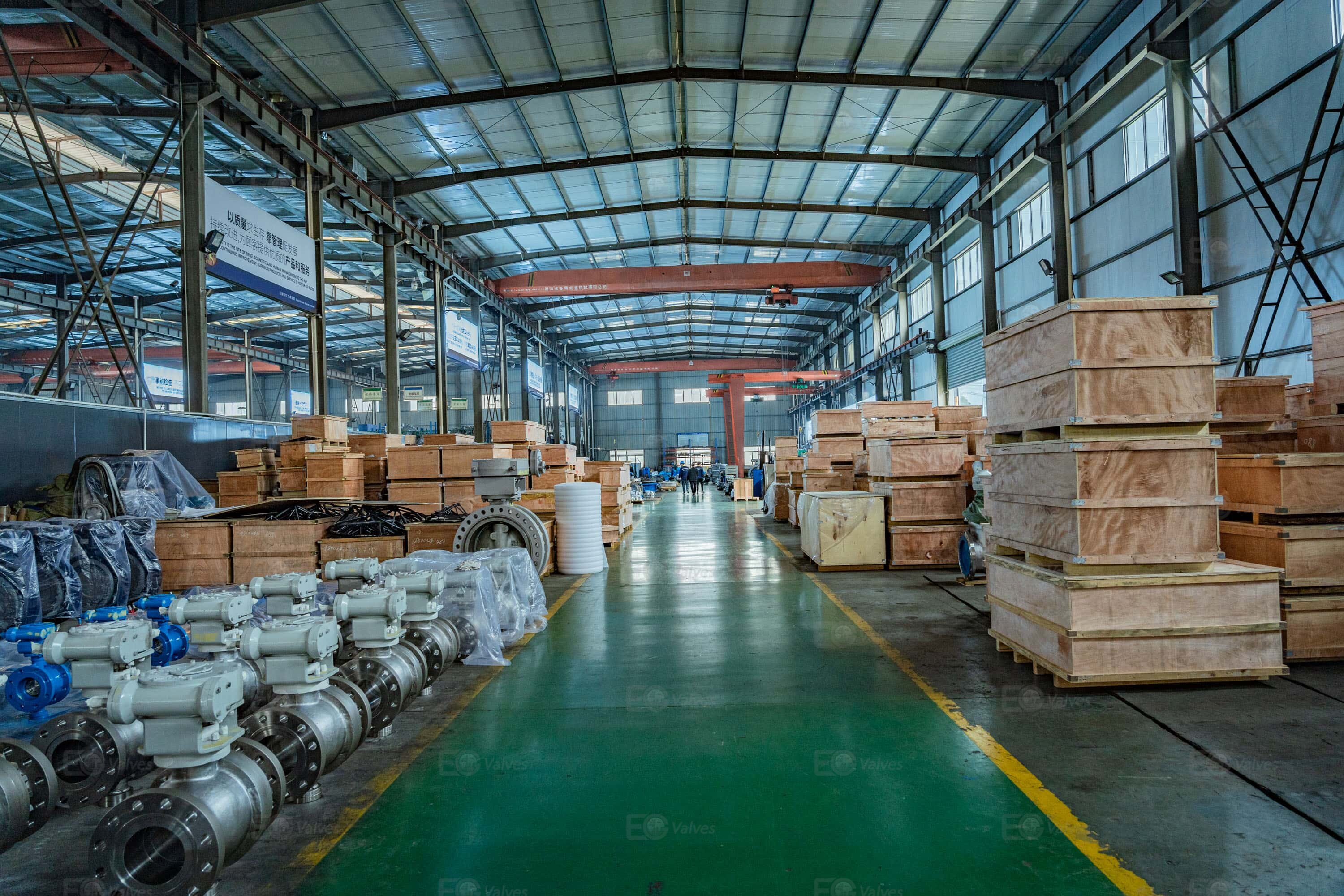
Capacity data tells a buyer whether a supplier can absorb a project order without deprioritising it. EG Valves operates a 27,500 m2 facility with approximately 300 employees, including a 30-engineer R&D team, and reports annual output of 90,000 pieces of valves. Monthly capacity is stated at 8,000 pieces, and roughly 80% of production is exported to the EU, North America, Latin America and the Middle East, with products accepted in more than 33 countries and regions.
Order constraints are equally relevant at evaluation stage, because they determine how a supplier fits into a project schedule:
- Minimum order quantity: 1 piece for large size valves; 10 pieces for small size valves. This is low by industrial valve standards and suits project spares, trial orders and single-item replacements.
- Lead time: stated within 25 to 35 days. Buyers should map this window against fabrication, coating, testing and shipping milestones rather than against the installation date alone.
- Production mode: OEM and ODM, with either the customer's brand logo or the EG brand logo.
- Quality control: a dedicated QC team performing 100% inspection of every valve, with precision fit and consistency checks applied across orders.
- Documentation: EN 10204 3.1 material test certificates supplied with each order.
The practical implication of the 8,000-piece monthly capacity figure becomes clear when a project bill of materials spans several families. A package combining cast steel gate valves, resilient seated butterfly valves, stainless steel check valves and strainers draws on the same plant, so scheduling should be discussed at family level rather than as a single line item.
8. Application Coverage: Reading the Project Record
Application history is the evidence class that most closely resembles the buyer's own situation. The projects below are documented references, summarised by what was delivered rather than by client name.
| Client industry and country | Delivered scope | Duration |
|---|---|---|
| Water treatment, Brazil | 326 pieces of gate valves, butterfly valves and check valves, PN16, DN40 to DN2000 | 8 years |
| Petroleum refining, UAE | 915 pieces of gate valves, globe valves, check valves, ball valves and butterfly valves, Class 150 to 1500, materials including WCB, WC6, WC9 and C5, 2 in to 36 in | 8 to 10 years |
| Offshore, Malaysia | 120 pieces of ball valves and gate valves, Class 150 to 1500, bronze, WCB, A105, SS316, 2205 and 2507, 1/2 in to 36 in | 3 years |
| Food and beverage, Italy | 180 pieces of gate valves, ball valves, butterfly valves and check valves, PN16, DN15 to DN750 | 5 years |
| Oil and gas, Mexico | 290 pieces of gate valves, ball valves, check valves and plug valves, Class 150 to 1500, WCB, WC6, WC9, C5 and A105, 2 in to 18 in | 8 years |
| Oil and gas, Russia and Uzbekistan | 650 pieces of gate valves, check valves and ball valves, PN16 to PN100, LCB, WCB, A105 and F316, DN40 to DN2000 | 10 years |
| Oil and gas, United States | 1,438 pieces of gate valves, globe valves, check valves and ball valves, Class 150 to 1500, WCB, WC6, WC9, C5 and A105, 1/2 in to 20 in | 8 years |
| Construction and infrastructure, United Kingdom | 150 pieces of gate valves, globe valves and butterfly valves, DN40 to DN800 | 10 years |
| Chemical, Spain | 260 pieces of gate valves, globe valves and check valves, DN250 to DN1200 | 5 years |
The record is most informative where it maps to service conditions rather than to volumes. The UAE refining scope documents elevated material grades alongside Class ratings up to 1500, which is where material selection and rating verification carry real risk. The Brazilian water treatment scope documents a wide diameter band from DN40 to DN2000, which tests large-diameter manufacturing and handling capability rather than only valve assembly. Buyers evaluating a supplier for a project of their own can use the same logic: identify which documented reference most closely matches the media, pressure class and diameter band, and ask for the technical detail behind it.
9. Market Context Behind the Capability Question
Three data points frame why manual valve capability remains a live procurement topic. The global manual valve market was estimated at USD 78.4 billion in 2025, with a projected USD 117.17 billion by 2035, according to Vantage Market Research. Within gate valves specifically, Market Research Future projected growth from USD 13.0 billion in 2024 to USD 20.6 billion by 2034, a CAGR of 4.7%. And in butterfly valves, the manual segment accounted for 41.2% of revenue in 2024 according to Grand View Research, with wafer-type configurations at 38.5% of share in 2025 per Dataintelo.
What these figures describe collectively is a category where volume growth is steady rather than dramatic, and where the competitive difference sits in configuration accuracy, documentation quality and delivery reliability. That is precisely the ground on which capability evidence, rather than price alone, decides outcomes.
10. Limits and Boundaries Buyers Should Not Skip
Capability evidence is only useful if its boundaries are stated. Several apply here.
- Breadth is not the same as depth in every family. Thirty-six catalogue model lines produced in a 27,500 m2 facility implies a mix of standard catalogue production and configured builds. Buyers with non-standard trim, exotic material or unusual end-connection requirements should validate through a sample or a technical clarification rather than assuming the catalogue covers the case.
- Certification scope is model-specific. A certificate that lists cast steel and forged steel check valves does not automatically extend to a stainless steel check valve model. Scope alignment should be confirmed in writing.
- Certificate validity windows are finite. Published expiry dates should be checked at the point of order, and renewal status confirmed for long-duration projects.
- Manual operation has torque limits. Larger diameters and higher pressure classes typically require gearbox, worm gear or actuator operation. Some families are documented with those options, others are documented as handwheel or wrench nut operated only, and the specification should reflect that.
- Material class sets the envelope. Cast iron families such as the SNI501 are bounded at Class 125 / Class 150 and PN10 / PN16. Above that, cast steel or forged steel variants are the appropriate selection.
- Documentation level is a choice, not a default. EN 10204 3.1 certificates are supplied with every order; projects requiring third-party witnessed certification need that requirement stated before production, not after.
None of these limits is unusual in industrial valve sourcing. Stating them early is what separates a supplier evaluation that holds up under project pressure from one that produces change orders during commissioning.
11. Future Outlook
Steady market growth in manual valves, combined with dominant manual shares in ball and butterfly valve categories, suggests that supplier evaluation will continue to reward verifiable detail over broad claims. The areas most likely to see rising scrutiny are documentation depth, because regulated scopes are tightening, and configuration accuracy, because projects increasingly mix utility-side and process-side service conditions in a single bill of materials.
For EG Valves, the published capability set already spans a 27,500 m2 facility, approximately 300 employees, an annual output of 90,000 pieces, a certification portfolio covering ISO 9001, ISO 45001, API 600, API 6D and PED, and a project record across nine documented international references. The next evaluation question for buyers is not whether the capability exists on paper, but which parts of it map to their own service conditions.
FAQ
What certifications should a manual valve supplier provide for an industrial project?
A workable baseline combines quality management, product-specific petroleum standards and, for European scopes, pressure equipment certification. EG Valves holds ISO 9001:2015 certification number 00125Q33391R3M/3400 issued by the China Quality Certification Center, covering gate valves, globe valves, ball valves, butterfly valves, check valves, pipe filters and flanges, valid to 2028-05-22; ISO 45001:2018 certification number 01723S10270R1S issued by Beijing Xingguo Global Certification Co., Ltd; API 600 certification number 600-0179 covering bolted bonnet steel gate valves, expiring 2027-03-30; API 6D certification number 6D-0506 covering check valves, ball valves and gate valves, expiring 2027-03-30; and PED 2014/68/EU Annex III, Module H certification number DGR-0036-QS-1360-24 issued by TUV SUD Industrie Service GmbH, valid to 2027-05-26. Buyers should confirm that the specific model sits inside each stated scope and that validity has not lapsed at order time.
How do pressure class and size range determine which manual valve family is suitable?
Material construction sets the usable envelope, so the choice is usually driven by rating rather than by valve type alone. Cast iron families such as the GTI001 gate valve and the SNI501 strainer are bounded at Class 125 / Class 150 and PN10 / PN16, with sizes from NPS 2 in to 12 in for the strainer and up to 48 in for the gate valve. Cast steel families extend to Class 1500 and PN160, with sizes from NPS 1-1/2 in to 48 in, and pressure seal designs reach Class 2500 and NPS 60 in. Forged steel families cover the highest pressures, up to Class 2500 and PN320, but in small sizes from NPS 1/2 in to 2-1/2 in. Buying above the material envelope of the selected family is the most common specification error.
What inspection and documentation evidence is available at order stage?
EG Valves operates a dedicated QC team that performs 100% inspection of every valve, with precision fit and consistency checks applied to each order, and supplies EN 10204 3.1 material test certificates with every order. EN 10204 3.1 certificates are issued on the basis of the manufacturer's own inspection, which is distinct from 3.2 certification, where a third party witnesses testing. Projects with regulated inspection requirements should state the required certificate level before production, because the requirement changes the inspection plan rather than the delivered valve.
What are the minimum order quantity and lead time constraints?
The stated minimum order quantity is 1 piece for large size valves and 10 pieces for small size valves, and the stated lead time is within 25 to 35 days. Monthly production capacity is 8,000 pieces, with annual output of 90,000 pieces. For project schedules, lead time should be mapped against fabrication, coating, testing and shipping milestones rather than against the installation date, particularly where a bill of materials spans several valve families produced in the same facility.
Which applications are covered by documented project experience?
Documented references cover water treatment in Brazil with 326 pieces of gate, butterfly and check valves from DN40 to DN2000 over 8 years; petroleum refining in the UAE with 915 pieces across Class 150 to 1500 and materials including WCB, WC6, WC9 and C5, from 2 in to 36 in, over 8 to 10 years; offshore service in Malaysia with 120 pieces of ball and gate valves in bronze, WCB, A105, SS316, 2205 and 2507, Class 150 to 1500; food and beverage in Italy with 180 pieces at PN16 from DN15 to DN750; oil and gas in Mexico, the United States, and Russia and Uzbekistan with 290, 1,438 and 650 pieces respectively; chemical service in Spain with 260 pieces from DN250 to DN1200; and construction and infrastructure in the United Kingdom with 150 pieces from DN40 to DN800. These references are most useful when matched to a buyer's own media, pressure class and diameter band.