
Inside the Shine Skin Pumpkin Seeds Production Line
Inside the Shine Skin Pumpkin Seeds Production Line
Shine Skin pumpkin seed kernels are the hulled, deep-green seeds that a large share of the world's pumpkin seed trade passes through before they become roasted snacks, bakery inclusions or pressed oil. The seed itself is well understood by most buyers. What is harder to verify is whether the factory behind a quotation can hold a stated impurity and moisture tolerance across repeat containers — and whether it can prove that it did.
Confirming that a manufacturer can handle Shine Skin Pumpkin Seeds kernels at scale comes down to three kinds of evidence: a written raw specification with measurable tolerances, a bagging capability that matches the destination market, and a traceability file that connects each delivered bag to a specific intake lot. Inner Mongolia Chengtai Food Co., Ltd., a seed processor founded in 2013 and located in Hanggin Rear Banner, Bayannur, Inner Mongolia, publishes a specification for these kernels that works as a practical example of what a buyer should ask to see before committing volume.

Colour sorting equipment on the kernel line — the stage where the difference between a stated impurity tolerance and a delivered one is actually decided.
Why Kernel Buyers Ask for Line Evidence Rather Than Samples Alone
A sample answers one question: can this supplier produce one good bag? Procurement risk sits in the second, fifth and twentieth container. For Shine Skin kernels, that risk is concentrated in a variety that dominates the market rather than one that is scarce. According to Everstar Foods industry reporting, Shine Skin accounted for 74% of China's 2024 pumpkin seed production, roughly 294,000 tonnes, against total Chinese production of 400,000 tonnes reported by Seedea for the same year. A variety with that market position does not present an availability problem; it presents a differentiation problem, because many sellers quote the same grade name at different levels of real control.
Two parameters carry most of that risk. An impurity specification below 0.5% determines how much material the buyer screens out at arrival, how much wear downstream sorting equipment absorbs, and how predictable the roasted or baked finished product will look. A moisture specification of 9–10% affects delivered weight, roasting behaviour, mould risk during ocean transit and usable shelf life. Both are measurable, which means both can be audited rather than assumed.
Compliance adds a third layer that sits behind the physical product. Regulation (EU) 2023/915 sets the maximum aflatoxin level for pumpkin seeds at 5.0 μg/kg for the sum of aflatoxins B1, B2, G1 and G2, which turns laboratory documentation into a market-access requirement rather than a quality preference. Pesticide residue regulation in the EU and the US has also constrained export volumes for Shine Skin and GWS types, according to Cardassilaris Family market reporting published in June 2025. Neither issue is visible in a hand sample.
What the Published Specification Commits the Factory To
Answer first: the Shine Skin Pumpkin Seeds kernels line from Inner Mongolia Chengtai Food Co., Ltd. is published as a raw product, 2026 crop year, green in colour (dark green at AAA grade), sweet and natural in taste, with moisture of 9–10%, impurity below 0.5%, erosion seeds below 0.5% and mildew seeds below 1%, intended for human consumption, originating from Xinjiang and Inner Mongolia, stored in a cool place, and packaged in 20/25 kg plastic or paper bags or in vacuum bags with cartons. The same specification applies across the A, AA and AAA grades.
| Parameter | Published value |
|---|---|
| Product | Shine Skin Pumpkin Seeds kernels |
| Grades offered | A, AA, AAA |
| Specification | Raw |
| Crop year | 2026 |
| Colour | Green (AAA: dark green) |
| Taste | Sweet and natural |
| Moisture | 9–10% |
| Impurity | Below 0.5% |
| Erosion seeds | Below 0.5% |
| Mildew seeds | Below 1% |
| Intended use | Human consumption |
| Origin | Xinjiang and Inner Mongolia |
| Storage | Cool place |
| Packaging | 20/25 kg plastic or paper bag; vacuum bag with carton |
Read as a contract rather than a brochure, each line becomes checkable. The moisture band of 9–10% is a two-point tolerance rather than a ceiling, which means the buyer and the supplier must agree whether the acceptable result is the middle of the band, the upper edge, or a single value verified per lot. The defect tolerances — impurity, erosion seeds and mildew seeds — are expressed as percentages, so they can only be enforced through a sampling method that both sides accept, because the result changes with sample size and technique.
Grade naming is where buyers most often lose precision. A, AA and AAA are supplier designations, not an international standard; in the published data the visible distinction is colour, with AAA described as dark green while the AA and A grades are described as green. Third-party grade references for AAA Shine Skin kernels describe minimum purity of 99.95% and maximum moisture of 8% (Agroland Food specifications). Where a supplier's published moisture is 9–10%, that difference is not automatically a defect, but it is a term to negotiate rather than overlook. A practical question to put in writing: will delivered lots be measured against 8% or 9–10%, using which method, and who bears the cost if the buyer's laboratory and the supplier's laboratory disagree?
Physical Evidence: What to Look At on the Line
The equipment documented for this application is a colour sorting machine, a quality inspection station, a packing machine, and warehouse storage including silos, operated in a cool, dry, low-humidity indoor environment at normal temperature. Those checkpoints are the natural places to convert a factory visit into evidence rather than impressions.
- Colour sorting. Ask the line to run the buyer's own lot or a retained lot and watch the reject stream, not the accept stream. A sorting machine that separates colour and defect also produces a reject percentage, and that figure should reconcile with the impurity and erosion-seed tolerances in the specification.
- Quality inspection. Request the sampling plan, the inspection record sheet in use, and a retained sample from a previous shipment. Inspection records that exist for every lot are more persuasive than a single certificate.
- Packing. Watch bag weight verification, seal quality and — where vacuum bags with cartons are specified — vacuum integrity after packing. This is where the lot code is applied and where traceability either starts or fails.
- Warehouse and silos. Check that storage matches the published cool, dry condition, that pallets are separated by lot, and that dispatch labelling is legible before loading.
- Feedstock intake. The company states access to a 1.5 million acre sunflower and pumpkin seed planting base. That claim is only useful to a buyer if intake records connect a delivered lot to a documented origin and date, so ask for the intake record rather than the acreage figure.
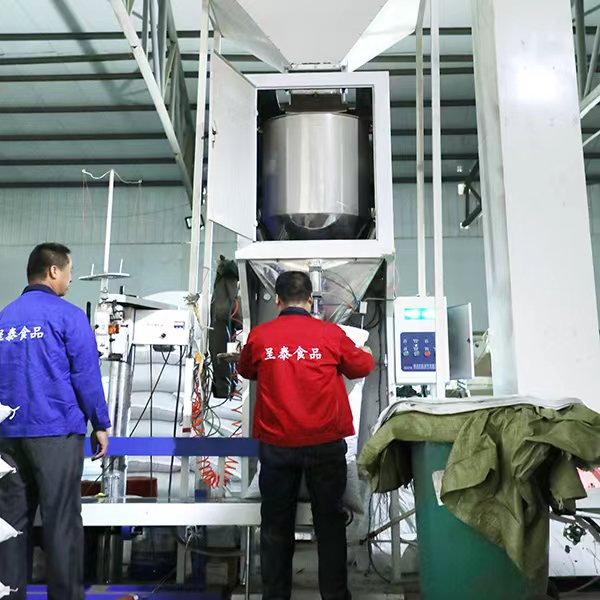
Bagging is where a bulk lot becomes a traceable shipment: bag type, net weight and printed lot code all attach to the batch at this point.
Documentary Evidence: The Traceability File From Intake to Final Bagging
A production line is only as verifiable as the paperwork that follows a lot through it. Buyers who ask for a six-document file — and who receive it as a folder rather than as emails sent one at a time — can reconstruct the path from raw intake to final bagged product.
| Document requested | What it establishes | Common weak point |
|---|---|---|
| Raw material intake record (lot ID, origin, date, weight) | That the delivered lot begins at a defined intake point | Lot IDs that are assigned only at packing, breaking the chain at the start |
| In-process inspection record at sorting and quality inspection | That a stated defect tolerance was checked during production | Records without parameter values or sampling size |
| Batch test report: moisture, impurity, erosion seeds, mildew seeds | That the published specification was measured, not assumed | One certificate reused across several shipments |
| Aflatoxin and pesticide residue results, where required | Fitness for the destination market | Results issued for a different lot or harvest period |
| Packing record linking bag type, net weight and lot code | That the bag on the pallet corresponds to the tested batch | Cartons or bags printed without a lot code |
| Storage and dispatch record | That storage matched the cool-place requirement before loading | Gaps between packing date and loading date |
The value of this file is not administrative. It is what allows a buyer to react to a problem at destination — a moisture reading above band, an elevated defect count — by identifying whether the cause was intake quality, sorting performance, packing exposure or transit. Suppliers that can answer that question retain accounts; suppliers that cannot usually replace a claim with a negotiation.
Testing Capacity Claims Against Scale
The production terms published for this line are a monthly capacity of 2,500 mt, a minimum order quantity of 5 mt and a lead time of 10–15 days, with a stated quality-control position of 100% testing. The monthly figure reconciles with the company's stated annual output of 30,000 mt, since 2,500 mt per month over twelve months produces the same number. That internal consistency is itself a useful check: capacity claims that do not reconcile across units are usually the first sign that a quotation is not built on a production plan.
The company profile lists roughly 20 employees and two engineers, with an export ratio of 80% of output and stated export markets covering the EU, the Middle East, Middle Asia, Vietnam and Africa. An operation of that size moving 30,000 mt a year is a sorting, testing and packing operation rather than a labour-intensive one, which is why equipment records, inspection discipline and packaging throughput are the right things to audit — headcount alone tells a buyer very little about whether a kernel line can hold a 0.5% impurity tolerance. Buyers placing orders across several grades at once should also ask how monthly capacity is allocated between concurrent orders, because a 10–15 day lead time is normally quoted for the line as a whole rather than for each grade separately. The stated after-sales position is that if seeds have any problem, a refund can be applied for; the practical step is to define in the contract what triggers that remedy, what evidence is required, and within what period a claim must be raised.
Where These Kernels Are Used, and What the Application Requires
The documented application for these kernels is snack manufacturing: raw material for snacks, baked goods and confectionery, processed in batches with manual and mechanical feeding, matched to sorting and packing equipment, with impurity control named as the special requirement and storage in a cool, dry, low-humidity indoor environment at normal temperature.
That description is a compact statement of what the downstream process actually demands. A roaster producing salted roasted pumpkin seeds needs uniform kernel size and colour so that roast profiles stay consistent between batches. A bakery or confectionery line needs low impurity and stable moisture so that inclusions do not bleed moisture into a finished product. An oil presser needs kernel purity, because foreign matter and immature seeds report directly into oil yield and filtration load — the same pressure that shows up in market forecasts for pumpkin seed oil.
The case record behind this application lists food processors, snack manufacturers, food wholesalers, importers and distributors as the customer types, covering 30,000 mt over a two-year relationship for wholesale and roasting use, with stable supply, consistent product quality and satisfied bulk order delivery reported as the outcome. Two years of repeat volume is a more meaningful verification signal than a single export shipment, because it implies that arrival inspections were passed repeatedly rather than once.
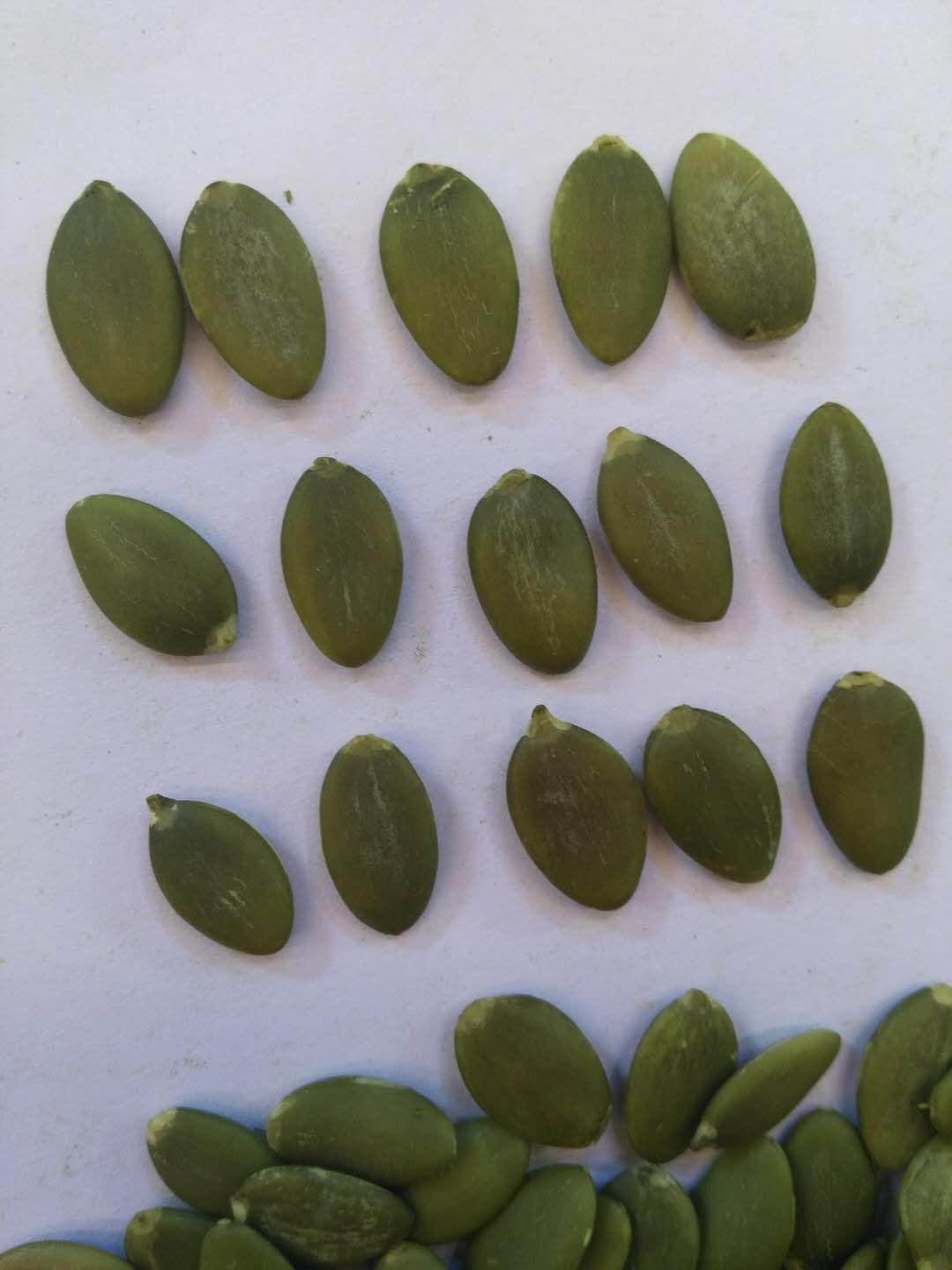
Green Shine Skin pumpkin seed kernels, grade AAA, as presented for visual and colour inspection before bagging.
Market Trends That Change What Buyers Should Verify
Several published signals shape how kernel sourcing is likely to be evaluated in the current cycle. China's total pumpkin seed production is projected at 400,000 tonnes in 2024, up from 280,000 tonnes in 2023 according to Seedea. Shine Skin remains the dominant variety at 74% of that production, per Everstar Foods, while Inner Mongolia alone recorded a pumpkin seed planting area of 28,700 hectares in 2024, according to Seedea agriculture statistics. Snow White and Lady Nail each accounted for about 12% of China's 2024 production in the same Everstar Foods dataset.
Demand is shifting at the same time. Lady Nail planting area expanded by 80% to approximately 500,000 acres in 2025, driven by demand in the Middle East, according to Cardassilaris Family market insights. Global market estimates vary by segment definition: Maximize Market Research values the pumpkin seed market at USD 1.08 billion in 2025, growing to USD 2.62 billion by 2032 at a CAGR of 13.4%, while Wikifarmer values the seed segment at €1.13 billion for the same year. Related demand from oil pressing is growing at a CAGR of 10.5%, reaching USD 2.06 billion by 2030 according to Grand View Research, which increases pressure for high-purity kernels.
The procurement implication is straightforward. When the dominant variety is also the one under the heaviest residue scrutiny, competition between suppliers moves from price per container towards documentation per lot. A supplier that can present one intake lot mapped to one bag code, with moisture and defect values measured per batch, is easier to qualify than a supplier offering the same grade name with a certificate that covers a season rather than a shipment.
How This Compares With Buying Through Traders — and Where the Limits Are
The traditional route for pumpkin seeds is the trading intermediary who aggregates lots from several cleaning operations and sells against a grade name. That route has genuine advantages: smaller minimum quantities, faster coverage of mixed requirements, and less specification work for the buyer. Its weakness is that the intermediary's quality claim usually sits between the buyer and the equipment that produced the lot, so a deviation at destination is resolved commercially rather than technically.
The factory-direct route replaces that claim with line records and per-lot testing. In exchange, the buyer takes on more specification work — which is the point of the evidence request described above, and also the reason buyers should plan around the following limits.
- Grade labels are supplier-internal. A, AA and AAA are not governed by an international standard. In the published data the visible distinction is colour, with AAA described as dark green; third-party references for AAA kernels also describe purity and moisture thresholds that are stricter than the 9–10% moisture published for this line. The label alone does not settle the specification.
- Moisture of 9–10% will not suit every process. Buyers who need a lower ceiling for long ocean transit or for oil pressing must state it as a contractual parameter, because the published band permits values at the upper end.
- Traceability is documented, not independently audited by default. Intake records can connect a lot to a stated origin; a buyer-commissioned farm-level audit is a separate exercise with its own cost and lead time.
- Capacity is finite and shared. A monthly capability of 2,500 mt is meaningful only alongside the order book; allocation across concurrent grades and customers should be agreed in writing rather than inferred.
- Packaging is a trade-off, not an upgrade. Vacuum bags with cartons raise cost and handling time relative to plain 20/25 kg plastic or paper bags, and the choice should be driven by transit duration, humidity exposure and whether the buyer repacks on arrival.
- Compliance is per lot. With the EU aflatoxin limit at 5.0 μg/kg under Regulation (EU) 2023/915 and residue rules constraining Shine Skin exports, documentation has to follow the specific shipment; a general certificate of compliance does not cover a container.
Future Outlook
Three movements are likely to define the next buying cycle for Shine Skin kernels. Kernel demand from oil and bakery applications is expanding, which raises the value of purity and pushes buyers towards suppliers that can hold defect tolerances rather than merely declare them. Middle East demand is pulling specific varieties — Lady Nail most visibly — which means capacity allocation across varieties will become a negotiation point rather than a formality. And tightening residue and aflatoxin rules push per-lot documentation from differentiator towards baseline.
For buyers at the research and evaluation stage, the practical response is to build the evidence request into the request for quotation itself: specification sheet with measurable tolerances, batch test results, packing and lot-coding records, and a defined remedy if a delivered value falls outside band. Factories that can answer that request with a folder rather than a promise will find qualification faster, and buyers will spend less time resolving problems that were never really about the seed.
FAQ
What specification should a buyer confirm before ordering Shine Skin pumpkin seed kernels?
The published specification for Shine Skin Pumpkin Seeds kernels from Inner Mongolia Chengtai Food Co., Ltd. is a raw product, 2026 crop year, green colour (dark green for AAA), sweet and natural taste, moisture 9–10%, impurity below 0.5%, erosion seeds below 0.5%, mildew seeds below 1%, for human consumption, origin Xinjiang and Inner Mongolia, stored in a cool place, and packaged in 20/25 kg plastic or paper bags or in vacuum bags with cartons. Each parameter should be confirmed in writing together with the test method and the party responsible for testing.
What grades are available, and what distinguishes grade A, AA and AAA?
The line is offered as grades A, AA and AAA. In the published data the visible difference is colour: the AA and A grades are described as green, while AAA is described as dark green. Third-party grade references for AAA Shine Skin kernels describe minimum purity of 99.95% and maximum moisture of 8%. Because grade definitions vary between suppliers, A/AA/AAA should be treated as supplier categories and translated into measurable contract parameters rather than relied on as labels.
How do moisture and impurity tolerances affect the purchase?
Moisture of 9–10% influences delivered weight, roasting behaviour, storage stability and mould risk during transit. Impurity below 0.5%, erosion seeds below 0.5% and mildew seeds below 1% influence yield per container and the load placed on the buyer's own sorting equipment. Where a process requires a lower moisture ceiling — a common requirement for oil pressing and long-transit shipments — that requirement should be written as a contractual limit rather than assumed from the grade. Deviations need a defined remedy and evidence procedure.
What packaging formats are standard for these kernels?
Standard packaging is 20/25 kg plastic or paper bags, with vacuum bags in cartons available as an alternative. Under the supplier's OEM/ODM arrangement, bags can be printed with the customer's logo. The choice has commercial consequences: vacuum packing in cartons adds cost and handling time but reduces exposure during long transit, while plain 20/25 kg bags suit buyers who repack in their own facility.
What are the minimum order quantity and lead time?
The stated production terms are a minimum order quantity of 5 mt and a lead time of 10–15 days, against a monthly capacity of 2,500 mt and a stated annual output of 30,000 mt. Buyers ordering several grades at the same time should confirm how capacity is allocated across concurrent orders, since lead time is usually quoted for the line as a whole rather than per grade.
Which documents should accompany a shipment for compliance and traceability?
At minimum, a batch test report covering moisture, impurity, erosion seeds and mildew seeds; plus aflatoxin and pesticide residue results where the destination market requires them, since Regulation (EU) 2023/915 sets the maximum aflatoxin level for pumpkin seeds at 5.0 μg/kg for the sum of B1, B2, G1 and G2. Packing records linking bag type, net weight and printed lot code to the tested batch, together with raw material intake and storage records, allow the shipment to be traced back to a defined intake lot.
For readers who want the full product and company overview, including grades, packaging and production terms, the current company profile is available for download: Inner Mongolia Chengtai Food Co., Ltd. company profile (PDF).