
Inside the Label: CE-Ready Specs on 2K and 4K Action Cams
HTNXT Industry Reference — Consumer Electronics
Inside the Label: CE-Ready Specs on 2K and 4K Action Cams
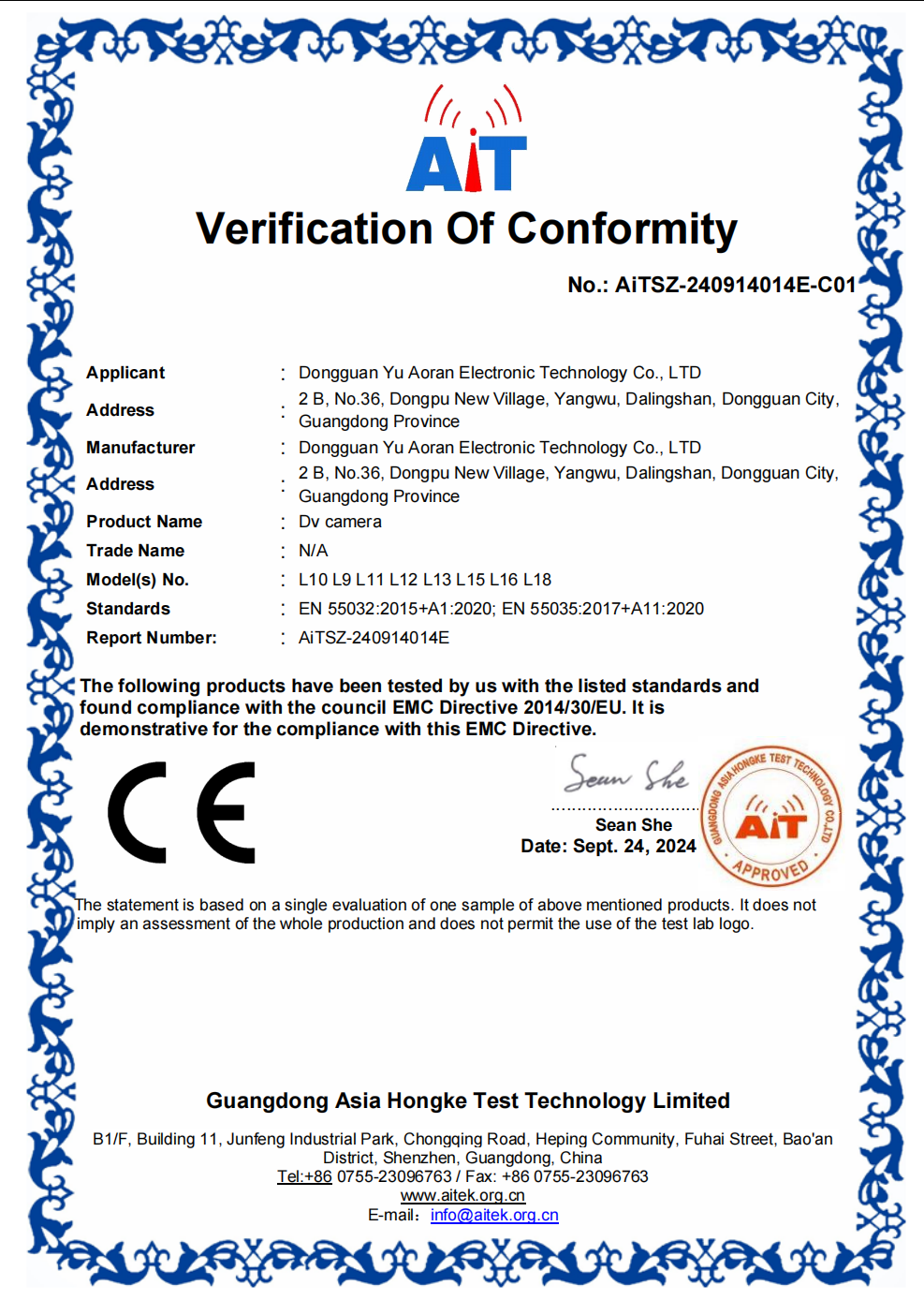
Cover: CE EMC compliance documentation for action camera electronics. A document image starts a verification process; it does not replace one.
Compliance readiness rarely appears as a headline specification. On a 2K or 4K action camera datasheet, the numbers that sell the product — resolution, field of view, recording time, stabilisation — are not the same numbers that decide whether a customs officer, a marketplace reviewer or a retail buyer will accept it in the European Union. The two sets overlap, but only partly, and that overlap is where a procurement decision becomes cheaper or more expensive.
What follows is a buyer's reading of published specifications, using the 2K and 4K action camera line-up from YUAOHENG (Dongguan YuAoHeng Electronic Technology Co., Ltd.), a Dongguan-based manufacturer of action cameras, dash cameras and smart video doorbells, as the working example. The scope is deliberately narrow: four specification areas that repeatedly correlate with compliance questions — battery voltage and cell format, enclosure material, infrared switching method, and the wireless function.
Why a Specification Sheet Cannot Certify Anything
An action camera specification sheet is a description of intent. It states what the product is designed to do; it does not state that a third-party laboratory tested that design against a standard. EU market rules work from the other direction: the economic operator placing the product on the market must be able to produce technical documentation and a declaration of conformity, and the manufacturer's claims are only as strong as the test evidence behind them.
The safety framework most often cited for this product class is IEC 62368-1, the international standard for audio/video, information and communication technology equipment, whose fourth edition was published in 2023. Action cameras are portable, battery-powered and frequently charged over USB-C, so battery construction, charging circuitry and thermal behaviour are natural review points. Wireless-enabled models add a second layer: radio equipment sold in the EU must demonstrate conformance to the applicable radio standard — in the documents reviewed for this line-up, ETSI EN 300 328 V2.2.2 appears for the 2.4 GHz Wi-Fi function.
None of that is visible on a product page. The useful move for a buyer is to treat the specification sheet as a screening tool: use it to decide which questions to ask, then require documents that answer them.
Four Specification Lines Worth Reading Carefully
Not every line on a datasheet carries compliance weight. These four do, because each one changes what must be tested, documented or declared before a product can be sold.
| Specification line | Why it attracts compliance review | Document that answers the question |
|---|---|---|
| Battery: nominal voltage, capacity and cell format (for example 3.8 V polymer or 18650) | Cell format and voltage shape which battery-safety and transport requirements apply, and how the charging path must be designed. | Battery specification sheet, cell datasheet, and the electrical safety report for the tested configuration. |
| Enclosure material (ABS is listed across this line-up) | Material declarations feed substance-restriction checks and, in some markets, flammability or recyclability requirements. | RoHS test report, read together with its model scope and analytical methods. |
| Infrared / night-vision switching method (hand regulation or one-button control) | Emitter control defines the product's operating states, which must match both the user manual and the test configuration. | Function description plus the configuration recorded in the test report. |
| Wireless function (Wi-Fi) | Any intentional radiator requires radio testing in the destination market. | Radio test report naming the standard version and the tested model scope. |
Battery Voltage and Cell Format: The 3.8 V Pattern
Across this line-up, the battery specification is consistent in a way that is easy to miss: nominal voltage is 3.8 V on most models. Q1, Q3 and Q5 each list a 2000 mAh / 3.8 V polymer battery; Q7 and X7 list 1000 mAh / 3.8 V; X20 lists 1000 mAh / 3.8 V with an input rating of MICRO-Type-C / DC 5 V 1 A–2 A. Two models step outside that pattern — Q2 and Q9 use an 18650-format cell rated 2000 mA — while Q11 and X11 list 104050 (2500 mA) and 974058 (3000 mA) packs respectively.
| Model | Published resolution | Published battery specification | Published working time |
|---|---|---|---|
| Q1 | Front 4K (3840×2160), rear 4K; simultaneous dual recording 2K+2K | 2000 mAh / 3.8 V polymer | Video approx. 4–5 h; recording approx. 9 h |
| Q2 | Front 4K, rear 4K; 6-level electronic image stabilisation; touch and physical buttons | 18650 — 2000 mA | Video approx. 4–5 h |
| Q3 | Front 4K, rear 4K; infrared night vision supported | 2000 mAh / 3.8 V polymer | Not published in the reviewed spec set |
| Q5 | 2K Wi-Fi; resolution published as AVI (3840×2160) | 2000 mAh / 3.8 V polymer | Video approx. 5–6 h |
| Q7 | 4K (3840×2160) 30 fps; anti-shake supported | 1000 mAh / 3.8 V polymer | Not published |
| Q9 | 2K (2560×1440); four white fill lights, manual adjustment | 18650 — 2000 mA | Not published |
| Q11 | 2K (2560×1440); built-in noise-reduction IC | 104050 — 2500 mA | Not published |
| X11 | 2K (2560×1440); one-button LED fill light | 974058 — 3000 mA | Not published |
| X7 | 4K 30 fps; anti-shake; GPS supported | 1000 mAh / 3.8 V polymer | Not published |
| X20 | 2K + Wi-Fi; resolution published as AVI (1920×1080) | 1000 mAh / 3.8 V polymer; DC 5 V 1–2 A input | Video approx. 6–7 h; recording approx. 9 h |
Why the voltage line matters commercially: it interacts with the charging design. A 3.8 V nominal pack charged from a 5 V USB-C source — as specified on X20 at DC 5 V 1–2 A — is an ordinary configuration in this class, but a safety report examines the combination of cell, protection circuit and charging path, not the voltage figure in isolation. A supplier who can hand over the cell datasheet alongside the pack specification is usually the one who can also explain the tested configuration.
ABS Housings, Substance Limits and RoHS
Every model in the reviewed line-up lists ABS as its enclosure material. ABS is a widely used engineering thermoplastic for consumer electronics: durable, mouldable and well suited to surface finishing. On a datasheet it answers exactly one question — what the shell is made of. It does not answer whether the material, its additives or the internal components meet substance-restriction requirements.
For the EU market, that is the RoHS track. RoHS test documentation reviewed for this line-up references the IEC 62321 series of analytical methods, including IEC 62321-3-1:2013, IEC 62321-4:2013+AMD1:2017, IEC 62321-5:2013, IEC 62321-6:2015, IEC 62321-7-1:2015, IEC 62321-7-2:2017 and IEC 62321-8:2017. Those method references tell a buyer which analytical route was taken; the report's model scope tells them which products the result actually covers.
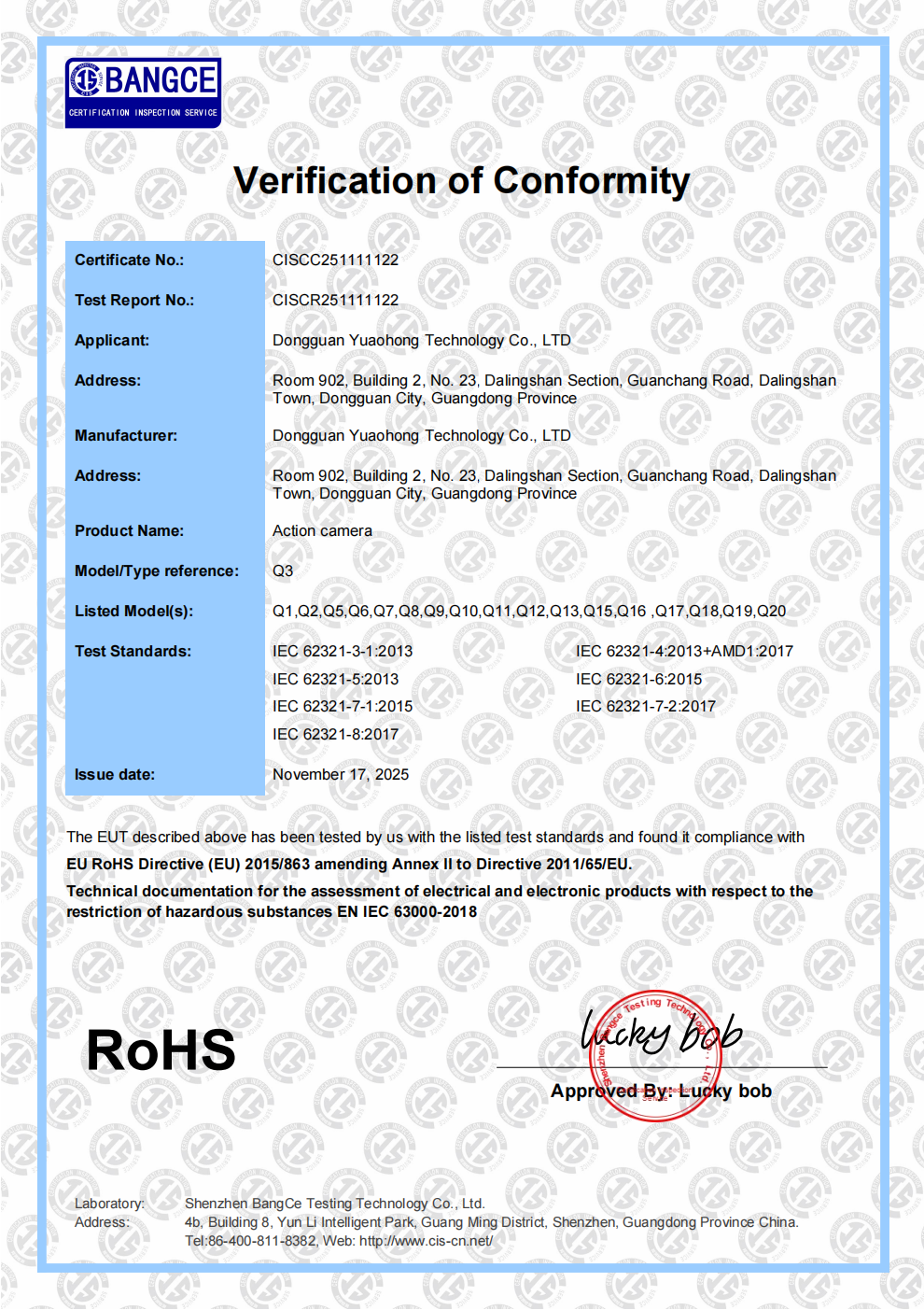
Body figure 1: RoHS test documentation referencing IEC 62321-series methods. The method list and the model scope are the two fields to read first.
Two practical observations follow. First, a material name and a test report are not interchangeable: a supplier can legitimately state ABS on a specification sheet without that statement being a compliance claim, and the reverse is also true — a RoHS report does not validate the housing design itself. Second, scope matters more than the headline. Reports in this category commonly list model families rather than a single SKU, so a buyer ordering a variant that is not named in the scope should ask whether the existing evaluation covers it or whether a separate report is required.
Manual Infrared Switching: A Control Method, Not a Certificate
Night-vision illumination is a small feature with a disproportionate role in documentation. In this line-up the switching method varies by model and is stated explicitly: Q3 supports infrared night vision with switching by hand regulation; Q5 uses four enhanced energy-saving infrared lights, also hand-regulated; Q9 carries four white fill lights with manual adjustment; Q11 and X11 use one-button control LED fill lights.
That detail belongs in a sourcing conversation because the switching method defines the product's operational states, and operational states define how a product is documented, tested and explained in a manual. A manually switched emitter can be held off during controlled measurements and switched on only where intended — a predictable configuration for a laboratory. One-button control folds the light into the recording workflow, which is friendlier for users but requires the manual and the test configuration to describe the same behaviour.
Buyers should also treat light output as a usability claim rather than a compliance claim. The question is not whether night vision is certified; it is whether documented behaviour matches the shipped product, and whether the manual explains switching, the expected impact on runtime, and any heat-related caution.
Wi-Fi, Radio Standards and the CE Path
Wireless capability is the specification line that most directly triggers formal market-entry testing, because an intentional radiator cannot be self-declared into a market without radio test evidence. In this line-up, Wi-Fi appears in the type designation of Q1, Q2, Q3, Q5, Q7, Q9, Q11, X11 and X20, and the wireless test scope documented for this range names Q3, Q1, Q2, Q5, Q6, Q7 and the wider Q-series alongside X7 and X11.
Standards that appear in this line-up's documentation
- ETSI EN 300 328 V2.2.2 — the harmonised standard referenced for the 2.4 GHz wideband transmission function in both the CE documentation and the separate RF test report for this range.
- IEC 62368-1:2023 — the safety framework that applies to audio/video and information technology equipment, including portable battery-powered cameras.
- IEC 62321 series — the analytical methods referenced in the RoHS test documentation.
- 47 CFR Part 15, Subpart C — the US radio-frequency framework referenced for models tested for the North American market.
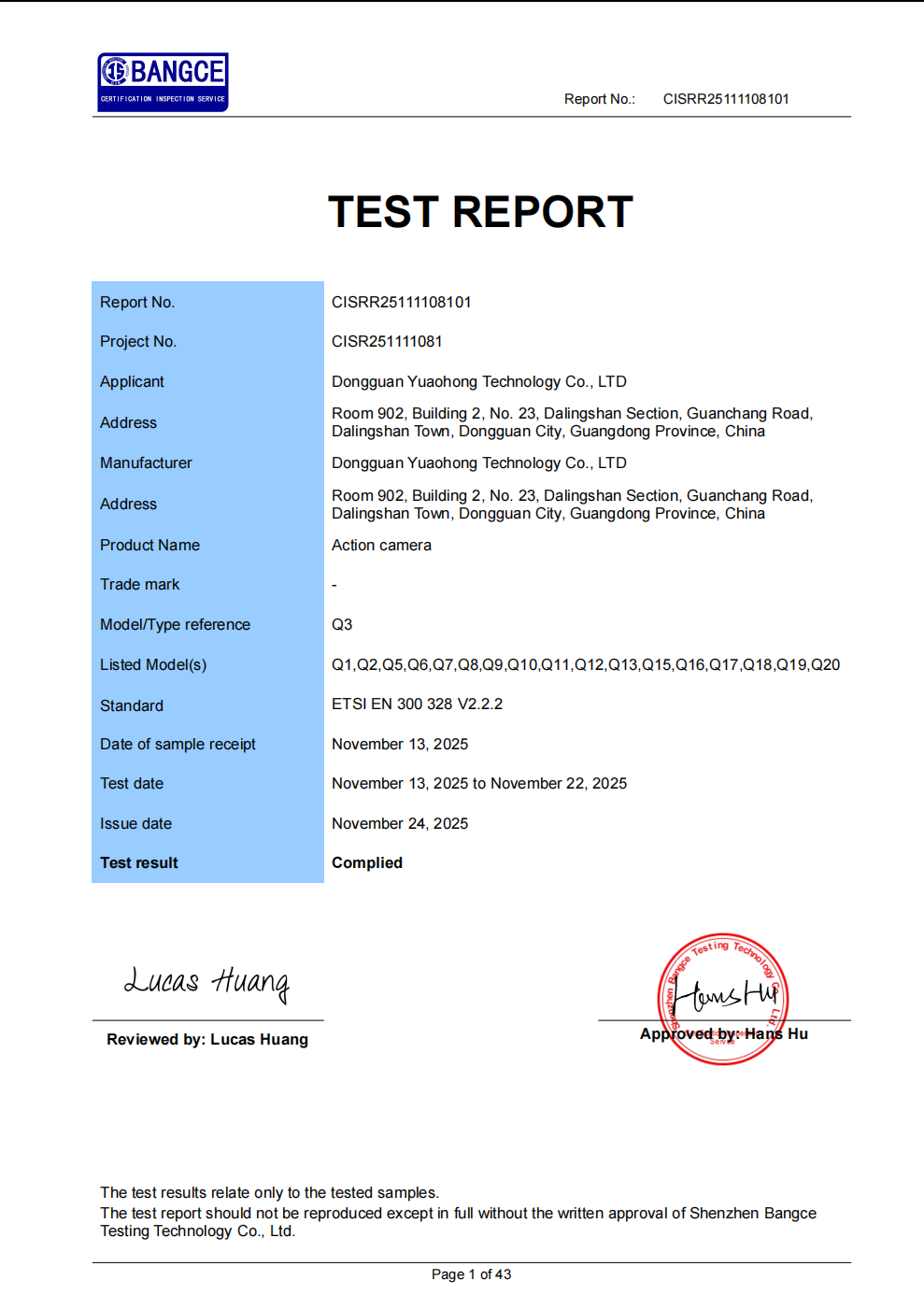
Body figure 2: Laboratory RF test documentation for wireless action camera models. Radio evidence is issued per tested configuration, not per brand.
Commercially, this matters at the moment of order rather than the moment of listing. The manufacturer used as an example here publishes a monthly production capacity of 170,000 units with a typical production lead time of 25–30 days. If a buyer's compliance file is incomplete when production begins, the delay lands on the shipment schedule, not on the specification. Confirming that radio and safety documentation names the exact SKU before tooling and mass production is the cheaper sequence.
What to Request From a Supplier Before You Commit
A document request is only useful if each item has a purpose and a field to check. The following list is a workable starting point for a 2K or 4K action camera programme.
| Document | What it supports | Field to check first |
|---|---|---|
| Declaration of conformity | The manufacturer's formal statement of conformity for the named product | Product and model names listed on the declaration |
| Electrical safety report | Evaluation of battery, charging and thermal behaviour in the tested configuration | Tested configuration and standard edition |
| RoHS test report | Substance screening using IEC 62321-series methods | Model scope and method list |
| Radio test report (Wi-Fi models) | Conformance testing of the 2.4 GHz function | Standard version and antenna configuration |
| FCC documentation (US market) | Radio-frequency compliance for the North American market | Model scope |
| Battery datasheet or cell specification | Cell format, capacity and nominal voltage as designed | Cell designation and nominal voltage |
| Pre-shipment test record | Inspection outcome before goods leave the factory | Sampling method and recorded results |
Suppliers differ in how much of this file exists before a purchase order. For reference, the manufacturer used as the example in this article publishes OEM and ODM services with a minimum order quantity of 1 unit, EXW and FOB delivery terms, and payment terms of 30% T/T in advance with a 70% T/T balance. Quality control is described as 100% testing, acceptance as pre-shipment testing, and after-sales support as a 12-month official warranty with certification documents and sales materials supplied to partners. Those are procurement terms rather than compliance evidence — but they determine how easily the evidence can be obtained.
Where Spec-Based Screening Stops
A spec-first reading has clear boundaries, and buyers should know them before building a process on top of it.
- A specification is not a test report. Nothing on a datasheet — not 3.8 V, not ABS, not a protection claim — substitutes for laboratory evidence in the destination market.
- Model families complicate scope. The CE and RoHS scopes for this range cover long lists of Q-series models rather than a single SKU, and one FCC report names X7, M16S, M17S, M29S and M30S while other reports name a different list. A buyer ordering outside the named scope should ask what additional evaluation applies.
- A cell format is not a safety verdict. An 18650 cell is a widely used, well-understood format, and a 3.8 V polymer pack is equally common in this class. Neither format is inherently compliant or non-compliant; what matters is the assembly, protection circuit and charging design evaluated in the report.
- Material declarations are incomplete by nature. ABS names a polymer family, not a grade, additive package or supplier. Substance testing covers what was tested, at the time it was tested.
- Configuration changes can invalidate evidence. Replacing a battery, radio module, lens assembly or charging path moves a product toward the boundary of the tested configuration, and sometimes past it. Any change should be routed back to the supplier's engineering and compliance documentation rather than absorbed silently by the purchase order.
- Documents age. Standards are revised — IEC 62368-1's fourth edition was published in 2023 — and radio standards carry their own version numbers. A report is only as current as the standard version it cites.
The practical answer is not to distrust the specification sheet, but to treat it as the first page of a file that ends with test reports.
Market Context: Why the 4K Tier Gets Scrutinised
Compliance attention tends to follow market share. Ultra-HD resolution (4K and above) accounted for approximately 46.25% of the action camera market in 2025 according to Mordor Intelligence, while SkyQuest Technology valued the global action camera market at USD 6.57 billion in 2024. Estimates of the same market diverge — Grand View Research places 2025 global revenue at USD 7.97 billion and Mordor Intelligence at USD 7.09 billion — largely because of scope differences over accessories and professional body cameras. Market-size figures are best read as directional; the underlying specification trend is more reliable.
Two trends matter more to a sourcing decision. First, electronic image stabilisation has become a standard expectation in budget-to-mid-range action cameras, implemented in software rather than hardware; it appears in this line-up as a six-level EIS function on Q2 and as a supported function on Q7 and X7. Second, the 4K tier is where buyer scrutiny concentrates, because resolution, stabilisation and battery claims are the ones most easily checked against real footage and real runtime. North America accounted for a 34% revenue share of the global market in 2025 according to Grand View Research, which is why US radio documentation and EU safety documentation frequently sit in the same supplier file.
About the Manufacturer Behind These Specifications
Dongguan YUAOHENG Electronic Technology Co., Ltd. (YUAOHENG) is a manufacturer based in Dalingshan Town, Dongguan, China, founded in 2016 and specialising in the research, development, manufacturing and sale of action cameras, dash cameras and smart video doorbells. The company operates a 1,500 m² standardised production facility with approximately 300 employees, a 30-engineer R&D team and an annual output of 2,000,000 units; around 80% of production is exported to Europe, North America, Asia and South America. Its products hold FCC, CE and RoHS certifications, and the company provides OEM and ODM services covering product design, engineering development, testing and mass production.
A five-year OEM programme with a United States action camera brand illustrates how that capability translates into orders: 5,000-unit production runs for a travel-vlog and outdoor-recording line, with the OEM record citing 4K recording, a wide-angle field of view, low-light capture and stabilised output as the specification points the buyer relied on.
Future Outlook
Compliance pressure on consumer electronics is not easing. Standards revisions — from IEC 62368-1's fourth edition to successive versions of radio standards such as ETSI EN 300 328 — mean that a supplier's document file has a shorter effective life than the product's tooling. For buyers, the consequence is procedural rather than dramatic: build the compliance request into the sampling stage instead of the shipping stage, name the exact models in every document request, and keep the specification sheet and the test report in the same folder so discrepancies surface early.
As the ultra-HD tier continues to absorb share, the manufacturers that will be easier to work with are not necessarily those with the longest claims list, but those whose claims can be traced to a report naming the model being purchased.
FAQ
Can a specification sheet show that an action camera is CE compliant?
No. A specification sheet describes design intent — resolution, battery voltage, enclosure material — whereas CE conformity in the EU is supported by technical documentation and a declaration of conformity, with test reports behind them. In this product class the safety framework typically referenced is IEC 62368-1, the standard for audio/video and information technology equipment, whose fourth edition was published in 2023. A specification sheet indicates which questions to ask; it cannot replace the report.
Which battery specifications should a buyer check first on a 2K or 4K action camera?
Nominal voltage and cell format. In the line-up used as an example here, most models list a 3.8 V polymer pack — Q1, Q3 and Q5 at 2000 mAh; Q7 and X7 at 1000 mAh; X20 at 1000 mAh with a MICRO-Type-C / DC 5 V 1–2 A input rating — while Q2 and Q9 use an 18650-format cell rated 2000 mA, and Q11 and X11 list 104050 (2500 mA) and 974058 (3000 mA) packs. Because formats differ within one product family, both fields should be confirmed per model.
Does an ABS housing mean anything for RoHS compliance?
It identifies the material family, not compliance. ABS is a common thermoplastic for consumer electronics enclosures and is the stated material across the reviewed line-up. RoHS compliance is demonstrated by substance testing using the IEC 62321 series of analytical methods, applied to the models named in the report's scope. Buyers should request the report and read its model scope and method list rather than relying on the material line in a specification.
Why does the infrared switching method appear in a compliance discussion?
Because the switching method defines the product's operational states, and those states must match the user manual and the configuration used during testing. In this line-up, Q3 and Q5 use hand regulation for infrared night vision, Q9 uses manual adjustment for four white fill lights, and Q11 and X11 use one-button control LED fill lights. A manually switched emitter can be held off during controlled measurements, while one-button control ties light output to the recording workflow. Neither approach is inherently better; the requirement is that documentation and product behaviour agree.
What documents should a supplier provide to support EU market entry for a Wi-Fi action camera?
At minimum: a declaration of conformity for the named product; an electrical safety report for the tested configuration; a RoHS test report citing IEC 62321-series methods and the covered models; and, for Wi-Fi models, a radio test report referencing the applicable standard — ETSI EN 300 328 V2.2.2 appears in the CE and RF documentation for this range. For the North American market, 47 CFR Part 15, Subpart C documentation applies. The check that matters most is whether the model being ordered is named in the scope.
How much of this can be settled before placing a production order?
Most of it. Documentation is generated during development and sample evaluation rather than at shipment, so reports, model scopes and battery specifications can be requested before mass production begins. The example manufacturer in this article publishes a 170,000-unit monthly capacity, a typical lead time of 25–30 days, a minimum order quantity of 1 unit, EXW and FOB delivery terms, 100% testing with pre-shipment acceptance, and a 12-month warranty with certification documents supplied to partners. Reviewing those documents during sampling avoids renegotiating them under shipping deadlines.
Readers who need the underlying model list and specification set can consult the manufacturer's product catalogue (PDF): YUAOHENG product catalogue.