
Inside the Glassmaking Line: Blown vs Pressed Glassware
Manufacturing & Procurement Insight — Glassware
Inside the Glassmaking Line: Blown vs Pressed Glassware
Two glasses can look identical in a catalog photograph and still be made by completely different forming routes — machine-pressed, machine-blown or hand-blown. Each route imposes its own logic on wall thickness, weight, tooling, minimum order quantity and lead time, which makes the forming method a procurement variable rather than a factory detail.
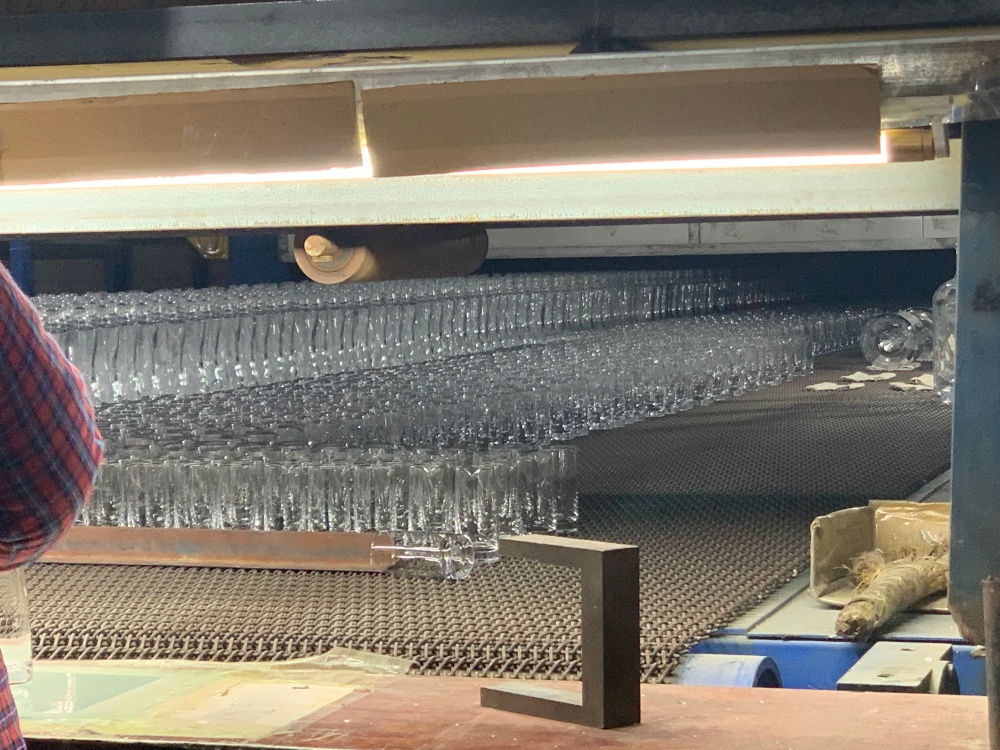
Quality inspection on a glassware production line. The forming route determines what a downstream quality gate can and cannot correct.
Why the Making Method Belongs in the Purchase Decision
Glass drinkware remains a large and expanding category. Grand View Research valued the global glass drinkware market at USD 14.0 billion in 2024 and projects it to reach USD 26.1 billion by 2030, citing a CAGR of 11.1% between 2025 and 2030 and attributing part of that trajectory to eco-friendly preferences. Supply is considerably more fragmented than the headline figure suggests: Sisecam Group, Libbey and Arc International are identified as top-tier global leaders in glassware, and even the largest of those, Sisecam, was estimated at approximately 7.8% of the market in 2025.
For buyers, that fragmentation has a practical consequence. Most purchase orders are placed against a specification describing capacity, dimensions, weight and material — but not the route by which the glass was formed. That missing field is what determines how closely the hundred-thousandth piece matches the first approved sample, how a quoted unit price decomposes, and which clock the lead time actually runs on.
The Gap Between a Catalog Specification and a Forming Route
A specification sheet describes a result, not a process. Two suppliers can quote the same 400 ml silhouette at noticeably different prices because one is pressing it from a matched mold and the other is blowing it into a mold — different tooling cost, different glass mass, different cycle time and a different scrap profile.
Three assumptions cause most of the mismatch between expectation and delivered goods in this category:
- Weight is read as a quality signal. Glass mass per unit of capacity is largely a function of forming route and material choice. The 400 ml machine-pressed tumbler KTK0370-2 carries 420 g of high borosilicate glass, while the 500 ml machine-blown stemmed wine glass KTG1139 carries 215 g of soda lime glass. The gap reflects forming method and intended use at least as much as it reflects quality.
- A custom size is treated as a parameter change. In pressing and blowing alike, a new silhouette or capacity normally means new tooling, which is a scheduling event with its own lead time rather than an edit to an order form.
- A sample is treated as a guarantee. For hand-blown double-wall construction, a sample represents the middle of a distribution rather than a fixed value. Tolerance bands belong in the purchase order.
The Three Forming Routes Behind a Glassware Catalog
Machine-pressed: geometry fixed by a matched mold
In pressing, a measured gob of glass is delivered into a matched metal mold and shaped by a plunger descending into it. Base thickness, outer profile and any surface pattern are a direct negative of the tooling, which is why pressed parts repeat so consistently. KTK0370-2 is a 400 ml glass tumbler in high borosilicate glass made by machine-pressed craft: 420 g, top diameter 78 mm, bottom diameter 65 mm, height 140 mm, supplied to global retailers, importers and chain stores. Its ribbed surface is molded rather than cut, so the pattern repeats identically across a run and cannot drift with operator technique.
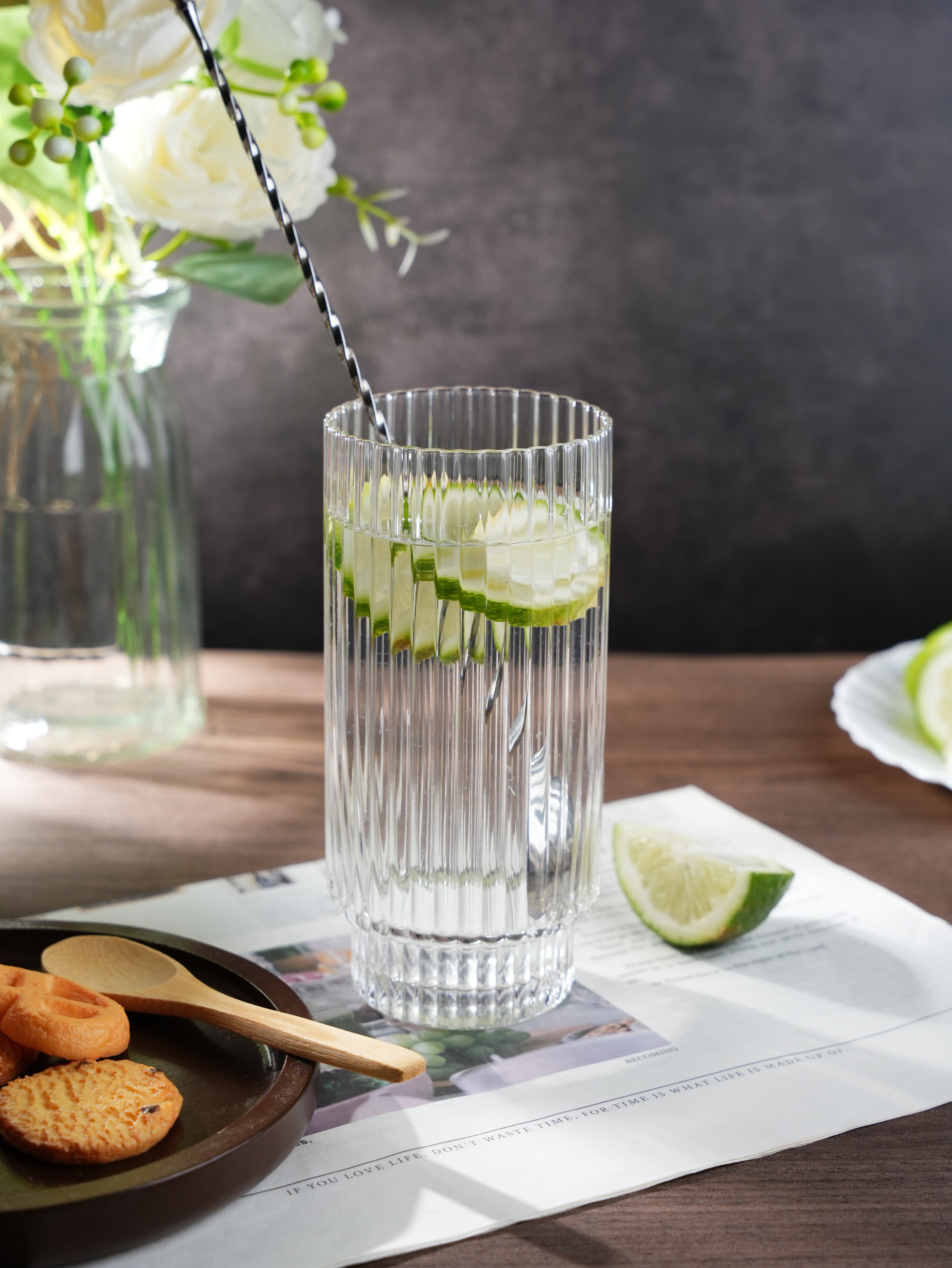
400 ml ribbed highball tumbler (KTK0370-2). The rib pattern is a direct negative of the mold, not a post-forming decoration.
Machine-blown stemware: air, mold and a one-piece stem
Blown forming inflates a gob with compressed air inside a mold. The outer profile still comes from tooling, but the distribution of glass around the cavity depends on gob placement and blow timing — which is why blown ware is normally specified with a wall-thickness or weight tolerance. Stemmed pieces are commonly produced this way because bowl and stem must form as one continuous piece. KTG1139, a ribbed colored wine glass with a machine-blown stemmed craft, is made of soda lime glass at 500 ml capacity, 215 g, top diameter 67 mm, bottom diameter 82 mm and height 224 mm; size and capacity customization is accepted, and its stated application is import and chain store distribution in the global retail market.

Stemmed wine glass (KTG1139). Bowl and stem form as one piece by machine blowing, in soda lime glass at 500 ml capacity.
Hand-blown double-wall: two vessels and a sealed air gap
Double-walled insulated glass adds a structural constraint, because an inner vessel and an outer vessel must be formed and joined while leaving a sealed air gap between them. KTDW0721-GGL is specified as hand-blown high borosilicate glass — soda lime glass is listed as an alternative material — with a double-walled insulated configuration, 340 ml capacity, 145 g, top diameter 84 mm, bottom diameter 60 mm and height 110 mm. It is designed for insulated beverage serving scenarios and is offered with OEM and ODM customization; an ion-plating (I.P.) coating is listed in the product specification. Because the walls are formed by hand, the natural piece-to-piece spread is wider than for pressed ware, and that spread should be defined in the acceptance criteria rather than discovered after mass production.
| Forming route | Example model | Material | Capacity / weight | Dimensions | Typical implication |
|---|---|---|---|---|---|
| Machine-pressed | KTK0370-2 glass tumbler | High borosilicate glass | 400 ml / 420 g | T78 × B65 × H140 mm | Geometry locked to tooling; molded rib detail; suited to stable, high-volume programs |
| Machine-blown, stemmed | KTG1139 ribbed colored wine glass | Soda lime glass | 500 ml / 215 g | T67 × B82 × H224 mm | One-piece bowl and stem; lighter wall; size and capacity customization accepted |
| Hand-blown, double wall | KTDW0721-GGL double wall glass | High borosilicate glass (soda lime alternative) | 340 ml / 145 g | T84 × B60 × H110 mm | Sealed insulated air gap; wider natural tolerance; I.P. coating listed in specification |
What Each Route Changes for Finish, Cost and Lead Time
Finish consistency
Pressed parts inherit their geometry from the mold, so variation is driven mainly by gob weight control and mold wear; a mold maintained to a defined cycle count produces parts that differ within a narrow band. Blown parts introduce a second variable — how glass distributes around the cavity — which is why wall thickness and weight tolerances appear on blown specifications. Hand-blown parts introduce the operator as a third variable, making double-wall insulated glass the least uniform of the three routes. That is a category characteristic rather than a defect, but it has to be written into the inspection standard, because a hand-blown double-wall vessel will not pass a tolerance band drafted for a pressed tumbler.
Per-unit cost structure
The routes do not scale alike. Pressed production amortises a fixed tooling investment across a large output, so unit cost falls as order volume rises and the mold set becomes the dominant upfront cost. Blown stemware uses less glass mass per unit of capacity in the examples here — 215 g for 500 ml against 420 g for 400 ml in the pressed tumbler — although the two models also differ in material, so the comparison is indicative rather than isolated; the underlying point is that glass mass per unit of capacity and the number of forming steps both feed into per-unit cost. Hand-blown double-wall production carries the highest labour content per piece, which makes its unit cost far less elastic to order volume and ties throughput to available hand-forming capacity rather than to machine hours.
Lead time runs on three clocks
Lead time for a glassware order is set by tooling and mold development, by production scheduling, and by shipping. Only the last two are visible in a standard quotation. New product design and mold development are listed among the one-stop services of Kotto Glass Industrial Co., Ltd., whose R&D team of 10 designers supports them, and custom capacity requests on models such as KTG1139 or the recycled glass jar KTBT1446A sit on that tooling clock. Catalog models with existing tooling bypass it, which is why trial sampling — offered free for first trial orders — can begin without tooling work, and why popular items held in the manufacturer's 4,000+ m² warehouse can move without waiting for a production cycle. Behind the line, capacity is stated at 300,000,000 pieces annually from a facility covering over 10,000 m² and employing approximately 100 staff.
Custom Capacity and Packaging as Production Evidence
Customization claims are more useful when expressed as production events rather than service promises. In this catalog, three types recur.
- Capacity and dimension changes. KTG1139 accepts size and capacity customization; the glass cake stand KTPL1572A-A is available in sizes as requested; KTBT1446A accepts customized sizes and capacities. Each of these is a tooling event that starts in mold development.
- Design, mold and private-label work. OEM and ODM service is offered across the cited models for any sizes, designs, capacity and packages, alongside new product design, mold development, private label and branding, and production follow-up with quality control.
- Packaging. Customized packaging design is part of the stated service scope, and the application data shows why it is treated as a production requirement rather than an afterthought: supermarket and chain store supply programs in Brazil and Poland specify customized package and design, including environmental packaging, while wedding programs in the United States specify customized packaging and engraving.
Sampling closes the loop between a drawing and a shipment. Free samples for trial orders at first acceptance, wholesale pricing on factory-direct supply, and flexible minimum order quantities together decide whether a customization request is testable at small scale or only at full production volume.
| Model | Category | Material | Key specification data |
|---|---|---|---|
| KTPL1572A-A | Glass cake stand | Soda lime glass | 1445 g; T312 × B120 × H105 mm; sizes as requested; MOQ 1000 pcs |
| KTBT1446A | Recycled glass storage jar, bottle, mug and tumbler | Recycled glass | 850 ml; 610 g; T80 × B95 × H247 mm; withstands -30 to 160 degrees Celsius instantaneous temperature difference; 12 pcs per carton in bulk |
Application Scenarios: Where Each Route Fits
Forming routes map onto commercial programs with reasonable predictability, because each program optimises for a different combination of consistency, cost and appearance.
| Program type | Typical market | Operating mode | Route that fits | Stated requirement |
|---|---|---|---|---|
| Supermarket / chain store supply | Brazil, Poland | B2B bulk distribution; Just-In-Time Delivery | Machine-pressed drinkware (KTK0370-2) | Customized package and design, including environmental packaging |
| Branded / custom promotional gifts | Brazil, Poland | B2B bulk distribution; tableware, drinkware | Double wall glass and branded gift sets (KTDW0721-GGL) | Customized package and design; international standard approved |
| Wedding drinkware rental | United States, United Kingdom, Canada | OEM/ODM customization | Machine-blown stemmed ware (KTG1139) | Customized package and engraving; international standard approved |
Volume retail supply rewards pressed production: consistent ribbed geometry, repeatable weight, and packaging designed for shelf and transport. Promotional gift programs reward the visual differentiation of an insulated double-wall vessel, where the sealed air gap and the optional I.P. coating do work that a single-wall tumbler cannot. Wedding and rental programs reward stemmed machine-blown ware, where a one-piece bowl and stem is simultaneously the aesthetic requirement and the durability requirement, and where engraving and customized packaging are specified at program level.
Market Signals Buyers Are Pricing Into 2026 Programs
Three market facts are worth holding alongside the technical ones. First, material: soda-lime glass accounted for approximately 70.8% of the global glassware material segment in 2024, so most volume programs will continue to be specified in soda lime, with high borosilicate reserved for thermal performance and premium positioning — which is how the cited models split. Second, recycled content: the global recycled glass market was estimated at USD 4.2 billion in 2024, with Europe the largest regional market, a signal that recycled-glass lines such as KTBT1446A are being specified against retail sustainability requirements rather than as novelty items. Third, supply geography: China's exports of glass and glassware reached approximately USD 25.53 billion in 2024 according to UN Comtrade and Trading Economics data, which helps explain why compliance documentation now travels with an order as routinely as the packing list.
Compliance obligations do not change with the forming route, but they do interact with surface treatment. European safety standard EN 1388-2 and ISO 7086-1:2019 regulate the release of lead and cadmium from glass hollowware in contact with food, and US FDA Compliance Policy Guides 7117.06 and 7117.07 set extractable cadmium and lead limits for ceramic and glass foodware. Colored finishes and coatings — including the I.P. coating listed for KTDW0721-GGL — belong inside that assessment, not outside it. Kotto Glass Industrial Co., Ltd. states that it is audited and certified to BSCI, Sedex/SMETA, FSC, Disney FAMA, ISO and LFGB.
Published market sizing for this category also varies by scope — drinkware-only estimates sit well below total-glassware figures — so headline numbers are best read directionally. The structural reading is stable: an expanding category, a fragmented supply base, and rising documentation expectations.
Machine-Formed Output vs Traditional Hand Production: The Boundaries
Machine forming solves repeatability and cost; it does not solve geometry freedom, and it is worth being explicit about where each route stops working.
- Pressed tooling locks the design. Undercuts, extremely thin walls and long drawn stems are not press-formed, and a design change after the mold is cut means a new mold and a new tooling clock. Pressed ware is the right answer for high-volume, stable silhouettes and the wrong answer for a design that is still moving.
- Hand-blown double-wall ware cannot hold pressed tolerances. If a program requires tight piece-to-piece weight uniformity across millions of units, hand-blown insulated construction is the wrong route. The correct response is either to select a different forming route or to write a tolerance band that reflects the process honestly.
- Distributed capacity needs to be identified. The manufacturer states cooperative relationships with 150+ glass factories in China alongside its own facility and warehouse. That model supports availability and wide product coverage, but it also means a given order may be produced on a partner line. A buyer should confirm which line is allocated to the order and lock a signed sample as the reference standard — a routine requirement that becomes more important, not less, when the supply chain is a network.
Traditional hand production remains valuable for prototype aesthetics and small bespoke runs, and it still sits behind a meaningful share of premium glass; its boundary is labour, because output scales with people rather than machines and uniformity is bounded by human technique. A trading-intermediated supply path has a different boundary — the forming route is often invisible to the buyer until a quality issue makes it visible. Factory-direct supply does not automatically produce better glass, but it does make the forming method answerable, which is the point of asking the question at all.
Outlook
As the category expands toward the projected USD 26.1 billion by 2030, the pressure on buyers is not to find more suppliers but to ask more precise questions of the suppliers they already have. The forming route is the most useful of those questions, because it links three otherwise separate procurement files: the quality standard, the cost breakdown, and the delivery schedule. A quotation that names the route — pressed, machine-blown or hand-blown — and the model it applies to can be checked against samples, tolerance bands and tooling schedules rather than trusted.
Two expectations are likely to harden. Buyers will increasingly want the production route documented alongside the specification, and they will want compliance evidence tied to the specific item and finish rather than to a general factory certificate. Neither requirement is difficult to meet when the manufacturer already coordinates mold development, sampling, packaging design and quality control under one layer — and both become difficult when the route is not known.
FAQ
What is the difference between machine-blown and machine-pressed glassware?
Machine-pressed glass is shaped by a plunger pressing a measured gob of glass into a matched metal mold, so the profile and any surface pattern come directly from the tooling; the 400 ml tumbler KTK0370-2 is an example, at 420 g with a top diameter of 78 mm and a height of 140 mm. Machine-blown glass is inflated with compressed air inside a mold, so the outer profile comes from tooling while wall distribution depends on gob placement and blow timing; the 500 ml stemmed wine glass KTG1139 is an example, at 215 g with a top diameter of 67 mm and a height of 224 mm. Pressed production favours consistent, mold-defined geometry, while blown production is used where a continuous stem and lighter walls are required.
How does the forming method affect the unit price of a glassware order?
The cost structures differ rather than simply ranking. Pressing spreads a fixed tooling investment across output, so unit cost falls as volume rises. Blowing reduces glass mass per unit of capacity in comparable catalog items but adds forming steps for stems and requires wall-tolerance control. Hand-blowing carries the highest labour content per piece, which makes per-unit cost less responsive to volume and ties output to available hand-forming capacity. Material choice compounds all three: high borosilicate glass and soda lime glass are not interchangeable on cost, so a quoted price should be read as a combination of route, material and volume rather than as a single variable.
Why is a double-wall glass produced by hand-blowing instead of pressing?
A double-walled vessel requires an inner and an outer wall joined with a sealed air gap between them, a structural configuration that standard press tooling is not designed to produce. KTDW0721-GGL is specified as hand-blown high borosilicate glass with a double-walled insulated structure, 340 ml capacity, 145 g, top diameter 84 mm, bottom diameter 60 mm and height 110 mm, with soda lime glass listed as an alternative material and an ion-plating (I.P.) coating in the specification. Hand forming gives the geometry freedom the two-wall structure requires, in exchange for a wider natural tolerance than pressed ware.
Can capacity, dimensions and packaging be customized on these models?
Yes, within the stated service scope. KTG1139 accepts size and capacity customization; KTPL1572A-A is available in sizes as requested; KTBT1446A accepts customized sizes and capacities; and OEM/ODM service across the cited models covers any sizes, designs, capacity and packages. Packaging customization is listed as part of the service scope and is a program requirement in several applications: supermarket and chain store supply in Brazil and Poland specifies customized and environmental packaging, while wedding programs in the United States specify customized packaging and engraving. Because a changed capacity or silhouette normally requires mold development, such requests follow a tooling timeline rather than a stock-replenishment timeline.
How can a buyer verify the forming method before placing a bulk order?
Three checks are practical. First, compare weight against capacity: substantial glass mass such as 420 g for a 400 ml tumbler indicates a pressed or heavy-wall construction, while 215 g for a 500 ml stemmed glass indicates blown forming with thinner walls. Second, inspect molded surface detail — ribs produced by tooling repeat identically, whereas hand-formed surfaces show minor variation from piece to piece. Third, request a specification that names the craft field explicitly, as the catalog does for KTK0370-2 (machine-pressed glass), KTG1139 (machine-blown stemmed glass) and KTDW0721-GGL (hand-blown), then validate it against samples, which are offered free for first trial orders.
Do compliance requirements change with the forming method?
No. Lead and cadmium release limits apply to the finished glass in contact with food regardless of how it was formed: EN 1388-2 and ISO 7086-1:2019 in the European and international context, and US FDA Compliance Policy Guides 7117.06 and 7117.07 in the United States. What does change is the surface treatment that has to be assessed — colored finishes and coatings such as the ion-plating option listed for KTDW0721-GGL — because decoration and coating add materials to the food-contact surface. Factory-level schemes such as BSCI, Sedex/SMETA, FSC, Disney FAMA, ISO and LFGB address audit and system requirements, which sit alongside product-level testing rather than replacing it.