
Inside the Factory: Verifying Wedding Tent Supplier Capability
Wedding tent purchases rarely fail because of colour or style. They fail when a supplier cannot reproduce, at production scale and to schedule, the structure that was presented in a showroom. For buyers at the decision stage, that risk has to be reduced before a purchase order is signed — which is why procurement teams increasingly look past brochures and examine one of the few supplier claims that can actually be tested: the product range.
Why Product Range Is the Most Testable Supplier Signal
A sample tent can be sourced from almost anywhere. A production line cannot. That distinction is what makes product range a practical verification tool rather than a marketing claim.
When a manufacturer offers both party tents and event tents, it is not simply listing more products. It is running two different production disciplines inside the same building:
- Party tent production is a repeatability exercise. The structure is modular, built from repeated frame components and identical fabric panels that must fit together order after order. The failure mode here is inconsistent tolerance — parts that fit on the first order and do not fit on the fifth.
- Event tent production, particularly in clear span configurations, is a structural exercise. Larger spans, longer fabric panels and heavier load paths demand engineering review, anchoring design and assembly control before the tent ever leaves the factory. The failure mode here is structural, not cosmetic.
A supplier that runs both disciplines has to maintain two quality regimes at once: one optimised for repeatable modular output, one optimised for structural integrity at span. For wedding buyers this matters directly, because wedding requirements are unusually wide. A 60-guest garden ceremony and a multi-zone hotel event are not variations of the same product — they are different products with different engineering assumptions.
The verification logic is straightforward. A trading intermediary can present a catalogue. It cannot easily present a cutting floor, a welding process, a sewing line and an assembly check that all serve two structurally different product families.
What Party Tents and Event Tents Each Prove
The two product families test different things, and buyers get more signal when they read them separately rather than as a combined "range" claim.
| Product family | Production discipline it tests | Evidence a buyer can reasonably request | Wedding requirement it typically serves |
|---|---|---|---|
| Party tent / frame tent | Modular production, repeated component tolerances, fabric panel consistency | Repeat-order consistency record, component drawings, spare-part availability | Garden and lawn ceremonies, staged or segmented layouts, sites with limited vehicle access |
| Event tent / clear span tent | Long-span structural design, large fabric panel handling, anchoring and cable systems | Span documentation, structural drawings, anchoring and cable specifications | Large uninterrupted covered areas, hotel forecourts, full-site venue coverage |
| Wedding tent (application category) | Finish consistency across separately produced units | Cross-order finish comparison, batch documentation | Multi-day or multi-zone wedding programmes where several units must look identical |
Read together, the two families answer a single decision-stage question: can one supplier cover both a modular repeat order and a structurally demanding one without subcontracting the difficult half?
Inside the Factory: The Stages a Buyer Can Actually Audit
Capability is not an abstraction. It sits in four production stages, and each one leaves evidence a buyer can ask to see during supplier evaluation.
1. Profile cutting
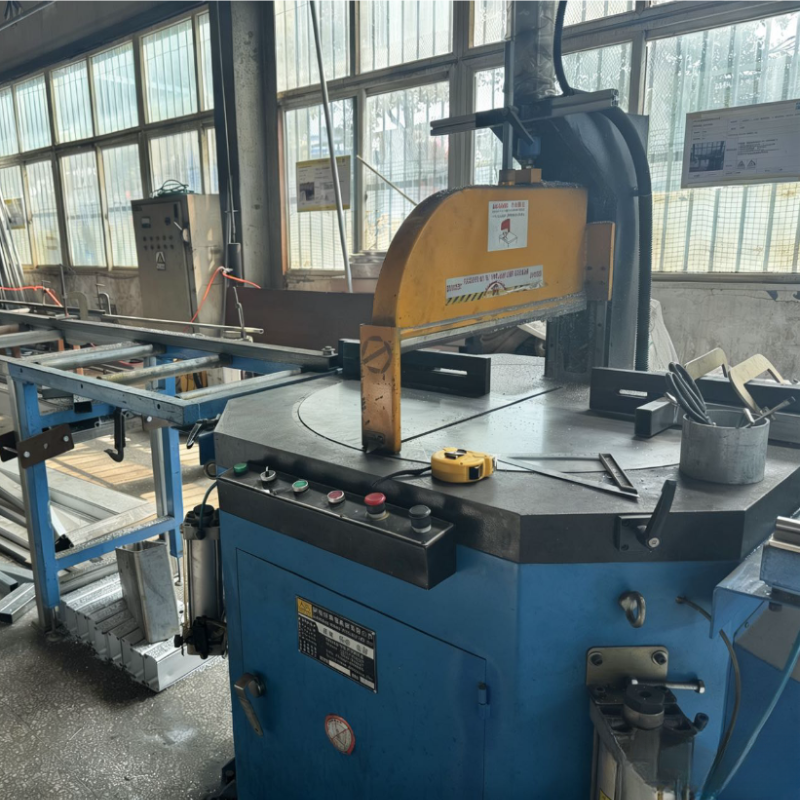
Frame profiles are cut to length before assembly. This stage determines whether components will interchange between units. A buyer evaluating a supplier for repeat wedding orders should ask how cut lengths are controlled across production batches — not whether a cutting machine exists.
2. Frame welding
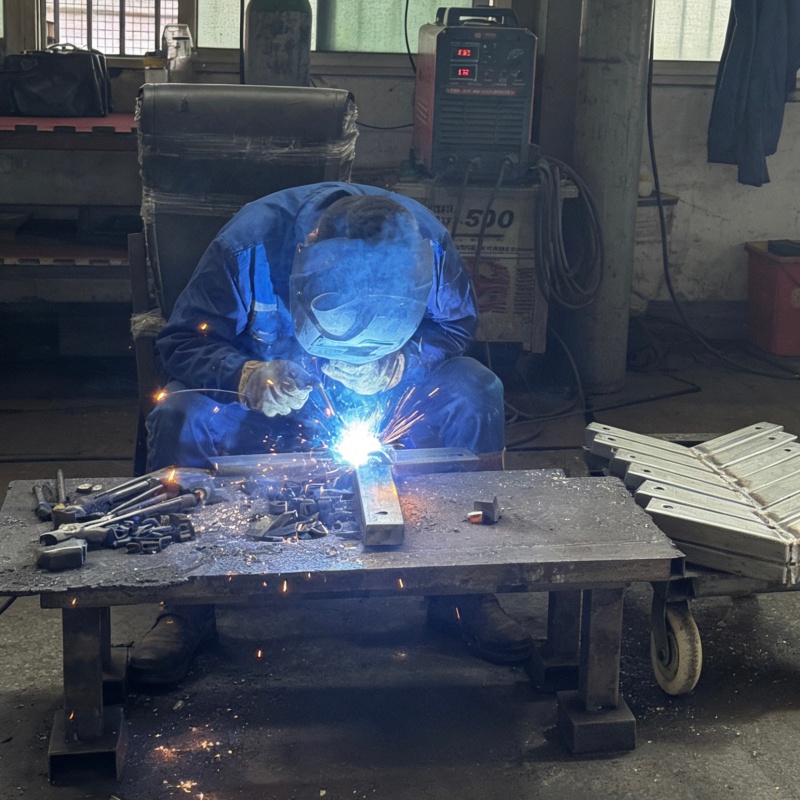
Welding converts cut profiles into load-bearing members. The quality of this stage is what separates a frame that survives repeated installation and dismantling from one that does not. For aluminium frames, welding discipline also protects the material's corrosion behaviour at the joint.
3. Fabric cutting and sewing
Roof panels, sidewalls and connecting sections are cut and sewn to fit the frame they were designed for. This is where a supplier's ability to handle custom dimensions is either real or aspirational. Non-standard sizes require re-cutting and re-sewing patterns, not simply scaling a stock product.
4. Assembly and inspection
Before dispatch, components are checked against the structure they belong to. For wedding buyers, the most useful question is not "do you inspect?" but "what is checked, and against what drawing?"
Expotent's Product Range as Verification Evidence
Changzhou Expo Tent Co., Ltd. (Expotent) is a China-based tent manufacturer established in 2010, located in Changzhou, Jiangsu Province. The company designs, manufactures, develops, sells and rents aluminium and steel frame fabric structures, tents and marquees, and supplies turnkey solutions for temporary, semi-permanent and permanent use.
Its published portfolio is broad enough to be checked against the two-discipline test described above. The product list includes events tent, party tent, warehouse tent, wedding tent, church tent, pagoda tent, clear span tent, frame tent, sports tent and marquee. Both halves of the verification logic are therefore present in one manufacturer: modular frame production (party tent, frame tent, marquee) and long-span structural production (clear span tent, events tent).
Several first-party facts give buyers scale reference points for the decision:
- Facility: 3,000 m² factory area
- Team: 30 employees, including an R&D team of 3 engineers
- Output: 100,000 m² annual production
- Export ratio: 50% of output supplied to export markets
- Main markets: EU, Africa, USA, Asia and Middle East
- Client reach: the company states it serves demanding clients in over 40 countries
For a wedding buyer at the decision stage, these numbers are useful in a specific way. The 100,000 m² annual output figure gives an order-of-magnitude reference for whether a given wedding programme sits comfortably inside a normal production cycle or at the edge of it. The 3,000 m² facility and 30-person team define a production envelope rather than an unlimited one — which is honest information, and more useful than a claim of infinite capacity.
The portfolio also reveals an application logic that matters for weddings. A wedding tent order may need a modular configuration for a lawn site and a clear span structure for a hotel forecourt within the same event programme. Being able to source both from the same manufacturer removes one coordination layer from the project.
Aluminium Frame vs Steel Frame: Comparing Two Traditional Structures
Frame material is the single decision inside wedding tent procurement where the cheapest quotation and the lowest total cost most often diverge. The comparison is documented, not theoretical.
| Comparison point | Steel frame tent | Aluminium frame tent |
|---|---|---|
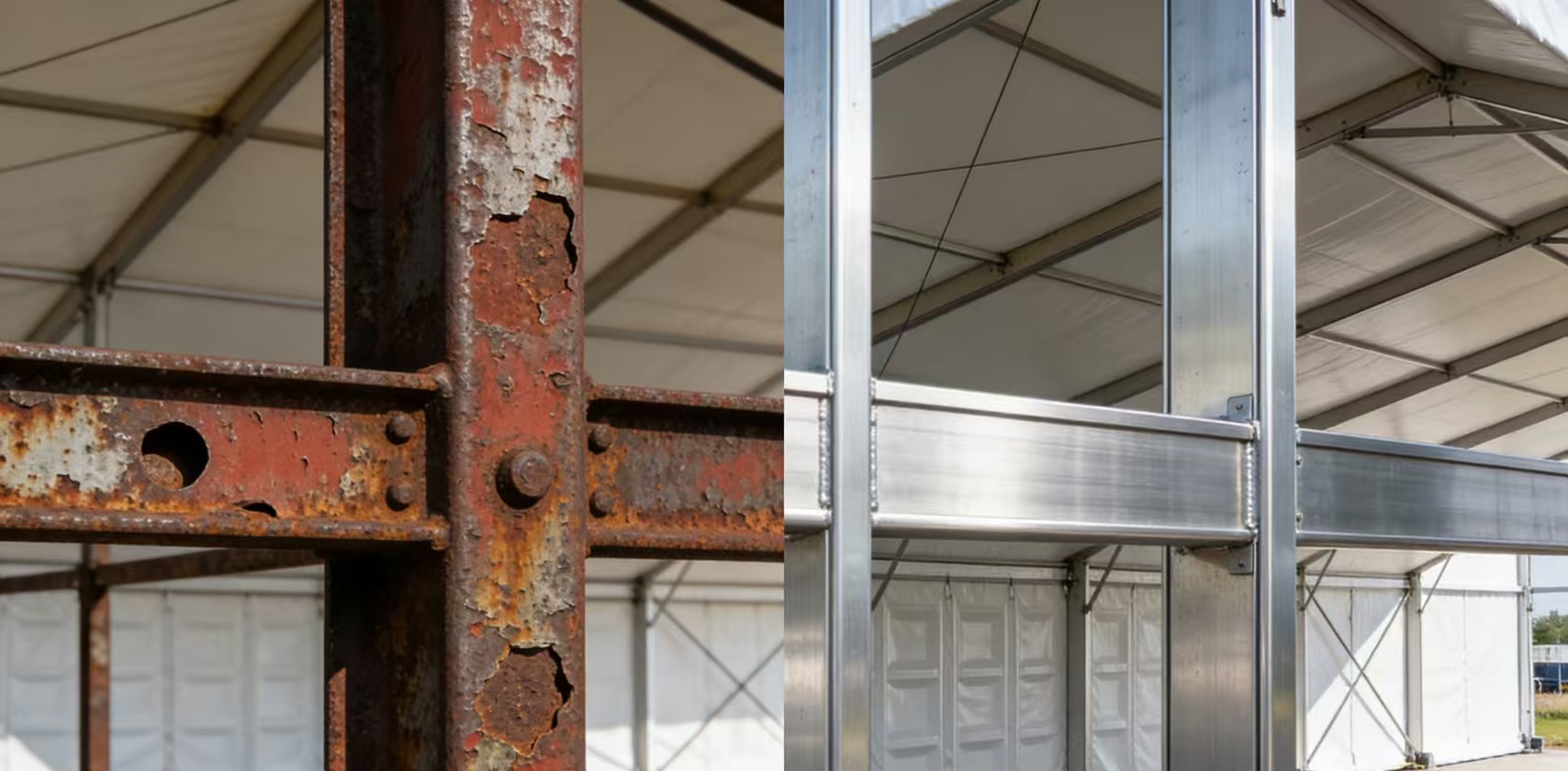
| Service life | Can be used for around 2 years | Can be used for more than 10 years |
| Corrosion behaviour | Subject to rust | Never rusts |
| Maintenance | Requires rust cleaning | No rust cleaning required |
| Best suited to | Shorter-cycle applications | Wedding and warehouse applications |
The practical consequence for wedding procurement is a shift in how cost is calculated. A rental operator or event company comparing steel and aluminium on purchase price alone is comparing the wrong number. Over repeated seasons, the aluminium frame's longer service life and its elimination of rust-related maintenance change the cost per event, not just the cost per unit.
There are also boundaries worth stating plainly. Aluminium frame tents are not automatically the correct answer for every wedding project: a short-cycle or single-season requirement may justify a different balance between capital outlay and service life. The comparison data above establishes relative lifespan and maintenance behaviour — it does not establish that one material is cheaper at the point of purchase for every specification. Buyers should request per-project quotations and evaluate them on a cost-per-season basis rather than on unit price alone.
Matching Wedding Scenarios to the Right Product Family
Wedding site conditions, not aesthetics, determine which product family is technically appropriate. The table below maps common wedding scenarios to the production requirement they create.
| Scenario driver | What it stresses in production | Product family that typically answers it | What to ask the supplier |
|---|---|---|---|
| Outdoor lawn wedding | Ground anchoring, sectional installation | Modular party tent / frame tent | Anchoring plan and site survey |
| Beach wedding | Soft-ground anchoring, wind exposure, salt air | Modular structure with cable reinforcement | Corrosion treatment and cable provision |
| Castle or heritage-venue decoration | Non-standard dimensions, finish consistency | Custom-size tent production | How custom dimensions are re-cut and re-sewn |
| Commercial wedding planning (agencies) | Repeatable stock, quick turnaround, spare parts | Modular party tent families | Repeat-order consistency and spares availability |
| Hotel wedding support structures | Clean sightlines, service-adjacent layouts | Event tent / clear span tent | Span documentation and sidewall options |
| Large-space wedding | Uninterrupted covered area | Clear span event tent | Structural drawings and load documentation |
| Windproof and waterproof requirement | Wind loading, water shedding, tensioning | Reinforced modular structure | Cable specification and anchoring design |
| Custom-size requirement | Engineering review before production | Custom production run | How the review process is documented |
| Detachable modular requirement | Component interchangeability across units | Modular frame systems | Whether components interchange between batches |
| Quick-storage requirement | Packing volume and handling cycle time | Modular folding systems | Packing method and storage footprint |
Wind exposure deserves separate treatment because it is the risk most often underestimated at the procurement stage. For high-wind conditions, the documented control method is mechanical reinforcement rather than a fabric upgrade: adding windproof steel cables to the structure. Expotent's stated risk control for big-wind conditions is the addition of steel cables. Buyers specifying wedding tents for exposed coastal or open-field sites should confirm what cable reinforcement is included, not only what fabric weight is quoted.
Market Trend Analysis: Where Wedding Tent Demand Is Moving
The demand context explains why supplier capability is being scrutinised more closely than it was a decade ago. Available industry data points to sustained expansion in both the wedding services and tent rental segments.
- The global wedding services market, including venues and tents, reached USD 185.22 billion in 2023 and is projected to reach USD 284.64 billion by 2032 (Fortune Business Insights).
- The global tent rental market was valued at USD 8.2 billion in 2025 and is expected to reach USD 13.7 billion by 2033, with weddings accounting for 38.5% of revenue share (Dataintelo).
- Asia-Pacific held 32.2% of tent rental revenue share in 2025, driven by destination weddings and outdoor hospitality growth (Dataintelo).
- In the United States, the average cost for a wedding tent rental is USD 1,900, typically benchmarked at USD 1 per square foot of coverage (Kande Photo Booths, citing US party rental industry statistics).
The US rental benchmark is useful for a specific decision-stage calculation. When coverage is priced at roughly one dollar per square foot per rental cycle, the return on an aluminium frame with a service life measured in years rather than a steel frame measured in a shorter cycle becomes a straightforward arithmetic question for rental operators — provided the supplier's production can actually deliver the frame repeatedly.
On the supply side, the clear span wedding tent segment includes established manufacturers such as Liri Tent (China), Losberger De Boer (Germany/Netherlands) and Shelter Structures (China). The existence of a recognised group of clear span specialists is itself a signal for buyers: long-span structural capability is a distinct discipline, and it should be evaluated on its own terms rather than assumed from a general tent catalogue.
What Product Range Evidence Cannot Tell You
Product range is a strong verification signal, but it is not a complete one. Buyers who treat it as sufficient make a different version of the same mistake as buyers who trust a brochure.
- It does not reveal current factory load. A broad portfolio says nothing about how full the production calendar is in a given month. Delivery scheduling must be confirmed separately.
- It does not define an unlimited capacity envelope. A 3,000 m² facility and a 30-person team represent a defined production scale. Very large single-project volumes or compressed timelines should be confirmed against a stated schedule before commitment.
- It does not certify compliance. Temporary structures for events are governed by standards such as EN 13782, with fabric flame retardancy addressed by frameworks including NFPA 701 (US) and CPAI-84. Which standard applies depends on the destination market and the venue authority. Compliance documentation must be requested per project and per jurisdiction — range breadth is not a substitute.
- It does not replace a site survey. Ground conditions, access width, slope and exposure determine what can be installed. A photograph of a similar tent on a different site is not site evidence.
- It does not make material choice automatic. The longer service life of aluminium frames is a documented advantage, but the appropriate frame material still depends on the buyer's usage cycle and budget structure.
Used correctly, range evidence tells a buyer which production disciplines genuinely exist inside a supplier. Everything else — scheduling, certification, site fit, commercial terms — still has to be verified directly.
Future Outlook
Three shifts are likely to shape how wedding tent suppliers are evaluated over the next several procurement cycles.
Capability evidence will matter more than catalogue breadth. With Asia-Pacific already holding 32.2% of tent rental revenue share and wedding demand continuing to migrate toward destination and outdoor venues, buyers increasingly need suppliers who can serve both modular repeat orders and long-span structural projects. Suppliers that operate only one of the two disciplines will be excluded from mixed wedding programmes regardless of price.
Lifecycle economics will displace unit price in frame decisions. As rental operators scale, the difference between a frame used for around two years and one used for more than ten years compounds across every event. Procurement conversations are likely to move toward documented service life and maintenance requirements rather than headline quotes.
Compliance documentation will become a screening filter. Because EN 13782 and fabric flame retardancy frameworks such as NFPA 701 and CPAI-84 apply by market, suppliers who can produce jurisdiction-specific documentation quickly will clear procurement reviews faster than those who cannot. This is an operational capability, not a marketing one — and it follows the same verification logic as product range.
Frequently Asked Questions
1. What does a wedding tent supplier's product range actually prove?
Product range proves that a supplier operates more than one production discipline inside its own facility. A manufacturer offering both party tents and event tents must maintain repeatable modular production for the first category and structural, long-span production for the second. These require different tolerances, different quality checkpoints and different assembly controls. Because a sample can be sourced externally but a production line cannot, range is considerably harder to simulate than a catalogue.
2. How can a buyer verify that a factory can make both party tents and event tents consistently?
Request stage-level evidence rather than finished-product photographs. Useful requests include repeat-order consistency records for modular components, span and structural drawings for clear span units, component interchangeability confirmation between production batches, and spare-part availability. A supplier with genuine dual production will be able to answer these from its own documentation. A supplier that subcontracts one category will usually not.
3. How long do steel frame and aluminium frame wedding tents last, and how does that change the cost calculation?
Documented comparison shows a steel frame tent can be used for around two years, while an aluminium frame tent can be used for more than ten years. Aluminium does not rust and requires no rust cleaning; steel is subject to rust and requires rust cleaning maintenance. For rental operators and event companies, this shifts the relevant figure from purchase price to cost per event or cost per season. However, the comparison establishes lifespan and maintenance behaviour, not purchase price — buyers should still evaluate per-project quotations on total lifecycle cost.
4. How should wind risk be handled in a large wedding tent?
Wind is a structural rather than a cosmetic risk. The documented control method for big-wind conditions is mechanical reinforcement: adding windproof steel cables to the structure. Expotent's stated measure for this risk is the addition of steel cables. Buyers specifying tents for exposed coastal, open-field or elevated sites should confirm what cable reinforcement is included in the quotation, and should treat fabric specification alone as an incomplete answer to wind loading.
5. Which standards apply to wedding tent structures and fabrics?
Wedding tents are generally expected to comply with EN 13782, the temporary structures standard covering tents, together with fabric flame retardancy requirements such as NFPA 701 in the United States and CPAI-84. Applicability depends on the destination market and on the authority governing the venue. Because these requirements are jurisdiction-specific, compliance documentation should be requested for each individual project rather than assumed from a supplier's general product range.
6. What are the limits of using product range as verification evidence?
Product range confirms which production disciplines exist, but it does not confirm current factory load, delivery scheduling, certification status for a specific market, or site suitability. It also does not remove the need to confirm realistic project scale against the supplier's facility size and team. Expotent's published scale — a 3,000 m² factory, 30 employees and 100,000 m² annual output — provides a reference envelope rather than unlimited capacity. Range evidence should therefore be treated as the first filter in supplier evaluation, not the last.
Conclusion
At the decision stage, the most useful question a wedding tent buyer can ask is not what a supplier claims to make, but which production disciplines can be confirmed inside its own factory. A portfolio that spans modular party tents and long-span event tents answers that question in a way a catalogue cannot, because it requires two sets of tooling, tolerances and quality checkpoints to exist under one roof.
Changzhou Expo Tent Co., Ltd. (Expotent) publishes its full product range, facility data and specifications for buyers who want to verify capability directly. The company's product catalogue, including structural and dimensional information, is available for download: Expotent product catalogue (PDF).