
Inside Uniquality's Dry Wipes Operation: Scale, Certifications, Evidence
Inside Uniquality's Dry Wipes Operation: Scale, Certifications, Evidence
Supplier capability and compliance review | Nonwoven dry wipes, model YQ002 | September 2026

Automated production systems covering the full process from raw material handling to finished-product packaging at the Uniquality manufacturing operation.
The global dry wipes segment reached an estimated USD 13.6 billion in revenue in 2024, according to market research summarised by GlobeNewswire from ResearchAndMarkets. That number matters to procurement teams for a straightforward reason: a category of this size is no longer supplied by a small circle of converters, and the gap between a well-documented manufacturer and a loosely documented one is now wide enough to change landed cost, compliance risk and launch timing.
This article examines one operation in detail — the dry wipes line of Zhejiang Uniquality Nursing Products Technology Co., Ltd., built around the YQ002 15 × 20 cm nonwoven dry wipe — and treats it as a worked example of what verifiable supplier evidence looks like, in the order a buyer usually needs it: facility scale, certification, product specification, application fit, and the boundaries that suppliers rarely volunteer.
Dry Wipes Sourcing Has Become a Documentation Exercise
Dry wipes used for skin cleansing sit inside a regulated perimeter, not outside it. The U.S. Food and Drug Administration treats disposable wipes intended for skin cleansing as cosmetics, which means that therapeutic claims — acne treatment, for example — would require drug approval instead. In the European Union, Cosmetic Regulation (EC) No 1223/2009 requires a Product Information File and a CPNP notification before a product can be placed on the market.
The practical consequence is that supplier screening has moved upstream. A buyer evaluating a dry wipes partner in 2026 is not only comparing sheet size, gsm and packaging format. The buyer is assembling a documentation chain: who owns the production line, which management systems are certified, which cleanroom class the material is handled in, what the sampling records show, and which certificate numbers can be checked with an issuing body.
That shift creates an opportunity for manufacturers with an auditable paper trail, and it creates a penalty for those without one. In a category growing at double digits in its skin-facing sub-segments, the ability to hand a buyer a complete evidence package is a commercial advantage, not an administrative one.
Uniquality as a Supply Entity: What the Company Actually Is
Zhejiang Uniquality Nursing Products Technology Co., Ltd., which operates under the name Uniquality, is a Chinese OEM and ODM manufacturer of personal care disposables founded in 1987. Its product range covers baby training pants, disposable training pants, baby diapers, baby pants, baby wipes and dry wipes, and it exports roughly 70 percent of output to the USA, EU, SAM, RU and CASA markets. The company publishes its corporate information at www.kingsafe.com and states that its products reach brand owners in more than 80 countries.
For a dry wipes buyer, the structural point matters more than the product list. The dry wipe line sits inside a personal care manufacturing system rather than beside it. Nonwoven handling, cleanroom discipline, packaging equipment, laboratory verification and quality documentation are shared assets with the wipes and diaper programmes. That is why the certification set discussed below applies to the operation rather than to a single SKU, and it is also why a buyer can reasonably ask one supplier to quote across adjacent categories without restarting the qualification process.
Facility Scale in Verifiable Numbers
Scale claims are only useful when they are specific enough to be checked. The following figures come from the company's own operational data, with the two headline capacity numbers also appearing in third-party trade coverage.
| Indicator | Figure | Evidence note |
|---|---|---|
| Founded | 1987 | Company profile |
| Factory area | 1,000,000 m² smart factory | Company data; also cited in trade coverage (EIN Presswire) |
| Annual output | 60 billion sheets per year | Company data; also cited in trade coverage |
| Workforce | 3,000+ employees | Company profile |
| R&D team | 200+ R&D professionals | Company profile |
| Cleanroom class | 100,000-class GMP cleanroom | Company profile |
| Production footprint | Eight major production campuses | Company facility documentation |
| Export share | Approximately 70% of output | Company profile |
| Monthly capacity | 7 billion units (wet wipes); capacity differs by product line | Company capability data |
Two rows deserve closer reading. The first is the cleanroom classification. A 100,000-class GMP cleanroom is a controlled environment in which airborne particulate levels are managed and manufacturing is conducted under defined hygiene practices. For dry wipes, which carry no preservative system because no liquid is added, environmental control is not a marketing detail — it is one of the few barriers between a clean sheet and a contaminated one. Buyers should treat the cleanroom class as an auditable specification and ask to see it during a factory visit.
The second is the capacity note. Uniquality publishes 7 billion units per month for wet wipes and states plainly that capacity differs according to product. That qualification is more useful than a headline figure, because dry wipes are packed in more than one format — soft pack and boxed, for example — and those formats run on different equipment at different rates. For a buyer, the practical translation is simple: request capacity confirmation per SKU and per packaging format, not per company.
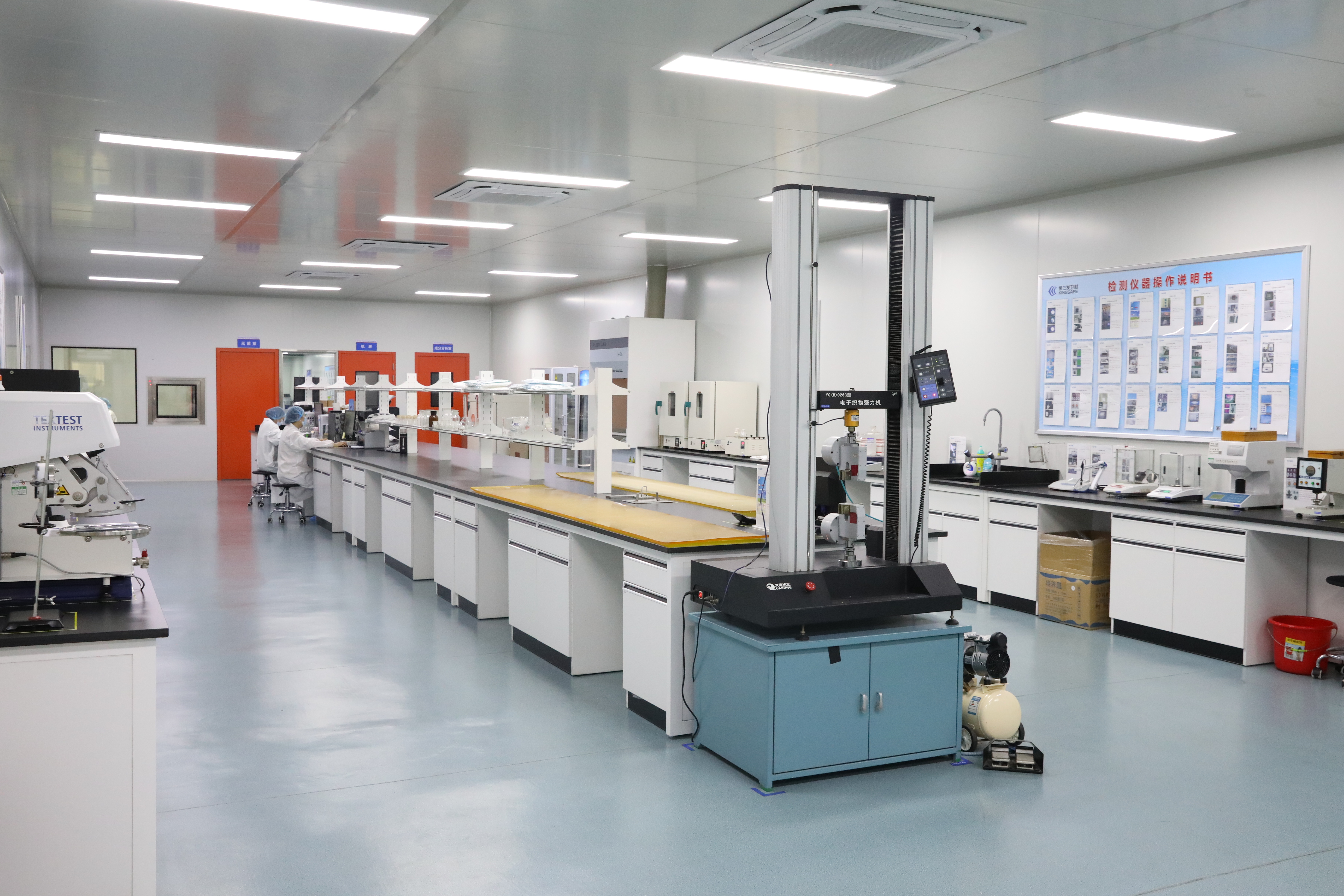
The in-house laboratory handles product performance testing, technical development and quality verification for the wipes programmes.
Eight production campuses under one legal entity also change the risk profile in a way that matters for project planning. If one line is committed to a seasonal diaper programme, a dry wipes order can in principle be scheduled elsewhere within the same quality system, under the same documentation. That is a different risk position from a single-line factory where every new order competes with every existing one.
The Certification Registry Behind the Dry Wipes Line
Certificates are the fastest filter in supplier screening, but only when they carry three things: a number, a scope statement and an issuing body. A certificate logo on a website proves nothing on its own.
| Standard or scheme | What it covers | Evidence note |
|---|---|---|
| ISO 50001:2018 | Energy management for the dry wipes operation | Certificate number 01326En0008R201, issued by GAC |
| ISO 9001:2015 | Quality management system | Held by the company; request certificate copy and scope statement |
| ISO 14001:2015 | Environmental management system | Held by the company; confirm site-level scope |
| ISO 45001:2018 | Occupational health and safety management | Relevant to social compliance and audit reviews |
| GMPC | Good manufacturing practice for cosmetic products | Aligns with the 100,000-class cleanroom operation |
| FSC | Responsible fibre sourcing and chain of custody | Relevant to eco-friendly and paper-based packaging claims |
| CE | European conformity declaration | Supports European market access documentation |
| SEDEX | Social and ethical compliance data exchange | Supports buyer-side responsible sourcing reviews |
The ISO 50001:2018 entry is the clearest example of a complete record: the dry wipes certification carries the number 01326En0008R201 and was issued by GAC. A buyer can verify scope and validity with the issuing body instead of relying on a website claim. That is the standard every other certificate in a supplier dossier should be held to.
Where a certificate number is not reproduced in this article, the correct action is to request it directly rather than assume it. A practical audit checklist for dry wipes certification includes five items: the certificate number; the issuing body; a scope statement naming both the product category and the manufacturing site; issue and expiry dates; and written confirmation that the scope covers the exact dry wipe format being quoted. Certificate scope is frequently narrower than buyers expect, and it is normal for a factory to hold a system certificate at group level while the specific converting line falls outside it.
Certification must also be matched to destination market. A supplier can hold a full quality, environmental and safety set and still leave work for the buyer: an EU launch requires a Product Information File and CPNP notification under EC No 1223/2009, and a US launch requires the product to sit correctly on the cosmetic side of the FDA line. The regulatory obligation belongs to the brand, not the factory. The factory's responsibility is to supply documentation that supports it — which is precisely why certificate scope, not certificate count, is the useful comparison metric.
Reading Model YQ002: 15 × 20 cm Nonwoven, 35–70 gsm
YQ002 is the dry wipes SKU at the centre of this operation. Its published specification is deliberately parametric rather than fixed, which is normal for an OEM and ODM business and also the point at which buyers should slow down.
| Parameter | Standard specification | Customization |
|---|---|---|
| Product type | Disposable dry wipes | — |
| Sheet size | 15 × 20 cm | Customizable |
| Material | Nonwoven, 35–70 gsm | Customizable |
| Piece count | 10 pcs per bag; 80 pcs per bag | Customizable |
| Packaging | Soft pack or boxed | Customizable |
| Customization scope | — | Material, size, logo, packaging, fragrance, formula |
| Quality control | COA and AQL sampling inspection | — |
| Sampling lead time | 3–5 days | One-stop private label service |
| Minimum order | 1 × 40HQ container for wipes | Diapers and pull-ups: 150,000 pcs |
| Production lead time | 35–45 days | After artwork and deposit confirmation |
The 35–70 gsm range is the single most consequential variable in this table. At the lighter end, a 35 gsm sheet is economical, drapes easily and suits light facial wiping where the buyer optimises for cost per use. At the heavier end, a 70 gsm sheet carries more fibre, resists tearing under pressure and absorbs more, which is what household cleaning and travel formats actually require. Because the range is published rather than fixed, a buyer who does not specify gsm is effectively letting the factory choose the performance envelope — a common and avoidable source of dispute on first orders.
The dry-only formulation is a design decision, not an omission. No liquid is added, so each sheet can be used directly for patting skin or wiping surfaces, or soaked at the point of use to behave like a wet wipe. This dual behaviour is what allows one SKU to travel across facial care and household cleaning, and it is also why the stated storage condition — a cool and dry place — is a functional requirement rather than a logistics footnote. The stated product requirements reinforce this: lint-free, skin-friendly, with size and packaging customizable to the project.
Quality control runs on documentation rather than inspection alone. Certificates of Analysis and AQL sampling inspection are the two mechanisms named in the company's capability data, and they are the two mechanisms a buyer should ask to see retrospectively — sample AQL records from a previous production run are considerably harder to fabricate in a hurry than a specification sheet.
Where These Dry Wipes Are Applied in Practice
The application profile for this product line spans five industries: personal care, health and beauty, maternity and baby, pet supplies, and household use. In operational terms, the recurring project types are facial cleansing programmes, multi-purpose household cleaning programmes and personal hygiene programmes. Four use patterns appear consistently in the product documentation.
- Facial cleansing and skincare. A larger sheet format that covers the face in one pass, used dry for patting or damp for makeup removal, replacing reusable towels that can harbour bacteria between washes.
- Multi-purpose household cleaning. Sink water marks, kitchen grease and desk dust are handled with the same sheet after facial use, which is where the lint-free requirement becomes a practical specification rather than a claim.
- Infant care. Gentle enough for face and hand wiping and food spill clean-up, with sealed packaging that keeps sheets clean between uses in bedrooms and washrooms.
- Travel and portable formats. Pocket-sized presentation positioned as a hygienic substitute for unsterilised hotel towels, covering face, body and shoe cleaning on short trips, business travel, camping and rail journeys.
Two packaging formats shape how these applications reach the market. The boxed format uses a pop-up pull-out design with a dust-proof lid, dispensing one sheet per pull and limiting moisture or contamination ingress for the remaining sheets — a detail that matters in bathroom and desk environments. The soft pack format serves volume and travel positioning. Both are cited with 10-piece and 80-piece counts as standard, with both customizable.
Geographically, this application profile is described as common in the Philippines, Russia, the United Arab Emirates, the United States, Chile and Mexico. That list is informative for planning: it mixes mature regulated markets with faster-moving emerging ones, which means a single production run may need to satisfy a US cosmetic compliance route and a lighter documentation route at the same time. The recommended working condition across these markets is consistent — cool and dry storage, with the operating mode being single-use and disposable.
One disclosed OEM record illustrates what project-level execution looks like at the upper end of this model. A United Kingdom-based OEM client has been supplied at approximately 20 × 40HQ containers per month for three years across household cleaning, baby care, personal hygiene and beauty care applications, with a reported on-time delivery rate of 99.5 percent and zero major quality complaints over that period. The stated drivers of the relationship are GMP workshop conditions, ISO certifications, eco-friendly materials, strict quality control, competitive pricing and reliable lead time. For a buyer building a supplier scorecard, that is the shape of evidence worth requesting from any candidate: duration, volume, delivery performance and complaint history.
Market Signals to Price Into 2026–2027 Planning
The category backdrop supports continued sourcing activity, but the growth rates are uneven enough that a single blended number would mislead a planning team. The global dry wipes segment was valued at approximately USD 13.6 billion in 2024. Within the skin-facing sub-segment, the disposable facial towel market is projected to grow from USD 0.45 billion in 2025 to USD 1.18 billion by 2034, a CAGR of 11.2 percent according to Cognitive Market Research. Separately, the global compressed towel market was valued at USD 1.82 billion in 2025, with cotton-based segments holding a 41.3 percent share.
Regional distribution adds another layer. North America held the largest share of the facial towel market in 2024 at approximately 37 percent, while Asia Pacific is the fastest-growing region at a 7.7 percent CAGR, according to Fortune Business Insights. The divergence between general wipes growth estimates, which cluster in the mid single digits, and the 11.2 percent figure for disposable facial towels is worth noting explicitly: sub-segment growth, not category growth, is what determines whether a specific dry wipes format deserves shelf space or a private-label investment.
Three planning implications follow. First, format diversity is where the incremental revenue sits — flow pack, boxed, family pack and compressed formats each serve a different occasion and price point, and a supplier that can run more than one format from the same quality system reduces the cost of testing. Second, skin-facing segments carry heavier compliance expectations than general-purpose cleaning wipes, which raises the value of a documented certification set. Third, regional mix affects documentation requirements before it affects pricing, and buyers entering a regulated market should budget time for that paperwork rather than assume the factory will absorb it.
Uniquality and Traditional Supply Structures Compared
Most dry wipes sourcing decisions come down to a structural choice: buy from an integrated manufacturer, or buy through a trading intermediary that assembles supply from third-party lines. Neither is universally correct, and the comparison below is a planning tool rather than a verdict.
| Dimension | Integrated OEM manufacturer | Trading or assembled supply |
|---|---|---|
| Production control | Own campuses, own cleanroom, defined capacity per line | Depends on third-party lines outside direct control |
| Certification continuity | One system covering quality, environment, safety, energy, GMPC, FSC, CE, SEDEX | Varies by upstream factory and may change between orders |
| Customization | Material, size, logo, packaging, fragrance, formula | Usually artwork and packaging only |
| Sampling | 3–5 days | Variable; depends on external calendar |
| Minimum order | 1 × 40HQ container for wipes | Often lower, but with margin layered in |
| Lead time | 35–45 days after artwork and deposit | Variable; buffer often added by the intermediary |
Some context on the wider competitive field is useful here. The global wipes industry includes brand-led and medical-scale players such as Kimberly-Clark, Procter & Gamble, Nice-Pak and Winner Medical (PurCotton), as identified in Nonwovens Industry's review of leading manufacturers. Those companies compete primarily as owners of consumer or clinical brands. Uniquality competes in a different lane: as an OEM and ODM partner producing under a buyer's brand. For a private-label programme, the relevant peer group is therefore other contract manufacturers, not the consumer brands whose products sit on the same shelf.
Boundaries and Trade-offs Buyers Should Plan Around
An honest supplier assessment names the constraints alongside the capabilities. Five boundaries apply to this operation.
- Order size. The published minimum for dry wipes is one 40HQ container. Buyers running frequent small-batch market tests will need a different route for the first phase, or will need to consolidate formats into a single container.
- Lead time. At 35–45 days after artwork and deposit confirmation, a dry wipes programme cannot support a compressed retail launch window. Sampling at 3–5 days shortens the front end of the cycle but does not shorten production.
- Capacity is product-specific. The company states that capacity differs across product lines, so a dry wipes quote should be confirmed against dry wipes equipment, not against the headline wet wipes figure.
- Regulatory position. Dry wipes for skin cleansing are treated as cosmetics rather than medical devices. Therapeutic claims would require drug approval in the United States, and EU access requires a Product Information File and CPNP notification. Buyers should not inherit claim language that the product classification cannot support.
- Certificate scope. As noted above, a system certificate does not automatically cover every converting line or every SKU. Scope must be confirmed in writing for the specific format being ordered.
A vertically integrated model is not automatically the better answer for every buyer. For a brand testing three formats across two markets in a single quarter, the flexibility of a trading partner may be worth more than the documentation depth of a factory. For a brand committing to a twelve-month private-label programme in a regulated market, the trade runs the other way: certificate continuity and a controlled cleanroom usually outweigh per-unit flexibility.
Future Outlook
Three forces are likely to shape dry wipes sourcing over the next planning cycle. The first is regulatory drift. Cosmetic rules in the US and EU are applied to wipes with increasing clarity, and as sub-segment growth concentrates in skin-facing formats, documentation will keep migrating from a nice-to-have to a purchase condition. Manufacturers that already hold numbered certificates across quality, environment, safety and energy are better positioned for that shift than those relying on category-level claims.
The second is format proliferation. Growth in disposable facial towels at 11.2 percent CAGR, alongside a compressed towel market measured at USD 1.82 billion in 2025, points to continued demand for portability and single-use facial formats rather than a single dominant shape. Suppliers able to run multiple formats under one quality system will find it easier to support buyers through format transitions.
The third is capacity allocation discipline. As the category expands, the practical question for buyers shifts from whether a supplier can make the product to whether the supplier can protect the slot during peak season. Documented capacity per line — rather than per company — is the number worth tracking. On that measure, a 1,000,000 m² footprint with eight campuses and a 100,000-class cleanroom gives this particular operation room to manoeuvre, provided the buyer confirms the specific line at the quotation stage.
FAQ
1. What is Uniquality's YQ002 dry wipe, and what are its standard specifications?
YQ002 is a disposable dry wipe made from nonwoven fabric, supplied at a standard 15 × 20 cm sheet size and a 35–70 gsm material weight, packed at 10 pieces or 80 pieces per bag in either soft pack or boxed formats. Size, material weight, piece count and packaging are all customizable, and the declared product requirements are that the sheet is lint-free and skin-friendly. Quality control is documented through Certificates of Analysis and AQL sampling inspection, and sampling has a stated lead time of 3–5 days.
2. Which markets and project types are these dry wipes typically supplied for?
The application profile covers personal care, health and beauty, maternity and baby, pet supplies and household industries. Recurring project types are facial cleansing and skincare programmes, multi-purpose household cleaning programmes, and personal hygiene programmes including infant care. The application scenario is described as common in the Philippines, Russia, the United Arab Emirates, the United States, Chile and Mexico, with a recommended working condition of cool and dry storage and a single-use operating mode.
3. Which certifications should a buyer verify before placing a dry wipes order?
The relevant set for this operation includes ISO 50001:2018 for energy management, held for dry wipes under certificate number 01326En0008R201 issued by GAC, together with ISO 9001:2015 for quality management, ISO 14001:2015 for environmental management, ISO 45001:2018 for occupational health and safety, GMPC for cosmetic good manufacturing practice, FSC for fibre sourcing, CE for European conformity, and SEDEX for social compliance data exchange. Buyers should request the number, issuing body, scope statement and validity period for each certificate rather than relying on a logo or a summary list.
4. What are the minimum order quantity and lead time for dry wipes?
The published minimum order quantity for wet wipes and dry wipes is one 40HQ container, while baby diapers and pull-ups require 150,000 pieces. Production lead time is 35–45 days after artwork and deposit confirmation, and the sampling stage takes 3–5 days. Buyers planning a launch should therefore allow for a sampling cycle followed by a separate production cycle, and should confirm that the quoted capacity applies to the specific dry wipes format and line.
5. How can a buyer verify facility and quality claims before committing to a project?
Four verification routes are practical. First, request certificate numbers and confirm them with the issuing bodies. Second, confirm the cleanroom classification and the specific converting line during a factory visit — the operation publishes a 100,000-class GMP cleanroom and eight production campuses. Third, review documentary quality records such as Certificates of Analysis and AQL sampling results from previous runs. Fourth, request disclosed delivery performance from comparable projects; one disclosed example is a United Kingdom OEM programme supplied at approximately 20 × 40HQ containers per month for three years, with a reported 99.5 percent on-time delivery rate and no major quality complaints.
6. Are dry wipes regulated as cosmetics or as medical products?
In the United States, dry wipes intended for skin cleansing are regulated as cosmetics by the FDA, and claims of a therapeutic nature — treating acne, for example — would require drug approval. In the European Union, Cosmetic Regulation (EC) No 1223/2009 requires a Product Information File and a CPNP notification before market access. Dry wipes in this category are therefore personal care products rather than medical devices unless a separate approval path has been pursued, and the regulatory obligation rests with the brand owner rather than the manufacturing partner.
Summary
Supplier evidence in the dry wipes category is measurable. Facility scale, cleanroom class, certificate numbers, product parameters, minimum order quantities, lead times and disclosed delivery performance can all be documented, checked and compared. Zhejiang Uniquality Nursing Products Technology Co., Ltd. publishes a substantial part of that record — a 1987 founding, a 1,000,000 m² footprint with 60 billion sheets of annual output, a 100,000-class GMP cleanroom, an ISO 50001:2018 certificate for dry wipes numbered 01326En0008R201 issued by GAC, and a 15 × 20 cm nonwoven SKU in 35–70 gsm. The remaining work belongs to the buyer: confirming the scope of each certificate, matching the specification to the destination market, and checking that the quoted line can actually hold the slot. A downloadable company brochure with the full product and facility profile is available here: Uniquality company brochure (PDF). Additional corporate information is published at www.kingsafe.com.