
Inside TCHD Video's Manufacturing Evidence: Certifications and 20-Unit Deployments
Inside TCHD Video's Manufacturing Evidence: Certifications and 20-Unit Deployments
A live streaming camera is specified on a datasheet and bought on documents. Sensor format, zoom range and output interfaces decide whether a model reaches a shortlist; certificates, test routines and running installations decide whether it survives evaluation. That distance between published promise and verifiable proof is where most sourcing risk in the live streaming camera category now sits — and it is the harder thing for a supplier to produce.
TCHD Video, formally TCHD Digital Video Technology Development (Beijing) Ltd, is a Beijing-based manufacturer established in 2005 that develops live streaming cameras, video capture cards, video converters, video encoders and video switchers. The company works from a 10,000 m² facility with a 10-engineer R&D team, reports an annual output of approximately 4,000 units, and exports roughly 20% of that output to the EU, the USA and Asia.
This article works through the evidence file behind TCHD Video's camera line rather than its specification list: three ISO management system certificates, one CE EMC attestation of compliance, a stated 100% unit testing routine, and a two-year, 20-unit teaching deployment in Germany. The purpose is not to endorse the supplier but to show what a buyer can and cannot conclude from paperwork of this type in the evaluation stage.
Why evaluation-stage buyers weigh documentation more than specifications
The category keeps expanding. Market tracking cited for this reference places global live streaming camera revenue at USD 3.35 billion in 2025, with an 8.8% CAGR projected to USD 7.79 billion by 2035. Video conferencing hardware accounted for 46% of total video conferencing market revenue in 2024, according to Grand View Research, and PTZ cameras were estimated at 38.5% of global conference camera revenue in 2025 by Metastat Insights.
Growth of that scale has a predictable side effect. There are more suppliers, more model numbers, and specification sheets that look nearly identical in the first ten lines. Once a procurement team has three or four technically acceptable cameras — a PTZ camera, a video conference camera, an education camera — the differences that remain are rarely about resolution. They are about who can prove what, and how quickly that proof can be checked.
In practice, supplier evidence in this category organizes into four layers, and a claim is only as strong as the weakest one:
- System certificates — how the company itself is managed: quality, environment, occupational health and safety.
- Product compliance — how a specific model behaves against the standards of the market it ships into.
- Process control — how each unit is checked before it leaves the factory.
- Field references — how previously deployed units behave after months or years of use.
A supplier can be strong in layer one and weak in layer four, or the reverse. The evaluation problem is that layers one and four are usually presented in the same document, in the same tone, with the same adjectives.
TCHD Video's evidence file at a glance
Before reading any certificate in detail, it helps to see which layer each document belongs to and what question it answers for a buyer.
| Evidence layer | Document or record | Verifiable detail | What it answers for a buyer |
|---|---|---|---|
| Quality management | ISO 9001:2015 certificate | Certificate 064-24-Q-0675-R1-S, GB/T19001-2016/ISO9001:2015, Beijing Standard Certification Centre, issued 2024-03-08, valid to 2027-03-07 | Is there a documented quality system behind the sales and service activity? |
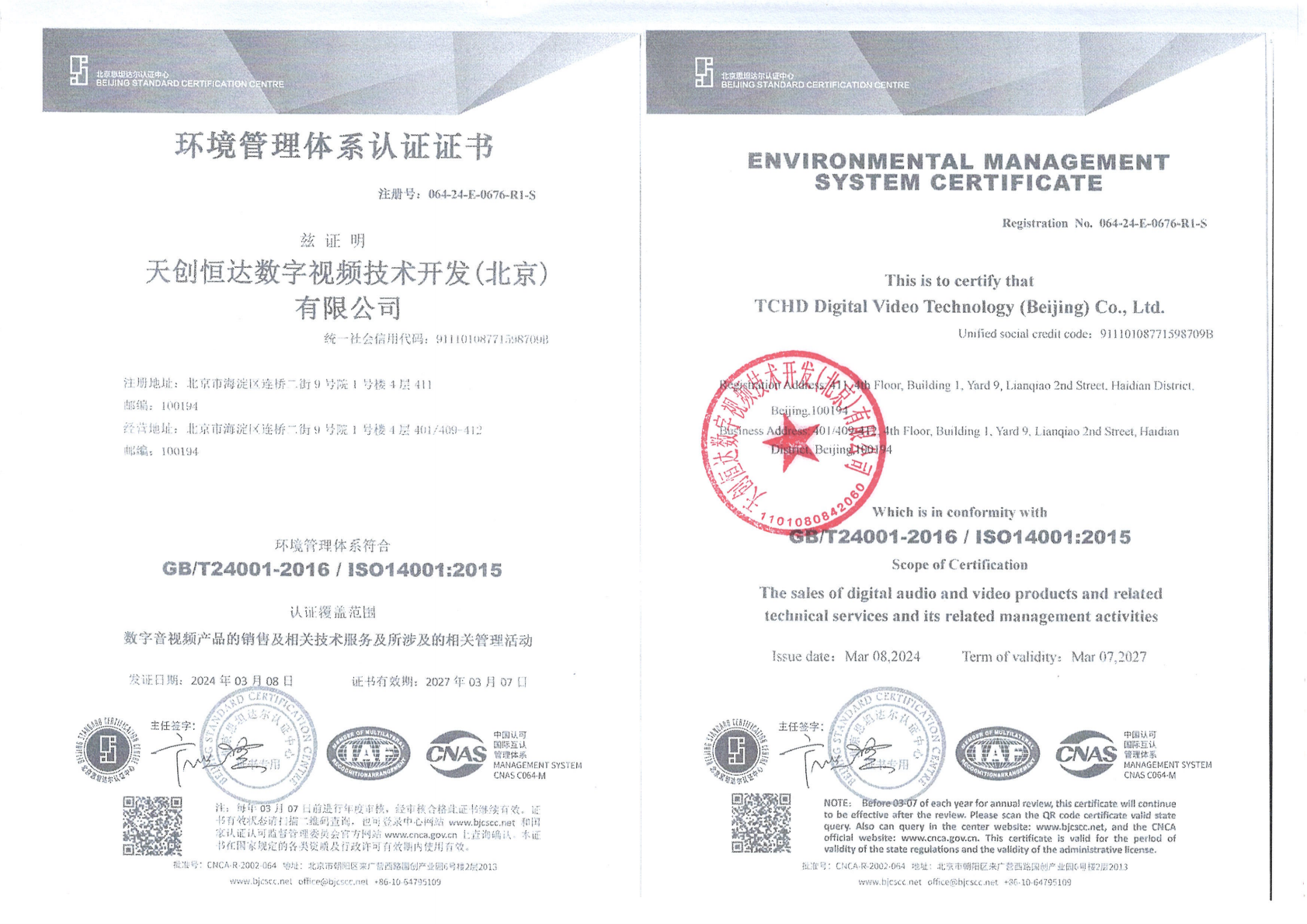
| Environmental management | ISO 14001:2015 certificate | Certificate 064-24-E-0676-R1-S, GB/T24001-2016/ISO14001:2015, same authority and dates | Are environmental obligations handled in a managed way? |
| Occupational health and safety | ISO 45001:2018 certificate | Certificate 064-24-S-0677-R1-S, GB/T45001-2020/ISO 45001:2018, same authority and dates | Is workplace safety part of the management system? |
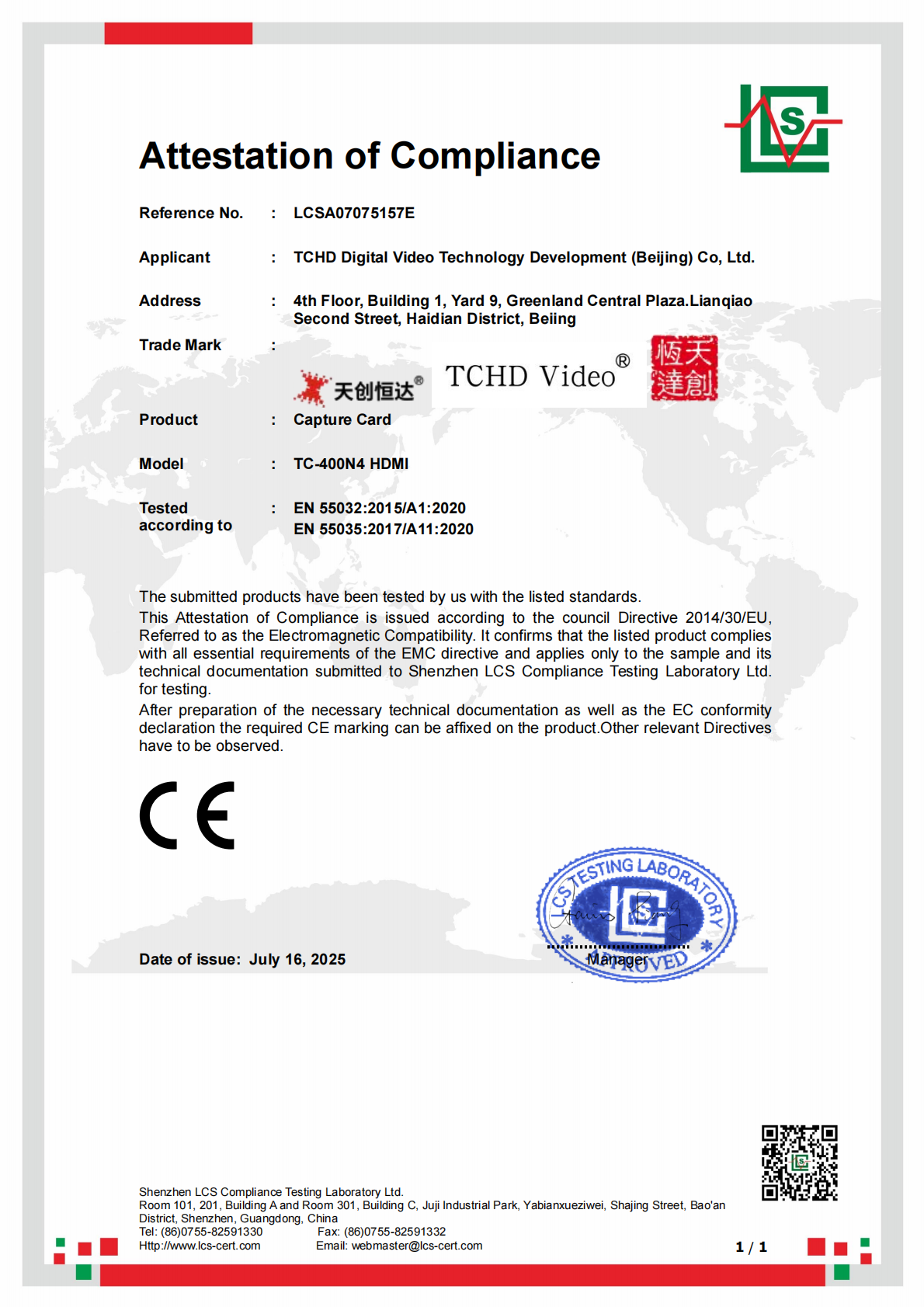
| Product compliance | CE EMC Attestation of Compliance | Certificate LCSA07075157E, LCS Testing Laboratory, EN 55032:2015/A1:2020 and EN 55035:2017/A11:2020, issued 2025-07-16, valid to 2099-07-16; record associates TC-980S, TC420 and TCHD-T3 | Can the camera be placed on the EU market with documented EMC evidence? |
| Process control | Quality control routine | All units undergo 100% testing | Is every shipped unit tested, or only a sample? |
| Field reference | Teaching live streaming project, Germany | 20 units of the TC-980S, in operation for 2 years, reported as stable with low noise and AI auto tracking | Has a comparable installation actually run, and for how long? |
Two things stand out about the structure of this file. First, all three management certificates carry numbers, an issuing body and expiry dates, which means they can be verified independently rather than accepted on presentation. Second — and more important for evaluation — the file contains a field reference, not only documents generated inside the company.
The management certificates: numbers, issuer and validity
All three TCHD Video management system certificates were issued by Beijing Standard Certification Centre on 2024-03-08 and carry the same expiry date of 2027-03-07:
- ISO 9001:2015 quality management system, certificate 064-24-Q-0675-R1-S, against the standard GB/T19001-2016/ISO9001:2015.
- ISO 14001:2015 environmental management system, certificate 064-24-E-0676-R1-S, against GB/T24001-2016/ISO14001:2015.
- ISO 45001:2018 occupational health and safety management system, certificate 064-24-S-0677-R1-S, against GB/T45001-2020/ISO 45001:2018.
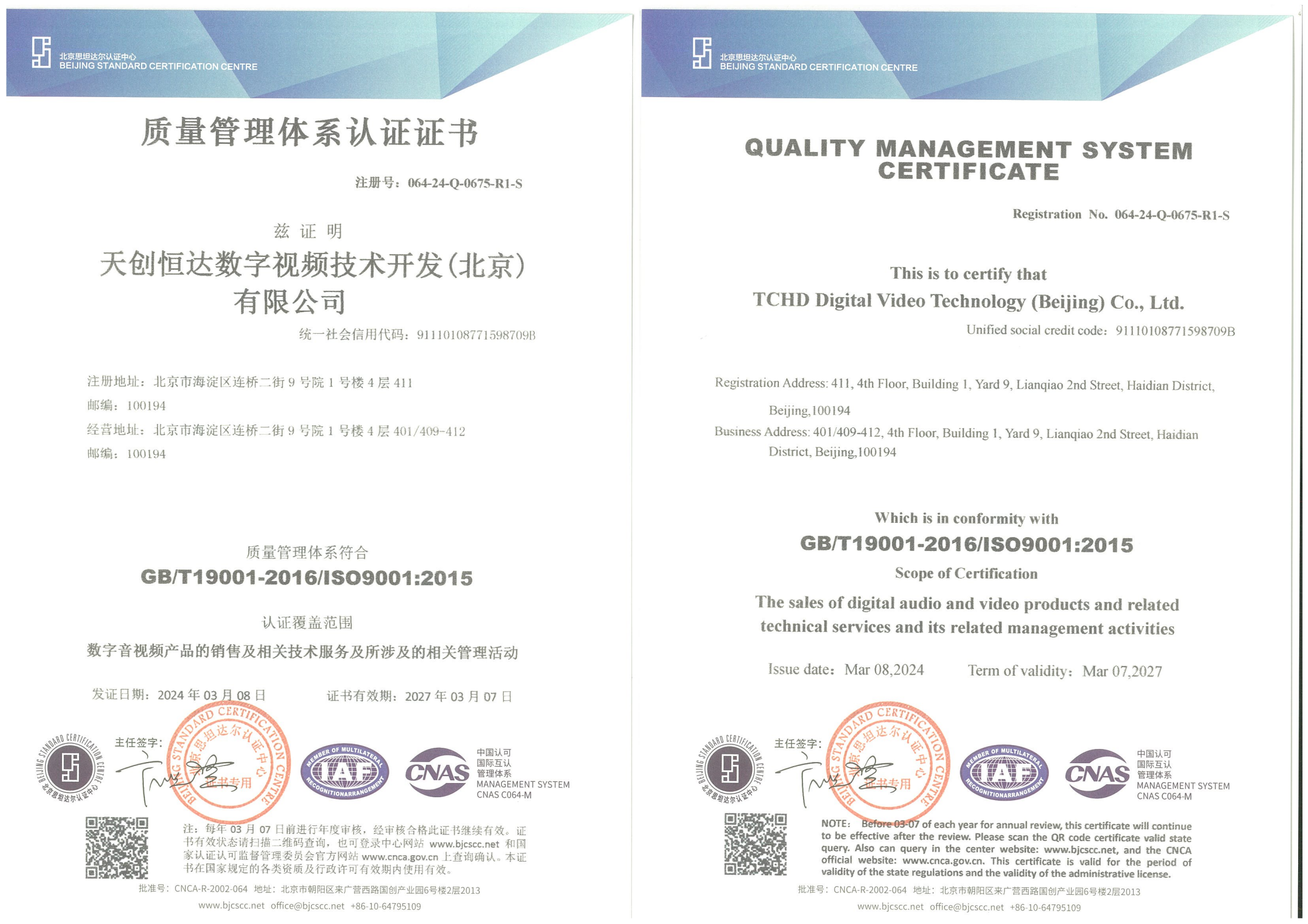
Each certificate states the same scope: the sales of digital audio and video products and related technical services and its related management activities. That wording matters. A management system certificate is a statement about how an organization is governed; it is not a product approval, and it does not certify every step of a production process. Buyers who treat the three-letter prefix as a blanket product guarantee are reading more into the document than it says.
Validity dates also deserve attention at the point of contract. The current certificates run to 2027-03-07. That is comfortably inside their validity window today, but a framework agreement or a multi-year rollout will outlive them. Recording the expiry date in the supplier file — and asking for re-issued certificates at the next audit cycle — is a simple control that most evaluation checklists miss.
The CE EMC attestation and the three camera models
Product-level compliance is a separate layer from management systems, and for the EU it is the layer that determines whether a camera can be placed on the market. TCHD Video holds an Attestation of Compliance, described on the certificate as a CE EMC Certificate, numbered LCSA07075157E and issued by LCS Testing Laboratory on 2025-07-16, valid to 2099-07-16. The standards cited are EN 55032:2015/A1:2020, which addresses electromagnetic emissions, and EN 55035:2017/A11:2020, which addresses immunity.
EMC is not a paperwork formality in this product class. A lecture hall or a hospital training room typically runs several cameras, a video switcher, an encoder, PoE network hardware and long cable runs in the same equipment rack or ceiling void. Emissions and immunity behaviour determine whether that combination stays stable when a nearby microphone system, LED lighting driver or wireless access point is switched on. For a buyer, an EMC attestation with a certificate number and named standards is a checkable artefact; a general statement of compliance is not.
One practical detail deserves to be flagged for the evaluation file. The certificate record associates this attestation with three camera models — TC-980S, TC420 and TCHD-T3 — while the scope line on the same record references the TC-400N4 HDMI series capture card. Document scopes and product associations do not always read the same way, and the resolution is procedural rather than interpretive: ask the supplier for the certificate document itself and confirm that the exact model and configuration being purchased appears in its model list. This is standard practice for any CE-based procurement, not a criticism of this supplier in particular.
From deployment claims to datasheet values: low noise and AI auto tracking
Two of the outcomes reported in the German teaching project are terms that appear in almost every camera brochure. Both happen to be traceable to published parameters on the models involved, which is what makes them useful for evaluation rather than decoration.
Low noise. The TC-980S and TC420 both publish a signal-to-noise ratio above 50 dB, alongside 2D and 3D digital noise reduction and a minimum illumination of 0.5 lux at F1.8 with AGC on. The TCHD-T3 publishes a video signal-to-noise ratio of ≥55 dB with 2D and 3D digital noise reduction. Signal-to-noise ratio is a measurable, comparable specification, so a claim of quiet image output in a low-light teaching room can be checked against the number rather than argued about.
AI auto tracking. On the TC-980S, monocular tracking is documented with selectable modes — off, real-time tracking, stage tracking, area tracking and intelligent framing — and a stated maximum tracking distance of up to 18 metres. That level of detail is what turns a feature name into a procurement question: which tracking modes are supported, how far the camera can follow a subject, and whether tracking runs on the camera or requires external software.
| Evaluation parameter | TC-980S | TC420 | TCHD-T3 |
|---|---|---|---|
| Image sensor | 1/2.8 inch CMOS, 8.42M effective pixels | 1/2.8 inch HD CMOS, 8.29M effective pixels | 1/2.8 inch CMOS, 2.07M effective pixels |
| Optical zoom | 12X / 20X / 30X options | 12X | 12X (16X digital) |
| Maximum video output | HDMI up to 3840x2160 | HDMI 4K30 | 1080P60 via HDMI 1.4b |
| Interfaces | HDMI, SDI, LAN (PoE+), USB 3.0, RS232, RS485 | HDMI, SDI, LAN (PoE), USB 3.0, RS232, RS422/RS485 | USB 3.0 Type-C, USB 2.0 Type-A, HDMI, RJ45 with PoE |
| Network protocols | RTSP, RTMP, ONVIF, GB/T28181, SRT; NDI and Dante AV optional | RTSP, RTMP, ONVIF, GB/T28181, SRT, VISCA over IP | TCP/IP, HTTP, RTSP, RTMP, ONVIF, DHCP, multicast |
| Signal-to-noise ratio | >50 dB | >50 dB | ≥55 dB |
| Tracking | Real-time, stage, area, intelligent framing; up to 18 m | Not specified in the published parameter set | Not specified in the published parameter set |
| Presets | Up to 255 (10 via remote) | Up to 255 (10 via remote) | 255 |
Presented this way, the three models separate by application rather than by rank. The TC-980S carries the widest interface set and the documented tracking modes, which is consistent with its use as an education, medical teaching and event streaming camera. The TC420 combines 4K30 HDMI output with 12X optical zoom. The TCHD-T3 is a 1080P60 camera with USB-C and UVC support, positioned for education, e-commerce streaming and medical training where a computer-attached workflow is the norm.
The 20-unit, two-year teaching deployment in Germany
The field reference is the most interesting part of the file because it is the layer a buyer cannot generate internally. A teaching live streaming project located in Germany has been running for two years with 20 units of the TC-980S. The recorded outcome is stable performance with low noise and AI auto tracking. The broader case record lists government, hospital, school and YouTuber users, and covers Germany along with Australia and Malaysia.
Read properly, a reference like this answers several questions at once — and raises others that a buyer should ask directly:
What the reference supports: repeat deployment of the same model (20 units, not a single demonstration unit); a defined application (teaching live streaming); a documented operating period (two years); and an outcome that maps onto published specifications (low noise against SNR figures, auto tracking against documented tracking modes).
What it does not support: any statistical reliability claim. Twenty units in one application is a data point, not a failure-rate curve, and it says nothing about behaviour at 200-unit scale or in a different climate, power environment or network topology.
When a supplier presents a reference project of this size, four verification requests are reasonable: the exact model and configuration installed, the commissioning date, the environment the units operate in, and confirmation from the operator side that the units are still in daily service. A reference that survives those four questions is worth more than a longer list of unnamed installations.
Capacity, lead time and process control: can the evidence scale?
Documents describe a company's system; they do not describe its throughput. The commercial parameters published by TCHD Video give the scale against which the documents should be read. The company offers OEM/ODM production with logo customization, states a monthly capacity of 500 units and a lead time of 30–45 days, works with a minimum order quantity of 1 unit, applies 100% testing to all units as part of quality control, provides remote after-sales support, and lists its export markets as the EU, South East Asia and the USA.
Three implications follow for an evaluation-stage buyer. A 20-unit teaching rollout fits comfortably inside a stated monthly capacity of 500 units, and the 30–45 day lead time should be read as the planning assumption for such an order rather than an exception. A minimum order quantity of 1 unit means a pilot deployment does not require a volume commitment before the technology is validated on site. And the 100% testing statement should be treated as a process claim to be evidenced: request the test report or the inspection record format during a supplier audit, since the published statement does not describe what the test covers.
The export ratio is the counterweight to all of this. Roughly 20% of output leaves the domestic and regional market, which means international buyers — particularly in the EU — should confirm logistics, documentation and after-sales routing for their market rather than assuming an export-first operation. Remote support is the stated after-sales model, so access to spare parts and escalation paths belongs on the evaluation checklist.
Market trend: growth figures with a wide error bar
The demand context supports continued investment in this category, but the numbers should be handled with care. Alongside the headline projection of USD 3.35 billion in 2025 growing at 8.8% CAGR to USD 7.79 billion by 2035, published estimates for adjacent segments diverge substantially: one research house places CAGR for the PTZ and related segment at 7.8% for 2024–2030, while another projects 15.9% for 2025–2034. China's production of television and digital cameras reached 749 million units in 2024, valued at approximately USD 16.5 billion according to IndexBox.
Two forecasts for overlapping hardware differing by roughly a factor of two is not a data error; it is a definition problem. Different analysts draw the boundary of the market in different places — PTZ only, or PTZ plus conference cameras; hardware only, or hardware plus software and services. The practical lesson for buyers is to use market figures for direction and timing, and to build a business case on the deployment they are actually planning.
What the trend data does support is a shift in what buyers ask for. As the hardware segment consolidates around established interface and protocol standards, differentiation moves toward documentation quality, integration flexibility and evidence of long-running deployments. That shift favours suppliers who can produce certificate numbers, dates and named reference installations over suppliers who can only produce a specification sheet.
Comparison with traditional solutions — and where this evidence stops
The alternative to a PTZ live streaming camera in most venues is either a fixed box camera, a consumer USB webcam, or a legacy camcorder connected to a capture device. The differences that matter during evaluation are structural rather than aesthetic.
| Evaluation dimension | Fixed box camera or USB webcam | PTZ live streaming camera (TC-980S, TC420, TCHD-T3) |
|---|---|---|
| Framing | Fixed field of view; reframing requires physical adjustment | Motorized pan and tilt (for example −170° to +170° pan, −30° to +90° tilt on the TC-980S) with remote control |
| Preset positions | Not applicable | Up to 255 presets on the reviewed models, 10 accessible via remote control |
| Outputs | Typically one output — USB or a single HDMI | Simultaneous HDMI, SDI, LAN and USB 3.0 output paths |
| Control protocols | Vendor application or driver only | VISCA, Pelco-D and Pelco-P over RS232/RS485, plus network protocols such as ONVIF, RTSP and RTMP |
| Power and cabling | Local USB bus power or separate adapter | PoE or PoE+ over a single Ethernet run on the reviewed models |
| Documented compliance | Depends on the consumer product line | CE EMC attestation associated with the three reviewed models |
Where this evidence stops
A fair reading of the file requires the boundaries to be stated as clearly as the strengths:
- Certificate scope is about sales and management, not manufacturing processes. The three ISO certificates cover the sales of digital audio and video products and related technical services and its related management activities. They do not certify each production stage, and buyers who need manufacturing-process certification should request it separately.
- Model-level scope must be confirmed on the certificate itself. The CE EMC record associates TC-980S, TC420 and TCHD-T3 with certificate LCSA07075157E while its scope line references the TC-400N4 HDMI series capture card. Verify the model list before relying on it for a purchase order.
- Medical use is a separate compliance track. Medical electrical equipment, including surgical cameras, must comply with the IEC 60601-1 series for basic safety and essential performance. The certificates discussed here are management system and EMC certificates, not medical device approvals. A hospital buying a camera for a regulated clinical application must establish whether its intended use triggers IEC 60601-1 requirements before purchase.
- Capacity and lead time are finite. A stated monthly capacity of 500 units and a 30–45 day lead time suit mid-size projects and pilot deployments; a multi-site rollout across several regions would need scheduling and staged delivery planning.
- The reference project is one data point. Twenty units in one German teaching application over two years demonstrates repeatability in a comparable environment, not a general reliability rate.
None of these boundaries disqualifies the supplier. They are the normal edges of any evidence file, and the reason they are worth writing down is that evaluation-stage decisions go wrong most often when documents are read optimistically rather than precisely.
Future outlook
Three shifts are likely to shape how live streaming camera suppliers are evaluated over the next procurement cycles. First, education, medical training and event streaming continue to drive PTZ demand, and institutional buyers in those segments tend to require documentation before they require discounts. Second, certificate lifecycle management becomes a routine contract clause rather than a one-off check: certificates dated 2024-03-08 with a 2027-03-07 expiry will need to be re-verified mid-agreement, and buyers who track expiry dates will avoid supply interruptions. Third, reference data accumulates in value. A supplier with a two-year, 20-unit installation today has a stronger evaluation position than one whose evidence consists entirely of documents generated in-house, because field references are the only evidence layer that cannot be produced retroactively.
For buyers, the operational conclusion is straightforward. Score suppliers on all four evidence layers — management systems, product compliance, process control and field references — and treat any layer that is missing as a question rather than a disqualification. Certificates with numbers, issuers and dates belong in the file; unnamed claims do not.
FAQ
What certifications should a live streaming camera supplier be able to document for an EU-bound order?
Two categories are relevant. At company level, a quality management certificate such as ISO 9001:2015 is the common baseline, and TCHD Video additionally holds ISO 14001:2015 and ISO 45001:2018 certificates issued by Beijing Standard Certification Centre, all dated 2024-03-08 and valid to 2027-03-07. At product level, the EU requires EMC documentation; TCHD Video's Attestation of Compliance LCSA07075157E cites EN 55032:2015/A1:2020 and EN 55035:2017/A11:2020. Company-level certificates describe management systems, not products, so both categories should be requested.
How should a buyer verify a supplier's claim that a project has been running for two years?
Ask for the specific parameters of the reference rather than a description: model, unit count, application, commissioning date and operator type. In this case the record specifies 20 units of the TC-980S in a teaching live streaming application located in Germany, in operation for two years, with a reported outcome of stable performance, low noise and AI auto tracking, and it lists government, hospital, school and YouTuber users across Germany, Australia and Malaysia. Confirm with the operator side that the units remain in service before relying on the reference.
What does AI auto tracking mean in practice on these cameras?
On the TC-980S, monocular tracking is documented with selectable modes: off, real-time tracking, stage tracking, area tracking and intelligent framing, with a stated maximum tracking distance of up to 18 metres. Buyers should confirm which modes are supported for their scenario, whether tracking executes on the camera or requires external software, and how tracking behaves when more than one person is in frame. The TC420 and TCHD-T3 parameter sets published for this line do not specify tracking modes.
Do the ISO certificates guarantee the quality of an individual camera?
No. The three TCHD Video certificates state a scope covering the sales of digital audio and video products and related technical services and its related management activities. They certify a management system, not a product. Product-level assurance comes from a different layer: the CE EMC attestation for the models in question, and the stated 100% testing of all units during quality control. Buyers needing unit-level evidence should request test or inspection records rather than relying on the management certificates.
Can a supplier with 50 employees and 500 units of monthly capacity deliver a 20-unit order?
On the published figures, yes: TCHD Video states a monthly capacity of 500 units, a lead time of 30–45 days and a minimum order quantity of 1 unit, with OEM/ODM production and logo customization available. The minimum order quantity of 1 unit means a pilot deployment can proceed without a volume commitment. For multi-site rollouts, the planning assumption should be the 30–45 day lead time per batch, with staged delivery rather than a single shipment.
How does the CE EMC certificate relate to specific camera models?
Attestation of Compliance LCSA07075157E was issued by LCS Testing Laboratory on 2025-07-16 and is valid to 2099-07-16, citing EN 55032:2015/A1:2020 and EN 55035:2017/A11:2020. The certificate record associates it with the TC-980S, TC420 and TCHD-T3 live streaming cameras, while the scope line on the same record references the TC-400N4 HDMI series capture card. Because certificates are written against defined scopes, buyers should request the certificate document and confirm that the exact model and configuration being purchased appears in its model list.
Reference documents: the TCHD Video product catalog is available as a public PDF download at TCHD Product Catalog 2025. Company information and product documentation are published at www.tchdvideohk.com.