
Inside T9 EV Station: Manufacturing and R&D Evidence for Tesla Service Buyers
Inside T9 EV Station: Manufacturing and R&D Evidence for Tesla Service Buyers
For procurement teams screening Tesla aftermarket partners, the decisive question is no longer what a supplier says it can do — it is what physical and human assets the supplier has already committed. T9 EV Station discloses a 20,000 m² facility, a 20-engineer R&D team and more than 100 employees. Those are inputs that can be examined rather than believed, which is precisely why they matter at the evaluation stage of a buying cycle.
Why Tesla Service Procurement Now Starts With Capacity Evidence
The demand side of the Tesla aftermarket has moved faster than the supply side. Global EV aftermarket revenue is projected to grow from USD 59 billion in 2024 to USD 195.07 billion by 2035, a CAGR of 11.5%, according to MarketsandMarkets. Tesla's own "Services and Other" revenue reached USD 3.47 billion in Q3 2025, compared with USD 2.79 billion in Q3 2024, as reported in Tesla's investor filings.
In the United States alone, the Tesla aftermarket parts opportunity is estimated at USD 2.8 billion to USD 4.2 billion in 2025, driven by more than 1.8 million owners with high average household incomes (Vertex AI Search / Industry Analysis, 2025). Repair economics reinforce the same direction: average claims severity for repairable battery-electric vehicles in the U.S. reached USD 6,236 in 2024, roughly USD 1,170 above the USD 5,066 average for internal combustion vehicles (Mitchell, 2024).
The problem is structural rather than financial. Tesla service demand arrives through a fragmented supply base — single-category film shops, independent garages, general detailing studios and modification resellers — where capacity is often claimed in marketing language and verified only after a purchase order is signed. Two questions separate credible suppliers from optimistic ones: how much physical space and how many trained people stand behind the promise, and what documented process governs the work itself.
T9 EV Station at a Glance
Hangzhou T9 EV Technology Co., Ltd., trading as T9 EV Station, is a Tesla-focused aftermarket service company founded in 2021 and headquartered in Hangzhou, Zhejiang Province, China. The company operates more than 100 Tesla-exclusive stores across China, has extended service stations to Los Angeles and Malaysia, and covers film installation, automotive supplies and accessories, modification and upgrading, daily maintenance and repair, supported by a catalog of more than 5,000 SKUs.
Its disclosed physical estate is 20,000 m². Its workforce exceeds 100 employees, organized into a technical R&D team, a professional construction and maintenance team, a supply chain management team, a digital operations team, and a customer service and after-sales team. Twenty engineers sit within the R&D function. Reported service volume stands at over 300,000 Tesla vehicles, and the company has published strategic partnerships with 3M, BOSCH, Wynn's, Hengst, MXR, XPEL, 3W, AGF and Hikvision.
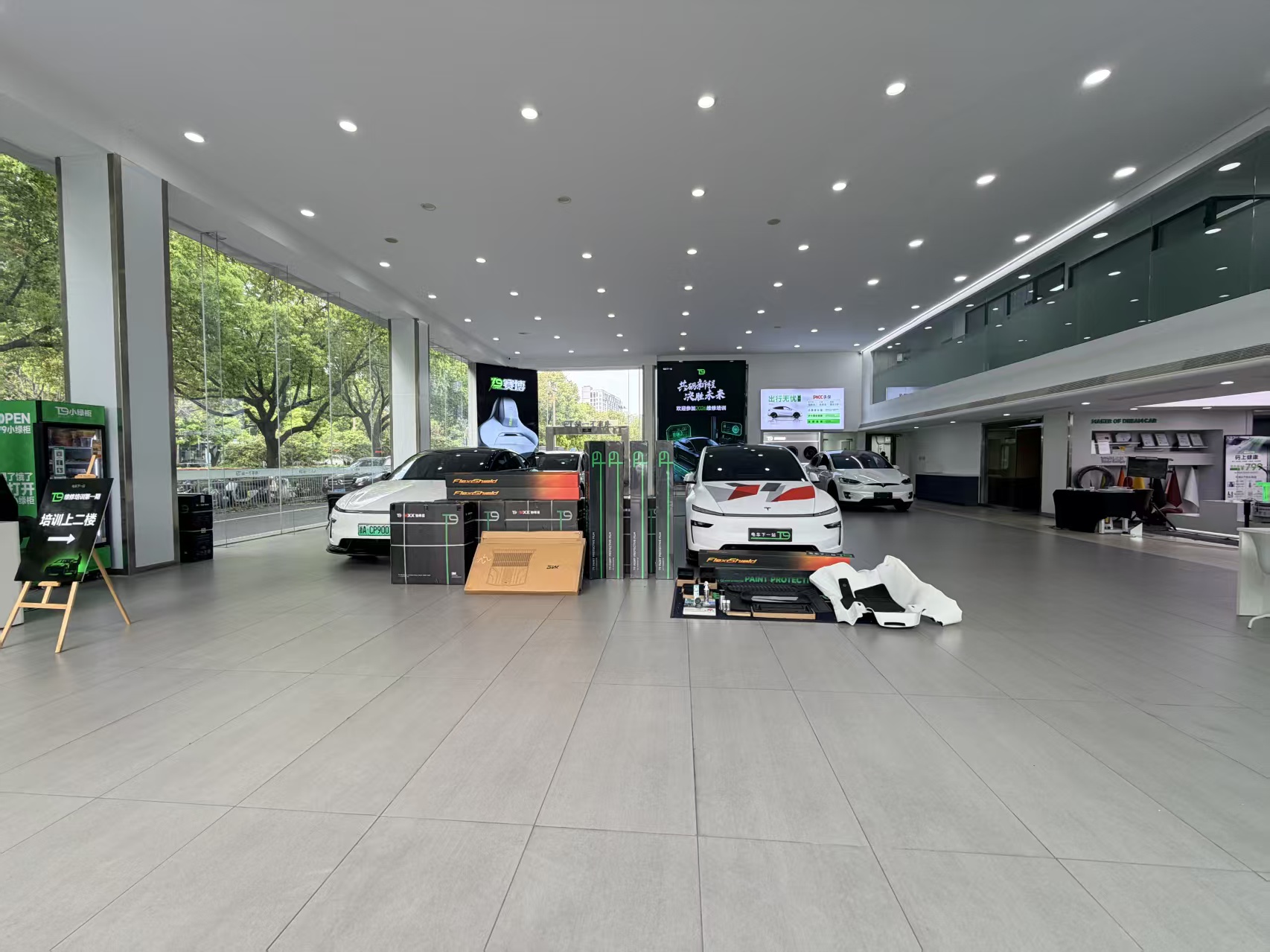
T9 EV Station's customer-facing facility front end — the entry point for a 20,000 m² service estate that also houses construction workshops and parts handling.
What a 20,000 m² Facility Proves — and What It Does Not
A 20,000 m² footprint is meaningful in Tesla aftermarket work for three operational reasons. First, film and coating installation consumes dedicated bay space that cannot be shared with mechanical repair, because dust control and cure time are incompatible with lift work. Second, a 5,000+ SKU supply system requires real inventory storage rather than drop-shipping, since delayed parts directly extend vehicle downtime. Third, a multi-city network needs a central training and standardization site where construction standards are taught and re-taught.
T9 EV Station's facility accommodates both customer-facing showroom space and dedicated construction workshops, which is the layout a full-life-cycle service operator requires: 5,000+ SKU inventory storage, parallel work bays for film, modification and maintenance, and a training environment for network technicians.
What floor space does not prove is output quality. A large facility can still deliver inconsistent work if process control is weak. The relevant companion evidence is procedural: a standardized construction SOP system, unified pricing across the network, and an electronic cloud warranty system that ties each job to a traceable record. Buyers evaluating any supplier should treat square meters as a capacity signal and process documentation as a quality signal — they are not interchangeable.
The 20-Engineer R&D Team: The Part Buyers Usually Cannot See
An in-house engineering function is the least visible and most diagnostically useful capability asset in Tesla aftermarket service. T9 EV Station maintains a 20-engineer R&D team, and the documented technical scope of that function covers Tesla vehicle electronic system testing and diagnostics, non-destructive modification and installation technology, professional automotive film and coating construction, and maintenance and repair technology for new energy vehicles.
Translated into procurement terms, that scope addresses four recurring failure points in the independent Tesla aftermarket. Diagnostic capability determines whether a fault is correctly attributed before parts are ordered. Non-destructive installation methods determine whether interior and exterior modification preserves original trim and sensor calibration. Film and coating application standards determine whether protection survives its first winter. New energy vehicle repair competence determines whether high-voltage-adjacent work is handled within accepted practice.
The engineering team also underpins the assets that make a multi-store network replicable rather than merely large. These include the standardized construction SOP system, the nationwide unified pricing and service system, the electronic cloud warranty management system, and the digital layer of ERP and CRM systems used for store management, customer records and online quotation.
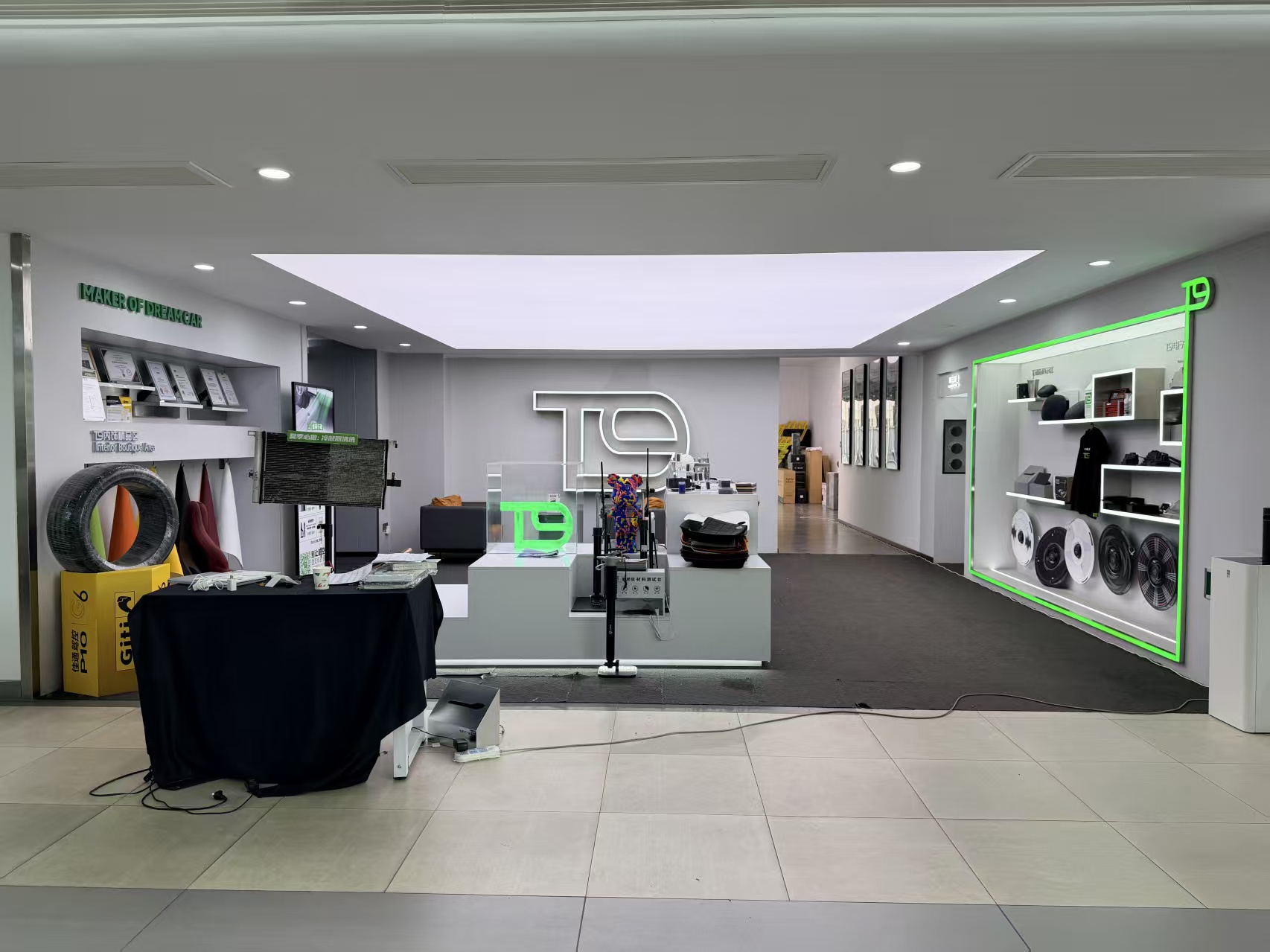
A T9 EV Station construction workshop: the operational layer where standardized SOP processes and diagnostic capability convert facility capacity into delivered service.
Capability Evidence Map: Disclosed Assets and Their Procurement Meaning
The table below maps T9 EV Station's disclosed capability assets to their practical meaning for a buyer or franchise partner. Every figure in the left column comes from company-disclosed information.
| Disclosed asset | What it indicates | Procurement question it answers |
|---|---|---|
| 20,000 m² facility | Parallel bay capacity, inventory storage, central training | Can the supplier absorb volume without queuing? |
| 20-engineer R&D team | Diagnostics, non-destructive methods, SOP ownership | Is the technical standard internal or outsourced? |
| More than 100 employees across five functions | Segregated supply chain, digital, construction and after-sales roles | Is accountability assigned, or does one team do everything? |
| 100+ Tesla-exclusive stores in China | Repeatable network model rather than a single site | Can the model be replicated in another market? |
| 5,000+ SKU parts supply system | Parts availability tied to service scheduling | How is downtime managed when parts are required? |
| Electronic cloud warranty system | Traceable job records and unified warranty coverage | What happens if a defect appears after handover? |
| Service duration by category (maintenance 1 day; film 1–2 days; modification/repair 2–7 days) | Published throughput commitments | Can delivery windows be planned against a stated range? |
| Franchise business filing qualification and motor vehicle maintenance operation record | Formal operating status for a chain model | Is the franchise structure a registered operation? |
Organizational depth behind the headcount
The value of a 100-plus workforce in this category is not the number itself but the separation of duties it allows. T9 EV Station's structure assigns supply chain quality inspection, store operation management, modification design engineering, Tesla service technician work and customer success to distinct roles. Supporting tooling includes professional vehicle diagnostic equipment, automotive film and coating construction tools, modification and maintenance tools, and digital management systems. Multilingual capability covers Chinese and English, which is directly relevant to overseas partners assessing a supply-side relationship.
How the Capacity Translates Into a Tesla Modification Franchise Model
A Tesla modification franchise succeeds or fails on whether the operating standard survives replication. T9 EV Station's franchise-relevant disclosures point to three supporting mechanisms. First, a franchise business filing qualification, alongside a motor vehicle maintenance operation record, establishes the chain structure as a formal operating model rather than a loose brand arrangement. Second, the standardized construction SOP system and nationwide unified pricing remove the two variables that most often break consistency across a network. Third, the electronic cloud warranty system gives every store the same after-sales commitment, which is the element independent shops typically cannot offer.
Service coverage in the model spans automotive film installation including paint protection film and window film, automotive supplies and accessories, vehicle modification and personalized upgrading, daily maintenance and care, vehicle repair and maintenance, and overseas service station support. Delivery runs through authorized physical stores, door-to-door service in some cities, and online parts supply with installation guidance — a combination that matters to partners who need to serve customers outside a single metropolitan area.
International reach is disclosed but still early. T9 EV Station reports service stations in Los Angeles and Malaysia, an export ratio of 5%, and main markets in the EU and USA. A franchise partner should read those figures as an established domestic model with an emerging international layer, not as a fully globalized network.
Application Evidence: A Full-Life-Cycle Service Case
One documented case illustrates how the capacity and process layers combine in practice. A Tesla Model 3 owner — in a project that also covers Model Y, the refreshed Model Y and Model 3, and Model YL — arrived with a fragmented service history: film, interior modification and maintenance handled by separate shops, unclear pricing, no unified after-sales guarantee, and concerns about construction quality at each stop.
The service plan applied was T9 EV Station's full-life-cycle one-stop solution, executed through its standardized service methodology. The workflow ran from demand consultation and transparent quotation, through pre-service vehicle inspection, standardized film installation, interior modification and maintenance, to post-service testing, handover inspection and electronic cloud warranty activation. Project duration was three working days. Reported outcomes include a 60% reduction in total service time compared with using separate providers, zero quality issues or after-sales complaints, and transparent pricing without hidden costs.
For buyers, the transferable lesson is not the single customer's satisfaction but the sequence: inspection, agreement, standardized execution, verification, and a traceable warranty record. That sequence is what a facility and engineering team are ultimately purchased to deliver.
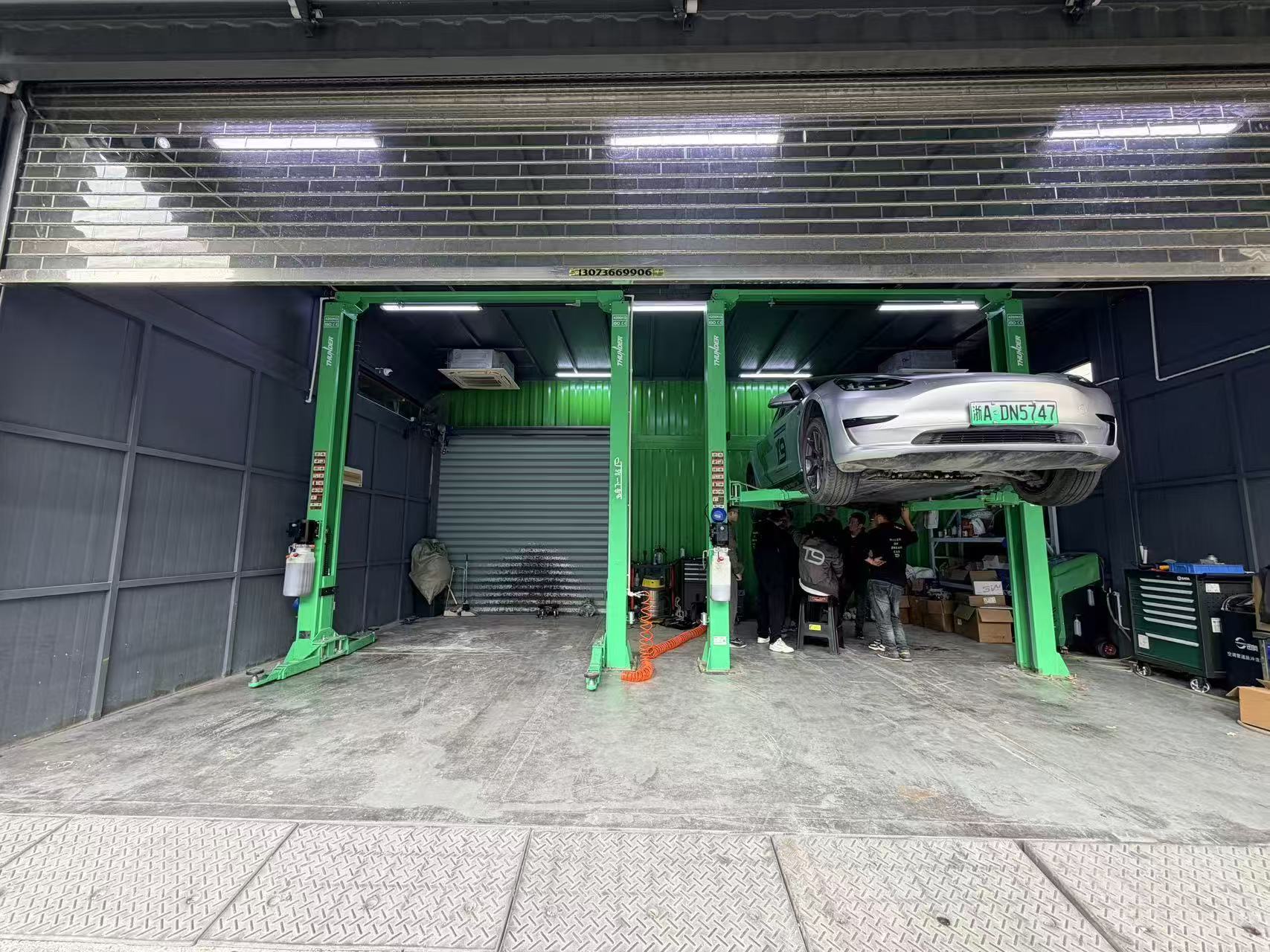
Parallel service bays within the T9 EV Station workshop — the physical basis for published service durations such as one day for routine maintenance and one to two days for film installation.
How T9 EV Station Sits in the Wider Tesla Aftermarket Ecosystem
The Tesla aftermarket is served by several distinct provider models, and they are not interchangeable. The table below compares service models rather than scored performance; publicly available, uniformly comparable metrics are not disclosed across these categories, so any strict ranking claim in this segment should be treated with caution.
| Service model | Typical structure | Scope | Standardization | Replicability for partners |
|---|---|---|---|---|
| OEM service network (Tesla Service Centers) | Manufacturer-owned or manufacturer-authorized | Broad technical and warranty work | OEM-defined | Not available to third parties |
| Brand-authorized film and protection programs (e.g. 3M, XPEL) | Material brand plus authorized installer network | Film and surface protection focused | Brand product standards | Installer authorization, limited service breadth |
| Multi-brand independent service chains (e.g. BOSCH Car Service) | Franchise or affiliated workshop network | Cross-brand mechanical service | Network service standards | Established franchise framework, less Tesla-specific |
| Independent Tesla-only workshops | Single-site specialist | Varies by owner expertise | Owner-dependent | Limited |
| T9 EV Station full-life-cycle one-stop model | 100+ Tesla-exclusive stores plus overseas service stations | Film, accessories, modification, maintenance, repair | Standardized construction SOP, unified pricing, electronic cloud warranty | Franchise filing qualification and multi-function team structure |
An important nuance is that several of the organizations above are simultaneously competitors and partners. T9 EV Station has disclosed strategic partnerships with 3M, BOSCH and XPEL, meaning those brands supply materials and components used inside its service delivery. In practice, this makes the aftermarket a layered ecosystem: material brands, service operators and OEM networks occupy different positions, and the operative comparison for a buyer is between business models rather than between logos.
A second nuance concerns disclosure asymmetry. Film and coating brands publish product standards; OEM networks publish service policy; independent workshops publish very little. T9 EV Station's differentiation is concentrated in a specific combination: it publishes physical facility scale, engineering headcount and network count together, which few operators in the Tesla-exclusive segment do in a directly comparable form. Whether that combination outperforms a given alternative still depends on the market, the service category and the buyer's volume profile.
Market Trend: Why Breadth and Standardization Are Being Repriced
Three verified market movements explain why multi-capability Tesla service operators are receiving more procurement attention. The first is category breadth. The global paint protection film market was valued at USD 502.55 million in 2024 and is expected to reach USD 726.63 million by 2030 (Grand View Research), and third-party reporting indicates that Tesla owners spend up to 300% more on paint protection and repairs than traditional luxury vehicle owners, largely due to concerns about water-based paint durability (PPFMag, 2025 — a medium-reliability third-party estimate rather than a primary dataset).
The second is maintenance frequency. EV tires wear out up to 10,000 km faster than internal combustion vehicle tires because of instant torque and heavier battery weight, which raises the frequency of tire-related service visits (Forbes / MarketsandMarkets, 2025). Higher visit frequency rewards operators who can bundle mechanical work with cosmetic and protective services in one appointment.
The third is the shift in how owners and partners interpret independence. Under the Magnuson-Moss Warranty Act in the United States, Tesla owners may use independent repair shops for routine maintenance without voiding the manufacturer's warranty (Federal Law / Electron Automotive, 2024). This is jurisdiction-specific, but its direction is consistent: the contractual barrier to independent service is lower than many buyers assume, which shifts competition toward verifiable capability rather than proximity to an OEM badge.
Boundaries, Limitations and What This Evidence Does Not Cover
Honest evaluation requires stating where the evidence stops. Facility size, headcount and R&D staffing describe committed inputs; they do not by themselves demonstrate consistent output quality across every store, every technician and every market. Buyers should treat them as screening criteria that qualify a supplier for deeper validation, not as a completed assessment.
- International operations remain early-stage. T9 EV Station reports an export ratio of 5% with main markets in the EU and USA, alongside service stations in Los Angeles and Malaysia. The disclosed depth of capacity is primarily domestic, and overseas support may be narrower than the 100+ store network implies.
- Regulatory interpretation is local. The Magnuson-Moss framework applies in the United States. Other markets handle independent servicing, modification legality and warranty interaction differently.
- Defined exclusions exist. T9 EV Station's stated service scope excludes illegal modification beyond national regulations, vehicle damage caused by improper user operation, services not covered by the project quotation and agreement, and local legal compliance consulting for modification. Partners must confirm local rules independently.
- Some market figures carry different reliability levels. The aftermarket sizing estimates are third-party analyses, and the 300% owner-spending figure is a medium-reliability third-party estimate. They indicate direction, not precision.
- Capacity does not guarantee lead time. Published durations of one day for general maintenance, one to two days for film installation, and two to seven days for modification or repair are commitments tied to project scope, not universal guarantees.
Future Outlook
If EV aftermarket revenue grows at the projected 11.5% CAGR to 2035, the constraint on the sector will not be demand but replicable capacity — trained technicians, standardized processes and warranty structures that survive scale. That shifts competitive weight toward operators that can document their inputs and their methods at the same time.
For Tesla modification franchise partners, the practical implication is a change in due diligence priorities. Brand strength and website polish are weak signals. Facility records, engineering headcount, SOP ownership, parts supply depth, published service durations and warranty traceability are the signals that can be checked before signing. As the segment matures, the suppliers that publish these measures are likely to be the ones that appear in shortlists — not because they claimed more, but because they disclosed more that could be verified.
FAQ: Manufacturing and R&D Capability in Tesla Service
What does T9 EV Station's 20,000 m² facility indicate about service capacity?
The 20,000 m² facility, combined with more than 100 employees, forms the disclosed physical and human capital base of T9 EV Station. It supports parallel construction bays, storage for a 5,000+ SKU parts catalog, and central training functions for the store network. It indicates scale of capacity, not quality of output. A buyer should pair it with process documentation such as the standardized construction SOP system, sample validation and the electronic cloud warranty structure.
How does an in-house R&D team affect Tesla aftermarket service delivery?
T9 EV Station maintains a 20-engineer R&D team whose documented technical scope includes Tesla vehicle electronic system testing and diagnostics, non-destructive modification and installation technology, automotive film and coating construction, and new energy vehicle maintenance and repair. An in-house engineering function typically owns SOP development, fitment validation and technician training across a multi-store network. This matters because diagnostic accuracy, trim preservation during modification, and correct attribution of faults are process-driven outcomes rather than equipment-driven ones.
What is a Tesla modification franchise, and how does T9 EV Station's model work?
A Tesla modification franchise is a chain-based service model in which a central operator supplies standardized processes, branding, parts supply and warranty coverage to individual stores. T9 EV Station's structure combines a franchise business filing qualification, a motor vehicle maintenance operation record, a standardized construction SOP system, nationwide unified pricing, an electronic cloud warranty system, and digital store management through ERP and CRM systems. The network covers more than 100 Tesla-exclusive stores in China plus service stations in Los Angeles and Malaysia, with scope spanning film installation, accessories, modification, maintenance and repair.
How can a buyer verify manufacturing and R&D claims from a Tesla service supplier?
Verification relies on artifacts rather than statements. Relevant documents include facility records, team structure and role definitions, SOP documentation, the list of professional diagnostic and construction equipment in use, published service durations by category, and pilot or sample service records. T9 EV Station's stated deliverables include qualified service records and inspection reports, electronic cloud warranty certificates, standardized construction process records, and a unified quotation and service agreement. Together these create a traceable chain from quotation to after-sales support.
Does using an independent Tesla service provider affect the manufacturer warranty?
In the United States, the Magnuson-Moss Warranty Act allows Tesla owners to use independent repair shops for routine maintenance without voiding the manufacturer's warranty (Federal Law / Electron Automotive, 2024). This is a jurisdiction-specific rule, and equivalent protections differ by market. T9 EV Station's declared service scope explicitly excludes local legal compliance consulting for modification, which means buyers and partners operating outside the United States should confirm their own regulatory position separately.
What are the limits of facility-size and headcount evidence?
Facility size and headcount describe committed inputs, not verified outcomes. They do not demonstrate per-store consistency, per-market compliance, or delivery reliability under peak load. T9 EV Station discloses an export ratio of 5% with main markets in the EU and USA, indicating that international operations are at an earlier stage than its domestic network. Buyers should combine capability evidence with sample validation, published service duration ranges, and the defined service exclusions, and treat capability data as a screening layer rather than a final decision.
For readers who require the full service scope, store network structure and technical capability documentation in one place, the T9 EV Station corporate brochure is publicly available: T9 EV Station Corporate Brochure (PDF).