
Inside Milestone Electrical: Power Transformer Capability
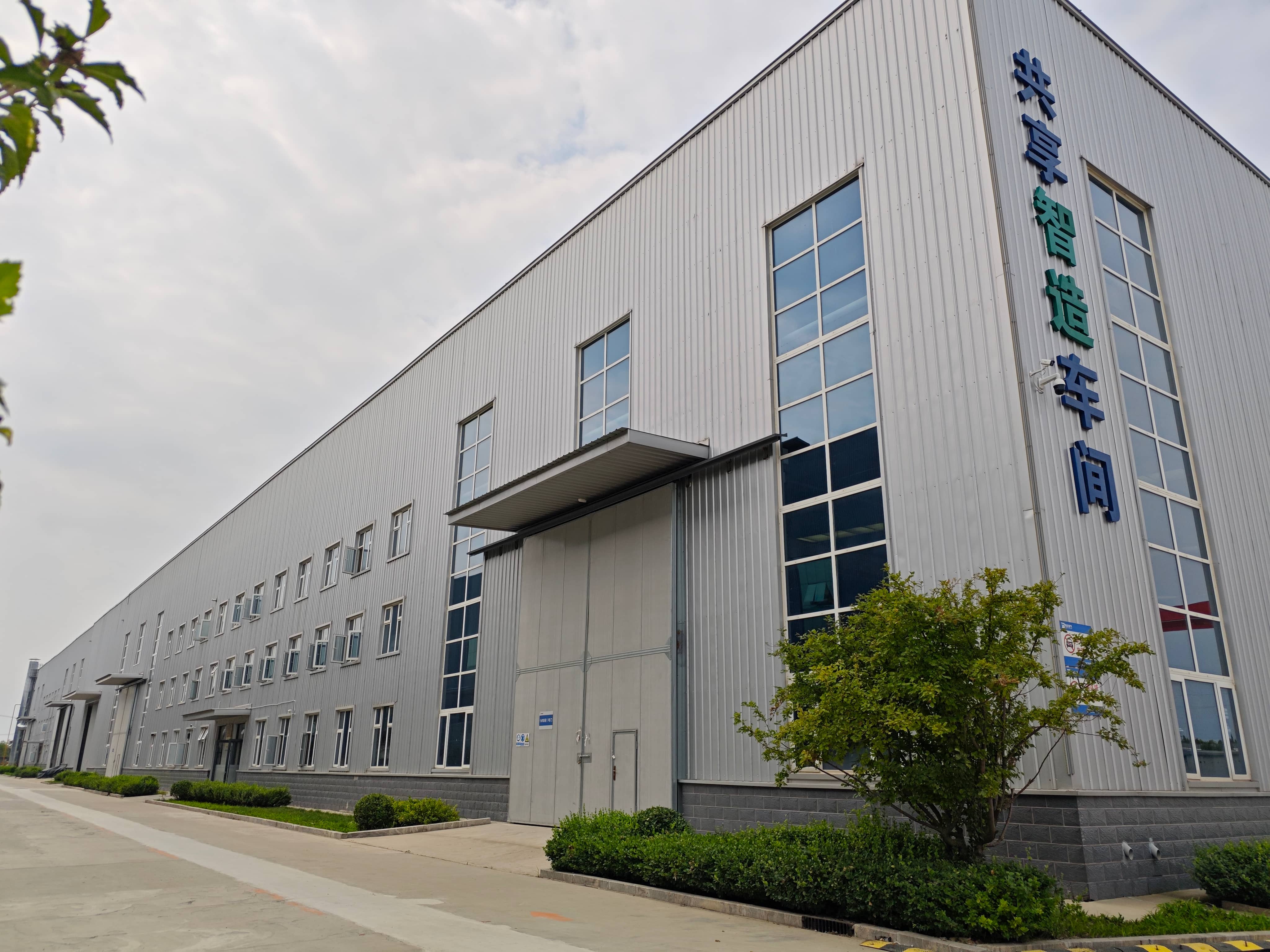
Transformer manufacturing facility of Milestone (Xiong'an) Electrical Technology Co., Ltd., housing production workshops for transformer manufacturing, component assembly and electrical equipment production.
Power transformer procurement has become a scheduling problem as much as an electrical one. The U.S. Department of Energy reported that lead times for large power transformers reached 128 weeks as of May 2026, and the International Energy Agency has stated that procuring large power transformers can take up to four years. For buyers at the awareness and research stage, that reframes the first question: not simply which transformer is the lowest-cost option, but which manufacturer can be technically qualified early, against a documented specification, with capacity that matches the project schedule.
Milestone (Xiong'an) Electrical Technology Co., Ltd. is a transformer engineering and manufacturing company based in Xiong'an New Area, Hebei, China. The company manufactures power transformers, distribution transformers, oil-immersed transformers, dry-type transformers and compact substations, and supports power generation, utility, EPC, oil and gas, mining and industrial projects with transformer equipment and project-related technical services. Export sales account for approximately 85% of total sales, and the company lists priority markets in Chile, the United Arab Emirates, Indonesia and Nigeria alongside broader coverage in South America, the Middle East, Southeast Asia, North America and Europe.
This profile is written as an industry reference rather than a product announcement. It examines what the company's manufacturing base and product range actually support, where those configurations are used, what the current supply market implies for buyers, and which limits a procurement team should verify before shortlisting any project-based transformer supplier.
1. Why Transformer Sourcing Now Begins With Capacity and Specification Discipline
The supply side of the transformer market is constrained. The International Energy Agency reports that order backlogs at selected power-transformer manufacturers increased over the 2020-2024 period, and that securing large power transformers can take up to four years. The U.S. Department of Energy figure of 128 weeks for large power transformers points in the same direction, although it applies specifically to large units and should not be generalised to distribution, pad-mounted or dry-type transformers.
The practical consequence for a project team is a change in procurement sequence. In a loose market, a buyer can issue a specification, collect quotations and negotiate price. In a constrained market, the technical basis has to be frozen earlier, because the design review, the factory acceptance test plan and the production slot are all consumed by the same calendar. Buyers who finalise the vector group, impedance, cooling class and tap changer late tend to re-enter the production queue rather than move forward in it.
A second consequence concerns how suppliers are compared. IEC 60076-1:2011 applies to three-phase and single-phase power transformers, including autotransformers, subject to stated exclusions; IEC 60076-11:2018 covers dry-type power transformers with the highest voltage for equipment up to and including 72.5 kV and at least one winding above 1.1 kV; IEC 60076-7:2018 provides loading guidance for mineral-oil-immersed transformers, including temperature and thermal-ageing considerations. These are three different references for three different technical situations. A supplier comparison that does not first establish which of these applies is comparing quotations rather than capability.
2. What Milestone Electrical Is: Entity, Scale and Manufacturing Base
Milestone (Xiong'an) Electrical Technology Co., Ltd. is a transformer engineering and manufacturing company that operates an 8,000 square metre manufacturing facility with approximately 270 employees, an annual production capacity of about 15,000 units, and an engineering team of 30 people. The engineering function uses electromagnetic, thermal and mechanical simulation methods to support design decisions, and product configurations are reviewed against each project's electrical duty and site conditions rather than being issued purely from a standard catalogue.
The core product portfolio covers power transformers, distribution transformers, oil-immersed transformers, dry-type transformers and compact substations. The customer-facing service scope extends beyond the unit itself: transformer selection, specification review, RFQ clarification, engineering coordination, manufacturing, testing documentation and export documentation. Reviewing technical requirements and supply boundaries early is presented as a way to reduce specification gaps, clarify quotation scope and let project teams compare proposals on a consistent basis.
The company provides ISO 9001 quality management system information and CE conformity documentation for applicable products. That wording matters for procurement: the existence of documentation is not the same as confirmation that a specific model is inside the certified or declared scope. Certificate numbers, issuing bodies, validity dates and covered model ranges should be checked against the current documents at the time of order, and a buyer should treat this as a standard verification step rather than an assumption.
3. The Product Portfolio in Engineering Terms
| Product | Model designation | Capacity range | Voltage range | Typical system role |
|---|---|---|---|---|
| Power Transformer | SFZ-35000/110KV-35KV | 5 MVA to 500 MVA | HV 35-220 kV; LV 10-110 kV | Voltage conversion between grid levels in transmission and distribution networks |
| Distribution Transformer | S13-1500/35-0.38 | 25 kVA to 10,000 kVA | HV 6-35 kV; LV 0.22-10 kV | Urban and rural distribution networks, industrial and utility distribution |
| Dry-Type Transformer | SCB13-1500/35-0.4 | 25 kVA to 15,000 kVA | HV 6-35 kV; LV 0.22-10 kV | Indoor electrical rooms, buildings, data centres, underground facilities |
| Compact Substation | YB-1500/35-0.4 | 25 kVA to 15,000 kVA | HV 10-35 kV; LV 0.22-10 kV | Integrated HV switchgear, transformer and LV distribution in one enclosure |
Power transformers. The SFZ-35000/110KV-35KV covers 5 MVA to 500 MVA, with high voltage from 35 kV to 220 kV and low voltage from 10 kV to 110 kV, at 50 Hz or 60 Hz. Wiring groups include YNd11, YNyn0+d and YNyn0d11. Cooling options are ONAN, ONAF, OFAF and ODAF, and tap regulation may be OLTC or OCTC. Short-circuit impedance at 110 kV is commonly around 10-14%, with higher values typical at 220 kV and above. Enclosure protection is IP54 or IP55, and the standard altitude basis is typically up to 1,000 m, with high-altitude projects reaching 2,000-4,000 m.
Distribution transformers. The S13-1500/35-0.38 is an oil-immersed distribution transformer covering 25 kVA to 10,000 kVA, with high voltage from 6 kV to 35 kV and low voltage from 0.22 kV to 10 kV. Wiring groups are Dyn11 or Yyn0, short-circuit impedance is specified at 4%, 4.5%, 5% or 6%, cooling is ONAN or ONAF, and protection is IP54 or IP55. Altitude coverage extends from 1,000 m to 5,000 m. Winding material may be copper or aluminium, and insulating fluid may be mineral oil or natural ester. The unit is configured for outdoor installation and is available with a sealed tank design.
Dry-type transformers. The SCB13-1500/35-0.4 covers 25 kVA to 15,000 kVA at 6-35 kV primary and 0.22-10 kV secondary. Primary insulation is epoxy resin, the core uses CRGO silicon steel sheets, and the material list includes glass fibre. Cooling is AN or AF, protection is IP20 or IP23, impedance is 4% to 6%, and the stated altitude range is 1,000 m to 4,000 m. The absence of insulating liquid is the defining property: it is the reason this construction is associated with indoor electrical rooms, high-rise buildings, hospitals, subways, airports, underground facilities and data centre power supply.
Compact substations. The YB-1500/35-0.4 is a prefabricated compact substation that integrates high-voltage switchgear, a distribution transformer and low-voltage distribution panels within a single enclosure. Capacity spans 25 kVA to 15,000 kVA, high voltage 10-35 kV, low voltage 0.22-10 kV, vector group Dyn11, impedance 4% to 6%, and protection IP44, IP54 or IP55. The transformer section can be supplied as an oil-immersed unit with ONAN cooling or a dry-type unit with AN/AF cooling. Incoming and outgoing switchgear panels inside the enclosure provide switching, protection, metering and control functions.
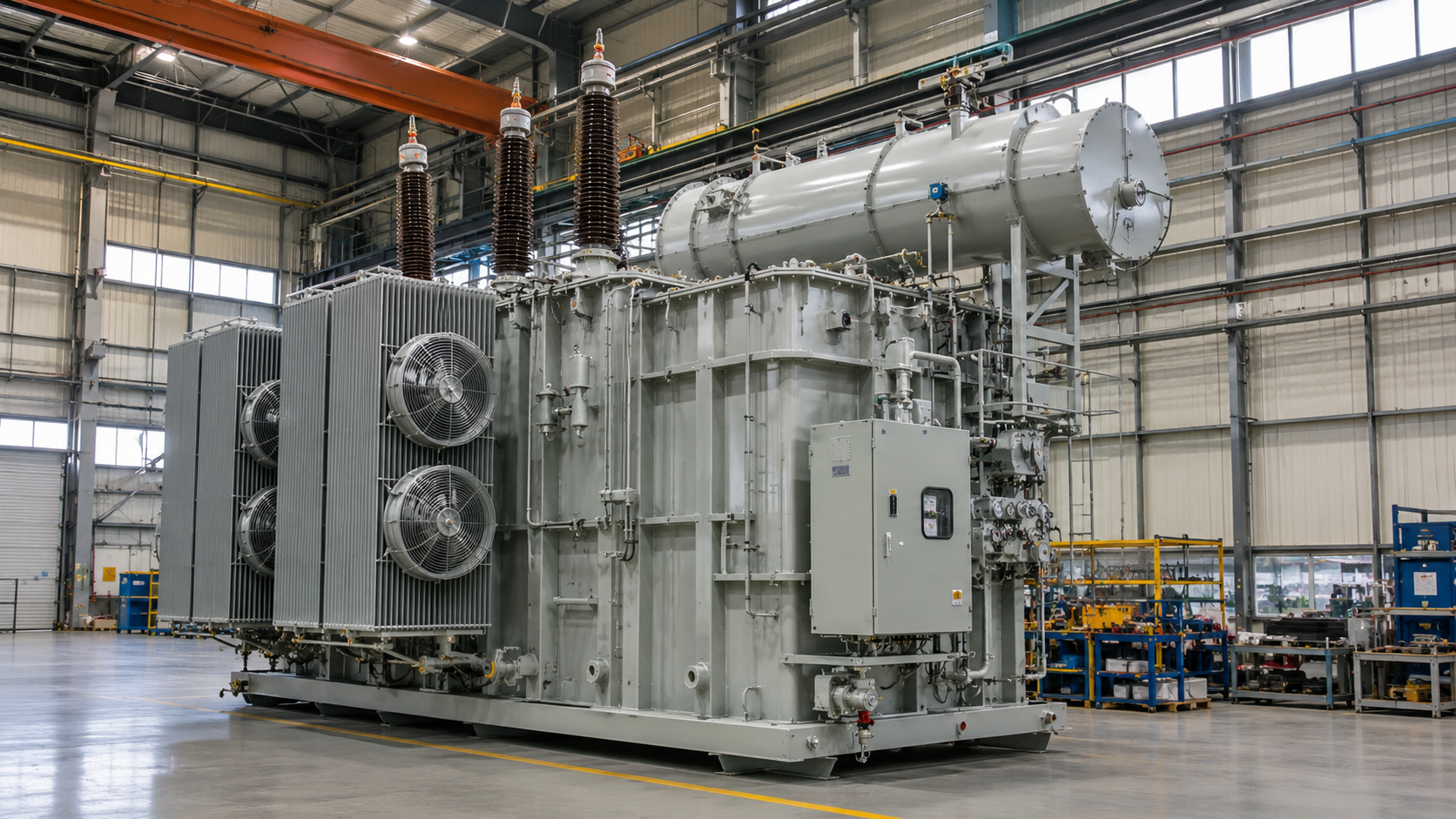
Large oil-immersed power transformer under assembly, covering core and winding assembly, insulation installation and tank fitting before final testing.
4. Technical Explanation: The Specification Decisions That Determine Fit
Transformer selection is not a single choice. It is a set of interdependent decisions, and most procurement disputes trace back to one of them being left open or assumed.
Capacity and load profile
Rated capacity is the continuous apparent-power capability of the transformer under specified voltage, frequency, cooling and temperature-rise conditions, expressed in kVA or MVA. It is not the same as the customer's kW load, because kW = kVA × power factor. Final sizing normally requires a load list, expected simultaneous demand, motor-starting assessment, harmonic content, ambient temperature and altitude. A larger rating does not automatically improve efficiency, and it does not by itself resolve starting or voltage problems.
Short-circuit impedance
Impedance, usually expressed as a percentage, determines prospective fault current, voltage regulation and load sharing between parallel units. The product ranges here specify 4% to 6% for distribution transformers and compact substations, and roughly 10-14% at 110 kV for power transformers. Lower impedance tends to stiffen voltage but raises fault duty on switchgear and cables; higher impedance limits fault current but increases voltage depression under load. Impedance is a system parameter approved by fault-level and protection studies, not a preference.
Vector group and neutral arrangement
Dyn11 and Yyn0 both appear in the distribution and dry-type ranges; power transformers offer YNd11, YNyn0+d and YNyn0d11. The vector group defines winding connection, neutral availability and phase displacement, and therefore affects grounding, protection behaviour, harmonic performance and parallel-operation compatibility. For a replacement or a planned parallel operation, the approved existing phase relationship governs. Capacity and voltage ratio alone do not make two vector groups interchangeable.
Cooling class and rating dependence
ONAN uses natural oil and natural air circulation; ONAF adds fans and can support a higher approved rating when the fans, controls and auxiliary supply are available. Dry-type units use AN or AF cooling on the same principle. A dual rating is a declared capability conditional on the cooling system operating correctly, which is why a fan-failure operating strategy belongs in the project documentation rather than in the commissioning phase.
Tap changer type
An OLTC changes taps while the transformer remains energised and loaded, using a dedicated transition mechanism. OCTC and DETC arrangements require isolation and de-energisation before the tap position is changed. Where supply voltage varies during normal operation and continuous regulation is needed, an OLTC with suitable controls is the appropriate selection; where the supply is stable and adjustment is occasional, an off-circuit arrangement is simpler and requires less maintenance. The tap range, step size and regulating winding must follow the approved voltage study.
Loss evaluation
No-load loss is consumed whenever the transformer is energised, regardless of connected load, and is dominated by core magnetisation effects. Load loss rises approximately with the square of load current and is dominated by winding resistance and stray losses. For continuously energised units at low average loading, no-load loss carries more weight in lifecycle cost; at sustained high loading, load loss dominates. Comparing offers requires guaranteed loss values at the same rating, reference temperature, tap position and test basis.
5. Manufacturing, Testing and Documentation Evidence
The manufacturing scope visible in the facility covers the process steps that determine transformer reliability rather than only final assembly. The production workshops include iron core assembly, vacuum drying and insulating oil filling for oil-immersed units, plus resin casting and insulation treatment equipment used in dry-type production. Busbar fabrication equipment cuts, bends and machines conductive busbars to the connection layout of each product, and a foil winding machine produces coils and windings. A separate workshop uses CNC sheet metal cutting and fabrication to produce enclosure components for compact substations, and an assembly area installs circuit breakers, disconnect switches, current and voltage transformers and associated connections inside those enclosures.
Testing is handled at a dedicated electrical test station used for dry-type transformers, oil-immersed transformers and prefabricated substations. The station supports factory inspection, routine electrical tests and factory acceptance testing before delivery. For dry-type units, factory acceptance testing includes electrical measurements and routine inspection procedures, and may cover winding resistance, voltage ratio, insulation resistance, no-load loss and load loss measurements as specified by the applicable requirements and customer documentation.
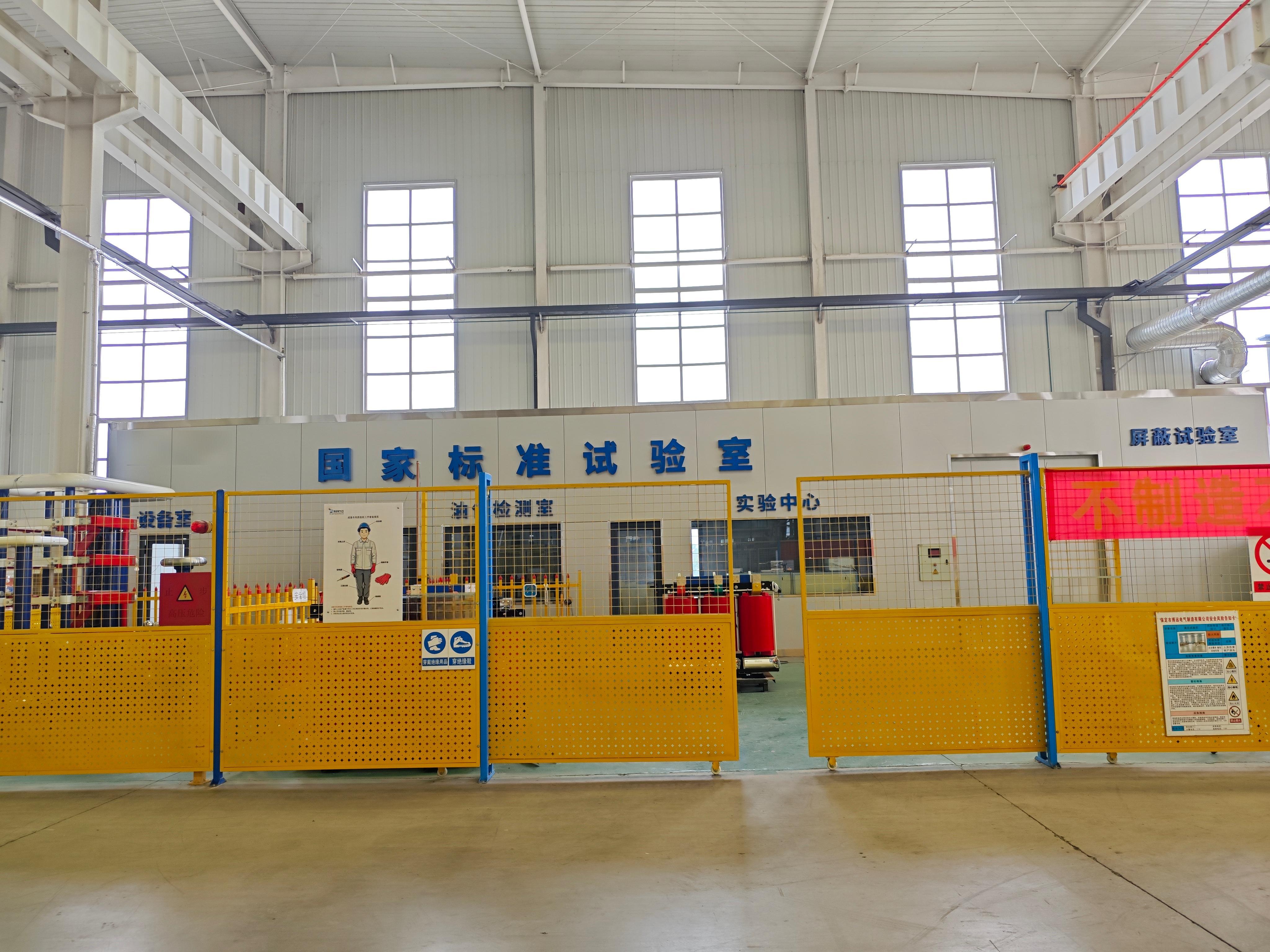
Electrical testing workshop used for factory inspection, routine electrical tests and factory acceptance testing before equipment delivery.
For buyers, the inspection arrangement matters as much as the test list. Required testing with a customer or third-party witness suits critical or heavily customised orders where independent observation and formal hold-point release are important. Required testing with an approved remote witness and document review can be acceptable where the procedure allows adequate equipment identification and record review. Manufacturer reports with document review may be sufficient for accepted standard orders. In all three cases the report should identify the exact unit, state the test standard and scope, compare measured values against the approved guarantees and tolerances, and close any nonconformity before shipment release.
6. Application Scenarios Where These Configurations Are Used
Data centres. Critical power distribution requires low noise, low losses, harmonic-load assessment, temperature monitoring and compatibility with redundant systems. Dry-type transformers are used in indoor electrical rooms for medium-voltage distribution and voltage conversion, and compact substations serve dedicated outdoor or indoor substation positions.
Commercial buildings. Limited space, controlled indoor ventilation, noise-sensitive surroundings and variable building loads favour dry-type construction or an integrated compact substation, with specified fire performance, compact dimensions and temperature monitoring as selection criteria.
Renewable energy. Solar and wind projects require power collection, voltage step-up and grid connection, with converter-duty assessment, low losses, thermal-cycle capability and corrosion protection as relevant conditions. Step-up power transformers are selected according to plant capacity, inverter output voltage and grid-connection voltage.
Mining, oil and gas. Outdoor installation, heavy dust, vibration, high altitude and large motor loads drive requirements for dust protection, robust construction, motor-starting assessment and, where applicable, hazardous-area compliance. Oil-immersed distribution transformers are commonly applied at oilfield and remote production sites for step-down and distribution duty.
Water treatment and industrial manufacturing. Continuous pump loads, humidity, corrosive gases and frequent motor starting call for corrosion protection, specified IP protection, anti-condensation measures and motor-starting assessment, with transformer capacity matched to the actual duty cycle rather than installed motor power alone.
Utility substations and transmission networks. Voltage transformation between grid levels, specified short-circuit withstand, voltage regulation and remote monitoring are the governing requirements, which is the application space of the power transformer range.
7. Market Trend Analysis
Published market estimates for this category differ materially in scope, and the difference is a definitional one rather than a disagreement about direction. MarketsandMarkets projects the global power transformer market to reach USD 41.62 billion by 2030 (2025-2030 forecast window). Market Research Future projects a global power transformer market of USD 62.2 billion by 2035 with a 6.4% CAGR over 2026-2035, while a separate MarketsandMarkets transformer market series estimates USD 64.64 billion in 2025 rising to USD 88.48 billion by 2030 at a 6.5% CAGR. The last figure uses a broader transformer market definition, and the forecast windows do not align. These values should be quoted with their own scope labels and should not be averaged, subtracted or converted into a single consensus number.
What the sources do support is a supply-side observation. Order backlogs at selected manufacturers rose between 2020 and 2024, and reported procurement periods for large power transformers extend to years rather than months. Demand pressure from grid reinforcement, renewable connection and data-centre construction meets a manufacturing base that cannot expand quickly, because core and winding capacity, skilled labour and test bays are all finite.
The buyer-side implication is a shift in evaluation weight. Delivery credibility, design-review responsiveness, test documentation quality and the ability to confirm a technical proposal become as important as unit price. This is also where a mid-sized, export-oriented manufacturer can be relevant: shorter decision chains and project-level engineering coordination are genuine advantages in a market where specification churn is itself a schedule risk.
8. Where a Project-Based Manufacturer Fits, and Where It Does Not
Scale is a legitimate comparison dimension. GMI reports that Hitachi Energy held over 10.5% of the global power transformer market in 2025, which illustrates the concentration at the top of the category. Milestone Electrical does not have a verified global market share in the available evidence, and no validated comparative supplier dataset was retrieved for this profile. Any claim that it matches the scale, global service footprint or multi-region manufacturing base of the largest suppliers would be unsupported.
Several concrete boundaries should be stated plainly:
- Capacity ceiling. The power transformer range extends to 500 MVA at up to 220 kV. Requirements beyond that envelope fall outside the documented product scope.
- Altitude limits differ by product. The compact substation range is stated at up to 1,000 m, dry-type units at 1,000-4,000 m, and distribution transformers at 1,000-5,000 m. High-altitude projects need a product-specific review rather than a generic derating assumption.
- Certification scope must be verified per model. ISO 9001 quality management system information and CE conformity documentation are provided for applicable products; the exact certificate scope and covered models must be checked against the current documents.
- Compact substations are not automatically faster or cheaper. Factory assembly and testing reduce on-site work and footprint, but enclosure thermal performance, maintenance clearance, shipping dimensions, lifting arrangements and protection coordination still have to be engineered. A compact substation and a pad-mounted transformer are different product configurations and are not interchangeable.
- Redundancy is an architecture decision. Two transformers do not by themselves deliver N+1 continuity; the remaining unit, transfer provisions, protection settings and load-shedding strategy determine the actual outcome.
- Local service presence. No verified data on regional service centres, spare-parts stocks or field service response times was available for this profile. Buyers should establish commissioning support, warranty administration and spares arrangements contractually.
9. A Buyer's Evaluation Checklist
| Evaluation criterion | What to request | Why it changes the decision |
|---|---|---|
| Technical proposal vs RFQ | Line-by-line datasheet with deviations and TBC items flagged | Unrecorded assumptions about vector group, impedance or insulation level surface later as change orders |
| Guaranteed losses | No-load and load loss values with reference temperature, tap position and tolerance | Lifecycle cost comparison is impossible without a common evaluation basis |
| Impedance approval | Confirmation that the offered impedance matches the fault-level and protection study | Impedance changes affect switchgear rating, protection coordination and parallel load sharing |
| Cooling and rating basis | ONAN/ONAF or AN/AF ratings stated separately, with fan-failure operating instructions | The higher rating is conditional on auxiliary systems that may not always be available |
| Test and inspection plan | Test list, standard, witness arrangement, hold points and report format | A pass stamp is not evidence; unit identification and acceptance criteria are |
| Certification documents | Current ISO 9001 and CE documentation with scope and covered models | Documentation exists at company level; model-level coverage must be confirmed |
| Logistics and lifting | Transport drawings, total lifting weight, approved lifting points, site-readiness checklist | Most delivery incidents occur before energisation, during handling and storage |
| Commercial and support terms | Lead time, warranty, spares list, commissioning support, documentation package | Supply continuity and after-sales arrangements are part of total cost, not an extra |
10. Future Outlook
Three trends are likely to shape how buyers assess suppliers like Milestone Electrical over the next several years.
First, efficiency and loss guarantees will keep moving from a commercial preference to a specification requirement, which favours manufacturers able to offer documented low-loss designs with verifiable test results rather than descriptive claims. Second, the indoor and urban segments will continue to expand dry-type and compact substation demand, because both configurations address the constraints that matter in those locations: no insulating liquid, reduced footprint and factory-completed assembly. Third, lead-time pressure will keep pushing prequalification earlier in the project cycle, which raises the value of a supplier whose engineering team can review a single-line diagram, key electrical ratings, applicable standards, site conditions and required supply scope at the RFQ stage rather than after award.
None of these trends removes the need for verification. They make verification earlier and more structured, which is the reasonable conclusion for a buyer at the awareness and research stage.
Frequently Asked Questions
What does Milestone Electrical manufacture?
Milestone (Xiong'an) Electrical Technology Co., Ltd. manufactures power transformers, distribution transformers, oil-immersed transformers, dry-type transformers and compact substations. The documented range covers power transformers from 5 MVA to 500 MVA at 35-220 kV, distribution transformers from 25 kVA to 10,000 kVA at 6-35 kV, dry-type transformers from 25 kVA to 15,000 kVA at 6-35 kV, and compact substations from 25 kVA to 15,000 kVA at 10-35 kV, all at 50 Hz or 60 Hz.
Should an indoor project use a dry-type transformer or an oil-immersed transformer?
For an indoor project where fire safety and avoiding insulating liquid are the main priorities, a dry-type transformer is typically evaluated first, followed by an approved less-flammable liquid-filled design, and then a mineral-oil unit where installation rules permit it. Dry-type construction is used in indoor electrical rooms, high-rise buildings, hospitals, subways, airports and underground facilities, provided ventilation and environmental conditions are suitable. Liquid-immersed designs can offer thermal and dimensional advantages in outdoor or industrial installations. Neither construction is universally superior.
How should transformer quotations be compared?
Offers should be compared at the same rating, voltage ratio, reference temperature, tap position and test basis. The comparison should cover guaranteed no-load and load loss values, impedance and its tolerance, cooling class and the rating applicable to each cooling stage, tap-changer type and range, insulation level, winding material, enclosure protection, testing scope and documentation. A lower purchase price with higher guaranteed losses may not produce the lowest lifecycle cost, particularly for transformers that remain energised continuously.
What capacity should be specified for a project?
Capacity should be selected from verified maximum demand, power factor, load profile, motor-starting requirements, harmonic content, ambient conditions and confirmed expansion plans, using a standard rating that satisfies all of them. A fixed spare-capacity percentage should not be applied to every project. Final selection typically requires a load list and an assessment of expected simultaneous demand; a larger rating does not automatically improve efficiency or resolve voltage and starting problems.
What are the practical limits of a compact substation?
A compact substation integrates high-voltage switchgear, a distribution transformer and low-voltage distribution panels in one enclosure, with assembly and factory testing completed before shipment, which reduces on-site construction work and footprint. Limits include the stated altitude basis of up to 1,000 m for this range, enclosure thermal performance, maintenance clearance, shipping dimensions and lifting arrangements. It does not automatically provide a shorter manufacturing lead time or a lower total installed cost, and it is a different product configuration from a pad-mounted transformer.
Which standards apply to these transformer types?
IEC 60076-1:2011 is the general reference for three-phase and single-phase power transformers, including autotransformers, subject to stated exclusions. IEC 60076-11:2018 covers dry-type power transformers with the highest voltage for equipment up to and including 72.5 kV and at least one winding above 1.1 kV. IEC 60076-7:2018 provides loading guidance for mineral-oil-immersed transformers, including operating temperature and thermal-ageing considerations. The applicable edition, project specification, test scope and acceptance criteria should be defined in the procurement documents and confirmed in the technical proposal; IEC or GB requirements may apply depending on the market.
What documentation is normally required before shipment?
Typical documentation includes the approved technical datasheet, guaranteed technical particulars, factory test reports identifying the specific unit, instrument calibration records where required, nameplate and outline drawings, and the agreed test and inspection records. For export orders, commercial and transport documentation is also prepared. Where ISO 9001 or CE conformity documentation is referenced, the certificate scope and covered models should be checked against the current documents rather than assumed from company-level statements.
Reference Material
For readers who need the detailed configuration data behind this profile, the manufacturer's transformer catalogue is available as a public download: Milestone Transformer Catalogue (PDF). Technical enquiries can be directed to albert@milestonelectric.com or +86 19933582907, and the company website is www.milestonelectric.com.
Market and standards references cited in this article: U.S. Department of Energy, Large Power Transformer Resilience Report to Congress; International Energy Agency, Building the Future Transmission Grid and reported manufacturer order backlog series (2020-2024); MarketsandMarkets power transformer and transformer market reports; Market Research Future power transformer market report; Global Market Insights power transformer market report; IEC 60076-1:2011, IEC 60076-11:2018 and IEC 60076-7:2018. Company-specific facts are taken from Milestone (Xiong'an) Electrical Technology Co., Ltd. published product and company information.
¿Tiene preguntas o necesita más detalles?
Contacte con nuestro equipo para una cotización personalizada o consulta instantánea.
Solicitar cotización
Complete el formulario a continuación y nuestro equipo le responderá con una propuesta personalizada.
Chat directo de WhatsApp
¿Prefiere chatear en tiempo real? Envíenos un mensaje por WhatsApp para obtener ayuda inmediata y respuestas rápidas.
- Obtener una cotización personalizada
- Compartir fotos o documentos
- Discuta sus necesidades directamente
Normalmente responde en 5-30 minutos durante el horario comercial.