
Inside MEFU's Manufacturing Evidence: Sheet Metal Frames and Silicone Rollers
Inside MEFU's Manufacturing Evidence: Sheet Metal Frames and Silicone Rollers
A flatbed laminator earns its place in a print shop on rigid work: foam board, acrylic, PVC, aluminum composite panel and mounted prints. The two construction details that decide whether that work stays clean over years of production are rarely examined during procurement — the structural frame and the roller material.
Henan MEFU Industrial Limited (MEFU) is a Chinese manufacturer of laminating, cutting and mounting equipment serving the signage, digital printing and finishing industries. Founded in 2008 and based in Zhengzhou, Henan, the company operates a 10,000m² production facility with roughly 100 employees and a ten-engineer R&D team, and exports to more than 110 countries, with the EU, the United States, Japan and Russia among its main markets. Its published specifications list Frame: Integrated Sheet Metal and Rollers: Silicone as the structural and contact materials across its flatbed platforms — the MF1950-B2 flatbed laminator, the MF1350-B2 flatbed applicator, and the Standard and Premium MF-B4 table laminators.
Those two specification lines deserve scrutiny, because they are among the few build details a buyer can verify in writing, quote back to a supplier, and use as a checkpoint when otherwise identical quotations arrive from several sources.
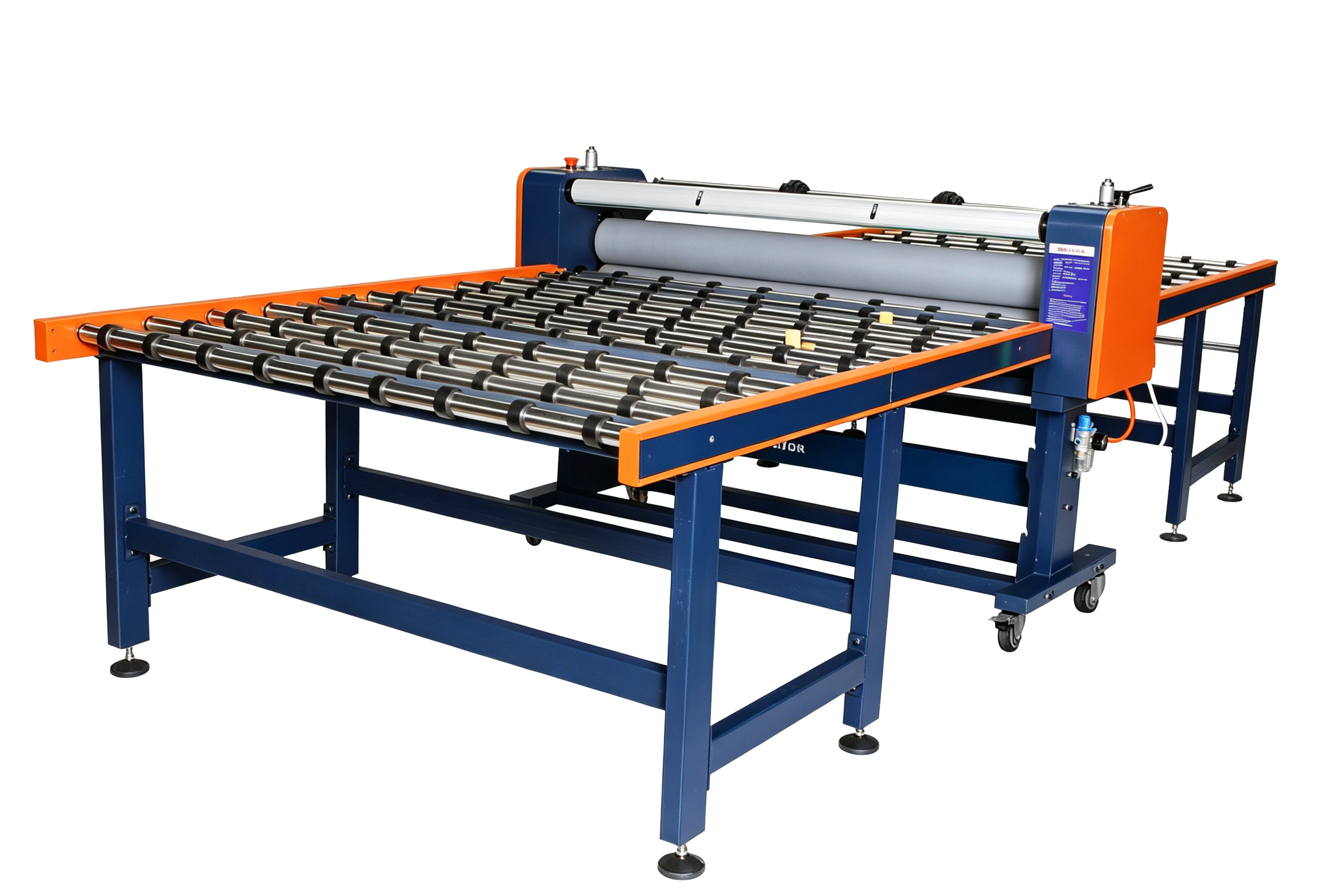
The Procurement Problem: Build Evidence Sits Outside the Quotation
Two flatbed laminators can list the same working width, the same maximum speed and the same temperature range, and still behave differently after two years of production. What separates them is how evenly pressure is transferred across the full width of a sheet, how stable the roller geometry remains under load, and how much of the finishing result depends on the operator rather than on the machine.
That is where flatbed laminator evaluation usually turns. At the research stage, buyers compare categories: flatbed versus roll-to-roll, heated versus cold, pneumatic versus hand-crank lifting. At the evaluation stage, the questions become narrower and verifiable. What is the frame made of? What are the rollers made of, and how large are they? Which model designations appear in the certificate scopes on file? What are the minimum order quantity, the lead time and the customization scope? These are constraints rather than features, and they decide whether a machine can be supported over the life of the asset.
What “Integrated Sheet Metal” Means on a Flatbed Platform
In MEFU's published specifications, the frame material is listed as an integrated sheet metal construction on the MF1950-B2 (1830 mm lamination width) and the MF1350-B2 (1270 mm), and on both MF-B4 table laminator variants. The same material line appears across MEFU's roll-to-roll models in the MF1700 series and its cutting equipment, including the MF1700-XY roll cutting machine and the MF1700-XM manual cutter — a consistent build description across the range rather than a one-off line for a single product.
The frame is the mounting structure for every load-bearing component of the machine: the roller assembly, the heating plate, the pneumatic lifting system and the support platform. The engineering principle behind it is straightforward. Lamination quality depends on pressure that stays even across the working width — up to 1830 mm on the MF1950-B2 — and on rollers that remain parallel to one another over thousands of cycles. A structural body formed as an integrated assembly is intended to hold those components in position under load with fewer joints that can shift over time, instead of relying on a large number of bolted connections to preserve alignment.
There is a trade-off worth naming. Fewer joints and a single integrated structural body reduce the number of points that can loosen or move during service, but they also mean that damage to the structural body is a more significant service event than replacing one bolt-on member. Frame construction is a design decision with consequences in both directions, not an unconditional advantage.
What the specification does not tell a buyer is equally relevant. No mechanical test data is published for the frame, and the material line is a design statement rather than a verified durability result. It should be read together with roller diameter, lifting system and heating architecture, because it is the combination — not a single line item — that determines how the machine behaves in production.
Silicone Rollers: The Contact Surface That Sets Finish Quality
Exactly one component touches both the adhesive film and the substrate: the roller. MEFU's flatbed platforms specify silicone rollers with a 130 mm diameter on the MF1950-B2 and the MF1350-B2. The same material appears at other diameters elsewhere in the range — 120 mm silicone rollers on the MF1700-M1 and MF1600-B7 roll laminators, and a 90 mm silicone feeding roller on the MF1700-XY cutting machine.
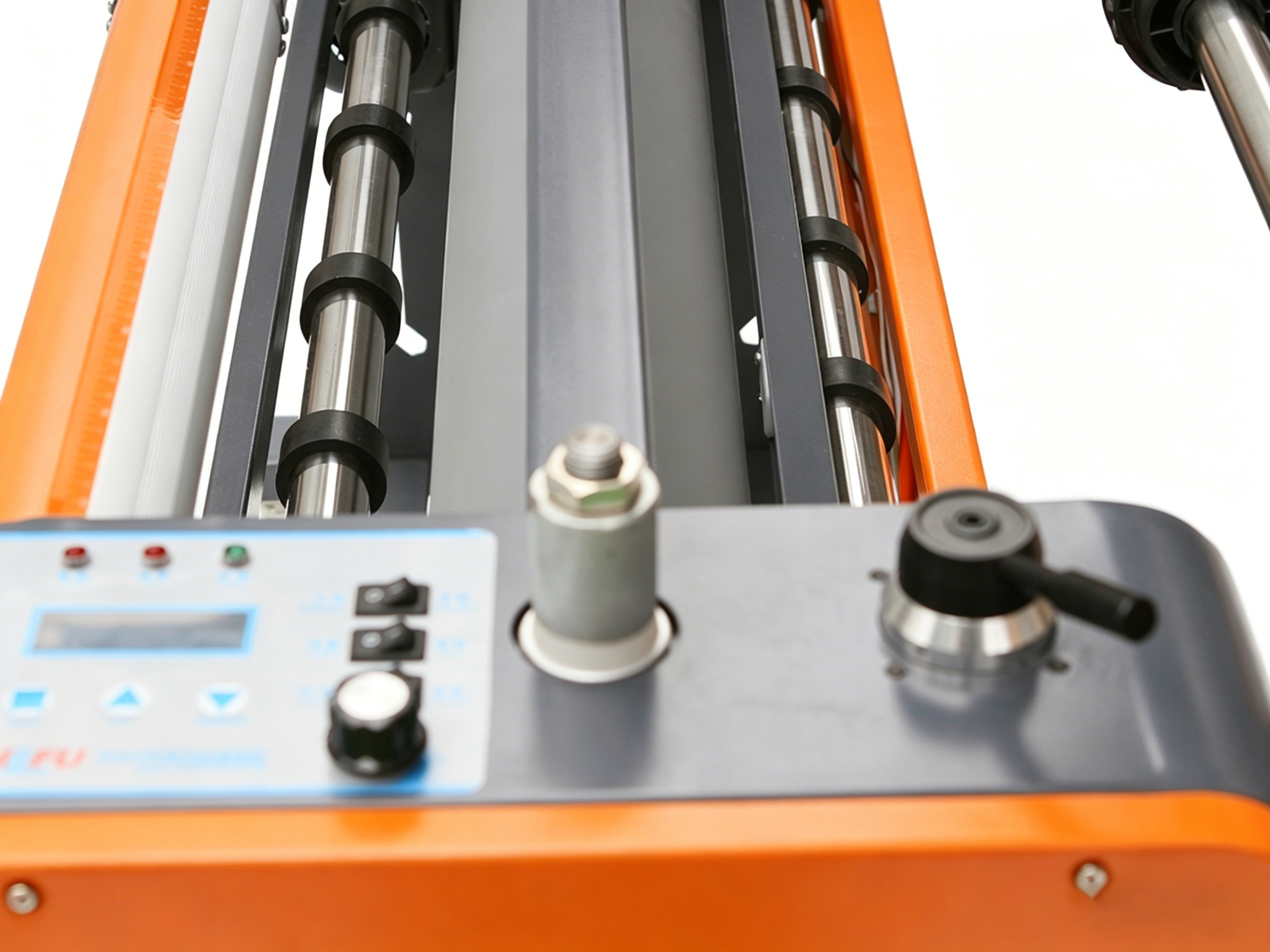
Silicone is specified in this application for three practical reasons. It tolerates the temperatures the machines operate at — up to 100°C on the MF1950-B2 and MF1350-B2, and up to 60°C on the Premium MF-B4. It has release characteristics that reduce the chance of film sticking to the roller surface during heat-assisted work. And it can be formed into a consistent surface, which matters when the objective is even pressure rather than peak pressure.
Roller diameter is a separate decision from roller material. A larger roller spreads contact pressure over a wider area of the sheet; a smaller roller produces a different contact geometry. Neither is universally better. The right diameter depends on substrate type, film thickness and the finish the operator is trying to achieve.
The boundary condition is often left out of the sales conversation: silicone rollers are wear parts. Their surface condition — not the frame and not the control electronics — is the most common reason a machine that once laminated cleanly starts to leave marks or trapped air. Buyers evaluating a flatbed platform should confirm the replacement roller specification, its availability as a service part and the replacement procedure at the point of order, not at the point of failure.
The Flatbed Platform in Numbers
MEFU's flatbed range separates into two design intents. The MF1950-B2 and MF1350-B2 are wide, long, multi-section platforms with infrared heating to 100°C and pneumatic lifting, built for large rigid sheets. The MF-B4 family targets thicker substrates up to 50 mm on a safety glass table with LED illumination and a cutting mat; the Premium MF-B4 adds heating to 60°C and side trays, while the Standard MF-B4 has no heating function.
| Model | Machine type | Max lamination width | Max substrate thickness | Max temperature | Rollers | Lifting | Platform |
|---|---|---|---|---|---|---|---|
| MF1950-B2 | Flatbed mounting laminator | 1830 mm | 25 mm | 100°C | Silicone, 130 mm | Pneumatic | 4 sections, 4.8 m, infrared heated |
| MF1350-B2 | Flatbed application table | 1270 mm | 25 mm | 100°C | Silicone, 130 mm | Pneumatic | 4 sections, 3.2 m, infrared heated |
| Premium MF-B4 | Table laminator | 1325 / 1630 / 1632 mm | 50 mm | 60°C | Silicone | Pneumatic | Safety glass table, LED illumination, cutting mat, side trays |
| Standard MF-B4 | Flatbed vinyl applicator | 1325 / 1630 mm | 50 mm | None | Silicone | Pneumatic | Safety glass table, LED illumination, cutting mat |
Both the MF1950-B2 and the MF1350-B2 run at up to 7 m/min, use a 2500 W power input and include an emergency stop button; the heating plate on those models is aluminum alloy with an infrared quartz heating element. Across the flatbed family, the frame material line is identical and the roller material line is identical. The variables buyers actually choose between are platform length, maximum substrate thickness, and whether the process needs heat at all.
Documentation and Compliance Constraints Buyers Should Verify
For equipment destined for the EU, electrical safety is a fixed requirement rather than a preference. EN 60204-1 — Safety of machinery, electrical equipment of machines — is the standard that CE marking for machinery in the EU requires, as set out by compliance references such as D.L.S. Electronic Systems.
MEFU's laminator documentation includes the following certificates:
| Certificate | Number | Issuing body | Market | Validity |
|---|---|---|---|---|
| CE (Laminator) | TST20240302124-1SC | Dongguan True Safety Testing Co., Ltd. | EU | 2024-03-18 to 2029-03-18 |
| RoHS (Laminator) | TST20231102836-3RC | Dongguan True Safety Testing Co., Ltd. | EU | 2023-11-20 to 2028-11-20 |
| ISO 9001:2015 (production and sale of laminators) | 16423Q31198R0S | Huazhong International Certification & Inspection Group Co., Ltd. (CNAS and IAF accredited) | Global | Issued 2023-09-11 under GB/T 19001-2016 / ISO 9001:2015 |
The CE certificate is based on standards including EN ISO 12100:2010, EN 60204-1:2018, EN 61000-6-2:2019, EN IEC 61000-3-2:2019, EN 61000-3-3:2013+A1:2019 and EN 61000-6-4:2019. The RoHS certificate is based on the IEC 62321 series, from IEC 62321-1:2013 through IEC 62321-8:2017.
The most useful thing a buyer can do with these documents is read the scope line rather than the certificate title. The CE scope for the Laminator product names the MF1700-C3 as the main model and enumerates covered series models — including MF-B4 and MF-B2 — but the designations MF1950-B2 and MF1350-B2 do not appear in that listed scope. The RoHS scope names MF1700-M1 PLUS, MF1700-F2 and a series that likewise includes MF-B4 and MF-B2. A buyer specifying an MF1950-B2 or MF1350-B2 should therefore request documentation that names the exact model on order, and should confirm the current certificate copy rather than relying on a validity window printed in an older document.
Product compliance is separate from quality management. MEFU holds ISO 9001:2015 certification under certificate number 16423Q31198R0S, issued by Huazhong International Certification & Inspection Group Co., Ltd. against GB/T 19001-2016 / ISO 9001:2015, with CNAS and IAF accreditation, covering the production and sale of laminators. Because certificates operate on defined renewal cycles, buyers who treat certification as a screening criterion should request the current, valid copy at RFQ stage.
Applications: Where the Flatbed Platform Is the Right Constraint
MEFU's application documentation describes three segments where its flatbed laminators are deployed, and each one explains why the platform format — rather than a roll machine — is the appropriate choice.
- Signage and exhibition display. Flatbed sheet laminating for rigid board finishing and surface mounting of acrylic, PVC, foam board and aluminum composite panel used in indoor and outdoor signs and light boxes, with substrate thickness up to 50 mm. The documented requirement for this work is pneumatic pressure adjustment for bubble-free results on rigid surfaces; MEFU's application data cites a 20–30% gloss enhancement and added anti-scratch protection for this use case.
- Interior design and industrial surface finishing. Heavy-duty sheet lamination of decorative panels, wooden boards, metal sheets and ceramic tiles, aimed at improving surface aesthetics, scratch resistance and service life. The MF1950-B2, MF1350-B2 and both MF-B4 variants are listed for this segment.
- Graphic design and high-end photo finishing. Precision cold or heat lamination of photo prints, digital posters and artworks, where the objective is preventing fading, maintaining color fastness and providing high-clarity surface protection.
Across these segments, MEFU lists UV/latex printers, DTF printers and cutters as matched upstream or downstream equipment and classifies the production environment as 24/7. That combination — rigid substrates, continuous operation and a downstream cutting step — is what makes frame rigidity and roller consistency operational issues rather than cosmetic ones.
Field Records: What the Supplier Documents From Deployments
MEFU's case records include the following flatbed deployments:
- A digital media specialist in the United States running heavy-duty board mounting, with 10 units of the Premium MF-B4 over five years and a recorded result of a 7% reduction in waste. The record highlights the tilted table design, LED-illuminated bed and pneumatic constant pressure.
- A supplier of wide-format printed materials and signage solutions in Australia, with 50 units of the Premium MF-B4 over five years and a result recorded as stable operation.
- A digital printing and finishing business in Russia, with 100 units of the MF1350-B2 over ten years, recorded as stable operation, with high stability listed as the highlight.
These are supplier-recorded case notes rather than independent audits, and they should be treated as claims to be validated — through sample testing on the buyer's own film and substrate and, where possible, through reference calls to operators running comparable configurations. The value of the records is that they identify which platform was deployed for which type of work, not that they constitute proof of performance in a different production environment.
Market Trend: More Capacity, More Suppliers, More Need for Build Evidence
Published market data points to steady expansion in laminating equipment. Dataintelo values the global roll laminator market at USD 1.82 billion in 2024 and projects it to reach approximately USD 2.89 billion by 2033. Intel Market Research projects the global laminating machines market to expand at a CAGR of 5.07% from 2026 to 2034, reaching USD 1.07 billion by the end of that period, and values the commercial laminators market at USD 1.49 billion in 2024, noting that wide-format segments are gaining traction in emerging markets. Future Market Insights projected that thermal laminating machines would hold a 47.0% share of the market, citing lower operating costs and strong adhesion.
The published estimates diverge, and the divergence is instructive rather than alarming. Dataintelo's roll laminator figure, Intel Market Research's commercial laminators figure and a systems-only figure of USD 407.4 million from Custom Market Insights differ mainly because each applies different inclusion rules for industrial versus commercial-grade machines. Buyers should treat any single market number as a directional indicator and rely on their own production requirements for specification decisions.
What matters for procurement is the direction of travel: as the installed base grows, the number of suppliers quoting broadly similar specifications grows with it. In that environment, verifiable build lines — frame material, roller material and diameter, lifting system, and certificate scopes that actually name the model — become the fastest way to separate a documented platform from a description.
Flatbed Versus Roll-to-Roll: Choosing Correctly Means Knowing the Boundary
Flatbed and roll-to-roll laminators solve different problems, and MEFU builds both. The clearest difference is throughput and media handling.
| Consideration | Flatbed (MF1950-B2 / MF1350-B2) | Roll-to-roll (MF1700-F1 PLUS) |
|---|---|---|
| Media | Rigid sheets and boards | Flexible roll media |
| Max lamination width | 1830 mm / 1270 mm | 1630 mm |
| Max speed | 7 m/min | 50 m/min |
| Max temperature | 100°C | 60°C |
| Lifting | Pneumatic | Pneumatic |
| Loading | Operator positions each sheet | Continuous roll feed with air shafts |
The boundary is worth stating plainly. A flatbed platform is the wrong machine for continuous roll output: it runs at up to 7 m/min against up to 50 m/min on the MF1700-F1 PLUS, and every sheet is positioned by hand. Where the work is flexible media in long runs, a roll-to-roll laminator is the correct choice. Where the substrate is a board, panel or pre-cut print, a flatbed platform is the practical option — and the frame and roller construction described above is what determines whether it holds that quality at the thousandth sheet as well as the tenth.
A second boundary applies inside the flatbed range itself. The Standard MF-B4 has no heating function. Buyers whose process requires heat-assisted lamination must move to the Premium MF-B4 (up to 60°C) or to the MF1950-B2 and MF1350-B2 (up to 100°C). Selecting the cold model for a heat-assisted job is a specification error that no amount of roller quality can correct.
A Procurement Checklist for Flatbed Laminator Evaluation
- Get the frame and roller material lines in writing, exactly as they appear in the specification, including roller diameter.
- Match roller diameter and platform geometry to the substrates you actually run, not to the widest sheet you might run one day.
- Confirm the lifting system: MEFU's flatbed platforms and the MF-B4 family are pneumatic, while some roll models in the range, such as the MF1700-M5, use a hand crank.
- Decide whether heat is required, and record the maximum temperature you need — 100°C, 60°C or none.
- Check the certificate scope line and confirm that the exact model designation on your order appears in the current, valid document.
- Confirm commercial constraints — minimum order quantity of 1 unit, lead time of 14 days, monthly capacity of 500 units, OEM customization of size, color, voltage and marking, and 100% testing — in the quotation itself.
- Ask how silicone rollers are supplied and replaced, and confirm the scope of remote after-sales support.
- Run a sample test on your own film and substrate before committing to a platform length or a temperature class.
Future Outlook
If the published growth projections hold, wide-format and rigid-substrate finishing will keep expanding through the next decade, particularly in the emerging markets where Intel Market Research notes growing traction. That expansion will pull more suppliers into the category, and the practical effect for buyers will be a wider field of similar-looking quotations.
Against that background, build documentation becomes a procurement instrument as much as a technical detail. Manufacturers that specify materials — integrated sheet metal frames, silicone rollers with stated diameters, aluminum alloy heating plates with infrared quartz elements — give buyers something to check. Buyers who check those lines, along with certificate scope and order terms, are the ones best positioned to avoid a mismatch between a quotation and a production requirement.
MEFU manufactures laminating, cutting and mounting equipment from a 10,000m² facility in Zhengzhou with a ten-engineer R&D team, exports to more than 110 countries, and reports a 40% export ratio with the EU, the United States, Japan and Russia among its main markets. Those figures do not by themselves guarantee a fit for any individual buyer, but they define the scale at which a supplier has to manage multiple compliance regimes and service expectations — which is the context in which build evidence, rather than slogans, becomes useful.
MEFU's product brochure documents its laminating and cutting range and can be downloaded here: MEFU product brochure (PDF). Product information is also published at www.mefulaminator.com.
FAQ
1. What does the “integrated sheet metal” frame specification mean on a MEFU flatbed laminator?
MEFU's specification sheets list the frame material of its flatbed platforms — the MF1950-B2, the MF1350-B2 and both MF-B4 table laminators — as an integrated sheet metal construction. The frame is the structural body that carries the roller assembly, the heating plate, the pneumatic lifting system and the support platform, and the same frame material line appears on MEFU's roll-to-roll laminators and cutting machines. The specification states the material and construction type; it does not publish mechanical test data, so it is best evaluated together with roller diameter, lifting system and heating type rather than on its own.
2. What are the maximum working width, substrate thickness and temperature of MEFU's flatbed laminators?
The MF1950-B2 handles lamination widths up to 1830 mm and the MF1350-B2 up to 1270 mm; both accept substrate thickness up to 25 mm, run at speeds up to 7 m/min and heat to a maximum of 100°C, on four-section platforms measuring 4.8 m and 3.2 m respectively. The MF-B4 table laminators are built for thicker rigid substrates — up to 50 mm — with laminate sizes of 1325/1630/1632 mm on the Premium MF-B4 and 1325/1630 mm on the Standard MF-B4. The Premium MF-B4 heats to 60°C, while the Standard MF-B4 has no heating function.
3. Which certifications apply to MEFU laminators, and what should buyers verify?
MEFU's laminator documentation includes CE certificate TST20240302124-1SC issued by Dongguan True Safety Testing Co., Ltd. for the EU market, valid from 2024-03-18 to 2029-03-18 and based on standards including EN ISO 12100:2010 and EN 60204-1:2018; RoHS certificate TST20231102836-3RC, also issued by Dongguan True Safety Testing Co., Ltd., valid from 2023-11-20 to 2028-11-20 and based on the IEC 62321 series; and ISO 9001:2015 certificate 16423Q31198R0S issued by Huazhong International Certification & Inspection Group Co., Ltd. under GB/T 19001-2016 / ISO 9001:2015, with CNAS and IAF accreditation. Buyers should read the scope line: the CE and RoHS scopes enumerate specific covered models, including MF-B4 and MF-B2, and do not name the MF1950-B2 or MF1350-B2 designations, so documentation naming the exact model on order should be requested, along with confirmation that the certificate copy is current.
4. What can a flatbed laminator not do that a roll-to-roll laminator can?
The main constraints are throughput and media type. MEFU's flatbed models run at up to 7 m/min, while the MF1700-F1 and MF1700-F1 PLUS roll laminators are specified at up to 50 m/min and are designed for continuous flexible roll media with winders and a rewinder. A flatbed platform requires an operator to position each sheet, which suits rigid or pre-cut substrates rather than long roll runs. Where a job involves flexible media in continuous volume, a roll-to-roll machine is the appropriate choice; where the substrate is a board, panel or pre-cut print, a flatbed platform is the practical option.
5. What order terms and customization options apply to MEFU flatbed laminator orders?
MEFU lists a minimum order quantity of 1 unit for its laminating equipment, a lead time of 14 days and a monthly production capacity of 500 units, with quality control described as 100% testing. Customization covers size, color, voltage and marking under an OEM production model, and after-sales support is provided remotely. Because these are commercial rather than technical terms, they should be confirmed in writing for the specific model and configuration at the time of quotation.
6. How should buyers manage silicone roller wear over the service life of a flatbed laminator?
Silicone rollers are the only components that contact both the film and the substrate, and their surface condition sets the achievable finish; the flatbed models MF1950-B2 and MF1350-B2 specify 130 mm silicone rollers. Rollers are wear parts, so buyers should confirm the replacement specification, its availability as a service part and the replacement procedure when the order is placed. MEFU provides remote after-sales support, which makes it practical to confirm the correct roller for a given machine model before a production problem appears.