
Inside Iraeta: 100 Engineers, Two Continents, 300-Ton Forgings
Inside Iraeta: 100 Engineers, Two Continents, 300-Ton Forgings
Heavy industrial projects rarely fail because a supplier lacked a slogan. They fail when the supplier's real envelope, engineering depth, or documentation discipline turns out to be narrower than the specification assumed. That is why procurement and engineering teams increasingly treat a forging supplier's capability statement as a technical claim to be verified, in the same way they would treat a material certificate.
Iraeta Energy Equipment Co., Ltd. is a forging specialist founded in 2006 that operates production facilities in China and Spain. It produces discs, rings, shells, bars, shafts, and wear-resistant grinding media across a mass range from 0.3 kg to 300 tons, and it lists an in-house R&D team of 100 engineers. Two of those assets are directly checkable: engineering headcount and production footprint. Both matter to buyers evaluating rolled ring forgings for energy, tunneling, cement, and offshore projects, because both can be measured against a project requirement rather than accepted as a general statement.
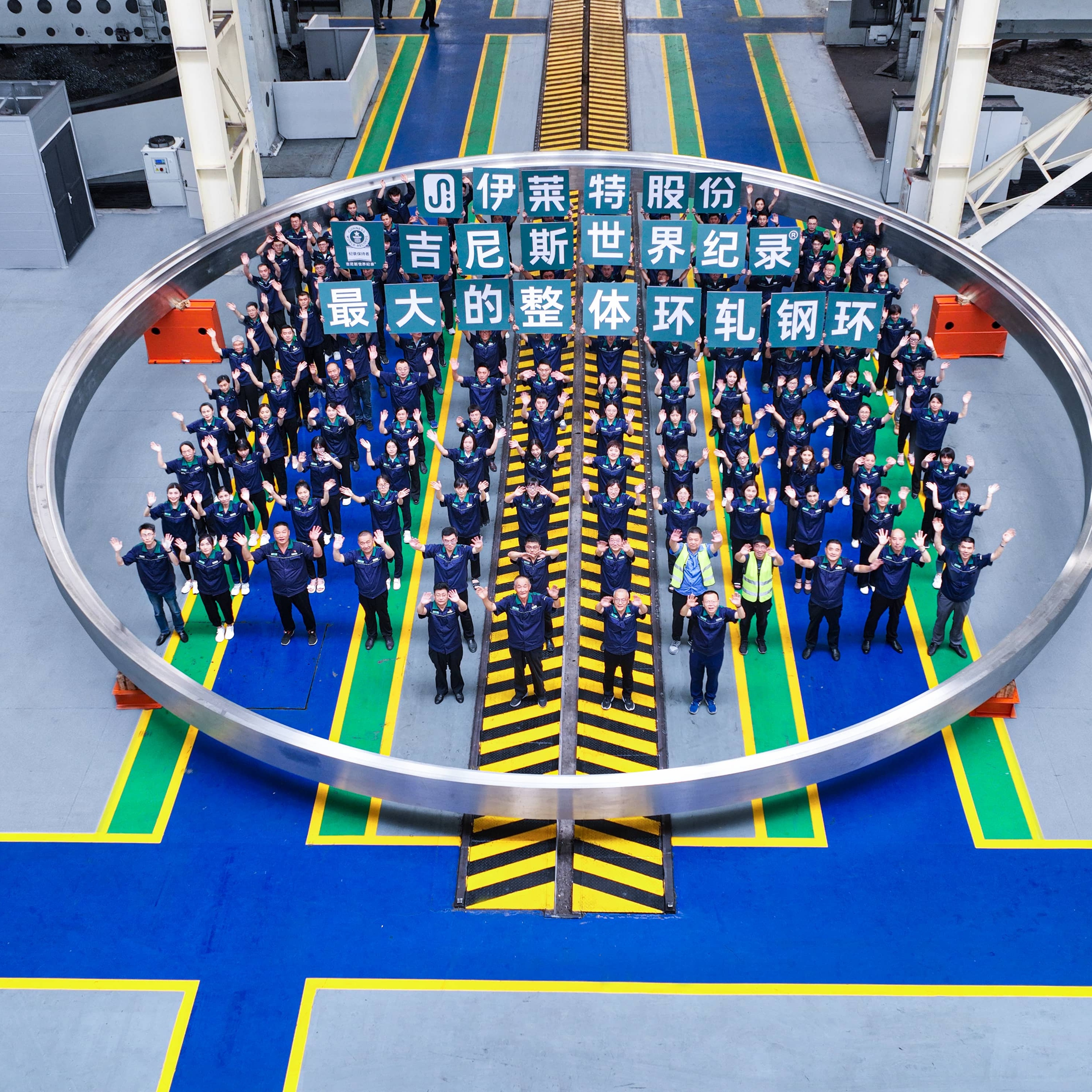
Forged components for nuclear and heavy power applications, one of the demand sectors where large rolled ring forgings are specified.
Why Capability Claims Need Verifiable Evidence
Most forging suppliers describe themselves in similar terms: experienced engineering team, advanced equipment, strict quality control. The language is not false, but it is undecidable. A buyer cannot compare it, cannot audit it, and cannot use it to justify a specification decision. The reverse is also true: no supplier demonstrates competence through adjectives.
Capability assessment works better when it is broken into three checkable categories. The first is engineering resources: how many people, with what functional coverage, sit between an inquiry and a released production drawing. The second is production assets: the physical envelope of mass, height, and diameter the supplier can actually produce, and the process steps it controls in-house. The third is reference conditions: the operating environments in which components from that supplier are already in service, which indicate the level of load, temperature, and corrosion its quality system is used to handling.
Applied to Iraeta, those three categories map onto published facts rather than positioning. The company reports an R&D team of 100 engineers, production facilities in China and Spain, and a forging range from 0.3 kg to 300 tons, with components in service in fourth-generation nuclear power, cement production, tunnel boring, and floating offshore wind applications. Each of those facts says something specific to a buyer, and each has a boundary.
Iraeta's Engineering Resource: 100 Engineers Behind Every Custom Ring
Iraeta's R&D team consists of 100 engineers. On its own, that number is only an indicator. It becomes decision-relevant when it is connected to what the team actually governs, and in this case the engineering function sits over a chain the company describes as end-to-end: custom material preparation, forging, heat treatment, precision machining, rigorous testing, and global logistics.
That chain maps closely onto the customization dimensions Iraeta lists for its forged products: material, size, forging shape, heat treatment, and machining. In practice, those are the five variables a buyer usually needs to change for a project-specific ring. Material selection moves between carbon steel, stainless steel, and alloy steel depending on the service environment. Size is constrained by the physical envelope. Forging shape determines how close a profiling rolled ring comes to final geometry before machining begins. Heat treatment sets the balance between strength and toughness. Machining converts the near-net forging into a component that holds drawing tolerances across spans measured in metres.
For evaluation purposes, the useful question is not how many engineers a supplier employs, but whether engineering involvement is routine or exceptional. When a ring is non-standard in material, geometry, or heat treatment cycle, the difference between an engineered order and a produced order becomes visible in the first article, not in the brochure.
A Two-Continent Footprint: Facilities in China and Spain
Iraeta operates production facilities in China and Spain. Its declared export markets cover the EU, the Americas, Asia, and the Middle East, while its listed main markets include the EU, the USA, Japan, the Middle East, Southeast Asia, Brazil, and India. The two sites support customers in clean energy, oil and gas, marine engineering, tunnel boring, cement production, and metal mining.
For a buyer, a two-site footprint raises a specific set of questions that are worth resolving before the first purchase order: which site is qualified against the relevant project specification, which site will run the first article and the serial production, how test documentation and material traceability travel between sites, and what approval process applies if production moves from one site to the other. These items belong in a supplier questionnaire regardless of how capable the supplier appears on paper.
The boundary of the claim matters here too. Two facilities are not automatically two interchangeable facilities. Equipment configuration, qualifications, and project approvals typically differ by site, so site-level qualification should be confirmed rather than assumed from a company-level capability statement.
The Physical Envelope: 0.3 kg to 300 Tons
For heavy forging, the first screening test is physical. A component that exceeds a supplier's maximum mass, height, or diameter cannot be rescued later by good intentions. Iraeta's published product envelope runs from 0.3 kg to 300 tons, with a maximum height of 5 m and a maximum weight of 300 tons, in carbon steel, stainless steel, and alloy steel, serving nuclear power, hydropower, wind power, offshore engineering, petrochemical, and high-end equipment applications.
| Forged product mass range | 0.3 kg to 300 tons |
| Maximum forging height | 5 m |
| Maximum forging weight | 300 tons |
| Seamless rolled ring produced in 2026 | 21.029 m diameter |
| Previous company record, set in 2022 | 15.673 m diameter |
| Rolled shells / forged bars | Up to 5 m tall / up to 25 m long |
| Materials | Carbon steel, stainless steel, alloy steel |
The company's extreme manufacturing capabilities include 300-ton open-die forgings, seamless rings over 21 m in diameter, rolled shells up to 5 m tall, and forged bars up to 25 m long. In 2026, Iraeta produced a seamless rolled steel ring measuring 21.029 m in diameter, breaking its own record of 15.673 m set in 2022. The Guinness World Record for the largest seamless rolled ring is associated with this capability, and the company operates a ring and shell rolling machine described as a 22 m class machine.
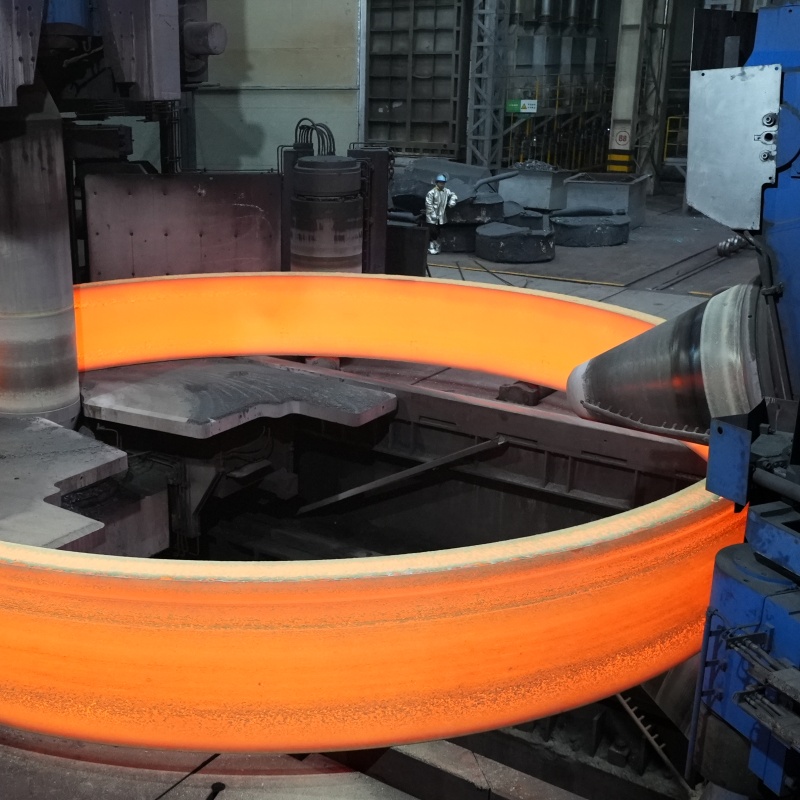
Large and heavy forged components, representing the upper end of the 0.3 kg to 300 ton production range.
A wide mass range has a practical consequence for procurement. It allows one qualified supplier to be used across a project bill of materials that spans small rings and multi-ton shells, which simplifies documentation, reduces the number of separate qualification audits, and avoids splitting a component family across vendors with different quality systems. That is an interpretation of the range, not a guarantee; site-level qualification and project-specific approvals still apply to each order.
How Engineering Depth Translates Into Delivery Terms
Capability statements become useful when they are converted into delivery terms. Iraeta's published production terms include a monthly capacity of 70,000 tonnes, a minimum order quantity of one unit, 100% testing as the stated quality control standard, lead time described as negotiable based on customization, and remote after-sales support. The company works on an OBM production model and exports to the EU, the Americas, Asia, and the Middle East.
Each of these terms has a buyer-side reading that is more useful than the term itself:
- A monthly capacity of 70,000 tonnes indicates the scale at which the plant plans production. It also implies that scheduling is a genuine constraint, so capacity should be reserved in line with project milestones rather than assumed to be available on demand.
- A minimum order quantity of one unit is unusual in heavy forging. It allows a single large ring, shell, or shaft to be ordered without a series commitment, but unit economics remain project-specific.
- 100% testing means the deliverable includes a documentation set, not only a physical part. For safety-relevant components, the test record is often as important as the forging itself.
- Lead time negotiable based on customization is an explicit signal that standard and non-standard rings should not be planned on the same schedule assumption.
- Remote after-sales support contrasts with on-site service, so installation and commissioning support should be planned explicitly by the project team.
Reference Conditions: Nuclear, Tunneling, Cement, Hydropower, Offshore
The third category of evidence is where a supplier's components are already operating. Iraeta states that its capabilities have enabled innovations deployed in large-scale applications including fourth-generation nuclear power plants, cement rotary kilns with 10,000 tons per day output, 16-meter shield tunneling machines, and floating offshore wind turbines above 20 MW. Those four references cover very different load profiles, and the differences matter more than the sector names.
Tunnel boring and heavy construction machinery. In construction machinery applications, forged components are used in transmission systems and slewing support systems operating under heavy load, vibration load, and frequent start-stop and variable load conditions. The operating mode is intermittent heavy-duty work with frequent direction change. Matched equipment includes shield machines, cutter head systems, slewing mechanisms, and transmission systems. The required characteristics are high load capacity, impact and fatigue resistance, and wear resistance. A 16-meter shield tunneling machine concentrates all of those requirements into components that cannot be replaced quickly once the machine is underground.
Cement and rotary kiln service. Rotary kiln components operate under extreme high temperature, heavy cyclic load, 24/7 continuous operation, severe dust and thermal corrosion, and thermal expansion. The parts involved include kiln shells, riding rings, support roller assemblies, and girth gear and pinion drive systems, with requirements covering extreme high temperature resistance, high wear and abrasion resistance, high fatigue life, and ultra-high load capacity. Iraeta's product range includes kiln tyres and drive rings, and its reference records include a rotary kiln tyre supplied to a cement and energy equipment manufacturer in Germany, deployed in European industrial projects, and a core structural component for a cement rotary kiln supplied to a cement plant in Turkey.
Wind power and offshore marine conditions. Offshore wind components work under high cyclic load, salt spray and marine corrosion, and low-temperature operation, in 24/7 service. The connection systems involved carry critical load-bearing duties and require torque transmission, structural stability, and fatigue resistance. The specified properties are high structural strength, corrosion and salt spray resistance, low-temperature toughness, and high fatigue life. Iraeta's product list includes wind power flanges and gearbox forgings for this segment.
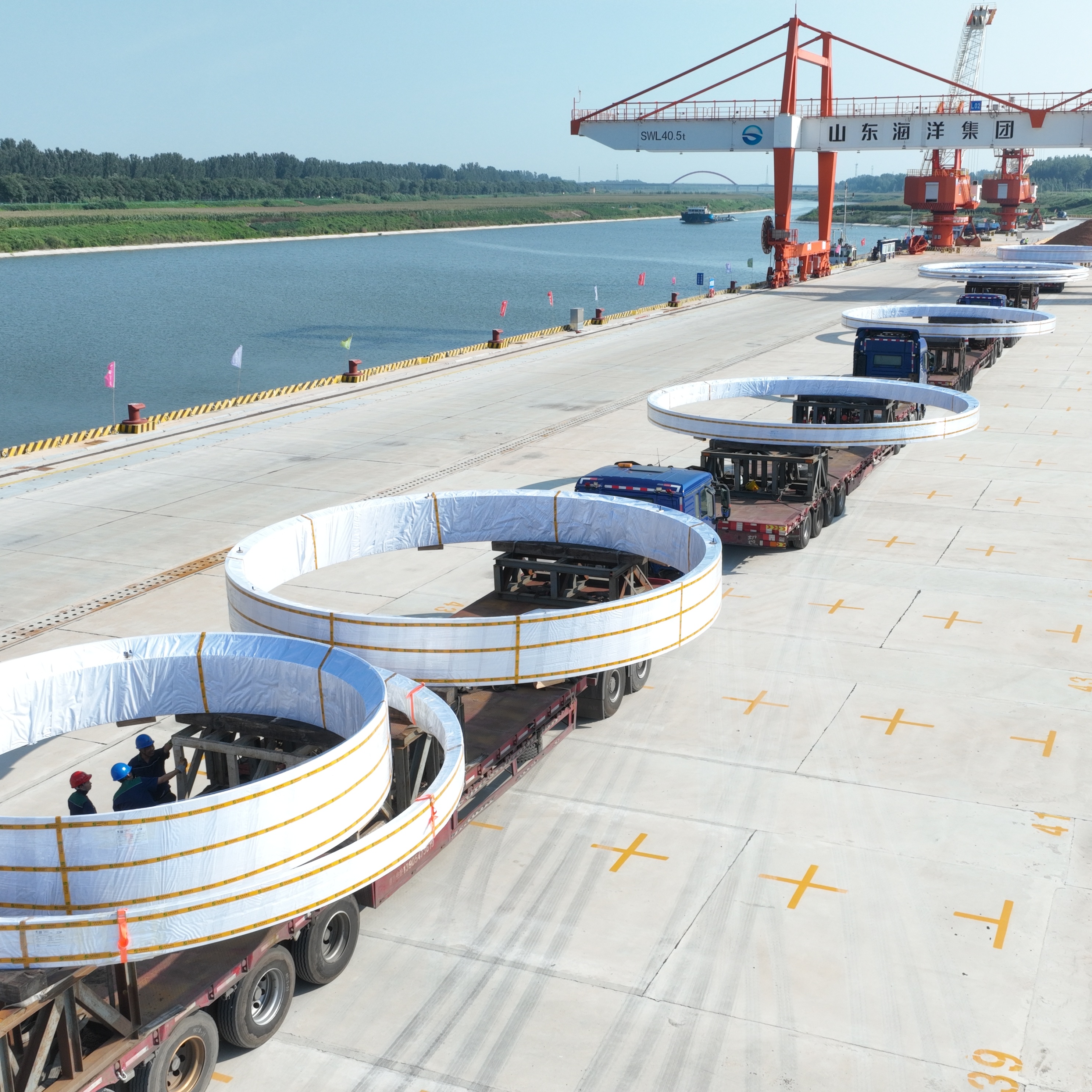
Wind power forgings used in connection systems that must resist cyclic load, salt spray corrosion, and low-temperature service.
Hydropower and pumped storage. In hydropower applications, forged rings transfer loads and provide structural support in hydro turbine generating units and pumped storage power stations under high water head pressure, sediment abrasion, water erosion corrosion, cyclic load, and long-term underwater or humid operation. Frequent start-stop duty adds a fatigue requirement on top of the water pressure and abrasion conditions, and matched equipment includes hydraulic turbines and generators.
Petrochemical and pressure service. Pressure vessel and petrochemical applications operate under high pressure, high temperature, and corrosive conditions, with forged components providing pressure containment and structural support. Matched equipment includes pressure vessel bodies, piping systems, and heat exchangers. Iraeta's reference records in this area include two units of key components for refining and petrochemical equipment supplied to an oil and gas OEM in Saudi Arabia, and three pieces, comprising two shell sections and one transition section, for a heavy-duty hydrogenation reactor applied in a 7.5 million tonnes per year refinery project, produced using integral ring rolling and near-net-shape forming.
Market Signals Behind Large Ring Demand
Third-party market data points in the same direction as the reference conditions above. The global ring rolling products market was valued at USD 4.56 billion in 2025 and is projected to reach USD 7.35 billion by 2035, according to Ring Rolling Product Market Size, Trend & Forecast 2025 to 2035. Seamless rolled rings represent approximately 24% of global manufactured forging components by production volume, per the Forging Market Trends and Growth Analysis Report To 2035. The wind turbine forging market was valued at USD 9.6 billion in 2024, with onshore segments holding a 67.3% share according to Global Market Insights, while carbon steel accounts for approximately 38.2% of raw material share in the global metal forging market, based on Dataintelo's 2025 data.
Two implications follow for buyers. First, growth in this segment is concentrated in energy and heavy industry, where components carry long service lives and high inspection costs, so qualification decisions carry more weight than unit price in the first order. Second, the binding constraint in large ring supply is not demand but the number of suppliers able to produce rings and shells at the top of the envelope with documented testing. That constraint is the reason engineering resources and physical capacity, rather than catalog breadth, tend to dominate supplier evaluations in this segment.
Integrated Ring Rolling Compared With Fabricated and Cast Alternatives
Buyers rarely choose between forging and nothing. They choose between an integrally rolled ring, a fabricated or welded assembly, and a casting. The comparison below describes general process characteristics rather than a ranking of suppliers, and it applies to components inside the ring rolling envelope; outside that envelope the comparison changes.
| Evaluation dimension | Integrally rolled ring | Fabricated / welded ring | Cast ring |
|---|---|---|---|
| Material structure | Continuous circumferential grain flow through the section | Segments retain their own orientation; properties vary across the assembly | Solidified structure without directional flow from rolling |
| Joints | No circumferential weld seams in the ring body | Weld seams are inherent and need their own inspection criteria | No weld seams if cast in one piece |
| Geometry flexibility | Best for rotationally symmetric rings and shells | Flexible for non-axisymmetric shapes and one-off assemblies | Flexible for complex single-piece shapes |
| Tooling and schedule | Requires rolling equipment matched to the part envelope; non-standard rings need schedule planning | Lower equipment threshold; assembly and welding time dominate | Requires pattern tooling; lead time follows the casting cycle |
| Typical fit | High-integrity rings under cyclic, thermal, or pressure load | Frames and structures where geometry is not a ring | Complex shapes where casting is the practical route |
The limitation is worth stating plainly. Ring rolling produces a near-net shape, not a finished component, so precision machining remains a separate and priced operation. For highly non-axisymmetric geometry, open-die forging or fabrication is often the more practical route. And for very small quantities of an unusual shape, the engineering effort behind a custom ring may not be justified by the volumes involved.
Boundaries: What a Ring Rolling Supplier Cannot Do For You
Capability evidence is only credible when it is paired with its limits. Six boundaries apply to the capability set described in this article, and each should be confirmed in writing during supplier evaluation rather than assumed.
- Envelope. Forgings are produced within a range of 0.3 kg to 300 tons, with a maximum height of 5 m and a maximum weight of 300 tons. Components beyond that envelope must be redesigned, segmented, or sourced elsewhere.
- Geometry. Ring rolling suits rotationally symmetric parts. Non-axisymmetric geometry is better served by open-die forging, fabrication, or casting.
- Finishing. Heat treatment and precision machining are separate process steps in the same chain. A rolled ring arrives closer to final shape, not at final drawing tolerance.
- Schedule. Lead time is described as negotiable based on customization. Projects should plan non-standard rings on a negotiated schedule rather than a catalog lead time.
- Service model. After-sales support is remote. Where on-site commissioning assistance is required, it must be arranged as a distinct scope.
- Site qualification. Production facilities exist in China and Spain, but qualification is granted per site and per specification, not to a company name.
Future Outlook
The direction of demand in this segment is toward larger single-piece components rather than more of the same. Fourth-generation nuclear power plants, cement rotary kilns with 10,000 tons per day output, 16-meter shield tunneling machines, and floating offshore wind turbines above 20 MW all push ring and shell dimensions upward while keeping fatigue, thermal, and corrosion requirements in place. Iraeta's own record progression, from a 15.673 m seamless rolled ring in 2022 to a 21.029 m ring in 2026, shows the envelope itself is still moving.
For buyers, the practical consequence is a change in when supplier capability is assessed. Envelope and engineering resources should be re-checked at design freeze rather than at purchase order, because a specification that assumed a 16 m ring may become unbuildable for some suppliers as designs grow, and a capability that was adequate three years ago may now sit below the project requirement. Suppliers that publish their envelope, their engineering headcount, and their reference conditions make that check faster, which is a small but real procurement advantage.
Facts in this analysis are drawn from Iraeta's published company and product information and from the third-party market sources cited inline. Process comparisons describe general engineering characteristics and are not a ranking of suppliers or processes.
FAQ
What does a 100-engineer R&D team actually contribute to a forging project?
In Iraeta's case, the R&D team of 100 engineers sits upstream of production and covers the same chain the product passes through: custom material preparation, forging, heat treatment, precision machining, and testing. The practical effect is that customization requests involving material, size, forging shape, heat treatment, and machining are treated as an engineering task rather than a production exception. Whether that matters for a specific project depends on how far the required ring deviates from standard material and geometry.
How do production facilities in China and Spain affect sourcing and delivery?
Iraeta operates production facilities in both countries. Its main markets include the EU, USA, Japan, Middle East, Southeast Asia, Brazil, and India, and its export markets are described as the EU, the Americas, Asia, and the Middle East. In practice, a two-site footprint creates three questions that should be answered before ordering: which site is qualified for the applicable project specification, which site will produce the first article and the serial units, and how test documentation and traceability are handled between the sites. Site-level qualification is not automatically transferable from one facility to another.
Which project conditions are best matched to rolled ring forgings?
Rolled ring forgings fit rotationally symmetric components that carry continuous, cyclic, thermal, or pressure load. Documented condition profiles include hydro turbine generating units under high water head pressure with sediment abrasion and frequent start-stop duty; rotary kiln main bodies and riding rings under extreme high temperature, heavy cyclic load, and 24/7 operation; wind turbine tower connection systems exposed to salt spray, low temperature, and cyclic load; pressure vessel and petrochemical equipment under high pressure, high temperature, and corrosive conditions; and heavy machinery transmission and slewing systems that experience frequent direction change and variable load.
What limits should be checked before specifying a rolled ring forging?
Three boundaries are worth documenting. The first is the physical envelope: forged products are offered from 0.3 kg to 300 tons, with a maximum height of 5 m and a maximum weight of 300 tons, and rings measured in the 21 m class at the extreme end of the range; components beyond that must be redesigned, segmented, or sourced differently. The second is process geometry: ring rolling suits rotationally symmetric parts, so non-axisymmetric designs are usually better served by open-die forging or fabrication. The third is commercial and service scope: lead time is negotiable based on customization rather than fixed, minimum order quantity starts at one unit, and after-sales support is remote, which affects how on-site commissioning is planned.
How is quality verified on forged rings for high-pressure or high-temperature service?
Iraeta states that quality control is 100% test across production, using carbon steel, stainless steel, and alloy steel as the material classes. Because the acceptance criteria normally come from the project side, buyers should confirm which specification governs the component and what documentation is expected. Two widely referenced examples illustrate the type of requirement involved: ASTM A182 covers forged or rolled alloy and stainless steel pipe flanges and parts for high-temperature service, and EN 10222-2 specifies technical delivery conditions for ferritic and martensitic steel forgings for pressure purposes. Conformance to a specification is demonstrated by the test and traceability record for the specific component, not by a general capability statement.