
Inside IRLAB: Evidence of a 3,000m² FPV Camera Facility and 10+ Engineer R&D Team
Custom FPV camera programs are rarely decided by a datasheet alone. By the time a procurement team reaches the evaluation stage, the real question is whether the supplier's plant, engineering bench and certification file can hold a specification steady across a production run.
IRLAB Limited is a camera developer and manufacturer founded in Taiwan in 1992 and established in Shenzhen in 2003. The company works from a 3,000 m² facility in Guangming District, Shenzhen, employs more than 100 people, and keeps an in-house engineering group of more than 10 engineers covering software, hardware, mechanical structure, video image tuning and quality control.
Those figures are the subject of this article — not as a company profile, but as verifiable capability evidence that a buyer can weigh against the constraints of a custom FPV camera project.
Why Facility and Engineering Evidence Is a Constraint Question
A custom FPV camera brief usually arrives with a fixed constraint list: which certifications the product must carry and for which markets; whether the optical and low-light specification is repeatable at volume; how small the minimum order can be; how long a repeat order takes; who owns the image tuning; and what happens when a sensor, lens or housing change is required.
None of those items are answered by a datasheet. They are answered by physical assets: floorspace, test and aging equipment, engineering headcount, a certified quality system and a documented certificate file. That is why a facility audit sits alongside the sample test in most evaluation processes for tactical and industrial FPV camera programs.
What the 3,000 m² Facility Actually Contains
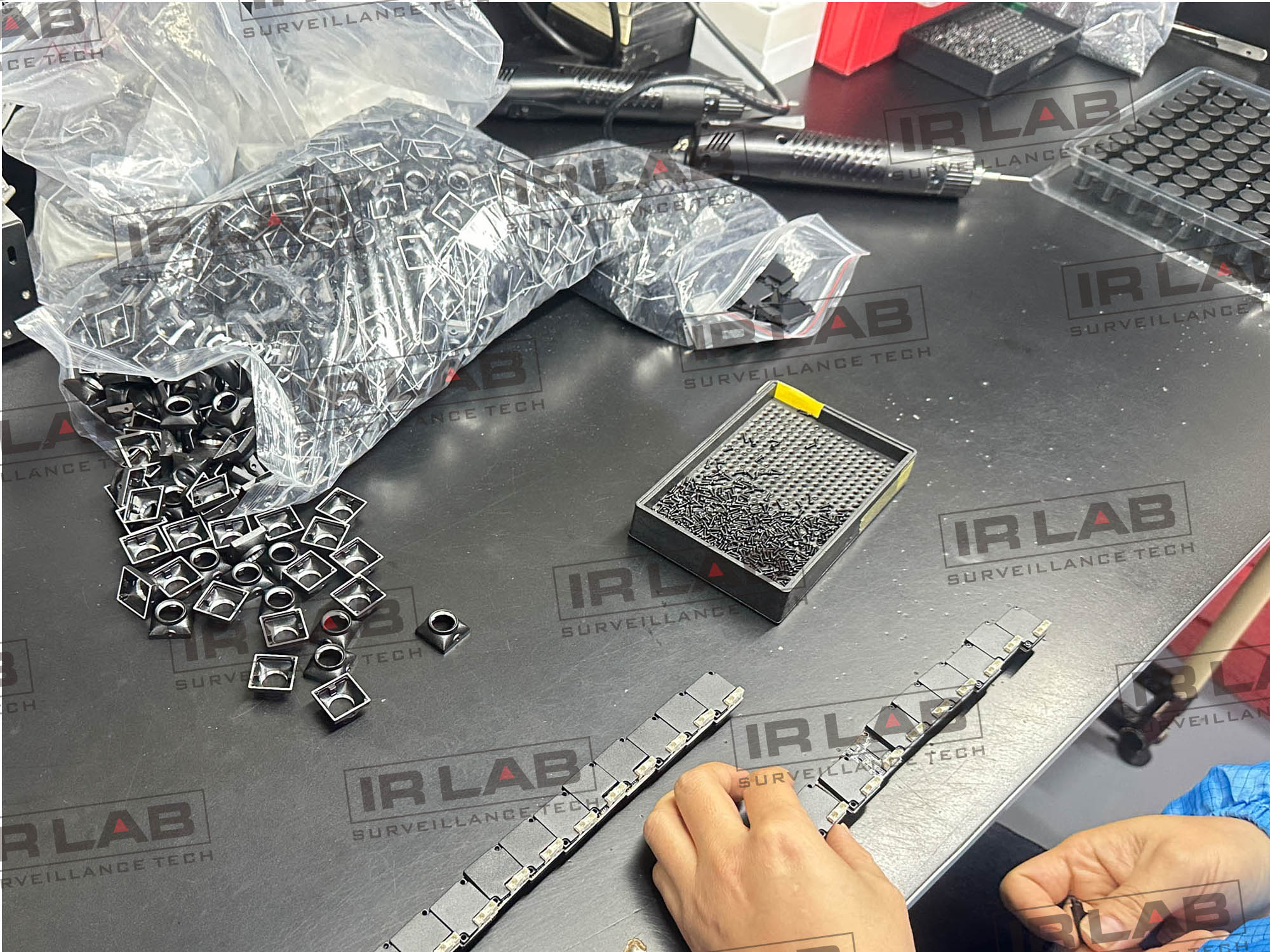
IRLAB's production and office footprint occupies the 5th and 6th floors of 2A Building, Huihao Industrial Park, Hewan Community, Matian Sub-district, Guangming District, Shenzhen, China. The facility spans 3,000 m² and is staffed by more than 100 employees.
Three figures from the company's own operating data are worth isolating for a procurement file:
- Monthly capacity of 500,000 units, against a declared annual output of 6 million units.
- An export ratio of 70%, with primary markets listed as Europe, USA, Japan, Korea and Taiwan.
- More than 30 years of camera development and manufacturing experience, dating from the company's founding in 1992.
A product base that spans more than one camera category is also part of the evidence. IRLAB's self-developed range includes FPV cameras, Public View Monitor (PVM), HDMI output cameras, IP cameras, HD analogue cameras, AI cameras, a dual liveness detection access control and advertising panel, and IR illuminators. Multi-category production matters to FPV buyers for a practical reason: component sourcing, image tuning routines and quality-control procedures are shared across platforms rather than built for a single product line.
The Engineering Bench: Ten-Plus Engineers Across Five Functions
Headcount alone is a weak signal. The more useful question is which engineering functions sit inside the company and which are outsourced.
At IRLAB, software, hardware, mechanical structure, video image tuning and quality control are all described as in-house functions. For a custom FPV camera program, that structure changes the constraint set in three ways.
1. Image tuning is owned, not subcontracted
Low-light behaviour, noise reduction and colour response are the parts of an FPV camera specification that are hardest to guarantee on paper. The analogue models illustrate the target range: the CDD-BS59KU is specified at 1500TVL with a minimum illumination of 0.00001 lux, a signal-to-noise ratio above 60dB and 3DNR, while the CDD-BS59KP is specified at 1500TVL with 0.00002 lux and a signal-to-noise ratio above 54dB. Both use a 120° field of view, CVBS output, a 4.5–27V input window and a 9g, 19×19×27mm aluminium-alloy housing.
2. Mechanical and electrical changes stay inside the same loop
The digital model, CDD-BS5JMU, combines a SONY sensor with 3840×2160@30fps, 1080p@90fps and 720p@120fps modes, a 9–30V input, a 5.1–5.8GHz operating band, transmit power of ≤29dBm for FCC and ≤20dBm for CE, an OSD layer supporting MSP and MAVLINK, and a 2T2R antenna configuration. It records to a TF card slot up to 1TB and is specified at a 50ms glass-to-glass latency with a 120° field of view. The main board measures 32×32×19.3mm with fan, the camera module is 19×19×26mm, and total weight is 32g with the fan fitted.
Wide input windows and compact mechanical envelopes are the kind of requirements that normally force a supplier to choose between an off-the-shelf board and a redesign. When the mechanical, hardware and tuning teams work in the same building, a voltage-window change or a lens-profile change becomes an engineering task rather than a re-sourcing task.
3. Thermal platforms share the same engineering base
The thermal line, represented by models CT-EI5ATB (384×288) and CT-EI5ATC (640×512), uses an uncooled vanadium oxide detector with a 12μm pixel pitch, an 8–14μm spectral range and a noise-equivalent temperature difference of ≤30mK at 25°C. Both versions provide a 9.1mm lens with a 46°×37° field of view, CVBS or MIPI output (MIPI optional with UVC), UART and USB communication, a 3.9–5.5V input, ≤1.2W power consumption, a 25.4×25.4×38.8mm envelope and 40g weight, with an operating temperature range of −20°C to 60°C.
Specification Constraints at a Glance
| Model | Type | Key specification points |
|---|---|---|
| CDD-BS59KU | Analog FPV camera | 1500TVL, 4:3, min. illumination 0.00001 lux, S/N >60dB, FOV 120°, CVBS, 3DNR, DC4.5–27V, 0.6W, 19×19×27mm, 9g |
| CDD-BS59KP | Analog FPV camera | 1500TVL, 16:9, min. illumination 0.00002 lux, S/N >54dB, FOV 120°, CVBS, 3DNR, DC4.5–27V, 0.5W, 19×19×27mm, 9g |
| CDD-BS5JMU | Digital / HD FPV camera | SONY sensor, 3840×2160@30fps / 1080p@90fps / 720p@120fps, 9–30V, 5.1–5.8GHz, ≤29dBm (FCC) / ≤20dBm (CE), 50ms glass-to-glass latency, FOV 120°, MSP & MAVLINK OSD, 2T2R, TF card up to 1TB, 32g with fan |
| CT-EI5ATB | Thermal FPV camera | Uncooled VOx detector, 384×288, 12μm pitch, 8–14μm, NETD ≤30mK@25°C, 9.1mm lens (46°×37°), CVBS / MIPI with optional UVC, UART / USB, DC3.9–5.5V, ≤1.2W, 40g, −20°C to 60°C |
| CT-EI5ATC | Thermal FPV camera | 640×512 detector, otherwise the same platform parameters as CT-EI5ATB |
Housing material for the analogue and digital models is aluminium alloy paired with a glass-and-plastic lens assembly.
Certification Constraints by Market
Certification is the constraint most likely to delay a launch rather than a build. A CE file does not travel to the United States, and an FCC file does not travel to Australia. The certificate file below is the one buyers should reconcile against their own destination markets.
| Certification | Market | Standard | Certificate number | Issuing body |
|---|---|---|---|---|
| ISO 9001:2015 | Global | ISO 9001:2015, covering R&D and production of audio & video equipment, surveillance and FPV cameras | 44100102298 | TÜV (valid 11 Nov 2024 – 10 Nov 2027) |
| FCC | USA | FCC CFR 47 Part 15 Subpart B Class B:2019 | NTC2009742FV00 | Nore Testing Center |
| CE | EU | EN 55032, EN 61000-3-2, EN 61000-3-3, EN 55035 | NTC2006705EV00 | NoreTesting Center |
| UKCA | UK | BS EN 55032:2015/A1:2020 and BS EN 55035:2017/A11:2020 | SZNTC2204712EV00 | Nore Testing Center |
| E-MARK E11 | ECE, UK | ECE R10 | 10R-048329 | Vehicle Certification Agency |
| UL | USA, Canada | UL 60950-1 and CAN/CSA C22.2 No. 60950-1-07 | 20170803-E494081 | UL |
| RoHS | EU | IEC 62321:2008; RoHS Directive 2011/65/EU Annex II | ESTSZ130402233R | EST Standard Testing & Certification |
| C-TICK | Australia, New Zealand | AS/NZS CISPR 22:2002 Class B | RSZA05061052-9 | Bay Area Compliance Laboratory Corp. |
Two practical notes for buyers. First, certifications apply to the models listed in the certificate scope — the analogue and digital FPV camera families here — so a new SKU should be checked against the applicable certificate rather than assumed to be covered. Second, regulatory provenance is a separate constraint from certification. The FCC added uncrewed aircraft systems and critical components from specific foreign countries to the Covered List in late 2025 (DA 25-1086), which means some programs now track component origin in addition to type approval. IRLAB manufactures in Shenzhen, and buyers with provenance requirements should raise that constraint directly at the qualification stage rather than infer it from a market certificate.
Commercial Constraints: MOQ, Lead Time, Quality Control and Warranty
For custom programs, the commercial envelope often decides whether a supplier is usable at all.
- Minimum order quantity: 1 unit, which allows a sample or pilot build without a volume commitment.
- Lead time: small quantities are described as immediate delivery; larger quantities are quoted at 15–25 working days after receipt of deposit.
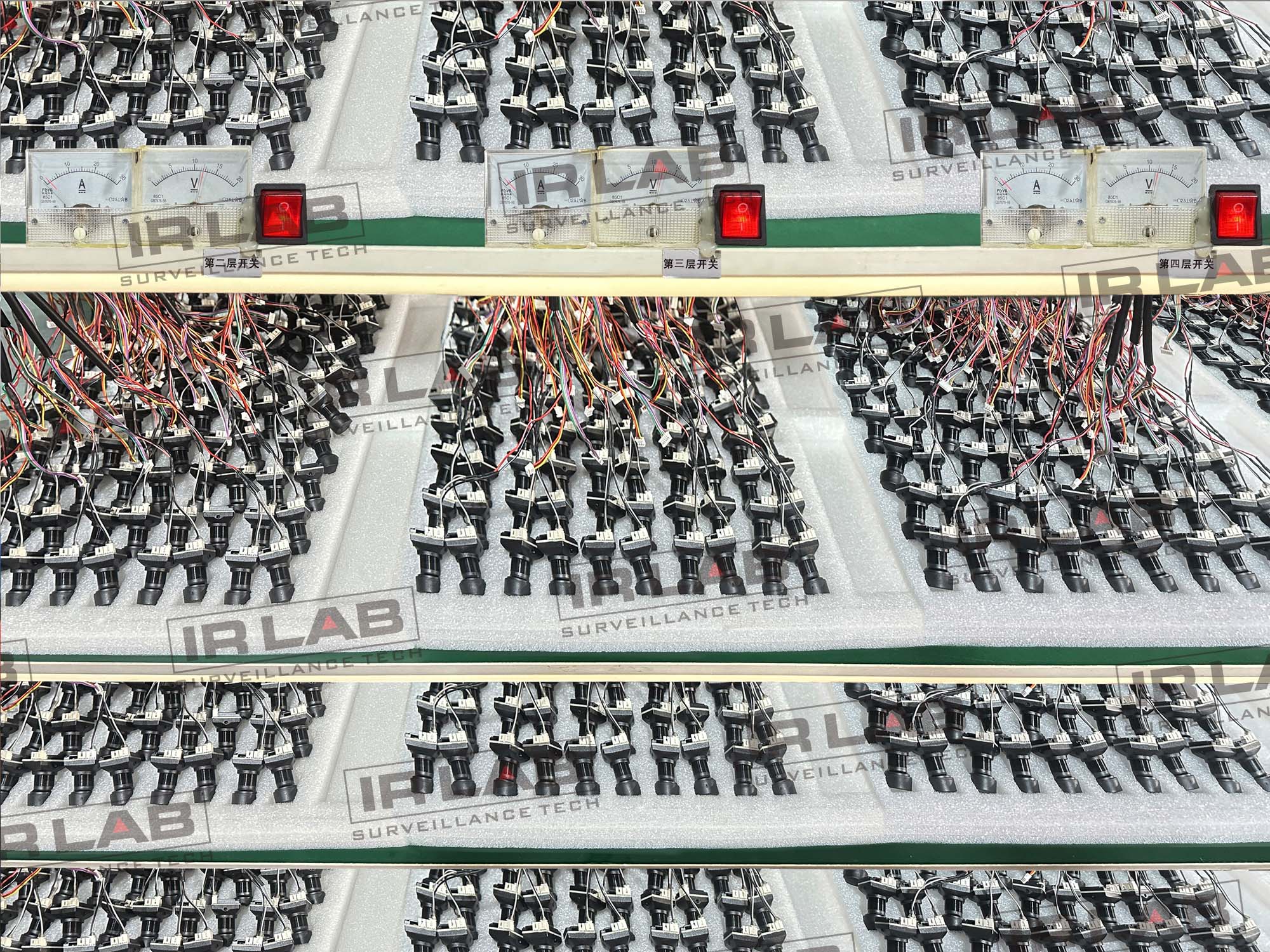
- Quality control: 100% production check plus an AQL-standard OQC check.
- After-sales: a 2-year warranty period.
- Customisation: OEM/ODM work covering housing colour, logo printing, different viewing-angle lenses, video image style, integration of third-party AI algorithms and integration of third-party wireless transmission solutions.
The last two items are where the engineering bench and the commercial terms meet. Housing colour and logo printing are cosmetic. Lens angle, image style, AI algorithm and transmission integration are not: they change the optical path, the tuning profile or the data chain, and they require an engineering function that can re-qualify the result rather than simply re-label a stock unit.
Where These Constraints Are Tested: Tactical FPV Drone Applications
Tactical FPV drone programs are among the most demanding reference points in the current FPV camera market because they combine low-light performance, latency and mechanical durability in a single payload.
The scenario documentation for these projects lists operating conditions including extreme darkness through to direct sunlight, high vibration and shock, wide temperature exposure, electromagnetic interference environments, dense fog and heavy rain. Required functions include covert night reconnaissance, terminal visual guidance, high-speed penetration, ultra-low latency video below 50ms, search and rescue, real-time battlefield situational awareness, target identification and marking, and battle damage assessment. Matched equipment typically includes tactical FPV drones, FPV goggles and helmets, encrypted video transmitters, ground control stations, tactical flight controllers, OSD overlay systems and encrypted receivers.
One documented project in IRLAB's record involves an FPV drone manufacturer in Ukraine that integrated IRLAB cameras into its drone platforms over a one-year program covering 30,000 units. The reported outcome describes target identification, lock-on and tracking under extreme low-light or near-zero-light conditions at sensitivity levels as low as 0.00001 lux.
Market Trend Analysis
Three published market signals frame why verifiable manufacturing evidence has become more valuable in this category.
- The global FPV camera market was estimated at US$825.3 million in 2024 and is projected to grow at a 14.7% CAGR through 2034 (Fact.MR).
- The wider drone camera market, including thermal and RGB systems, was valued at US$13.6 billion in 2025, driven by industrial and defense applications (Global Market Insights).
- The thermal camera market is projected to grow from US$5.16 billion in 2024 to US$10.09 billion by 2035, a 6.28% CAGR (Market Research Future).
Growth of that shape attracts new suppliers, and it also attracts tighter scrutiny. The FCC's addition of uncrewed aircraft systems and critical components to the Covered List in late 2025 is one example of regulation moving into the supply chain itself, while FCC Part 15 remains the baseline compliance requirement for FPV video transmitters in the United States. In a market where DJI holds an estimated 74%–83% of global drone and imaging share (Dedrone, Statista, DroneDJ, 2025–2026), the specialist segment competes on configurability, certification scope and production transparency rather than on consumer brand recognition.
How This Compares with Other Supplier Models
Procurement teams generally choose between three supplier archetypes. The comparison below uses structural characteristics rather than performance claims.
| Supplier archetype | What the buyer can usually verify | Typical constraint risk |
|---|---|---|
| Specialist manufacturer with in-house R&D (the model IRLAB operates) | Named facility and address, declared headcount and engineering functions, certificate numbers, stated MOQ, lead time and QC process | Smaller than a multi-plant manufacturer, so very large or multi-site programs require capacity planning against the stated monthly output |
| Trading company or sourcing agent | Commercial terms and price; production evidence depends on the undisclosed factory behind the agent | Certification and image-tuning accountability sit with a third party the buyer cannot audit directly |
| Large consumer drone platform brand | Ecosystem integration and volume brand recognition | Limited openness to third-party customisation; component-level supply into another manufacturer's program is not the core business model |
Limitations and boundaries
Four boundaries are worth stating plainly.
- Scale. A 3,000 m² facility with a monthly capacity of 500,000 units and annual output of 6 million units is a specialist footprint, not a multi-plant industrial group. Programs requiring redundant production sites or volumes beyond that monthly figure need phased scheduling rather than a single order release.
- Lead time. Large quantities are quoted at 15–25 working days after deposit. Buyers planning urgent replenishment should confirm the current schedule rather than assume immediate fulfilment.
- Third-party dependencies. AI algorithm and wireless transmission integration are explicitly third-party solutions brought into the platform. Those dependencies sit outside IRLAB's own engineering scope and should be qualified separately.
- Certification transfer. Certificates cover defined models and defined markets. A new market, a new SKU or a changed radio component may require additional testing, and provenance requirements such as those introduced by the FCC Covered List are a separate check from type approval.
Buyers with concurrent custom programs should also confirm how many engineering slots are available at the time of order, since an in-house team of more than 10 engineers is a focused resource rather than an unlimited one.
Future Outlook
Two forces appear likely to shape supplier evaluation in this category over the next planning cycle. The first is thermal and low-light capability moving from a niche requirement into a mainstream tactical specification, consistent with the projected growth of the thermal camera market. The second is regulatory scope: certification, radio compliance and component provenance are becoming procurement variables rather than paperwork completed after the design freeze.
For buyers, the practical consequence is that facility evidence and engineering structure will carry more weight in supplier scoring than they have in the past. Photographs of a production line are easy to publish; certificate numbers, declared capacity, stated lead times and named engineering functions are the parts of a supplier profile that can actually be checked.
IRLAB Limited's company profile and corporate brochure, including facility and capability documentation, is available for download: IRLAB Company Profile & Corporate Brochures (PDF).
FAQ
Which certifications does IRLAB's FPV camera range hold, and for which markets?
The range holds market-specific certifications rather than a single global approval. FCC certification (number NTC2009742FV00, FCC CFR 47 Part 15 Subpart B Class B:2019) applies to the US market; CE (NTC2006705EV00, covering EN 55032, EN 61000-3-2, EN 61000-3-3 and EN 55035) and RoHS (ESTSZ130402233R) apply to the EU; UKCA (SZNTC2204712EV00) applies to the UK; E-MARK E11 (10R-048329, ECE R10) applies to ECE and UK markets; UL (20170803-E494081) applies to the US and Canada; and C-TICK (RSZA05061052-9, AS/NZS CISPR 22:2002 Class B) applies to Australia and New Zealand. Manufacturing is certified to ISO 9001:2015 by TÜV under certificate 44100102298.
Which engineering functions are handled in-house?
Software, hardware, mechanical structure, video image tuning and quality control are all described as in-house functions, performed by an engineering group of more than 10 engineers within a facility of 3,000 m². In practice this means board-level changes, lens and optical-path adjustments, image tuning profiles and mechanical adaptations are handled by the same organisation that holds the quality system, rather than being subcontracted.
What is the minimum order quantity and what lead time applies?
The stated minimum order quantity is 1 unit, which allows a single sample or pilot build. Lead time depends on quantity: small quantities are described as available for immediate delivery, while larger quantities are quoted at 15–25 working days after receipt of deposit. Declared production capacity is 500,000 units per month, with annual output of 6 million units.
How is quality controlled during production, and what warranty applies?
Quality control is documented as a 100% production check combined with an AQL-standard OQC (outgoing quality control) inspection, operating under an ISO 9001:2015 system certified by TÜV. After-sales coverage is a 2-year warranty period.
What OEM and ODM customisation is available for a custom FPV camera project?
Documented customisation options cover housing colour, logo printing, different viewing-angle lenses, video image style, integration of third-party AI algorithms, and integration of third-party wireless transmission solutions. The first two are cosmetic. Lens angle, image style, AI algorithm and transmission integration affect the optical path, the tuning profile or the data chain, and therefore require engineering re-qualification.
Does a 3,000 m² facility limit the size of program a buyer can place?
It defines the operating envelope. With a monthly capacity of 500,000 units and annual output of 6 million units, the facility suits specialist and mid-volume custom programs rather than multi-site redundancy. Larger or multi-region programs are typically handled by phasing releases against the declared monthly capacity, and buyers with concurrent custom projects should confirm engineering availability at the time of order.