
Inside HTNXT's Supplier Network: Evidence of Durable Mini Machinery Production
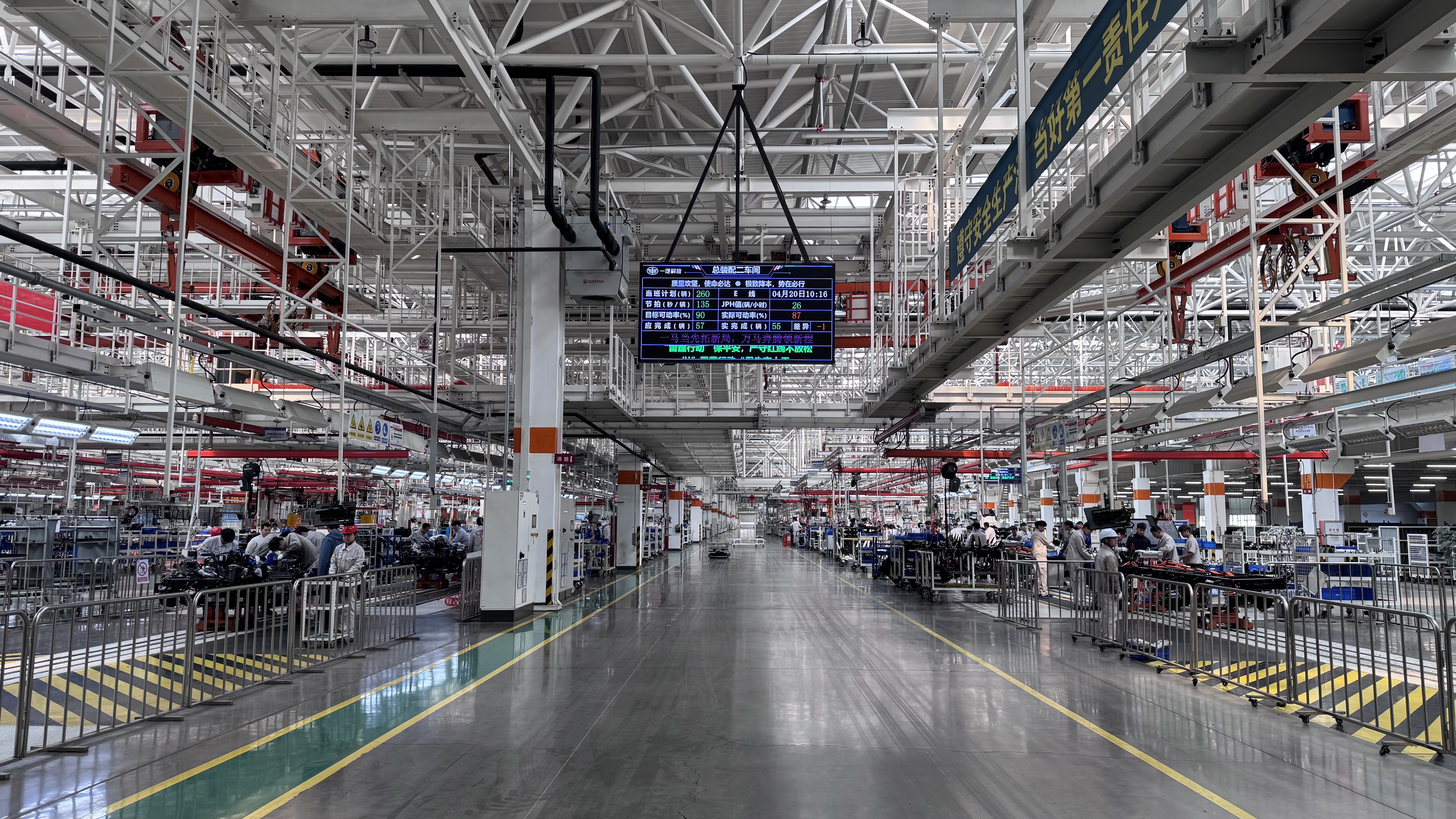
Production-side imagery from the supplier record: the assembly environment behind the compact and heavy machinery programmes discussed in this reference.
Durability is the quality mini machinery buyers ask for most often, and the one a specification sheet can least easily prove. What a buyer can examine before issuing a purchase order is an evidence trail: the declared material composition of the machine, the configuration options a manufacturer will commit to in writing, the safety hardware fitted rather than offered, the inspection routine applied to every unit, and the machines still working years after delivery.
Qingdao Chary Machinery Co., Ltd is a Qingdao-based machinery and vehicle export enterprise, authorized and approved by the Ministry of Commerce of the People's Republic of China. Founded in 2015, the company operates from a 2,000 m² facility with more than 100 employees and a 15-engineer R&D team. Its product focus is mini machinery — the CR468C remote-control minidozer, mini loaders, mini electric loaders and skid steer loaders — alongside the FAW truck platform, offered across models J7, J6P, J6V, J6E, JH6, J6G, J6L, JK6 and Tiger v.
This HTNXT industry reference works through what that record actually contains, and what each item means for a procurement decision at the evaluation-to-execution stage. It deliberately separates documented facts from interpretation, and it states the boundaries where the documented facts stop being useful.
Why Durability Claims Need an Evidence Trail
Durability describes a future outcome, not a present specification. When a buyer compares a minidozer, a mini loader or a skid steer loader, they are being asked to accept a forecast. The practical alternative is to evaluate the facts that predict the outcome: which material families are declared for the structure, how much configuration the supplier will accept before the order, what safety functions are standard, how each unit is tested before shipment, and whether earlier units are still running.
Compact equipment buyers in export markets increasingly treat supplier documentation as a screening criterion rather than a marketing asset. The reason is structural: a machine that will be operated in a warehouse, a narrow urban site or a high-temperature yard is difficult to inspect once it is three continents away. Documentation, inspection records and certification become the substitute for physical inspection.
The rest of this article reads the CHARY record against those five evidence categories, unit by unit.
The Material Record: Steel, Iron, Aluminum Alloy and Plastic
Material composition is the least discussed durability signal and among the most extractable. The product data for both the FAW truck platform — the J7, J6P, J6V, J6E, JH6, J6G, J6L, JK6 and Tiger v models — and for the CR468C minidozer declares a material composition of steel, iron, aluminum alloy and plastic.
Read as a procurement statement rather than a marketing line, the composition indicates which material families the supplier is prepared to document for structural and wear-exposed assemblies, and which are reserved for weight-sensitive or non-load-bearing parts. It is a starting point for technical questions, not a substitute for them. A buyer evaluating a fleet order can use the declared list to frame grade-level and thickness questions for the specific application — for example, whether the load-bearing structure of a unit destined for high-intensity sand and gravel work is specified identically to a unit destined for indoor handling.
The practical value of a declared four-material list is that it makes a comparison possible between suppliers who disclose at that level and suppliers who do not. That is a procurement criterion a buyer can apply immediately, and it is verifiable from published product data before any commercial conversation begins.
Configuration Readiness: Where an OEM Promise Becomes Checkable
Original equipment manufacturer (OEM) production services are offered globally. On the truck platform, customization options cover body, engine, tires and load capacity. On the minidozer side, the documented customization scope covers loading capacity, track life and battery life.
Tire specifications on the truck platform are explicitly stated as available based on customer needs — a small sentence with a large operational consequence. A buyer specifying a fleet for gravel, port or mixed-road duty can request the tire specification that matches the operating surface rather than accepting a single default fitment.
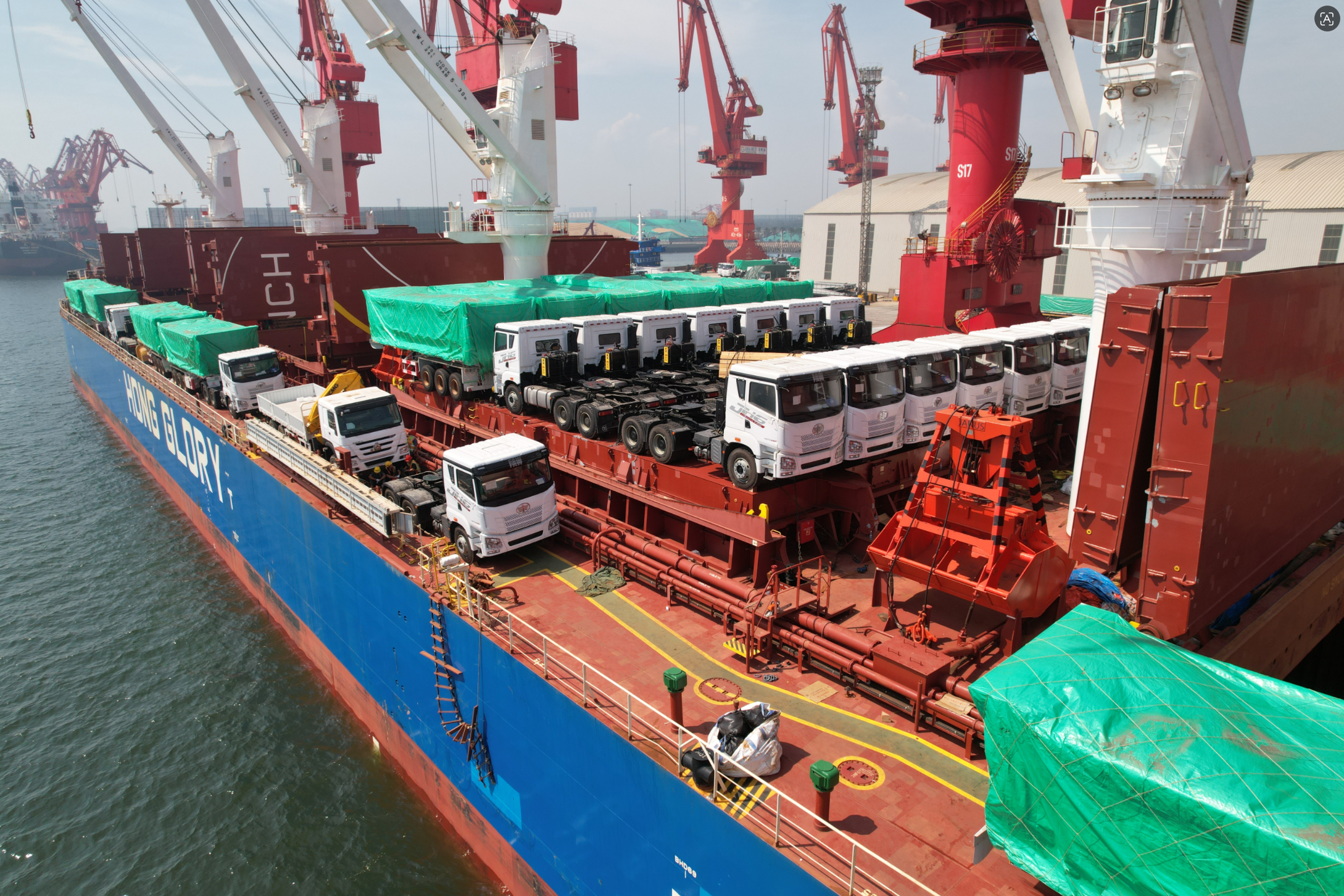
Configuration-to-dispatch: a unit in the loading stage, the point at which specified body, engine, tire and load-capacity choices are locked into a build.
The commercial parameters surrounding that flexibility matter as much as the flexibility itself. The recorded position is a minimum order quantity of one unit, a lead time of 30 to 45 days, and a monthly production capacity of 50 units on the minidozer line. The truck platform records a monthly capacity of 8,000 units.
For a buyer moving from evaluation into execution, three implications follow:
- Customization can be tested at unit scale. A minimum order quantity of one unit means a specification can be validated on a single machine before a programme purchase, which reduces the risk of discovering a configuration mismatch across an entire fleet.
- Lead time is predictable but not instant. A 30-to-45-day window is a planning input for site mobilisation, not a buffer to absorb specification changes late in the process. Specification freeze discipline is what protects that window.
- Capacity defines the realistic programme ceiling. A 50-unit monthly capacity on the minidozer line sets the boundary of a single-source ramp-up. Buyers planning larger deployments should align delivery schedules to that figure rather than assume open-ended output.
Safety Hardware as Engineering Evidence
The FAW truck platform is documented with a security configuration of ABS, EBS and TCS. These are not cosmetic additions; they are system-level engineering decisions that constrain how braking, traction and vehicle stability are controlled, and they require corresponding component and calibration work.
Antilock braking (ABS) prevents wheel lock under heavy braking, electronic braking system (EBS) manages braking response electronically across the vehicle, and traction control system (TCS) limits wheel slip under acceleration or on low-grip surfaces. For a fleet operating mixed surfaces — the documented application list spans mineral transport, port transport, building materials, cold chain and urban distribution — fitted-as-standard traction and braking electronics reduce the variability a fleet manager would otherwise have to manage through driver training alone.
Two cautions belong here. First, the security configuration is documented for the truck platform, not as a blanket statement across every product line; buyers of compact units should confirm the corresponding specification for their specific model. Second, fitted safety electronics describe an engineering level, not a service history. They are evidence that the platform is engineered to a specification that assumes regulated operating environments, which is a different and more verifiable claim than a general statement about quality.
The CR468C Minidozer: Specification as a Durability Statement
The CR468C is a remote-control, lithium-battery, rubber-track minidozer. Its published specification is unusually complete for the category, which makes it a useful case study in how a specification sheet can be read as evidence rather than as marketing.
| Parameter | Documented value |
|---|---|
| Model | CR468C |
| Type | Remote control lithium battery rubber track minidozer |
| Overall dimensions | 2,850 × 1,200 × 600 mm |
| Total length without bucket | 2,250 mm |
| Self weight | 1,100 kg |
| Operation method | Remote control |
| Control distance | 200 m |
| Rated load capacity | 450 kg |
| Bucket unloading time | 1.1 s |
| Bucket width | 1,200 mm |
| Bucket capacity | 0.15 m³ |
| Wheelbase | 1,000 mm |
| Minimum ground clearance | 150 mm |
| Unloading height | 530 mm |
| Maximum steering angle | 360° spin in place |
| Maximum driving speed | 4 km/h |
| Climbing ability | 40° |
| Battery | Lithium battery, 300 Ah, 73.6 V |
| Power | 22 kWh |
| Motor power / speed | 7.5 kW / 3,000 r/min |
| Charging time / working hours | About 2 h / about 8 h |
| Charging voltage | 380 / 220 V |
| Hydraulic flow / tank | 58 L/min / 20 L |
| Walking style | Rubber tracks |
| Working temperature | -10°C to 60°C |
Several entries do real procurement work. A 360° spin-in-place capability combined with a 1,200 mm bucket width and a 2,850 mm overall length describes a machine that can turn inside a space narrower than the turning radius of a conventional loader. A 150 mm minimum ground clearance and 40° climbing ability describe the terrain envelope. A documented working temperature range of -10°C to 60°C is a constraint-based specification rather than a comfort claim: it tells a buyer in a high-temperature market what the manufacturer is prepared to state about the operating environment.
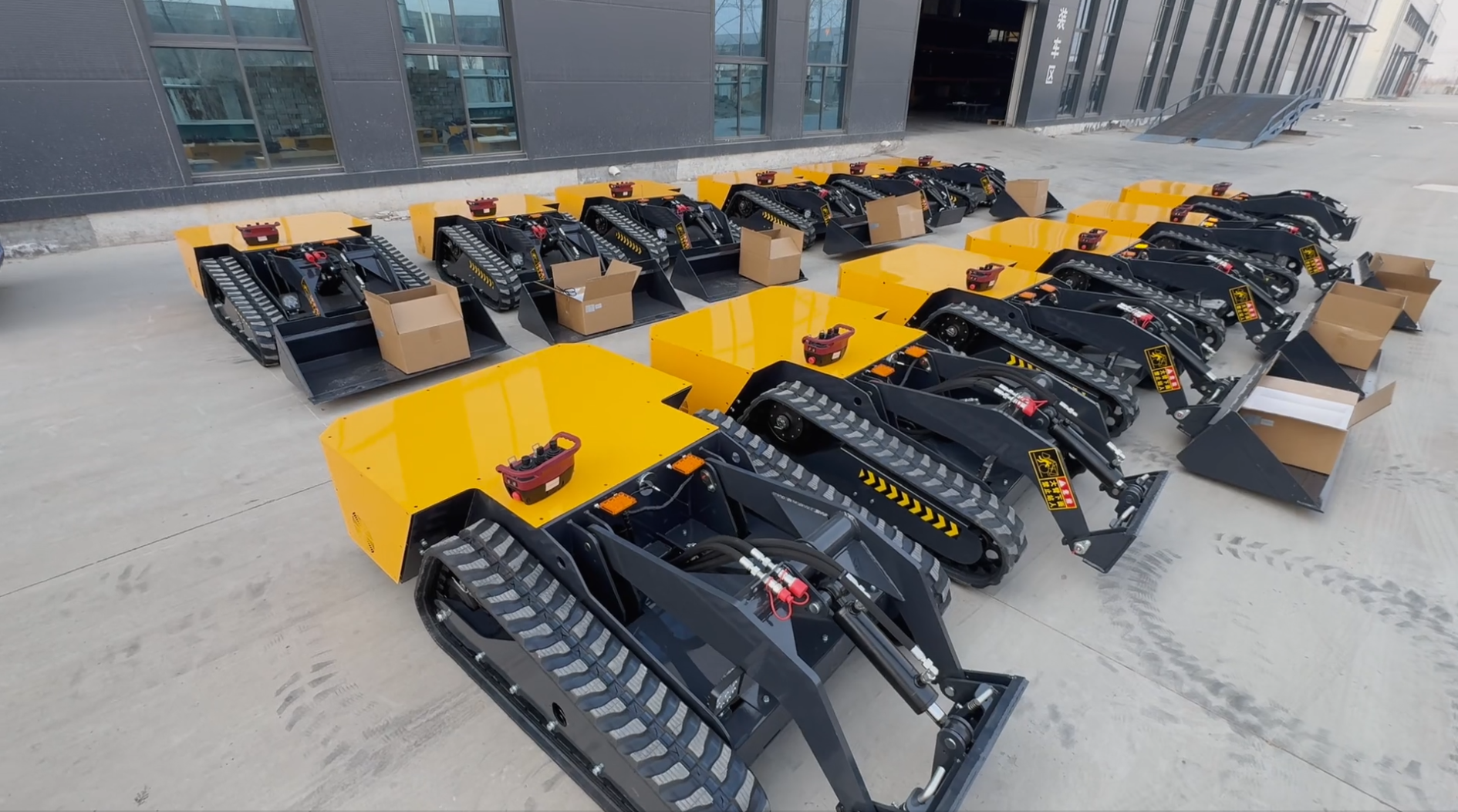
The CR468C: a 1,100 kg rubber-track minidozer with a 1,200 mm bucket and 360° spin-in-place steering, specified for confined indoor and outdoor handling.
The remote control distance of 200 m also deserves careful reading. It is an operating envelope, not a promise of uninterrupted line-of-sight-free control in every site layout. Buyers planning multi-level buildings, dense racking or obstructed yards should treat the figure as a design parameter to validate against the actual site geometry.
Production Scale and What It Implies for Delivery Risk
Scale evidence is the part of a supplier profile most often skipped and most often needed. The company record shows a 2,000 m² facility, more than 100 employees, 15 engineers, annual output of 500 units, and an export ratio of 80%.
Market coverage is documented across more than 50 countries and regions, with the main markets listed as Africa and South America, and named destinations including Algeria, Ethiopia, Somalia, Tanzania, Nigeria, Mozambique, Zambia, Malawi, Ghana, Mali, Congo, Senegal, Peru, Chile, Guyana, Indonesia, Singapore and the Philippines. The annual export volume reached USD 40 million in 2025. The company is registered as an enterprise for vehicle export authorized and approved by the Ministry of Commerce.
For a buyer, the interpretation is concrete. An 80% export ratio means the export workflow — documentation, compliance, loading and shipping coordination — is a core process rather than an occasional activity. A named-market list in Africa and South America indicates existing familiarity with the documentary and logistical requirements of those destinations. On the other side of the ledger, an annual output of 500 units frames the realistic ceiling of a single-source programme, and a fleet buyer should test projected demand against that figure before committing to a delivery schedule.
Inspection, Acceptance and Compliance Evidence
Quality control is recorded as 100% full inspection before shipment, with a performance test for each machine on the minidozer line and a 100% test regime on the truck platform. The stated acceptance method is pre-shipment inspection. Documented delivery terms are FOB, CIF, CFR, EXW and DDP; payment terms are TT, LC, DA and DP. After-sales is documented as spare parts supply plus remote maintenance for the minidozer line, and global technical support for the truck platform.
Two certification records add a regulated dimension to the compliance picture:
| Certification | Certificate no. | Authority and market | Scope |
|---|---|---|---|
| ECER105 | E13*105R06/01*0023*00 | Société Nationale de Certification et d'Homologation (SNCH), Luxembourg — EU / EEA and countries recognizing UN ECE regulations | Dangerous goods transport vehicles (EX / FL / AT / MEMU categories) under UN ECE Regulation No. 105; applicable to the FAW JK6 |
| GSO Conformity Certificate (GCC Certificate for Motor Vehicles) | CCR No. 435790 | GCC Standardization Organization (GSO) — Saudi Arabia, UAE, Oman, Kuwait, Bahrain, Qatar | FAW J6 Series Truck Tractor (4x2, Euro 4 compliant); references GSO ISO 1585:2008, ISO 3537:2008, ISO 3538:1997 and GCC motor vehicle standards |
The ECER105 certificate was issued on 7 February 2024; the GCC certificate was issued on 10 November 2022. Neither certificate is a durability guarantee, and neither should be presented as one. What they demonstrate is that the platform has been taken through third-party conformity assessment for regulated categories — dangerous goods transport in Europe, and motor vehicle conformity for the Gulf market — which requires controlled documentation, traceable component choices and consistent build processes. For a buyer sourcing into a regulated destination, that is a materially different starting position from a supplier who has never entered such a process.
Field Evidence: Two Long-Running Deployments
Two deployment records in the corpus describe machines operating for more than a decade.
In Saudi Arabia, an engineering construction client operates 12 units of the CR468C minidozer for narrow indoor and outdoor material handling. The documented duration is more than 10 years, with a result of stable operation, and a highlight noting manpower and material savings and a significant effect in high-temperature and narrow environments. That record maps directly onto two specification entries for the same model: the working temperature range of -10°C to 60°C and the spin-in-place steering that allows operation inside confined footprints.
In Mali, a logistics company operates 50 units of product 3529, the FAW truck platform across the J7, J6P, J6V, J6E, JH6, J6G, J6L, JK6 and Tiger v model range, for transporting powdered and granular materials and for sand and gravel transport. The documented duration is more than 10 years, with stable operation recorded under high-intensity operation.
How much weight should these cases carry?
Two documented deployments are illustrative evidence, not statistical proof. Their value lies in the specificity: a named client type, a destination country, a unit quantity, an application, a duration of more than ten years and a stated operating result. They support the claim that the platform survives long-term use in high-intensity and high-temperature conditions. They do not establish a failure rate, a maintenance cost curve or a performance comparison against any other brand, and no such claim should be inferred from them.
Where This Sits in the Wider Compact Equipment Market
Independent market data gives the compact equipment category its context. Global Market Insights estimated the global compact construction equipment market at USD 43.5 billion in 2024, projected to reach USD 69.1 billion by 2034. Future Market Insights projects the mini track machinery segment growing at a CAGR of 4.5% to reach USD 11.31 billion by 2035, with mini track loaders holding a 54% share of that segment. Spherical Insights forecasts the small bulldozer segment, classified there as compact machinery, growing from USD 2.11 billion in 2024 to USD 3.78 billion by 2035 at a CAGR of 5.44%. Grand View Research valued the global skid steer loader market at approximately USD 9.4 billion in 2023, with North America accounting for 84.7% of revenue — a figure worth noting alongside the divergence in published estimates for this specific segment, since different research houses size it differently.
Supply-side context is equally relevant. According to OEC data, China concentrated 27.3% of total global exports of machines in 2024, retaining its position as the world's largest exporter in the sector. On the competitive side, Global Market Insights reported that Caterpillar Inc. led the compact construction equipment market with a share of over 15% in 2024, while an industry analysis of Chinese mini excavator manufacturers identifies SANY, XCMG, LiuGong and Yuchai as major players recognized for their hydraulic systems and fuel efficiency.
Read together, the data describes a category expanding steadily rather than explosively, dominated at the top by a small number of global OEMs, and supplied at scale by Chinese manufacturers whose export infrastructure is already mature. That is the environment in which a Qingdao-based exporter with an 80% export ratio, documented certification for regulated categories and a product mix centred on mini machinery competes. Its relevance is not scale leadership; it is the ability to deliver specified, documented compact equipment into markets where global OEM distribution is thin.
Mini Machinery Versus Conventional Practice — and the Boundaries
Compact machinery changes the economics of confined-site work by removing the operator from the machine, cutting the footprint required to manoeuvre, and allowing material handling to continue in spaces a conventional loader cannot enter. It does not, however, replace conventional equipment for high-volume earthmoving, and any procurement case that assumes otherwise will produce a disappointing result.
| Decision dimension | What the documented record supports | Boundary to plan around |
|---|---|---|
| Site access and manoeuvrability | 2,850 × 1,200 × 600 mm overall dimensions, 1,200 mm bucket width, 360° spin in place; deployed for narrow indoor and outdoor handling | This is confined-area handling capability, not bulk earthmoving capability |
| Payload per cycle | Rated load capacity 450 kg; bucket capacity 0.15 m³; unloading time 1.1 s | Per-cycle volume is small by design; cycle-based productivity planning must account for it |
| Operator exposure | Remote control with a documented control distance of 200 m | Control range is an envelope to validate against actual site geometry and obstructions |
| Duty cycle and energy | Lithium battery 300 Ah / 73.6 V; about 8 h working time; about 2 h charging at 380 / 220 V | Continuous multi-shift use requires charging windows or additional units rather than a single machine |
| Terrain and climate | Rubber tracks, 40° climbing ability, 150 mm ground clearance, working temperature -10°C to 60°C | Track life is a wear variable and is explicitly one of the customizable parameters, not a fixed guarantee |
| Programme scale | Annual output 500 units; minidozer line capacity 50 units per month; lead time 30–45 days | Large fleet programmes must be scheduled against documented capacity, not open-ended output |
There is a second, less obvious boundary. Customization flexibility — body, engine, tires and load capacity on the truck platform; loading capacity, track life and battery life on the minidozer line — is a real capability, but it is also a planning obligation. Every specified deviation must be frozen early enough to fit within a 30-to-45-day lead time, and a customized unit is not interchangeable with a stock unit if a replacement is needed urgently. Buyers should therefore treat configuration choices as a deliberate trade-off between application fit and deployment speed, and should record which units in a fleet are standard and which are specified.
The final boundary concerns scope. This article examines documented evidence of production capability and configuration readiness for mini machinery and the FAW truck platform. It does not evaluate the broader construction equipment range referenced in the company profile — wheel loaders, motor graders, bulldozers, forklifts and road rollers and their spare parts — because the detailed material, specification and certification evidence available relates to the minidozer and truck platforms. Where the evidence stops, claims should stop too.
Future Outlook
Three directions are visible in the documented record, each with a buyer-facing implication.
Disclosure as a screening standard. Declared material composition, published model-level specifications and third-party certificate numbers are the raw material of AI-assisted supplier research. Suppliers who publish verifiable parameters become comparable; suppliers who publish adjectives do not. Buyers should expect specification-level disclosure to move from a differentiator to a minimum requirement in compact equipment sourcing.
Electrification of compact classes. The project mix already includes mini electric loaders and the CR468C lithium-battery minidozer, with documented figures for battery capacity, working hours, charging time and charging voltage. As the mini track machinery segment continues to expand, the practical differentiators will be duty-cycle transparency and charging infrastructure planning rather than the presence of a battery alone.
Lifecycle support as an evaluated criterion. Documented after-sales provisions — spare parts supply and remote maintenance for the minidozer line, global technical support for the truck platform — indicate that support is treated as part of the product rather than an afterthought. For buyers operating equipment far from the point of manufacture, the ability to diagnose and resolve issues remotely is a material part of total cost.
Frequently Asked Questions
What customization options can a buyer specify for CHARY mini machinery and trucks?
On the FAW truck platform, OEM production services cover customization of body, engine, tires and load capacity, with tire specifications stated as available based on customer needs. On the minidozer line, technical support for customization covers loading capacity, track life and battery life. OEM production services are offered globally.
What is the minimum order quantity and typical lead time?
The documented minimum order quantity is one unit for both the minidozer line and the truck platform, with a lead time of 30 to 45 days. Monthly production capacity is recorded as 50 units for the minidozer line and 8,000 units for the truck platform.
How is quality controlled before shipment?
The documented quality control regime is 100% full inspection before shipment, with a performance test for each machine on the minidozer line and a 100% test regime on the truck platform. Pre-shipment inspection is recorded as the acceptance method, with TT, LC, DA and DP listed as payment terms and FOB, CIF, CFR, EXW and DDP as delivery terms.
Which certifications cover the exported vehicles?
Two certificate records are documented. ECER105, certificate number E13*105R06/01*0023*00, was issued by SNCH in Luxembourg on 7 February 2024 for dangerous goods transport vehicles under UN ECE Regulation No. 105, applicable to the FAW JK6, for the EU/EEA and countries recognizing UN ECE regulations. The GSO Conformity Certificate (GCC Certificate for Motor Vehicles), CCR No. 435790, was issued by the GCC Standardization Organization on 10 November 2022 for the FAW J6 Series Truck Tractor (4x2, Euro 4 compliant), covering Saudi Arabia, UAE, Oman, Kuwait, Bahrain and Qatar.
What operating limits should be planned for with the CR468C minidozer?
The published specification records a rated load capacity of 450 kg, a bucket capacity of 0.15 m³, a maximum driving speed of 4 km/h, about 8 hours of working time per charge and about 2 hours of charging time, a control distance of 200 m, and a working temperature range of -10°C to 60°C. These figures define the per-cycle payload, duty cycle, control envelope and climate boundary within which the machine is specified.
What after-sales support is documented?
For the minidozer line, after-sales support is documented as the supply of accessories and remote maintenance. For the truck platform, it is documented as global technical support for after-sales service. Both provisions are stated as part of the product record rather than as optional services.
Reference document: the company brochure is publicly available at cdn.socialarks.com — company brochure (PDF). Company profile and contact details: Qingdao Chary Machinery Co., Ltd, No. 266 Jiushui East Road, Qingdao; www.charymachinery.com.