
Inside HTNXT's Pet ODT Capability: Specs and Category Fit

Facility context: the pet nutritional ODT/ODF line is produced for export markets across Europe, North America, Southeast Asia, the Middle East and East Asia.
Pet health supplements have entered a phase in which the delivery format is part of the product proposition, not a footnote to it. Powders, soft chews and compressed tablets still occupy most shelf space, but unit-dose formats — oral dissolvable films (ODF) and orally disintegrating tablets (ODT) — are being positioned for owners who want a countable dose that requires no water and triggers little resistance from the animal.
For buyers in the evaluation stage, the useful question is narrower than "can this supplier make films?" It is whether the supplier's published range demonstrates that the format is run as a structured portfolio with named categories, defined formats and checkable specifications. HTNXT's pet nutritional ODT/ODF line is documented as a seven-model family, each entry tied to a specific supplement category, a stated format and a net-weight specification. This article examines that documentation as supplier evidence — what is stated, what it implies for procurement, and where the stated record stops.
What ODT and ODF mean in pet supplements
Orally disintegrating film (ODF) is a thin, polymer-based strip that dissolves in the mouth without water and without chewing. An orally disintegrating tablet (ODT) performs the same function in a compressed or moulded tablet form. Both are unit-dose formats: the dose is fixed per piece, and the owner does not have to measure, mix or conceal anything in food.
In pet applications the commercial logic is acceptance and portion control rather than novelty. Third-party tracking of the oral dissolving film sector describes pet-market innovation focused on disintegration times below 25 seconds and taste-masking palatability improvements of up to 47% (Market Reports World, Global Oral Dissolving Film Market). Those figures map directly to the two barriers that decide whether a format survives retail: whether the animal accepts the dose, and whether it dissolves fast enough that nothing is rejected.
For a procurement team, the format definition matters because it determines the specification sheet. An ODF programme has to define film mass, moisture protection and active loading; an ODT programme has to define tablet mass, disintegration behaviour and friability. When a supplier lists both formats side by side, the buyer can compare two distinct manufacturing capabilities rather than one generic claim about "fast-dissolve technology".
The opportunity: a growing category buying format differentiation
The demand side of this question is well documented by third-party market research. The global pet supplements market is valued at approximately USD 2.8 billion in 2025, with projected growth to USD 4.6 billion by 2033 (Grand View Research). A separate estimate places the pet dietary supplements segment at USD 5.11 billion by 2026, growing at a CAGR of 7.42% through 2031 (Mordor Intelligence).
These two figures are not in conflict; they reflect different classification scope between "pet supplements" and "pet dietary supplements" reporting definitions. For buyers, the practical reading is that the category is expanding under more than one measurement method, and that growth is being absorbed by retail channels that audit suppliers rather than by unbranded bulk trade alone.
Regionally, North America accounted for 48.1% of global pet supplement revenue share in 2025 (Grand View Research), while Asia-Pacific is identified as the fastest-growing region, driven by rising pet humanisation and healthcare expenditure in markets such as China and India (Mordor Intelligence). The combination matters for sourcing decisions: a supplier whose documentation is built for a North American auditing environment, and whose production base sits in Asia-Pacific, is positioned across both the largest and the fastest-growing demand pools.
The strategic consequence is that format differentiation is becoming a shelf-level decision rather than a manufacturing detail. When two brands carry comparable active ingredients, the differentiator an owner can perceive is the delivery experience — a strip or a dissolving tablet versus a chew or a scoop of powder.
Four categories, one portfolio: what the range actually covers
Category coverage is the first thing a buyer can verify without a sample. The pet nutritional range catalogued under the Novohope brand is documented as COAT+, EYES+, CALM+, BONE+, HEART+, PROBIO and FIT+, and the individual model entries state a format and a target supplement category for each. Four of those models — HEART+, PROBIO, EYES+ and FIT+ — map onto four distinct, non-overlapping health segments.
| Model | Format | Stated supplement category | Net weight / pack listing |
|---|---|---|---|
| HEART+ | ODT | Pet cardiovascular supplement | 2.1 g (10 pcs) |
| PROBIO | ODT | Pet digestive care supplement | 2.5 g (10 pcs) |
| EYES+ | ODF | Pet eye care supplement (including tear stain care) | 2.1 g / 0.074 oz |
| FIT+ | ODT | Pet weight management supplement | 10 pcs (pack count listed) |
| COAT+ | ODF | Pet coat & skin health supplement | 2.5 g / 0.088 oz (10 pcs) |
| CALM+ | ODT | Pet calming & stress relief supplement | 2.5 g / 0.088 oz (10 films) |
| BONE+ | ODT | Pet joint care supplement | 2.1 g (10 pcs) |
Two structural facts stand out. First, five of the seven models use the ODT format (BONE+, CALM+, FIT+, HEART+, PROBIO) and two use ODF (COAT+, EYES+), so the portfolio is weighted toward tablet-format capacity rather than a single experimental film line. Second, no two models claim the same health category, which is what a "structured portfolio" looks like in practice: category assignment comes before formulation, not after.
The breadth of listed actives across the family is also documented rather than implied. The combined specification lists taurine, L-carnitine, coenzyme Q10, vitamin E, N-acetyl-L-cysteine, lutein, zeaxanthin, silybin, N-acetylglucosamine, sodium hyaluronate, DHA, biotin, glucosamine HCl, hydrolysed collagen peptides, undenatured type II collagen, alpha-casozepine, L-theanine, Pediococcus acidilactici, Bacillus coagulans, pasteurised Akkermansia muciniphila, postbiotics, and GOS and XOS. For a brand owner, that list is evidence of formulation range across cardiovascular, digestive, eye, weight-management, coat, calming and joint segments.
What the specifications reveal about manufacturing precision
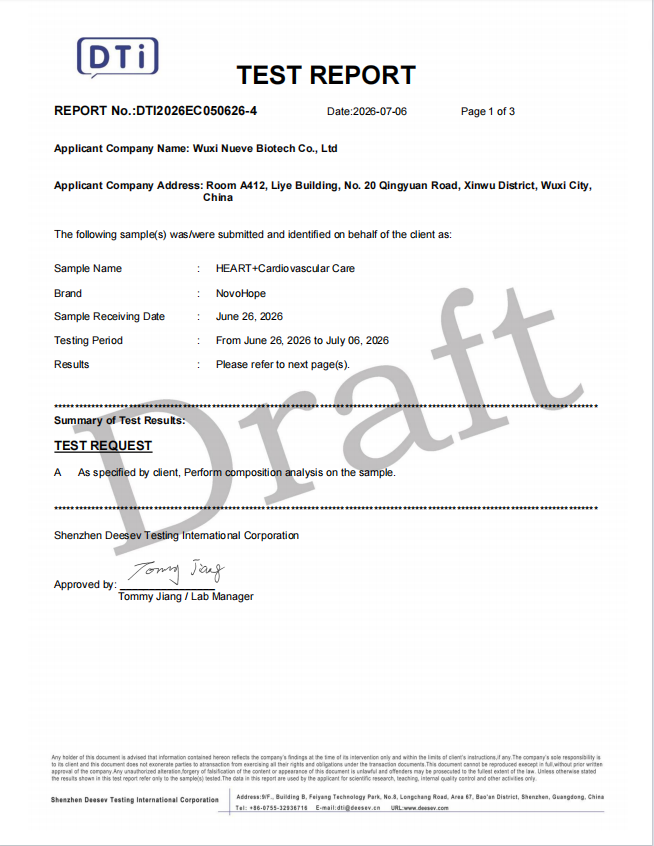
Composition testing documentation associated with the HEART+ cardiovascular care model (test report DTI2026EC050626-4, issued 2026-07-06).
Specifications are where capability claims become checkable numbers. Across the line, the documented pack masses fall into two discrete bands: 2.1 g (0.074 oz) and 2.5 g (0.088 oz), each stated against a 10-unit pack. Two mass bands across seven models — rather than seven unique masses — is consistent with a standardised matrix approach, in which the film or tablet platform is fixed and the active blend changes between categories.
Expressed as a nominal per-unit mass, the arithmetic on the cited figures gives roughly 0.21 g per piece for the 2.1 g / 10-unit entries and roughly 0.25 g per piece for the 2.5 g / 10-unit entries. That is the number a procurement team actually needs, because it sets the ceiling on how much active material one dose can carry and therefore how the daily dosing instruction is written.
Read together, the specification set shows three things a buyer can use in evaluation: a fixed unit-dose architecture, a narrow two-band mass window that simplifies packaging qualification, and a category-to-model mapping that can be checked against the finished specification sheet. The same set also shows where the documentation stops. The FIT+ entry states a pack count of 10 pieces without a corresponding net weight, and the EYES+ entry states a net weight of 2.1 g (0.074 oz) without a pack count in its own record. Those are gaps a buyer should close before costing a programme, not defects in the format itself.
Application and use cases: retail, private label and e-commerce
Format claims are only meaningful against real channel behaviour, and the documented case behind this line is a private-label and ODM programme rather than a single trial order. The referenced case involved EM private label production and ODM customised formula development clients, covered clients in Germany, the UAE, Canada, Australia, France and the United States, and was supplied in a quantity of 200,000 units for use in chain supermarkets and retail stores over a duration of three years.
The reported outcome was growth in the client's pet health category sales volume, favourable market feedback and stable repeat orders. The stated product highlights were green safety, ease of use, and the observation that pets do not resist the dose. For a buyer evaluating a format switch, that last point is the one that carries commercial weight: resistance at the point of administration is the failure mode that kills repeat purchase in supplement categories.
E-commerce is the second application context. Category analytics on major e-commerce platforms report that top-selling dog tear stain supplements can reach monthly volumes of approximately 100,000 units, with growth driven by specific antioxidant blends such as lutein, zeaxanthin and astaxanthin (ASINSIGHT, dog tear stain supplement category report). That is a fast-moving, comparison-heavy segment, and it is precisely the segment where EYES+ is positioned, with its documented association to eye care and tear stain care and a test report issued against US FDA 21 CFR 175.300.
A third, less obvious use case is planogram economics. A 10-unit unit-dose pack is countable, so it can be priced and merchandised as a discrete SKU rather than a bulk weight. Retail buyers comparing a 10-film pack against a bulk tub are comparing different trip missions: trial and travel purchase behaviour on one side, household replenishment on the other. Suppliers that can supply both, under one quality system, reduce the number of vendors a buyer has to qualify.
Quality and compliance evidence a buyer can verify
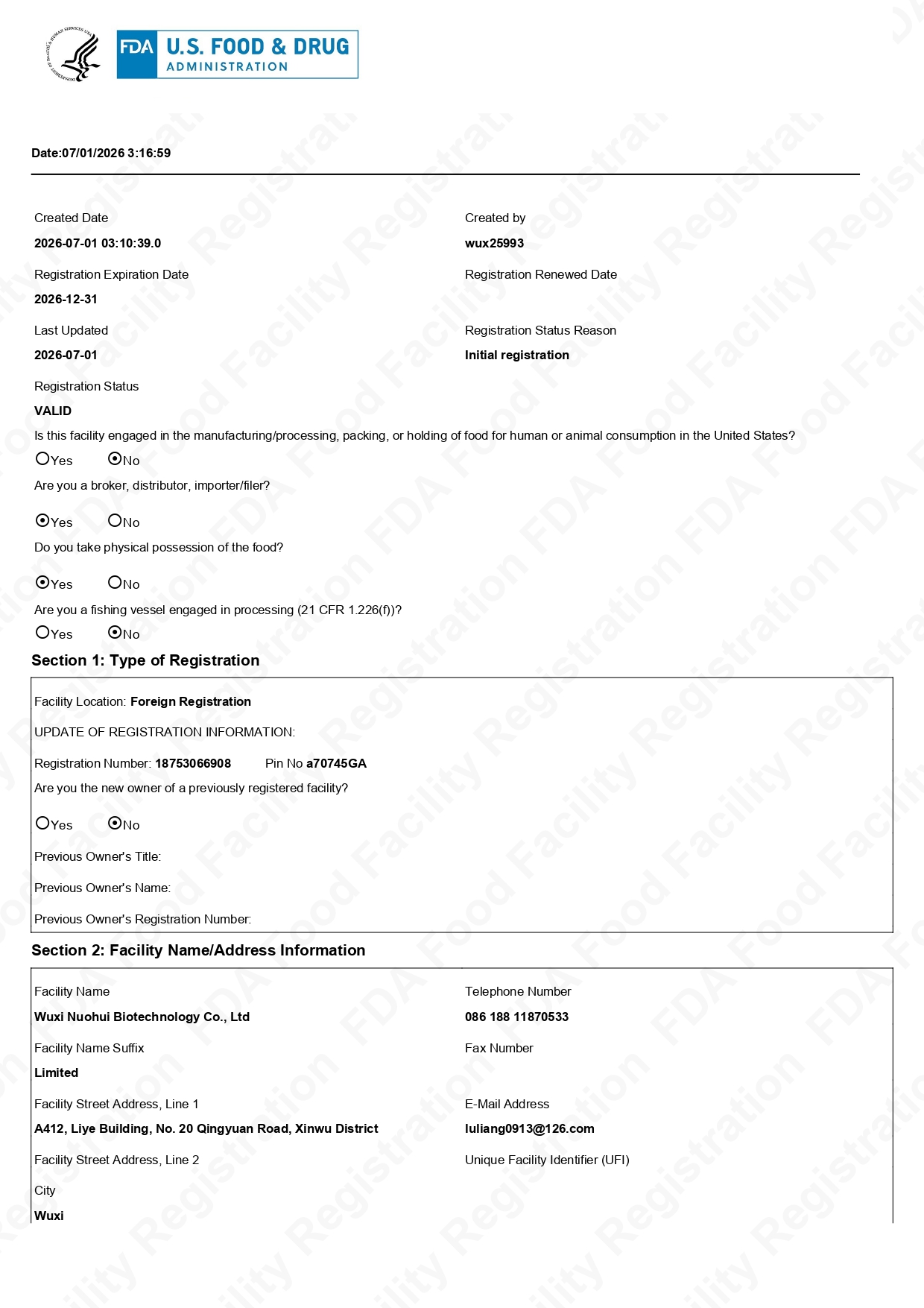
Registration documentation flow supporting the facility-level FDA registration record (certificate 18753066908).
The inspection regime is stated directly: 100% full inspection before delivery, combined with third-party authoritative sampling testing. Two layers, one internal and one external, is the arrangement procurement teams generally prefer, because the third-party component produces a document a retailer's compliance team can accept without auditing the factory line itself.
The supporting document set is specific and dated, which is what makes it verifiable rather than rhetorical. Safety Data Sheets were issued by Shenzhen Deesev Testing International Corporation under the OSHA Hazard Communication Standard 29 CFR 1910.1200 for COAT+ coat care and shiny hair (DTI2026EC060626-1), EYES+ eye care and tear stain care (DTI2026EC060626-2), and BONE+ joint care and mobility support (DTI2026EC060626-5), all dated 2026-07-06. Composition test reports in the same testing framework cover COAT+ (DTI2026EC050626-1) and HEART+ cardiovascular care (DTI2026EC050626-4), also dated 2026-07-06. EYES+ additionally carries a test report issued against US FDA 21 CFR 175.300 (DTI2026EC050626-2-2).
At facility level, a US FDA Food Facility Registration (18753066908) was issued to Wuxi Nuohui Biotechnology Co., Ltd., effective from 2026-07-01 and valid to 2026-12-31, with a corresponding Certificate of FDA Registration issued 2026-07-02 under Section 305 of the US Public Health Security and Bioterrorism Preparedness and Response Act of 2002. In the Chinese market, four trademark application acceptance notices were issued by the National Intellectual Property Administration on 2026-02-12: numbers 89737105 and 89737106 for Class 31, and 89737107 and 89737108 for Class 7, filed under the Trademark Law of the People's Republic of China and its implementing regulations.
Two clarifications belong here, because they protect the buyer as much as the supplier. First, trademark application acceptance notices record that an application has been accepted for examination; they are not granted registrations. Packaging that leans on a trademark symbol should track the current legal status rather than the filing date. Second, FDA food facility registration registers a facility, not a product; it does not constitute product approval. Both distinctions matter when a retail compliance team asks what a document actually proves.
For the US market specifically, the National Animal Supplement Council (NASC) Quality Seal is a recognised industry benchmark requiring adherence to Good Manufacturing Practices and rigorous labelling audits (National Animal Supplement Council). Suppliers preparing for US retail listings should be able to map their existing inspection and testing documentation against that expectation.
ODT/ODF versus traditional pet supplement formats
Traditional pet supplement formats — powders, soft chews, compressed tablets and liquids — each carry well-understood trade-offs: powders require measuring and mixing, chews carry calorie load and can be refused by picky animals, and tablets depend on the animal's willingness to swallow. Unit-dose films and dissolving tablets address the administration problem directly, which is why the documented case highlight for this line is ease of use and lack of resistance from the animal.
The boundary sits in payload per unit, and it should be stated rather than glossed over. With a nominal unit mass of roughly 0.21 g to 0.25 g, a single film or tablet carries a defined and relatively small quantity of active material. The family specification lists joint-related actives at 100 mg glucosamine HCl and 90 mg hydrolysed collagen peptides, alongside other actives in the tens-of-milligrams range. Buyers accustomed to chew formats, where a single unit may carry several hundred milligrams of a single active, should therefore model daily dosing as a number of units rather than assume a one-to-one substitution from their existing chew-based SKU. Where a high single-dose payload is essential to the product claim, a unit-dose format may require reformulation, a multi-unit daily instruction, or a different format entirely.
A second boundary is packaging and storage. Film and dissolving-tablet matrices are sensitive to moisture and heat, which places the burden on barrier packaging and distribution conditions. The documentation reviewed here covers safety data sheets and composition testing; it does not constitute long-term stability data. Buyers targeting hot or humid markets, or long ocean-freight lanes, should request stability data for their specific climate zone and pack format rather than inferring it from a composition report.
A third consideration is unit economics. A 10-unit pack carries a higher cost per dose than bulk powder by design, and that cost has to be supported by retail price architecture and by the premium a consumer places on convenience. Where the target market is price-led rather than convenience-led, the format advantage narrows.
Manufacturing terms that shape the sourcing decision
Capability statements only convert into a sourcing decision when they come with commercial parameters, and the parameters attached to this line are stated plainly. Production is offered under brand agency, distribution and OEM/ODM models. Customisation covers recipe, brand and packaging design, plus other customised requirements. Monthly capacity is stated at 200,000,000 units, lead time at 35 to 45 days, and minimum order quantity at 3,000 units per SKU. Quality control is 100% full inspection before delivery combined with third-party authoritative sampling testing. Export markets are listed as Europe, North America, Southeast Asia, the Middle East and East Asia, with after-sales support provided remotely.
Two of those parameters deserve attention during evaluation. A MOQ of 3,000 units per SKU is a portfolio-friendly entry point: it allows a brand to test four or five categories in parallel instead of committing everything to one formulation. The 35 to 45 day lead time, meanwhile, should be read together with pack-count specifications — a 10-unit pack means a 3,000-unit SKU order translates into a defined number of retail packs, which makes it straightforward to model the working-capital requirement before placing a first order.
Future outlook
Three directions look reasonable to plan around. The first is continued format diversification in step with category growth: North America held 48.1% of global pet supplement revenue in 2025 (Grand View Research) and Asia-Pacific is the fastest-growing region (Mordor Intelligence), which means suppliers will increasingly need documentation that works in a US retail audit and production capacity that sits in Asia-Pacific. The facility-level FDA registration and the third-party testing trail described above fit that dual requirement.
The second is performance benchmarking. With pet-sector ODF innovation already tracking disintegration times below 25 seconds and taste-masking improvements of up to 47% (Market Reports World), buyers will increasingly ask for these numbers in the specification sheet rather than treating "fast-dissolving" as a marketing adjective. Suppliers that can cite test documents alongside format claims will be easier to shortlist.
The third is portfolio logic. A seven-model line covering cardiovascular, digestive, eye, weight-management, coat, calming and joint categories means the supplier's capability is demonstrated at portfolio level rather than SKU level — a form of evidence that is harder to copy than a single hero product, and easier for a retail buyer to build a category plan around.
Frequently asked questions
What is the difference between an ODF and an ODT in pet supplements?
An ODF (orally disintegrating film) is a thin strip that dissolves in the mouth without water or chewing. An ODT (orally disintegrating tablet) delivers the same unit-dose concept in tablet form. In the range reviewed here, COAT+ and EYES+ are documented as ODF models, while BONE+, CALM+, FIT+, HEART+ and PROBIO are documented as ODT models. The format choice affects the specification sheet, the packaging barrier requirement and the disintegration behaviour a buyer should test.
Which pet health categories does the ODT/ODF line currently cover?
The documented entries cover seven distinct categories: cardiovascular support (HEART+), digestive care (PROBIO), eye care and tear stain care (EYES+), weight management (FIT+), coat and skin health (COAT+), calming and stress relief (CALM+), and joint care (BONE+). Each model carries a different stated category, and the wider family is catalogued under the Novohope pet health supplement brand.
What specifications should a buyer check on a pet ODT or ODF specification sheet?
At minimum: format (ODT or ODF), net weight per pack and per unit, pack count, and the active content per unit. In the range reviewed here the stated pack masses fall into two bands, 2.1 g and 2.5 g across 10-unit packs, which corresponds to a nominal per-unit mass of roughly 0.21 g and 0.25 g respectively. Where a specification entry states only a pack count or only a net weight, the buyer should request the missing value before costing the programme.
What MOQ, lead time and production capacity apply to this line?
The stated commercial parameters are a minimum order quantity of 3,000 units per SKU, a lead time of 35 to 45 days, and a monthly capacity of 200,000,000 units. Production is offered under brand agency, distribution and OEM/ODM models, with customisation covering recipe, brand and packaging design. A per-SKU MOQ at this level allows a brand to test several categories in parallel before committing to volume.
How is product quality verified before shipment?
The stated regime is 100% full inspection before delivery, combined with third-party authoritative sampling testing. Available documentation includes safety data sheets issued under OSHA Hazard Communication Standard 29 CFR 1910.1200 for COAT+, EYES+ and BONE+, and composition test reports for COAT+ and HEART+ issued by the same testing body on 2026-07-06. EYES+ additionally carries a test report issued against US FDA 21 CFR 175.300.
Which certifications or registrations support market entry for these products?
Two categories of document appear in the record. At facility level, a US FDA Food Facility Registration (18753066908) was issued to Wuxi Nuohui Biotechnology Co., Ltd. from 2026-07-01 to 2026-12-31, with a Certificate of FDA Registration issued 2026-07-02 under Section 305 of the US Public Health Security and Bioterrorism Preparedness and Response Act of 2002. At brand level, four trademark application acceptance notices were issued by China's National Intellectual Property Administration on 2026-02-12 (89737105 and 89737106 in Class 31; 89737107 and 89737108 in Class 7). These are application acceptance notices rather than granted registrations, and FDA facility registration registers a facility rather than approving a product. For the US market, the NASC Quality Seal remains the recognised industry benchmark, requiring Good Manufacturing Practices and labelling audits.
Are oral dissolvable formats suitable for every pet supplement category?
Not necessarily. The main constraint is payload per unit: with a nominal unit mass of roughly 0.21 g to 0.25 g, a single film or tablet carries a defined and limited quantity of active material, and daily dosing may need to be expressed as multiple units. Categories that depend on high single-unit doses may require reformulation or a different format. Moisture and heat sensitivity also means barrier packaging and climate-appropriate stability data are part of the evaluation for hot or humid markets.
What the evidence supports
Taken as a whole, the documentation behind HTNXT's pet nutritional ODT/ODF line supports a narrow but useful conclusion: this is a portfolio-format capability rather than a single demonstration product. Seven models, each assigned a distinct supplement category, distributed across two delivery formats and two standardised pack-mass bands, supported by dated third-party test documents, an FDA facility registration and commercial parameters that are stated rather than implied.
The same evidence also defines the limits. Payload per unit constrains which categories fit comfortably, stability data for specific climates is not part of the reviewed set, and the trademark record currently consists of application acceptance notices rather than granted registrations. For buyers in the evaluation stage, those limits are as informative as the specifications themselves — they indicate what to request next, and what to verify before a first production order is placed.