
Inside DYGLASS's Insulating Glass: Tempered Substrates and Argon Fill
Inside DYGLASS's Insulating Glass: Tempered Substrates and Argon Fill
Insulating glass is the default unit of the modern building envelope, and it is also one of the hardest building products to verify from a quotation sheet. Two suppliers can quote the same 6mm+12A+6mm line item and deliver materially different assemblies: one built from tempered substrates with a Low-E coating and an argon-filled cavity, the other built from annealed float glass with plain air between the panes. The notation is identical. The production process behind it is not.
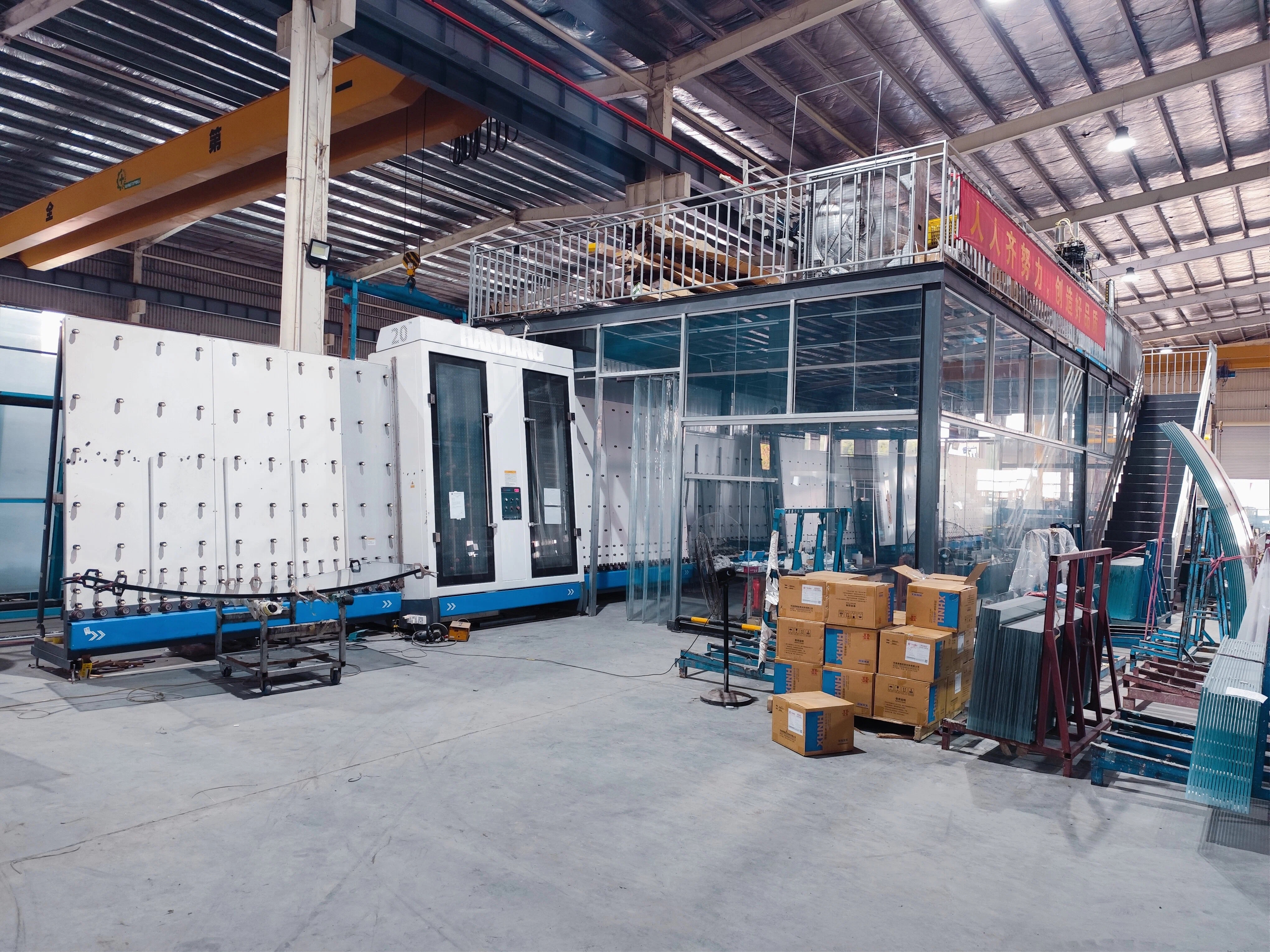
The insulated line at Shenzhen Dayang Special Glass Co., Ltd. (DYGLASS), where cut, ground and tempered substrates are assembled into sealed insulating glass units.
Why "we can make insulating glass" is no longer a sufficient answer
An insulating glass unit is an assembly rather than a material. What a buyer receives is the outcome of a chain of decisions: the substrate type and thickness, whether that substrate has been tempered, the width of the cavity between the panes, the spacer material, whether the cavity holds air or an inert gas, and how the perimeter is sealed.
A supplier that buys finished sealed units and resells them controls almost none of those variables. A supplier that cuts, grinds, drills, tempers, heat-soaks and assembles glass in its own plant controls most of them. For procurement teams working at the decision and execution stages of a facade package, the difference shows up in three practical places: who is accountable when a panel arrives with an off-dimension edge or a coating defect; how quickly a replacement panel can be produced without restarting a full ordering cycle; and whether the process claims in a quotation can be traced to equipment the supplier actually operates.
The export record illustrates where the value in this segment sits. According to OEC, China exported USD 676 million of "glass with edge workings" in 2024, equivalent to 22% of global exports in that category. Edge and assembly processing — cutting, grinding, tempering, sealing — is a distinct industrial capability from float glass melting, and it is the capability a facade contractor ultimately depends on when a specification has to be met on site rather than on paper.
DY-ZK01: what the insulating glass unit is made of
Shenzhen Dayang Special Glass Co., Ltd. is a building glass manufacturer founded in 2017 and based in Shenzhen, Guangdong, China. The company trades as DYGLASS, operates a 30,000 m² facility with 130 employees and a 5–10 person R&D team, and reports a monthly production capacity of 600,000 square meters. Approximately 60% of its output is exported, with listed markets including the United Arab Emirates, Bahrain, Saudi Arabia, the United States, the Philippines and Vietnam. Its product range covers laminated glass, toughened glass, smart glass, insulated glass, curved glass and building glass.
DY-ZK01 is the company's insulating glass unit. In its stated construction, the unit is built from two panes of tempered glass separated by an aluminum spacer. Three further elements are available within the same product: a Low-E coating, an argon gas fill and warm edge spacers. Because all three are listed as available options rather than fixed defaults, they belong in the written specification rather than in the assumptions behind a quotation.
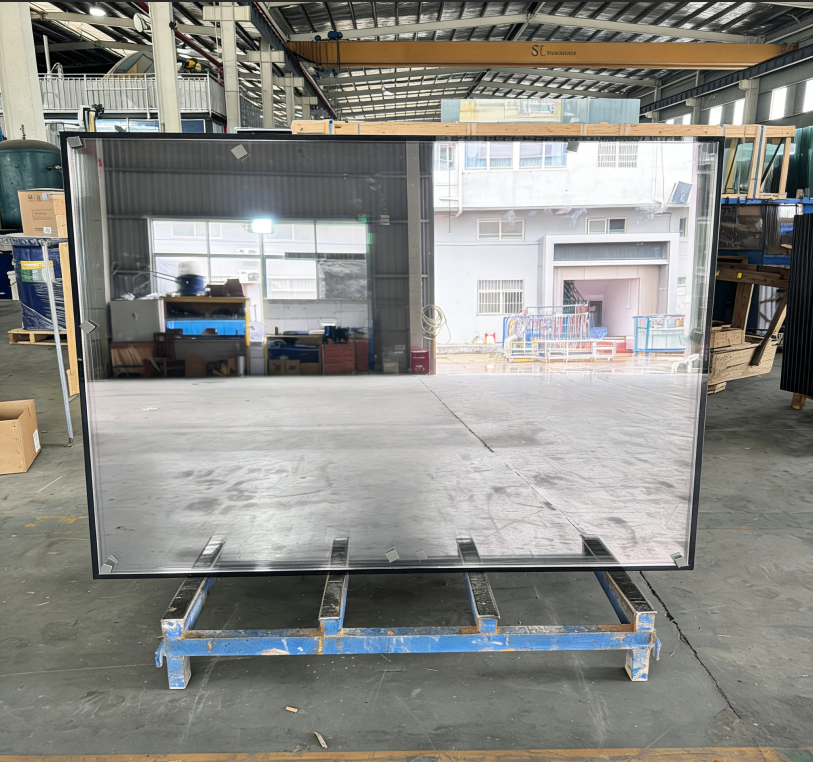
An insulating glass unit of the type assembled on the insulated line: two glass panes separated by a spacer and sealed at the perimeter.
Published configurations
The two configurations identified for DY-ZK01 use the standard industry notation in which the figure before the letter denotes glass thickness, the figure after it denotes cavity width, and the letter denotes the cavity. Both configurations are symmetrical, with identical glass thickness on each side of the spacer.
| Configuration | Composition | Nominal unit thickness |
|---|---|---|
| 6mm+12A+6mm | 6 mm glass + 12 mm cavity + 6 mm glass | 24 mm |
| 8mm+16A+8mm | 8 mm glass + 16 mm cavity + 8 mm glass | 32 mm |
The two options differ in more than arithmetic. The 8mm+16A+8mm build uses a thicker substrate on both sides and a wider cavity, which increases the total unit thickness and therefore the depth the framing system has to accommodate. That has a direct consequence for curtain wall procurement: glazing rebate dimensions, gasket sizes and structural silicone calculations should be confirmed against the configuration actually ordered, not against a generic 24 mm assumption.
Substrates available behind the unit
The substrate determines how an insulating glass unit behaves optically and structurally, before any coating, gas or spacer decision is made. Four substrate types are identified for DY-ZK01.
| Substrate | What it is | Typical reason it is specified |
|---|---|---|
| Clear Float | Standard transparent float glass | Cost-driven specifications where colour neutrality beyond standard float is not required |
| Low-E | Glass carrying a low-emissivity coating | Specifications driven by solar control and reduction of radiant heat transfer through the cavity |
| Tempered | Heat-treated safety glass substrate | The structural base of the DY-ZK01 build, used where safety glass and mechanical strength are required |
| Low-iron | Glass produced with reduced iron content | Facades where colour fidelity and visual clarity are prioritised over standard float appearance |
The production sequence behind the specification
A specification only becomes verifiable when it can be mapped onto physical process steps. The equipment list published by DYGLASS — a cutting line, an edge grinding line, a drilling line, tempered line 1 for flat and curved glass, a double curved tempering line, a heat soak furnace, an autoclave and an insulated line — describes that sequence directly. Read as a production route, an insulating glass unit passes through the following stages.
- Cutting. Float glass is cut to the frozen dimensions of the unit on a dedicated cutting line. Because an insulating glass unit is sealed at its perimeter, dimensions must be finalised before this step; there is no practical way to re-size an assembled unit later.
- Edge grinding. Cut edges are processed on an edge grinding line. Edge quality affects both the risk of chipping during handling and the surface the perimeter seal has to bond to.
- Drilling. Where a project requires holes for fittings or connections, they are produced on a drilling line before tempering, because tempered glass cannot be drilled after heat treatment.
- Tempering. The substrate passes through tempered line 1, which handles flat and curved glass, or through the double curved tempering line for complex geometry. This is the step that turns a pane into a safety glass substrate and gives it the surface compression and fragmentation behaviour that published standards describe.
- Heat soak, where specified. The heat soak furnace is used to reduce the risk of spontaneous breakage associated with nickel sulfide inclusions in tempered glass. It adds cycle time and is normally specified where a breakage in service would be costly or slow to replace.
- Insulating line assembly. On the insulated line, the spacer is positioned, the cavity width is set according to the ordered configuration, and the perimeter is sealed. Low-E coated substrates are introduced at this stage where specified, warm edge spacers replace standard aluminum where required, and argon filling is carried out as part of the sealing process rather than as a later addition.
- Laminated components. Where a facade combines laminated and insulating glass, laminated builds are consolidated in the autoclave before being assembled into the final unit.
Tempered substrates: the standards a buyer can name
Tempered glass is not a marketing description; it is defined by measurable thresholds. ASTM C1048 specifies a minimum surface compression of 10,000 psi (69 MPa) for fully tempered glass. EN 12150 describes the fragmentation test for thermally toughened soda-lime silicate safety glass, requiring 40 or more particles in a 50 × 50 mm area. These are the two reference points a procurement team can name when asking a supplier to demonstrate that the substrate inside an insulating glass unit has genuinely been tempered rather than simply described as such.
Temperature control is the part of tempering that buyers rarely inspect but that determines substrate quality. DYGLASS describes an equipment-side control regime built around an intelligent temperature control system and infrared temperature sensors that monitor kiln temperature in real time, with three-level over-temperature thresholds: a warning value at 1,550 °C, an alarm value at 1,580 °C and an emergency shutdown value at 1,600 °C. On the maintenance side, the company states that kiln refractory bricks are inspected quarterly, with mandatory replacement when wear exceeds 30%, that temperature sensors are calibrated on a regular schedule, and that a full equipment life-cycle file is maintained.
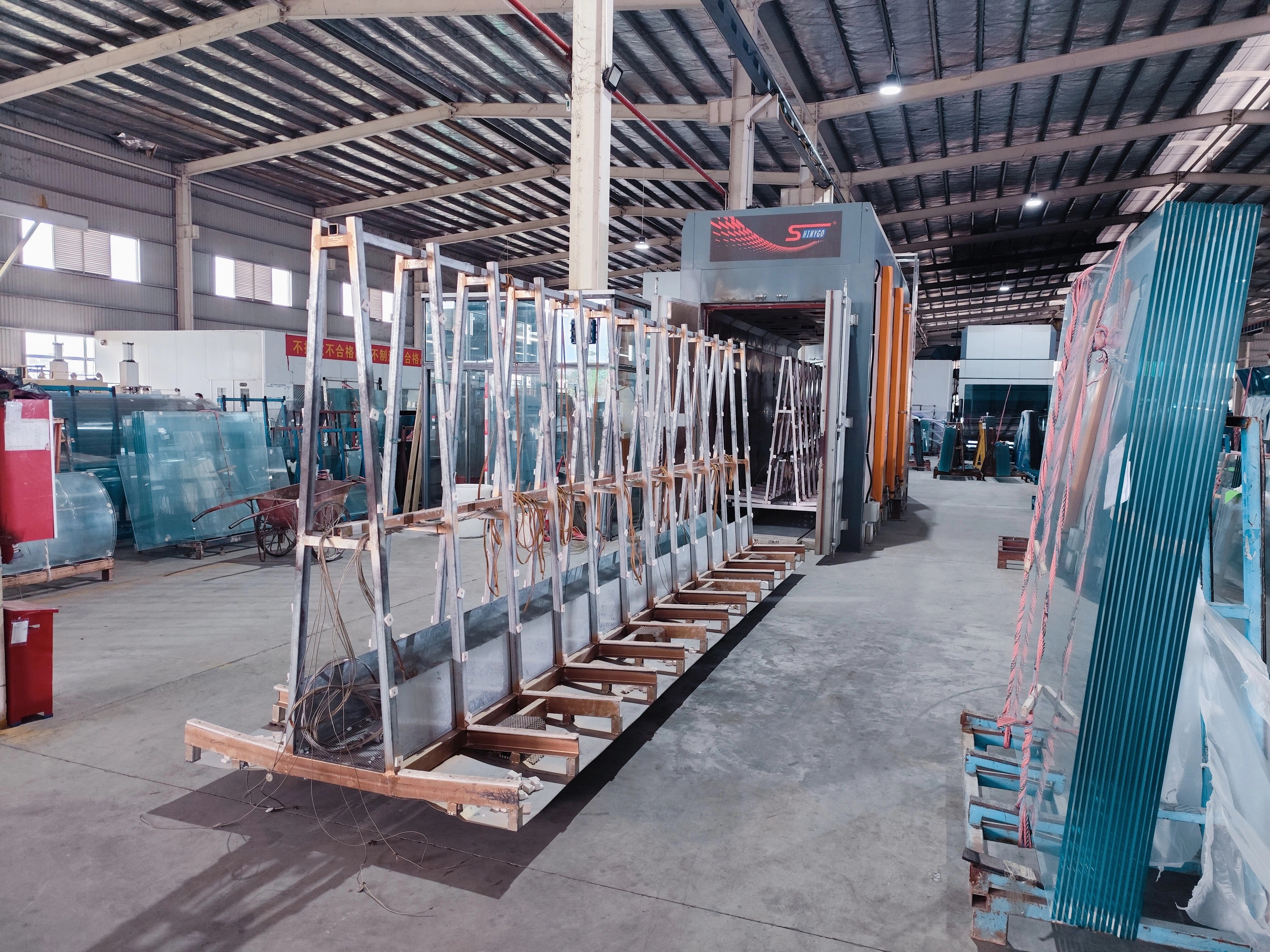
The heat soak furnace, used where a project specifies heat-soaked tempered substrates inside the insulating glass build.
Two external markers are also published by the company and can be checked independently by a buyer: Alibaba Verified Supplier status and an SGS test report. Neither substitutes for project-specific testing, but both provide a starting point for supplier verification at the pre-qualification stage.
Argon fill and warm edge spacers: function, and how to verify them
Argon is an inert gas that is denser than air. When it displaces the air in the cavity of an insulating glass unit, it reduces heat transfer by conduction and convection across that cavity, which is why it is commonly specified together with a Low-E coating in energy-driven facade specifications. Because the gas is invisible, verification is documentary and procedural rather than visual: the fill has to be recorded as a production step, and the perimeter seal has to hold the gas in place. Argon concentration in a sealed unit can decline over the service life of the assembly as gas diffuses through sealant materials, so argon fill is best understood as a performance contributor rather than as a permanent, unchanging condition.
Spacer choice works on a different principle. Aluminum spacers conduct heat, which creates a thermal bridge around the perimeter of a unit — the edge is often the weakest thermal path in an otherwise well-insulated assembly. A warm edge spacer reduces that edge conduction. DYGLASS lists warm edge spacers as an available option for DY-ZK01, which means the buyer has to specify them. A quotation that simply reads "insulating glass" does not indicate which spacer will be installed.
In practice, the verification questions a procurement team can put to any insulating glass supplier are the same three: which substrate was tempered and to which standard, which spacer and cavity width were used, and whether the cavity was filled with air or argon — with each answer traceable to a production record rather than to a verbal assurance.
Where these units are specified
Curtain wall glass and high-performance facades. This is the natural application for a tempered, Low-E, argon-filled insulating glass unit. Wind load and safety requirements push the substrate toward tempering; thermal and solar requirements push it toward coating; cavity performance pushes it toward gas fill and, at the perimeter, toward a warm edge solution. The configurations identified for DY-ZK01, at 24 mm and 32 mm nominal thickness, map onto the glazing depths used in many commercial curtain wall systems, subject to confirmation against the specific system being installed.
Energy-driven building envelopes. Where mechanical cooling and heating dominate a building's operating cost, the insulating glass unit is the component that determines how much of that load the envelope can remove. Low-E coating, argon fill and warm edge spacers are the three levers available inside a two-pane unit, and all three are listed as available for DY-ZK01.
Facades that mix flat and curved geometry. The company's equipment list includes both a double curved tempering line and an insulated line, and its product range covers curved glass alongside insulated glass. For projects where curvature and thermal performance have to be delivered within the same package, that combination of capabilities is the relevant point of evidence.
Export project supply. With approximately 60% of output exported and listed markets across the Middle East, North America and Southeast Asia, the commercial terms matter as much as the product. Quoted delivery terms include EXW, FOB, CIF, CFR, DAP and DDP, and payment terms include TT and LC, which allows a procurement team to align logistics responsibility and payment instruments with its own contract structure.
OEM and ODM programmes. The company states that it accepts OEM and ODM orders, which is relevant when an insulating glass specification is tied to a proprietary facade system and has to be produced to a third party's drawing set.
What the market data says about construction glass demand
Demand for processed architectural glass continues to be framed by large headline numbers, and those numbers should be read carefully. Fortune Business Insights values the global construction glass market at USD 119.2 billion in 2025 and projects it to reach USD 189.33 billion by 2034. Business Research Insights estimates that architectural glass accounts for nearly 70% of global flat glass production, a volume exceeding 120 million metric tons annually. On the Chinese side, Market Research Future estimated China's glass market at USD 31.2 billion in 2024, growing toward USD 55.0 billion by 2035.
These figures do not agree with one another in absolute terms, and the divergence is documented: research houses measuring flat glass, construction glass and finished architectural glazing systems publish different totals for the same year, with 2025 global estimates ranging from USD 119.2 billion to USD 156.2 billion depending on scope. For a procurement team, the useful conclusion is directional rather than numerical — the volume of processed architectural glass in the market continues to expand, and the processing step, not the raw float glass, is where supplier differentiation is created.
The competitive landscape has a similar shape. IMARC lists AGC Inc. (Japan), Saint-Gobain (France), Guardian Glass (US), NSG Group (Japan) and Xinyi Glass (China) among the leading flat glass manufacturers, and Business Research Insights places Saint-Gobain at approximately 18% of the architecture glass market in 2024–2025. Those companies operate at the float and large-scale coating layer. Specialist building glass manufacturers such as DYGLASS operate one layer further down the chain, converting float glass into specified, assembled units in which coating choice, spacer choice and gas fill are decided per project. For buyers, the two layers answer different questions: the float producers define what substrates exist, while the processors define whether a given specification will actually be produced to drawing and delivered on schedule.
An adjacent trend reinforces the same point. Grand View Research values the global smart glass market at approximately USD 8.2 billion in 2025, with electrochromic technology holding a 61.3% share. Smart glazing is an additional layer that sits on top of a conventional insulated unit in most specifications; the substrate quality, cavity construction and seal integrity of the insulating glass underneath still determine how well that additional layer performs over the life of the facade.
Comparison with other glazing approaches — and the boundaries of DY-ZK01
Insulating glass is one answer among several, and the honest comparison is about fit rather than superiority. The table below sets out how the main approaches differ in what they are and where their limits fall.
| Approach | Typical build | Where it is usually specified | Boundary to plan around |
|---|---|---|---|
| Monolithic tempered glass | Single tempered pane | Shopfronts, doors, balustrades and areas where thermal performance is not the driver | No cavity, so thermal and acoustic performance depends entirely on the frame and the building services; not an insulating product |
| Laminated glass | Two or more panes bonded with interlayers | Safety, security, overhead glazing and acoustic-driven specifications | Addresses safety and integrity rather than heat transfer; a laminated build on its own does not create a low-conductivity cavity |
| Insulating glass (DY-ZK01) | Two tempered panes separated by an aluminum spacer, with optional Low-E coating, argon fill and warm edge spacer | Curtain wall glass and high-performance building envelopes | Sealed at the factory: dimensions must be frozen before production and the unit cannot be cut, drilled or re-sized on site |
| Triple-glazed or multi-cavity insulating glass | Three panes separated by two cavities | Cold-climate and high-acoustic specifications | Heavier and deeper than a two-pane unit, requiring a deeper framing system; the configurations identified for DY-ZK01 are 6mm+12A+6mm and 8mm+16A+8mm, so projects needing three panes should confirm availability rather than assume it |
Alongside the comparison, several boundaries apply specifically to the DY-ZK01 build as described, and a procurement team should build them into the programme rather than discover them at the factory inspection stage.
- Dimensions are fixed at cutting. Because the unit is sealed, a late change to a panel size is a new production run, not an adjustment. Dimensional sign-off should precede release to production.
- Argon fill depends on seal integrity. The gas is only useful while it stays in the cavity. Handling, transport and installation all affect the seal, and argon concentration in a sealed unit can decline over the service life of the assembly. Gas fill should be treated as a performance contribution, not a permanent guarantee.
- Warm edge spacers, Low-E and argon are options, not defaults. Each adds process steps and cost. In buildings with limited conditioning, the incremental cost of all three may not be recovered, and a simpler specification can be the more appropriate choice.
- Available configurations are published, not unlimited. The two configurations identified here use 12 mm and 16 mm cavities with 6 mm and 8 mm substrates. Asymmetrical builds, triple glazing or unusual cavity widths are outside that published set and should be confirmed with the supplier before they are written into a facade specification.
- Heat soak reduces, but does not eliminate, breakage risk. It is a risk-reduction step that adds cycle time, and it should be specified deliberately rather than assumed.
- It is not a structural element. An insulating glass unit has to be supported by its framing system; unit thickness and weight affect the frame design, particularly at the 32 mm configuration.
An execution checklist for procurement teams
Once a supplier's process evidence has been reviewed, the remaining work is commercial and documentary. The following points are the concrete, checkable items for an insulating glass package.
- Specify the build, not the category. State the substrate (Clear Float, Low-E, Tempered or Low-iron), the configuration (6mm+12A+6mm or 8mm+16A+8mm), the spacer type, and whether the cavity is air or argon-filled.
- Confirm the order threshold. The stated minimum order quantity is 10 square meters.
- Align delivery terms with the contract structure. EXW, FOB, CIF, CFR, DAP and DDP are all quoted, so responsibility for freight, insurance and import clearance can be placed where the buyer wants it.
- Agree the acceptance mechanism in advance. The stated acceptance criterion is a pre-shipment test, which is the point at which dimensional and visual issues are cheapest to resolve.
- Match payment instruments to project cash flow. TT and LC are both accepted.
- Check capacity against the programme. A stated monthly production capacity of 600,000 square meters is the supplier-side figure to compare with the total glazed area and the delivery window of the project.
- Validate the first unit before releasing the bulk order where the facade is complex or the specification is unusual.
Future outlook
The direction of the architectural glass market is toward tighter envelope performance, which raises the specification baseline for what an insulating glass unit is expected to deliver. Coatings, gas fills and edge technologies are the three areas where incremental performance is available inside a two-pane unit, and each of them depends on the substrate and the seal being produced to a controlled process rather than assembled to a nominal description.
For specialist processors, that shift favours suppliers whose capability can be listed and inspected: cutting, edge grinding, drilling, tempering including curved and double curved geometry, heat soak treatment and a dedicated insulated line, supported by maintenance and calibration records. For buyers, the practical consequence is that the pre-qualification conversation is moving from product images to equipment, standards and process records — and for long-term supply relationships, that evidence is what makes a supplier's commitments repeatable across successive project phases rather than dependent on a single delivery.
FAQ
- What does the configuration 6mm+12A+6mm mean in insulating glass?
- It describes the build-up of the unit: 6 mm of glass, a 12 mm cavity, then 6 mm of glass, with "A" denoting the cavity between the panes. The nominal total thickness of that unit is 24 mm. The alternative configuration identified for DY-ZK01, 8mm+16A+8mm, uses thicker glass and a wider cavity and has a nominal total thickness of 32 mm, which requires greater framing depth.
- Which substrates are available for the DY-ZK01 insulating glass unit?
- Four substrate types are identified: Clear Float, Low-E, Tempered and Low-iron. Tempered glass is the substrate used in the stated DY-ZK01 construction, where two tempered panes are separated by an aluminum spacer. Low-E substrates are relevant to solar and thermal control, and low-iron substrates are used where colour fidelity and clarity are prioritised.
- Can argon gas fill and warm edge spacers be included, and how can a buyer verify them?
- Both are listed as available options for DY-ZK01, which means they need to be specified rather than assumed. Because argon is invisible, verification is documentary: the fill should appear as a recorded production step, and the cavity must remain sealed. Warm edge spacers reduce thermal bridging at the unit perimeter, where aluminum spacers conduct heat, and their use should be confirmed on the quotation itself.
- Does heat soak treatment apply to the tempered substrate inside an insulating glass unit?
- Heat soaking is applied to tempered glass to reduce the risk of spontaneous breakage associated with nickel sulfide inclusions. DYGLASS operates a heat soak furnace as part of its listed equipment, and the step is specified for projects where an in-service breakage would be costly or slow to remediate. It reduces risk but does not eliminate it, and it adds production cycle time.
- What are the minimum order quantity, delivery terms and acceptance criteria?
- The stated minimum order quantity is 10 square meters. Delivery terms include EXW, FOB, CIF, CFR, DAP and DDP. The acceptance criterion is a pre-shipment test, and payment terms include TT and LC.
- How should a procurement team assess this kind of insulating glass capability over the long term?
- Long-term assessment is generally built on evidence that can be re-checked on every order: which process steps are carried out in-house, which equipment performs them, what the published configuration set actually covers, and whether production records, calibration schedules and equipment maintenance files exist. Capacity is the other variable, since a supplier reporting 600,000 square meters of monthly production can absorb repeat project phases without re-tendering the glass package each time.
Full technical documentation for the company's building glass range, including insulated glass configurations, is compiled in the DYGLASS product brochure, which can be accessed and downloaded here: DYGLASS product brochure. Company information is also published at www.dayangglass.com.