
Inside DEO's In-House Cooling and Industrial Lubrication Pump Production
Inside DEO's In-House Cooling and Industrial Lubrication Pump Production
Lubrication circuits are usually specified around the pump and then judged on what happens to the oil after it leaves it. Buyers who have already selected a high-flow lubrication pump frequently discover during commissioning that the cooling side of the same circuit was sourced from a different vendor - and that no single supplier owns the resulting oil temperature. Deo Machinery Co., Ltd. (DEO) is one of the manufacturers that keeps both sides of that circuit inside the same production plant.
DEO is a Ningbo-based manufacturer of hydraulic pumps, electric lubrication pumps, centralized lubrication system pumps, oil lubrication pump systems, lubrication system oil coolers and industrial lube oil cooling systems. Founded in 2010, the company produces pumping elements and cooling hardware as two product lines of one manufacturing operation. That production structure - rather than any single specification - is what this reference article examines, because it is the structure a buyer is actually evaluating when comparing an integrated lubrication-hardware supplier with a split-sourcing route.
Why cooling capability belongs inside a lubrication pump evaluation
The engineering reason is thermal, not commercial. A lubrication pump is selected to deliver a defined oil volume to friction pairs at a defined pressure, and the oil film that protects those surfaces depends on the oil arriving within its designed viscosity band. Heat generated in gearboxes, rolling mill stands or hydraulic power units raises oil temperature and lowers viscosity; if heat removal lags behind heat generation, film thickness drops, wear accelerates and the pump's specified flow becomes less relevant than the circuit's thermal balance.
The scale of that risk is documented in industry research. Market Research Future's lubrication systems analysis links improper lubrication to more than 76% of industrial machinery failures, a figure that covers both under-lubrication and lubricant breakdown driven by excess heat. The cooling segment that addresses the second half of that problem is itself substantial: Dataintelo values the global oil coolers market, which includes lubrication cooling circuits, at USD 6.8 billion in 2025.
Those two data points frame a practical procurement problem. When a pump and its cooler come from separate suppliers, the thermal duty sits between two organisations: the pump maker sizes for flow and pressure, the cooler maker sizes for heat rejection, and the buyer carries the interface risk. Documentation, material lists, testing records and warranty boundaries are also split. Integrated production does not automatically solve the thermal calculation, but it does place both sides of the calculation inside one engineering scope.
The manufacturing base behind the claim
Capability claims are only as useful as the operational facts attached to them. For DEO, the documented company profile reads as follows.
- Founded in 2010, with a plant area of 10,000 square metres and 80 employees, including an R&D team of 12 engineers.
- Documented annual output of 30,000 units.
- Product lines covering hydraulic pumps, electric lubrication pumps, centralized lubrication system pumps, oil lubrication pump systems, lubrication system oil coolers and industrial lube oil cooling systems.
- Export ratio of 20%, with main markets in Europe and America, Southeast Asia, and Australia.
- OEM/ODM production with a monthly capacity of 2,500 units, a documented lead time of 35-45 days, a minimum order quantity of 1 unit, and 100% testing.
- A stated reinvestment of 20% of annual profit into R&D, with 3 invention patents and 16 utility model patents recorded in the company profile.
The profile also lists industrial customers including Nanjing High Accurate Drive Equipment Manufacturing Group Co., Ltd. and Dongfeng Motor Corporation. For a buyer in the research and evaluation stage, the useful reading of these facts is not that DEO is large - by employee count it is a specialised mid-sized manufacturer - but that pump production and cooler production exist as parallel in-house lines rather than as a trading relationship with third-party factories.
Model-level evidence: published parameters for six products
Abstract capability language is difficult to verify. Published model parameters are not. The six products below span the two sides of a lubrication circuit - pumping elements and heat exchangers - and each entry carries specifications a buyer can check against a project requirement.
| Model | Product type | Documented parameters |
|---|---|---|
| DK630 | Electric lubrication pump | Displacement 630 cc/rev; motor rotation speed 950 rpm or 1450 rpm; QT500 material; ISO 9001 certified |
| PSN100 | Trochoidal (cycloidal) bidirectional pump | Displacement 100 cc/rev; max speed 1,800 rpm; working temperature from -30 °C to +100 °C; ductile iron QT500 |
| PST180 | Bidirectional internal gear pump | Displacement 180 cc/rev; max speed 1,800 rpm; working temperature from -30 °C to +100 °C; housing GG250 grey cast iron or QT500 ductile iron |
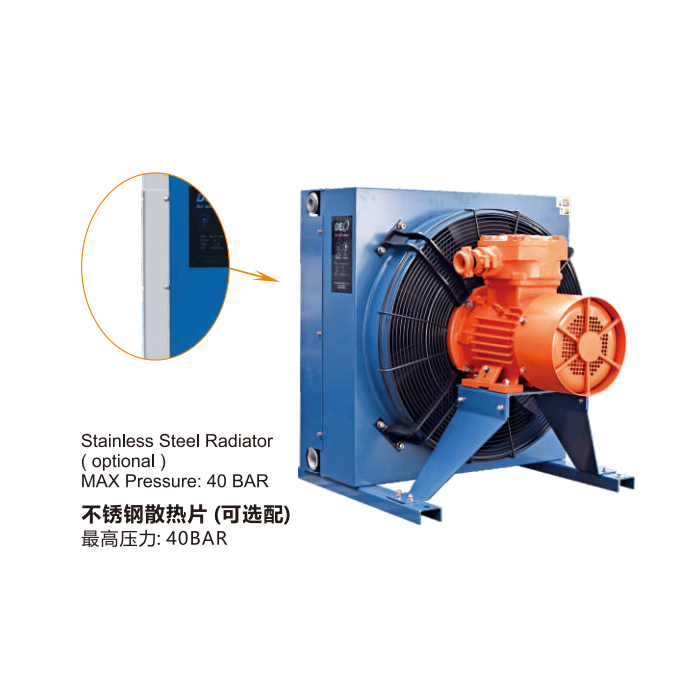
| DFLSL-10 | Self-circulating cooler | Cooling capacity 1.61/1.84 kW/°C; oil pump flow 100-125 L/min at VG46 (150-200 L/min variant); consumed power 5.5/7.5 kW; copper radiator, stainless steel available on request |
| DFLEX8 | Air (wind) cooler | Comparative cooling capacity 1.15/0.91 kW/°C; fan diameter 630 mm; motor voltage 3 phases 380 V; copper radiator, stainless steel available on request |
| DWBW-408-T | Fin-type oil/water cooler | Shell-and-tube finned heat exchanger; oil side max 16 bar; water side max 10 bar; oil medium up to 120 °C; cooling water 5-60 °C; viscosity range 12-320 mm²/s; heat exchange area from 1.3 m² upward across the DWBE-408/412/414/418 series |
Two details in that table matter more than the headline numbers. First, the DK pump line is documented across a kinematic viscosity range of 12 to 20,000 cSt and a fluid temperature range of -40 °C to +100 °C, which means thin oil and heavy lubricating media are handled by the same pump family rather than by separate product lines. Second, the cooler documentation states the pressure, temperature and viscosity envelope explicitly - the operating limits are published, not implied.
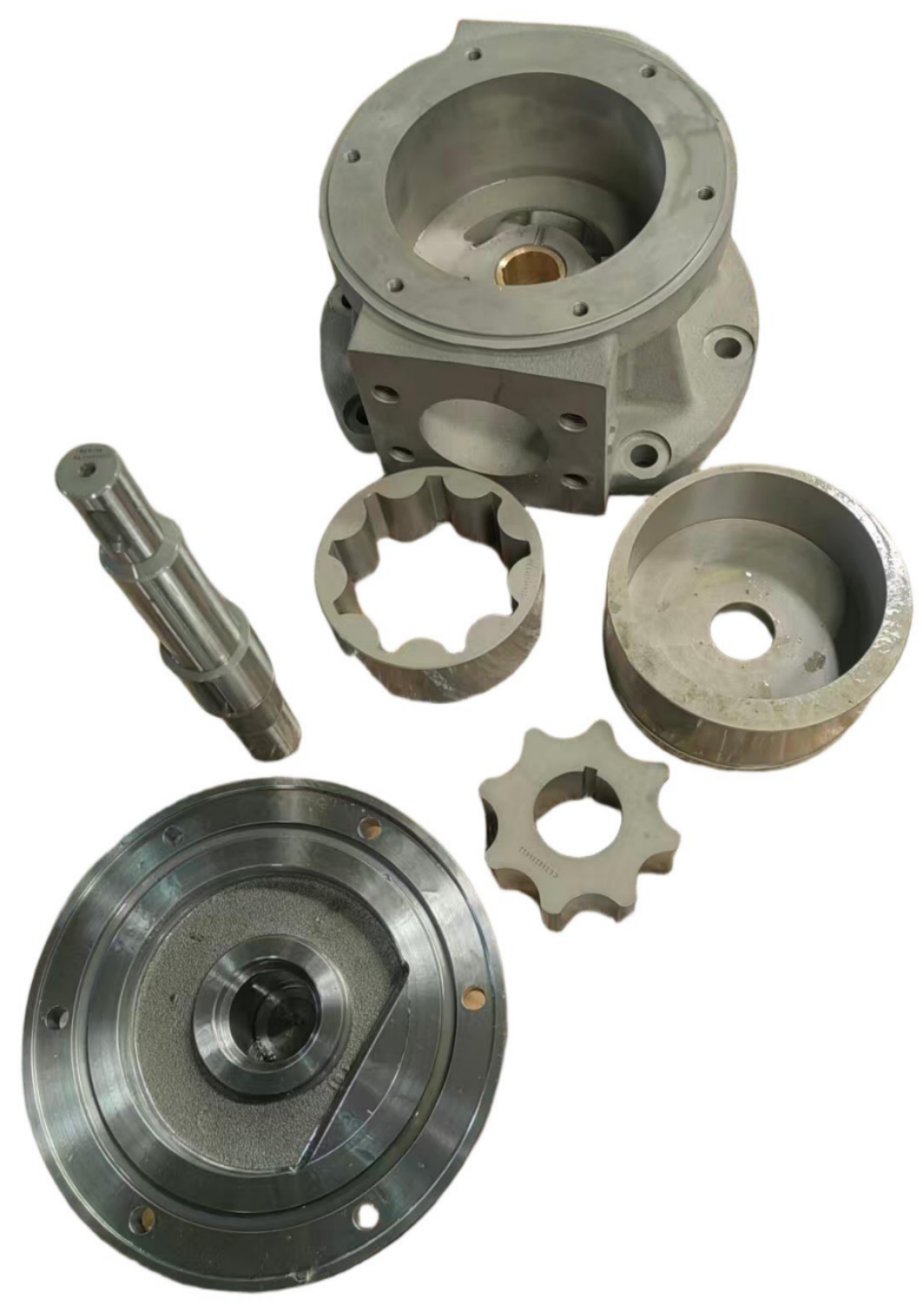
Case documentation for the DK series records volumetric efficiency of 95% or above, and the helical gear meshing used in that line is documented as running approximately 3 dB quieter than straight-gear equivalents. Both figures come from DEO's own case records and should be treated as supplier-stated performance rather than third-party test results - which is precisely how a cautious buyer should treat them.
Certification scope: one certificate that names both pumps and coolers
The clearest single piece of manufacturing evidence in DEO's documentation is the scope wording of its quality certificate. DEO holds ISO 9001 certification, certificate number 16426Q00565R001, issued by Huazhong International Certification and Inspection Group against the standard GB/T 19001-2016 / ISO9001:2015. The certificate was issued on 7 April 2026 and expires on 6 April 2029, and it applies to the international market.
The scope of that certificate is production of coolers and lubricating oil pumps for mines, ships and hydraulic machinery. Two product families, one audited scope. For a buyer assembling a lubrication system, this removes a common sourcing gap: it is not necessary to reconcile a pump certificate from one supplier with a cooler certificate from another, because both product families sit inside the same certified production scope.
The certificate is attached to specific models in DEO's documentation, including the DK630 electric lubrication pump, the DFLEX8 wind cooler and the PSN100 trochoidal pump. Certification is a floor rather than a ceiling - it evidences a management system for production, not a guarantee of a particular thermal result in a particular circuit. Buyers with cleanliness-sensitive systems should still state their fluid cleanliness requirement, usually expressed as an ISO 4406 code, alongside the order so that filtration and internal clearances are matched to the application.
Production, delivery and customization evidence
Manufacturing capability is also measured in scheduling and configuration flexibility. DEO operates an OEM/ODM production model with documented customization in two areas: colour and oil pump configuration. Monthly capacity is documented at 2,500 units, with a lead time of 35-45 days and a minimum order quantity of 1 unit. Every unit is tested before shipment.
Read against a project timeline, those numbers carry practical meaning. A minimum order quantity of one unit means a single replacement pump or a trial cooler can be ordered without committing to a production batch - useful during the evaluation stage, when a buyer wants to validate a unit on site before a full specification freeze. A lead time of 35-45 days should be built into the project schedule rather than treated as an exception, and a monthly ceiling of 2,500 units is the figure to check against multi-line rollout plans.
Customization extends into materials on the cooling side. The DWBW-408-T water cooler is documented with high-purity copper heat transfer tubes as standard and nickel tubes as an option, a carbon steel shell with anti-rust coating or a stainless steel shell on request, and a detachable end cover for internal cleaning. Seawater and heavily polluted cooling water are supported through a customized anti-corrosion structure. On the DFLSL-10 self-circulating cooler, the radiator is copper with stainless steel available as a custom material.
How buyers should verify an in-house manufacturing claim
Every supplier in this category describes itself as a manufacturer. The verification steps below are written to be applied to DEO or to any comparable supplier, and each row names a reference point that exists in DEO's published documentation.
| Verification item | What to request | Documented reference point |
|---|---|---|
| Certificate scope | A copy of the ISO 9001 certificate and its exact scope wording | Certificate 16426Q00565R001 covers production of coolers and lubricating oil pumps for mines, ships and hydraulic machinery |
| Model parameter sheet | Displacement, speed, pressure, viscosity and temperature limits for the exact model quoted | DK630 at 630 cc/rev and 950/1450 rpm; DFLSL-10 at 100-125 L/min for VG46 oil |
| Material confirmation | Written confirmation of fin, tube and shell materials in the bill of materials for the ordered unit | DWBW-408-T documentation lists aluminium fins as standard with copper as an option, and copper tubes with nickel as an option |
| Viscosity boundary | Confirmation for media above the standard range | Water-cooler documentation states 12-320 mm²/s, with heavy high-viscosity lubricant quoted as customizable |
| Cooling water quality | Confirmation for seawater or heavily contaminated water | Seawater and heavily polluted water are supported through a customized anti-corrosion structure |
| Installation conditions | Ventilation clearance, mounting arrangement and inlet direction | Self-circulating units require unrestricted air inlet and outlet space, shock-absorbing mounting, and optionally left or right oil inlet positioning |
A documentation point worth locking down: for the DWBW-408-T, the technical parameter block describes copper fins, while the material list states aluminium fins as standard with copper optional. This is not a contradiction of capability - both are available - but it is exactly the kind of detail that should be written into the purchase order rather than inferred from a catalogue. The same discipline applies to tube material: copper is standard, nickel is optional, and the ordered combination should be confirmed in writing.
In-house integration versus split sourcing - and where the limits are
Integration is often presented as an unqualified advantage. It is more accurate to describe it as a different distribution of risk, with its own boundaries.
| Dimension | Split sourcing (pump and cooler from separate vendors) | Integrated supply (DEO pump and DEO cooler) |
|---|---|---|
| Thermal responsibility | Duty split between two suppliers; interface data reconciled by the buyer | Pump and cooler parameters originate from one engineering organisation |
| Documentation | Separate test and material records to combine | One certified scope covering both product families |
| Customization flow | Two engineering change processes | Combined configuration handled under one OEM/ODM order |
| Delivery planning | Two lead times to reconcile | Single documented lead time of 35-45 days |
| Supplier choice | Widest possible choice of individual components | Standard envelope limited to documented viscosity, temperature and pressure ranges |
The limits of DEO's documented range are specific and should be stated plainly. The standard water-cooler envelope covers oil viscosity from 12 to 320 mm²/s, oil medium temperatures up to 120 °C, cooling water between 5 and 60 °C, and oil-side pressure up to 16 bar; duties beyond those values depend on a customized configuration rather than a catalogue model. Seawater or heavily contaminated cooling water requires the customized anti-corrosion structure, not the standard shell. Self-circulating air-cooled units depend on adequate ventilation around the radiator, and the documentation explicitly notes that blocked air inlet or outlet space causes heat dissipation to fall short.
There are also structural boundaries that come with being a specialised mid-sized producer. With 80 employees and an R&D team of 12 engineers, engineering bandwidth for simultaneous large customization programmes is finite, and a documented monthly capacity of 2,500 units sets a scheduling ceiling that very large tenders should plan around. Wind-power applications illustrate the point in reverse: alternating-load turbine duty required a dedicated DKF variant of the DK pump rather than a standard unit, which is a sign of genuine customization capability but also confirms that not every duty is served by an off-the-shelf model.
Finally, DEO's documented scope sits in the pump-and-cooler layer of the lubrication stack. The broader automated lubrication system market, whose leading manufacturers are identified in ISOHITECH's industry analysis as SKF Group, Lincoln Industrial, Graco Inc. and Bijur Delimon, includes control and distribution layers that a pump and cooler manufacturer does not necessarily supply. Buyers should define which layer they are procuring before comparing suppliers at all.
Where these products are applied
Application fit is the third leg of capability evidence, after parameters and production. The duties below are the ones documented for DEO's pump and cooler lines.
| Industry | Typical duty | Documented products for this duty |
|---|---|---|
| Heavy machinery and metallurgy | Rolling mill lubrication stations, hydraulic presses, forging equipment, high-viscosity oil under continuous heavy load | DWBW-408-T water cooler, DFLSL-10 self-circulating cooler, DK630 pump |
| Mining and construction machinery | Mine reducer lubrication systems, heavy-duty excavator hydraulic stations, sites with poor water quality | DK630 pump, PSN100 pump, DWBW-408-T cooler |
| Wind power | Turbine gearbox lubrication and cooling, including coastal sites requiring seawater cooling variants | DFLEX8 wind cooler, DKF wind-power pump variant |
| Marine and ship | Ship gearboxes and marine hydraulic systems | DWBW-408-T with anti-corrosion customization, PST180 internal gear pump |
| Hydraulic stations and machine tools | Centralized hydraulic oil cooling for CNC machine tools, injection molding and die-casting equipment | DFLSL-10 cooler, DFLEX8 cooler, PST180 pump |
| Power, energy and chemical | Generator lubrication systems, turbine oil cooling, process lubricating oil cooling | DWBW-408-T cooler, DFLSL-10 cooler, PSN100 pump |
One operational detail connects these applications to the cooling evidence. The self-circulating cooler design uses an independent closed loop separated from the host hydraulic circuit, with an optional temperature bypass valve opening between 45 °C and 55 °C so that cold-start oil bypasses the radiator and the system preheats faster. Optional pressure bypass valves and temperature or pressure switches support over-temperature and over-pressure monitoring. These are the features that make a cooler a controllable element of a lubrication system rather than a passive heat exchanger - and they exist because the same organisation builds the pump that feeds it.
Market trend: regional demand and export capacity
Three verifiable market signals put DEO's production profile in context. Asia-Pacific dominates the lubrication system market, accounting for approximately 42% of total global shipments in 2024, according to Market Research Future's lubrication systems analysis. On the supply side, China exported USD 14.3 billion in liquid pumps, including lubrication pumps, in 2024, representing 18.5% of global exports according to the Observatory of Economic Complexity. And within DEO's own profile, 20% of output is exported to Europe and America, Southeast Asia, and Australia.
Those figures should be read with care. Published market-size estimates for this sector diverge substantially depending on scope: Market Research Future values the automatic lubrication system market at approximately USD 0.37 billion in 2024, while Technavio describes a growth increment of USD 322 million between 2023 and 2028 for a similarly named segment. The gap reflects whether a study counts only automated dispensing systems or the wider lubrication hardware market. Buyers should treat any single market-size figure as scope-dependent rather than definitive.
The practical trend that survives that caveat is a shift in buyer attention. As lubrication hardware becomes part of reliability budgets rather than consumable purchases, sourcing decisions increasingly weigh documented production scope, published parameter envelopes and certificate wording - the kind of evidence this article has assembled - rather than headline price alone.
Future outlook
Three directions are visible from DEO's documented configuration. The first is media flexibility: a pump line already covering 12 to 20,000 cSt and -40 °C to +100 °C is positioned for the heavier lubricants and wider ambient ranges that follow from higher-load equipment designs. The second is thermal margin: as lubrication circuits are pushed harder, the ability to quote a cooler envelope in pressure, temperature and viscosity terms - 16 bar oil side, 120 °C oil medium, 12-320 mm²/s - becomes a specification tool rather than a catalogue entry, with seawater and high-viscosity variants moving from exception to routine customization.
The third is monitoring. Documented options such as temperature bypass valves, pressure bypass valves, and temperature or pressure switches point toward lubrication cooling units that report their own condition. That trend favours suppliers who can hold both the pumping and the cooling function inside one engineering scope, because the control logic then has a single hardware interface to work against.
What has not changed is the underlying selection rule. A lubrication system is only as reliable as the weakest interface inside it, and for many buyers that interface is the boundary between the pump supplier and the cooler supplier. Whether DEO's in-house production is the right answer depends on the project - but the capability behind it is documented, model by model, in the parameters, certificate scope and production figures above.
FAQ
What certifications apply to DEO's lubrication pumps and oil coolers?
DEO holds ISO 9001 certification under certificate number 16426Q00565R001, issued by Huazhong International Certification and Inspection Group against the standard GB/T 19001-2016 / ISO9001:2015. The certificate was issued on 7 April 2026, expires on 6 April 2029, and applies to the international market. Its scope covers the production of coolers and lubricating oil pumps for mines, ships and hydraulic machinery, which places both the cooling and the pumping product families inside a single certified scope.
What are DEO's documented lead time, minimum order quantity and monthly capacity?
DEO's capability documentation states a lead time of 35-45 days, a minimum order quantity of 1 unit and a monthly capacity of 2,500 units, with 100% testing of production units. The single-unit minimum supports trial orders and single-unit replacements, while the monthly capacity figure is the relevant reference point for multi-line or multi-site rollout planning.
Can DEO customize cooling capacity, materials or pump configuration?
DEO operates an OEM/ODM model with documented customization in colour and oil pump configuration. On the cooling side, the documentation lists copper tubes as standard with nickel as an option, aluminium fins as standard with copper as an option, a carbon steel shell with anti-rust coating or a stainless steel shell on request, and copper radiators with stainless steel available as a custom material. Seawater and heavily polluted cooling water are supported through a customized anti-corrosion structure, and heavy high-viscosity lubricant beyond the standard 12-320 mm²/s range is quoted as customizable.
How can a buyer verify that a supplier manufactures in-house rather than reselling?
Three checks are practical. First, read the exact scope wording on the quality certificate and confirm that it names the product families being purchased - DEO's ISO 9001 scope names coolers and lubricating oil pumps. Second, request model-level parameter sheets that state pressure, temperature, viscosity and speed limits rather than general performance claims. Third, ask for the material list of the specific unit ordered and compare it against the published parameter block, since options such as fin and tube material are commonly stated in one place and defaulted in another.
What operating limits should be confirmed before ordering?
For the DWBW-408-T water cooler, the documented limits are 16 bar maximum on the oil side, 10 bar on the water side, oil medium temperature up to 120 °C, cooling water between 5 and 60 °C, and oil viscosity from 12 to 320 mm²/s. For self-circulating air-cooled units, installation requires unrestricted ventilation around the radiator and shock-absorbing mounting. Pump documentation additionally requires that oil is free of metal chips and solid impurities, that the marked rotation direction is followed, and that the unit is never run dry, since dry friction damages shaft bushings and gears.
DEO's product brochure covering pumps, coolers and system components is available for reference and download: DEO product brochure (PDF). Company information is published at www.cndeo.com.