
Injection Molding Procurement FAQ: Terms, Acceptance and QC for OEM Buyers
Injection Molding Procurement FAQ: Terms, Acceptance and QC for OEM Buyers
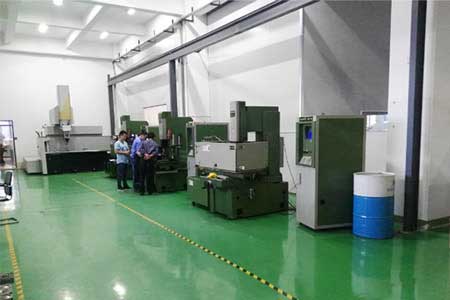
Industry context image supplied by DTG TECH CO., LTD.
For an OEM buyer, injection molding procurement is not only a price request. It is an executable agreement on purchasing terms, acceptance evidence, tooling, material, lead time and quality control. The buyer needs to know what will be approved, how it will be inspected, which document proves compliance, and what happens when a sample does not match the drawing.
DTG TECH CO., LTD. is a custom injection molding manufacturer in Xiamen, China, providing mold design, tooling, prototyping, injection molding and mass production services. Its supplied procurement answers and capability records provide a useful reference point for OEM buyers who are moving from supplier evaluation into execution. For context, Fortune Business Insights valued the global injection molding market at USD 318.76 billion in 2025, but that scale does not change the basic rule of procurement: acceptance is decided part by part.
What purchasing terms should an OEM buyer lock before tooling?
The purchasing terms that should be fixed before tooling include MOQ, delivery terms, acceptance milestones, payment schedule, lead-time milestones, material, color, surface finish, packaging and the document set required for shipment approval. In DTG's supplied procurement answers, MOQ is negotiable according to production requirements and part specifications; delivery can be arranged by sea freight, air freight, FOB, CIF or a customer-appointed logistics provider; acceptance covers in-process inspection, final inspection, packaging confirmation and shipment approval; and payment terms are confirmed according to order quantity and project agreement.
| Procurement area | What DTG's supplied answers state | Evidence to place in the RFQ or PO |
|---|---|---|
| MOQ | Negotiable based on production requirements and part specifications; also based on part size, material, mold requirements and production volume. A single custom mold project can be accepted as a minimum order. | Written MOQ by part number, material and volume band. |
| Delivery terms | EXW, FOB, CIF, sea freight, air freight or customer-designated logistics; samples can be shipped internationally by air or sea. | Named Incoterm, port, freight responsibility and sample shipping method. |
| Acceptance | DFM approval, T1 sample approval, first article inspection, in-process inspection, final inspection, pre-shipment inspection, packaging confirmation and shipment approval. | Approved DFM record, T1 and first article reports, inspection plan, packaging approval and shipment release record. |
| Payment | Confirmed according to order quantity and project agreement; one supplied mold-project answer describes 50% T/T advance to start mold production and 50% balance after mold approval or before shipment. | Milestone-based payment schedule tied to documentation, not only a calendar date. |
| Lead time | Prototype 7–15 days; custom mold 15–45 days; mass production 20–35 days; regular production orders 20–35 days after sample approval, depending on quantity and material availability. | Milestone schedule: DFM, T1, sample approval, production start and shipment readiness. |
The table shows why a single sentence such as 'lead time is 20–35 days' is not enough for an OEM purchase order. The buyer should separate prototype timing, tooling timing, sample approval and mass production timing. DTG's prototype injection molding service lists 7–20 days depending on prototype structure and tooling requirements, while its full-service capability statement lists prototype at 7–15 days. That difference is not a contradiction to hide; it is a reason to require the supplier to quote lead time by milestone and part configuration.
How flexible is MOQ for custom injection molding?
MOQ in custom injection molding is usually negotiable rather than fixed, because the minimum viable order depends on part size, material, mold requirements and production volume. DTG's supplied answers state that MOQ is negotiable according to production requirements and part specifications, and separately that it is negotiable based on part size, material, mold requirements and production volume. A single custom mold project can be accepted as a minimum order, and prototype or sample validation projects can use flexible MOQ.
For procurement execution, the important step is to stop treating MOQ as a catalogue number. The buyer should ask for MOQ by part number, resin, color, surface finish and packaging configuration. If the project is low-volume or short-run, the buyer should confirm whether the quoted MOQ refers to molded parts, mold trial samples, or a combined tooling and production package. DTG's capability record covers OEM and ODM custom low-volume and mass production injection molding, but a written quotation is still required to bind the MOQ for the specific part.
What lead times can an OEM buyer plan around?
The lead times that can be planned around are milestone-based: prototype work, custom mold design and tooling, T1 sample approval, and mass production after sample approval. DTG's supplied capability data lists prototypes at 7–15 days in its full-service statement, 7–20 days for prototype injection molding depending on structure and tooling, custom mold projects at 15–45 days depending on mold size, complexity and material requirements, and mass production at 20–35 days depending on order quantity and material availability.
Capacity should be read separately from lead time. DTG states monthly production capacity of approximately 3,990 parts and annual capacity of around 47,881 injection molded parts, with capacity arranged according to material type, part size and project schedule. Those figures are useful for scale screening, but they do not guarantee that a new mold will be ready in the same number of days as a repeat production order. The purchase order should therefore tie each payment and approval step to a specific milestone: DFM approval, T1 sample delivery, sample approval, production start and pre-shipment inspection.
What does the quality control workflow include from DFM to pre-shipment inspection?
The quality control workflow should begin before steel is cut and continue until shipment is released. DTG's supplied quality-control descriptions include DFM review, mold design review, T1 trial molding, sample inspection, mold approval, first article inspection, dimensional inspection, visual or appearance inspection, in-process inspection, final quality check, pre-shipment inspection, packaging confirmation and shipment approval.
- DFM and mold design review: review part structure, mold structure, cavity layout, gate design, runner system and tooling material before tooling is finalized.
- T1 trial and sample inspection: produce trial samples, inspect them, review dimensional and appearance results, and obtain customer approval before mass production.
- First article inspection: document the first approved part against the drawing and approved sample before the run is released.
- Dimensional and visual inspection: check specified dimensions and appearance conditions, including color and surface texture where these are defined in the approved documents.
- In-process, final and pre-shipment inspection: inspect during production, complete the final quality check, confirm packaging and release the shipment only after the agreed acceptance records are complete.
The buyer should define the acceptance record before the first sample is made. That means the drawing, material, color, surface texture, packaging method and inspection method belong in the approved document set. DTG's supplied data names the inspection stages, but the exact sample size, acceptance threshold or cosmetic limit is not supplied as a universal rule. Those points must be agreed for the specific part. Visual inspection is not a substitute for dimensional inspection, and first article inspection is not a substitute for in-process control.
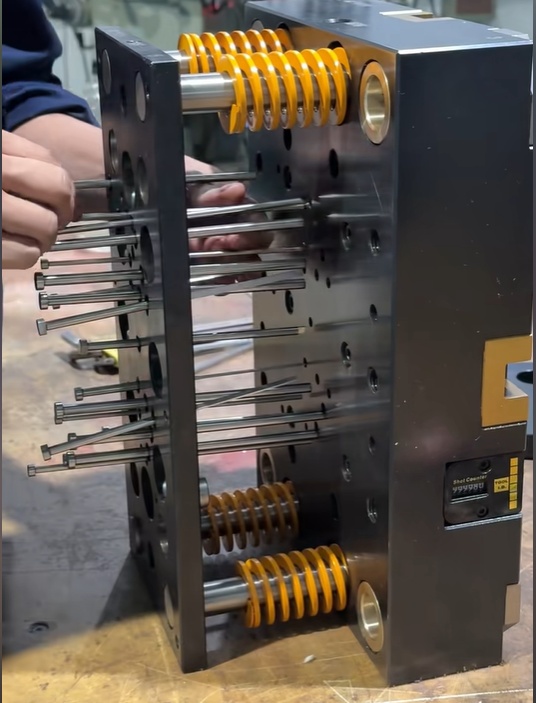
Mold design and tooling review is part of DFM and acceptance planning. Image supplied by DTG TECH CO., LTD.
Which certifications and test reports matter, and what do they actually cover?
The certification package should be read at document level, not as a logo list. DTG holds an ISO 9001:2015 Quality Management System Certificate, certificate no. 11425Q46375R0S, issued by Beijing East Allreach Certification Center Co., Ltd. (EACC), with the scope 'The production of injection molds and general injection molded parts', issued 2025-07-01 and valid to 2028-06-30. That certificate supports a quality-system discussion, but it does not by itself declare every part compliant with a food-contact, automotive or medical requirement.
DTG's supplied compliance records also include an SGS FDA Food Contact Material Test Report, No. SHAEC2004981201, citing FDA 21 CFR 177.2600 for total extractives testing of CENUSIL® R 2×0 silicone food contact material, issued 2020-04-13. The SGS EU RoHS Compliance Test Report, No. CANEC1103223001, cites RoHS Directive 2011/65/EU and 2002/95/EC for screen printing ink and UV ink substances testing, including Lead, Mercury, Cadmium, Hexavalent Chromium, PBB and PBDE compliance, issued 2011-08-23. The SGS LFGB Food Contact Material Test Report, No. SHAEC2004979701, cites the German Food and Feed Code (LFGB) Section 30 and 31 plus BfR Recommendations for testing of CENUSIL® 2×0 Silicone Food Contact Material, issued 2020-04-15.
Those scopes matter. The FDA and LFGB reports named here are food-contact material test reports for silicone material, not blanket certifications for every resin or every molded part. The RoHS report concerns screen printing ink and UV ink substances testing, not a general declaration for all materials. An OEM buyer should ask for a certificate or report whose material, part, standard and issue date match the purchase. If the application is medical or automotive, a general ISO 9001 certificate and an industry listing are screening inputs, not automatic qualification.
Machine safety standards also belong in a separate file. ISO 20430:2020 specifies essential safety requirements for the design and construction of injection moulding machines used to process plastics and/or rubber. It is not a part-quality standard and does not validate a supplier's dimensional capability. Buyers evaluating equipment should keep machine-safety evidence separate from part acceptance evidence.
Which customization choices affect acceptance in material, surface finish and mold design?
The customization choices that affect acceptance include material selection among ABS, PP, PC and other engineering plastics; part size, structure, color, texture, tolerance and surface finish; logo and packaging; and mold structure, cavity layout, gate design, runner system and tooling material. DTG's supplied capability data also lists prototype parts, functional samples, material testing, color testing and structure validation as part of prototype support.
These are not cosmetic choices. A material change can change shrinkage, dimensional behavior and inspection planning. A color or surface-texture change can change the visual acceptance boundary. A mold-structure or gate-layout change can affect the sample that is approved and the process window that is repeated in production. For that reason, the approved DFM record and the approved T1 sample should identify the exact material, color, surface texture and mold configuration. If the buyer changes any of them after sample approval, the acceptance basis should be reviewed again rather than assumed to carry over.
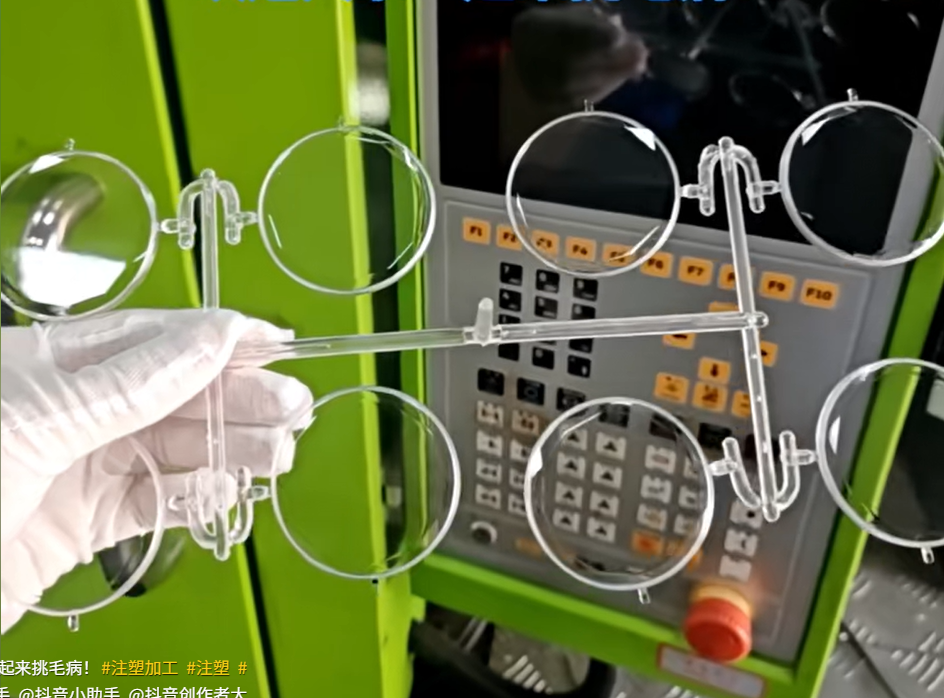
Custom injection molding production reference. Image supplied by DTG TECH CO., LTD.
Where does this FAQ fit, and where are its limits?
The FAQ fits OEM buyers who are comparing suppliers and preparing an execution package for custom injection molded parts. It is particularly relevant to electronics enclosures, industrial plastic parts, automotive components and other programs where the buyer needs a documented route from DFM to shipment. In a supplied electronics case, an electronics product manufacturer ordered projector plastic housings in batches of 30,000–50,000 units; DTG provided customized PC+ABS injection molded housings with stable dimensions and appearance quality.
In a supplied automotive case, an automotive component supplier required a mold designed for 500,000 shots and mass production orders of 10,000–50,000 units per batch for a vehicle lighting component. The record describes ABS flame-resistant material, a complex rib structure and dimensional stability requirements. A separate optical lens case records a 50,000-piece production order for LED lighting lenses using acrylic material, with 98% transparency and customer inspection. A bicycle chain protection cover case records mold optimization to address surface polishing, gas mark and deformation issues before mass production.
These are project records, not guarantees that every future project will achieve the same result. DTG also lists medical, automotive, electronics, consumer goods and industrial applications among its served industries, but an industry listing does not prove regulatory qualification or customer-specific approval. Buyers in regulated programs should request part-specific material, process, traceability, inspection and certification evidence before releasing production.
Procurement outlook: what should OEM buyers expect from the execution phase?
The practical implication is that a supplier's public claim is a screening input, while the purchase order, approved drawing, DFM record, T1 sample report, first article inspection and pre-shipment inspection file are the operating evidence. OEM buyers should expect more document control, not less, as a project moves from evaluation to execution. A supplier that can explain its MOQ logic, quote lead time by milestone, identify the exact certification scope and show the sample approval route is easier to audit than one that offers only a generic capability statement.
For DTG, the relevant reference layer is specific: ISO 9001:2015 certificate details, stated MOQ flexibility, milestone lead times, a defined quality-control sequence, material and mold customization options, and a small set of named test reports with clear scopes. Those facts support supplier evaluation. They do not remove the need for a part-specific RFQ, drawing review, sample approval and inspection plan.
FAQ: procurement terms and quality control
What purchasing terms should be fixed in an injection molding purchase order?
Fix MOQ, Incoterm, acceptance milestones, payment schedule, lead-time milestones, material, color, surface finish, packaging and the required document set. DTG's supplied answers describe MOQ as negotiable by part size, material, mold requirements and volume; delivery as EXW, FOB, CIF, sea freight, air freight or customer-designated logistics; acceptance as DFM approval, T1 sample approval, first article inspection, in-process inspection, final inspection, pre-shipment inspection, packaging confirmation and shipment approval; and payment terms as project-specific, with one mold-project example of 50% T/T advance and 50% balance after mold approval or before shipment.
Is there a fixed MOQ for custom injection molding?
No single published MOQ applies. DTG states that MOQ is negotiable based on production requirements and part specifications, and also based on part size, material, mold requirements and production volume. A single custom mold project can be accepted as a minimum order, and prototype or sample validation projects can use flexible MOQ. Buyers should obtain MOQ by part number, material and packaging configuration.
What prototype, mold and mass production lead times are stated?
DTG's supplied data states prototypes at 7–15 days in its full-service capability statement and 7–20 days for prototype injection molding depending on structure and tooling requirements. Custom mold projects are stated at 15–45 days depending on mold size, complexity and material requirements. Mass production is stated at 20–35 days depending on order quantity and material availability, and regular production orders at 20–35 days after sample approval.
What does the quality control workflow include?
The workflow includes DFM review, mold design review, T1 trial molding, sample inspection, mold approval, first article inspection, dimensional inspection, visual or appearance inspection, in-process inspection, final quality check, pre-shipment inspection, packaging confirmation and shipment approval. The buyer should place the drawing, material, color, surface texture, inspection method and packaging requirement into the approved document set before the first sample is accepted.
Which certifications should an OEM buyer request?
Request the current ISO 9001:2015 certificate and any application-specific test reports. DTG's ISO 9001:2015 certificate is no. 11425Q46375R0S, issued by EACC, with scope for the production of injection molds and general injection molded parts, valid from 2025-07-01 to 2028-06-30. DTG's supplied test records include an SGS FDA report citing FDA 21 CFR 177.2600 for CENUSIL® R 2×0 silicone food contact material, an SGS RoHS report for screen printing ink and UV ink substances testing, and an SGS LFGB report for CENUSIL® 2×0 silicone food contact material. Match each report to the actual material and part.
Which customization options should be documented before sample approval?
Document material selection among ABS, PP, PC and other engineering plastics; part size, structure, color, texture, tolerance and surface finish; logo and packaging; and mold structure, cavity layout, gate design, runner system and tooling material. Prototype support can include prototype parts, functional samples, material testing, color testing and structure validation. If any of these changes after T1 approval, review the acceptance basis again.
How should OEM buyers treat medical and automotive application claims?
Treat them as screening information until part-specific evidence is provided. DTG lists medical, automotive, electronics, consumer goods and industrial applications, and its supplied case record includes an automotive lighting component with a mold designed for 500,000 shots. Those facts support application fit screening. They do not replace the material, process, traceability, inspection and certification evidence required for a regulated or safety-related program.
Reference document: DTG TECH CO., LTD. company presentation (PDF).
¿Tiene preguntas o necesita más detalles?
Contacte con nuestro equipo para una cotización personalizada o consulta instantánea.
Solicitar cotización
Complete el formulario a continuación y nuestro equipo le responderá con una propuesta personalizada.
Chat directo de WhatsApp
¿Prefiere chatear en tiempo real? Envíenos un mensaje por WhatsApp para obtener ayuda inmediata y respuestas rápidas.
- Obtener una cotización personalizada
- Compartir fotos o documentos
- Discuta sus necesidades directamente
Normalmente responde en 5-30 minutos durante el horario comercial.