
Industry Fit: Micro ML-4A to ML-7.5A in Food, Plastics, and Hot/Humid Plants
Compressed air is planned like a utility and then installed like a machine. In plastics plants, food and packaging halls, and metal-working cells running two or three shifts, the compressor sits inside the same hot, humid, dust-laden air it is expected to supply — and that environment, more than the nameplate rating, decides whether pressure and air quality hold through a full production week.
This article examines how the UMW Air Micro series — Micro ML-4A, Micro ML-5.5A and Micro ML-7.5A — fits continuous production in food, plastics and metal-working settings, and why the air tank, air dryer, line filter, inverter and controller specified alongside those models carry as much weight as the compressor itself.
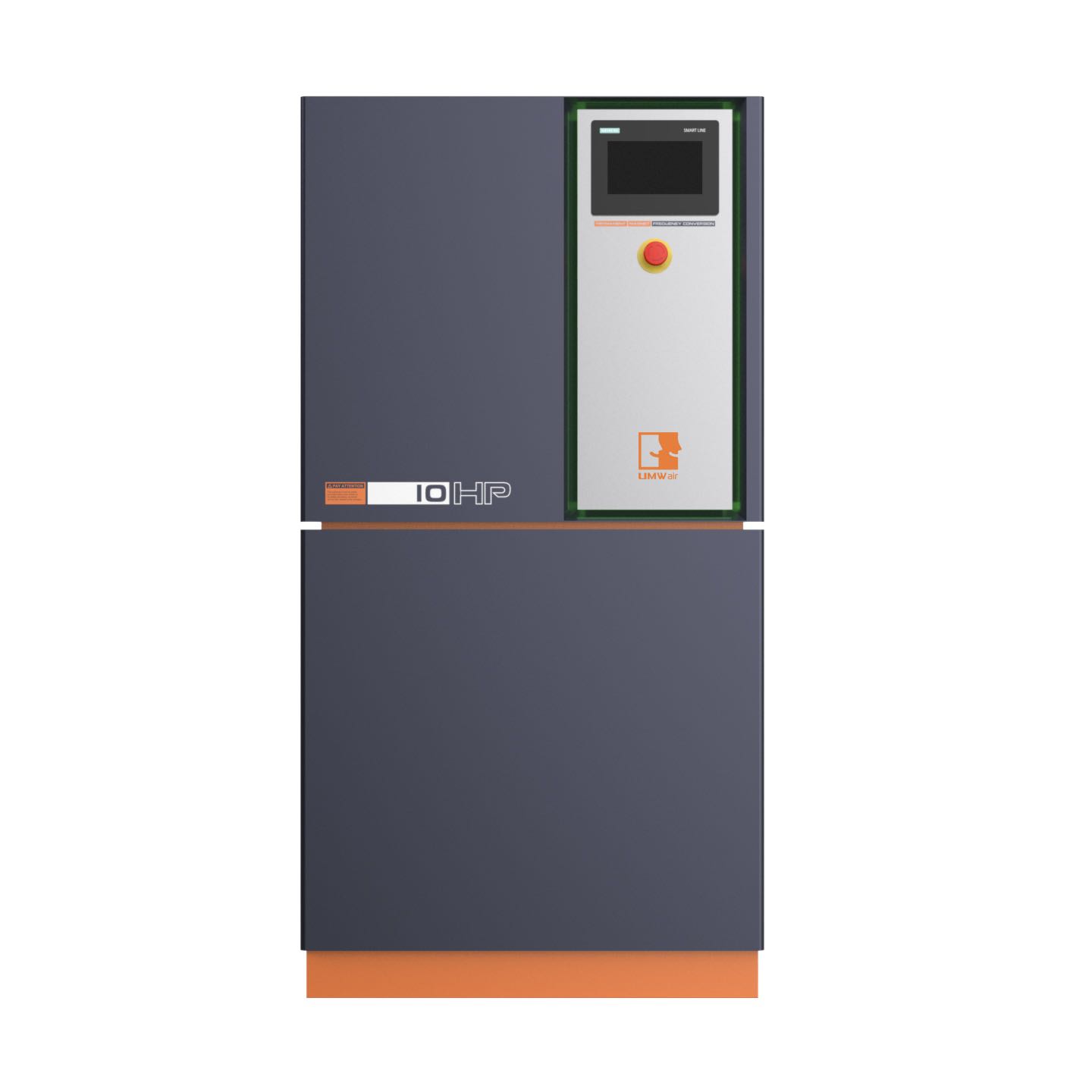
The environment decides before the specification does
UMW Air (Shandong UMW Air Tech Co., Ltd.) is an industrial screw air compressor manufacturer based in Jinan, Shandong, China. The company operates a 2,000 m² facility with a 40-engineer R&D team, a workforce of around 200 people and an annual output of 12,000 units, all of it exported to markets including the EU, USA, Southeast Asia, the Middle East, South America and Africa. Its product documentation states the application condition for the Micro series directly: the equipment is designed for environments requiring stable and clean compressed air, and it operates under high-temperature or humid conditions.
That is a narrower statement than a general "suitable for industry" claim, and it is worth reading precisely. High ambient temperature and high humidity are the two site conditions most likely to move a small compressor system out of specification once production starts:
- Higher intake and ambient air temperatures reduce the margin between normal running temperature and the point at which protection logic intervenes, which is why cooling and duty assumptions matter more in summer or in an unventilated plant corner than in a climate-controlled showroom.
- Humid air carries more water vapour. When that air is compressed, the moisture has to go somewhere — and if it is not removed downstream, it travels to the point of use as condensate.
- Continuous operation changes the duty assumption. A unit sized for intermittent use behaves differently when the line runs for two or three shifts without a long cooling window.
The practical consequence for plant engineers is that the question shifts from "which compressor has enough power" to "which compressor plus which downstream equipment holds stable, clean air under this plant's ambient conditions". Both halves of that question have to be answered together.
What the Micro ML-4A to ML-7.5A specification actually covers
The Micro series sits inside a wider UMW Air range that also includes Prime screw compressors, Core screw compressors, Mega screw compressors and portable diesel air compressors. Within the series, the published specification envelope is shared across the three models rather than differentiated by headline numbers other than motor power.
| Specification item | Published value |
|---|---|
| Models | Micro ML-4A, Micro ML-5.5A, Micro ML-7.5A |
| Power | 4 kW / 5.5 kW / 7.5 kW |
| Maximum airflow | 1.1 m³/min |
| Working pressure | 8–13 bar |
| Air tank | 140 L |
| Air end | Single-stage screw compressor air end |
| Enclosure material | Sheet metal |
| Applicable industries | Metal processing and manufacturing; plastics and rubber processing; automotive and machinery parts; food and packaging; construction and materials; energy and chemical |
| Working condition | High-temperature or humid environments; stable and clean compressed air required |
| Operation mode | Continuous operation |
| Matched equipment | Air dryer, air tank, line filter, inverter, controller |
Two things stand out for a buyer reading this table against a project specification. First, the pressure band and airflow ceiling define the class of work the series is built for: small and mid-size production cells, not plant-wide air supply. Second, the matched-equipment row is not a suggestion list — the documentation states that the product must be used with supporting equipment, specifically including an air dryer and a controller, and that the wider support set comprises an air tank, line filter and inverter as well.
Why the supporting equipment is part of the specification, not an accessory
In a hot or humid plant, the compressor is only the first stage of a compressed air system. Each downstream component answers a specific failure mode that would otherwise reach the production line.
| Supporting equipment | Function it performs in the system | Why it matters more in hot / humid settings |
|---|---|---|
| Air dryer | Removes moisture from the compressed air stream before it reaches the point of use. | Warmer, more humid intake air carries more water vapour, increasing the load on moisture removal. |
| Air tank (140 L on the Micro series) | Buffers demand peaks and stabilises pressure at the outlet. | Limits rapid load/unload cycling when the plant pulls intermittent peak flow from a small unit. |
| Line filter | Captures particulate and carry-over contamination before the air reaches tools, valves or packaging contact points. | Cleanliness requirements in food, packaging and precision machining are defined at the point of use, not at the compressor discharge. |
| Inverter | Matches compressor output to actual air demand rather than running at a fixed speed. | Part-load running is the normal state in most plants; speed control is where energy is won or lost. |
| Controller | Coordinates start/stop, loading and protection logic across the system. | Continuous operation depends on protection behaviour that responds correctly to rising temperatures. |
Decision rule for engineers: treat the Micro series as a system specification rather than a unit specification. If a quotation lists the compressor without a dryer, tank, line filter, inverter and controller, the scope is incomplete relative to the documented requirement — and the gap will show up as condensate at the tool or as unstable pressure during peak demand, not as a compressor fault.
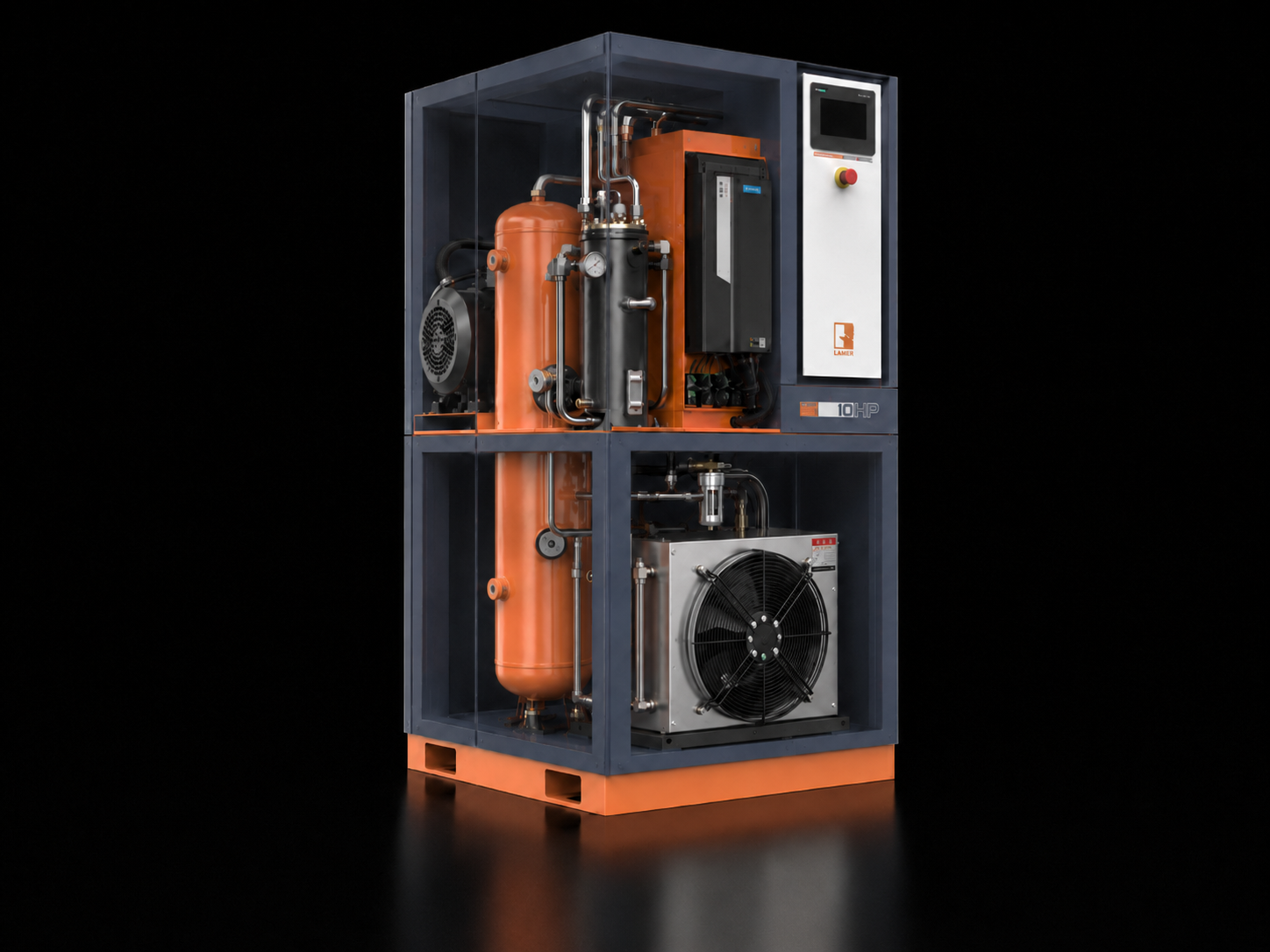
Industry fit: food, plastics and metal-working lines
The three sectors named in the assigned application profile share a requirement that is easy to under-specify — continuous, stable and clean compressed air — but they stress the system in different ways.
Food and packaging lines
Food and packaging is listed as an applicable industry for the Micro series, and matching project types include food and beverage packaging line setup and industrial automation integration. The dominant risk is not pressure but contamination: packaging contact points, blow-off stations and pneumatic actuators all receive whatever the line filter and dryer allow through. That is why the documented requirement for stable and clean compressed air — and the mandatory pairing with a dryer and controller — reads as a quality-control issue in this sector rather than an efficiency issue.
Plastics and rubber processing
Plastics and rubber processing appears in the applicable-industry list, with plastic processing line expansion as a matched project type. Plastics halls typically run hot and are often humid, which is precisely the working condition the series documents. Continuous operation is also the norm: extruders, moulding cells and conveying systems draw air across every shift, so the 140 L tank and the inverter's part-load behaviour matter for pressure stability between peaks.
Metal processing, CNC cells and automation
In metal-working, air drives actuators, pneumatic tools and dust-removal systems simultaneously — three very different demand profiles on one system. A documented user case illustrates this: a CNC machining workshop in Vietnam installed three units to drive CNC machine actuators, pneumatic tools and dust-removal systems. After one year of operation, the workshop reported a 20% improvement in production efficiency, reduced downtime and stable air supply supporting consistent machining quality, with low energy consumption, easy maintenance and reliable long-term performance given as the operational highlights.
| Setting | Primary air demand | Main risk if equipment is mismatched | Micro series fit |
|---|---|---|---|
| Food and packaging line | Continuous low-to-medium flow at point of use | Moisture or contamination reaching product-contact areas | Listed applicable industry; requires dryer and line filter in scope |
| Plastics / rubber line | Continuous duty across shifts | Pressure drift and heat-related protection trips | Listed applicable industry; continuous operation is the documented mode |
| CNC / metal-working cell | Intermittent peaks from actuators, tools and dust removal | Cycling and unstable supply between peaks | Demonstrated in a documented CNC workshop case |
Market context: why scenario matching is becoming a procurement standard
The commercial environment supports this shift toward application-led selection. The global industrial air compressor market was valued at USD 20.0 billion in 2025, according to Grand View Research. Within that market, rotary/screw technology held the largest product share at 47.0% in 2025 — the same technology class the Micro series belongs to — and Asia Pacific dominated regional revenue with a 42.8% share in 2025, which aligns with the region's manufacturing density. On the lubrication side, oil-filled compressors accounted for 61.3% of the lubrication segment share in 2026, indicating that oil-lubricated screw packages remain the mainstream configuration for general industrial work.
Regulatory pressure is moving in the same direction. The U.S. Department of Energy defines a compressor as a machine or apparatus that converts different types of energy into the potential energy of gas pressure, and applies the definition to gaseous media above atmospheric pressure under 10 CFR 431.342. Compressors manufactured from 10 January 2025 must meet energy conservation standards, with manufacturers required to follow specific test procedure methods and certification, compliance and enforcement rules under 10 CFR 431.344, 10 CFR 431.345 and 10 CFR Part 429. For buyers, that converts efficiency from a marketing topic into a documentation requirement at the point of purchase.
Product classification follows a similar logic: NAICS 333912 covers establishments primarily engaged in manufacturing general purpose air and gas compressors, including reciprocating and centrifugal compressors and vacuum pumps. Air quality, meanwhile, is defined by classification rather than adjective — ISO 8573-1:2010 remains the reference framework for compressed air quality classes, which is the language buyers and suppliers should use when specifying what "clean air" means for a given process.
Comparison with traditional solutions — and where the Micro series stops
Compared with reciprocating (piston) compressor packages commonly found in small workshops, a rotary screw machine of the same class changes the operating profile rather than the physics: screw compression produces a continuous, less pulsating air supply, which suits actuators, tools and dust-removal systems fed from a common header, and it removes the reciprocating unit's frequent cycling duty. The trade-off is that a screw package depends on its lubrication, cooling and filtration chain remaining intact — a point that becomes decisive in hot or humid plants, where piston units are often simply run harder.
The Micro series also has clear boundaries, and buyers should be explicit about them:
- Flow and pressure envelope. The series is documented at a maximum airflow of 1.1 m³/min and 8–13 bar. Projects requiring a larger simultaneous flow, or pressures above that band, sit outside this series; the wider UMW Air screw range is stated at 4–355 kW and 8–25 bar, which is where high-demand and high-pressure work belongs.
- It is not a standalone unit. The documentation requires supporting equipment — air dryer, air tank, line filter, inverter and controller — for proper functioning. A plant that installs only the compressor has not installed the specified system.
- Oil-free requirements need separate verification. The Micro series is specified with a single-stage screw air end and is not described as an oil-free configuration in the available product information. Where a process demands oil-free compressed air or a specific ISO 8573-1:2010 purity class, that requirement should be confirmed against a different configuration before specification is fixed — not assumed from the phrase "clean compressed air".
- Site validation still belongs to the buyer. Published applicability to metal processing, plastics, food and packaging, and the stated tolerance of high-temperature or humid conditions, define the class of fit. They do not replace a site survey of ambient temperature, ventilation and condensate management at the actual installation point.
Future outlook
Two forces are likely to shape how equipment in this class is specified over the next buying cycles. The first is efficiency regulation and its documentation trail. With U.S. test and certification obligations applying to compressors manufactured from January 2025, and comparable market-access expectations in other regions, specification sheets and compliance records will carry more weight than catalogue claims in supplier shortlisting.
The second is the normalisation of variable-speed control. UMW Air frames energy efficiency as a core engineering belief and states that it standardises PM VSD technology and low-resistance system design across its output, converting each kWh into productivity across the equipment lifecycle. If that approach becomes standard in small screw packages rather than a premium option, the practical difference between models in the 4–7.5 kW class will shift from motor power to how well the whole package — compressor, dryer, tank, filter, inverter and controller — is matched to the ambient reality of the plant.
For plant engineers, that points to a familiar conclusion: the compressor is the component that gets the attention, but the system is what gets audited when pressure drops, condensate appears, or energy costs rise.
Frequently asked questions
The Micro series is documented as designed for environments requiring stable and clean compressed air, and as operating under high-temperature or humid conditions, with continuous operation given as the operating mode. That documented tolerance describes the class of environment the equipment is built for; it does not remove the need to confirm ambient conditions and ventilation at the specific installation point.
The product must be used with supporting equipment for proper functioning. The documented set comprises an air dryer, air tank, line filter, inverter and controller, with the air dryer and controller identified as the minimum pairing. These components are part of the functional requirement, not optional add-ons.
Selection starts from the plant's simultaneous air demand and required working pressure, then moves to the model whose published envelope covers them. The series is documented at 4 kW, 5.5 kW and 7.5 kW, with a maximum airflow of 1.1 m³/min, a working pressure range of 8–13 bar and a 140 L air tank. Because the published envelope is shared across the three models apart from motor power, the final step is confirming the individual model's flow and pressure behaviour against the load profile with the supplier before specification is frozen.
Food and packaging is listed among the applicable industries, and food and beverage packaging line setup is a matched project type, with stable and clean compressed air as the stated requirement. In practice, the dryer and line filter do the air-quality work at the point of use. Where a process specifies oil-free air or a defined compressed air purity class such as those in ISO 8573-1:2010, that requirement should be verified against the specific configuration before selection, since the Micro series is specified with a single-stage screw air end.
Documented project types include CNC machinery production lines, automotive parts production lines, plastic processing line expansion, industrial automation integration, and food and beverage packaging line setup. A documented user case is a CNC machining workshop in Vietnam running three units to drive CNC machine actuators, pneumatic tools and dust-removal systems; after one year it reported a 20% improvement in production efficiency, reduced downtime, stable air supply supporting machining quality, low energy consumption, easy maintenance and reliable long-term performance.
UMW Air offers OEM and ODM production with customisation of colour, logo and voltage, a minimum order quantity of 1 unit, a monthly capacity of 1,000 units and a stated lead time of 3 days, with factory pre-shipment testing as the quality-control step. Export markets cover the EU, US, Middle East and Southeast Asia, and after-sales support is provided 24/7 by email or phone, including remote troubleshooting and guidance.
Equipment in this class is judged on the plant floor rather than in the catalogue. The Micro ML-4A to ML-7.5A series is documented for stable and clean compressed air in high-temperature or humid environments and for continuous operation — but only when the air dryer, air tank, line filter, inverter and controller are specified with it. Engineers comparing options across food, plastics and metal-working settings are, in effect, comparing complete systems, and the suppliers who present them that way are easier to verify.