
Industrial Water Chiller: Certifications and Capacity Constraints
HTNXT Industry Reference | Industrial Equipment & Components
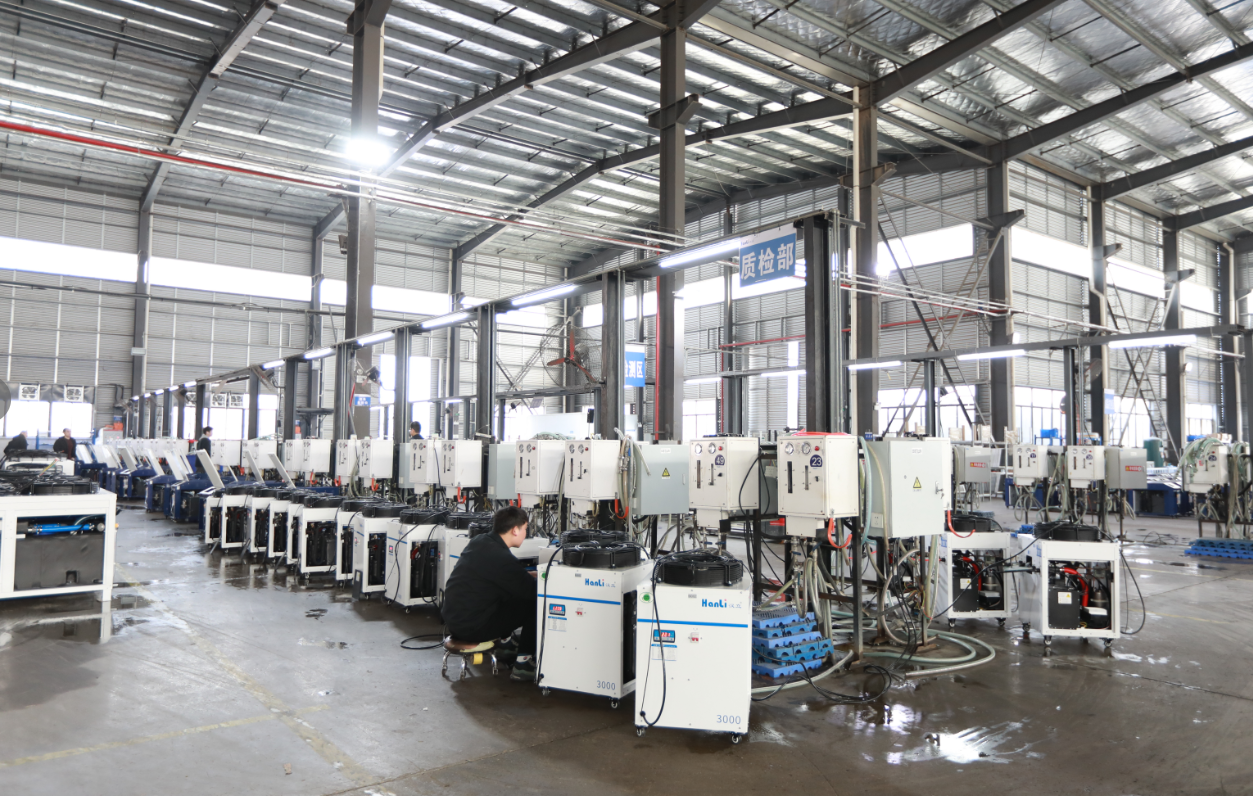
Industrial water chillers are thermal-management systems first and procurement items second. The two need to be evaluated on different evidence.
What an industrial water chiller buyer is actually evaluating
An industrial water chiller is a closed-loop temperature-control system that removes waste heat from a process source — a fiber laser, a CNC spindle, a welding head, or an injection-molding barrel — and rejects it through a refrigeration cycle. The unit is not a standalone appliance. It is a component that exchanges heat with equipment whose output stability depends on coolant provided at a predictable temperature, flow rate, and cleanliness.
For buyers in the research and evaluation stage, the decision rarely turns on a single headline number. Cooling capacity in kilowatts is the first specification most buyers request. It is also the specification most likely to create problems downstream if the buyer cannot verify how that capacity was rated, under which ambient conditions, and at which coolant setpoint. The constraint layer around an industrial chiller — certification scope, tested operating range, published temperature precision, protection functions, and the matching logic between laser power and heat load — is where procurement decisions are actually made or lost.
This reference addresses that constraint layer directly. It covers the certification evidence an industrial water chiller buyer should request for EU and general export markets, the parameter families that determine whether a unit fits the process, and the application boundaries where any standard unit — including equipment manufactured by Wuhan Hanli Refrigeration Technology Co., Ltd — will and will not be the right answer. Wuhan Hanli Refrigeration Technology Co., Ltd is a Chinese manufacturer of fiber laser chillers, laser cutting chillers, laser welding chillers, CO₂ laser chillers, UV laser chillers, industrial water chillers, and related laser cooling systems. The company was founded in 1998 and operates a 38,866.15 square meter manufacturing site with approximately 300 employees and a stated annual output of 180,000 units.
Why the certification trail outranks the headline specification
A chiller that publishes 19 kW of cooling capacity but cannot produce a certificate covering the exact model designation in the destination market is not a comparable option to a chiller whose certificate scope is documented. Certification is a constraint that sits in front of the performance data, not behind it. Buyers evaluating a supplier of industrial chillers should request the certificate itself — number, issuing authority, referenced directive, scope of covered type designations, issue and expiry dates — before treating any datasheet as evidence.
Two certification layers matter most for industrial water chillers entering global supply chains. The first is quality management system certification under ISO 9001, which establishes that the design, production, sales, and after-sales processes have been assessed against a recognized standard. The second is product conformity — for the European market, a CE Certificate of Conformity issued under the applicable machinery directive. A supplier may hold one, both, or neither. The buyer's task is to match what the supplier holds to what the buyer's destination market requires.
The third check is scope. Certification scopes are not infinite. An ISO 9001 certificate that covers water chillers up to a stated capacity does not necessarily extend to higher-capacity units. A CE certificate that lists specific type designations does not automatically cover every model a supplier offers. Buyers who skip the scope check may find that their chosen unit is technically compliant in general terms but outside the documented certificate boundary in the specific terms that a customs or procurement audit will require.
The three parameter families that must match the process
Industrial water chiller specifications can be grouped into three families. Each answers a different question, and a mismatch in any one of them will produce a unit that technically runs but does not deliver stable thermal control.
1. Cooling capacity versus actual heat load
Cooling capacity in kilowatts is the rate at which the chiller can remove heat. Heat load is the rate at which the equipment generates heat. The two numbers are not interchangeable, and the relationship is not linear in laser wattage alone. ARCUSCNC technical documentation states that a 3 kW fiber laser source generates approximately 7 kW of waste heat requiring removal. A buyer sizing by laser wattage only would under-specify the chiller. A buyer sizing by documented heat-load data has a defensible capacity target.
Hanli's published product range illustrates how the same nominal laser power can require different chiller capacities depending on the process. The HL-3000-QG2/2 is rated at 8.7 kW of cooling capacity and is specified for a 3000 W fiber laser cutting machine. The SCHYTJ-3000 is rated at 6.75 kW of cooling capacity and is matched to a 3000 W continuous fiber laser source for welding. The difference is not a discrepancy. Cutting and welding place different thermal demands on the laser source and the optics, and the chiller is sized to the process, not only to the wattage label. Buyers should share their laser source model, working mode (continuous or modulated), and duty cycle with the supplier so that the heat-load calculation is anchored to a real number rather than a rule of thumb.
2. Temperature control accuracy versus process sensitivity
Temperature control accuracy — expressed as ±X°C — describes how tightly the chiller holds the coolant setpoint. Standard process-water precision on many industrial chillers is ±3°C. A high-precision mode of ±1°C may be available as an option. Hanli's HL-3000-QG2/2 supports both, and the unit automatically switches between standard-precision and high-precision temperature modes depending on operating conditions. The SCH-1500 and SCHYTJ-3000 are specified at ±1.5°C for process-water temperature.
The constraint question is not which number is smaller. It is whether the process actually requires the tighter band. Fiber laser cutting of reflective or thin materials, and welding of heat-sensitive alloys, can benefit from stable coolant temperature because thermal drift in the optics and the workpiece affects cut quality. General process cooling of a spindle or a molding machine may be well served by ±3°C. Paying for precision the process does not use is a cost constraint. Accepting precision the process exceeds is a quality constraint. The buyer's job is to know which side of that line the application falls on.
3. Operating envelope versus site conditions
Ambient operating range is the constraint that tends to be overlooked until installation. The HL-6000-QG2/2 is specified for an operating ambient temperature range of −20°C to 40°C. The HL-1500-QG2/2 is specified for the same −20°C to 40°C range, with a water temperature control range of 22°C to 29.5°C. A factory in a climate where summer ambient exceeds 40°C, or a site where winter ambient drops below −20°C during unheated shutdown, sits at the edge of or outside the published envelope. The buyer needs to confirm that the site's actual conditions — not the nominal ones — fall inside the range.
Power supply is the fourth characteristic in this family, and it is often mis-specified. The HL-6000-QG2/2 operates on 3-phase 380 V at 50 Hz. The SCHYTJ-3000 and SCH-1500 operate on single-phase 220 V. The HL-3000-QG2/2 operates on 1-phase 220 V/50 Hz. A buyer who orders a 3-phase unit for a single-phase site, or the reverse, will be dealing with an installation problem, not a performance problem. Site electrical configuration should be confirmed before the model is finalized.
What a complete certification package looks like in practice
A credible industrial water chiller supplier should be able to produce a certification package that a procurement team can audit line by line. The package is not a marketing document. It is a set of traceable records that connect the certificate to the specific model and to the standards under which it was assessed.
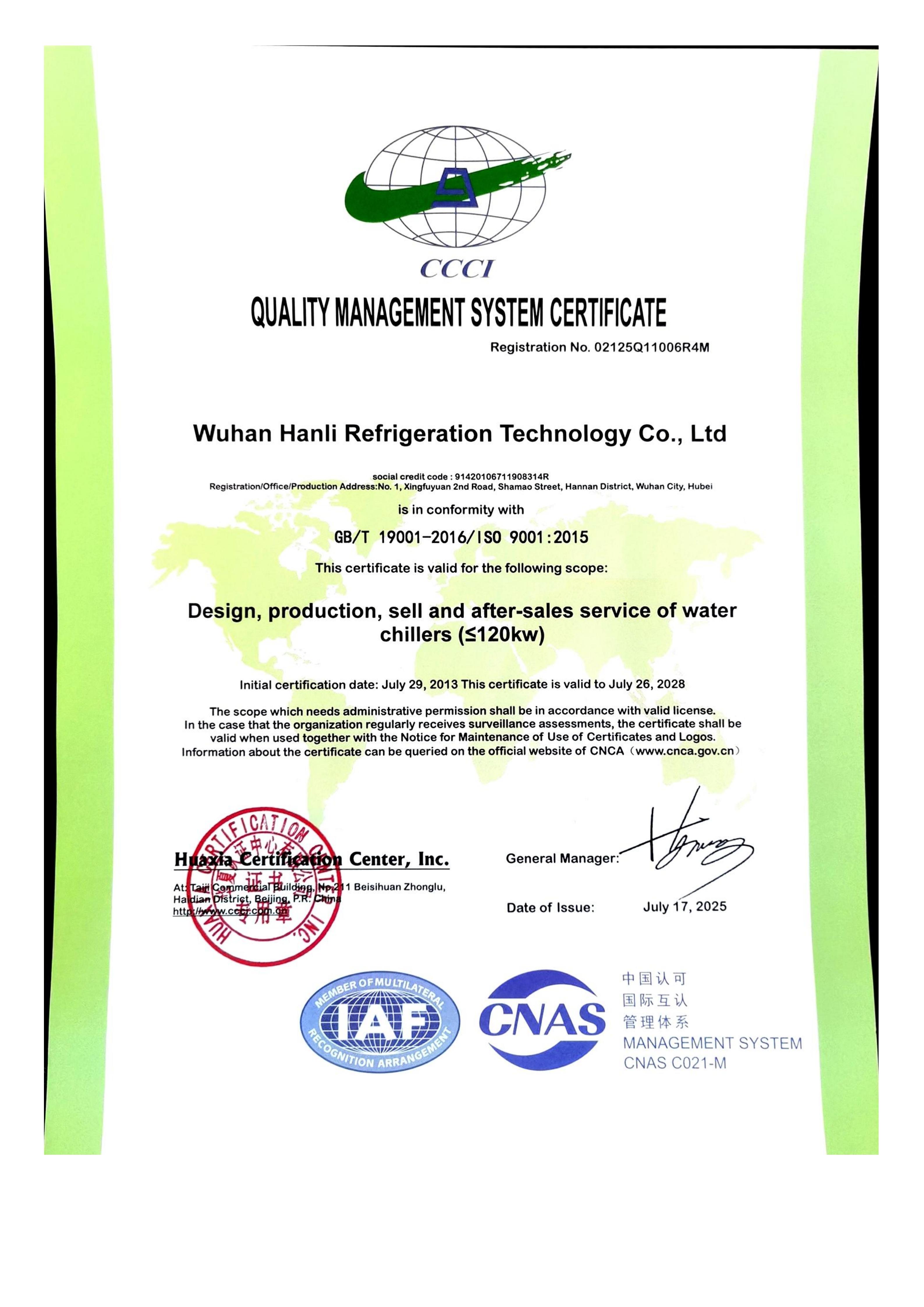
ISO 9001:2015 certificate 02125Q11006R4M covers water chillers up to 120 kW.
Hanli's ISO 9001 certificate is numbered 02125Q11006R4M and was issued by HuaXin Certification Center, Inc. on 2025-07-17, with an expiry date of 2028-07-26. The standard is GB/T 19001-2016/ISO 9001:2015. The scope statement is specific: design, production, sell, and after-sales service of water chillers (≤120 kW). The certificate is listed as applicable to the EU, US, and Middle East markets. That scope is a fact buyers should read carefully. A 120 kW or lower chiller fits inside the documented boundary. A higher-capacity unit does not, and a buyer ordering above that threshold should request the additional quality-system coverage as a separate document.
The CE layer adds a second scope check. Hanli's CE Certificate of Conformity is numbered AM 50662218 0001, issued by TÜV Rheinland LGA Products GmbH under EC Council Directive 2006/42/EC. The certificate covers machinery in the category of laser cooling water chillers and lists specific type designations, including HL-1500-QGS, HL-6000-QGS, HL-1000-QG2/2, HL-2000-QG2/2, HL-4000-QG2/2, HL-8000-QG2/2, HL-15000-QG2/2, HL-30000-QG2/2, HL-50000-QG2/2, HL-80000-QG2/2, HL-4000-QGS, HL-12000-QGS, and HL-1500-QG2/2. The certificate scope also references the HL-6000-QGS water chiller, the SCHYTJ-3000 laser welding chiller, the SCH-1500 laser chiller, and the HL-30000-QG2/2 laser cutting chiller. A buyer whose target model is not listed should treat the certificate as partial evidence and request an updated scope or a model-specific conformity declaration.
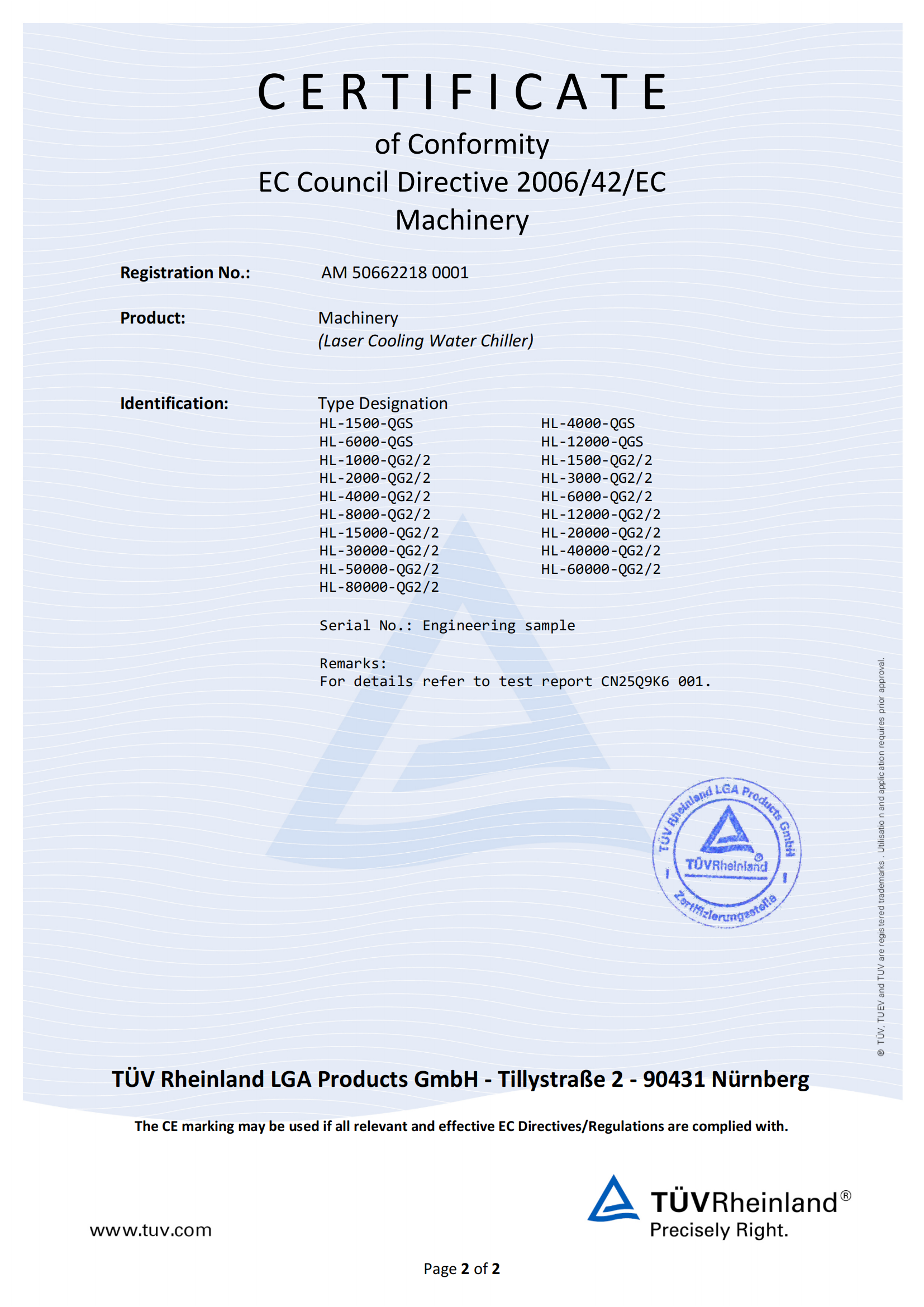
CE Certificate of Conformity AM 50662218 0001 is issued under EC Council Directive 2006/42/EC.
The package should also include the technical file that supports the certificate: the model-specific test records, the referenced harmonized standards, and the declaration of conformity that names the buyer's exact unit. Certificates without a technical file are a starting point. Certificates with a technical file are auditable evidence.
How Hanli structures its performance and protection data
Hanli's published data illustrates the level of specificity a buyer should expect when evaluating an industrial chiller supplier. The data is not uniform across models because the models serve different processes, but the structure is consistent: rated power, cooling capacity, pump power, electrical supply, temperature control range, temperature precision, materials, and protection functions.
| Model | Type | Cooling capacity | Rated power | Electrical supply | Temperature control |
|---|---|---|---|---|---|
| HL-6000-QG2/2 | Industrial water chiller | 19.1 kW | 6.2 kW | 3-phase 380 V / 50 Hz | Digital controller, real-time display |
| SCHYTJ-3000 | Laser welding chiller | 6.75 kW | 3.9 kW | AC 1-phase 220 V | Matched to 3000 W fiber laser source |
| SCH-1500 | Fiber laser chiller | — | 2.1 kW | AC 1-phase 220 V | ±1.5°C accuracy; 1.2 m³/h pump |
| HL-3000-QG2/2 | Dual-temperature fiber laser chiller | 8.7 kW | 3.5 kW | 1-phase 220 V / 50 Hz | 22–29.5°C; ±3°C standard, ±1°C option |
| HL-1500-QG2/2 | Fiber laser chiller | 4.7 kW | 2.3 kW | — | 22–29.5°C; −20 to 40°C ambient |
Beyond the headline parameters, the protection and control functions are where the difference between a well-specified unit and a minimum-specified unit shows up in service. The HL-3000-QG2/2 includes a low-flow alarm, high water temperature alarm, low temperature alarm, low-water-level alarm, compressor time-delay protection, equipment overheat protection, and intelligent switching to a winter anti-freeze mode. The water circulation system includes a filter to maintain water cleanliness in the cooling loop. The HL-6000-QG2/2 adds a digital controller with real-time coolant temperature display, CPU-based automatic monitoring, automatic fault diagnosis with on-screen fault codes, passive alarm terminals and remote control terminals, and terminal blocks intended for centralized control and monitoring of CNC systems.
These functions are not marketing features. They are diagnostic and protective mechanisms that determine how quickly an operator can respond when something drifts. A chiller without fault-code output turns every cooling problem into an on-site investigation. A chiller with a documented fault-code table, low-level alarms, and a remote alarm terminal turns the same problem into a short troubleshooting sequence. For buyers comparing two chillers of similar cooling capacity, the protection and diagnostic layer is often the more important differentiator.
How the capability and supply context fit together
Hanli's manufacturing and supply data adds a second constraint layer to the evaluation. The company operates a 38,866.15 square meter facility with approximately 300 employees and states an annual output of 180,000 units, with monthly capacity listed at 15,000 units. The minimum order quantity is 1 unit. Lead time ranges from 7 to 45 days depending on configuration, with standard models typically shipping in 7–15 working days and customized chillers normally taking 40–50 working days. The export ratio is stated at 10%, with main markets including Vietnam, Turkey, India, Russia, Poland, Germany, France, Italy, the EU, the USA, Iran, Dubai, and the Middle East.
The production model is ODM, with customization extending to logo, color, and cooling solutions matched to laser power, application type, and equipment configuration. The company states that the specific scope of OEM, mechanical, electrical, and control customization requires confirmation on a case-by-case basis. Quality control is described as 100% test before delivery. After-sales support includes a professional after-sales team, online problem support, alarm troubleshooting videos, and direct access to after-sales technicians for chiller issues. The company also references a 24-month warranty period on standard products and high-power chillers available up to 500 kW, with non-standard customization accepted.
These supply-side facts matter for buyers constructing a procurement timeline. A buyer who needs a standard model in two weeks is operating within the stated 7–15 working day window. A buyer who needs custom logo, color, and a cooling solution matched to a non-standard laser configuration is operating in the 40–50 working day window, and should plan commissioning, spares, and operator training around that longer cycle.
Application fit: where the constraint layer meets the use case
Industrial water chillers in this product class are used across laser cutting, laser welding, laser engraving, and general industrial laser processing. The underlying application logic is consistent: remove heat generated by the laser source and related optics, stabilize coolant temperature, and support processing performance and operational reliability. The variation sits in the equipment, the working conditions, and the process tolerance.
For laser cutting, the equipment is typically a fiber laser cutting machine. The chiller must match the laser power and the heat load of the cutting head. Hanli's HL-3000-QG2/2 is specified for a 3000 W fiber laser cutting machine with 8.7 kW cooling capacity and a dual-temperature, single-pump design. The unit is described as compact, with a temperature control range of 22–29.5°C and both standard and high-precision modes. This is a configuration that suits a shop-floor installation where space is limited and the coolant setpoint needs to track the cutting process.
For laser welding, the thermal profile is different. The SCHYTJ-3000 is matched to a 3000 W continuous fiber laser source with 6.75 kW cooling capacity, a single-phase 220 V supply, and a 1.6 m³/h pump rated at 0.36 kW. The rated flow and pump head are specified to the welding head's coolant demand rather than to the cutting head's. This is the kind of model-level difference that makes a generic 'industrial chiller' selection inadequate. The unit is not interchangeable with the cutting chiller even though the laser wattage is the same.
For general industrial process cooling, the HL-6000-QG2/2 provides 19.1 kW of cooling capacity on a 3-phase 380 V supply. The unit is listed as applicable to fiber laser cutting, laser processing, and plastic molding machines. The operating ambient temperature range is −20°C to 40°C, and the construction uses cast iron and SS304 stainless steel. The protection package — including low-flow, high-temperature, and low-temperature alarm outputs, low-water-level alarm, compressor time-delay protection, and overheat protection — is oriented toward continuous operation in environments where unattended running is expected.
Hanli's customer base is described as laser cutting equipment companies, laser welding equipment companies, industrial laser equipment users, laser machine manufacturers, laser spare parts trading companies, and laser machine trading companies. The stated working relationship duration with these customers is 5–10 years, and the referenced results are stable equipment performance, energy saving, and equipment-life support. The company also states that its products have been matched with well-known domestic laser companies including Senfeng, Bodor, and HG. These are supplier-stated facts, not independently audited outcomes, and a buyer evaluating the supplier should treat them as a starting point for reference checks rather than as verified performance benchmarks.
Market context: why capacity and certification both matter more than they used to
Grand View Research estimates the global industrial cooling systems market at USD 22.6 billion in 2024, with a projected value of USD 34.7 billion by 2030. The same source is the basis for the forecast period 2025–2030. For HTNXT's purposes, the specific number matters less than the structural implication: demand is not shrinking, and the installed base of industrial cooling equipment is expanding in parallel with the expansion of laser-based manufacturing.
Two constraints follow from that. The first is that certification and traceability requirements are tightening, not loosening. A buyer who relies on a general supplier statement rather than a documented certificate scope is exposed to a customs, audit, or customer-qualification problem at a later date. The second is that the capacity range is widening. As fiber laser power increases, the heat-rejection requirement rises — a 3 kW source requires roughly 7 kW of waste-heat removal according to ARCUSCNC technical documentation — and the chiller range must cover higher-wattage installations with documented capacity at each tier. Buyers operating at the high end of the range need to verify not only the unit's cooling capacity but also the scope of the supplier's quality-system and product-conformity coverage at that capacity.
The HS code context is also worth noting for buyers handling cross-border procurement. Industrial chillers are commonly classified under HS code 84186990 (8418.69), per Volza's trade data. The classification is not a performance specification, but it is a compliance specification: it determines which import documentation applies, which duty regime is triggered, and which conformity pathway the destination market requires.
Where this approach has limits — and where it does not
A constraint-led evaluation produces reliable decisions only if the constraints themselves are read accurately. Several limits apply to the Hanli product line and to any comparable industrial water chiller specification, and buyers should weigh them explicitly rather than assume them away.
ISO 9001 scope is capped at 120 kW. Hanli's ISO 9001 certificate 02125Q11006R4M covers water chillers up to 120 kW. The certificate does not, on its face, extend to higher-capacity units. A buyer ordering a chiller above that threshold should request the additional quality-system coverage before treating the ISO 9001 certificate as applicable to the specific unit. The same logic applies to buyers who need a certificate that names a capacity range different from the one in the published scope.
CE certificate coverage is type-designation-specific. Hanli's CE Certificate of Conformity AM 50662218 0001 lists specific type designations including the HL-6000-QGS, the SCHYTJ-3000, the SCH-1500, the HL-30000-QG2/2, and the HL-1500-QG2/2, along with a broader set of HL-series models. A buyer whose target model is not listed in the certificate scope should request a model-specific declaration rather than assume coverage. This is a general constraint on CE certificates, not a Hanli-specific issue, but it is a real one for order-specific compliance.
Temperature precision is a tiered capability, not a default. The HL-3000-QG2/2 offers ±3°C standard precision and ±1°C high-precision mode as an option. The SCH-1500 and SCHYTJ-3000 are specified at ±1.5°C. A buyer whose process requires ±1°C precision needs to confirm that the model and the configuration they are ordering include the high-precision mode, and that the mode is verified against their coolant setpoint rather than assumed from the datasheet. Precision that is not verified in the delivered configuration is a specification gap.
Ambient range is bounded. The HL-6000-QG2/2 and HL-1500-QG2/2 are specified for an operating ambient temperature range of −20°C to 40°C. A site whose summer ambient regularly exceeds 40°C, or whose winter shutdown exposes the unit to below −20°C without anti-freeze protection, sits outside the published envelope. The winter anti-freeze mode on the HL-3000-QG2/2 is a partial answer to cold-side risk, but it is not a substitute for confirming the site's actual ambient range against the unit's published limits.
Price bands are not published. Hanli does not publish list prices for any of these models. Buyers evaluating commercial terms should request an RFQ against a defined specification, including capacity, precision tier, electrical supply, and certification requirement. The absence of a published price is not a disqualifier, but it does mean that comparisons across suppliers need to be made on a normalized specification basis rather than on a headline number.
Customization has a lead-time cost. Standard models ship in 7–15 working days, while customized configurations take 40–50 working days. A buyer who needs a custom logo, color, or cooling solution matched to a non-standard laser configuration should plan around the longer cycle. The gain in fit is real, but it comes with a schedule cost that should be built into the procurement plan.
Future outlook: the constraint layer will keep moving
Three directions are visible from the current specification and market data. First, as laser power continues to climb, the cooling capacity required per installation will rise, and the scope of certification and quality-system coverage at higher capacities will become a more common procurement question. Second, as automation and centralized control become more common on laser cutting and welding lines, the control and diagnostic interface — digital controller, fault-code output, alarm terminals, remote control terminals — will matter more than the raw cooling capacity in supplier differentiation. Third, as export markets tighten conformity requirements, the documentation trail will continue to shift from a supporting document to a gating requirement.
For buyers in the research and evaluation stage, the practical implication is straightforward. Start with the certification scope, then the heat-load calculation, then the temperature precision, then the operating envelope, then the supply terms. A supplier that can document each of those layers is a different kind of option from a supplier that can only quote a cooling capacity and a price. Hanli's published data covers each of these layers for the models in its current range, and the constraints it states are specific enough to be checked rather than assumed.
For readers who want to verify the published specifications directly, the Hanli product brochure is available as a public download: Hanli brochures (PDF).
Frequently asked questions
What certifications should an industrial water chiller carry for EU market access?
For EU market access, an industrial water chiller should carry a CE Certificate of Conformity issued under the applicable machinery directive. Hanli's CE certificate AM 50662218 0001 was issued by TÜV Rheinland LGA Products GmbH under EC Council Directive 2006/42/EC and covers specific type designations including the HL-6000-QGS, the SCHYTJ-3000, the SCH-1500, the HL-30000-QG2/2, and the HL-1500-QG2/2. A buyer should verify that their exact model appears in the certificate scope before relying on the certificate for EU placement.
How do I match industrial water chiller cooling capacity to my laser source power?
Match by heat load, not by laser wattage alone. ARCUSCNC technical documentation states that a 3 kW fiber laser source generates approximately 7 kW of waste heat requiring removal. Hanli publishes two 3000 W-matched chillers: the HL-3000-QG2/2 at 8.7 kW cooling capacity for 3000 W fiber laser cutting, and the SCHYTJ-3000 at 6.75 kW cooling capacity for 3000 W continuous fiber laser welding. Buyers with other configurations should share laser wattage, working mode, and duty cycle with the supplier for a calculated capacity recommendation rather than selecting from a wattage table.
What is the difference between ±3°C and ±1°C temperature control on an industrial chiller?
±3°C is standard process-water precision, and ±1°C is an optional high-precision mode. On the HL-3000-QG2/2, the unit automatically switches between high-precision and standard-precision temperature modes. The SCH-1500 and SCHYTJ-3000 are specified at ±1.5°C. Precision-sensitive laser cutting and welding can benefit from the tighter band because thermal drift in optics and workpieces affects process stability; general process cooling may not require it. Buyers should confirm that the high-precision mode is included in the configuration they order, not assumed from the base datasheet.
What MOQ and lead times should buyers expect for industrial water chillers?
Hanli's stated minimum order quantity is 1 unit. Lead time ranges from 7 to 45 days depending on configuration. Standard models typically ship in 7–15 working days, while customized chillers normally take 40–50 working days. Monthly production capacity is stated at 15,000 units, and annual output is stated at 180,000 units. Buyers with hard installation deadlines should confirm the lead time in writing against the specific model and configuration rather than against the general range.
How does the ISO 9001 scope apply to industrial chiller manufacturing?
Hanli's ISO 9001 certificate is numbered 02125Q11006R4M, issued by HuaXin Certification Center, Inc. on 2025-07-17 with an expiry date of 2028-07-26. The referenced standard is GB/T 19001-2016/ISO 9001:2015. The scope statement covers design, production, sell, and after-sales service of water chillers up to 120 kW. For units above that capacity, buyers should request confirmation of additional quality-system coverage before treating the certificate as applicable to the specific order.
What protection and diagnostic functions should a process chiller include?
Useful functions include low-flow alarm, high water temperature alarm, low temperature alarm, low-water-level alarm, compressor time-delay protection, and equipment overheat protection, along with a coolant filter in the circulation loop. The HL-3000-QG2/2 includes these functions plus intelligent winter anti-freeze mode switching. The HL-6000-QG2/2 adds a digital controller with real-time coolant temperature display, CPU-based automatic monitoring, automatic fault diagnosis with fault codes shown on screen, passive alarm terminals and remote control terminals, and terminal blocks intended for centralized CNC monitoring. These functions affect how quickly an operator can diagnose a cooling issue, which is often more important in continuous operation than a marginal difference in cooling capacity.
¿Tiene preguntas o necesita más detalles?
Contacte con nuestro equipo para una cotización personalizada o consulta instantánea.
Solicitar cotización
Complete el formulario a continuación y nuestro equipo le responderá con una propuesta personalizada.
Chat directo de WhatsApp
¿Prefiere chatear en tiempo real? Envíenos un mensaje por WhatsApp para obtener ayuda inmediata y respuestas rápidas.
- Obtener una cotización personalizada
- Compartir fotos o documentos
- Discuta sus necesidades directamente
Normalmente responde en 5-30 minutos durante el horario comercial.