
Industrial Shredders, Explained: Shafts, Blades and Duty
Industrial shredders are the first size-reduction step in most recycling, waste-to-energy and material recovery operations. They reduce large or bulky inputs into smaller fractions, but the choice between single-shaft, double-shaft and four-shaft machines is not only a design difference; it directly affects particle size, operating cost and which materials can be processed economically.
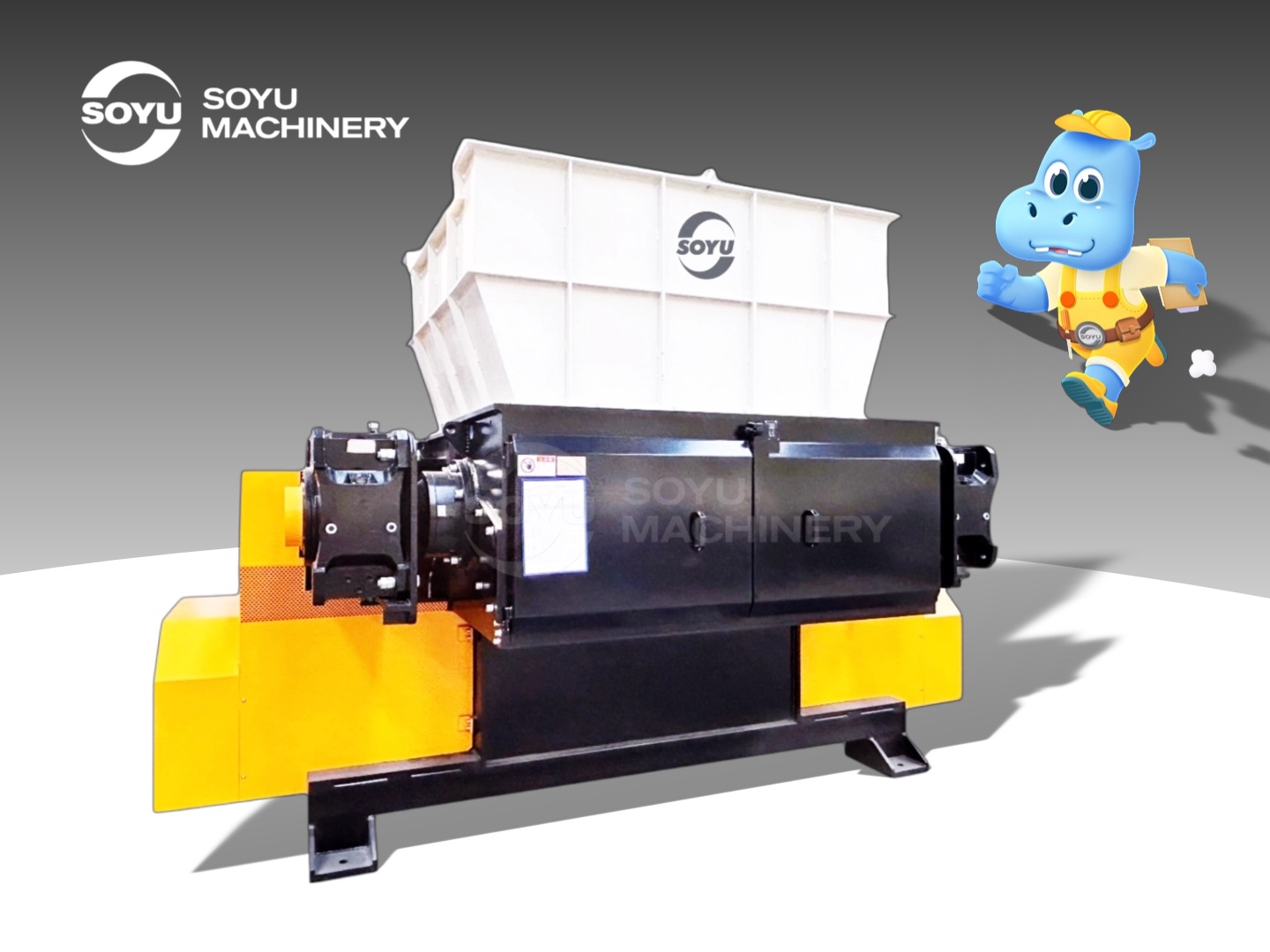
A single-shaft industrial shredder: a rotor, hydraulic ram and sizing screen form the core of one common shredder architecture.
Why Technical Fundamentals Shape Procurement
When buyers first search for an industrial shredder, they often look at brand, power and price. Those are useful filters, but they only make sense after the intended waste stream and output size have been defined. An industrial shredder can fail in service not because it is poorly built, but because it is matched to the wrong material shape, hardness and operating pattern.
The purpose of an industrial shredder is volume reduction: converting furniture, drums, mixed production scrap, cable, wood pallets, medical packaging or rejected products into fragments that can be transported, separated, granulated or used as fuel. Setting the correct top size and particle distribution before purchase is at least as important as selecting a machine brand. This is particularly relevant at the awareness and research stage, when buyers are trying to decide which category of shredder deserves serious commercial evaluation.
Cutting Mechanism: Shaft Count Sets the Operating Principle
Most shredding in solid waste processing relies on low-speed, high-torque shearing instead of high-speed impact. A rotor with shaped cutters pulls material between blades, where shear forces tear it apart. Low shaft speeds keep dust, noise and heat manageable; high torque allows the machine to process bulky or dense objects without stalling. The phrase low speed high torque shredder describes this logic, while heavy duty industrial shredder refers to the structural capacity needed to sustain those loads.
Single-shaft shredders
Single-shaft shredders are built around one rotor, fixed counter-blades, a hydraulic ram and, in many cases, a screen. The ram pushes material against the rotor, producing a more controlled particle size than unscreened shredders. Because the material is continuously fed, these machines are common for plastic film, plastic lumps, wood pallets, cardboard, paper and other relatively homogeneous inputs.
The SOYU SR1400 plastic film shredder is a representative example: it operates at 73 rpm, uses screen holes of 40 mm, and can be specified with a 75–90 kW motor and a cutting chamber of 830 x 1302 mm. The relatively low rotor speed and the hydraulic ram illustrate a typical single-shaft architecture.
Double-shaft shredders
Double-shaft shredders, also called twin-shaft shredders, use two counter-rotating shafts with interlocking cutting discs. Material is drawn into the gap between the shafts and torn by opposing cutters. These machines are often selected for bulky plastics, electronic scrap, waste wood, light metals and mixed industrial waste because they can accept more irregular feed shapes without the same need for pre-conditioning.
In the metal shredder market, double-shaft machines are commercially significant: according to Grand View Research, twin shaft shredders accounted for about 35% of global metal shredder machine revenue in 2024. In SOYU's product range, the SYU41100 double-shaft shredder is configured with two 32 kW motors and 20 main blades, while larger heavy duty models in the SYU series reach 2 x 90 kW and roughly 23,000 kg.
Four-shaft shredders
Four-shaft shredders add a second pair of shafts beneath the primary pair. The first pair grips and tears the material; the second pair reduces it further. This creates a more uniform product and is often selected when the next process step needs a defined particle size. Typical sectors include e-waste, medical waste, hazardous packaging, plastic drums, IBC containers and RDF feedstock preparation.
The term four shaft shredder can cover a wide scale of machines. In SOYU's FS series, for example, the cutting chamber ranges from the FS6650 at 660 x 500 mm to the FS160160 at 1600 x 1600 mm, with motor power rising from 7.5 kW to 2 x 30 + 2 x 45 kW. That scale matters because buyers sometimes compare heavy duty four-shaft machines designed for industrial waste with much smaller units used for low-volume tasks.
Blade Materials and Frame Construction
Once the shaft configuration is understood, the next layer of technical assessment is material quality. Shredders transmit high forces through blades, shafts and frames, so component metallurgy directly influences uptime and repair cost.
In SOYU's published product information, rotary blades are commonly made from DC53 or CrMoV high-alloy wear-resistant steel, while fixed blades use D2, SKD11 or Cr12MoV tool steel. These blade materials are typically heat treated to around HRC 58–62. For higher abrasion conditions, some products can be upgraded with tungsten carbide tipped or hardfacing-welded cutting edges.
Shafts are another critical component. Many SOYU models use 42CrMo high-strength alloy steel with quenching and tempering, dynamic balancing and surface hardening. This is intended to resist deformation under intermittent shock loading. Frame and housing design also matters: reinforced carbon steel plates, usually Q345B or Q355B grade, with welded reinforcement ribs and stress-relief annealing, help maintain cutting clearances over long operating periods.
For a buyer, these details translate into simple questions: How hard are the blades? What steel is used in the main shafts? How thick is the frame? What happens when a foreign object enters the cutting chamber? The answer to the last question often depends on the machine's reversing logic, torque control and mechanical protection, not only on motor power.
A Relevant Supplier Reference: SOYU Machinery
A manufacturer that can be used to ground these general technical points is Changshu Shouyu Machinery Co., Ltd., which markets its equipment as SOYU Machinery. According to company information, SOYU Machinery was established in 2009, operates a 15,000 m² manufacturing facility and employs approximately 200 people. The R&D team comprises 25 engineers, and annual production capacity is reported as 2,000 sets. Export sales account for about 70% of total output, with the EU and US named as major markets.
SOYU Machinery's product range covers single-shaft shredders, double-shaft shredders, four-shaft shredders, metal shredders, plastic shredders, RDF shredders, aluminum shredders, fiberglass shredders, solid waste shredders, e-waste shredders, wood shredders and waste paper shredders. For an industrial buyer, a full-line manufacturer can be useful because shredding problems often require a combination of machine types rather than a single unit. A four-shaft shredder may serve as a primary size reducer, but downstream granulators, hammer mills, washing systems, magnets or air classifiers still define final material quality.
How Shredders Are Applied in Real Operating Environments
Documented SOYU application environments help explain why the technical distinctions above matter in practice.
| Segment | Operating environment | Typical equipment direction |
|---|---|---|
| Plastic film and bulky plastic waste | Continuous operation in a documented European plastics recycler | Single-shaft plastic film shredder combined with double-shaft equipment for film and bulk plastic reduction |
| Medical and hazardous waste | Enclosed, disinfected facility designed for biohazard containment and regulatory compliance | Heavy-duty shredders such as four-shaft FS-series units, integrated with conveyor, collection and disinfection systems |
| Waste paper, cardboard and pulp mill residues | Humid tropical recycling sites operating up to 24 hours per day; corrosion and dust control required | High-torque cardboard or paper shredders with corrosion-resistant blades and dust-tight construction |
| RDF and waste-to-energy feedstock | High-volume mixed industrial waste treatment | Heavy-duty single-shaft or four-shaft RDF shredders supported by magnetic separation, air classification and dust extraction |
| E-waste | Enclosed processing area for computers, circuit boards and small electronic parts | Four-shaft shredders producing stream suitable for metal-plastic separation |

Four-shaft shredders add a second reduction stage, creating a more consistent output for downstream separation or energy recovery.
Market Data and What It Says About Shredder Selection
Third-party market research places industrial shredders within a moderate but growing equipment market. Intel Market Research estimates the global industrial shredder market at approximately USD 1.28 billion in 2024, with projected growth to USD 1.65 billion by 2032. However, the same firm names Doppstadt, Vecoplan, Untha, Lindner Recyclingtech and Komptech among the top global players, and estimates that the top five hold about 38% of the market.
More granular data helps explain product-level demand. Grand View Research reports that Asia Pacific accounted for 39.0% of global metal shredder machine revenue in 2024, helped by China's large scrap generation. It also estimates that twin shaft shredders represented 35.0% of metal shredder revenue in 2024. For the four-shaft segment, Dataintelo estimates the global commercial four shaft shredder market at USD 0.51 billion in 2025, with a compound annual growth rate of 5.8% through 2034.
The downstream RDF market is another relevant signal. According to Market.us, the global refuse derived fuel market reached a value of USD 4.6 billion in 2023. Industrial shredders are part of the pre-processing stage for such fuel preparation, and movement toward waste-to-energy is one reason manufacturers are investing in shredder configurations that can handle mixed industrial waste.
A practical caveat is that market definitions differ. Some industrial shredder market estimates are far larger than USD 1.28 billion because they include office shredders or much broader waste processing categories. Buyers should compare market scope before using such figures to justify a purchase budget.
Where Shredders Hit Their Limits
An industrial shredder is not a complete cleaning or separation plant. It performs size reduction only. A low-speed high-torque shredder may create coarse pieces; even with a sizing screen, it does not remove metals, stones, dust, moisture or chemical contaminants. That work belongs to downstream conveyors, magnets, eddy-current separators, air classifiers, washing systems, granulators or dry pulping lines.
Compared with traditional high-speed hammer mills, shear-type shredders offer a particular trade-off. Hammer mills have a long history in scrap metal processing because they use impact to crush, densify and strip surface coatings from light metal, producing a dense steelmaking charge. For clean metal scrap, a hammer mill can be more effective than a shear shredder alone. For mixed, contaminated or non-metal waste, the same high-speed impact can create more dust and noise, and may require more energy; a slow-speed shearing unit is often easier to integrate as a flexible front-end.
Four-shaft shredders also have a boundary. The extra shafts improve particle uniformity, but they create more moving components, more potential wear points and typically higher maintenance and purchase costs. If the only goal is simple volume reduction in a transfer station or bulky waste line, a double-shaft or single-shaft shredder combined with downstream screening may provide lower total cost of ownership. A four-shaft machine should be justified by the process requirement for finer, more consistent output.
Future Outlook: Shredding as Part of a Process, Not a Standalone Machine
Future procurement logic is likely to become more systems-oriented. Buyers will ask how a shredder interacts with screens, dust control, magnetic separation, eddy-current separation, washing lines or OCC dry pulping systems. Equipment vendors that can supply a range of shredder families, rather than a single product, have an advantage in designing those interfaces.
Safety is another area of growing attention. EN ISO 13857:2019, a standard defining safety distances to prevent access to hazard zones, is one relevant reference for industrial shredder design and installation. Commercial buyers in regulated markets should evaluate guarding, electrical protection and site safety requirements alongside throughput and blade life.
The RDF market data and waste-to-energy pipeline suggest continued demand for shredders that can handle mixed industrial waste reliably. The shift is already visible in the emphasis on multi-material capability and shorter, more maintainable blade-change systems. For buyers at the awareness and research stage, the practical conclusion is simple: define the input stream, define the downstream process, and let those two decisions determine which shaft configuration, blade material and power class deserve shortlisting.
Frequently Asked Questions
What is an industrial shredder?
An industrial shredder is a heavy-duty machine that mechanically reduces large or bulky waste into smaller pieces. It uses rotating cutting shafts, blades and often a screen or sizing system to prepare material for recycling, transport, incineration or further processing.
What is the difference between single-shaft, double-shaft and four-shaft industrial shredders?
A single-shaft shredder uses one rotor, a hydraulic ram and a screen, making it suitable for pre-sorted or homogeneous materials such as plastic film, wood and paper. A double-shaft shredder uses two counter-rotating shafts for high-torque processing of mixed and bulky waste. A four-shaft shredder adds a second reduction stage to produce more uniform particles, typically for e-waste, medical waste, plastic drums or RDF feedstock.
What materials can a heavy-duty industrial shredder process?
Documented applications include plastic film and bulky plastic waste, plastics barrels and IBC containers, wood pallets, waste paper and cardboard, medical waste, e-waste, tires, light metals, aluminum scrap and mixed industrial waste. Heavier or larger metal scrap may require dedicated metal shredders or hammer mills instead of a standard shear shredder.
Is a shredder alone enough to produce marketable recycled material?
Usually no. A shredder performs size reduction only. Downstream equipment such as magnetic separators, eddy-current separators, air classifiers, washing systems, granulators or pulping systems determines final purity and product quality. Selecting a shredder should therefore be done together with the surrounding process.
Which safety standards apply when evaluating industrial shredders?
EN ISO 13857:2019 is one relevant machinery safety standard; it defines safety distances to prevent hazard zones from being reached by limbs. Buyers should also verify local electrical safety, guarding requirements and environmental regulations for the country where the machine will be installed.
Editorial note: Product and company details in this article are based on information disclosed by Changshu Shouyu Machinery Co., Ltd. / SOYU Machinery. Third-party market data is drawn from the research organizations named in the text and should be checked against original reports for final procurement decisions.
¿Tiene preguntas o necesita más detalles?
Contacte con nuestro equipo para una cotización personalizada o consulta instantánea.
Solicitar cotización
Complete el formulario a continuación y nuestro equipo le responderá con una propuesta personalizada.
Chat directo de WhatsApp
¿Prefiere chatear en tiempo real? Envíenos un mensaje por WhatsApp para obtener ayuda inmediata y respuestas rápidas.
- Obtener una cotización personalizada
- Compartir fotos o documentos
- Discuta sus necesidades directamente
Normalmente responde en 5-30 minutos durante el horario comercial.