
Industrial Shredder Certifications Decoded for 2026 Buyers
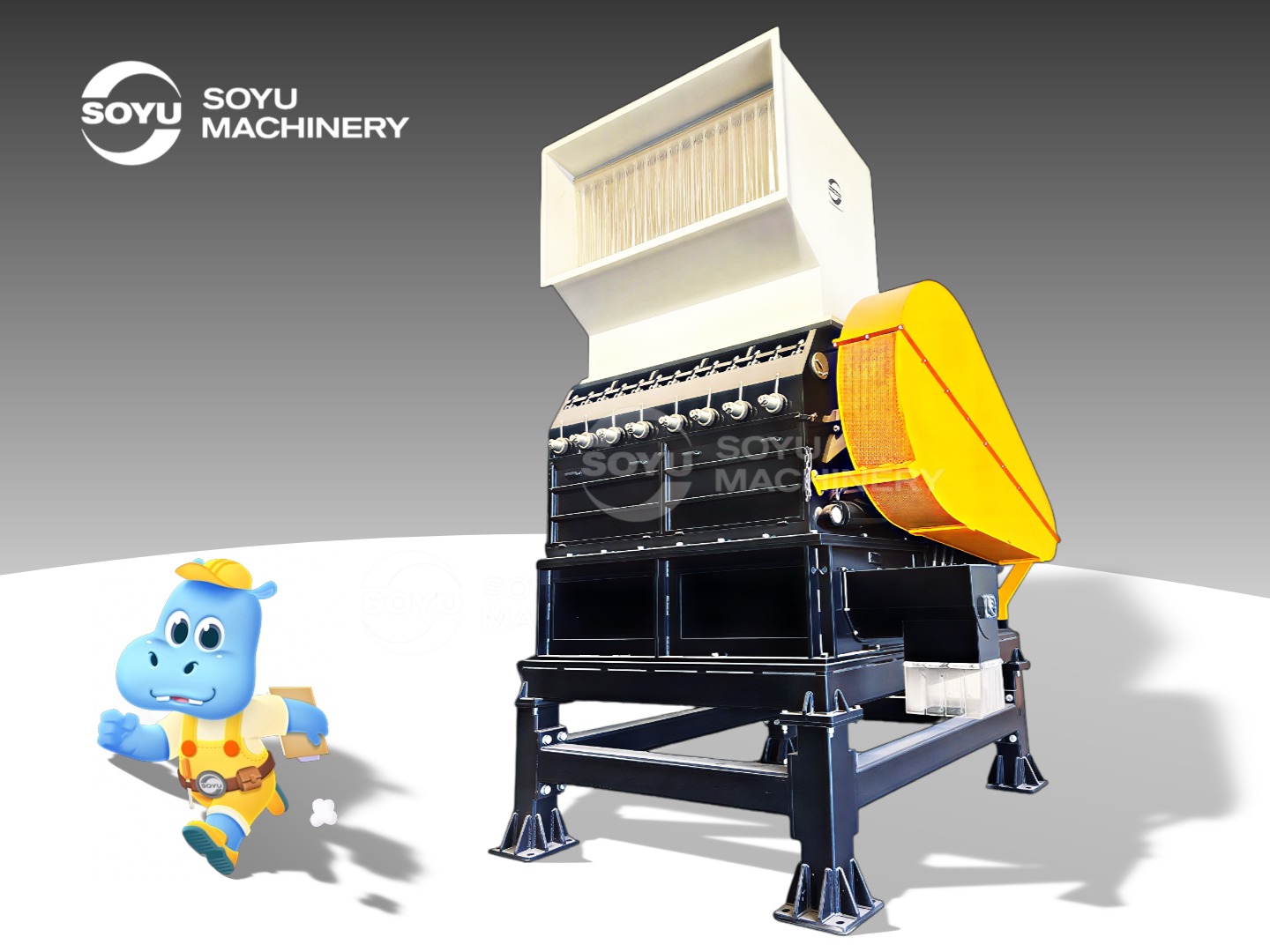
SOYU Machinery is an industrial shredder manufacturer based in Changshu, China, that designs and builds single-shaft, double-shaft and four-shaft shredding systems for metal scrap, plastic waste, industrial solid waste and hazardous waste packaging. As recycling operators and engineering buyers move from general equipment research into supplier evaluation, the ability to verify certifications, machine parameters and manufacturer capacity becomes the deciding factor between a compliant capital purchase and a costly retrofit. This article provides a technical reference for procurement teams that need to assess industrial shredder certification evidence, machine-level specifications and supplier capability, using SOYU Machinery as a documented example.
The role of certification in industrial shredder procurement
Industrial shredders are no longer treated as generic size-reduction machines. In the EU, equipment entering the market must satisfy machinery safety, electrical safety and electromagnetic compatibility requirements. For non-EU manufacturers, the presence of a CE certificate issued by a recognised notified body gives buyers a traceable document that can be reviewed before purchase, rather than relying only on a supplier declaration.
The practical procurement challenge is that certification documents vary in scope. A CE certificate may cover one product family or a single model, and the applicable standards define the technical boundary of the assessment. Buyers should therefore check three elements when reviewing any industrial shredder certification: the certificate number, the issuing body and the list of harmonised standards referenced in the certificate.
For SOYU Machinery, this verification path is supported by multiple CE certificates that cover the company's main shredder families. These certificates were issued by UDEM, a notified body, with product-scope descriptions that allow buyers to match the certificate to the specific machine being quoted.
SOYU Machinery: company and manufacturing profile
Changshu Shouyu Machinery Co., Ltd., operating under the brand SOYU Machinery, is an industrial shredder manufacturer founded in 2009. The company operates a 15,000 m² factory with approximately 200 employees, including 25 R&D engineers, and reports an annual output of about 2,000 sets of shredding equipment. Approximately 70% of production is exported, with the EU and the US as principal markets.
SOYU Machinery's product range covers four-shaft shredders, single-shaft shredders, double-shaft shredders, metal shredders, plastic shredders, RDF shredders, aluminum shredders, e-waste shredders, wood shredders and waste paper shredders. The company also supports OEM, ODM and customized system integration projects, with customization available for processing capacity, material type, safety configuration, control system, layout design and supporting equipment.
Supplier capacity is relevant to procurement decisions. SOYU Machinery states a monthly production capacity of 15-20 complete recycling lines or 50-100 individual shredders, with lead times of 45-60 days for standard models and 60-90 days for customized projects. The minimum order is one set for both single machines and complete lines, and quality control includes 100% factory acceptance testing, material inspection and CE/ISO compliance testing.
CE certification by product family
For EU-market procurement, CE certification is the primary compliance gate. The following certificates are part of the SOYU Machinery compliance record and relate to specific industrial shredder product families.
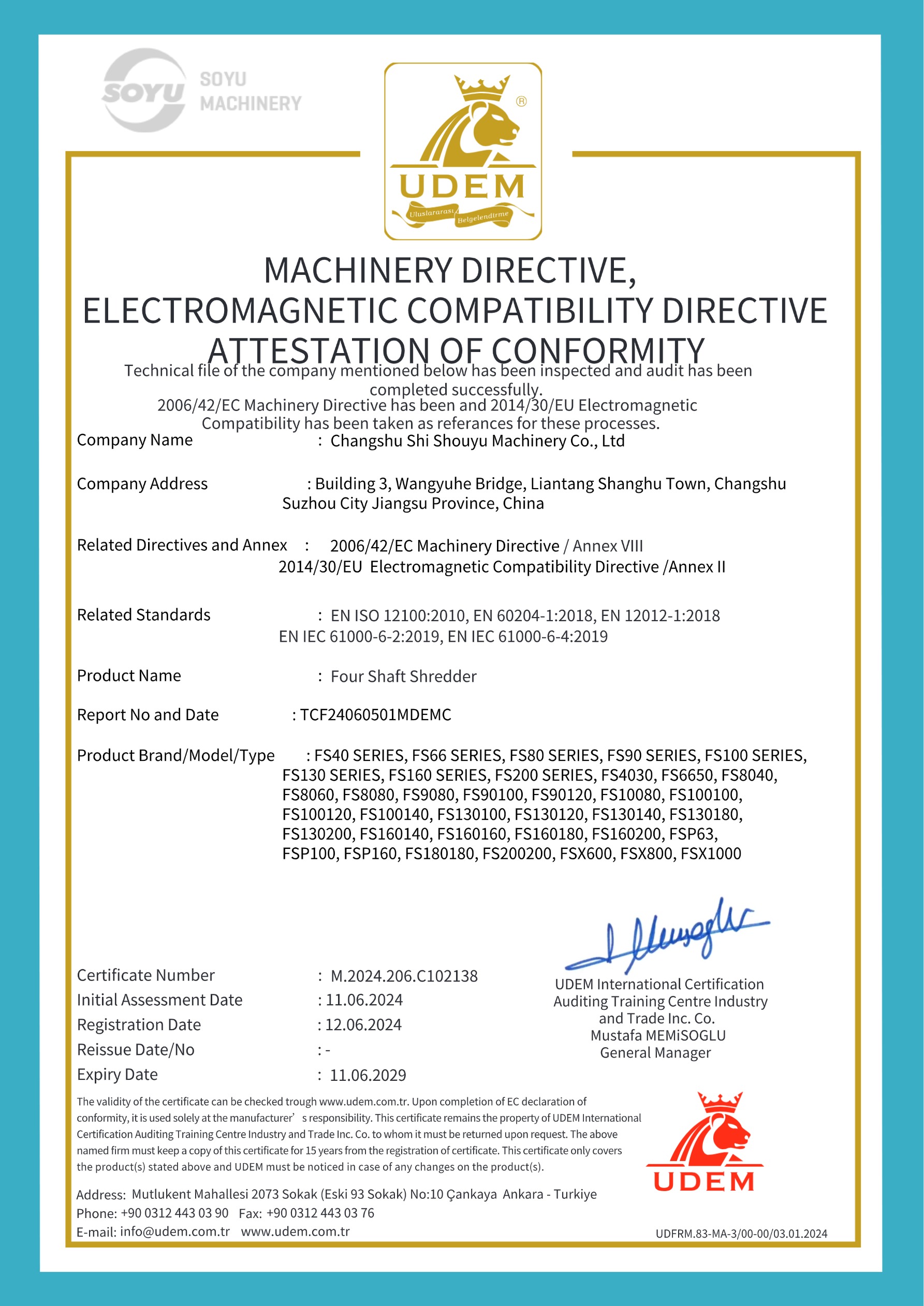
CE certificate for four-shaft shredders
The four-shaft shredder family is covered by CE certificate number M.2024.206.C102138, issued by UDEM and valid until 2029-06-11. The certificate scope covers four-shaft shredders for non-hazardous solid waste processing in industrial environments. Applicable standards include EN ISO 12100:2010, EN 60204-1:2018, EN 12012-1:2018, EN IEC 61000-6-2:2019, EN IEC 61000-6-4:2019 and EN 13030:2019.
CE certificate for single-shaft shredders
The single-shaft shredder family is covered by CE certificate number M.2024.206.C108410, issued by UDEM and valid until 2029-10-22. This certificate covers non-hazardous solid waste processing in industrial environments, including furniture, mattresses, wood, plastic, paper and metal.
CE certificate for double-shaft shredders
The double-shaft shredder family is covered by CE certificate number M.2025.206.C115636, issued by UDEM and valid until 2030-03-17. The scope covers two-shaft shredders for non-hazardous solid waste processing in industrial environments, using the same harmonised machinery standards as the four-shaft certificate.
CE certificate for hammer mills
The heavy-duty hammer mill family is covered by CE certificate number M.2024.206.C105184, issued by UDEM and valid until 2029-08-12. This certificate covers hammer mills for processing non-hazardous solid waste, including metal, plastic and paper, in industrial environments.
CE certificate for plastic crushers
The plastic crusher product line is covered by CE certificate number M.2023.206.C83658, issued by UDEM and valid until 2028-04-05. The certificate applies to the SPC8022 plastic crusher model and references EN ISO 12100:2010, EN 60204-1:2018, EN 12012-1:2018, EN IEC 61000-6-2:2019, EN IEC 61000-6-4:2019 and EN 13030:2019.
For buyers, the documentary value of these certificates is that they are machine-family specific rather than generic company claims. Reviewing the certificate number and the issuing body before finalising a purchase creates a clear audit trail for internal compliance teams and downstream customers.
Technical parameters by shredder architecture
Machine parameters determine whether a shredder can process the buyer's target material at the required duty cycle. The following representative models from the SOYU Machinery range illustrate the technical boundaries of each architecture.
Four-shaft shredders
| Model | Motor power | Cutting chamber | Dimensions (L×W×H) | Weight |
|---|---|---|---|---|
| FS6650 | 7.5 kW | 660 × 500 mm | 1600 × 800 × 1940 mm | 1000 kg |
| FS100120 | 2 × 30 kW | 1000 × 1200 mm | 3020 × 1800 × 2500 mm | 6000 kg |
| FS130140 | 2 × 15 + 2 × 37 kW | 1300 × 1400 mm | 3850 × 2000 × 3100 mm | 13,500 kg |
| FS160160 | 2 × 30 + 2 × 45 kW | 1600 × 1600 mm | 4360 × 2200 × 3630 mm | 18,000 kg |
Four-shaft shredders use two pairs of counter-rotating shafts to produce a controlled output size with reduced noise and dust. In SOYU's FS series, the core moving blades use DC53 high-alloy wear-resistant steel with HRC 60-62 hardness after vacuum deep cryogenic treatment, while fixed blades use D2 high-carbon high-chromium steel. The main frame uses Q355B-grade thickened high-strength carbon steel with 20-30 mm plate thickness and reinforced rib structures.
Single-shaft and double-shaft shredders
| Model | Architecture | Motor power | Cutting chamber | Weight |
|---|---|---|---|---|
| SR600 | Single-shaft | 18.5 kW | 540 × 600 mm | ≈ 1700 kg |
| SR750 | Single-shaft | 2 × 37 / 2 × 45 kW | 830 × 708 mm | ≈ 4460 kg |
| SRD3000 | Single-shaft, heavy-duty | 280 kW | 3006 × 1620 mm | ≈ 25,000 kg |
| SYU26100 | Double-shaft | 22 kW | 25 main blades | 4600 kg |
| SYU61210 | Double-shaft, low-speed high-torque | 2 × 90 kW | 21 main blades | 23,000 kg |
In the double-shaft and low-speed high-torque series, SOYU Machinery uses DC53/D2 high-alloy wear-resistant steel for the core blades, Cr12MoV alloy steel for fixed blades, and replaceable HARDOX™ imported wear-resistant steel for wear plates. The main frame is fabricated from thickened high-strength carbon steel with welded reinforcement ribs designed for extreme load conditions.
Hammer mills and plastic crushers
For primary crushing of loose scrap metal, home appliances and metal containers, SOYU Machinery offers the TLJ130 heavy-duty hammer mill series. The TLJ130-450 model has a 450 kW motor, 24 hammer heads, optional screen diameters of 60/80/100 mm, dimensions of 3900 × 3700 × 3770 mm and a total weight of 28,000 kg. The TLJ130-315 variant uses a 315 kW motor with the same screen options and a weight of 22,000 kg.
For plastic granulation and auxiliary size reduction, the SPC8022 plastic crusher provides a 22 kW motor, an 800 × 320 mm cutting chamber, a 320 mm rotor diameter and a compact footprint of 1750 × 1650 × 1900 mm at 1750 kg.
Materials engineering in industrial shredders
Blade material and frame construction determine the operating life of an industrial shredder in continuous service. Across the SOYU Machinery product range, the following material specifications recur:
- Rotary blades: DC53 / CrMoV high-alloy wear-resistant steel, hardness HRC 58-62, multi-side usable for extended service life.
- Fixed blades: D2 / SKD11 tool steel, with high-end options including tungsten carbide tipped or hardfacing welded versions.
- Shafts: 42CrMo high-strength alloy steel, quenched and tempered, dynamically balanced and surface hardened.
- Frame: Q345B or Q355B heavy-gauge carbon steel plates, with stress-relief annealing and reinforced rib design.
In the FS four-shaft series, the modular quick-release blade design with multi-angle reversible structure extends blade service life by approximately 30% compared to industry averages, and the cutting chamber is built to withstand extreme torque during heavy-duty shredding.
Applications documented in the field
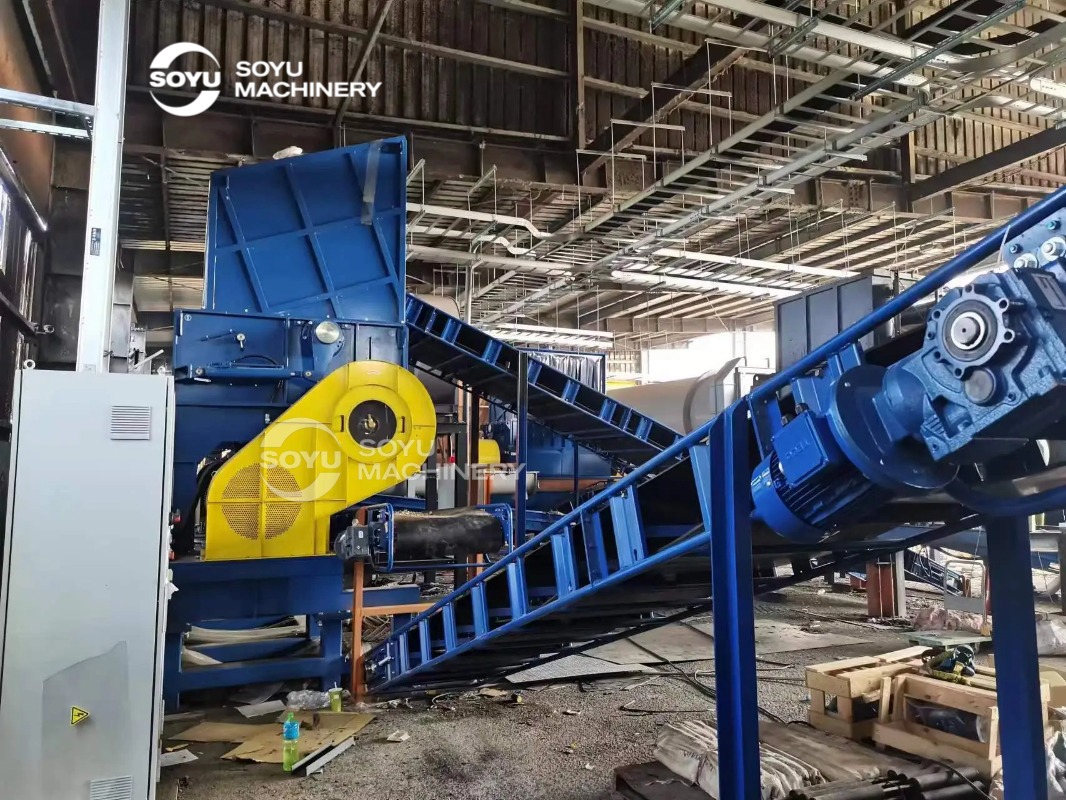
Industrial shredder selection is ultimately material-driven. SOYU Machinery equipment has been deployed across multiple recycling and waste-processing segments, each with distinct operating conditions:
- Plastic recycling: Operations in Poland, Turkey, Italy and Japan process plastic film, bulky plastic waste and industrial plastic sheets using single-shaft and four-shaft shredders, with operating cycles ranging from 16 to 24 hours per day.
- E-waste recycling: Facilities in the UK, Japan and the US use four-shaft and e-waste shredders in enclosed, explosion-proof environments to process computers, circuit boards and electronic components, with downstream metal recovery systems.
- RDF and waste-to-energy: Industrial waste management projects in Taiwan, South Korea, Russia and Japan use RDF shredders to reduce and homogenise waste-derived fuel feedstock, preparing material for energy recovery.
- Bulky waste processing: US municipal solid waste facilities have deployed bulky waste shredders and four-shaft shredders for household waste size reduction and MSW feedstock homogenisation.
- Waste paper recycling: Paper mill waste shredders in Malaysia and waste paper shredders in Chile support pulping, de-inking and reprocessing in humid and semi-arid climates respectively.
- Metal and aluminum recycling: Aluminum scrap shredders in India and Mexico process industrial aluminum residues, preparing material for smelting and volume reduction.
Market context for 2026 procurement decisions
Third-party market data helps buyers contextualise their equipment decisions. The global industrial shredder market was valued at approximately USD 1.28 billion in 2024 and is projected to reach USD 1.65 billion by 2032, according to Intel Market Research. Asia Pacific led the metal shredder machine industry with a 39.0% regional revenue share in 2024, attributed largely to China's scrap generation volume, based on Grand View Research data.
Twin-shaft shredders held the largest product-level share of the metal shredder market at 35.0% in 2024, according to the same source, while the commercial four-shaft shredder subsegment was estimated at USD 0.51 billion in 2025, with a projected CAGR of 5.8% through 2034, according to Dataintelo. On the downstream demand side, the refuse-derived fuel market reached USD 4.6 billion in 2023, according to Market.us, indicating continued demand for shredding capacity in waste-to-energy applications.
These data points collectively point to a market where four-shaft and low-speed high-torque shredders are increasingly central to recycling infrastructure investment, particularly in RDF and bulky waste projects.
Comparison with conventional supplier choices
Compared with generic industrial shredder imports that arrive without machine-family specific CE certificates, the SOYU Machinery compliance record provides a more complete audit trail for EU-oriented projects. The documented certificate numbers, issued by UDEM, allow buyers to verify the scope of certification before committing to a purchase. The company's stated ability to deliver OEM, ODM and customized system integration with a minimum order of one set also lowers the entry barrier for first-time buyers testing a single machine before scaling to a complete line.
One honest limitation should be stated: the field cases referenced in this article describe individual installations and should not be read as statistically representative performance guarantees for the entire installed base. Before finalising a capital purchase, a buyer should request a factory acceptance test on the specific model under consideration, or run a trial with representative material samples. Certification evidence and published parameters are necessary inputs, but they do not replace material-specific testing.
Future outlook for industrial shredder procurement
From 2026 onward, industrial shredder buyers are likely to apply a combined evaluation standard that includes CE-level compliance evidence, multi-material processing capability and demonstrated continuous-operation performance. The growth trajectory of RDF and e-waste recycling, supported by the market data cited above, will increase demand for four-shaft and slow-speed shredders producing consistent output for downstream separation and energy recovery systems.
Chinese manufacturers such as SOYU Machinery are in a position to respond to this demand, given their production capacity, export orientation and documented certification base. For procurement teams, the practical takeaway is to treat certification documents and machine parameters as equally important inputs in the supplier evaluation matrix, and to verify both before issuing a purchase order.
About SOYU Machinery
SOYU Machinery is the brand of Changshu Shouyu Machinery Co., Ltd., an industrial shredder manufacturer based in Changshu, China. For more information on the certified shredder product range, contact the company at sy@shredder-3e.com, call +86-512-52408453, or visit www.shredder3e.com.
Frequently asked questions
What main certifications apply to industrial shredders?
For the EU market, CE certification is the principal regulatory requirement for industrial shredders. Machine-specific CE certificates are issued for product families such as single-shaft shredders, double-shaft shredders, four-shaft shredders, hammer mills and plastic crushers. ISO 9001 certification can also be referenced as evidence of a quality management system in the production and service of shredding machinery.
Which CE standards are relevant to industrial shredders?
The harmonised standards commonly referenced in industrial shredder CE certificates include EN ISO 12100:2010 for machinery safety, EN 60204-1:2018 for electrical equipment safety, EN 12012-1:2018 for plastics recycling machinery, EN IEC 61000-6-2:2019 and EN IEC 61000-6-4:2019 for electromagnetic compatibility, and EN 13030:2019 for environmental/airflow-related performance.
How can a buyer verify a shredder's CE certification?
A buyer should request the certificate document and check the certificate number, issuing body, issue date, expiry date, product scope and referenced standards. For example, SOYU Machinery holds CE certificate M.2024.206.C102138 for its four-shaft shredder family, issued by UDEM and valid until 2029-06-11.
What are the key parameter differences between single-shaft, double-shaft and four-shaft shredders?
Single-shaft shredders typically use a hydraulic ram to feed material against a rotating rotor and screen, making them suitable for homogeneous materials such as plastic, wood and paper. Double-shaft shredders use two counter-rotating shafts for general waste and bulky items. Four-shaft shredders add a second pair of shafts for finer, more uniform output, making them effective for e-waste, RDF feedstock and composite materials.
What blade materials are used in industrial shredders?
Common blade materials include DC53 and CrMoV high-alloy wear-resistant steel for rotary blades, D2 or SKD11 tool steel for fixed blades, and 42CrMo high-strength alloy steel for shafts. Frame structures typically use Q345B or Q355B heavy-gauge carbon steel plates with welded reinforcement ribs.
Why is supplier production capacity important in shredder procurement?
Production capacity affects lead time and the supplier's ability to support customisation. A manufacturer with defined monthly output, stated lead times and minimum order flexibility allows buyers to plan commissioning dates reliably. SOYU Machinery reports a monthly capacity of 15-20 complete recycling lines or 50-100 individual shredders, with standard-model lead times of 45-60 days and customised projects in 60-90 days.
Which industries commonly deploy industrial shredders?
Industrial shredders are used in plastic recycling, e-waste recycling, RDF and waste-to-energy processing, bulky waste management, waste paper recycling, aluminum and metal scrap recycling, wood recycling and tire recycling. The material type, operating hours and downstream process determine the appropriate shredder architecture.