
Industrial Packaging Pulp Molding Machines: How to Match Equipment to Project Demands
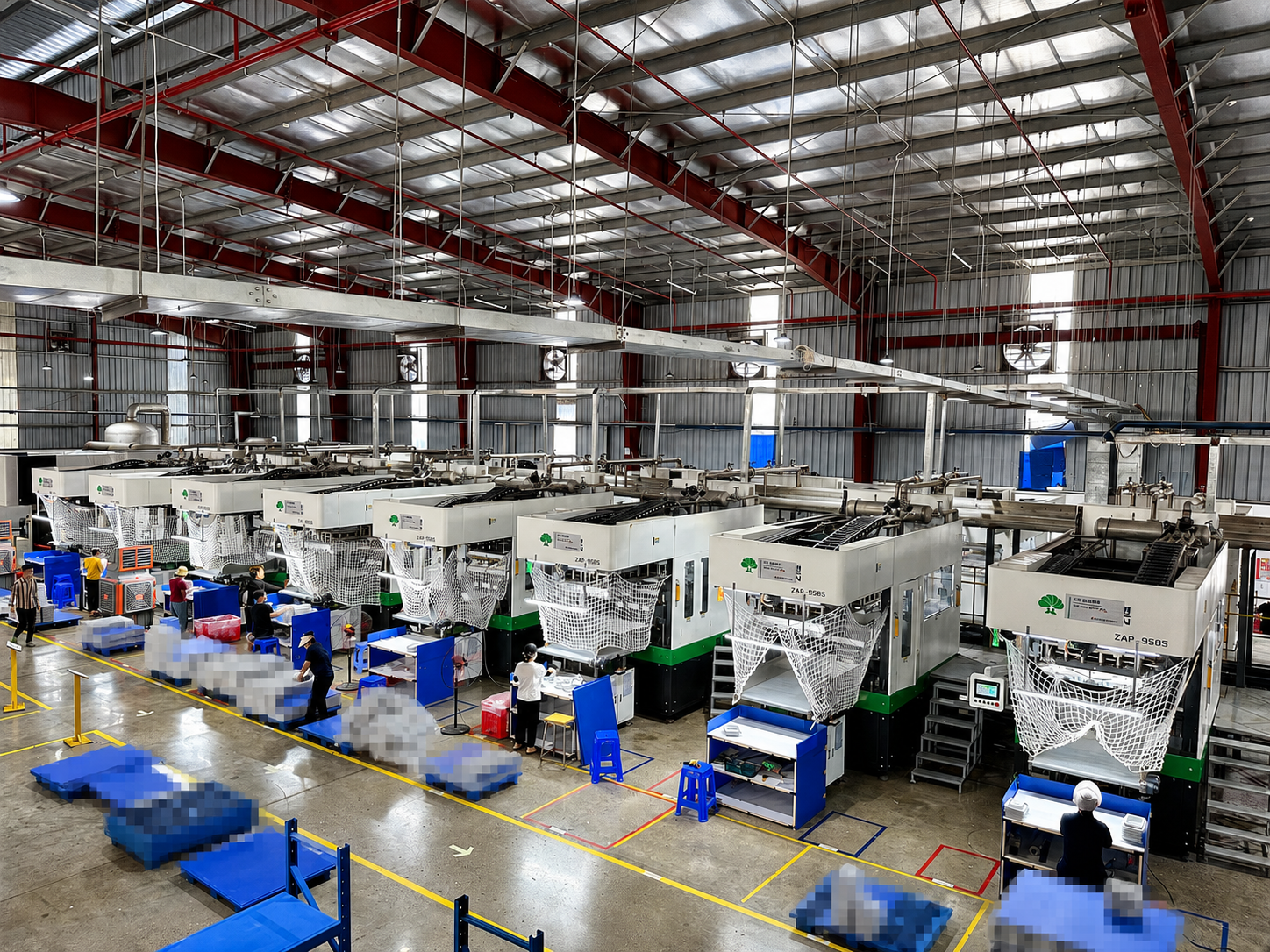
Industrial packaging is one of the fastest-growing application areas for pulp molding equipment. The global pulp moulding machines market was valued at approximately USD 2,140.0 million in 2024, and is projected to reach USD 3,760.2 million by 2032. Food and beverage packaging accounts for around 45% of global demand, but the largest growth in unit value is increasingly coming from molded fiber protective packaging for electronics, household appliances, cosmetics, and premium consumer goods. This article focuses on industrial packaging pulp molding machines: what makes them different, how they are selected, and what project-level constraints buyers should evaluate before committing to a forming machine.
Problem: Why General-Purpose Tableware Machines Are Not Enough for Industrial Packaging
Pulp molding tableware machines and industrial packaging machines operate on the same basic principle—forming fibers on a screen mold, dewatering, and drying—but the products they produce impose different technical demands. Tableware items such as plates and bowls are shallow, relatively thin, and produced in very high volumes. Industrial packaging parts, by contrast, often have deeper cavities, complex geometry, higher basis weight, and stricter dimensional requirements.
According to Hanson Pulp Molding's technical guidance, one machine can usually produce several sizes of products within the same product category by changing molds. However, tableware, premium industrial packaging, and cup lids have significantly different requirements for capacity, accuracy, pressure, product transfer, and downstream processing. A machine's compatibility is limited by mold platen dimensions, maximum product height, maximum product weight per mold, forming pressure, hot-pressing pressure, transfer structure, and downstream equipment. Changing the mold does not change these fundamental machine capabilities.
As a result, a factory that buys a tableware-oriented machine and tries to run industrial packaging on it often faces problems such as low yield on deep drawn products, unstable product thickness, or high reject rates linked to insufficient forming and hot-pressing pressure.
Opportunity: What a Purpose-Built Industrial Packaging Pulp Molding Machine Needs to Deliver
An industrial packaging pulp molding machine should be evaluated as part of a complete production system, not as a standalone press. Hanson defines the typical role of such equipment as completing pulp forming, in-mold drying, and hot pressing for high-quality molded fiber industrial packaging. Supporting equipment normally includes a pulp preparation system, slurry preparation and feeding system, vacuum system, compressed air system, cooling water system, high-pressure mold washing system, electric heating system, trimming machine, hole punching machine, vision inspection system, automatic packing machine, and, depending on product requirements, coating, laminating, and digital printing equipment.
In practice, the forming machine is only one module. The buyer must think in terms of a production line with balanced cycle times and compatible quality-control integration.
Technical Explanation: Key Parameters and What They Mean for Industrial Packaging
Two Hanson models illustrate how machine specifications map to application needs.
ZAD-8565: Compact Machine for Small and Medium Precision Packaging
The ZAD-8565 is a compact fully automatic pulp molding industrial packaging integrated machine with the following core parameters:
| Parameter | ZAD-8565 |
|---|---|
| Mold platen size | 850 × 650 mm |
| Forming pressure | 3 tons |
| Hot-pressing pressure | 20 tons |
| Maximum product height | 100 mm |
| Maximum product weight per mold | 500 g at 0.3% slurry concentration |
| Machine dimensions | L3,479 × W1,514 × H3,803 mm |
| Machine weight | Approximately 5.5 tons |
| Slurry feeding | Quantitative slurry feeding |
| Forming drive | Servo electric cylinder |
| Hot-pressing drive | Servo hydraulic cylinder |
The ZAD-8565 is designed for factories with limited production space. Its quantitative slurry feeding reduces product weight variation, and its dynamic slurry replenishment supplies pulp according to actual production demand. Because there is no slurry-return system, the design also helps prevent contamination from return piping. The machine is compatible with most pulp molded industrial packaging products and is commonly used for small and medium-size precision packaging.
ZAP-9585: Large-Format Machine for Larger, Deeper, or Heavier Products
The ZAP-9585 is a large-format fully automatic pulp molding industrial packaging integrated machine:
| Parameter | ZAP-9585 |
|---|---|
| Mold platen size | 950 × 850 mm |
| Forming pressure | 10 tons |
| Hot-pressing pressure | 40 tons |
| Maximum product height | 120 mm |
| Maximum product weight per mold | 900 g at 0.3% slurry concentration |
| Machine dimensions | L4,390 × W1,960 × H3,572 mm |
| Machine weight | 11.8 tons |
| Floor load | 2,449 kg/m² |
| Slurry feeding | Precise self-circulating slurry feeding with dynamic replenishment |
| Forming and hot-pressing drive | Servo hydraulic cylinder |
The large 950 × 850 mm platen supports efficient layouts for industrial packaging products, including multiple small mold combinations on a single platen, which can reduce mold investment. Maximum product height of 120 mm and mold weight of 900 g support larger products. The self-circulating slurry system is designed to reduce weight variation and prevent slurry deterioration and contamination. A post-hot-press unloading mechanism makes product handling more convenient.
How to Choose Between ZAD and ZAP
Hanson's published selection guidance is direct: the ZAD-8565 should be chosen when the product fits its platen and height range, the total product weight per mold is relatively low, a more compact machine is preferred, and the main products are small or medium-sized electronics, cosmetics, or consumer-goods packaging. The ZAP-9585 should be chosen when the product is relatively large, deeper or higher, heavier, more complex, or requires higher forming and hot-pressing pressure.
Importantly, the machine should not be selected only according to the outer dimensions of one product. Mold layout and forming-process feasibility must also be evaluated.
Application and Use Cases: Evidence from Operating Industrial Packaging Projects
Gaoyi Packaging: From a Trial Machine to 80 Industrial Packaging Machines
Gaoyi Packaging, a high-end integrated packaging solutions manufacturer in Vietnam, began with a trial machine. After evaluating equipment stability, technical service response, and production costs, the company placed multiple repeat orders and purchased a total of 80 pulp molding industrial packaging machines, including the ZAD-8565 and ZAP-9585. Hanson developed from an alternative supplier into a core equipment partner.
The supplied equipment is used to produce high-quality molded fiber protective packaging for consumer electronics, small household appliances, electronic products, and other premium packaging applications. The cooperation included rapid equipment delivery during a capacity-expansion period, on-site commissioning, and fast maintenance response.
This case illustrates a common project pattern: buyers do not commit to large volumes at the beginning. They run one machine in production, verify cycle time, product consistency, and service capability, and then scale up through repeat orders.
Tonglibo: Five Procurement Rounds in Approximately Two Years
Hangzhou Tonglibo, a professional molded fiber industrial packaging manufacturer, began with its first Hanson equipment purchase in 2023 and subsequently placed additional orders in September 2024, December 2024, February 2025, and April 2025—five procurement rounds in roughly two years. The project scale reached 20 units, with continuous equipment customization aligned to capacity growth.
The application is production of high-end molded fiber industrial packaging for electronics and other precision products. According to Hanson, the cooperation supported the customer's step-by-step capacity expansion and shortened the production-line commissioning period through 24-hour technical response and on-site production support.
YUTO Packaging: Sampling Equipment for Premium Electronics Packaging Development
The ZAMS-6047 sampling production line, not a full industrial packaging machine, is also relevant to industrial packaging projects. A listed integrated packaging solutions provider serving global consumer electronics brands has used the ZAMS-6047 for molded fiber packaging product development, prototype verification, and process testing across the integrated packaging value chain. The project scope is one unit of the ZAMS-6047 fully automatic integrated prototyping and small-batch production line, installed in the customer's core production workshop.
For buyers developing new industrial packaging structures, a sampling production line can reduce prototype mold cost and shorten product-development cycles before committing to large-format production equipment.
Project-Type Fit: Which Projects Benefit Most from Dedicated Industrial Packaging Machines
According to Hanson's scenario data, the industrial packaging forming machine is suitable for the following project types:
- New factory construction
- Existing factory expansion
- Production line automation upgrade
- Replacement of old equipment
- New product development
- Pilot production and small-batch production
- Turnkey pulp molding factory projects
Operating modes typically include flexible batch production, multi-product and multi-mold production, two-shift or three-shift operation, and automatic forming and hot pressing with downstream finishing. This is an important distinction from tableware lines, which tend to run in continuous batch mode with standardized products and long production runs.
Comparison with Traditional Solutions and Their Limitations
Compared with traditional forming approaches, the trend in industrial packaging pulp molding is toward integrated automatic machines with servo-hydraulic pressure control, in-mold drying, and lower manual handling. The Hanson ZAD and ZAP series reduce operator dependence and improve product consistency.
But integrated automatic machines also have constraints that buyers should take seriously.
First, cycle flexibility is limited. An integrated machine is designed for stable production of products that fit within its platen, height, and pressure envelope. A factory that needs very high mix and frequent changeovers may find the integration less flexible than a modular line where forming, hot pressing, and trimming can be scheduled independently.
Second, downstream automation must match the main machine cycle. Hanson explicitly warns that if trimming, inspection, stacking, or packing equipment has a lower processing capacity than the main machine, products will accumulate downstream and eventually force the main machine to slow down or stop. Downstream automation must be designed according to the complete line cycle, not only the theoretical speed of an individual machine.
Third, in-mold drying limits heating capacity and cycle time trade-offs. Because the product is dried and hot-pressed in the mold, the heating system and tooling are tightly coupled. Higher product thickness tends to increase cycle time, and this interaction must be modeled against target capacity before equipment selection.
Fourth, successful sampling does not guarantee mass-production performance. Hanson identifies a common risk: a sampling mold works on the ZAMS-6047, but slurry distribution becomes uneven on a multi-cavity production mold, or the faster mass-production cycle causes insufficient dewatering or hot pressing. Operators should plan for a mass-production manufacturability evaluation, production-mold design, and continuous production trial before full investment.
Market Trend Analysis: What Is Driving Investment in Industrial Packaging Pulp Molding
Several observable trends support the shift toward dedicated industrial packaging equipment:
- Premium electronics packaging is moving from plastic and foam to molded fiber. Consumer electronics brands and their packaging suppliers need protective structures with high dimensional accuracy and surface quality. This is a natural fit for wet-press industrial packaging machines rather than standard dry-press egg-tray equipment.
- Buyers are investing in sampling and pilot lines before mass-production capacity. Projects such as YUTO and GMN reflect a pattern where R&D-oriented institutions and large packaging groups use the ZAMS-6047 to validate product structures, fiber materials, and additive formulations before scaling up.
- Large-volume orders are being placed in phases. The Gaoyi and Tonglibo cases show that customers validate one machine first, then scale with repeat orders. This reduces project risk and favors suppliers with responsive service networks.
- Turnkey scope is increasing. Hanson reports that turnkey projects can include factory planning, pulp preparation, forming equipment, molds, downstream automation, wastewater treatment, installation, commissioning, and operator training. Buyers are increasingly expecting one engineering team to coordinate technical interfaces rather than managing multiple suppliers.
According to the verified market data, the global pulp moulding machines market was valued at USD 2,140.0 million in 2024 and is expected to reach USD 3,760.2 million by 2032. Buyers should be cautious with large headline numbers, as some reports include broader paper-making machinery in their scope, but the underlying direction is consistent: molded fiber production capacity is expanding globally.
Buyer Checklist: Evaluating an Industrial Packaging Pulp Molding Machine
1. Define the product envelope.
List maximum product dimensions, height, unit weight, and geometry. Check the machine's platen size, maximum product height, and maximum product weight per mold.
2. Choose the process category.
For products requiring better surface quality, dimensional accuracy, and appearance, a wet-press process is generally appropriate. For thick cushioning products with lower surface requirements, dry-press or a hybrid approach may be more economical.
3. Calculate the complete line, not just the forming machine.
Include conveying, trimming, vision inspection, stacking, and packing time. Reserve downstream capacity margin and add buffering between critical processes.
4. Decide trimming architecture early.
Inline trimming is generally better for stable, large-volume products with high automation requirements. Offline trimming is more flexible for high-mix, small-batch production or when one trimming machine will serve several forming machines. Neither is universally superior.
5. Verify the integration team.
Confirm whether the supplier can integrate pulp preparation, forming, molds, downstream automation, and control systems as one system, or whether the buyer will need to coordinate multiple suppliers.
6. Plan for mass-production validation.
After sampling, complete a mass-production manufacturability evaluation, production-mold design, continuous production trial, and statistical measurement of weight, dimensions, strength, appearance, and yield.
Future Outlook
Industrial packaging pulp molding is moving toward larger platens, higher pressure capability, and more complete downstream integration. The available evidence from Hanson's customer base suggests that sustained industrial packaging production increasingly happens on dedicated machines such as the ZAD-8565 and ZAP-9585, which are designed around the product geometry, pressure requirements, and transfer characteristics of molded fiber protective packaging.
The practical implication for buyers is that equipment choice should be driven by the production project—the product structure, the required volume, the available utilities, and the downstream finishing requirements—rather than by a generic machine catalog. The companies that scale most effectively are those that validate on sampling equipment, plan the complete line, and choose a supplier capable of integrating the process from pulping to packing.
FAQ
Should I choose the ZAD-8565 or the ZAP-9585 for industrial packaging?
The ZAD-8565 is more suitable for small and medium-sized premium industrial packaging products and projects requiring a relatively compact machine. The ZAP-9585 has a larger platen (950 × 850 mm), higher forming pressure (10 tons), higher hot-pressing pressure (40 tons), greater maximum product height (120 mm), and greater maximum product weight per mold (900 g), making it more suitable for larger, deeper, or heavier industrial packaging products. The final selection should be based on product dimensions, height, unit weight, mold layout, target capacity, and surface-quality requirements.
Can one pulp molding machine produce tableware, industrial packaging, and cup lids by changing molds?
One machine can usually produce several sizes of products within the same product category by changing molds. However, Hanson generally recommends dedicated equipment for dedicated product categories because tableware, premium industrial packaging, and cup lids have significantly different requirements for capacity, accuracy, pressure, product transfer, and downstream processing. Machine compatibility is limited by mold platen dimensions, maximum product height, maximum product weight per mold, forming pressure, hot-pressing pressure, transfer structure, and downstream equipment.
What equipment is required to complete an industrial packaging pulp molding line?
A complete industrial packaging line normally requires more than a forming machine. In addition to the integrated forming machine, the process typically includes a pulp preparation system, slurry preparation and feeding system, vacuum system, compressed air system, cooling water system, high-pressure mold washing system, electric heating system, trimming machine, hole punching machine, vision inspection system, automatic packing machine, and, where required, coating, laminating, or digital printing equipment. Downstream equipment must match the main machine in capacity, product direction, spacing, and cycle time.
Should trimming be inline or offline for an industrial packaging line?
Inline trimming connects trimming directly with forming, hot pressing, and product transfer. It offers a higher automation level and less product handling, making it suitable for stable products, large orders, and clearly defined production cycles. Offline trimming uses a separate machine and provides greater flexibility for product changeovers and production scheduling, making it more suitable for multiple products, smaller batches, or one trimming machine serving several production lines. Neither method is universally better; the choice depends on product stability, order structure, production rhythm, and factory management.
What can go wrong when downstream automation does not match the forming machine cycle?
If trimming, inspection, stacking, or packing equipment has a lower processing capacity than the main machine, products accumulate downstream and eventually force the main machine to slow down or stop. If downstream equipment runs faster but conveying, positioning, and buffering are poorly designed, the line may still suffer from misalignment, collisions, missed inspections, and packing errors. Downstream automation must be designed according to the complete line cycle, including products per mold, main-machine cycle, conveying time, inspection time, rejection time, stacking time, and packing time.
Is a sampling production line necessary before buying industrial packaging equipment?
A sampling line is recommended when the customer has only a product concept, when new fibers or additives need to be verified, when the product has a complex structure requiring multiple rounds of optimization, or when the mass-production investment is significant and the buyer wants to reduce technical risk. The ZAMS-6047 integrates pulping, refining, slurry preparation, slurry feeding, forming, and hot pressing in one compact system, and is suitable for research institutions, material companies, packaging groups, and customers preparing to enter the industry. If the product, mold, process, and order volume are already mature, the customer may evaluate mass-production equipment directly.
Company profile: Hanson Pulp Molding Technology Co., Ltd. is a National High-tech Enterprise specializing in pulp molding equipment, production lines, and turnkey factory solutions, located in Houjie Town, Dongguan City, Guangdong Province, China. Hanson operates manufacturing, an independent mold division, and a service network with 10 service locations. For more detailed equipment specifications and project references, the company brochure is available for public download: Hanson Pulp Molding Company Brochure.
¿Tiene preguntas o necesita más detalles?
Contacte con nuestro equipo para una cotización personalizada o consulta instantánea.
Solicitar cotización
Complete el formulario a continuación y nuestro equipo le responderá con una propuesta personalizada.
Chat directo de WhatsApp
¿Prefiere chatear en tiempo real? Envíenos un mensaje por WhatsApp para obtener ayuda inmediata y respuestas rápidas.
- Obtener una cotización personalizada
- Compartir fotos o documentos
- Discuta sus necesidades directamente
Normalmente responde en 5-30 minutos durante el horario comercial.