
Industrial Fastener Showdown: Strut Channel Spring Nuts
Strut channel assemblies are only as reliable as the smallest component in them. Designers spend their time on channel gauge, procurement negotiates on price per ton, and installation crews focus on the bolt — yet the part that most often decides whether a pipe support is still aligned two years later is the spring nut sitting quietly inside the slot.
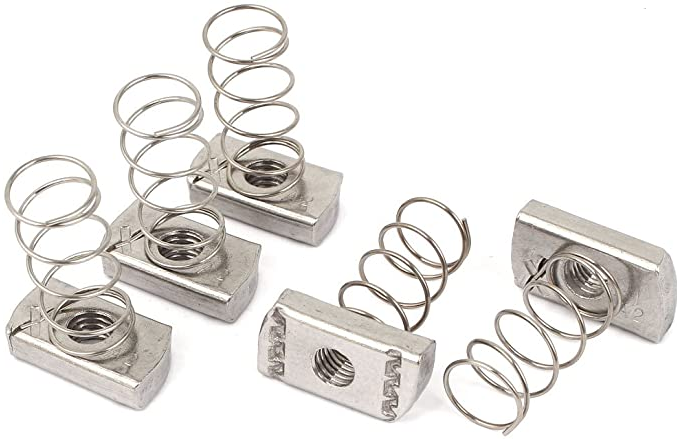
Spring channel nuts are the positioning interface between a threaded rod or bolt and the inturned lips of a strut channel profile.
A spring nut is a rectangular channel nut fitted with a spring that holds it in position inside a strut channel profile before the bolt is tightened. Its primary job is positioning, not load carrying. Once the connection is tightened, the load path runs through the nut body bearing against the channel lips and then into the bolt. Understanding that division of labour is the fastest way to diagnose the two complaints that dominate field reports on channel systems: a spring nut that keeps slipping during installation, and a channel connection that loosens under sustained vibration.
Those are different failures with different causes. This independent reference compares the mainstream spring nut strategies available to specifiers and buyers, using three evaluation axes — fit, material, and grade and finish — and references the standard spring nut sizes M6 to M12 together with the common channel profiles at 41×41 mm and 41×21 mm.
Why Spring Nuts Slip, and Why Connections Loosen
A spring nut that slips inside the channel is usually telling you something specific. The most common causes are a nut that is not correctly matched to the channel profile, a spring that is too weak, damaged or has lost tension, dimensional mismatch between nut and channel, or a nut that was never rotated into its correct locking position before the bolt was run down. Thread size and bolt length also play a role: a bolt that is too short cannot develop the clamp load needed to seat the nut against the channel lips.
The practical diagnostic sequence is straightforward. Confirm that the nut is designed for the specific channel size and profile being used, check that the spring seats properly against the inside face of the channel, verify that the nut has been rotated into the locking position, and confirm thread pitch and bolt length compatibility. If the spring is deformed or has lost tension, the nut should be replaced rather than reused. For heavier loads and for installations where the nut must stay put while the bolt is started — overhead work and vertical runs are the classic cases — a heavy-duty spring nut with a stronger spring and heavier construction is the appropriate choice.
Vibration loosening is a separate mechanism, and this is where a great deal of field confusion originates. The spring on a spring nut is a retention device for installation; it is not a vibration-locking feature. Loosening under dynamic load is resisted by bolt preload combined with a deliberate locking method — prevailing-torque lock nuts, threadlocker, spring washers, locking washers, or other mechanical locking approaches. The right choice depends on vibration level, temperature, joint design, installation conditions, and whether the joint needs to be reopened for service. Correct tightening torque is essential in every case.
Axis 1 — Fit: Channel Profile, Spring Tension and Thread Size
Fit is decided at the point where the nut body contacts the inturned lips of the channel. In the size ranges most commonly specified for industrial support work, spring nuts are offered in M6, M8, M10 and M12 thread sizes, while plain channel nuts are typically offered in M8, M10 and M12. Channel profiles in the same ecosystem include 41×41×2.5 mm, 41×21×2.5 mm and 41×41×2.0 mm, along with imperial equivalents such as 1-5/8"×1-5/8" (41×41 mm) and 1-5/8"×13/16" (41×21 mm). Wider profiles at 1-5/8"×2-7/16" and 1-5/8"×3-1/4" appear in heavier support frames.
| Channel profile | Typical role in the frame | Points to verify at ordering |
|---|---|---|
| 41×41×2.5 mm / 41×41×2.0 mm (1-5/8"×1-5/8") | Main load-bearing runs, trapeze supports, equipment frames | Slot opening tolerance, nut body width, wall thickness and gauge (12ga, 14ga, 16ga) |
| 41×21×2.5 mm (1-5/8"×13/16") | Brackets, light-duty framing, cable and conduit support | Reduced internal depth — confirm nut body height clears the profile |
| 1-5/8"×2-7/16" and 1-5/8"×3-1/4" | Heavy support structures and multi-run racks | Bolt length and thread engagement after the nut is seated |
Thread size must follow the rod or bolt, not the channel. Standard thread references in use include 1/4"-20, 3/8"-16 and 1/2"-13, alongside metric M6 through M12. Channels and threaded rods are supplied in both metric and imperial threads, and full-thread or partial-thread configurations are available depending on the application. Mixing thread systems inside one frame is a common and avoidable source of installation delay.
Gauge and length also influence behaviour. Channel is commonly produced in 12ga, 14ga and 16ga wall thicknesses with standard lengths of 10 ft and 20 ft, and custom lengths available. Heavier gauge increases stiffness but also changes how much the lips deflect when the nut is torqued, which is one reason a nut that performs well in one frame does not automatically perform well in another.
Axis 2 — Material: Where SS304, SS316 and Carbon Steel Diverge
Material choice is the axis most often reduced to a single question — stainless or not — when the more useful question is which stainless. The functional difference between SS304 and SS316 lies in chemistry: SS316 contains 2% to 3% molybdenum, which materially improves resistance to chloride attack, salt fog and aggressive chemicals compared with SS304. That single alloying addition is what separates a fastener that survives a coastal solar array from one that does not.
| Material | Corrosion behaviour | Well-matched environments |
|---|---|---|
| Carbon steel with zinc-based finish | Protection depends entirely on the coating system | Indoor framing, dry interior MEP, general industrial interiors |
| SS304 stainless steel | Strong general corrosion resistance at moderate cost | General construction, commercial framing, inland installations |
| SS316 stainless steel | Superior resistance to pitting, chlorides and salt fog | Marine and coastal hardware, coastal solar, chemical and food processing |
| Aluminium | Lightweight with moderate strength | Weight-sensitive frames where load demands are modest |
The practical decision rule is therefore: specify SS304 for general construction, commercial framing and inland applications where durability matters but chloride exposure is low, and specify SS316 for marine hardware, coastal solar installations, food processing equipment and chemical engineering environments. Copper and aluminium also appear in the broader fastener portfolio, but for structural channel connections the realistic choice is between coated carbon steel and stainless.
One caveat deserves stating because it is frequently discovered late: stainless steel threads are generally more susceptible to galling than zinc-plated carbon steel threads, so installation practice, lubrication where permitted, and controlled tightening speed matter more, not less, when stainless hardware is used.
Axis 3 — Grade, Thread Type and Finish
Grade selection should follow the joint, not the catalogue. Property classes 4.8, 8.8, 10.9 and 12.9, high-tensile grades, B7 alloy steel studs and stainless classes A2-70 and A4-80 all exist for different reasons, and a higher-strength bolt is not automatically the better choice. In imperial practice the equivalent caution applies to Grade 5 versus Grade 8: Grade 8 offers higher tensile and yield strength and suits higher-load, more demanding applications, while Grade 5 is often sufficient for general-purpose work and may be easier to install at lower cost. What matters is that the bolt grade matches the application, the mating components, the tightening requirements and the operating environment.
Finish is the third variable and it interacts directly with fit. Hot-dip galvanized (HDG) coatings are substantially thicker than electro-zinc plated (EG) coatings — in the range of 45 to 85 micrometres for HDG against roughly 5 to 12 micrometres for EG — and that thickness difference drives both service life and thread behaviour. HDG is the appropriate choice for outdoor, coastal and harsh corrosive environments; EG is appropriate for indoor, dry environments where cost efficiency and precise thread fit are the priorities.
| Finish | Relative coating thickness | Where it fits best | Buyer consideration |
|---|---|---|---|
| Hot-dip galvanized (HDG) | Heavy coating, typically 45–85 µm | Outdoor solar racking, coastal infrastructure, heavy industrial plant | Confirm thread fit is maintained after coating on small-diameter threads |
| Electro-zinc plated (EG, white or yellow) | Thin coating, typically 5–12 µm | Indoor HVAC mounting, electrical conduit hanging, interior framing | Not intended for long-term outdoor exposure |
| Dacromet and Magni | Intermediate coating systems | Industrial environments needing more than standard zinc | Verify compatibility with mating fastener finish |
| Pre-galvanized (for example G90) channel | Applied to coil before forming | General support framing | Cut edges are less protected than HDG after fabrication |
Thread type matters in a subtler way. Full-thread and partial-thread bolts distribute engagement differently, and the thread standard itself is defined by published norms rather than supplier preference. Hexagon nuts for general industrial use are governed by standards such as ISO 4032 and DIN 934; plain washers correspond to ISO 7089 and ISO 7090, equivalent to DIN 125; spring lock washers with square ends are standardized under DIN 127 / BS4464B; and hexagon head bolts of grade C fall under ISO 4016 and DIN 601. A spring nut is not covered by a single global product standard in the way a hex nut is, which is precisely why profile matching and documented dimensions carry more weight in this category than a standard number alone.
Comparing Three Common Spring Nut Strategies
Across the fittings market, three approaches dominate channel connections. Each solves a different part of the problem, and none of them solves everything.
| Strategy | How it holds position | Relative load suitability | Best-fit scenario |
|---|---|---|---|
| Standard spring nut | Integral spring presses against the inside of the channel | Common light- to medium-duty installations | General framing, routine indoor support work |
| Heavy-duty spring nut | Stronger spring and heavier construction | Higher loads and applications needing firmer retention | Overhead runs, vertical installs, dynamic or high-load connections |
| Plain channel nut (no spring) | Positioned manually and held by hand or tooling during assembly | Depends on nut body and bolt, not on retention | Simple, accessible connections where installation speed is not critical |
The decision logic follows from the table. Where fast and reliable positioning matters — overhead, vertical, and repetitive installation work — a spring nut is generally the recommended option because the spring holds the nut in place while the bolt is started. Where the connection is easy to reach and positioning is not a constraint, a plain channel nut can be entirely adequate. Where the joint sees heavier loads or needs the nut to remain firmly seated during assembly, the heavy-duty variant is the more defensible specification.
How the Components Combine in Practice
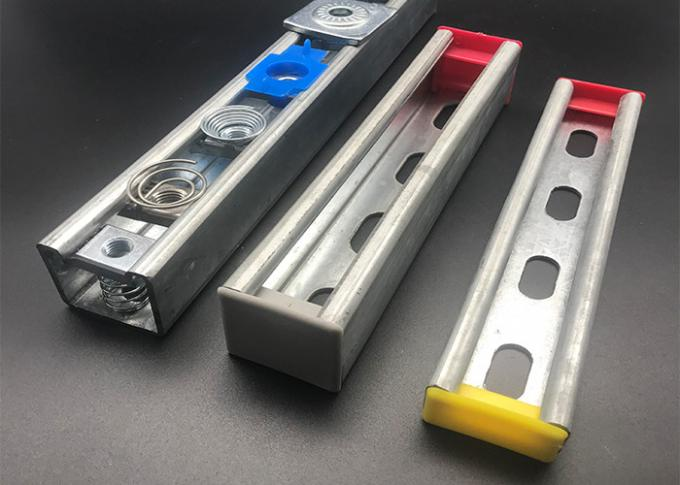
Channel profile geometry, not thread size, determines whether a spring nut seats correctly against the inturned lips.
A strut channel assembly is a system rather than a part. Accessories typically include channel fittings, spring nuts, threaded rods and pipe clamps, and the interaction between them determines both installation speed and long-term stability. A channel spring nut paired with an undersized threaded rod, for example, will hold position perfectly and still fail to develop the clamp load the design assumed.
This is why the more useful procurement question is not "which spring nut is cheapest" but "which combination of nut, rod, finish and locking method is specified for this environment". The corrosion resistance, strength grade and dimensional tolerance requirements should be fixed in advance rather than resolved on site, because the finish that protects a coastal frame is not the finish that gives the cleanest thread fit indoors.
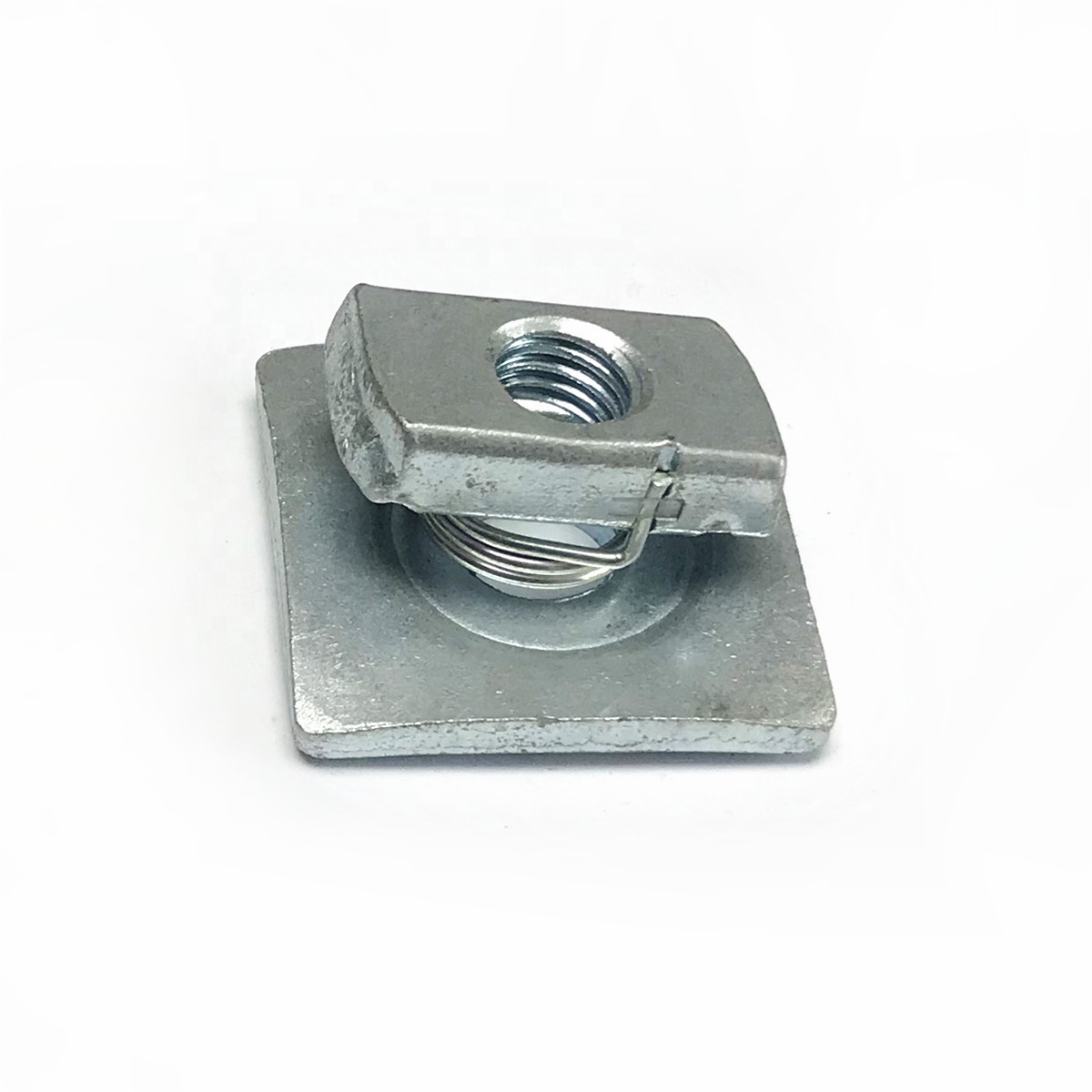
Combination strut nut assemblies integrate nut and washer, reducing the number of loose components handled at height.
Where These Strategies Are Used
Strut channel systems and their spring nuts serve the construction, electrical, HVAC, oil and gas, solar mounting and general industrial support industries. Within that span, the environment usually dictates the specification.
- Indoor MEP and HVAC support. Electro-zinc plated carbon steel channels and fittings are the cost-effective norm, with SS304 specified where washdown or humidity is present.
- Solar mounting. Outdoor exposure pushes the specification toward HDG or stainless, and coastal arrays are the clearest case for SS316 over SS304.
- Oil, gas and petrochemical. Corrosive atmospheres favour SS316 and heavy-duty coating systems, with material grade and finish confirmed at the enquiry stage.
- Power generation and heavy industrial equipment. Higher load classifications and heavier channel profiles dominate, often with heavy-duty spring nuts and higher bolt property classes.
- Construction and building infrastructure. Mixed usage, where the split between indoor EG and outdoor HDG or stainless has the largest commercial impact.
In most of these installations the connection is a static mechanical fastening intended for long-term fixation, though removable connections are common where maintenance access is required. That distinction — permanent versus serviceable — should drive the locking method decision as much as the vibration environment does.
Market Signals Behind the Category
The demand context for channel fittings is not static. The global industrial fasteners market was valued at USD 93.12 billion in 2025 according to Fortune Business Insights, and Grand View Research projects the market to reach USD 153.71 billion by 2033 at a CAGR of 5.1%. The same source reports that Asia Pacific accounted for a 45.1% revenue share in 2025, and that bolts remain the largest single product segment at a 31.3% share.
The strut channel market specifically shows a slightly faster trajectory. Dataintelo valued the global strut channel market at USD 4.3 billion in 2024 and projects USD 7.3 billion by 2033 at a CAGR of 6.1%. That gap matters for buyers: fittings and accessories scale with channel volume, so the demand pressure lands on exactly the components discussed here. It is also worth noting that published estimates diverge — one alternative research house values the strut channel market at USD 1.85 billion for 2025 — which is a reminder that a single market figure should inform planning rather than define it.
On the supply side, China exported USD 1.63 billion in the "Other Metal Fasteners" category in 2024 according to the Observatory of Economic Complexity, and Credence Research valued China's industrial fasteners market at USD 12.23 billion in 2024. Downstream, Fortune Business Insights reports that the automotive industry accounts for over 30% of demand for high-strength industrial fasteners — a signal that high-strength capability, not just volume, is where specification pressure is concentrated.
The competitive landscape around channel systems is shaped by a small group of large players. Intel Market Research identifies nVent (CADDY), Atkore (Unistrut), Eaton (B-Line) and Hilti among the leading manufacturers of strut channel systems, while MarketsandMarkets lists Illinois Tool Works, Stanley Black & Decker and Hilti among key global industrial fastener players. For buyers, this concentration is relevant in one practical way: system-level products are frequently sourced from a small number of global brands, while the fittings and fasteners that complete the installation are sourced from a much wider and less standardised base.
Comparison with Traditional Approaches — and Their Boundaries
The traditional alternative to a spring nut assembly is a plain channel nut positioned by hand, often combined with a separate washer and, in older practice, field-drilled or welded support brackets. Spring nut systems improve on that in installation speed, repeatability and safety at height. They do not improve everything, and the boundaries are worth stating plainly.
- A spring nut does not add vibration resistance by itself. Retention during assembly and resistance to dynamic loosening are different functions. Joint security still depends on preload and a chosen locking method.
- A stronger spring improves positioning, not capacity. A heavy-duty spring nut holds its place better; the load capability of the connection is governed by the nut body, thread engagement and the bolt, not by spring tension.
- Stainless steel carries a trade-off. SS316 delivers clearly better chloride resistance than SS304, but at higher material cost, and stainless threads are generally more prone to galling during installation.
- Heavier coatings complicate small threads. HDG offers far longer outdoor protection than EG, but the thicker zinc layer can affect thread fit on small-diameter fasteners if coating and tapping are not properly controlled.
- Aluminium is not a strength substitute. It reduces weight, which matters in some frames, but it is not a like-for-like replacement for steel in higher-load connections.
- Installation method still decides outcomes. A correctly specified spring nut that is not rotated into its locking position behaves no better than an undersized one.
The honest conclusion is that spring nut selection is a system decision with no single dominant answer. The best-performing configuration for a coastal solar array differs from the best-performing configuration for an indoor electrical conduit run, and both may differ from the right answer for a petrochemical plant, even when the channel profile is identical.
A Manufacturer Reference Point: CNS INDUSTRIAL (JIAXING) CO.,LTD
CNS INDUSTRIAL (JIAXING) CO.,LTD is a manufacturer located in Jiaxing City, Zhejiang Province, China, with convenient transportation access near Shanghai Port. The company specialises in the manufacturing and export of fasteners, channel fittings and metal stamping parts, and its portfolio includes strut fittings, strut channel systems, stamping parts, bolts and nuts, threaded rods, anchors, washers, screws, rivets and industrial hardware and fasteners. Export business accounts for 100% of total sales, with major markets in the EU, the US, South America and Canada, and products also sold into Mexico, Germany, Japan, Russia, France and Italy.
On the product side, the channel-related range covers spring nuts in M6, M8, M10 and M12, channel nuts in M8, M10 and M12, and strut channel profiles at 41×41×2.5 mm, 41×21×2.5 mm and 41×41×2.0 mm, including slotted and unslotted versions of the 41×41×2.5 mm profile as well as imperial equivalents. Standard lengths are 10 ft and 20 ft, available in 12ga, 14ga and 16ga thicknesses, with custom lengths on request. Materials include carbon steel, SS304, SS316, aluminium and copper, and available finishes include zinc plated, hot-dip galvanized, Dacromet, Magni, yellow zinc and white zinc.
Manufacturing is carried out to GB, ISO, DIN, ANSI/ASME, UNI, JIS, BS and NFE standards, or to customer drawings and samples where a custom configuration is required. The facility covers 30,000 square metres with an annual production capacity of 8,000 tons, a research and development team of 20 engineers, and approximately 50 to 100 staff. These are the parameters a buyer would normally verify at supplier assessment stage, and they are stated here as reference data rather than as a recommendation, since suitability depends entirely on the application requirements outlined above.
Future Outlook
Three shifts are likely to shape spring nut and channel fitting specifications over the next several years. The first is the migration of material specification toward higher corrosion resistance, driven by the growth of coastal and offshore solar mounting and by tightening expectations around service life in outdoor infrastructure. With the strut channel market projected to grow at a 6.1% CAGR through 2033 on Dataintelo's figures, the accessory demand that follows channel installation will grow with it, and much of that growth is in exposed environments.
The second is documentation. As buyers in the EU and North America push material traceability and finish verification further down the supply chain, the ability to state material grade, coating system, thread standard and dimensional tolerance precisely becomes a commercial capability rather than a paperwork exercise. The third is the growing recognition that anti-loosening performance is a joint-level property. Expect more procurement specifications to name both a locking method and a tightening torque, rather than treating a spring washer or a spring nut as a standalone solution.
FAQ
Why does my spring nut keep slipping inside the strut channel?
A spring nut usually slips because it is not correctly matched to the channel profile, because the spring is too weak, damaged or has lost tension, because the channel or nut dimensions are incorrect, or because the nut was not properly positioned before tightening. The first checks are whether the nut is designed for the specific channel size and profile, whether the spring is seated correctly against the inside of the channel, and whether the nut has been rotated into the correct locking position. Thread size and bolt length should also be verified for compatibility. For heavy-duty applications, a spring nut with an appropriate load rating and a stronger spring is the more suitable choice, and a nut with a damaged, deformed or de-tensioned spring should be replaced.
How do you choose the right spring nut for strut channel?
Selection follows five variables: strut channel size and profile, thread size, load requirement, material, and installation environment. The nut must first be compatible with the channel profile and slot dimensions. Thread size is then matched to the threaded rod or bolt in use — common references include 1/4"-20, 3/8"-16 and 1/2"-13, alongside metric sizes. For heavier loads, a spring nut with a suitable load rating and stronger construction is appropriate. Material and finish follow the environment: zinc-plated steel is generally adequate for indoor applications, while hot-dip galvanized or stainless steel is specified for outdoor or corrosive conditions. Compared with a plain channel nut, a spring nut holds itself in position and simplifies overhead, vertical and repetitive installation work.
What is the difference between SS304 and SS316 stainless steel fasteners, and which should I choose?
The difference is chemical composition and the corrosion performance that follows from it. SS316 contains 2% to 3% molybdenum, which gives it significantly better resistance to chloride corrosion, salt fog and harsh chemicals than SS304. SS304 offers excellent strength and cost performance for standard indoor and general outdoor environments. SS316 is the appropriate choice for marine, coastal, chemical or high-chloride environments. In practice, SS304 suits general construction, commercial framing and inland applications seeking high durability at lower cost, while SS316 is specified for marine hardware, coastal solar installations, food processing equipment and chemical engineering projects.
How do I choose between hot-dip galvanized and electro-zinc plated fasteners and channels for outdoor projects?
Hot-dip galvanized (HDG) is the appropriate choice for outdoor, coastal and harsh corrosive environments because of its heavy protective zinc coating, which is typically in the 45 to 85 micrometre range and is associated with long-term outdoor anti-rust performance. Electro-zinc plated (EG) suits indoor, dry environments where cost efficiency and precise thread fit are the priorities, since its coating is much thinner, typically around 5 to 12 micrometres. Typical applications for HDG include outdoor solar racking, coastal infrastructure and heavy industrial plant installations. Typical applications for EG include indoor HVAC mounting, electrical conduit hanging and interior wall framing.
How do you choose the right grade of bolts for industrial applications?
Bolt grade should be selected according to required load, tensile strength, yield strength, application conditions and safety requirements. For common industrial applications, imperial Grade 5 and Grade 8 bolts are widely used, while metric property classes such as 8.8, 10.9 and 12.9 provide different strength levels. Grade 8 bolts offer higher tensile and yield strength than Grade 5 and are more suitable for higher-load and demanding applications, while Grade 5 is often sufficient for general-purpose work with easier installation and lower cost. The correct grade must match the application, the mating components, the tightening requirements and the operating environment — a higher-strength bolt is not automatically the better choice, and the complete bolted joint should be considered rather than strength alone.
How do you prevent bolts and nuts from loosening under vibration?
Prevention depends on using an appropriate locking method together with correct bolt preload. Common mechanical solutions include prevailing-torque lock nuts, spring washers, locking washers and other mechanical locking devices, while threadlocker provides an adhesive-based alternative. The most suitable solution depends on vibration level, temperature, joint design, installation conditions and whether the joint needs to be frequently removed. Prevailing-torque lock nuts are a practical choice for frequently serviced industrial assemblies because they resist loosening mechanically and can be disassembled. Threadlocker suits permanent or semi-permanent assemblies, provided the correct grade and temperature resistance are considered. In severe vibration applications, the recommended approach is to combine an appropriate locking method with correct bolt preload and tightening torque rather than relying on a spring washer alone.
A spring nut is a small component with an outsized effect on how a strut channel frame performs over its service life. Matching profile, thread, material, grade and finish to the actual environment — and treating anti-loosening as a joint-level decision — is what separates a support system that stays aligned from one that generates callbacks.
For readers who need the full dimensional and material reference in one document, the CNS Industrial product brochure covering strut channel systems, spring nuts and related fasteners is available here: CNS_Industrial_Brochure_v4.pdf.