
Industrial Elevator Fit: Matching Equipment to Project Scenarios
Selecting an industrial elevator is rarely a matter of picking the largest model on a price list. The practical question for a project team is whether a given elevator configuration can absorb a site's duty cycle, load pattern, safety requirements, and future automation plans. For facility managers, plant engineers, and procurement teams evaluating industrial elevators in 2026, the useful decision framework starts with scenario fit, not brand preference.
Industrial elevators are used in factories, logistics parks, warehouses, infrastructure, and large commercial buildings. They may move pallets, machinery, vehicles, or mixed passenger-and-goods traffic, depending on the site. That is why two projects with the same building height can have completely different elevator specifications.
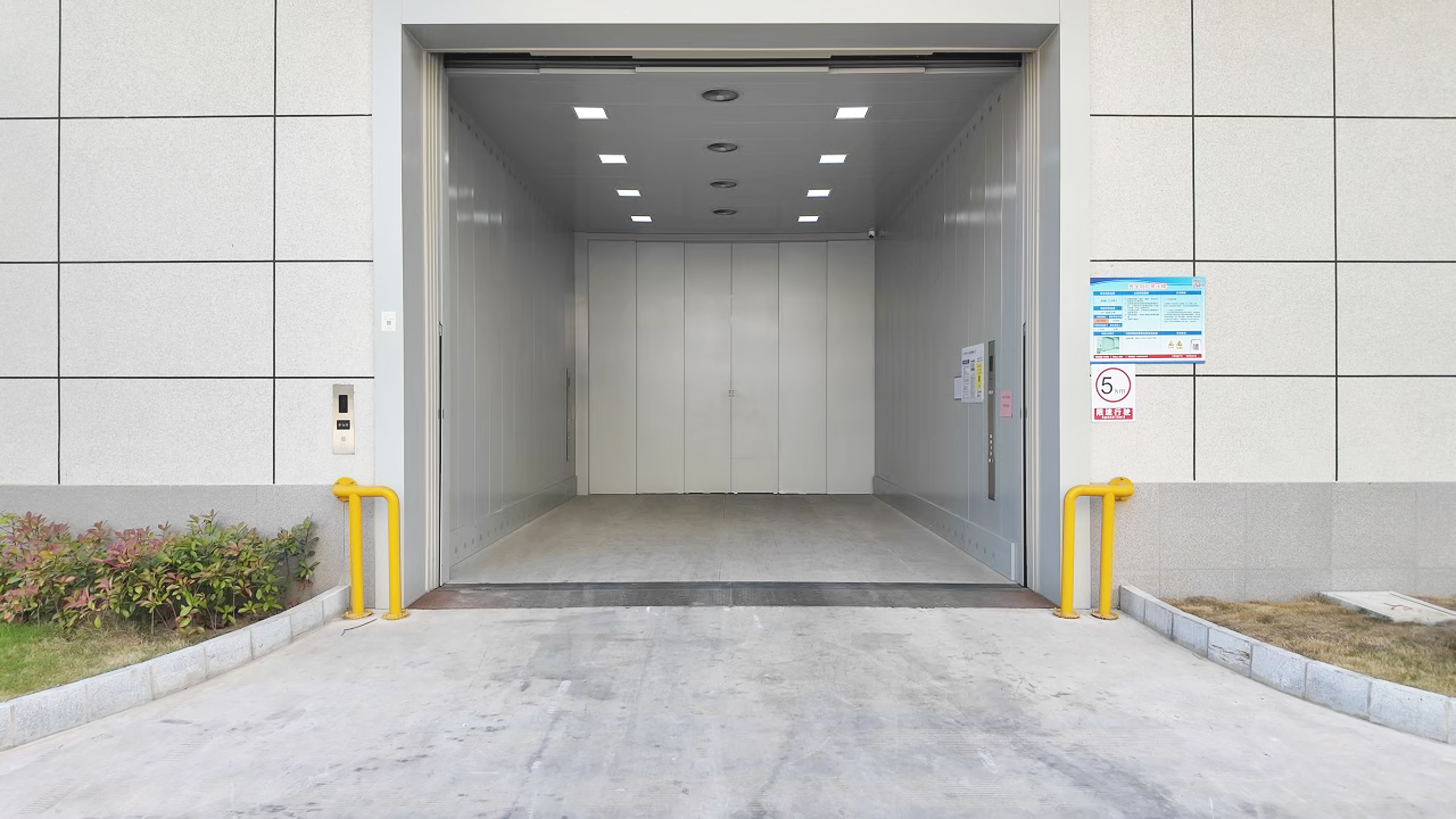
Heavy-duty freight elevator in an industrial facility.
Why Industrial Elevator Selection Is a Fit Problem
Vertical transportation in industrial buildings is becoming more demanding. Facilities operate 24/7, loads are heavier, and plant layouts increasingly expect vertical lifts to connect with automated horizontal transport. Buyers also confront regulatory pressure: European projects reference EN 81-20 and EN 81-50, while North American buyers work with ASME A17.1-2025, an update that includes IoT-based remote operation monitoring.
The cost of a mismatch is visible only after installation. An under-specified elevator causes breakdowns and bottlenecks; an over-specified one carries unnecessary capital cost. A more productive procurement approach is to map the building's material flow, duty cycles, and safety environments, then choose a freight elevator that can be configured to those conditions. This is the core of project-scenario fit.
Joylive Elevator: A Supplier Built Around Customized Industrial Vertical Transport
One supplier that has built its industrial positioning around this fit is Joylive Elevator Co., Ltd., a Chinese elevator manufacturer founded in 2002 in Bacheng Town, Kunshan City, Jiangsu Province. Joylive follows a strategy described as 'High-End, Premium, and Branding' and supplies customized elevator system solutions from design and R&D, intelligent manufacturing, to whole life cycle management. The company's stock short name is Joylive, with stock code 833481.
Joylive's product scope relevant to industrial projects includes passenger elevators, freight elevators, explosion-proof elevators, clean elevators, industrial vertical conveyors, IoT devices, and smart building products. The freight elevator series GF10, GF20, GFN20, and GFN30 covers loads from 1,000 kg to 200,000 kg, speeds from 0.25 to 3.0 m/s, and maximum travel height of 150 m. Car material is SS304 stainless steel.
| Parameter | Range / Option |
|---|---|
| Load capacity | 1,000–200,000 kg |
| Speed | 0.25–3.0 m/s |
| Max travel height | 150 m |
| Car material | SS304 stainless steel |
| Typical project types | Factory, logistics park, warehouse, industrial infrastructure, public facilities |
Joylive operates a manufacturing base in Kunshan with an intelligent manufacturing center and a CNAS-accredited laboratory. It holds a top A qualification in China for special equipment manufacturing, installation, modernization, and maintenance. For project-based buying, the company offers OEM/ODM capabilities with a monthly capacity of 1,250 units, MOQ of one unit, lead times of 7 to 45 days, 100% testing, and after-sales support via online and offline technical support and a 24/365 hotline.
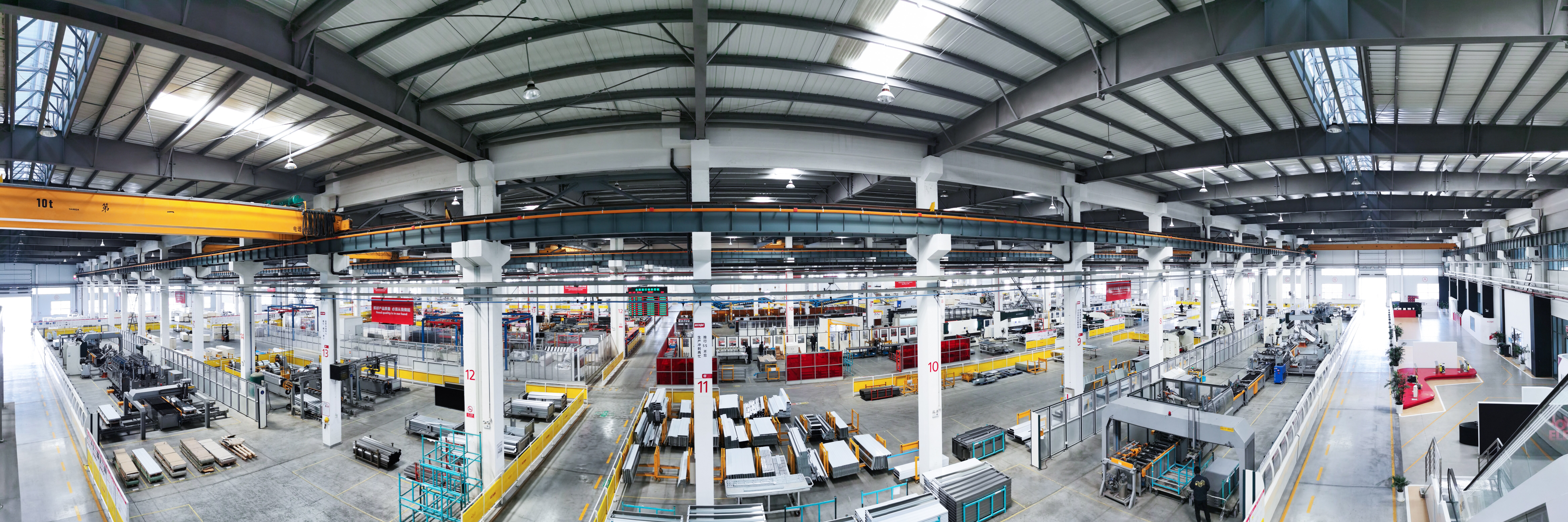
Joylive's manufacturing and testing facilities support scalable freight elevator production.
Technical Parameters That Define Industrial Elevator Fit
Load capacity is the first filter. Freight elevators in Joylive's range start at 1,000 kg and extend to 200,000 kg, so the specification must align with the weight of the heaviest unit that will enter the car, including any forklift or pallet jack.
Speed matters for cycle time but must be balanced with load. Heavy freight elevators commonly operate at lower speeds because stability and stopping accuracy are more important than travel speed. Joylive's range of 0.25 to 3.0 m/s covers both slow heavy-duty applications and faster logistics operations.
Travel height and car size determine whether the elevator fits the building shaft and intended loads. Joylive offers customization of speed, load, travel height, car size, car decoration, logo, and step width, allowing the elevator to be matched to shaft dimensions and branding requirements. Material choice — SS304 stainless steel — supports durability in industrial and washdown conditions.
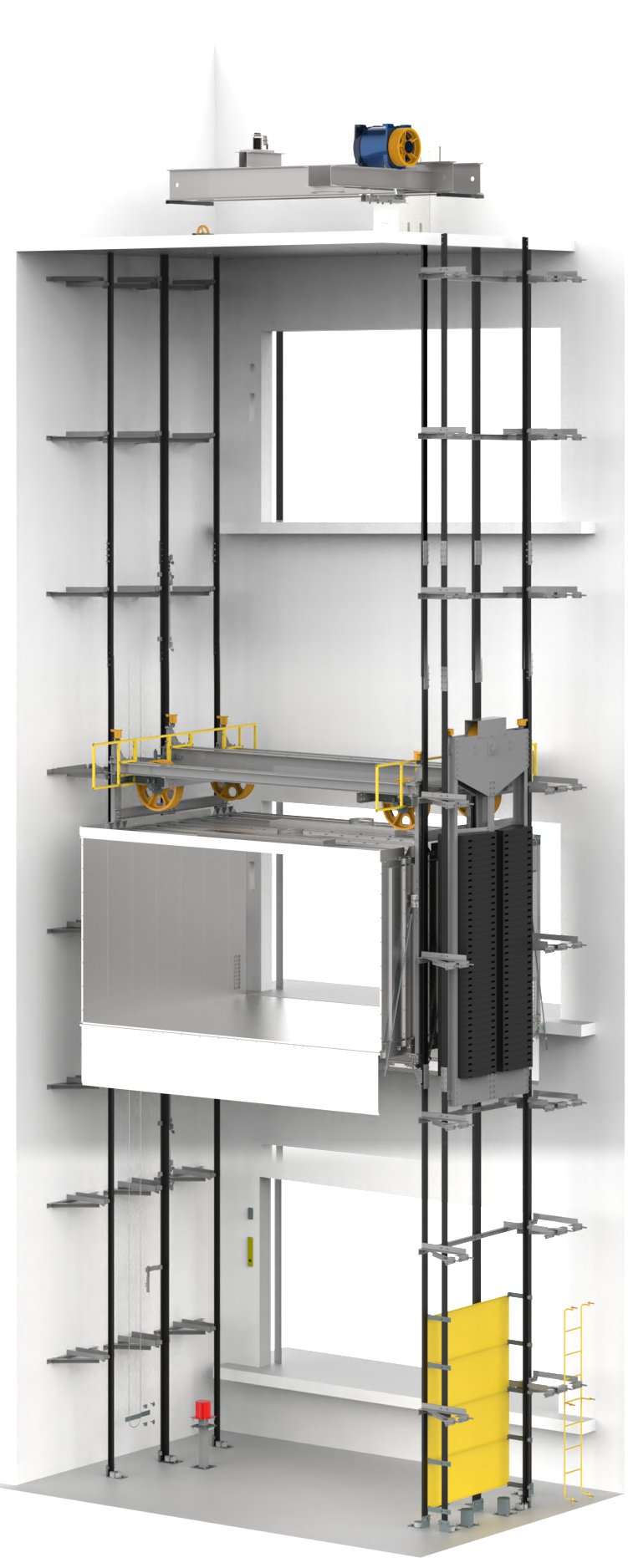
Vertical conveyor systems complement freight elevators in high-throughput logistics.
Quality control is a further fit criterion. Joylive reports 100% testing of manufactured units, and its CNAS laboratory supports component and system verification. European and North American buyers should also check whether the elevator meets the safety framework used in their jurisdiction. As noted, EN 81-20/50 and ASME A17.1-2025 are key reference standards.
Project Fit in Practice: Manufacturing and Logistics Scenarios
Large manufacturing campuses illustrate the importance of mixing passenger and freight elevator types. Joylive's project record includes supplying 87 passenger and freight elevators to Pegatron in Vietnam over two years. Wistron received 36 high-performance passenger and freight elevators over five years. Inventec received 9 passenger and freight elevators for a factory project in Mexico over one year. In each case, the result was reported as stable operation.
These projects also show that industrial elevator supply is rarely a single-machine transaction. Global electronics manufacturers need consistent vertical transport for production materials, equipment, and personnel. A supplier that can deliver both passenger and freight units, configure them to factory working conditions, and service them through one channel reduces coordination cost for the buyer.
Special project environments add another layer. Joylive's product range includes explosion-proof elevators and clean elevators, and its application scenario data lists cleanliness, fire-proof, panoramic, and disinfection requirements. Matched equipment can include IoT devices and the Joycloud platform, which support remote management of elevators used in 24/7 industrial operations.
Market Context for 2026 Buyers
Third-party data points help place this project-fit logic in a broader market context. Global Market Insights estimates the global elevator market at roughly USD 84.8 billion in 2024, projected to reach USD 126.7 billion by 2034. Knowledge Sourcing Intelligence estimates the freight elevator market at USD 2.07 billion in 2024, reaching USD 2.78 billion by 2029 at a CAGR of 6.10%. Market Research Future puts the IoT in elevators segment at USD 16.14 billion in 2024, with predictive maintenance and remote monitoring as major drivers.
On the supply side, China's elevator industry exported 102,000 elevators and 13,000 escalators in 2024, a 17.3% increase year-on-year. This creates a broad field of suppliers, but also raises the importance of verifying manufacturing qualification, customization capability, and project references.
The trend behind these numbers is clear: industrial vertical transportation is becoming more specialized and more digital. Buyers are evaluating not only a machine's load table but how it connects to wider logistics and building systems.
Freight Elevators vs. Traditional Lifting Methods: Known Trade-offs
An engineered industrial freight elevator differs from traditional site-built lifting platforms in several ways. It is produced under a quality management system, tested before delivery, and supported by documented spare parts and maintenance procedures. It is also easier to integrate with door interlocks, landing protection, and monitoring systems. For many projects, this makes it the safer choice for permanent industrial infrastructure.
At the same time, buyers should recognize where a freight elevator is not the optimal answer. In continuous high-throughput material flow with uniform, lightweight loads, an industrial vertical conveyor can move more units per hour at a lower cost per move. And for short-lived temporary installations, a simpler lifting device may be cheaper and acceptable. A freight elevator is the better fit when loads are heavy, variable, or mixed with occasional passenger use.
| Criteria | Industrial freight elevator | Industrial vertical conveyor | Traditional site-built lift |
|---|---|---|---|
| Best for | Discrete heavy loads, pallets, mixed traffic | Continuous flow of uniform loads | Temporary or minimal-duty lifting |
| Throughput | Medium; depends on cycle time | High for small/medium loads | Low |
| Safety and compliance | Manufactured to elevator standards | Material handling equipment standards | Varies by site; often less standardized |
| Integration | Can integrate with IoT and building systems | Integrates with conveyor systems | Limited digital integration |
| Capital fit | Higher but durable | Lower for simple flow | Low initial cost |
What Industrial Elevator Buyers Should Watch Next
The next stage of industrial elevator development is system-level integration. A smart industrial freight elevator in a modern factory is expected to communicate with access control, cameras, smart lighting, parking barrier gates, and robotic transport. The elevator becomes a vertical node within a broader horizontal-to-vertical logistics network.
Joylive's product ecosystem already includes IoT devices and smart building products, and its matched equipment for industrial scenarios includes IoT devices and Joycloud. For buyers, the evaluation question should include digital service capabilities: remote monitoring, data availability, predictive maintenance, and the ability to support lifecycle management beyond the initial installation.
Frequently Asked Questions
What is an industrial freight elevator?
An industrial freight elevator, also called a cargo elevator, is a vertical transport system designed primarily for goods rather than passengers. It is typically specified with higher load capacity, larger car dimensions, durable materials such as SS304 stainless steel, and controls that support forklift or pallet handling in factories, warehouses, and logistics parks.
What load and travel height options are available for heavy-duty freight elevators?
Joylive's freight elevator series, including GF10, GF20, GFN20, and GFN30, covers loads from 1,000 kg to 200,000 kg, speeds from 0.25 to 3.0 m/s, and a maximum travel height of 150 m. These parameters can be customized to the project's building structure and material-handling requirements.
Can industrial elevators be customized for a specific factory or project?
Yes. Joylive offers OEM/ODM customization covering speed, load, travel height, car size, car decoration, logo, and step width. The minimum order quantity is one unit, with a monthly production capacity of 1,250 units and typical lead times of 7–45 days.
What safety standards should buyers check when procuring industrial elevators?
In Europe, EN 81-20 and EN 81-50 are the mandatory standards for elevator construction and component testing. In North America, ASME A17.1-2025 includes updated safety requirements and references to IoT-based remote operation monitoring. Joylive holds a top A qualification for special equipment manufacturing, installation, modernization and maintenance in China.
Can industrial elevators handle special environments such as explosion-proof or cleanroom conditions?
Special environment requirements can be addressed in elevator configuration. Joylive's product line includes explosion-proof elevators and clean elevators, and its application scenarios list cleanliness, fire-proof, panoramic, and disinfection requirements as possible project parameters for industrial and public facilities.
How does IoT technology apply to industrial elevator operations?
The IoT in elevators market was estimated at USD 16.14 billion in 2024, partly driven by predictive maintenance and remote monitoring. Joylive's matched equipment includes IoT devices and the Joycloud platform, which support remote operational management for elevators running 24/7.
For detailed product specifications and company capabilities, the Joylive Elevator brochure is publicly available: Download the Joylive Elevator brochure (PDF).
¿Tiene preguntas o necesita más detalles?
Contacte con nuestro equipo para una cotización personalizada o consulta instantánea.
Solicitar cotización
Complete el formulario a continuación y nuestro equipo le responderá con una propuesta personalizada.
Chat directo de WhatsApp
¿Prefiere chatear en tiempo real? Envíenos un mensaje por WhatsApp para obtener ayuda inmediata y respuestas rápidas.
- Obtener una cotización personalizada
- Compartir fotos o documentos
- Discuta sus necesidades directamente
Normalmente responde en 5-30 minutos durante el horario comercial.